
WABAG: The Future of Water Is Technology

The Business That Keeps the World's Water Alive
Each morning starts off almost identically. We brush our teeth, take a shower, make a cup of tea or coffee, wash the vegetables, fill the water bottles and get ready for the day. Water is invisible and silent with each of these moments, but we rarely pause to ask the mundane question: "Where has this water come from?
Most of us think of the answer as being straightforward. It is sourced from a local river, lake or possibly from a borehole beneath the ground. However, this is just the start of the journey. Companies like WABAG build the systems behind the rest of it. It takes one of the most advanced engineering systems in the world to get a drop to your kitchen before the first drop ever hits the ground. It travels through intake stations, treatment plants, filtration systems, storage reservoirs, pumping stations, laboratories and hundreds of kilometres of pipelines along the way. The water is filtered of all mud, bacteria, viruses, chemicals, heavy metals, industrial pollutants, and all sorts of minute impurities until it is safe for drinking.The dirty business of turning dirty water into clean water.
Beyond Construction of a Water Treatment Plant
At first glance, WABAG looks like any other engineering company. It is given a contract, constructs a water treatment facility, turns it over to the customer and moves on to the next project. WABAG would otherwise be just another EPC (Engineering, Procurement and Construction) contractor bidding solely on costs.
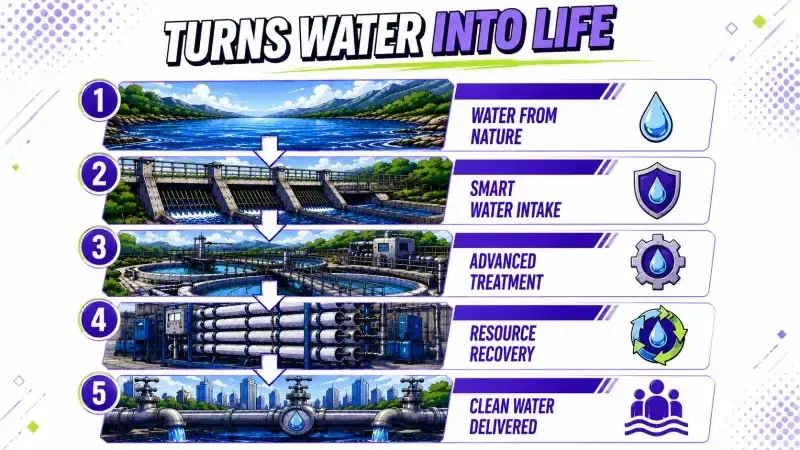
But that's not the way business is conducted.
Building a bridge, building a building and building a power plant are relatively simple water treatment plants. Each project starts out with its own problem, since no two water sources are exactly alike. Groundwater has a different composition of impurities in it as compared to water from a river. The composition of municipal sewage is completely different from that of pharmaceutical waste water. The vast majority of the salts found in seawater are dissolved salts, and industrial effluents can include chemicals, heavy metals, oils or biological contaminants. Each client has their own needs as well. One city might just want to have safe drinking water, and another industry might want ultra-pure water to help make semiconductors, or the complete zero liquid discharge (ZLD) option, to meet environmental regulations.
That is, there is no machine in the world that can clean all water types. Each project is to be customized, with various treatment technologies integrated in a single, efficient and consistent system that provides the desired water quality. It's just that complexity is where WABAG's expertise starts.
When it comes to the end of the day, if WABAG doesn't make the equipment, what does it do?
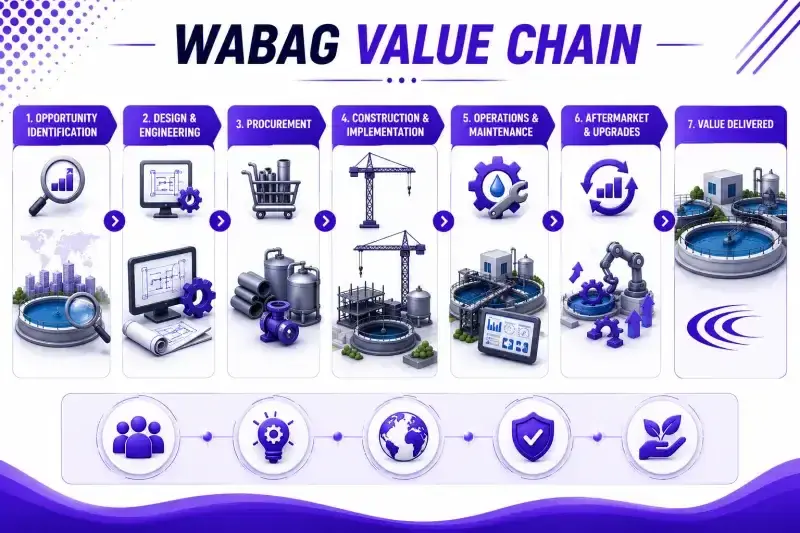
WABAG makes giant desalination units and water treatment units—this is one of the biggest misconceptions investors have about WABAG. But that's not what its business is.
There are hundreds of specialised companies worldwide that produce the pumps, membranes, valves, motors, blowers, pipes, instrumentation systems and electrical components in a treatment plant. WABAG obtains these components from qualified suppliers according to the technical specifications of the projects.
It's valuable somewhere else!
Don't think of WABAG in the role as an equipment manufacturer, but as a system designer. An architect is not a cement-mixer, a steelworker or a glass-blower; rather, they are a designer of the way hundreds of materials and systems will combine to provide a functional building. Likewise, WABAG doesn't manufacture most of the pumps, membranes or valves used in a treatment plant. It has the expertise to combine hundreds of technologies and thousands of components into one complete water treatment system.
All projects start with knowing the customer's problem. The company conducts water quality analysis and identifies contaminants, reviews regulatory requirements and creates a desired water quality. From this it chooses the best possible mix of physical, chemical and biological treatment technologies.
After the treatment process is determined, WABAG prepares detailed engineering designs, is responsible for sourcing specific equipment from international suppliers, manages plant construction, commissioning the plant and in many cases operates and maintains the plant under long-term O&M agreements. The end result is not a machine, but a complete water treatment system, which will provide a consistent quality water source, every time.
This ability to have the technology, from the engineering work to the long-term operations, is what makes WABAG stand out from a traditional EPC contractor. An Asset-Light Business in a Heavy Industry
How can WABAG not offer equipment if it's not for sale?
The solution is technology, engineering skills and years of experience. The company has built its own technologies over the years in the water treatment, wastewater treatment, industrial water recycling, desalination and Zero Liquid Discharge (ZLD) fields.
Many technology-driven businesses also derive value from assets that don't appear on factory floors. Understanding how intellectual property creates competitive advantages can help investors evaluate such companies better. Read Economic Moat Explained: Why Some Companies Stay Dominant for Decades.
WABAG has been supported by R&D centres both in India and Europe, along with a portfolio of over 125 patents and proprietary technology and is therefore based on engineering excellence, not manufacturing size.
In many aspects, WABAG is more of a software than a traditional manufacturer. As software companies generate value with their intellectual property, WABAG generates value with its engineering ability, process design and the ability to solve highly complex water treatment problems which are not solvable using standardised solutions.
What makes customers come back?What is it that makes customers return?
Failure isn't an option in the water treatment industry. When the drinking water plant breaks down, millions of people can lose their safe water supply. In the event of an industrial wastewater plant not complying with environmental standards, customers are subject to production shutdowns, financial penalties and reputation losses.
Thus, customers do not just accept the lowest bidder. They focus on technical skills, operational experience, reliability and longevity.
That is where WABAG's experience can be a big competitive advantage. The company's knowledge base is tougher for new comers to match as it has delivered over 1500 projects in over 25 countries. All successful projects build and improve their technical fortitude, customer confidence, and their capacity to secure even more significant and ambitious projects.
Experience generates a virtuous circle in project-based businesses when successful work gets more references, more references translate to more projects, and more projects increase technical expertise.
What new markets, countries, and regions will future growth come from?
It's not sufficient to have a good business model. The real question is whether there are long-term growth prospects within the industry itself.
The solution is powerful structural trends in the global water market that are driving the water business forward: the rise of desalination, water reuse in wastewater, the reuse of water in industry, more stringent environmental requirements, and rising international demand for sustainable water infrastructure – all of which WABAG is addressing.
Such trends continue to increase the demand for companies that can design, construct and maintain intricate water treatment plants.
What is amazing about water infrastructure is that it's nearly invisible. We just turn the tap and a stream of water runs out. However, for a few days, if this hidden network were to malfunction, hospitals would begin to struggle, industries would shutter, restaurants would close and daily life would come to a standstill.
The best measure of water systems is that nobody notices when they are working. However, behind this invisible system, there are firms such as WABAG, that ensure that one of the most key resources in the world is provided to millions of people each day without fanfare.
"Know what you own, and know why you own it."- Peter Lynch
The Company Behind the Invisible Infrastructure
This invisible network is the result of the work and efforts of companies that most people have never heard of, but impact millions of lives every single day. One such company is VA TECH WABAG.
WABAG was established in 1924 and has been doing one thing since the foundation—the treatment, recycling, desalination and efficient management of water for cities and industries. WABAG has deliberately chosen to stay a pure-play water technology company, where each sector is approached individually in contrast to diversified engineering firms, which are engaged in dozens of infrastructure sectors. It now serves more than 25 countries and has completed more than 1500 water infrastructure projects, as well as counting the company among the biggest players in the desalination game for water, and is recognized as one of the most important private water operators in the world. Instead of producing pumps, pipes or valves, this company uses cutting-edge design, proprietary technologies and the equipment of specialist manufacturers to design, construct, commission and, in some cases, operate fully functional water treatment ecosystems.
But why WABAG have been able to remain in business for over 100 years in a sector where many infrastructure businesses have failed is not possible to explain without figuring out why water is one of the most precious resources in the world. But, as soon as one gets an insight into the size of the challenge, the value of a company such as WABAG becomes more readily understood.A silent danger is slowly spreading towards us.
The amount of water on earth has remained almost constant for millions of years, but the number of people who rely on it has grown a lot! 100 years ago, the global population was approximately 2 billion people. Today it is over eight billion and with each new person comes the need for water for drinking as well as agriculture, industry, medical services, sanitation, power generation and many other industrial applications.
Unfortunately, freshwater resources are not expanding at the same rate as the demand. The frequency and regularity of rainfall has become erratic, groundwater reserves are diminishing at a rate much greater than they can be replenished, rivers are becoming dry in many areas and pollution is still affecting precious groundwater sources. In parallel, rising standards of living are increasing water demand even more. The demand for water for manufacturing, modern agricultural use, data centres and semiconductor production, and for growing cities is enormous and demands clean and reliable water in massive amounts.
This is an evolving reality which has turned water, which used to be a natural abundance, into one of the most valuable strategic assets in the world today. At the Annual Investor Meet, its management underscored the need to treat and reuse water, as more than two billion people still do not have access to safe drinking water and the availability of freshwater resources is decreasing, as one of the largest long-term infrastructure opportunities in the world.
Under every city lies an opportunity, hidden.Under every city lies an opportunity, hidden.
The significance of water infrastructure is unknowingly growing with almost every global megatrend. New drinking water and sewer facilities are needed as part of the fast-paced urbanization. As the manufacturing expands, so does the demand for water in the industry. Water quality in semiconductor plants is very critical. Treatment systems are critical to pharmaceutical companies. Data centres use vast amounts of cooling water and there are increasingly tighter environmental requirements for industries to reuse and recycle water before it is discharged.
Now, water is moving beyond being an enabler for economic growth to being an enabler for economic growth. This brings up a pertinent point.
Who designs, builds and operates those sophisticated water treatment systems for all cities, all industries and all governments?
The Invisible Companies Behind Every Glass of Water
A water treatment plant is a huge machine that purifies dirty water for most people. But in fact there is no such universal machine. All projects are individual and each water source is unique. The treatment required for river water, seawater, municipal sewage, pharmaceutical effluent, refinery wastewater, and industrial wastewater are completely different.
The construction of a modern water treatment plant isn't just about making equipment; it's about developing an entire ecosystem. Engineers design the water-treatment plant by studying the quality of the water that is fed into the system, setting the required water quality parameters for the treated water, choosing from a variety of water-treatment technologies, commissioning thousands of individual system components, produced by a wide range of water-treatment manufacturers, and then running and maintaining the plant for decades. The true skill isn't in pump and membrane making or designing but in knowing how to integrate hundreds of technologies into a reliable system that always delivers clean water.
This is a capability of only a few companies in the world.
One of them is an Indian multinational, that has been working relentlessly for over a hundred years to solve one of the oldest and significant problems of human life – water.In today's world, WABAG is a company with a pressing need to be more, because the world needs more companies like WABAG.
A Once-in-a-Generation Opportunity
All great companies have a strong long-term trend. This was the beginning of mobile computing for the smartphone industry. It was digital transformation for cloud providers. It's the worldwide shift to cleaner sources of energy for renewable energy companies.
But for WABAG the structural trend is not as complex, and it is certainly more basic.
Clean water is in short supply in the world.
Demand for water is much more stable than is the demand for most products in an economy. People and their communities still require drinking water, cities continue to produce sewage, industries still need water to produce goods and services, and even when economies are doing well, governments still need water infrastructure to serve their communities. This reduces the sector's sensitivity to the short-term economic environment and brings it closer to the demographic and environmental trends that are likely to affect the sector over the longer term.Water treatment for decades was regarded as a compliance or public utility service. It's now a smart investment. Water security is now increasingly correlated with economic development, industrial growth, public health and national resilience, and governments are increasingly aware of this link. This trend is gradually growing the potential market for companies that can provide dependable water solutions.
The World is Learning that Water Cannot be Wasted
Traditionally societies have taken the same course. Fresh water was abstracted from rivers or underground, used once, treated only to adhere to environmental standards and returned to the environment.
But that model is quickly becoming unfeasible.
Freshwater is becoming more precious with each drop, and scarcity is creating challenges. The view of wastewater as a waste is changing, and wastewater is increasingly viewed as a resource that can be recovered, treated and reused. A manufacturing plant can recycle water, for example, more than one time, rather than fresh water being required on an on-going basis. Treated wastewater can be turned into industrial grade water, alleviating the need for drinking water sources. These advanced treatment technologies are capable of processing even highly contaminated wastewater.
This change has a profound impact on the economics of the industry. Rather than constructing water systems just to provide new water, countries are putting money into systems that get the best possible use of the water in circulation. Water treatment is no longer about purification but also the establishment of a circular water economy where reuse is the exception rather than the rule.
The expansion of areas of expertise for companies such as WABAG – from drinking water treatment to wastewater treatment, from engineering and recycling of industrial effluents to reuse and Zero Liquid Discharge solutions – increases the potential of opportunities for the companies.
Desalination: Converting Ocean Water into a Source of Water.
However, if recycled water is part of the solution, then innovative approaches to making new fresh water are part of the solution.
Oceans and sea waters account for almost 97% of the water dispersed all around the earth, which has too much salt to use directly for human consumption. Desalination has emerged as one of the few viable options for providing long-term water supplies for many countries with chronic water shortages along their coastlines.
Desalination has been around for some time, but with technology advances, it has become more energy-efficient and cost-effective and is gaining growing traction for large-scale municipal and industrial use. Investment in desalination plants is likely to be sustained as populations have continued to increase in water stressed coastal areas.
This is important for WABAG especially as desalination is one of its main competences. The company has carved a niche for itself among the top private desalination firms in the world and has been able to achieve big successes in desalination in several geographies. WABAG is not relying on one alone water treatment segment, but across conventional water treatment and advanced desalination, thus enjoying a plurality of structural growth drivers.
WABAG's Growth Drivers
Industries are emerging as one of the largest customers.
Municipalities are the biggest consumers of water infrastructure, but industries are a growing source of demand.
Without reliable water supplies, modern manufacturing wouldn't work. Ultra-pure water is essential to semiconductor manufacturing plants to ensure product quality. Industrial wastewater treatment systems are specially designed for pharmaceutical facilities, which are required to comply with strict regulatory requirements. Water is required for huge amounts of power plants to cool and to generate steam. Sensitive water management systems are essential for refineries, steel mills, chemical production facilities, food processing facilities, textiles, mining companies, and data centres.
Meanwhile, environmental laws are becoming more stringent throughout the world. Industries aren't only assessed on their products anymore but on the responsible way they manage water resources. There is a current trend of investing in wastewater recycling and Zero Liquid Discharge systems that are not only mandated by regulations but also to cut down on the amount of fresh water needed and for more sustainable long term solutions.
This diversification of demand is especially useful as it helps to lessen the dependence on any particular group of customers. Combined, these are multiple independent sources of business growth for the municipal projects, industrial water treatment, desalination, wastewater recycling, and long term operations.
The value of experience has never been greater.
Infrastructure projects are growing in scale, complexity and performance. The plants today are expected to be completed on schedule, but are also required to perform efficiently for many years with constant adherence to environmental and operational standards.
The more complicated a project, the more experience can be a major advantage.
The Knowledge Base developed from a company's successful projects across various countries, climates, regulatory environments, and water conditions is difficult to duplicate. Each project completed contributes to the knowledge of treatment technologies, execution methodology, operational issues and customer requirements.
This establishes a virtuous cycle. The more experience, the better it can be done. Improved performance solidifies customer trust. As customer confidence increases, projects become bigger and bolder, and technical expertise increases.
WABAG has executed over 1,500 projects in over 25 countries, which is why they have the knowledge of how to do just this. With its accumulated experience it is able to bid for technically challenging projects where it is not just the lowest bidder but has the ability to execute.
A strategy focused on concentration, rather than diversification.
Some companies expand their business into other ventures to grow the company.At some stage, many infrastructure companies embark on other lines of business in order to expand their operations. The road widens into the airport. Power companies get into real estate. Engineering companies enter into various infrastructure domains.
WABAG has made a conscious decision to take a different route.
Over the years, management has reiterated its commitment to the water business, which they believe there is sufficient opportunity in the world for water infrastructure to sustain the company's long-term growth. Instead of spreading out investments and management time over areas that are not related, the company is focusing on a single area or domain.
This targeted approach has a number of benefits. Research and development continue to focus on the technologies of water. Engineering teams develop specialism rather than disperse their attention between various industries. Each project helps to gradually establish the company's technological leadership in the market, while also improving its competitive position.
Diversification may help you avoid being dependent on a single industry, but a high degree of specialization may give you more competitive moats. WABAG has decided on the latter, taking a gamble that it will be better off becoming one of the top water tech providers than one of the middle-of-the-road competitors in numerous other infrastructure industries.
You can't assume that growth opportunities are great investments.
The long term opportunity is starting to become apparent. Drought is growing in severity. Increasing investment in treatment infrastructure by governments. Industries are recycling and re-using water. Desalination is expanding. Environmental laws are becoming more stringent. All these trends combine to form a positive structure demand situation for companies such as WABAG.
But an industry with a bright future is not sufficient in itself to be a reason to invest.
There are many examples of companies that have done well in industries that are attractive but simply failed to deliver returns to shareholders due to poor execution, capital allocation, profitability, or inconsistent financial performance, among other reasons.Of course, the next thing that comes to mind is.
Has WABAG truly turned these headwinds of the industry into a more powerful business?
But to do that, one needs to go beyond technology, industry, and trend and look at the most important thing for every investor – the company's financial performance, order book, profitability, cash flows, and future visibility of growth.
"Price is what you pay. Value is what you get."- Warren Buffett
Is WABAG a long-term Compounder?
Often a great industry does not result in a great investment.
We now understand the value of water in the world. We have witnessed the governments' investment in water security, and how industries are recycling water used for various purposes; and why desalination and water reuse are becoming long-term requirements instead of an option for investment.Investing isn't a matter of acquiring an industry.
It's all about the purchase of a business.
There are all sorts of examples in history of firms that succeeded in a fast-growing sector, but never actually generated shareholder value. A few grew too quickly. Others overextended themselves, underbid jobs so they would obtain contracts, or pursued revenues without making a good profit. In particular, infrastructure has always been a sector that cannot be claimed to be booming and thriving if there is only one side of the coin.Rather, the question that should be asked is if the water industry has a bright future. What's really important is whether WABAG has developed a business that can turn that opportunity into something that can be valuable for shareholders in the long term.
"A great business at a fair price is superior to a fair business at a great price." - Charlie Munger
Growth Is Meaningful Only If It Is Profitable
While winning big projects is often front-page news, there is not a lot to be said about the quality of the business except by looking at the money. Any company can double its revenue just by taking on low-margin contracts, but find out later that the cost of the contracts have done the opposite.
In recent years, WABAG has adopted a new attitude.
Rather than blindly pursuing any opportunities that might be available, management has always preferred to seek growth that is profitable. The company has been more cautious in its approach to bidding for new projects, and has started turning down jobs that may not be profitable enough for them to accept, going only for jobs that they believe they will be able to profit from more than they will lose. It's a major change in thinking compared to the revenue-focused mentality that can be found in infrastructure companies, in which case it is sometimes more important to grow revenue rather than profits.
In the case of EPC businesses, projects can last for several years, making discipline particularly crucial. The bad deal on a contract can impact the profitability of a project even after it has been accepted. WABAG's marketing strategy is based on execution, risk management and margin discipline, which should drive long-term creation of shareholder value and not short-term revenues.
The Importance of an Order Book
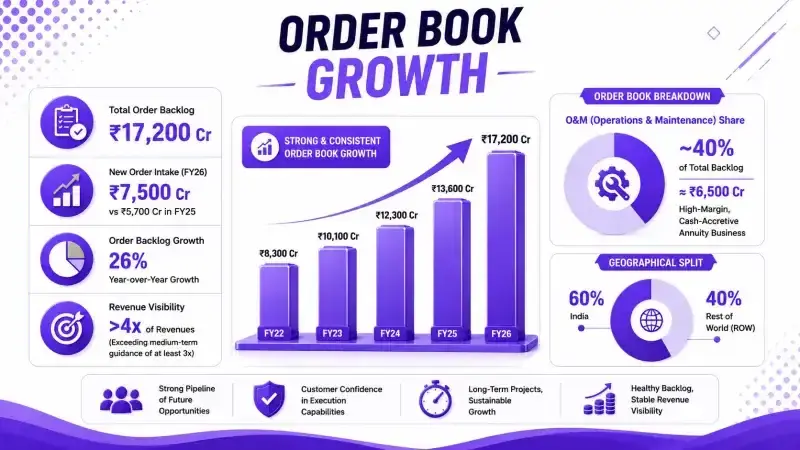
The order book is one of the first metrics that investors will look at in project-based businesses.
As opposed to manufacturing firms, which rely on the demand of customers month to month for future sales, EPC companies typically only start work after being awarded contracts. The order book thus becomes a stream of future revenues, helping to give a glimpse into the business in the coming years.
This is especially relevant for WABAG since the majority of water infrastructure works are big, technically complex and last a long time. When a project is awarded the revenue is recognized over time, as the project is executed.
A healthy order book thus has two functions. Firstly, it gives confidence that the business has enough jobs to continue to earn money. Second, it demonstrates customers' confidence in the company's ability to take on technically complex projects. If the ability to execute is as important as the price, then repeat orders can serve as a good measure of competitive powers.
But investors need to keep in mind that not all order books are the same. The quality of projects, margins (expected), time to execution, customer profile, and payment terms are often more important than the headline number.
From a financial point of view this is one of the most important benefits of WABAG. Different business models require different levels of capital investment. To understand why this matters for profitability and long-term returns, read Capital-Intensive Businesses Explained: Risks, Economics, and Investor Insights.
The company does not have a large investment in manufacturing assets for pumps, membranes, valves, or other equipment, and a large part of investment is allocated to engineering assets, technology development, IP protection and project execution.
The advantage of this asset-light strategy is several-fold financially. The lower the capital intensity, the less investment the business will need to expand. The company will be able to be technologically flexible, as it can obtain the equipment from the most appropriate manufacturers and not just from the company. It also minimises the chances of extensive manufacturing equipment becoming outmoded due to ongoing developments in water treatment technology.
WABAG Key Financials
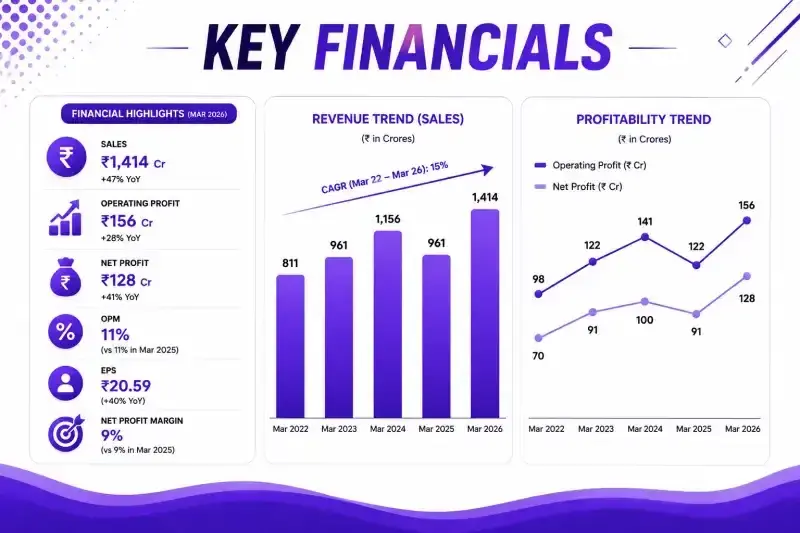
WABAG is a company in moderate growth for the last few years, but now it has started to grow in a stronger way. The 5-year CAGR for revenue has been 7%, but over the past 5-6 quarters, there has been a clear acceleration in the rate of revenue growth, with each quarter seeing a double-digit revenue increase; this suggests that execution of its large order backlog has converted into more revenue.
The profitability has also improved significantly. The Operating Profit Margin (OPM) of the company has remained consistent in the range of 11-13% of revenues...
Margins often reveal far more about a business than revenue growth alone. Learn how investors interpret profitability in Operating Profit Margin vs Net Profit Margin: Which Tells the True Story?
even as the raw material prices and supply chain costs were volatile on account of geopolitical events like West Asia conflict. This highlights the disciplined project execution, pricing power and procurement cost control capability of WABAG.
The highlight of the structural improvement is operating profits. Operating margins in the single digits before March 2022 now have been steadily driven higher to double digits as a result of the improved project mix, execution efficiency and operational discipline.
The company's cash generation has improved in conjunction with its earnings. The Operating Cash Flow has been improving steadily and the ratio of CFO to Operating Profit is also looking good, meaning that the accounting profits are now turning into cashflow. In the case of EPC companies where the quality of a business depends on working capital management, strong cash conversion is of more significance.
The balance sheet has also been improved in the past few years. Reserves have risen to ₹2,556 crore, borrowings are comparatively low at ₹228 crore and the firm has been running a decent financial position and executing big infrastructure projects.
The return ratios also signify better capital efficiency. Return on Equity (ROE) has been at the low to mid teens...
Return on Equity is one of the most important indicators of management efficiency. If you're unfamiliar with this metric, our guide Return on Equity (ROE) Explained: A Step-by-Step Guide for Investors explains it in detail.
all along with 16% in FY26, signifying improved profitability, but not too much leverage.
A shareholder would have benefited from this operational enhancement. The stock price performance has been impressive with a CAGR of 41% over the past five years as investors have re-rated the stock based on the improved execution, margins and cash generation in the business.
What could be better than the ₹17,200 crore order book of WABAG that gives a revenue visibility of over 4X annual revenues to support prospective growth? That's combined with better cash flows, decent margins, a solid balance sheet and better execution, and the company is certainly more solid than it was a couple of years ago.
Recurring Revenue Makes the Business More Stable
EPC projects continue to be a key component of WABAG's business, but the interaction with its clients may not stop after project completion.
The company is often asked to cover the operation and maintenance of a treatment plant on a long-term contract by many municipalities and industrial clients. These contracts are normally characterised by the following aspects: monitoring of plant performance; maintenance of equipment, optimisation of treatment processes, compliance with regulatory requirements, maximisation of operating efficiency over many years.
"You can't predict. You can prepare."- Howard Marks
Key Risks
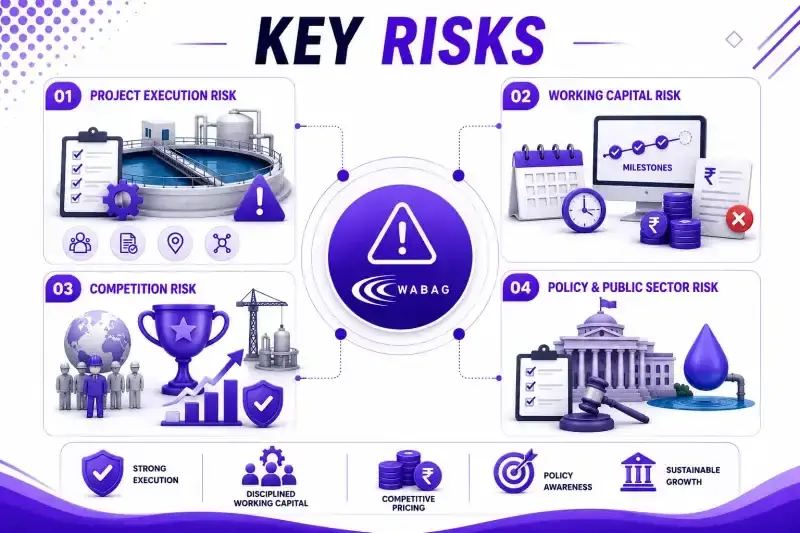
Project execution, one of the most important threats. Oftentimes, large infrastructure initiatives are multi-stakeholder, require various regulatory approvals, land availability, customer coordination, and engineering challenges. Any delay in one aspect can impact on project schedules and cash flow.
Another difficulty is working capital. Typically, payments get attached to project milestones, so if there's a delay in the customer's payment, the receivables increase for a short period, even if the project is profitable.
Competition is another factor you should take into account. Global engineering companies and local EPC contractors are attracted to water infrastructure. All of which means that a winning project has to be competitively priced while still being profitable and management has consistently stressed that point.Last but not least, a significant share of demand comes from governments and public utilities, which means policy decisions, tender timelines and the priorities for public expenditure can affect the awarding of new projects.
None of these risks are specific to WABAG, but rather are significant factors for investors looking at any project-driven infrastructure company.
"The stock market is filled with individuals who know the price of everything, but the value of nothing."-Philip Fisher
The Bigger Picture
From a distance, WABAG appears to be a very peculiar mix.
It is in a sector with long-term demand and not economic fashions. It has purposefully stayed narrow in scope to a single domain in which it has been very successful for over a century. Rather than competing on scale of manufacturing, it relies on engineering, proprietary technology, project execution and on-going customer relationships. Its asset-light strategy enables it to invest in intellectual capabilities instead of big manufacturing equipment and recurrent O&M contracts provide more stability for the business model.
Every business has its flaws and falterings. The risks associated with execution, project delays, competitive bidding and working capital needs are still inherent in the business. WABAG should also be considered based on the size of its order book, the opportunity it has for engineering expansion, as well as how it will protect margins, allocate capital and generate cash flows over time with satisfactory execution quality.
Final Thoughts
Water is and has always been crucial to life,
If you'd like to evaluate companies like WABAG using a structured investor framework, don't miss A Fundamental Checklist: How to Research a Stock in 1 Hour.
But in the next 20 to 30 years it is likely to be one of the most important strategic resources on the planet. Growth in population, urbanisation, industrialisation, climate change and rising environmental consciousness.
Explore our Products
Research Framework

Emerging Titans
Combination of quantitative analysis, industry tailwinds, and management assessment - SPRINT investment philosophy

Tiny Titans
Heavy emphasis on scuttlebutt research, plant visits, and early on-ground signals
FAQs
What exactly does WABAG do?
+WABAG is a pure-play water technology company that designs, engineers, builds and, in many cases, operates water and wastewater treatment plants. Unlike equipment manufacturers, it does not manufacture most of the pumps, membranes or valves used in these plants. Instead, it integrates technologies from multiple suppliers into a complete water treatment solution tailored to each customer's specific water quality requirements
Why doesn't WABAG manufacture its own equipment?
+Manufacturing pumps, membranes and valves is not WABAG's core strength. Its competitive advantage lies in system engineering, proprietary treatment technologies and project execution. By sourcing equipment from the world's best suppliers, WABAG can choose the most suitable components for every project while focusing on designing the most efficient treatment process. This also makes the business relatively asset-light compared to traditional manufacturers.
What are the biggest growth drivers for WABAG over the next decade?
+Several long-term structural trends are increasing demand for water infrastructure:
Rising urbanization and population growth
Water scarcity and declining freshwater availability
Increasing industrial demand for clean and recycled water
Growth in desalination projects
Stricter environmental regulations
Expansion of wastewater recycling and Zero Liquid Discharge (ZLD) systems
Higher investments by governments in water security
These trends are expected to support long-term demand for companies with advanced water treatment expertise like WABAG.
Why is WABAG's order book important for investors?
+Since WABAG is an EPC and project-based company, projects are awarded before revenue is recognized. The order book represents contracted work that will be executed over the coming years, providing visibility into future revenue. However, investors should look beyond the headline number and evaluate the quality of the projects, expected margins, customer profile, execution timeline and payment terms, as these determine how profitable the order book ultimately becomes.
What are the biggest risks investors should consider before investing in WABAG?
+Although WABAG operates in an attractive industry, investors should be aware of several risks:
Delays in project execution or regulatory approvals
Working capital pressure due to milestone-based customer payments
Competitive bidding that can reduce project margins
Dependence on government and municipal spending
Cost inflation or supply-chain disruptions affecting project execution
The company's long-term success will depend on maintaining execution quality, protecting margins, managing working capital efficiently and converting its large order book into profitable cash flows.

High growth stock specialist, Value Educator
Shashank Mahajan is an equity research professional with over 12 years of experience in identifying high-potential SME and micro-cap stocks at an early stage. He follows a rigorous scuttlebutt research–driven approach, combining on-ground insights with deep financial analysis. Shashank specializes in uncovering under-researched and under-owned companies with strong management quality and long-term growth potential. Through disciplined research and early identification, he focuses on spotting tomorrow’s market leaders before they enter the mainstream investor radar.
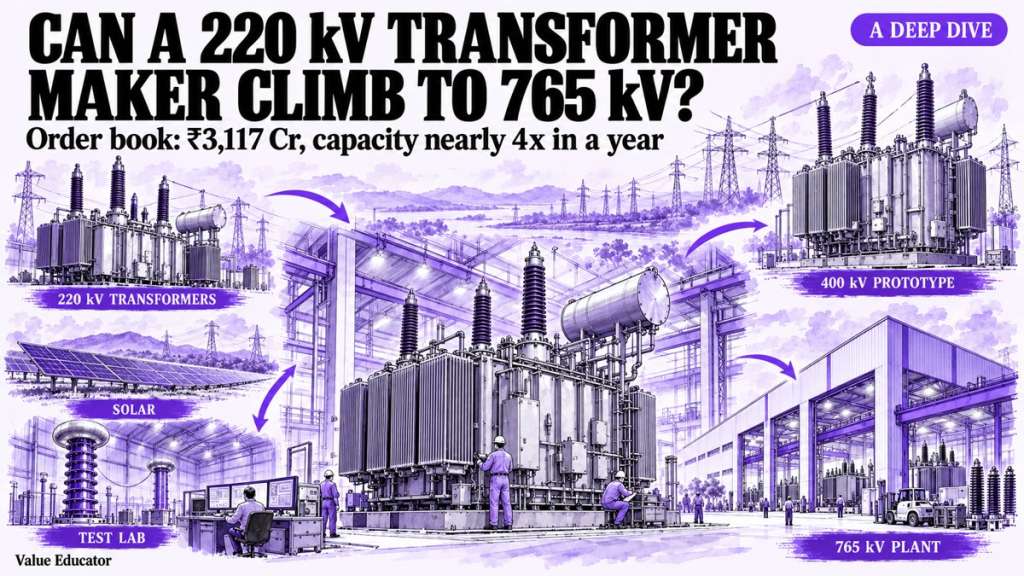
Atlanta Electricals: Capacity Nearly Quadrupled in a Year
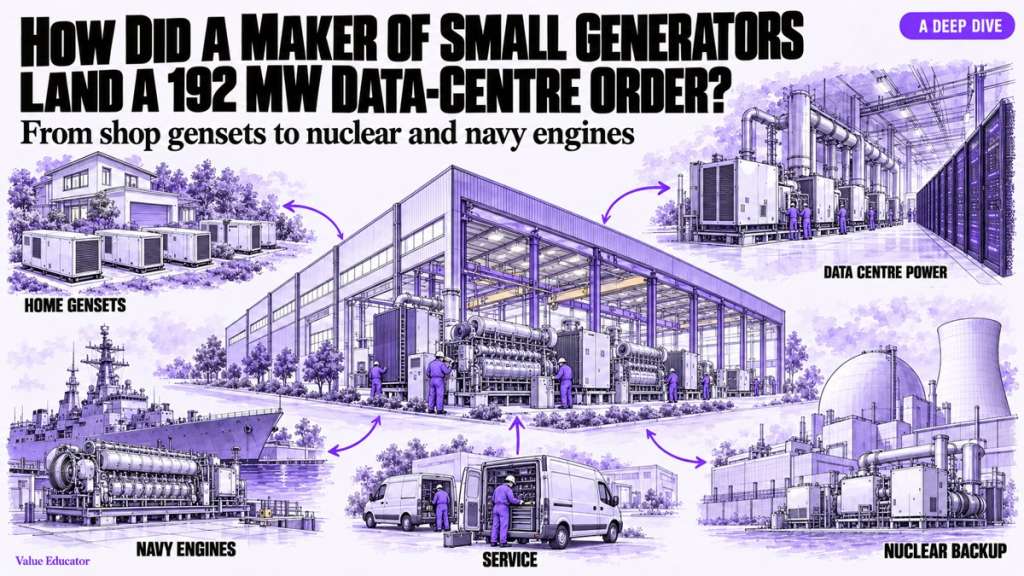
Kirloskar Oil Engines: Data Centres, Nuclear and the Navy
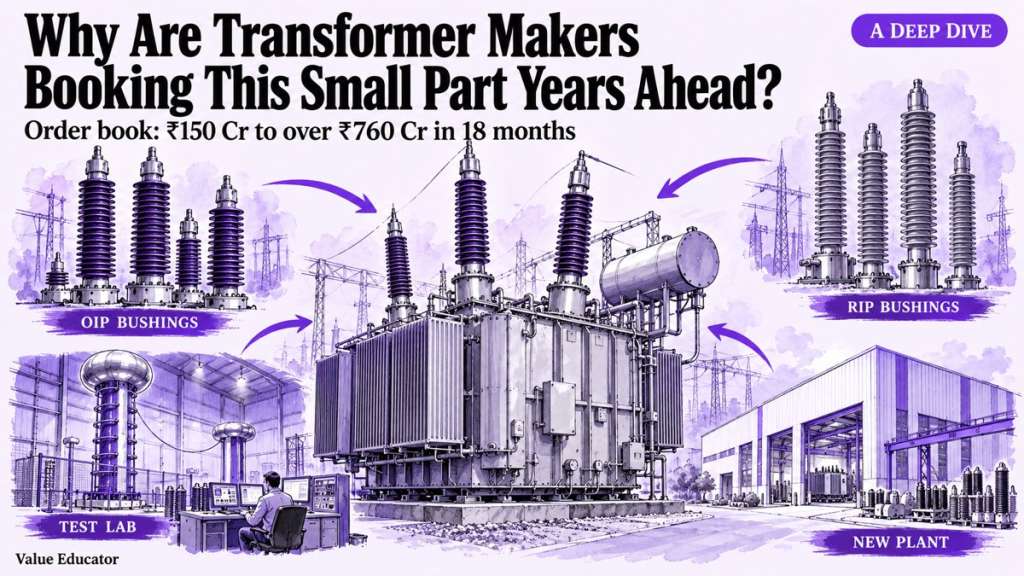
Yash Highvoltage: Bushing Maker With ₹760 Cr of Orders
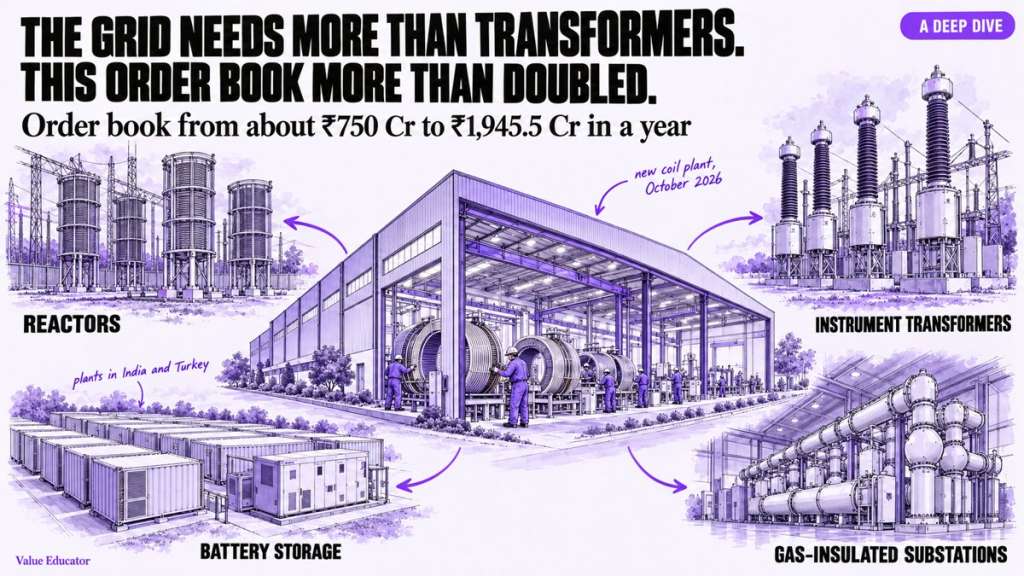
Quality Power: Reactor Maker With a ₹1,945.5 Cr Order Book
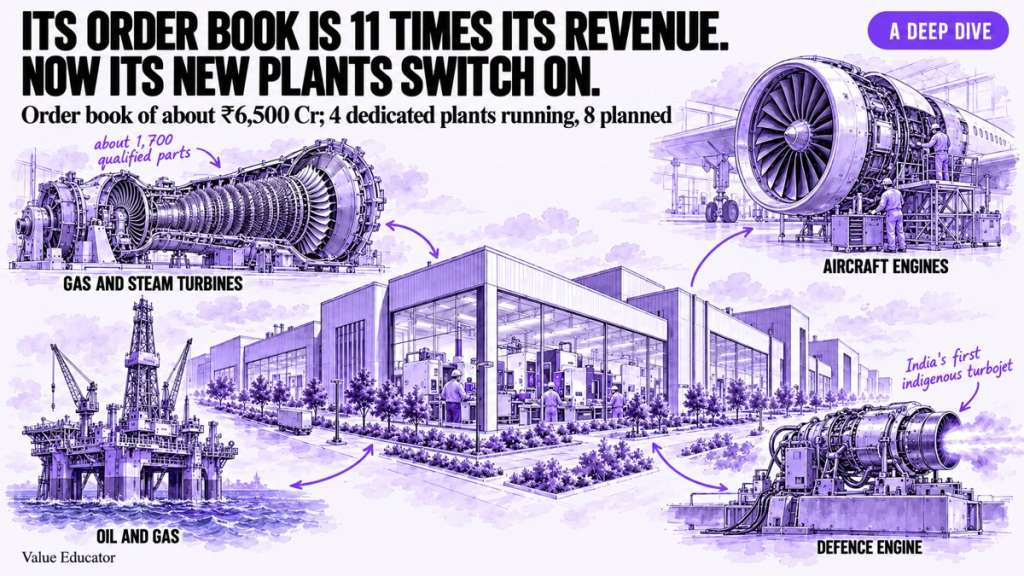
Azad Engineering: Turbine Blades, Jet Engines and Orders
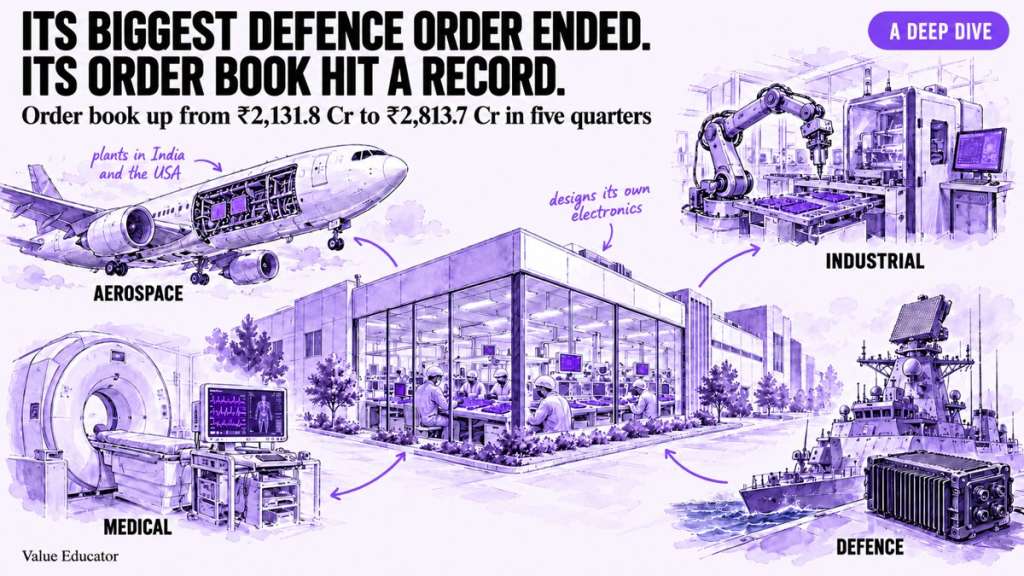
Cyient DLM: Aircraft Electronics and a Record Order Book
Explore our Products
Research Framework
Emerging Titans
Combination of quantitative analysis, industry tailwinds, and management assessment - SPRINT investment philosophy
Tiny Titans
Heavy emphasis on scuttlebutt research, plant visits, and early on-ground signals



Modern Warfare to Multibaggers
Key Trends. Strategic Shifts. Opportunities Ahead.
Don't Miss This Exclusive Webinar!
Join Value Educator to decode the key trends shaping India's defence sector and learn how to identify tomorrow's potential leaders in the space.
- In-depth research on India's defence sector
- Live Q&A session
- Actionable takeaways for long-term investors

 Orders
 Subscription
 Share with friends


Required Details
₹23999.00
(12 month subscription)
As per SEBI regulations, all users are mandated to complete the KYC that is validated for 1 year. Post payment, you will be redirected to the KYC screen


No comments yet. Be the first to comment!