
Anup Engineering: Heat Exchanger Maker for Refineries

In 1962, a small workshop in Ahmedabad began making fabricated parts for textile and chemical mills. Six decades later, that business, The Anup Engineering Limited, builds heat exchangers, pressure vessels, reactors and columns for refineries, petrochemical plants, LNG terminals and hydrogen projects, and counts global EPC companies and national oil companies among its customers.
For most of its history it worked quietly inside the Arvind Group. It was carved out and listed on its own in 2019, and since then it has moved from routine fabrication into heavy, high-metallurgy equipment that only a handful of manufacturers worldwide are qualified to make. This article follows that journey: how the company scaled, the capabilities it built, who it now sells to, and what its numbers show.
Figures in this article are updated to the Q2 FY27 results of 6 November 2026; the long-term charts run to FY25. This article is research, not a recommendation to buy or sell any stock.
Despite operating in the engineering segment since 1962, the company struggled to meaningfully scale for many decades. The real transformation began around 2010, when leadership focus, execution discipline, and long-term strategy started to change.
From that point, the business gradually shifted toward higher-quality projects, stronger capital allocation, and tighter financial control. Over the years, this translated into better margins, healthier cash flows, and a much stronger balance sheet. Today, the company operates as a net-cash business, generating consistent operating cash flows and funding growth largely through internal accruals rather than debt.
Key financials of the company:
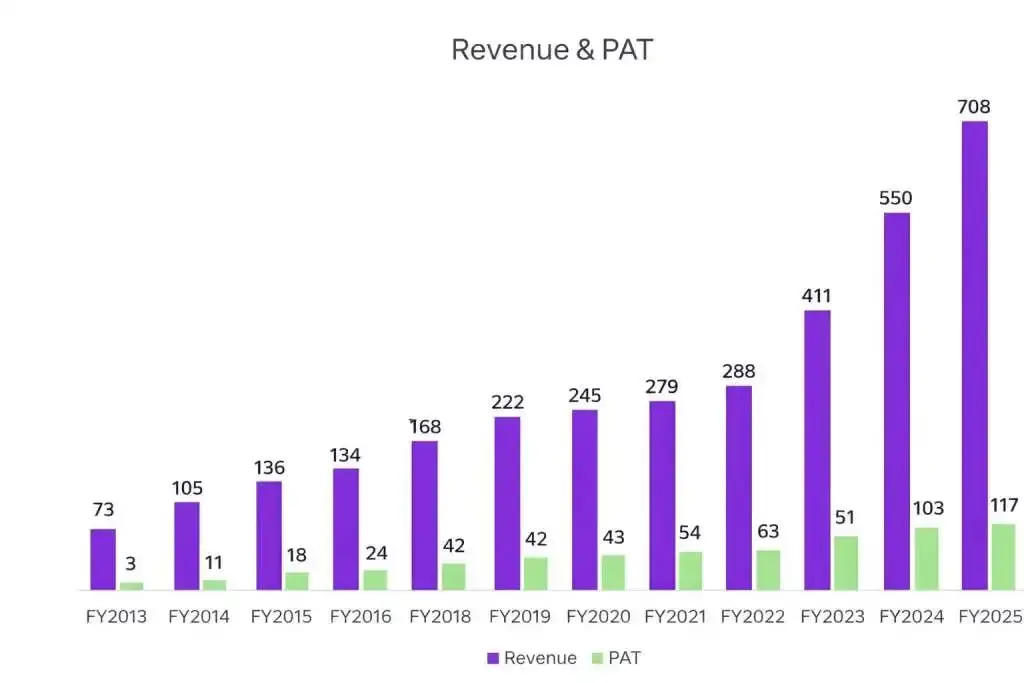
Anup’s revenue graph tells the story of a company steadily climbing the value chain. From ₹73 crore in FY13 to a record ₹822 crore in FY26, the growth has been consistent, with the real acceleration beginning once the demerger unlocked focused strategy and capex.
PAT followed the same upward trend, showing that profitability scaled along with size.
What stands out is that management had publicly set a long-term target of ₹1,000 crore by FY25. Revenue reached ₹733 crore on a consolidated basis in FY25 and ₹822 crore in FY26, still short of the headline goal, but the trajectory shows why: the mix shifted toward heavier, more engineered, longer-cycle equipment, which delays revenue recognition but builds a stronger business. The underlying trend still reflects a company moving toward that ₹1,000 crore mark with a structurally better margin and capability base.
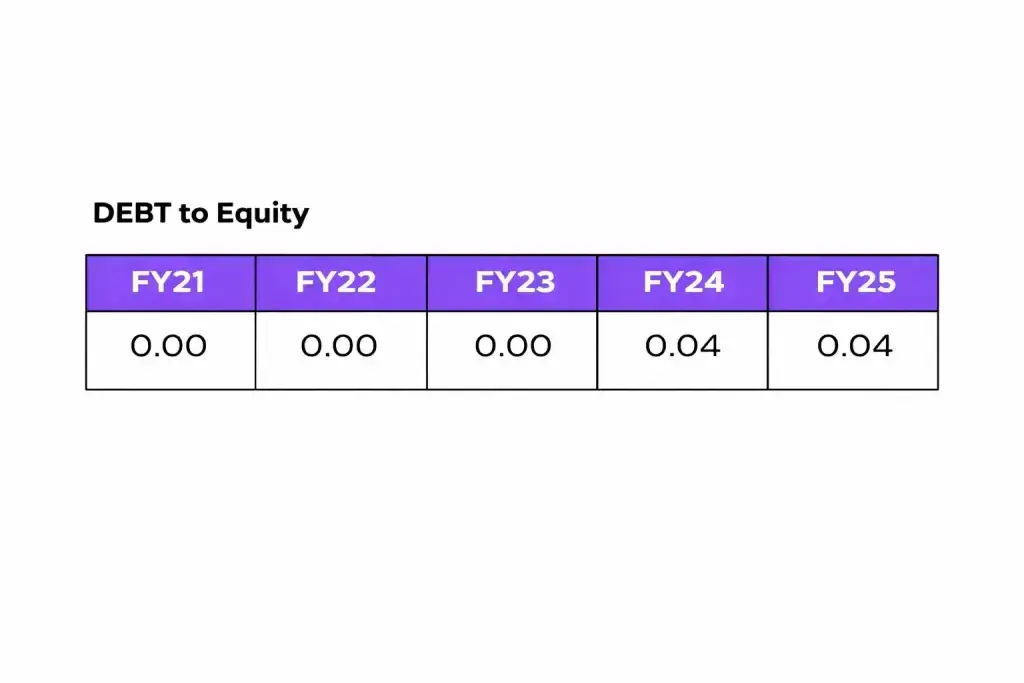
Anup’s debt-to-equity staying near zero for five straight years tells you everything about how the company thinks.
A clean balance sheet is not just a comfort — it is a competitive advantage in small and mid-caps. We cover why this matters in “What is Debt to Equity Ratio? Why it Matters for Small Cap Investing.”
Even while commissioning Kheda, expanding capacity 2.5x and entering hydrogen and high-complexity equipment, the business chose to grow almost entirely through internal accruals.
This discipline kept risk low, protected margins and gave management freedom to focus on capability-building instead of repayments. A near-debt-free balance sheet is one of the strongest foundations of Anup’s long-term growth.
The Latest Results: A Record FY26, Then a Slower Start to FY27
FY26 was Anup’s best year so far. Consolidated revenue rose 12% to a record ₹822 Cr, from ₹733 Cr in FY25, EBITDA reached ₹174 Cr with a 21.2% margin, and profit after tax was ₹110 Cr. Phase 2 of the Kheda plant was commissioned at the end of January 2026, taking total capacity to about 20,000 tonnes a year, which the company says can support revenue of about ₹1,200 Cr.
The first half of FY27 was much weaker. Geopolitical disruption slowed new orders through the past year, and work on the orders that did come in started late. Revenue in H1 FY27 fell 24.5% to ₹307.6 Cr, and with fixed costs spread over less revenue, the EBITDA margin dropped to 8.8%. Raw material costs also rose about 6%. Q2 was better than Q1: revenue grew 46% over the previous quarter to ₹182.4 Cr, although it was still 21.5% below Q2 FY26.
| ₹ Cr (consolidated) | Q2 FY27 | Q2 FY26 | H1 FY27 | H1 FY26 | FY26 |
|---|---|---|---|---|---|
| Revenue from operations | 182.4 | 232.3 | 307.6 | 407.5 | 822 |
| EBITDA | 17.5 | 51.5 | 27.0 | 91.8 | 174 |
| EBITDA margin | 9.6% | 22.2% | 8.8% | 22.5% | 21.2% |
| Profit after tax | 6.6 | 32.0 | 7.2 | 58.3 | 110 |
The order book tells a different story from the results. It stood at ₹941 Cr including letters of intent on 6 November 2026, up from ₹769 Cr at the time of the FY26 results, and about ₹390 Cr of it is already booked for FY28. Domestic orders make up 67% of the book and exports 33%, and the company reports an enquiry pipeline of about ₹1,200 Cr. In August, management guided for FY27 revenue growth of 5-10% with an EBITDA margin of about 15%, which depends on a much stronger second half.
The company is also entering new areas. It won orders worth more than ₹150 Cr for heat exchangers for thermal power plants, made a start in nuclear in FY26, and began work in a new category, a patented clean energy storage system, with a European technology partner that has placed a repeat order.
Now, let’s go beyond the numbers and understand what really powered Anup’s rise.
Phase 1- The Quiet Rise of Anup Engineering
The Anup Engineering story goes back to 1962, when it began as a small Ahmedabad workshop supplying fabricated components to textile and chemical mills. Over the decades, the company kept moving steadily up the engineering value chain — from basic fabrication to centrifuges, pressure vessels, heat exchangers and tall columns used in refineries, petrochemicals and fertilizer plants. Instead of chasing aggressive growth, Anup compounded capability, improving precision, metallurgy handling and delivery reliability year after year.
Much of this evolution took place within the Arvind Group, where Anup built a reputation as a dependable process-equipment fabricator for domestic and global EPC customers. As the businesses within the group matured, the engineering vertical was eventually carved out and, in 2019, listed independently as The Anup Engineering Limited. The demerger did not create a new business — it unlocked an existing one, now backed by focused strategy, sharper capital allocation and a long-term vision to scale as a specialised engineered-equipment manufacturer with a global customer base.
Phase 2- The Capability Leap
When Anup became an independent entity, it did not need to rediscover its identity — the engineering capability was already deeply rooted. What changed was the discipline of operating as a focused, standalone business.
Process-equipment manufacturing doesn’t follow typical factory economics. Revenue is recognised only after inspection, approval and dispatch, which makes quarterly numbers volatile and execution quality visible only at the full-year level.
Despite this, the first standalone year showed clear momentum — operating revenue grew to ₹221 crore and margins improved from 26% to 29%, helped partly by incentives but more importantly by a rising share of export-led, high-complexity work.
Operating revenue grew about 10 percent to ₹221 crore, and margins improved from 26 percent in FY18 to 29 percent in FY19.
Around this time, the company initiated a ₹150-crore capacity and capability expansion plan, funded almost entirely through internal accruals. The objective was not to add volume, but to shift Anup from a dependable fabricator to a specialised engineered-equipment manufacturer.
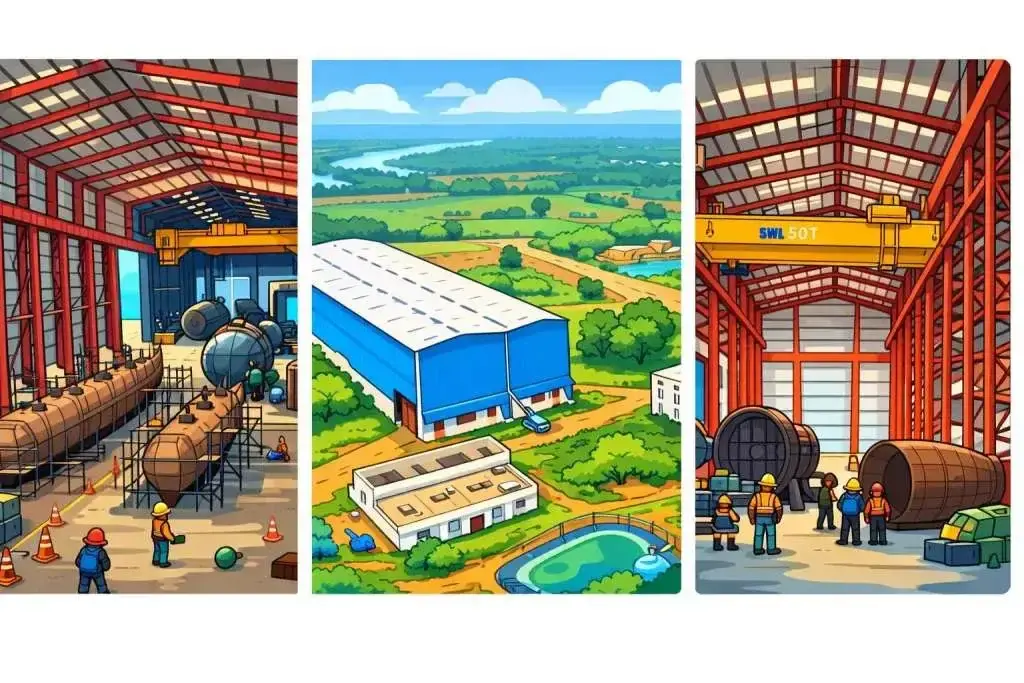
While the Odhav facility was strengthened, the real step-change came from the Kheda plant — built specifically for large, complex, high-metallurgy equipment typically handled by only a handful of global players.
A clean-room facility at Odhav further enhanced precision work in duplex steels, titanium and Inconel — metals used in severe-service environments where weld quality and process discipline are critical. Together, Kheda added scale while the clean room added precision — marking Anup’s transition into the high-end engineering league and positioning it closer to cryogenic and hydrogen-ready capability.
Management also articulated a medium-term ambition of reaching ₹1,000 crore in revenues — not as an aggressive projection, but aligned to industry tailwinds such as refinery upgrades, fertiliser expansion, LNG infrastructure and emerging hydrogen investments.
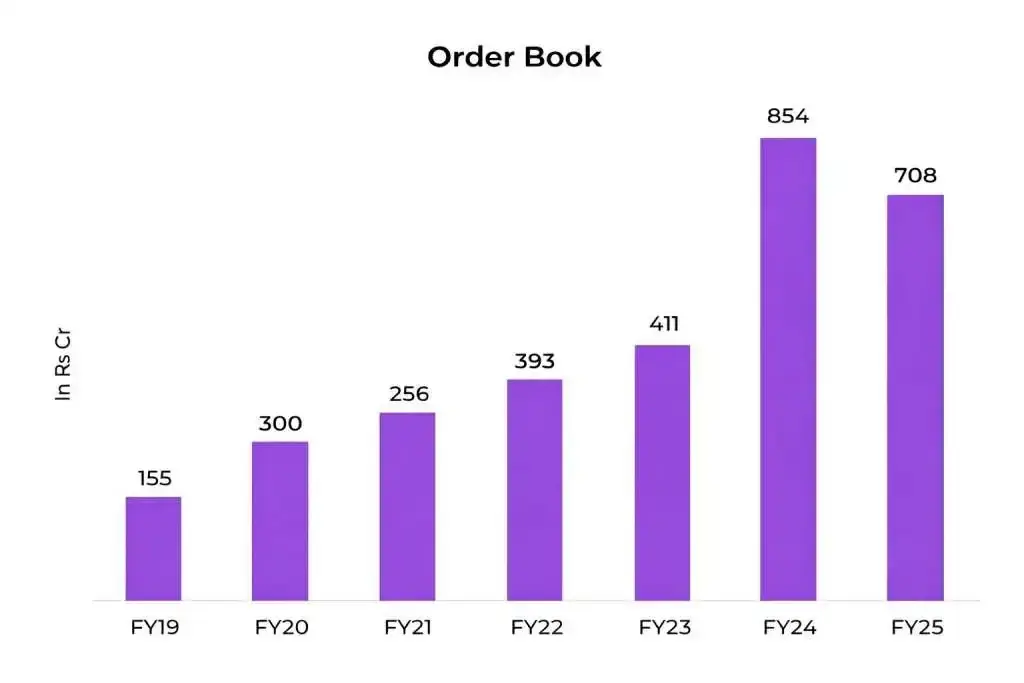
The company entered FY20 with an order book of ₹300 crore, almost double the prior year, dominated by shell-and-tube heat exchangers and high-specification engineered equipment supplied to leading global EPC players like Petrofac and Technip.
This shift was the result of years of capability building — advanced metallurgy handling, thicker-wall fabrication, and projects executed under global licensor standards. As a consequence, average equipment value rose from ~₹1 crore to ~₹2.7 crore, reflecting higher engineering intensity and stronger customer trust.
The pandemic temporarily disrupted inspections and dispatch schedules, but demand remained intact — no orders were cancelled or renegotiated. The challenge was execution timing rather than business viability. The company’s confidence was evident in its decision to maintain dividend payouts, signalling a strong balance sheet, cash-flow visibility and long-term conviction.
Key Breakthrough Orders During the Pandemic: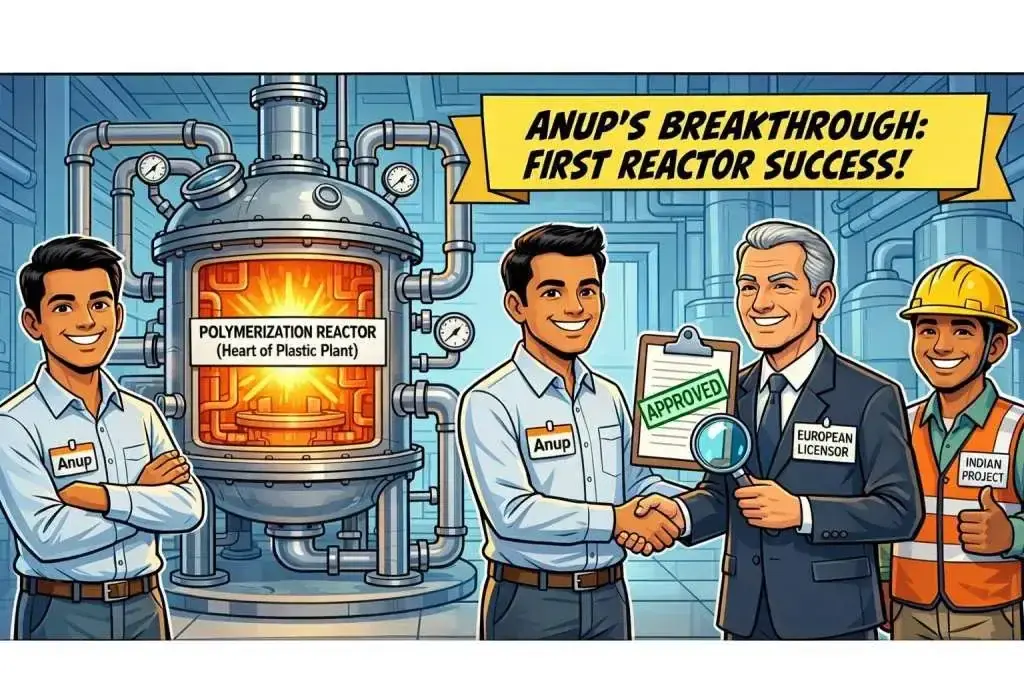
During this period, Anup achieved one of its most important capability milestones — securing approvals to work with Chrome-Moly and Super Duplex steels. These materials are used in high-pressure, high-temperature and corrosive environments such as refinery reactors, petrochemical units, hydrogen systems and fertilizer plants, where only a limited number of qualified global vendors operate.
These approvals were not routine certifications; they effectively moved the company into a higher engineering league. They enabled Anup to participate in larger, more complex, higher-value projects — resulting in fewer competing vendors, stronger customer trust and structurally better margin potential.
Alongside this, the company expanded its presence across South America, Europe and the Middle East — not through opportunistic orders, but through vendor-qualification wins earned via process discipline, documentation strength and delivery consistency.
By the time Anup entered FY22, it was operating meaningfully higher in the engineering value chain than when it was first listed — with deeper capability, stronger export relevance and a much clearer role in complex, high-specification equipment.
Phase 3- The Shift From Fabricator to Engineering Powerhouse
By FY23, Anup had clearly moved beyond the profile of a mid-sized fabricator. A record ₹537 crore order book and a ₹103 crore PSU-refinery project marked its entry into the top tier of engineered-equipment suppliers.
This phase was defined by a sharp capability upgrade. The company began executing complex jobs involving duplex steels, Inconel, titanium and other severe-service metallurgies — the kind used in units operating under extreme temperature and pressure. Only a small pool of global vendors qualify for this category, and Anup’s Odhav clean-room facility played a key role in meeting these precision and quality thresholds.
These capabilities also unlocked high-value applications in LNG and hydrogen, where equipment must withstand cryogenic temperatures and pressure shocks without failure. In parallel, the company strengthened its thick-wall fabrication capability — routinely working in the 50–80 mm range and scaling up to ~180–185 mm with cladding — a space where very few manufacturers globally can compete. This moved Anup into projects with higher technical entry barriers, fewer competing vendors and structurally superior margin potential.
1. Anup’s First Polymerisation Reactor: A True Capability Test.
The company delivered its first polymerisation reactor for an Indian project through a European process licensor — a category where vendor approvals are extremely stringent because even minor welding or metallurgical errors can fail the unit.
Clearing this audit reinforced Anup’s credibility in high-specification, mission-critical equipment.
2.A 200-Tonne Test of Strength
Around the same period, Anup manufactured a single-piece ~200-tonne unit using Chrome-Moly-Vanadium steel — the largest equipment in its history.
Handling such thickness, weight and metallurgical complexity placed the company in a small global peer set and signalled readiness for heavier, high-pressure projects.
3.The Global Validation Phase
Export momentum accelerated — not just in volume, but in the quality of customers. Names such as:
- Graham Corporation (US)
- Indorama
- ITT
- Air Products
entered the order book — organisations known for rigorous vendor audits and documentation standards.
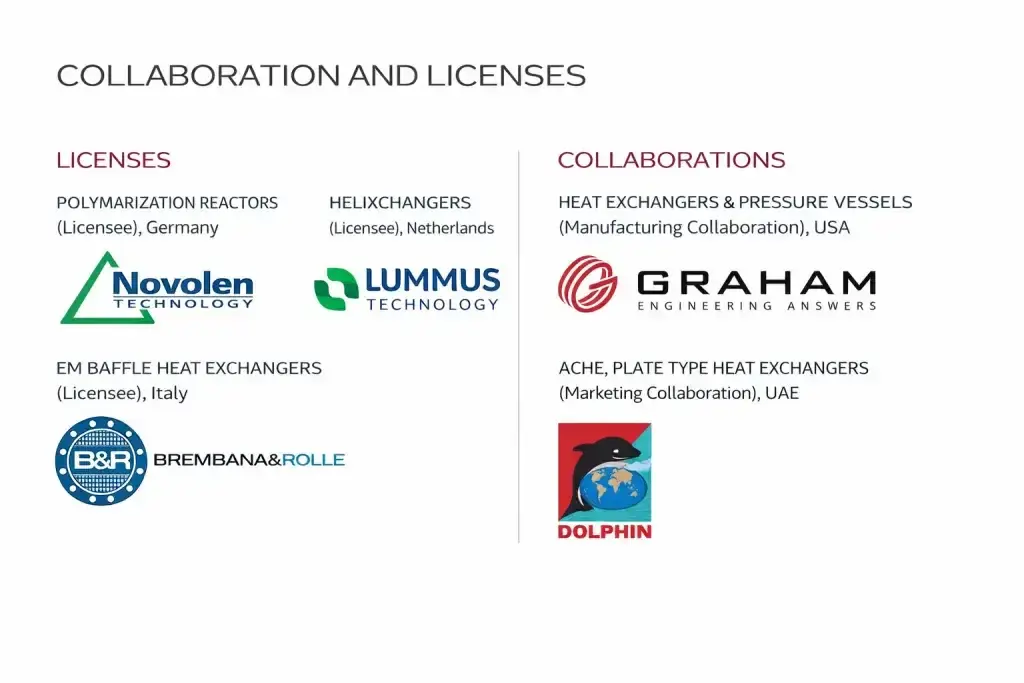
The inflexion point came when Graham elevated Anup to an exclusive manufacturing partner, offering first-right-of-refusal on select projects — a rare upgrade that reflects trust in metallurgy, weld quality, testing traceability, and delivery discipline.
4. Hydrogen quietly became one of Anup’s biggest breakthroughs.
The world is now in the middle of a major energy shift, and hydrogen has moved from “Instead of chasing electrolyser manufacturing, Anup positioned itself where hydrogen projects require the highest engineering reliability, thick-wall vessels, high-pressure exchangers, and severe-service reactors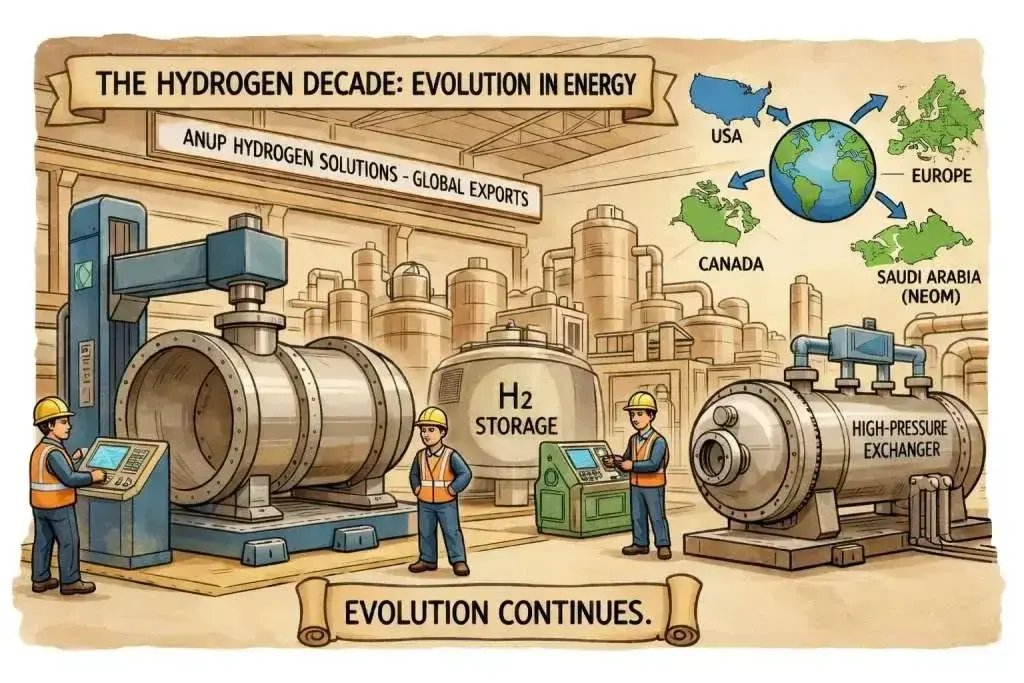 In hydrogen, failure risk sits inside the equipment, which is why only a limited number of global fabricators qualify.
As hydrogen capex accelerated across:
- the US & Canada
- Europe
- Middle East
Anup naturally integrated into project supply chains. The strongest validation came through participation in the NEOM green hydrogen project (with Air Products) — one of the world’s most demanding engineering benchmarks.
This alignment did three things:
Hydrogen is not a short-term narrative — it is a multi-cycle capex theme — and Anup entered it with the exact metallurgical and fabrication capability the industry is willing to pay a premium for.
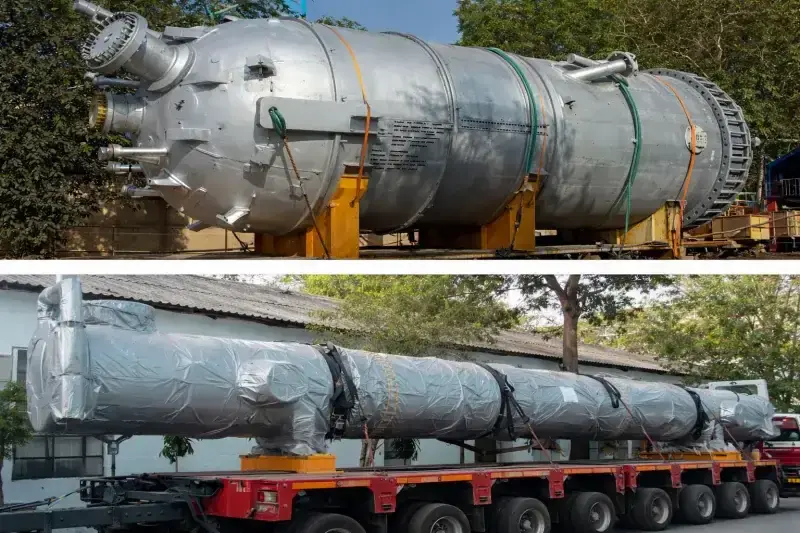
HYDROGEN SERVICE EQUIPMENT
5. Acquired Mabel Engineers Pvt. Ltd. (Tamil Nadu)
They also acquired Mabel Engineers Pvt. Ltd. in Tamil Nadu, a move that added more depth to their fabrication capability and expanded the range of products they could offer. It wasn’t a scale-driven acquisition, but a strategic one meant to strengthen their technical bench and widen the kind of equipment Anup can now build.
Manufacturing Plant :
6. The Oil & Gas Capex Wave: What’s Driving It
Globally, oil & gas has entered its strongest capex cycle in years. Energy security, rising demand in developing markets, and the push for cleaner fuels are forcing companies to expand and upgrade infrastructure. That’s why the big money today is flowing into deepwater developments, LNG terminals, refinery upgrades, and large brownfield expansion programs. National oil giants like Saudi Aramco and ADNOC are leading this wave, announcing multi-billion-dollar plans to boost capacity and modernise their facilities.
For companies like Anup, this matters because every one of these projects needs heat exchangers, reactors, pressure vessels, cryogenic systems, and hydrogen-ready equipment. As the world rebuilds and upgrades its energy backbone, high-end fabricators aren’t just benefiting, they're becoming essential to this new capex cycle.
By this point, Anup wasn’t just fighting for market share in India. It was standing on a global stage, competing with fabricators from China, Mexico and Europe. Europe remained structurally expensive, China competitive but inconsistent on quality, and India still held a clear cost advantage even during tariff pressure.
That advantage became stronger because nearly 70 percent of Anup’s material sourcing was domestic, with forgings coming mainly from Korea and exotic grades selectively sourced from Europe. This supply strategy kept costs predictable and ensured the company wasn’t exposed to sudden trade shocks.
Even in the middle of tariff uncertainty, Anup managed to win a USD 1 million US order. It was a quiet but powerful confirmation that its competitiveness wasn’t dependent on price alone. The world’s toughest markets were choosing it for capability, not cost arbitrage.
What truly changed in this phase was Anup’s identity. The years of building deeper metallurgy capability, handling heavier and more complex equipment, increasing the share of engineered products, forging OEM partnerships and scaling capacity through Kheda all came together.
hese were no longer incremental improvements. They collectively pushed the company into a different league. Anup had clearly crossed the line from a “fabricator” to a full-fledged engineered-equipment partner.
The company now excelled in areas where most competitors struggle with equipment above 30 MT, severe-service metallurgy, high-pressure applications and precision-heavy designs. These categories naturally reduce competitor count because they demand capability, not just manpower. In contrast, the sub-30 MT segment is crowded with low-cost players, so Anup chose to focus squarely on high-barrier jobs where skill outweighs price.
Inorganic Growth Plans
Anup has started actively exploring acquisitions in three areas that fit naturally with its engineering DNA:
• Energy technologies
• Speciality chemicals
• Packaged process systems
These aren’t random expansions. They’re deliberate moves to add new capabilities, accelerate growth, and enter segments where customers value engineering depth over price.
New Verticals Starting to Take Shape
- Anup Technical Services
This is part of the company’s long-term strategy to build revenue that keeps coming every year.
It had about 10 purchase orders by the end of FY26, three site jobs were under way in H1 FY27, and management expects about ₹50 crore of revenue from it this year, at margins of 30 percent or more. It gives Anup a steady, asset-light income stream while staying close to its core customers.
- Air-Cooled Heat Exchangers (ACHE)
These are becoming increasingly important in refineries and gas-processing units.
Anup has already quoted on three enquiries an early step toward adding another high-value product line.
- Strong Middle East Push
The Middle East is now a major strategic focus. The region is investing heavily in energy, petrochemicals and hydrogen, exactly the industries where Anup excels.
- They now count Saudi Aramco and ADNOC among key customers.
- Their first Aramco order covered 26 heat exchangers, scheduled at the time for delivery in Q3 FY26.
- The company has set up an official presence in Dubai to stay closer to regional clients.
- A full-time Sales & Marketing head for Europe–Middle East (EME) is already stationed there.
Management expects strong traction from Aramco, ADNOC and the big EPC contractors in the region, a market where order sizes are large and the entry barriers are high.
The order book shows a clear step-up in scale over time, rising from ₹155 crore in FY19 to ₹854 crore in FY24. It stood at ₹769 crore at the time of the FY26 results, and it reached ₹941 crore, including letters of intent, in November 2026.
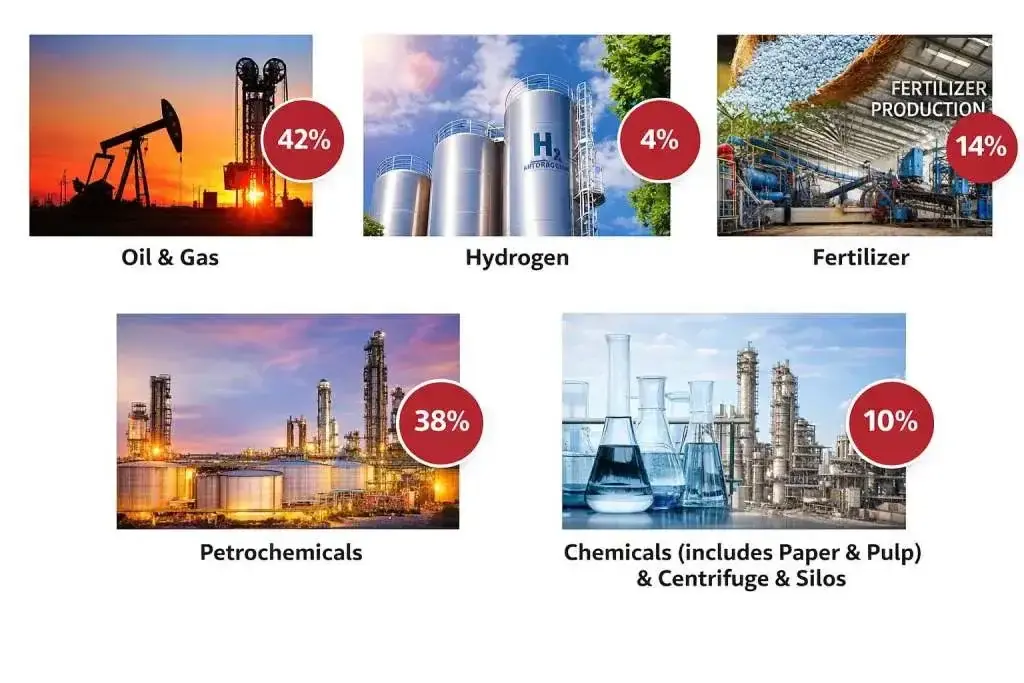
Q2FY26 sector wise revenue breakdown
competitors
With this shift, Anup found itself placed among India’s top four players in complex process equipment, standing alongside giants like L&T Heavy Engineering and ISGEC, and also competing with niche heat-exchanger specialists like Tema India and Patel Airtemp. But unlike diversified capital-goods companies, Anup’s strength came from sharp focus. It wasn’t trying to be everything. It was trying to be the best at one thing, and it was succeeding.
This was the phase where Anup stopped looking like a scaled fabricator and started behaving like a precision-engineering partner trusted by global EPCs, licensors and energy players. The evolution was complete.
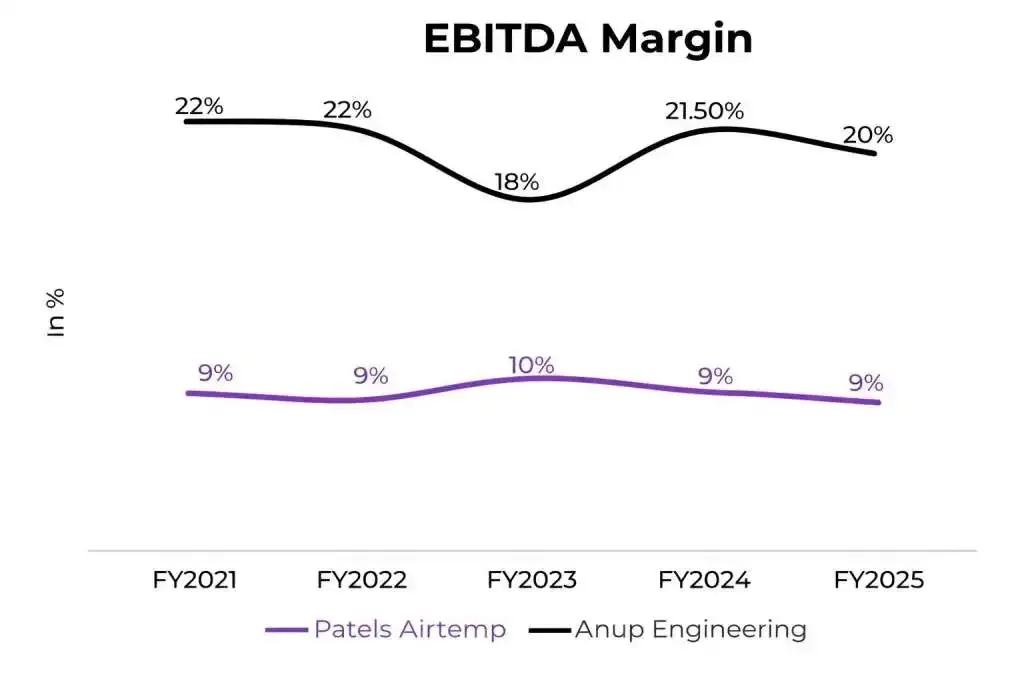
Anup’s EBITDA margins are structurally higher than peers such as Patels Airtemp, consistently remaining in the ~18–22 per cent range compared to ~9–10 per cent for peers. This margin premium reflects Anup’s positioning in high-complexity, engineered equipment rather than commoditised fabrication. The company operates in segments with higher entry barriers, limited qualified vendors, and greater pricing power.
Overall, the sustained margin gap highlights Anup’s stronger value addition, superior execution capability, and disciplined focus on high-specification projects.
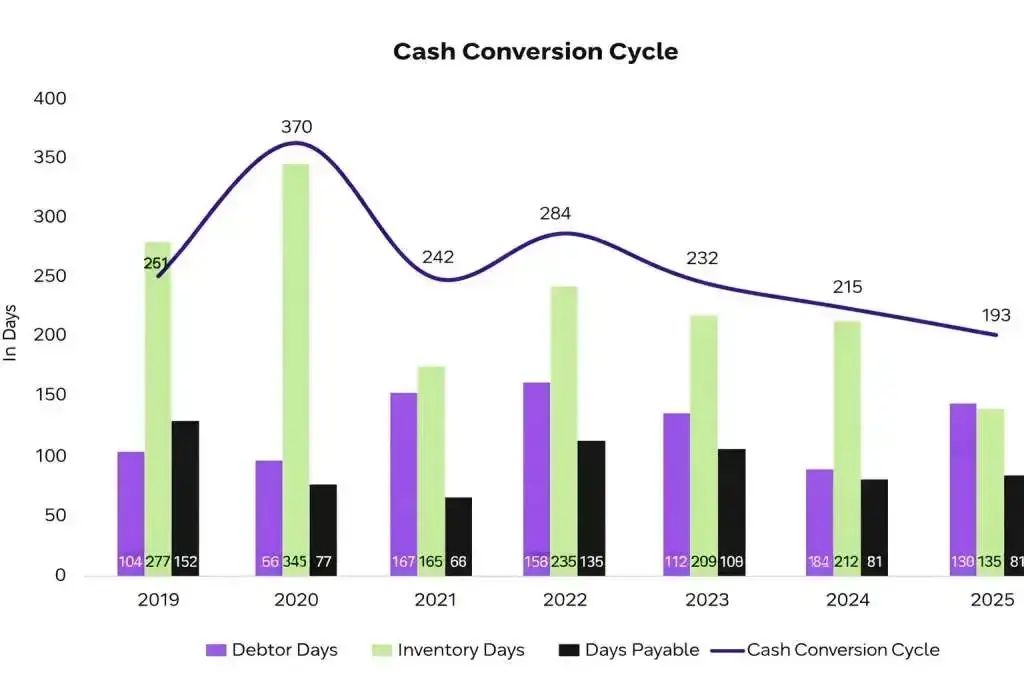
The cash-conversion cycle (CCC) shows a business that became far more efficient as it scaled. Inventory days spiked during the pandemic because material procurement and inspections were delayed, which pushed the CCC to its peak in FY20. As operations normalised and planning improved, both inventory and debtor days steadily tightened.
Payables became more stable, and by FY25 the CCC had dropped to 193 days, its best level in years. This trend reflects stronger execution discipline, smoother project scheduling and a shift toward larger, engineered equipment where customer payments are more structured and predictable. Overall, it shows a business learning to convert orders into cash faster as it matures.
This chart captures Anup’s steady transition from a largely domestic supplier to a company with a meaningful global footprint.
In the early years, domestic sales made up nearly 80–90 per cent of revenue.
As its capabilities in metallurgy, design and execution strengthened, export wins began coming through in sharp, step-like jumps. These weren’t small, incremental orders, but large, lumpy projects from the US, Middle East and Europe — typical of project-driven engineering businesses.
The result is visible in the numbers. Export contribution rose from around 10 per cent in FY13 to about 54 per cent in FY25. In H1 FY27, exports were 49 per cent of revenue and domestic sales 47 per cent, with the rest from deemed exports and SEZ customers.
This steady rise in export share aligns closely with management’s long-stated objective of a balanced 50:50 domestic–export mix. Given the trajectory and the nature of the order book, that target no longer looks aspirational — it looks well within reach.
This chart shows how Anup’s business mix has gradually broadened, even though heat exchangers still make up the bulk of revenue.
Earlier, the portfolio was heavily dominated by shell-and-tube exchangers, but over time the share of vessels, reactors and columns has been rising. That slow shift tells you something important: customers are trusting Anup with heavier, more complex, higher-value equipment.
The increasing contribution from other engineered products also reduces dependence on a single category and strengthens margins. The trend is moving in the same direction as the company’s strategy towards a more balanced, capability-led product mix rather than pure fabrication volume.
“You get exceptional results by doing ordinary things for an extraordinary length of time.”- Peter Lynch
1. Capability Compounds Faster Than Capital
Most companies scale by buying more machines.
Anup scaled by learning harder things:
Tougher metals,
Thicker plates,
Cleaner fabrication,
Cryogenic readiness,
Proprietary designs.
Capability is harder to copy than capacity.
That’s why Anup rose while many fabricators stayed stuck.
2. Focus Beats Diversification
Where competitors tried many products, Anup chose one identity:
“Build the most complex, high-pressure, high-thickness equipment.”
That single-minded focus pulled it into the global league.
3. A Clean Balance Sheet Gives You Freedom
While others diluted equity or took loans, Anup built everything through internal accruals.
No debt meant:
- No pressure during slowdowns,
- No compromise on long-term bets,
- Full control over expansion timing.
This is one of the biggest reasons the growth story stayed intact through the slowdowns.
4. The Market Rewards Companies That Move Up the Value Chain
Early Anup competed with dozens of Indian fabricators.
Later Anup competed with only a handful globally.
Every step upward reduced competition and improved pricing power.
That’s how margins scale even before revenue scales.
5. Export Success Comes From Capability, Not Cost Advantage
India has many low-cost fabricators.But exports grew for Anup only after it earned global approvals for:
- Titanium,
- Inconel,
- Duplex steels,
- Cryogenic work,
- Thick-wall reactors,
- High-pressure hydrogen equipment.
Capability, not cheap labour - opened the Middle East, US, and Europe.
6. A Business Is Built Long Before the Market Notices
By the time the market noticed Anup:
- Kheda was already built,
- Clean room was operational,
- Order book was global,
- Hydrogen capabilities were proven,
- Margins were stable,
- The balance sheet was flawless.
Strong businesses usually have a quiet phase where they transform long before the market pays attention.
Anup followed the same script.
7. Management Quality Matters More Than Narratives
Anup’s leadership:
- Avoided debt,
- Didn’t chase hype,
- Focused on engineering depth,
- Built customer trust brick by brick,
- Executed consistently for a decade.
Good management turns a good business into a great one.
Great management turns it into a lasting business.
Explore our Products
Research Framework

Emerging Titans
Combination of quantitative analysis, industry tailwinds, and management assessment - SPRINT investment philosophy

Tiny Titans
Heavy emphasis on scuttlebutt research, plant visits, and early on-ground signals
FAQs
What does Anup Engineering make?
+Anup Engineering makes process equipment such as shell-and-tube heat exchangers, pressure vessels, reactors and columns. They are used in refineries, petrochemical and fertiliser plants, LNG terminals and hydrogen projects.
How did Anup Engineering perform in Q2 FY27?
+Consolidated revenue was ₹182.4 Cr in Q2 FY27, up 46% from Q1 but 21.5% below Q2 FY26, and the EBITDA margin was 9.6%. The order book stood at ₹941 Cr including letters of intent, with about ₹390 Cr booked for FY28.
Who are Anup Engineering's customers?
+It supplies Indian and global EPC companies and energy companies. Names in its order book have included Graham Corporation, Indorama, ITT and Air Products, and it counts Saudi Aramco and ADNOC among key customers in the Middle East.
How much of Anup Engineering's revenue comes from exports?
+Exports rose from about 10 per cent of revenue in FY13 to about 54 per cent in FY25. In H1 FY27, exports were 49 per cent of revenue and domestic sales 47 per cent, while the order book in November 2026 was 67 per cent domestic and 33 per cent exports.
Does Anup Engineering have debt?
+Its debt-to-equity ratio stayed near zero for five straight years. The company funded its Kheda plant, capacity expansion and new capabilities largely from internal accruals rather than borrowing.
What new businesses is Anup Engineering building?
+It is building Anup Technical Services, an asset-light service business, and adding air-cooled heat exchangers. It is also exploring acquisitions in energy technologies, speciality chemicals and packaged process systems.

High growth stock specialist, Value Educator
Shashank Mahajan is an equity research professional with over 12 years of experience in identifying high-potential SME and micro-cap stocks at an early stage. He follows a rigorous scuttlebutt research–driven approach, combining on-ground insights with deep financial analysis. Shashank specializes in uncovering under-researched and under-owned companies with strong management quality and long-term growth potential. Through disciplined research and early identification, he focuses on spotting tomorrow’s market leaders before they enter the mainstream investor radar.

Syrma SGS: Less Consumer Work, ₹7,420 Cr of Orders
Centum Electronics: Radar, Space Electronics and EMS
Highest Order Book Stocks in India 2026: Ranked List
Aerospace Stocks in India 2026: Suppliers and Order Books
EMS Stocks in India 2026: Electronics Makers and Order Books
Data Centre Stocks in India 2026: Suppliers and Operators
Explore our Products
Research Framework
Emerging Titans
Combination of quantitative analysis, industry tailwinds, and management assessment - SPRINT investment philosophy
Tiny Titans
Heavy emphasis on scuttlebutt research, plant visits, and early on-ground signals



Modern Warfare to Multibaggers
Key Trends. Strategic Shifts. Opportunities Ahead.
Don't Miss This Exclusive Webinar!
Join Value Educator to decode the key trends shaping India's defence sector and learn how to identify tomorrow's potential leaders in the space.
- In-depth research on India's defence sector
- Live Q&A session
- Actionable takeaways for long-term investors

 Orders
 Subscription
 Share with friends


Required Details
₹23999.00
(12 month subscription)
As per SEBI regulations, all users are mandated to complete the KYC that is validated for 1 year. Post payment, you will be redirected to the KYC screen


No comments yet. Be the first to comment!