
HPL Electric & Power: Smart Meters, Wires and Two Engines

In FY22, an Indian maker of meters, switches and lights earned ₹444.1 Cr from its electricity meters. Three years later, in FY25, the same line brought in ₹1,075.6 Cr, as India began to swap its old meters for smart ones. Then the meter business slowed, and the rest of the company took over. In the July to September 2026 quarter, its wires and cables grew 159.46% to ₹177.99 Cr, and its consumer side made up about 55% of revenue.
That shift is the key to this company. The meter is the box that counts the power used in a home or a shop. A smart meter is a meter that sends its reading to the power company on its own, over a radio or mobile network, so the company can bill without a visit and switch supply on or off from its office. Most new smart meters in India are also prepaid, which means the customer recharges first and then uses the power.
Those meters are paid for under a government scheme called RDSS, the Revamped Distribution Sector Scheme. Under it, a state power distribution company, or discom, hires an AMISP, which means an Advanced Metering Infrastructure Service Provider. The AMISP installs and runs the meters for years and is paid a monthly fee. It does not always make the meters itself, so it buys them from meter makers. That is where this company comes in.
That company is HPL Electric & Power Ltd (NSE: HPL). It sells under a brand that is about 70 years old, and it makes meters, lights, wires and cables, fans and switchgear in seven plants in Haryana and Himachal Pradesh. Switchgear is the name for the switches and circuit breakers that protect a building's wiring. Its plants can make about 11 million electronic meters a year, along with 26 million lighting units, 16 million switchgear units and 194 million metres of wires and cables. It sells its consumer products through more than 900 authorised dealers and over 90,000 retailers.

So you can think of HPL as two businesses under one roof. One makes meters for AMISPs and utilities, on long contracts. The other sells switches, lights and cables through shops and dealers, where orders come in every day.
HPL Electric & Power in five numbers
- Q2 FY27 revenue of ₹608.31 Cr, up 40.02%, its first quarter above ₹600 Cr
- An order book of ₹2,700+ Cr on 2 November 2026, with over 96% from metering
- Consumer and industrial revenue of ₹615.05 Cr in H1 FY27, against ₹784.67 Cr in all of FY26
- Capacity for about 11 million meters a year, running at around 70%
- An EBITDA margin of 11.74% in Q2 FY27, against 15.17% a year ago
So revenue is at a record, but the margin has fallen by more than a fifth. How did both happen in the same quarter? Let's first understand the company, and then look at the latest results.
HPL Electric & Power: Company Overview
HPL Electric & Power Ltd was incorporated on 28 May 1992 as HPL-Socomec Private Limited, and its registered office is in New Delhi. Lalit Seth is Chairman, Rishi Seth is Managing Director, and Gautam Seth is Joint Managing Director and CFO. The company makes smart, prepaid and net meters for utilities and AMISPs, and switchgear, lighting, wires and cables, and fans for homes, shops and industry. It runs seven plants in Haryana and Himachal Pradesh, with capacity for about 11 million meters, 26 million lighting units, 16 million switchgear units and 194 million metres of wires and cables a year, and two R&D centres with more than 100 engineers. It had 1,271 permanent employees in FY26. Revenue was ₹1,811.1 Cr in FY26, and its order book stood at ₹2,700+ Cr on 2 November 2026, almost all of it for meters. Read this Power Sector Stocks in India 2026: List by Value Chain
"Behind every stock is a company. Find out what it's doing."
— Peter Lynch
HPL is really two companies: a meter maker that sells on long, fixed-price contracts, and a consumer brand that sells wires and switches through shops. Knowing which one is growing, and which one earns the margin, is the first step to reading its results.
A Record Quarter With Thinner Margins
Let's look at Q2 FY27, the July to September quarter that HPL reported on 5 November 2026: a record for revenue, with thinner margins. All figures here are consolidated. Revenue was ₹608.31 Cr, up 40.02% from ₹434.45 Cr a year ago and up from ₹515.24 Cr in Q1 FY27. It was the highest quarterly revenue in the company's history.

As we can see in the table, most of the growth stayed above the EBITDA line. EBITDA rose 8.37% to ₹71.42 Cr, far slower than revenue. Profit after tax rose 4.68% to ₹23.40 Cr, which is a margin of just 3.85% on sales.

That chart also shows us when the margin broke. For four quarters in FY26 the EBITDA margin stayed between 15.14% and 16.51%. In Q1 FY27 it fell to 12.26%, and in Q2 FY27 to 11.74%. The gross margin, the share of revenue left after the cost of materials, fell to 28.57% from 36.56% a year ago.
Management gave two reasons: cost and mix. On cost, prices of metals, industrial plastics and electronic parts rose sharply from March 2026, which it links to the geopolitical situation. On mix, the consumer side, which earns a lower margin, grew much faster than meters.
Of the two, cost hurts more in meters. HPL sells its meters to AMISPs at fixed prices, agreed when the order is placed, so it cannot pass a rise in costs on to the buyer. It is trying to cut costs through redesign and new components instead. We can see the effect in the segment EBIT margin, which is each segment's profit before interest and tax as a share of its revenue. In meters, it fell to 12.28% in Q2 FY27 from 17.52% a year ago.
But the consumer side is different. There, HPL has already raised some prices in Q2 and plans more after Diwali, and it expects most of the cost rise to be passed on by the end of Q3. Management said it does not see the margin falling further from here, and it expects the EBITDA margin to settle around 12% to 12.5% for the full year.
"The single most important decision in evaluating a business is pricing power."
— Warren Buffett
HPL has some pricing power in its consumer products, where it can raise prices with a lag of a month or two. On fixed-price meter contracts it has almost none, and that split explains much of the fall in its margin.
Below EBITDA, depreciation is the other drag. It rose 47.62% to ₹18.71 Cr, as the new plants built over the last two and a half years came into use. Finance cost was about flat at ₹22.50 Cr. Profit before tax rose only 2.95% to ₹31.39 Cr.
So if we add the two quarters, H1 FY27 revenue was ₹1,123.55 Cr, up 37.44%. EBITDA rose 8.64% to ₹134.60 Cr, at a margin of 11.98%, and profit after tax rose 3.08% to ₹42.10 Cr.
But cash moved the other way. Operating cash flow was about ₹52.8 Cr in H1 FY27, against about ₹114.9 Cr in H1 FY26. The main reason was stock. Inventory rose to ₹843.87 Cr in September 2026 from ₹748.51 Cr in March. Trade receivables rose to ₹794.95 Cr from ₹765.27 Cr. Net debt, after cash and bank balances, rose to about ₹709.6 Cr from about ₹668.6 Cr.
Beyond the numbers, on 5 November 2026 the board also gave an in-principle nod to a restructuring. It will evaluate splitting one or more of its businesses into separate companies through a scheme of arrangement, to give each product line more focus. Management called it an enabling provision for now, with no structure or timeline decided.
The Orders Behind the Meter Business
Now let's look at the order book, because it shows how much meter work is already booked. On 2 November 2026 it stood at ₹2,700+ Cr, and over 96% of it came from metering. The company says that covers roughly two and a half years of metering revenue at the current pace.

As we can see in the chart, the book has come down from its peak. It was ₹2,000+ Cr in May 2024 and reached ₹3,500+ Cr in May 2025. It was ₹3,200+ Cr in May 2026 and again in August 2026, before falling to ₹2,700+ Cr in November.
But management does not see that dip as a problem. It says new orders come in every month, that it has revenue visibility of over 2 years, and that whether the figure is 2,500 or 3,000 is not material right now. The consumer side is not in this number at all, because its orders cover only about 15 to 20 days of sales.
What the order book says: HPL is not an AMISP. It supplies meters to the AMISPs that win the projects. Management says it is a preferred approved vendor of Adani, is approved with EESL, and works with all the independent AMISPs. So its new orders depend on how fast those AMISPs install, and on how much they choose to buy from HPL.
From Meter Maker to Two Engines
To see why the mix matters, let's go back a few years. HPL was incorporated in 1992 as HPL-Socomec Private Limited, and its brand goes back further. For most of its history it sold meters to state utilities through tenders, and switches and lights through dealers. The company says it has supplied most state and central utilities for the last two decades.
Then the smart meter wave arrived, and the meter side grew fastest. Revenue from metering rose from ₹444.1 Cr in FY22 to ₹1,075.6 Cr in FY25. The consumer side, which the company calls Consumer & Industrial, or C&I, stayed close to ₹600 Cr a year over the same time.

That table shows us two phases. From FY22 to FY25, meters drove the growth, and metering's share of revenue rose from about 44% to about 63%. The EBITDA margin rose with it, from 12.3% to 15.0%, because meters earned more than the consumer products.
Then, in FY26, the order flipped. Metering revenue fell 4.57% to ₹1,026.43 Cr, after an industry-wide slowdown in installations in Q1 FY26. C&I grew 25.62% to ₹784.67 Cr, led by wires and cables. Profit was about flat at ₹91.25 Cr, because depreciation rose after new capacity came in.

That chart shows a point that is easy to miss. From FY22 to FY26, profits added up to about ₹266.9 Cr, but operating cash flow added up to about ₹669.7 Cr. Two large costs sit between EBITDA and profit. One is interest: finance cost was about ₹94.1 Cr in FY26, more than the year's profit. The other is depreciation, which was about ₹63.2 Cr.
That cash went into new plants. Read this Cash Flow Statement Explained HPL spent about ₹180.0 Cr on property, plant and equipment in FY26, against about ₹76.2 Cr in FY25, much of it for smart meter capacity. Management says it now has the meter capacity it needs, and that meter capex from here will mostly be maintenance.
That build-out also changed the group structure. HPL makes part of its meter output through a subsidiary, Himachal Energy Private Limited, in which it held 97.15%. On 29 October 2026, after that subsidiary bought back its own shares, it became a wholly owned subsidiary, so all of its profit now belongs to HPL.
Lenders have also grown more comfortable with the balance sheet. CRISIL upgraded HPL's long-term rating to A+/Stable from A/Stable in April 2026, and India Ratings affirmed IND A+/Stable in June 2026. The board also recommended a dividend of ₹1 per share for FY26.
Meters, Wires, Switches and Lights
Now that we know how HPL got here, let's look at what it sells today. It sells meters, wires, switches and lights, and reports them in two segments. Here is how the two compared in Q2 FY27.

As we can see in the last column, both margins fell in the quarter, but meters fell further. Read this Segment-Wise Revenue Analysis Explained

Smart Meters for AMISPs
Let's start with meters, which still fill almost the whole order book. HPL makes smart meters, prepaid meters, solar net meters and trivector meters for utilities. Its plants can make about 11 million meters a year.
In Q2 FY27 metering revenue rose 18.17% to ₹270.85 Cr, and 13.97% from Q1 FY27. In H1 FY27 it rose 17.40% to ₹508.50 Cr. Management says the industry has moved from a fast, uncertain phase to a steadier one, and it expects growth of 15% to 20% to continue.
That growth is not limited by capacity. Management puts meter plant use at around 70%, after a lot of capex in the last two and a half years. It says it can produce more easily if the government pushes the rollout harder before its 2028 deadline.
Still, the margin is the number to watch. The metering EBIT margin was 17.52% in FY26, and fell to 12.28% in Q2 FY27. Management says a margin of 15% plus is sustainable at current volumes, and that the last two quarters reflect a one-off rise in material costs and longer lead times for electronic parts.
Scale is the reason behind that view. Management points out that in electronics, costs fall as volumes rise, and that is what happened as smart meter output grew. But its buyers are a few large AMISPs that place repeat orders and know where costs are going, so lower costs tend to flow into lower prices too. Its smart meters are certified to IS 16444, the Indian standard for smart meters, and the company lists this among its qualification credentials for tenders.
The buyer side is also changing. Management expects consolidation among meter makers over the next two years, and says AMISPs will favour established suppliers with proven quality. It says its business is spread across many AMISPs and does not depend on one or two. It also expects a next round of meter technology, which it calls smart metering 2.0, to bring new volumes in later years. HPL has also built some data analytics work for utilities in Odisha and West Bengal, though it has not given numbers for it.
Wires and Cables
Now let's turn to the fastest-growing line. Wires and cables revenue was ₹177.99 Cr in Q2 FY27, up 159.46%, and ₹323.74 Cr in H1 FY27. That half alone is about 95% of the ₹340.74 Cr the line made in all of FY26.
That growth, management says, is mostly volume, not higher copper prices. Demand comes from real estate, industrial makers and panel builders, solar, telecom and 5G, and institutional buyers. Its wire and cable lines run at about 80% of capacity, and it has added 7 to 8 new machines in the last six months.
That speed is not new. Wires and cables grew 50.0% in FY26, and in H1 FY27 revenue more than doubled to ₹323.74 Cr from about ₹150 Cr a year before. Management expects the percentage growth to slow in H2, because Q3 and Q4 of FY26 were already strong quarters, even as revenue keeps rising in rupees.
Management now calls wires and cables a key growth line for the next 3 to 5 years. It is working on new speciality cables, which it expects to reach commercial production around June next year, for areas such as data centres, infrastructure and electric vehicles. Any new capex for this is still being evaluated.
Switchgear, Lighting and Fans
Now let's look at the rest of C&I, which is a basket of switchgear, lighting and fans. In Q2 FY27, lighting and electronics grew 59.43% to ₹60.79 Cr, and domestic switchgear grew 43.23% to ₹33.33 Cr. Industrial switchgear was ₹65.34 Cr, 29.18% higher than Q1 FY27, against a strong quarter a year ago. The company says it holds about half of India's market for on-load change-over switches.
Each of these has its own plan. HPL launched a new modular switch range, KYRO, in August 2026. It plans to relaunch its lighting range with smart lighting in February, around the ELECRAMA trade show. Fans are still small, and summer 2027 will be its first season selling them across India.
All of these lines reach buyers through the same shops. Three years ago, management says, HPL had about 30,000 to 35,000 retailers. It now has over 90,000 and targets 1,00,000 by March 2027, then plans to double that in about three years. It keeps its dealer count near 900 and focuses on the quality of each new dealer rather than the number. A team of field salespeople, tracked by location, visits 20 to 30 shops a day each.
Water Meters and Exports
Let's now look beyond these, at water meters and exports. HPL launched a smart water meter, Neeram Pulse, in FY26, and set up a separate plant for it in Gurugram. It has run pilots with customers and expects meaningful numbers next year. It also won its first good order from Africa, with an advance paid. Neither line is reported separately yet.
Exports remain small for now. Management says new free trade agreements should help, and that buyers in Africa and the Middle East are showing interest. But shipping delays and higher freight costs slowed deliveries in the last six months, and meters for foreign utilities need long approval and certification cycles before volumes can grow.
Where HPL Sits in the Power Value Chain
Now let's place both engines in the power chain. Power plants make electricity, transmission lines carry it across states, and discoms take it down to homes, shops and factories. HPL works at the last two steps.
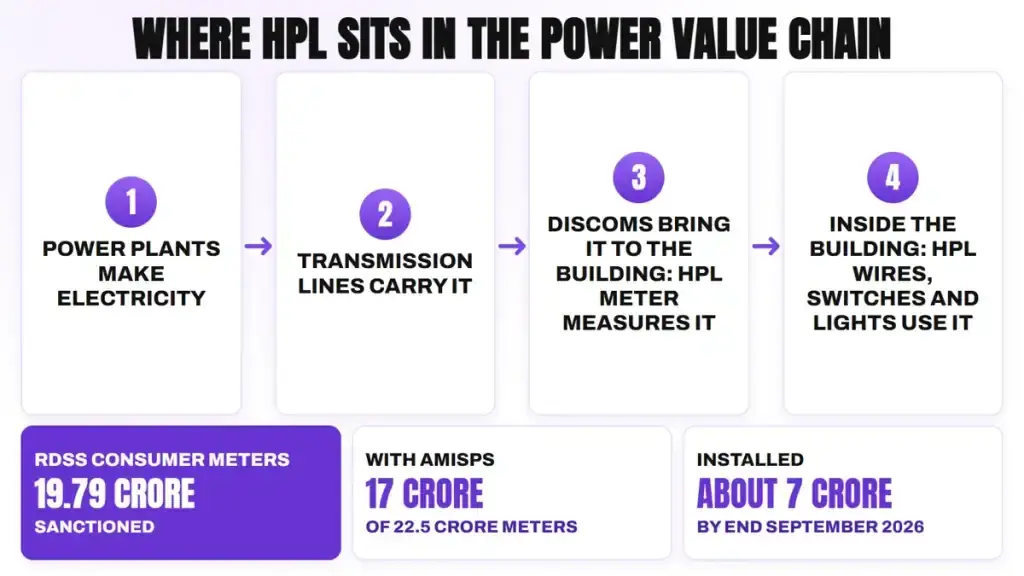
On the utility side, its meters sit at the point where the power used is measured and billed. For a discom, a prepaid smart meter means better collection of bills, lower dues from customers and real-time data on use. Under RDSS, smart metering worth ₹1,30,671 crore has been sanctioned, covering 19.79 crore consumer meters, 52.53 lakh distribution transformer meters and 2.05 lakh feeder meters. The rollout is now expected to run to FY28, 2 to 3 years beyond the first FY26 target.
That rollout is still mid-way. Read this Genus Power vs HPL Electric: Smart Meter Makers Compared Management said in November 2026 that about 7 crore meters had been installed by the end of September, and that 17 crore of the 22.5 crore meters had already been awarded to AMISPs. So a large part of the work is already with AMISPs, waiting to be ordered from meter makers like HPL.
On the consumer side, HPL's products sit after the meter, inside the building. Wires carry the power through the walls, switchgear protects the circuits, and lights and fans use the power. Every new home, office or factory needs them, whether or not it gets a smart meter.
So the two engines tie HPL to two different cycles, as you can see. Meters follow government schemes and AMISP schedules. Wires, switches and lights follow construction, industry and household spending. One can slow while the other grows, which is what happened in FY26.
Why HPL's Moat Is Hard to Copy
Now that we know where HPL sits, let's look at its moat. Read this Economic Moat Explained A meter is not hard to make, and many new companies have entered the market. So the question is why an AMISP, which must keep meters working for years, would choose HPL.
One reason we can see is the length of the record. HPL has supplied utilities for about two decades, and management makes a pointed claim about the earlier cycle. From 1996 to about 2020, it says, there were almost 45 meter makers in India, and only 5 survived the change in technology.
A second reason is that an AMISP's own income depends on the meter. It is paid over many years, and its payments depend on the meters working and sending data. HPL says it guarantees its meters will work for 10 years, and claims 98% operational success on service level agreements across India. That makes a buyer wary of the cheapest bid, and HPL argues that low-price entrants have not lasted.
"Time is the friend of the wonderful business, the enemy of the mediocre."
— Warren Buffett
An AMISP is paid over many years, so a meter that keeps working matters more than a meter that is cheap on day one. That gives makers with a long record an edge, if their meters hold up.
A third is in-house work. HPL has 2 R&D centres with more than 100 engineers, and spent about ₹17.4 Cr on R&D in FY26. Its meters carry their own software, and it uses Wirepas RF mesh technology for meter communication. It also makes many of its own parts, from moulded plastics to sheet metal.
On the consumer side, the moat is the channel. HPL sells through 90+ branch and representative offices, 900+ authorised dealers and over 90,000 retailers, with 620+ staff for sales and brand building. It targets 1,00,000 retailers by March 2027, and says it aims to double C&I in the next 3 years largely through this network.
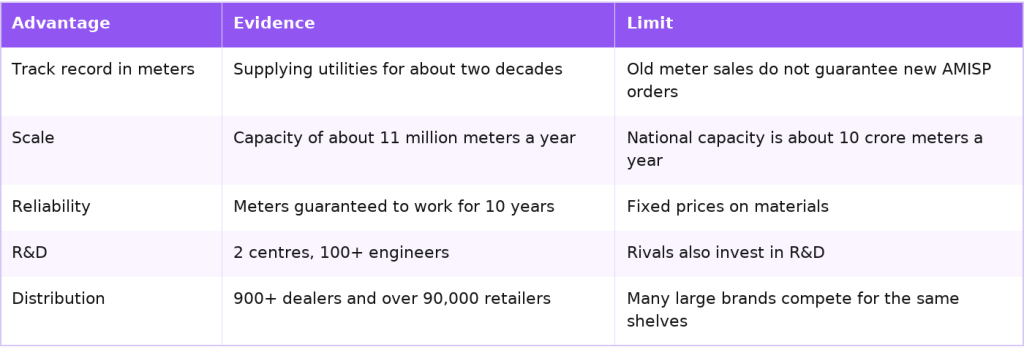
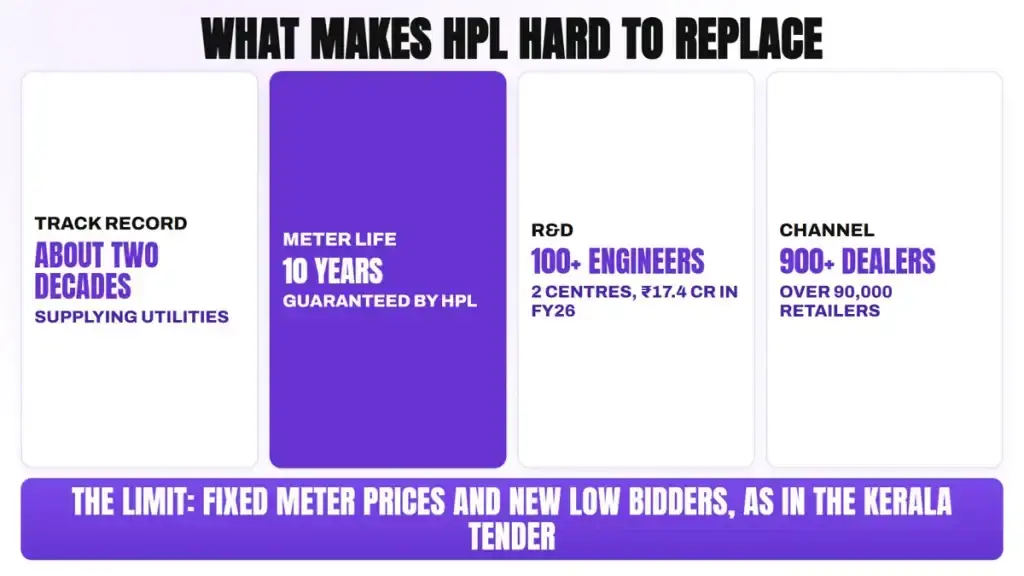
That table also shows the limit of the moat. India has an estimated meter capacity of about 10 crore a year, and the top 8 to 9 makers hold 70% to 80% of it. HPL is one of them, but its share of capacity is about one-ninth. And in one recent Kerala tender, an analyst said in November 2026 that the lowest bidder priced about 50% below HPL. The moat is real, but it does not stop price pressure.
Financials: Five Years of Revenue, Margins and Cash Flow
One quarter can mislead in a company with two very different businesses, so let's look at the full years together. The figures below are consolidated; EBITDA excludes other income, and the first half of FY27 is shown for comparison.

Revenue grew about 1.8 times in four years, from ₹1,014.0 Cr in FY22 to ₹1,811.1 Cr in FY26, and the EBITDA margin rose from 12.3% to 15.5% as smart meters became a larger part of sales. Net profit grew from ₹7.8 Cr to ₹91.3 Cr over the same years, though it was about flat in FY26 as depreciation rose.
Cash flow has been stronger than profit. From FY22 to FY26, net profit added up to about ₹266.9 Cr, while operating cash flow added up to about ₹669.7 Cr, because interest and depreciation take a large share of EBITDA before it reaches profit. In FY26, finance cost of about ₹94.1 Cr was more than the year's profit. In the first half of FY27, operating cash flow fell to about ₹52.8 Cr as inventory rose.
The balance sheet carries that interest. Net debt was about ₹668.6 Cr in March 2026, about 2.4 times FY26 EBITDA, and about ₹709.6 Cr in September 2026. CRISIL upgraded its long-term rating to A+/Stable in April 2026. Inventory and receivables, each about five months of revenue, are the main lever management has named for freeing cash.
"Beware of little expenses; a small leak will sink a great ship."
— Benjamin Franklin
For HPL the leak is not small: interest and depreciation took about ₹157 Cr of FY26 EBITDA of ₹281.43 Cr. That is why a few points of margin change the profit line so much.
What FY27 Could Look Like on Management's Numbers
So where does the business go from here? Management has not given a single revenue target for FY27. But it has given three markers we can use: C&I revenue, metering growth and the margin.
So let's start with C&I. In May 2026 management said C&I should reach about ₹1,000 Cr of revenue in FY27. In November it said C&I would end "well north" of that. H1 FY27 C&I revenue was already ₹615.05 Cr, so H2 needs only about ₹385 Cr to cross ₹1,000 Cr. That is less than the about ₹400 Cr it made in H2 FY26.
Now let's turn to metering, where management expects growth of 15% to 20%. On FY26 metering revenue of ₹1,026.43 Cr, that means about ₹1,180 Cr to ₹1,232 Cr for FY27. With ₹508.50 Cr done in H1, H2 would need about ₹672 Cr to ₹723 Cr, against about ₹593 Cr in H2 FY26.
That brings us to the margin, where management expects about 12% to 12.5% for the year. If C&I reaches ₹1,000 Cr and metering grows 15%, revenue would be about ₹2,180 Cr. At a 12% to 12.5% margin, EBITDA would be about ₹262 Cr to ₹273 Cr, which is below the ₹281.43 Cr of FY26.
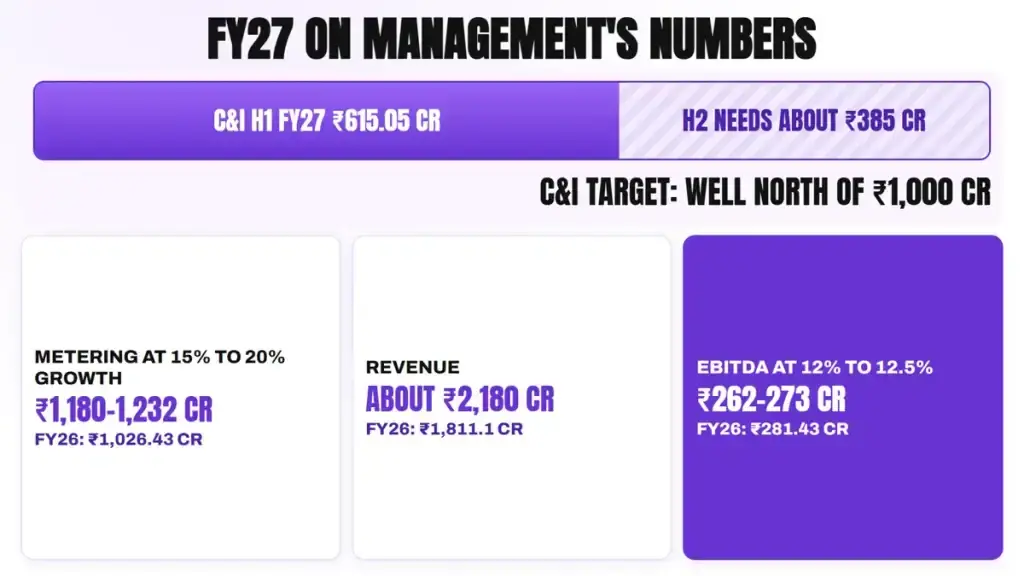
So, on management's own numbers, FY27 revenue could grow about 20% while EBITDA stays about flat. The margin, not the order book, decides whether profit grows this year.
Management seems aware of this. In November 2026 it said its focus for the second half is to turn scale into stronger earnings and cash, through better margin quality, disciplined execution and tighter working capital. It also said its sales plan for FY28 is almost ready, though it has not shared any numbers from it.
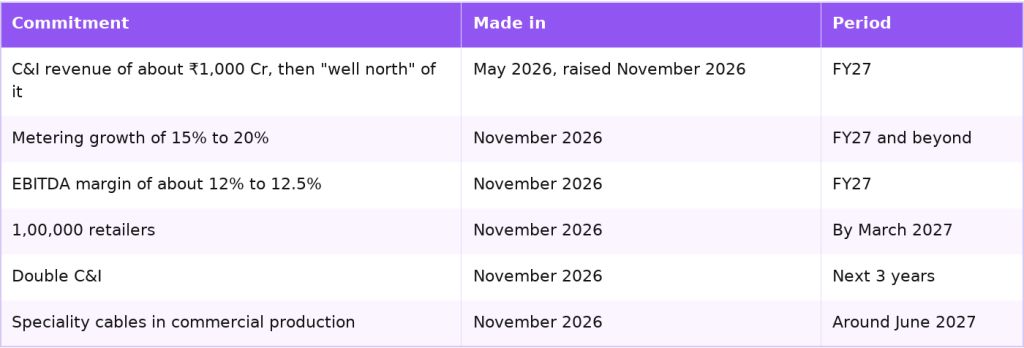
Those commitments are easier to judge against the past. So let's check what management said before against what it delivered.
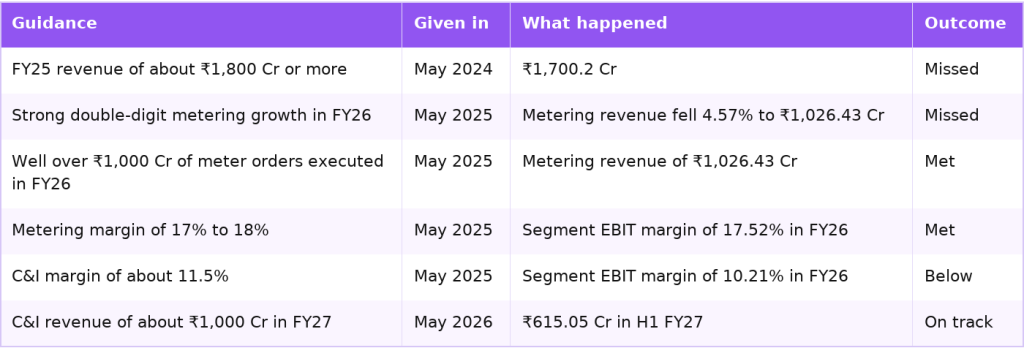
That record shows us a clear pattern. HPL has delivered on its consumer business and on the meter margin in a normal year. It has been less accurate on the pace of meter revenue, which depends on AMISP schedules it does not control. That makes the margin and the H2 meter numbers the ones to watch.
Key Risks
Now let's look at what could go wrong for HPL, because the latest quarter has already shown some of these risks.
- Fixed-price meter contracts: HPL cannot pass on cost increases in metering. If metal, plastic or chip prices stay high, the metering margin could stay well below its FY26 level of 17.52%.
- A falling margin overall: the EBITDA margin fell from 15.54% in FY26 to 11.74% in Q2 FY27. If price rises in C&I do not stick, the 12% to 12.5% range for the year is at risk.
- Interest and depreciation: finance cost of about ₹94.1 Cr in FY26 was more than the year's profit, and depreciation is rising. Small margin changes swing profit a lot.
- Working capital: receivables were about 154 days of FY26 revenue in March 2026 and inventory about 151 days. Inventory rose further in H1 FY27, and operating cash flow more than halved.
- Debt: net debt was about ₹709.6 Cr in September 2026, about 2.4 times FY26 EBITDA on the March figure.
- A smaller order book: the book has come down from ₹3,500+ Cr in May 2025 to ₹2,700+ Cr. New orders depend on AMISPs, and a few large AMISPs control a lot of the pipeline.
- Price competition: new meter makers are bidding low, as in the Kerala tender. HPL says such bids do not last, but they can still pull prices down for a while.
- The end of the meter wave: RDSS runs to FY28. After the first phase, meter demand could slow unless replacement or new technology orders take over.
- An open restructuring: the board is evaluating a split of the businesses, but no structure, ratio or timeline is decided.
"In metering, since we have the fixed contracts, the cost increases, these we are not able to pass on." - Gautam Seth, Joint Managing Director and CFO, November 2026
"Anybody who tried to disrupt based on pricing has not grown or not survived." - Gautam Seth, Joint Managing Director and CFO, November 2026
"You can't predict. You can prepare."
— Howard Marks
No one can say when metal and chip prices will ease. What an investor can track is how exposed HPL is to them, through fixed-price meter contracts, debt and working capital, which is what the list below sets out.
Explore our Products
Research Framework

Emerging Titans
Combination of quantitative analysis, industry tailwinds, and management assessment - SPRINT investment philosophy

Tiny Titans
Heavy emphasis on scuttlebutt research, plant visits, and early on-ground signals
What to Track Next
If you follow HPL, these are the signals that will show where it goes next.
- The EBITDA margin against the 12% to 12.5% range, and whether C&I price rises hold after Diwali
- Metering revenue in H2 FY27 against 15% to 20% growth, and the metering EBIT margin after 12.28%
- C&I revenue for FY27 against "well north" of ₹1,000 Cr, and wires and cables after ₹323.74 Cr in H1
- The order book after ₹2,700+ Cr, and new orders from AMISPs as states tender more meters
- Inventory after ₹843.87 Cr, operating cash flow, and net debt after about ₹709.6 Cr
- The board's decision on the restructuring, and any capex plan for new cables
Conclusion
Let's put it all together. HPL Electric & Power grew from about ₹1,014.0 Cr of revenue in FY22 to ₹1,811.1 Cr in FY26, first from smart meters and then from wires, switches and lights. It now has two engines: a meter business with ₹2,700+ Cr of orders and capacity for about 11 million meters a year, and a consumer business that made ₹615.05 Cr in just the first half of FY27. The cautious thread is the margin: the EBITDA margin fell from 15.54% in FY26 to 11.74% in Q2 FY27, and operating cash flow fell in the first half as stock built up. The next two quarters will show whether price rises and lower costs bring it back.
Still, the growth has not yet reached the bottom line. What happens next depends on whether the margin holds near 12% on fixed-price meter contracts, whether C&I price rises stick, and whether the stock and debtors built up in H1 turn into cash.
FAQs
What does HPL Electric & Power do?
+HPL Electric & Power makes smart, prepaid and net meters for utilities and AMISPs, and switchgear, lighting, wires and cables, and fans for homes, shops and industry. It runs seven plants with capacity for about 11 million meters a year. FY26 revenue was ₹1,811.1 Cr.
How did HPL Electric & Power do in Q2 FY27?
+Revenue rose 40.02% to a record ₹608.31 Cr, led by wires and cables, which grew 159.46% to ₹177.99 Cr. EBITDA rose 8.37% to ₹71.42 Cr, but the EBITDA margin fell to 11.74% from 15.17% as material costs rose. Profit after tax was ₹23.40 Cr.
Is HPL Electric an AMISP?
+No. HPL makes meters and supplies them to AMISPs, the service providers that install and run smart meters for discoms. Management says it is a preferred approved vendor of Adani, is approved with EESL, and works with all the independent AMISPs.
What is HPL Electric & Power's order book?
+The order book stood at ₹2,700+ Cr on 2 November 2026, with over 96% from metering. The company says that covers roughly two and a half years of metering revenue. The book was ₹3,500+ Cr in May 2025 and ₹3,200+ Cr in August 2026.
What has management said about FY27?
+Management expects consumer and industrial revenue to end well north of ₹1,000 Cr, after ₹615.05 Cr in H1 FY27, and metering growth of 15% to 20%. It expects the EBITDA margin to settle around 12% to 12.5% for the year, against 15.54% in FY26.
What are the main risks for HPL Electric & Power?
+Its meter contracts are fixed-price, so higher costs of metals, plastics and chips cut the margin. Finance cost of about ₹94.1 Cr in FY26 was more than the year's profit, net debt was about ₹709.6 Cr in September 2026, and the order book has come down from ₹3,500+ Cr in May 2025. The board is also evaluating a split of the businesses, with no structure decided.

High growth stock specialist, Value Educator
Shashank Mahajan is an equity research professional with over 12 years of experience in identifying high-potential SME and micro-cap stocks at an early stage. He follows a rigorous scuttlebutt research–driven approach, combining on-ground insights with deep financial analysis. Shashank specializes in uncovering under-researched and under-owned companies with strong management quality and long-term growth potential. Through disciplined research and early identification, he focuses on spotting tomorrow’s market leaders before they enter the mainstream investor radar.
More about Shashank Mahajan →
PCBL Chemical: Carbon Black Margins and Battery Materials

KEC International: Record Orders, Weak Margin, High Debt

Sona BLW: EV Revenue Now Tops Half of Its Auto Sales

Kaynes Technology: EMS, Chip Plants and ₹10,563.5 Cr Orders

Sterlite Technologies: Glass Rods to Hyperscaler Deals
Netweb vs Black Box vs Rashi: Data-Centre Hardware Compared
Explore our Products
Research Framework
Emerging Titans
Combination of quantitative analysis, industry tailwinds, and management assessment - SPRINT investment philosophy
Tiny Titans
Heavy emphasis on scuttlebutt research, plant visits, and early on-ground signals



India's Aerospace Opportunity
Global Demand. Supply Bottlenecks. Opportunities Ahead.
Don't Miss This Exclusive Webinar!
Join Value Educator to decode the key trends shaping India's aerospace sector and learn how to identify tomorrow's potential leaders in the space.
- How the aircraft value chain works, layer by layer
- Indian companies supplying global aircraft makers
- A framework to judge any aerospace company

 Orders
 Subscription
 Share with friends


Required Details
₹23999.00
(12 month subscription)
As per SEBI regulations, all users are mandated to complete the KYC that is validated for 1 year. Post payment, you will be redirected to the KYC screen


No comments yet. Be the first to comment!