
KEC International: Record Orders, Weak Margin, High Debt

In the three months to September 2026, an Indian company that builds power lines in more than 75 countries reported its highest ever order book, at ₹39,946 Cr. In the same quarter its profit before tax fell 81%, to just ₹41 Cr, on revenue of ₹5,468 Cr. And the money it owed, after taking away its cash, rose to ₹7,793 Cr once supplier credit that carries interest is counted.
That company builds things that most of us see every day but rarely think about. The tall steel towers that carry high-voltage power lines across fields and deserts. The substations where that power is stepped down. Railway electrification and metro stations. Factories, housing towers, solar and wind farms, and the power cables that run under city roads.
All of this work is done under one kind of contract, called EPC, short for engineering, procurement and construction. The EPC contractor designs the project, buys the materials and equipment, builds it and hands it over to the owner. The owner pays as the work moves forward, often holding back a part of each bill until the project is done. So an EPC company earns a thin margin on a very large amount of work, and its real skill lies in finishing projects on time, on budget and with the cash collected.
That company is KEC International Ltd (NSE: KEC), the flagship company of the RPG Group. It began in 1945 as a power transmission EPC company and took its first turnkey line project abroad in 1968. Today it works in six businesses: power transmission and distribution (T&D), civil, transportation, renewables, oil and gas pipelines, and cables and conductors. It has more than 250 projects under way and 8 factories, including six tower plants in India, Dubai, Mexico and Brazil.
So in the power value chain, KEC's place is in the middle. It does not make electricity and it does not sell it to homes. It builds the lines and substations that carry power from the plants to the cities in India, the Middle East, Africa and the Americas. It also makes many of the towers, conductors and cables that go into them.
KEC International in five numbers
- An order book of ₹39,946 Cr in September 2026, its highest ever, and about ₹43,500 Cr with L1 positions
- Q2 FY27 profit before tax of ₹41 Cr, down 81%, at an EBITDA margin of 5.0%
- Net debt with acceptances of ₹7,793 Cr in September 2026, up from ₹6,480 Cr a year earlier
- New orders of ₹13,528 Cr in H1 FY27, about 70% of them in T&D
- FY27 revenue growth guidance cut to 8% to 10%, from 12% to 15%
So a company with more work booked than ever had one of its weakest quarters in years. Why did that happen, and what does management expect next? Let's first understand the company, and then look at the latest quarter.
KEC International: Company Overview
KEC International Ltd is the flagship company of the RPG Group, with its registered office at RPG House in Worli, Mumbai. Its roots go back to 1945, when it began as a power transmission EPC company. H. V. Goenka is the chairman, Vimal Kejriwal is managing director and CEO, and the promoter group held 50.10% of the shares in March 2026. The company works in six businesses: power transmission and distribution, civil, transportation, renewables, oil and gas pipelines, and cables and conductors. It runs 8 factories, including six tower plants in India, Dubai, Mexico and Brazil with 4,83,800 MT a year of capacity, and two cable plants in Vadodara and Mysuru owned by its subsidiary KEC Asian Cables. It has more than 7,800 employees and a footprint in more than 110 countries, counting supply contracts. Consolidated revenue was ₹23,506 Cr in FY26, and the order book reached ₹39,946 Cr in September 2026. Read this Power Sector Stocks in India 2026: List by Value Chain
"Behind every stock is a company. Find out what it's doing."
— Peter Lynch
KEC is six businesses that earn, spend and collect cash in very different ways. Knowing which of them drives the order book, the margin and the debt is the first step to reading its results.
The Quarter That Cost KEC Its Margin
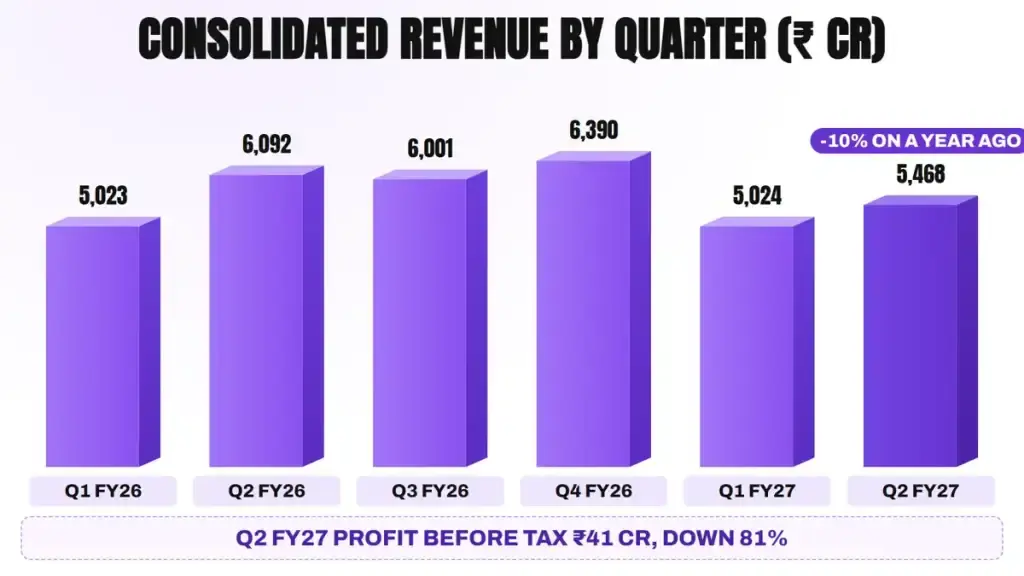
Let's look at Q2 FY27, the quarter that cost KEC much of its margin. It covers July to September, and KEC reported it on 2 November 2026. Consolidated revenue was ₹5,468 Cr, down 10% from ₹6,092 Cr a year ago, though up 9% from ₹5,024 Cr in the June quarter. For the first half, revenue was ₹10,491 Cr, down 6%.
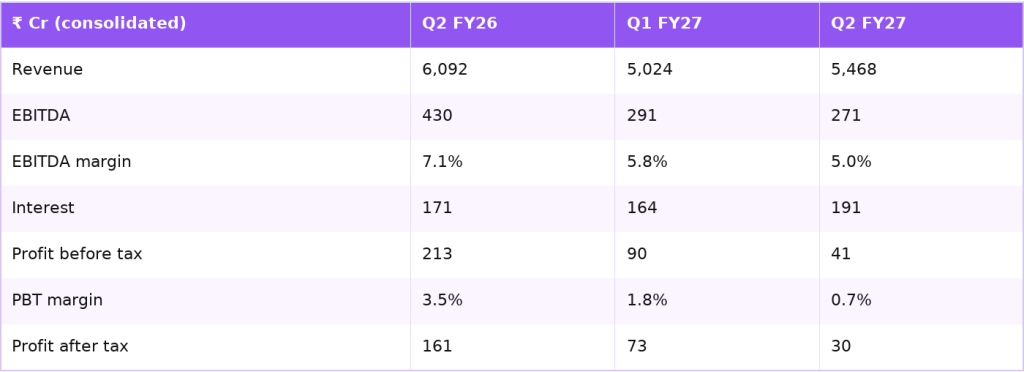
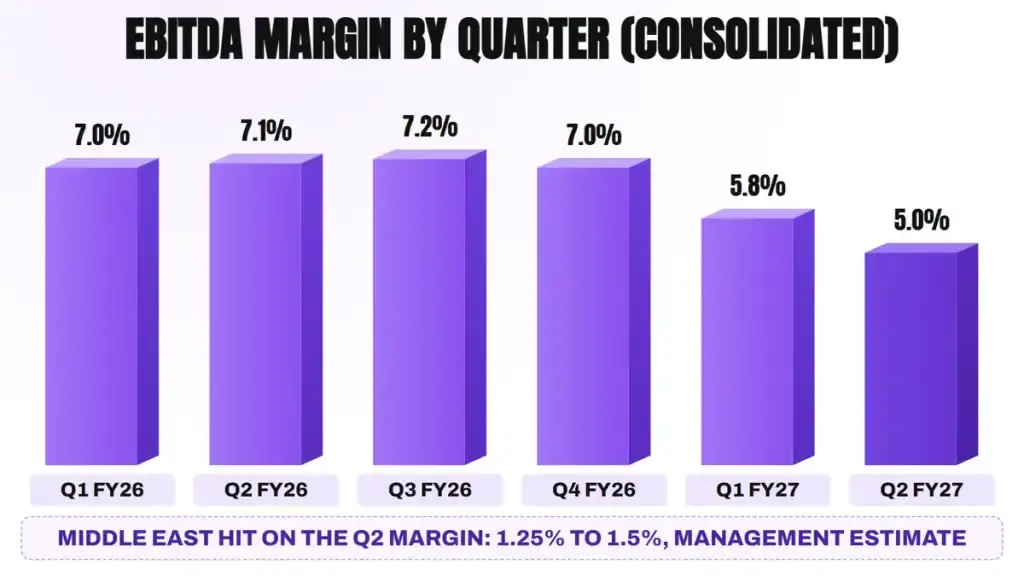
As we can see, the fall was much larger in profit than in revenue. EBITDA is the profit from the projects before interest, depreciation and tax. It fell 37% to ₹271 Cr, and the EBITDA margin fell to 5.0% from 7.1%. Interest rose 11% to ₹191 Cr, or 3.5% of revenue. So almost all of the EBITDA went into interest and depreciation, and profit after tax was ₹30 Cr, against ₹161 Cr a year ago.
So what went wrong? Management gave three main reasons. Most of the damage came from the conflict in the Middle East, which has disrupted shipping into the Gulf, raised freight and fuel costs to record levels and slowed the supply of equipment and steel. Management puts the revenue lost to it at ₹300 Cr to ₹350 Cr in the quarter, and the hit to the margin at 1.25% to 1.5%. Shipments to Afghanistan, for example, now go through Europe and Turkey at several times the earlier freight cost.
Beyond the Middle East, land in India also held back the work. Three of KEC's substation projects in India could not start because the client had not secured the land, and one of them has been stuck for more than 1.5 years. Right-of-way problems on lines and heavy rain in Gujarat and Madhya Pradesh slowed construction further. On top of that came the cost of closing old projects, mainly metros, and slow settlement of claims in the transportation and metro work.
That margin slide did not start this quarter. The EBITDA margin was 7.0% to 7.2% in each quarter of FY26, then fell to 5.8% in the June quarter and 5.0% in September. KEC has filed claims with clients for the extra costs. The clients have said they will settle them once the conflict ends, and in the meantime they have paid about ₹300 Cr as an advance to ease the cash strain.
The Debt and the Cash That Arrived in October
Now let's look at the balance sheet, which is where the quarter hurt the most. Net debt is borrowings minus cash. KEC also reports interest-bearing acceptances, which are supplier bills that banks have paid on its behalf and on which it pays interest, so it reports net debt both with and without them. Net debt with acceptances was ₹7,793 Cr on 30 September 2026, against ₹6,722 Cr in March 2026 and ₹6,480 Cr a year earlier. Without acceptances, net debt was ₹5,614 Cr. Read this Debt to Equity Ratio Explained
That rise has three causes, the company says. About ₹600 Cr of collections, mostly from the Middle East and Afghanistan, slipped into October and has since been received. It built up extra inventory to protect itself from commodity prices and shipping delays. And collections in its water and metro projects were lower than planned. In the first half, cash flow from operations was negative at ₹400.37 Cr, against negative ₹917.09 Cr in the first half of last year. Read this Cash Flow Statement Explained
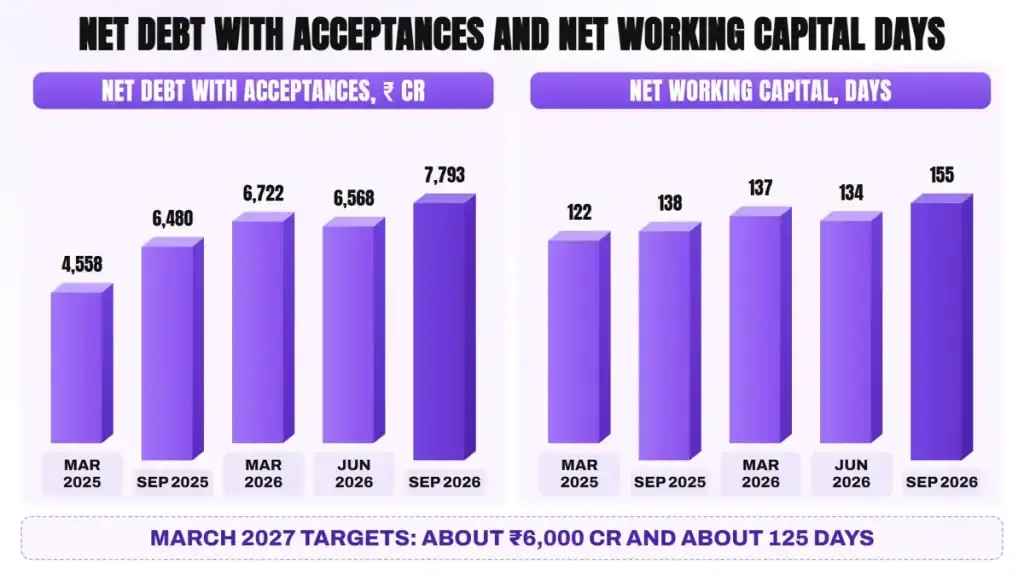
Working capital points the same way as the debt. Net working capital days is the number of days of revenue tied up in receivables, unbilled work and inventory, after taking away what the company owes its suppliers and the advances it has received. At KEC it was 155 days in September 2026, against 137 days in March 2026 and 122 days in March 2025. A large part of that is the Saudi projects, where clients hold back 20% of each bill until the work is done, and water projects under the Jal Jeevan Mission, where states have been slow to pay.
Still, some of that cash has started to come in. KEC received more than ₹200 Cr from Afghanistan in October, money that had been stuck for more than five years, and expects about ₹150 Cr more. Management expects net debt with acceptances to fall to about ₹6,000 Cr by March 2027. It also expects net working capital of about 125 days by then, against its earlier target of 110 days.
The Orders Behind the Next 18 Months
Now let's look at the orders, because in EPC they are the clearest guide to the next few years of revenue. The order book is the value of signed work not yet done. L1 means a tender where the company was the lowest bidder, so the order is likely but not yet signed.
At the end of September 2026 the order book was ₹39,946 Cr, the highest KEC has reported, against ₹39,325 Cr a year earlier and ₹36,267 Cr in March 2026. With L1 positions of about ₹3,500 Cr, the total is about ₹43,500 Cr. Management says that gives clear revenue visibility for the next 18 months. It also has tenders worth more than ₹2,00,000 Cr under evaluation or in the pipeline, more than half of them in T&D. Read this Highest Order Book Stocks in India 2026: Ranked List
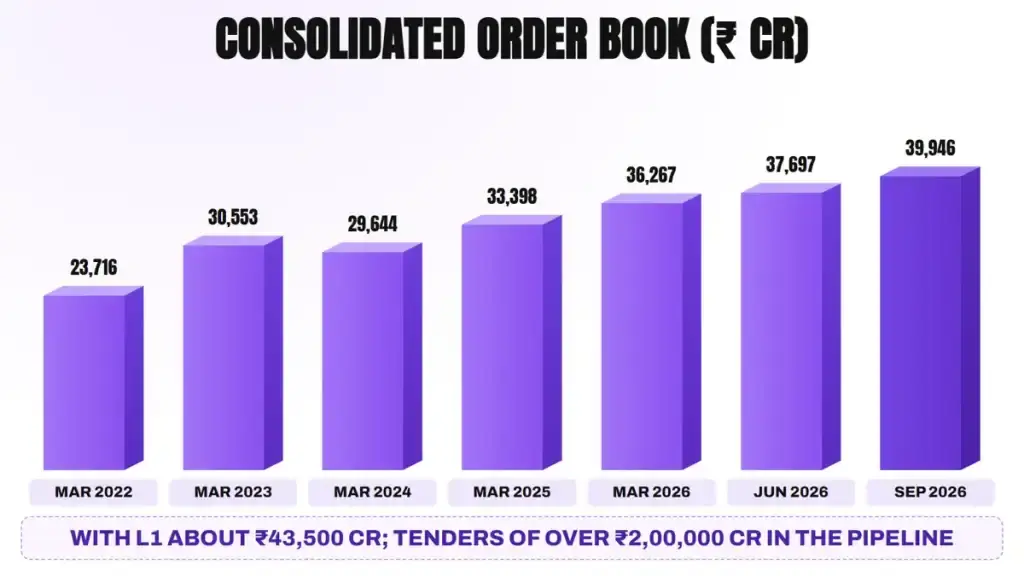
That book has grown from ₹23,716 Cr in March 2022. Read this Kalpataru Projects vs KEC International: T&D EPC Compared In H1 FY27 KEC won ₹13,528 Cr of new orders, about 70% of them in T&D. Civil and transportation together made up just 11% of new orders, against 23% of revenue, because management is now choosing its civil and railway work much more carefully.
What the order book says: ₹39,946 Cr is about 1.7 times the ₹23,506 Cr of revenue in FY26. T&D, including SAE Towers in the Americas, is about 65% of the book, and about 42% of it is outside India.
Then came the orders that matter most for the second half. After the quarter ended, KEC won orders and L1 positions of more than ₹3,000 Cr from POWERGRID, India's central transmission utility, after a gap of 15 months. They include its single largest T&D order in India, worth almost ₹1,200 Cr, and work on them starts in December 2026. Its T&D order book and L1 together are now more than ₹28,000 Cr.
How an 80-Year-Old Line Builder Grew Into Six Businesses
Now that we have seen the quarter, let's go back and see how an 80-year-old line builder grew into six businesses. Its first line projects abroad date back more than half a century, and the company has been building towers and lines for 80 years. It is now part of the RPG Group, which H. V. Goenka chairs, and Vimal Kejriwal is its managing director and CEO.
For most of those years, KEC was a tower and line company. It added a tower plant in Dubai, bought SAE Towers in the Americas, and merged RPG Cables into the company. Over the years it also moved into railways, civil construction, solar, oil and gas pipelines and, most recently, wind. The idea was to use the same project skills across more kinds of infrastructure.
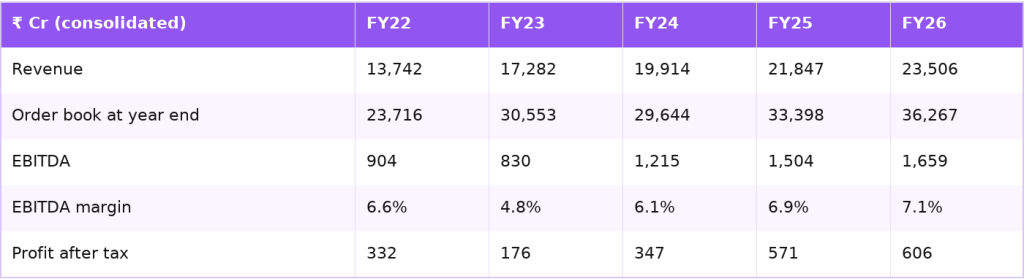
That growth came with a hard lesson. In FY22 and FY23, commodity prices and logistics costs rose sharply while KEC was working through contracts it had already priced. The EBITDA margin fell to 4.8% in FY23 and profit after tax to ₹176 Cr, even as revenue grew 26% that year. In the years after, railways and civil, the newer businesses, added costs from delayed projects and long claims.
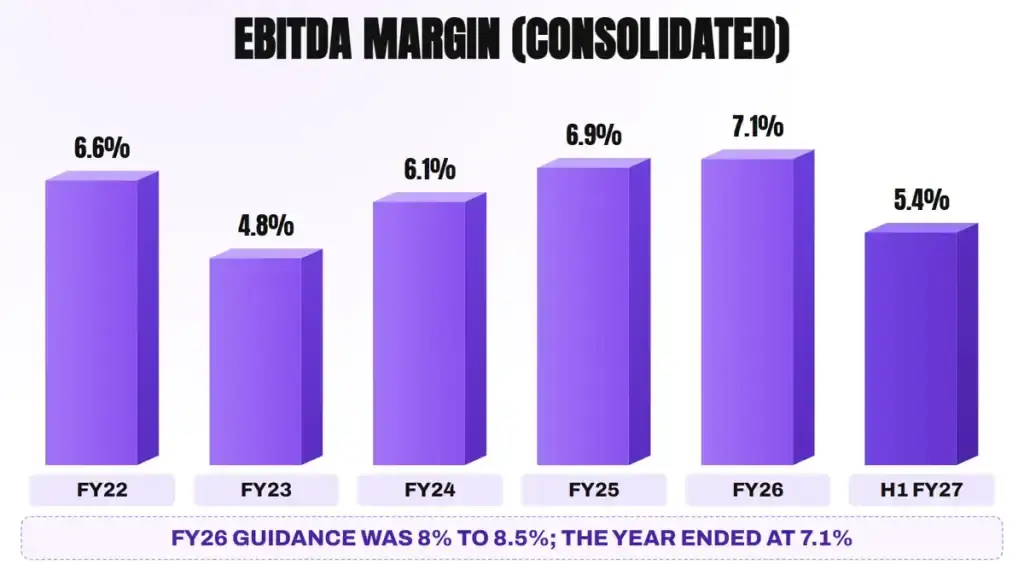
Then came the recovery, and it lasted three years. The EBITDA margin rose to 7.1% in FY26, revenue reached a record ₹23,506 Cr and profit after tax rose to ₹606 Cr. T&D grew to 68% of revenue in FY26, from 59% a year earlier. In 2024 the company also raised about $100 million from investors through a share placement to fund that growth.
Still, the recovery stopped short of where management had aimed. It had guided for an EBITDA margin of 8% to 8.5% in FY26, and the year ended at 7.1%. And the margin has now slipped back to 5.4% for H1 FY27, below even the 6.1% of FY24.
"Turnarounds seldom turn."
— Warren Buffett
KEC's margin recovery from FY23 to FY26 was real, but it stopped short of the 8% to 8.5% management had promised and then slipped back. The next few quarters will show whether the recovery resumes or stalls.
"We have not made enough money to fund that growth. So obviously, the funding of the growth has taken place by debt." - Rajeev Aggarwal, Chief Financial Officer, November 2026
Six Businesses With T&D at the Centre
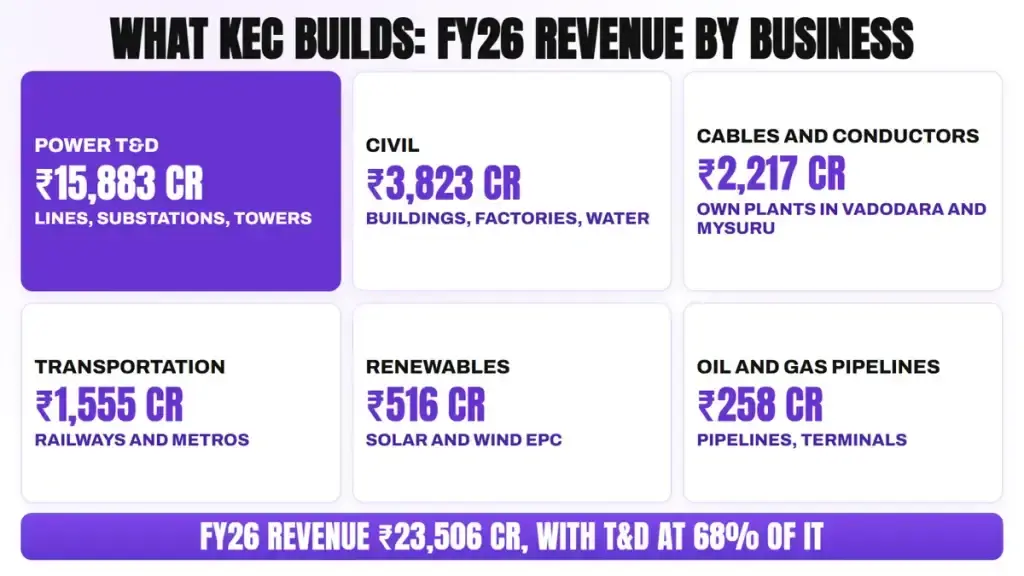
Now let's split the business into its parts, because each one has a different client, margin and cash cycle. Read this Segment-Wise Revenue Analysis Explained KEC reports six businesses, and T&D is by far the largest.
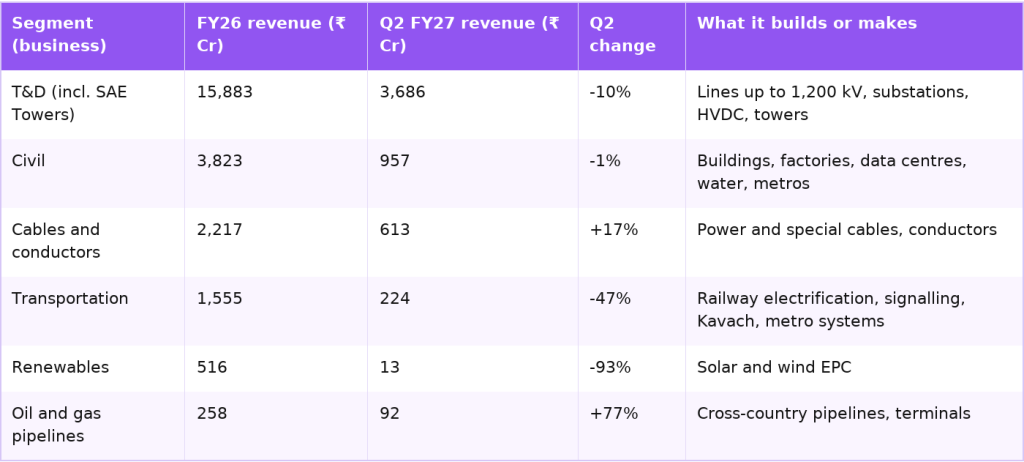
As we can see, the businesses are moving in different directions. T&D and cables are growing, while transportation and renewables shrank sharply in the quarter. Management calls its approach "shrink to grow": fewer orders in civil and railways, and more in T&D.
T&D, the Core of the Company
Let's start with T&D, the core of the company, which brought in ₹15,883 Cr of revenue in FY26, up 24%. In Q2 FY27 its revenue fell 10% to ₹3,686 Cr, but rose 15% from the June quarter. KEC builds transmission lines up to 1,200 kV, air-insulated substations up to 1,150 kV and gas-insulated substations up to 765 kV, and has built HVDC terminal stations.
That work runs on its own factories. KEC has tower and structure capacity of 4,83,800 MT a year, across six tower plants, and four tower testing stations, three in India and one in Brazil. Between 70% and 80% of the towers from its India and Dubai plants go into its own projects.
Beyond India, T&D includes SAE Towers, its wholly owned subsidiary in the Americas, with plants in Brazil and Mexico. SAE sells towers, poles and hardware to other companies, mainly in the US, Mexico and Brazil. Its revenue grew 15% to ₹493 Cr in Q2 FY27. It has won more than ₹1,900 Cr of new orders so far in FY27, more than 2.5 times a year earlier, and its order book and L1 now stand at ₹3,700 Cr.
Alongside India, the Middle East is the other large T&D market. It makes up about 22% of KEC's order book and L1, and management puts the Middle East order book at about ₹9,000 Cr. It says cash flows from there have stayed stable, but new orders are taking longer to be finalised while the conflict lasts.
Civil, the Business Being Slowed Down
Next, let's look at civil, which builds homes and offices, factories and hospitals, data centres, water schemes and metro stations. Revenue was ₹3,823 Cr in FY26 and ₹957 Cr in Q2 FY27, down 1%. KEC is building more than 70 high-rise residential and commercial towers. In the quarter, a Chennai Metro Phase 2 project it built was inaugurated, and its second package there is due to be finished by March 2027.
Even so, this business has been hard to run. Labour shortages, delays in work fronts from clients and late payments in water projects all raised costs. KEC has about ₹800 Cr to ₹900 Cr of receivables in the Jal Jeevan Mission, and still has an order book of about ₹1,000 Cr to ₹1,100 Cr there. So it took only three new civil orders in FY27 so far, worth about ₹1,200 Cr, all in buildings, factories and hospitals.
Cables and Conductors, the Factory Business
Now let's move to cables and conductors, run through KEC Asian Cables, a wholly owned subsidiary. It makes power cables up to 220 kV, railway and solar cables, and aluminium conductors at two plants in Vadodara and Mysuru. Revenue was ₹2,217 Cr in FY26, up 23%, and ₹613 Cr in Q2 FY27, up 17%.
That business is still adding products. Part of a new facility for elastomeric cables and E-Beam processing has been commissioned, with production due to start in Q3 FY27, and a second phase of aluminium conductor capacity is under way, at a cost of about ₹50 Cr. Management expects cables revenue of about ₹2,500 Cr to ₹2,600 Cr in FY27, and ₹4,000 Cr or more in FY28. It says the margin in cables is now 5.5% to 6%, held down by higher polymer and freight costs.
Transportation, Renewables and Oil and Gas
Finally, let's look at the three smaller businesses. Transportation is mostly railway work. It had revenue of ₹1,555 Cr in FY26 and ₹224 Cr in Q2 FY27, down 47%, as old projects were finished and few new ones were taken. It has entered the rigid overhead catenary segment for metros with an order for Jaipur, and is bidding for Kavach train-safety and tunnel ventilation work.
Renewables had revenue of ₹516 Cr in FY26 but only ₹13 Cr in Q2 FY27, and the developers of two or three of its wind projects are struggling to acquire land. It won more than ₹1,150 Cr of new orders in FY27, including two large wind orders, and is executing solar and wind projects of more than 950 MW. Oil and gas pipelines, the smallest business, grew 77% to ₹92 Cr in the quarter on two projects in Saudi Arabia and Africa.
Where KEC Sits in the Power Value Chain
Now let's place KEC in the wider power chain. Power is made at a coal, solar, wind, hydro or nuclear plant. It then has to travel, often hundreds of kilometres, over high-voltage lines to substations near cities, where it is stepped down for the local distribution network. KEC's place is that middle part: it designs, supplies and builds the transmission lines and substations.
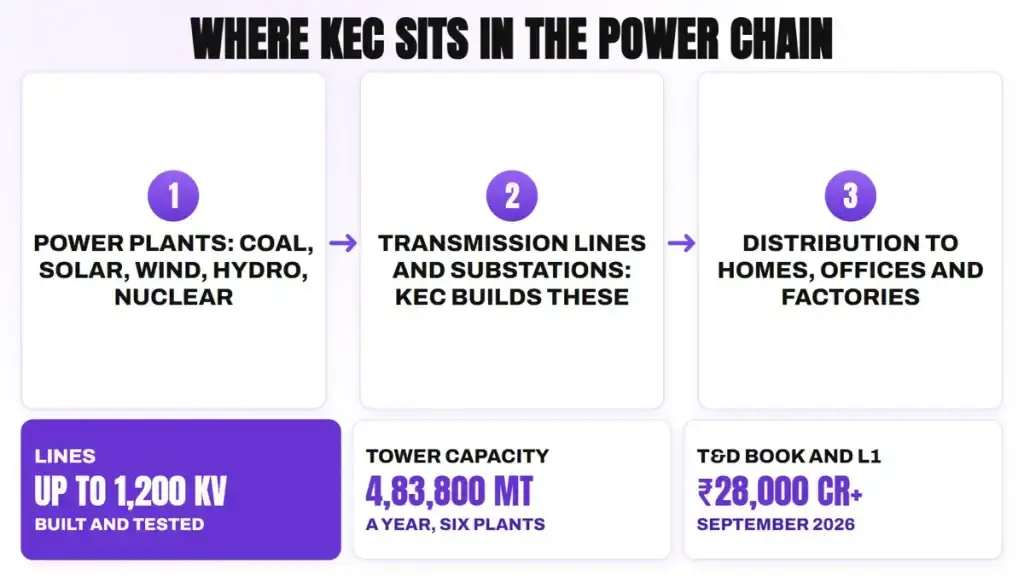
That part of the chain is getting more work because of how India's power mix is changing. Solar and wind plants are often built far from the cities that use the power, so each new renewable park needs new lines to carry its power. Management points to renewable evacuation, HVDC corridors and the third phase of the green energy corridor as the main sources of new T&D work in India. It also expects new rules on land compensation for transmission lines to ease some of the right-of-way delays.
So in this chain, KEC is both a maker and a buyer. Its own plants supply much of the steel structure and cable that its sites use. Other equipment, such as transformers, comes from other makers. Its clients are the owners of the lines: POWERGRID, state utilities, private developers that win transmission projects through bidding, and utilities in the Middle East, Africa and the Americas.
Beyond lines, KEC also reaches into other parts of the power and data economy. Its renewables business builds solar and wind farms and the lines that connect them. Its civil business builds data centres, and management sees the growth of AI and data centres as a source of work for both T&D and civil.
Why KEC's Moat Is Hard to Copy
Now that we have seen the businesses, let's understand the moat. Many companies can build a line or a building. So the question is why a utility in India, Saudi Arabia or Africa should hand a large transmission project to KEC and not to a smaller, cheaper contractor.
One part of the moat is the record. Large T&D tenders ask bidders to show similar projects they have already finished, at the same voltage and in similar terrain. KEC has more than eight decades of line building behind it, a design library of more than 70 years and more than 400 engineers in eight design centres. That record lets it bid in more than 75 countries for EPC work, and win large orders like the ₹1,200 Cr POWERGRID order.
Another layer comes from owning the means of production. KEC makes its own towers, with 4,83,800 MT a year of capacity across six plants on three continents, and tests them at its own stations. It also makes conductors and cables, so on a POWERGRID project that includes these products it earns on both the supply and the construction. That gives it more control over time and cost on long-distance lines.
Beyond the factories, geography adds a third layer. With work across India, the Middle East, Africa, the SAARC region and the Americas, KEC is less dependent on a single country's tendering cycle. When POWERGRID orders slowed for 15 months, orders from Saudi Arabia, the UAE and the Americas filled part of the gap.
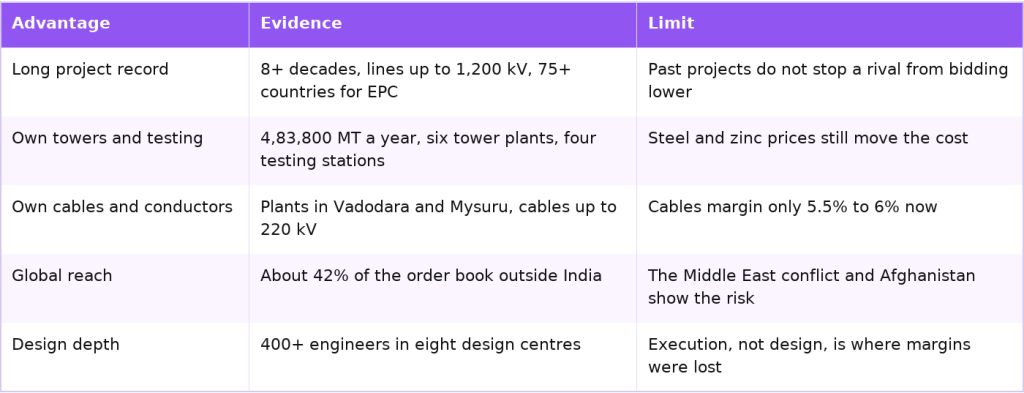
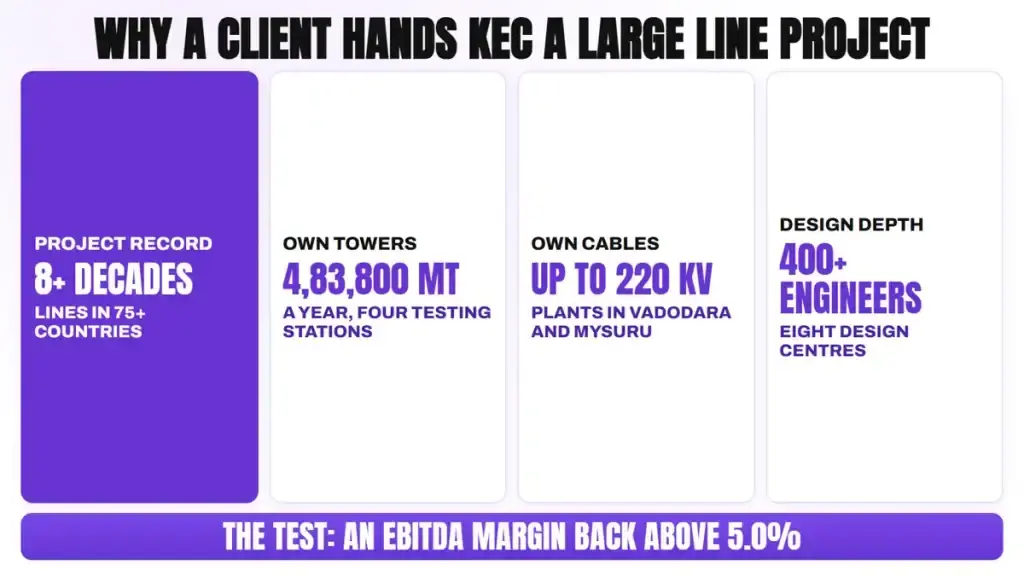
That table also shows the limits of the moat. The moat wins orders, but it has not protected the margin. The EBITDA margin has stayed between 4.8% and 7.1% in each of the last five years, and fell to 5.0% in Q2 FY27. Management agrees that the cost of closing old projects has taken 2% to 3% off the margin in recent quarters, which is why it has not been talking about a 9% or 10% margin. So the moat shows up in the order book, and much less so far in profit or cash.
"The key to investing is not assessing how much an industry is going to affect society, or how much it will grow, but rather determining the competitive advantage of any given company and, above all, the durability of that advantage."
— Warren Buffett
Transmission spending is clearly growing. For KEC, the open question is whether its record and its factories can turn that growth into steady margins and cash, and not just a bigger order book.
Financials: Five Years of Revenue, Margins and Cash Flow
One quarter can mislead in a business where projects run for two to three years, so let's look at the full years together. All figures are consolidated, as reported by the company; EBITDA here excludes other income.
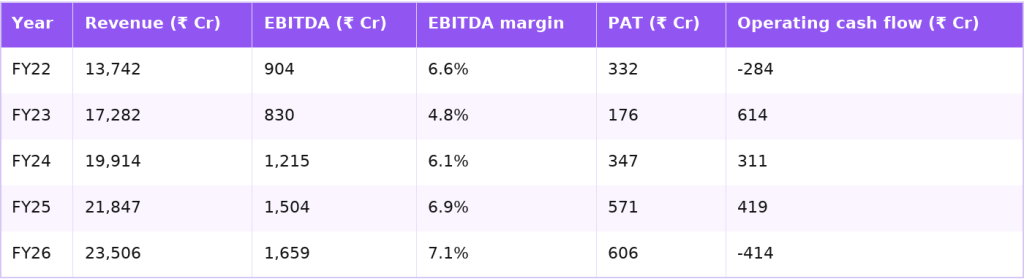
Revenue grew about 1.7 times in four years, from ₹13,742 Cr in FY22 to ₹23,506 Cr in FY26, and profit after tax rose from ₹332 Cr to ₹606 Cr. The EBITDA margin fell to 4.8% in FY23, when commodity and logistics costs jumped, and then climbed back to 7.1% in FY26. Even at that level, interest of ₹664 Cr took about 40% of FY26 EBITDA.
Cash flow is the weak spot. From FY22 to FY26, operating cash flow added up to about ₹646 Cr, against ₹2,032 Cr of profit after tax, or only about a third. It was negative in two of the five years, including FY26, when more money got tied up in Saudi retentions, water projects and stock held in the Dubai plant.
The balance sheet shows the result. Net worth rose to ₹6,160 Cr in FY26, but the debt-to-equity ratio went up to 0.9 from 0.7, and return on net worth fell to 10.5% from 12.1%. The next test is whether the cash due from the Middle East, Afghanistan and water projects arrives as planned.
"Beware of little expenses; a small leak will sink a great ship."
— Benjamin Franklin
For an EPC contractor, the leaks are interest, slow collections and the cost of closing old projects. At KEC they have taken a large share of the profit that the projects earned.
What FY27 and FY28 Could Look Like on Management's Numbers
So where does the business go from here? On 3 November 2026 management cut its FY27 revenue growth guidance to 8% to 10%, from the 12% to 15% it had given in May and repeated in August. It said it has lost about ₹600 Cr of revenue to the Middle East so far this year, and is not sure it can recover it. The growth, it says, will come mainly from India T&D, as the POWERGRID orders start in December.
Now let's put that range against the first half. FY26 revenue was ₹23,506 Cr. Growth of 8% means FY27 revenue of about ₹25,386 Cr, and 10% means about ₹25,857 Cr. H1 FY27 revenue was ₹10,491 Cr, so the second half needs about ₹14,895 Cr to ₹15,366 Cr. That is 20% to 24% more than the ₹12,392 Cr of H2 FY26, against a fall of 6% in the first half. Management expects a strong rise in revenue in the March quarter.
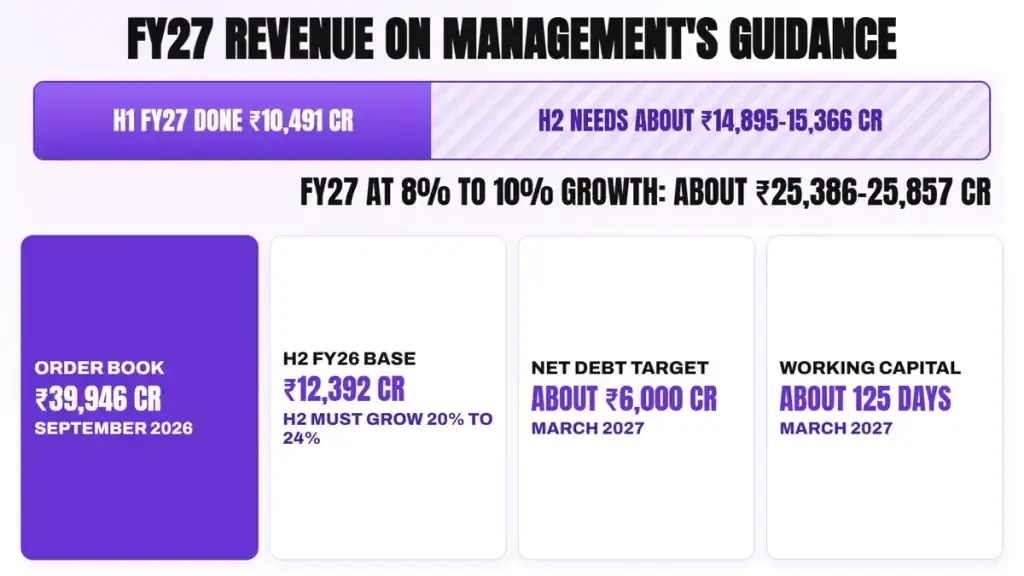
Beyond revenue, management has given no margin guidance for FY27. It says Q2 FY27 should be the lowest margin it reports, that the loss-making old projects should be closed by the second quarter of FY28, and that it expects 15 to 20 civil projects to be closed this year. It also says it does not expect to need new capital. But it has said that, at the right time, it could sell part of the cables subsidiary to an investor or through a public issue, and that the decision may come by the end of next year.
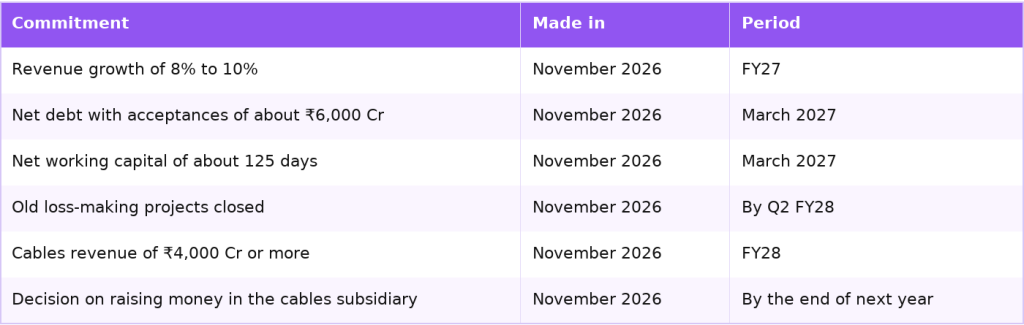
Those commitments are easier to judge against the past. So let's check what management said before against what it delivered.
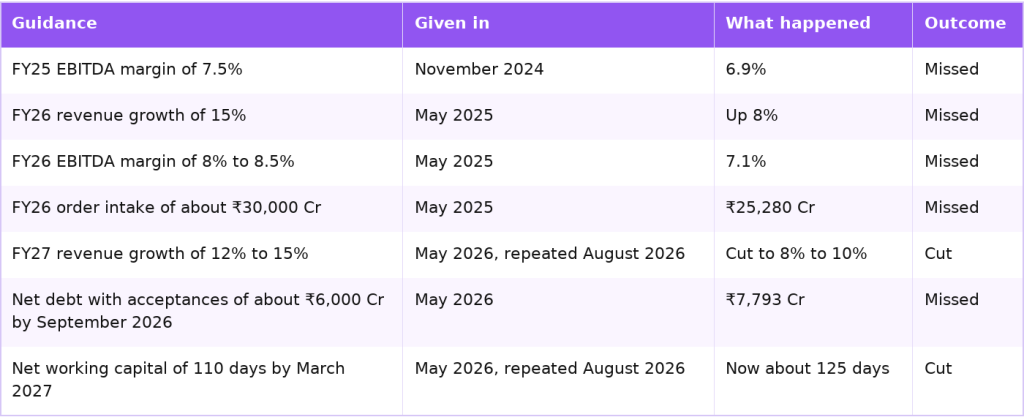
That record shows us a clear pattern, and you can see it in the table. Orders have come in, and the order book is at a record. But revenue, margin and debt targets have been missed or cut in each of the last two years, partly because of the Middle East conflict, and partly because of problems in civil, railways and water. The next two quarters will show whether the POWERGRID orders and the October collections change that pattern.
Key Risks
Now let's look at what could go wrong for KEC, because several of these risks have already shown up this year.
- Debt and working capital: net debt with acceptances was ₹7,793 Cr in September 2026 and net working capital 155 days. Interest was 3.5% of revenue in Q2 FY27. If collections slip again, the ₹6,000 Cr target for March 2027 would be missed.
- Middle East conflict: the region is about 22% of the order book and L1. Freight, fuel and supply delays have already cost revenue and margin, and the extra costs depend on claims that clients will settle only after the conflict ends.
- Water receivables: about ₹800 Cr to ₹900 Cr is due in Jal Jeevan Mission projects, and payments have come in slowly. KEC has also spent about ₹100 Cr more to finish some of these projects.
- Closing old projects: costs of closing old metro, railway and civil projects have hit the margin in several quarters. Management cannot say what the next closures will cost.
- Land and right of way in India: three substation projects have been held up because the client could not secure land. Delays like this push revenue out and raise site costs.
- Thin margin: an EBITDA margin of 5.0% leaves little room. A further rise in steel, zinc, aluminium or freight costs on fixed-price work would hit profit quickly.
- Tax and legal claims: claims against the group not acknowledged as debt stood at ₹188.22 Cr in March 2026, including ₹129.64 Cr of sales tax and VAT matters.
"My expectation is that this is the lowest number which we have got to." - Vimal Kejriwal, Managing Director and CEO, November 2026
"Risk comes from not knowing what you're doing."
— Warren Buffett
KEC knows how to build lines; its risks lie in costs it cannot control, from freight and land to state payments. The list below sets out where they could hurt.
Explore our Products
Research Framework

Emerging Titans
Combination of quantitative analysis, industry tailwinds, and management assessment - SPRINT investment philosophy

Tiny Titans
Heavy emphasis on scuttlebutt research, plant visits, and early on-ground signals
What to Track Next
If you follow KEC, these are the signals that will show where it goes next.
- FY27 revenue against the 8% to 10% growth guidance, and the March quarter in particular
- The EBITDA margin after 5.0% in Q2 FY27
- Net debt with acceptances against about ₹6,000 Cr, and net working capital against about 125 days by March 2027
- The start of the POWERGRID projects from December 2026, and new orders after ₹13,528 Cr in H1 FY27
- Middle East claims, and collections from Afghanistan and the Jal Jeevan Mission
- Any decision on raising money in the cables subsidiary
Conclusion
Let's put it all together. KEC International has grown revenue from ₹13,742 Cr in FY22 to ₹23,506 Cr in FY26, and its order book from ₹23,716 Cr to a record ₹39,946 Cr in September 2026. It has the factories, the record and the reach to keep winning large transmission orders, and POWERGRID has started ordering from it again. The cautious thread is the balance sheet, with net debt and acceptances of ₹7,793 Cr and net working capital of 155 days in September 2026. The next two quarters will show whether the October collections and the new T&D orders bring both down.
Still, the last quarter showed how much of that work has yet to turn into profit and cash. What happens next depends on whether the new T&D orders lift revenue in the second half, whether the old projects are closed on budget, and whether the cash from the Middle East, Afghanistan and water projects brings the debt down as planned.
FAQs
What does KEC International do?
+KEC International is an EPC contractor of the RPG Group: it designs, buys the materials for and builds large projects for their owners. Its biggest business is power transmission and distribution, and it also works in civil, transportation, renewables, oil and gas pipelines, and cables and conductors. FY26 consolidated revenue was ₹23,506 Cr.
How did KEC International do in Q2 FY27?
+Consolidated revenue was ₹5,468 Cr, down 10% from a year ago but up 9% from the June quarter. The EBITDA margin fell to 5.0% from 7.1%, and profit before tax fell 81% to ₹41 Cr. Management blamed the Middle East conflict, land problems in India T&D and the cost of closing old projects.
What is KEC International's order book?
+The consolidated order book was ₹39,946 Cr in September 2026, the highest it has reported and about 1.7 times FY26 revenue. With L1 positions it was about ₹43,500 Cr. After the quarter, KEC won orders and L1 positions of more than ₹3,000 Cr from POWERGRID, including its largest India T&D order of almost ₹1,200 Cr.
Where does KEC fit in the power value chain?
+KEC builds the transmission lines and substations that carry power from power plants to cities, in India and abroad. It makes its own towers, with 4,83,800 MT a year of capacity across six plants, and its own conductors and cables. It does not make or sell electricity.
What has KEC International guided for FY27?
+In November 2026 management cut its FY27 revenue growth guidance to 8% to 10%, from 12% to 15%, and gave no margin guidance. It expects net debt with acceptances to fall to about ₹6,000 Cr and net working capital to about 125 days by March 2027.
What are the main risks for KEC International?
+Net debt with acceptances was ₹7,793 Cr and net working capital 155 days in September 2026. The Middle East is about 22% of the order book and L1, and about ₹800 Cr to ₹900 Cr is due in Jal Jeevan Mission water projects. The EBITDA margin was 5.0% in Q2 FY27.

High growth stock specialist, Value Educator
Shashank Mahajan is an equity research professional with over 12 years of experience in identifying high-potential SME and micro-cap stocks at an early stage. He follows a rigorous scuttlebutt research–driven approach, combining on-ground insights with deep financial analysis. Shashank specializes in uncovering under-researched and under-owned companies with strong management quality and long-term growth potential. Through disciplined research and early identification, he focuses on spotting tomorrow’s market leaders before they enter the mainstream investor radar.
More about Shashank Mahajan →
PCBL Chemical: Carbon Black Margins and Battery Materials

Sona BLW: EV Revenue Now Tops Half of Its Auto Sales

HPL Electric & Power: Smart Meters, Wires and Two Engines

Kaynes Technology: EMS, Chip Plants and ₹10,563.5 Cr Orders

Sterlite Technologies: Glass Rods to Hyperscaler Deals
Netweb vs Black Box vs Rashi: Data-Centre Hardware Compared
Explore our Products
Research Framework
Emerging Titans
Combination of quantitative analysis, industry tailwinds, and management assessment - SPRINT investment philosophy
Tiny Titans
Heavy emphasis on scuttlebutt research, plant visits, and early on-ground signals



India's Aerospace Opportunity
Global Demand. Supply Bottlenecks. Opportunities Ahead.
Don't Miss This Exclusive Webinar!
Join Value Educator to decode the key trends shaping India's aerospace sector and learn how to identify tomorrow's potential leaders in the space.
- How the aircraft value chain works, layer by layer
- Indian companies supplying global aircraft makers
- A framework to judge any aerospace company

 Orders
 Subscription
 Share with friends


Required Details
₹23999.00
(12 month subscription)
As per SEBI regulations, all users are mandated to complete the KYC that is validated for 1 year. Post payment, you will be redirected to the KYC screen


No comments yet. Be the first to comment!