
Kaynes Technology: EMS, Chip Plants and ₹10,563.5 Cr Orders

On 31 March 2026, the Prime Minister opened a chip packaging plant at Sanand, in Gujarat. It had already shipped India's first commercially made multi-chip module, a small package that holds several chips and works as one power unit. A few weeks later the same company said this plant had revenue visibility of over ₹2,500 Cr for the next five years. And the plant was only one of its projects.
So who builds a chip plant in Gujarat? You might expect a chip designer. But it is an electronics maker from Mysuru that has spent more than 35 years building other companies' products. Its main work is called EMS, short for electronics manufacturing services. An EMS company takes a customer's design, buys the parts and builds the electronics in its own plants.
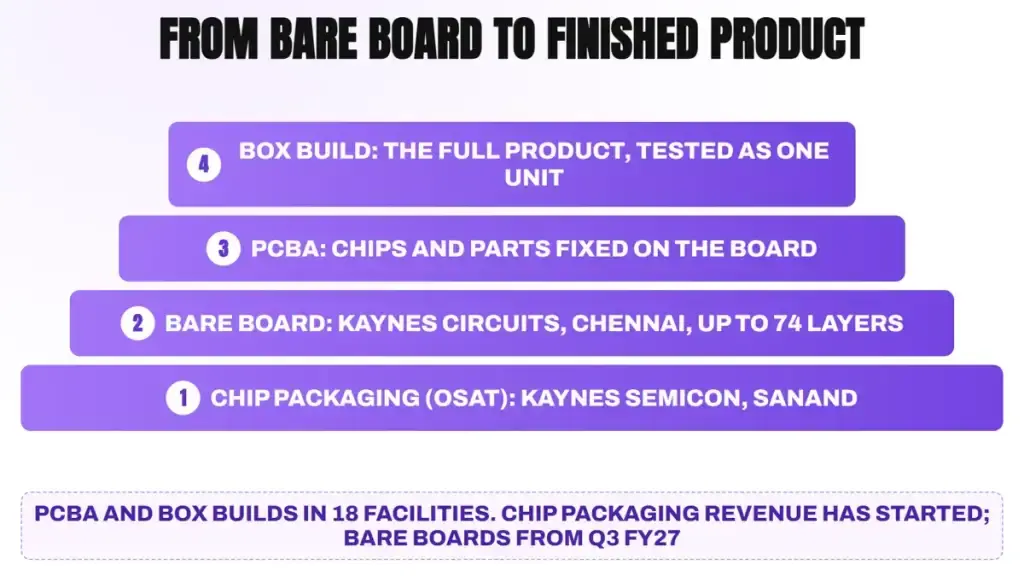
That work comes in two levels. Printed circuit board assembly, or PCBA, means fixing chips, resistors and connectors onto a bare board so that it works as a circuit. A box build is the next step up. It refers to the full product, where the boards go into a case with cables, a screen and software and are tested as one unit. A railway signal box, a factory controller or an X-ray machine are box builds.
That leaves two gaps in the chain, one below the board and one inside the chip. So the bare board itself is one gap, and India still relies on imports for many complex bare boards. The other gap is OSAT, which stands for outsourced semiconductor assembly and test. An OSAT plant takes a finished chip die, packs it into a sealed body with legs or balls and tests it before it goes onto a board. The company is now building both of those steps itself.
That company is Kaynes Technology India Ltd (NSE: KAYNES). It runs 18 manufacturing facilities and serves more than 500 customers in more than 30 countries. Its customers make cars and two-wheelers, factory equipment, trains, aircraft and medical machines, and it also makes smart meters of its own. FY26 revenue was ₹3,680.9 Cr, as restated by the company in November 2026, and its order book stood at ₹105,635 Mn in September 2026.
Kaynes Technology in five numbers
- FY26 revenue of ₹36,809 Mn at an EBITDA margin of 14.2%, as restated
- Q2 FY27 revenue of ₹9,525 Mn, up 4.4%, with core EMS revenue up 34%
- An order book of ₹105,635 Mn in September 2026, about 2.9 times FY26 revenue
- About ₹1,200 Cr spent on the chip packaging and bare-board plants by August 2026
- A target of ₹450-500 Cr of FY27 revenue from those two plants, starting in Q3
So an electronics maker with a large order book is now moving into chips and bare boards. Why, then, did its profit and cash flow look so different from its order book? Let's first understand the company, and then look at the latest quarter.
Kaynes Technology: Company Overview
Kaynes Technology India Ltd has its head office and registered office in Mysuru, Karnataka, and is listed on the NSE and BSE. It designs and builds electronics for other companies: circuit board assemblies, cable harnesses and complete box-build products for automotive and EV, industrial, railway, aerospace and defence, and medical customers. Through its subsidiaries it also makes smart meters (GridCrest Technologies), runs EMS plants in Canada and the USA (August Electronics and Digicom), and is building a chip packaging plant at Sanand (Kaynes Semicon) and a bare-board plant near Chennai (Kaynes Circuits). The group runs 18 manufacturing facilities with 26 SMT lines and serves more than 500 customers in more than 30 countries. Savitha Ramesh is the chairperson, Ramesh Kunhikannan the executive vice chairman, Dr. Muthukumar Narayanaswamy the managing director and Jairam P Sampath the whole-time director and CFO. FY26 revenue was ₹36,809 Mn, as restated in November 2026, and total equity was ₹48,256 Mn in March 2026. Net debt was about ₹1,703.1 Cr in September 2026. Read this EMS Stocks in India 2026: Electronics Makers and Order Books
"Behind every stock is a company. Find out what it's doing."
— Peter Lynch
Kaynes is three businesses under one name today: board and box-build work, smart meters, and two new plants for chips and bare boards. Each one earns and collects money in its own way, so it pays to look at them one by one.
The Quarter the Core EMS Business Carried
Let's look at Q2 FY27, the July to September quarter, when the core EMS business again carried the company. Kaynes reported it on 14 November 2026. Revenue grew 4.4% to ₹9,525 Mn, but EBITDA was 16.2% lower at ₹1,256 Mn, and profit after tax was 65.6% lower at ₹398 Mn. The year-ago figures in this section are the restated ones.

That table hides two businesses moving in opposite directions. Management said the core EMS business grew 34% in the quarter, to about ₹799 Cr from about ₹595 Cr a year ago. Smart-meter revenue was about ₹54 Cr, against about ₹228 Cr. For the first half, meter revenue was about ₹270 Cr.
That lower meter number was a choice, as it was in the June quarter. Kaynes held back meter supplies until the utilities paid and installations caught up.
"Cash is a fact, profit is an opinion."
— Alfred Rappaport
Kaynes chose to sell far fewer meters in Q2 FY27 because the buyers were paying late. Revenue was smaller, but the meter dues came down and the cash that did come in was real. Meter receivables, current and non-current together, came down to about ₹1,091 Cr in September, from about ₹1,402 Cr in June. Management says it collected more than ₹400 Cr in the half year, and that it will sell more meters once those dues are below ₹750 Cr.
"This quarter, we choose to put balance sheet strength and cash discipline ahead of short-term revenue, while continuing to invest ahead of time in the capabilities that will define Kaynes over the next decade." - Ramesh Kunhikannan, Executive Vice Chairman, November 2026
That shift also shows in the margin. Meters are sold as a product, so they carried a higher margin than EMS work. For FY26, management put the EMS margin at around 10.5% and the meter margin at around 22%. On top of that, material cost rose to about 68.0% of revenue, from about 66.7% a year ago. Copper and aluminium were at multi-year highs, and the rupee moved from about 85 to the dollar in June 2025 to around 95-96 in the quarter. Kaynes also still held the extra stock of about ₹200-250 Cr that it bought in April to keep its customers' lines running.
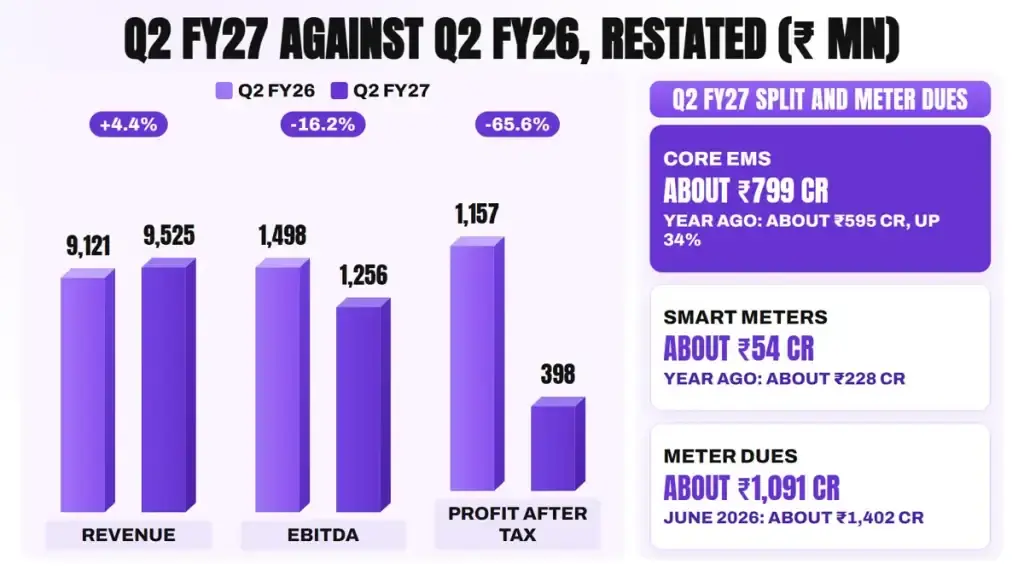
Profit moved far more than revenue, and three lines below EBITDA explain most of the gap. First, depreciation and amortisation rose by about 74.6%, to ₹347 Mn, as new plants came onto the books. Second, finance cost nearly tripled, to ₹387 Mn, as borrowings rose to fund the plants and working capital. Third, other income was ₹186 Mn against ₹341 Mn, as the money raised from investors has been spent. The tax charge was also about 38.5% of profit before tax, against about 21.9% a year ago.
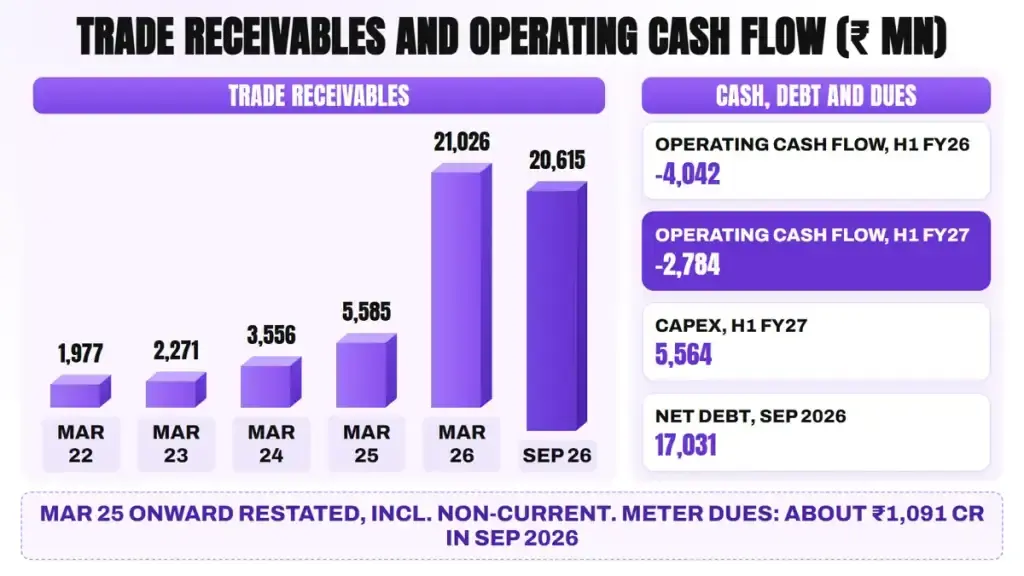
That leaves the half year as a whole. For H1 FY27, revenue grew 17.9% to ₹18,987 Mn, and EBITDA grew 3.4% to ₹2,681 Mn, at a margin of 14.1%. Profit after tax was ₹852 Mn, against ₹1,824 Mn. Net cash used in operations was ₹2,784 Mn, against ₹4,042 Mn in H1 FY26, while capex was ₹5,564 Mn.
The ₹105,635 Mn Order Book and How It Turns Into Revenue
Now let's look at the orders, because they set the pace of the next few quarters. Read this Kaynes vs Cyient DLM vs Syrma SGS: EMS Stocks Compared The order book was ₹105,635 Mn at the end of September 2026, up 30.4% from ₹80,994 Mn a year earlier. That is about 2.9 times FY26 revenue. In the September quarter the book rose by about ₹16,597 Mn, while Kaynes billed ₹9,525 Mn. So new orders were about ₹26,122 Mn in the quarter.
That book has grown in steps over two years. It was ₹41,152 Mn in March 2024 and ₹65,969 Mn in March 2025. It reached ₹90,722 Mn in December 2025 and came back to ₹83,663 Mn in March 2026, when Kaynes billed ₹12,426 Mn in a single quarter. It then rose to ₹89,038 Mn in June 2026, before the jump in the September quarter.

That link between the book and revenue is not fixed. An EMS order is a schedule, not a single shipment. The customer releases its build plan, Kaynes buys the parts, and revenue comes only when the customer's own project is ready to take the product. Management says the orders are noncancelable, but it also says some of them move when customers change their timing.
What the order book says: ₹105,635 Mn is about 2.9 years of FY26 revenue. So much of the next two years' work is already booked, but revenue still depends on when buyers take delivery.
That is why the book and the revenue line have not always moved together. A Kavach railway safety order worth about ₹300 Cr was pushed out of FY26. In November 2026, management said one Kavach product had received approval and Kaynes was now eligible for commercial production. It also said its aerospace business had grown more than 70% and its railway business more than 50%.
From Circuit Boards to Box Builds
Now that we have seen the quarter, let's go back and see how Kaynes reached this size. Its head office, research centre and two plants are in Mysuru. Over the years it moved up from boards to full products, and its customers moved with it. In FY26 its Mysuru facility alone crossed ₹10,000 Mn of revenue.

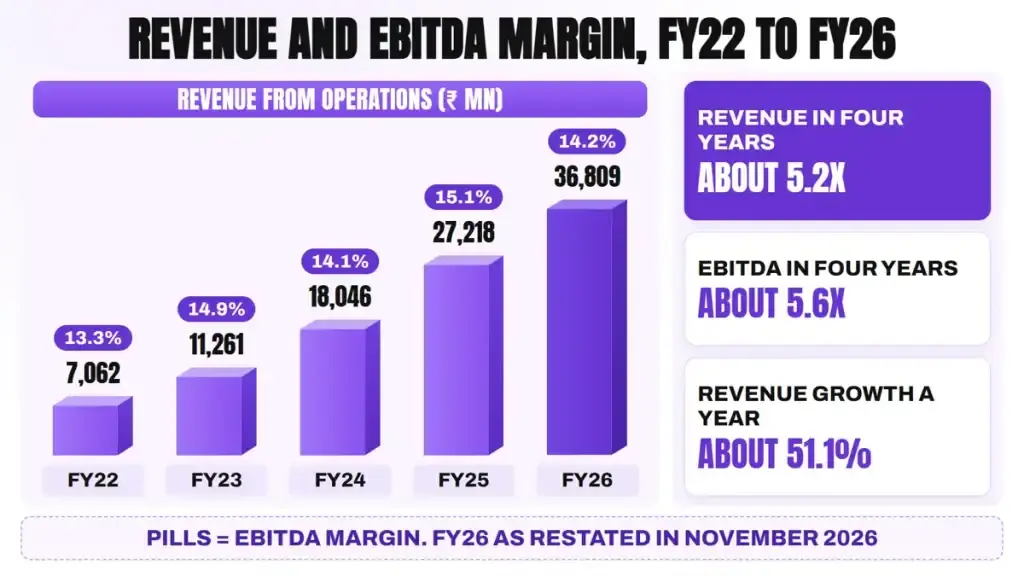
The FY26 column shows the figures as restated by the company in November 2026, while FY22 to FY25 are as first reported. On that basis, revenue grew about 5.2 times in four years, and EBITDA about 5.6 times. That is a compound growth rate of about 51.1% a year in revenue. Over the same years, the EBITDA margin moved between 13.3% and 15.1%, and it was 14.2% in FY26.
That growth came in two parts. The first part was organic, as Kaynes added box builds, design work and new customers in each vertical. The second came from two acquisitions in the last two years. One was Iskraemeco India, a smart-meter maker that Kaynes had earlier supplied with boards. It is now called GridCrest Technologies. The other was August Electronics in Canada, which gives Kaynes a plant close to North American customers such as Honeywell, Otis and Eaton.
That growth also needed outside money. After its listing, Kaynes raised more money through qualified institutional placements. In the first half of FY26 alone, it raised ₹16,010 Mn from new shares. Total equity grew from ₹24,885 Mn in FY24 to ₹48,256 Mn in March 2026, as restated. Cash flow is the part of the record that we will come back to.
Five Business Lines on One Factory Base
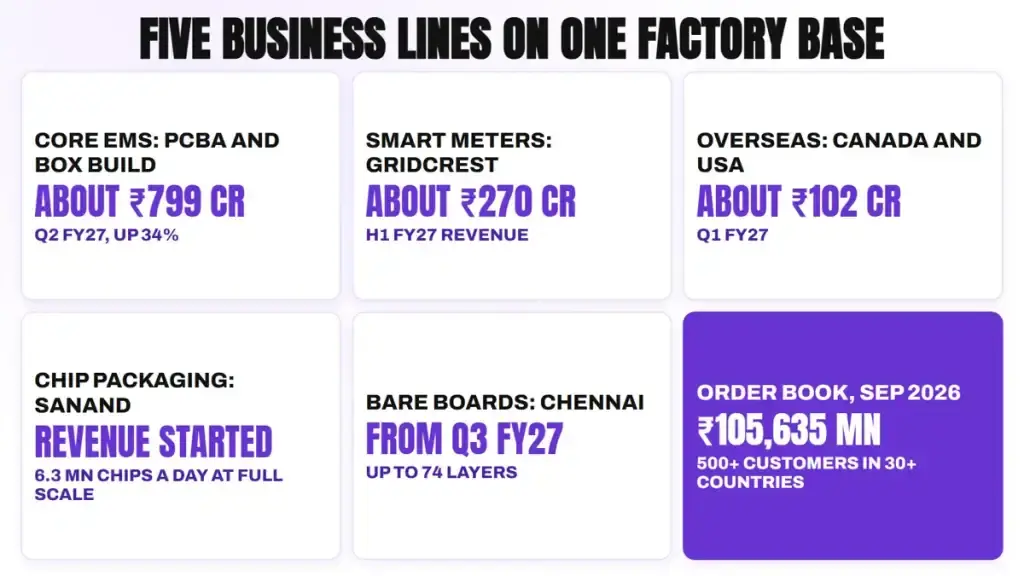
Before we come back to cash, let's split Kaynes into its business lines. The company reports a single segment, electronics manufacturing services, so we have built the split from what management said in its results discussions. Read this Segment-Wise Revenue Analysis Explained

These lines sound alike, but each one earns money in a different way. The EMS lines are paid when a built product ships. The meter line is paid partly on installation and partly over eight years of service. The two new plants sell parts that the EMS line, and other makers, will use.
PCBA and Box Builds
Let's start with PCBA and box builds, the core business that still earns most of the money. Management put FY26 EMS revenue at about ₹2,700 Cr. In Q2 FY27 the core EMS business brought in about ₹799 Cr, up 34%, and management expects the electronics business to grow more than 30% in FY27, against market growth of more than 15%.
That growth is spread across many buyers, as you can see from its recent wins. Kaynes has 26 SMT lines, which are the machines that place parts on boards, and 70 through-hole lines for larger parts. It added a large Indian electric two-wheeler maker in Q1 FY27, after finishing the product and its testing in about eight months. This quarter it also agreed a joint venture with Toyokawa Techno, in which Kaynes will hold 90%, to make thin-film transistor display modules. Kaynes already builds board assemblies for vehicle displays, so this adds the display itself.
Those customers also rate it, and we can see that in the awards. In the June quarter Kaynes received supplier awards from Mahindra and Siemens. On the rail side, its version of Kavach, India's train collision avoidance system, now has one product approved for commercial production.
That core business has also been better at collecting cash than the group. In May 2026, management said its EMS receivables were about ₹379 Cr at the start of FY26 and about ₹399 Cr at the end, while EMS revenue grew by about 30%. It also said the core EMS net working capital days had come down from 83 in FY24 to 53 in FY26.
Smart Meters at GridCrest
Next, let's look at the meter business, which was a big part of revenue and the main reason the cash flow looks the way it does. Management put FY26 meter revenue at about ₹960 Cr, about a quarter of the group.
That business works differently from EMS, as you will see. Under the government's smart-meter programme, an AMISP, or advanced metering infrastructure service provider, supplies the meters, installs them in homes and runs them for years. GridCrest took on contracts for about 35 lakh meters on this model. Payment comes only after the meters are installed and billing starts, and installation in rural areas took far longer than planned. Read this Days Sales Outstanding (DSO) Explained
So the dues built up, and Kaynes has now changed course. Meter receivables were about ₹1,252 Cr at the end of FY26, rose to about ₹1,402 Cr in June 2026 after the June quarter's supplies, and came down to about ₹1,091 Cr in September. Kaynes now plans to keep meter manufacturing and hand installation and upkeep to a partner, which would buy its meters from Kaynes at first. Management says it is at an advanced stage with a partner, and that it will share the plan with its next quarterly results.
Chip Packaging at Sanand
Now let's turn to the two new plants, starting with the chip packaging plant. The Sanand plant is built to handle 6.3 Mn chips a day at full scale. The total project cost is about ₹3,200 Cr. The central government pays 50% of the eligible cost, and the state adds 20% more, under India's semiconductor programme.
That support has started to arrive. By July 2026 Kaynes Semicon had received about ₹170 Cr of subsidy. It also signed two partnerships in Japan in December 2025. AOI Electronics brings advanced packaging know-how, and Mitsui will supply lead frames, moulding compounds and chemicals.
That plant began with power modules. Its first commercial product, an intelligent power module, went to the chip company AOS. In November 2026, management said Unit 2 of the plant was operational, several products were receiving customer approvals, and revenue from chip packaging had started.
That plant also has a new anchor customer. In November 2026, Kaynes signed a term sheet under which Vishay Intertechnology would take a 49% stake at the Kaynes Semicon level. Vishay would use about 75-90% of the plant's capacity, and the rest stays with customers whose products are already validated. Management says taking a new chip product from validation to commercial production usually takes about 12-14 months, and that Vishay's experience should make validation faster. A definitive agreement is expected in two to three months.
Bare Boards in Chennai
Next comes the bare-board plant, the second new step. HDI stands for high-density interconnect. It refers to boards with very fine lines and tiny holes, so that more connections fit in a small space. Phones, telecom gear, EVs and defence electronics use them. Kaynes Circuits has built a plant near Chennai for multilayer boards of up to 74 layers, HDI boards and flexible boards.
That plant arrives at a good time for board makers. Management says bare boards are in short supply worldwide, with lead times of six to eight months and suppliers asking for advance payment. The Phase 1 investment is ₹14,000 Mn. In August 2026, Kaynes said one large global customer had asked for the plant's entire capacity, and in November it said the plant was operational and would start billing in Q3 FY27.
"As far as PCB is concerned, our entire capacity is been requested by one large player, a global player." - Ramesh Kunhikannan, Executive Vice Chairman, August 2026
That leaves the money spent so far. Up to August 2026, Kaynes had put about ₹1,200 Cr into the two plants, about ₹700 Cr in chip packaging and about ₹500 Cr in bare boards. In Q2 FY27 it added about ₹221 Cr of capex net of subsidy, of which ₹140 Cr went into bare boards, ₹59 Cr into chip packaging and ₹21 Cr into EMS.
What Makes Kaynes Hard to Copy
Now let's ask what protects this business, and why it is hard to copy. An EMS maker does not own the product it builds. So its edge has to come from being hard to replace once a customer has approved it.
That approval is the first layer we look at.
"The key to investing is not assessing how much an industry is going to affect society, or how much it will grow, but rather determining the competitive advantage of any given company and, above all, the durability of that advantage."
— Warren Buffett
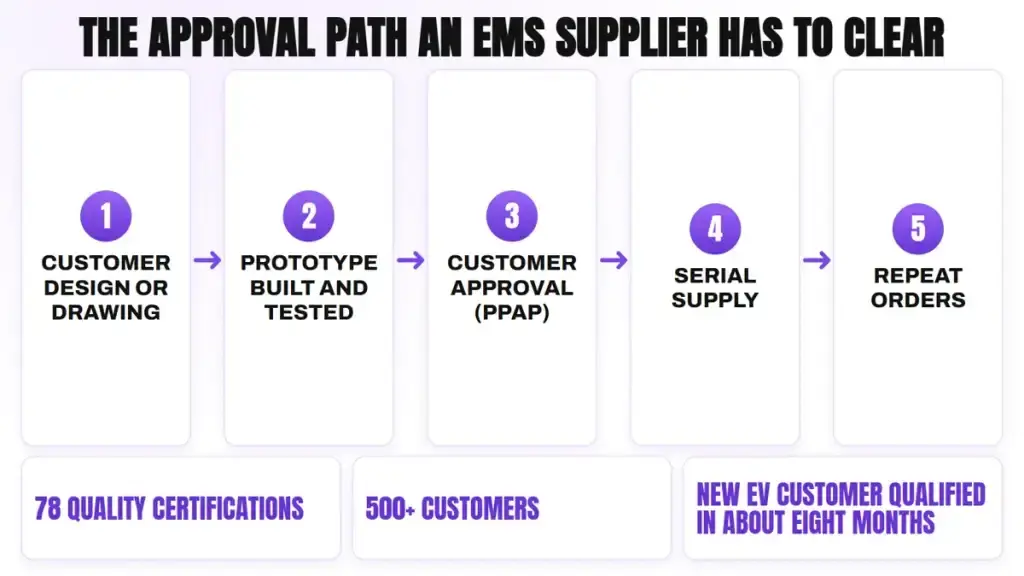
Indian electronics will grow either way. For an EMS maker, what lasts is the list of customer approvals it has earned, product by product. In automotive work, a supplier has to pass a PPAP, or production part approval process. It means the customer tests the first parts from the supplier's line and signs off on the process before serial supply starts. Aerospace, rail and medical buyers run similar checks. Kaynes holds 78 quality certifications, including aerospace and medical standards. Once a board is approved on its line, a customer has to repeat all of that to move it elsewhere. Read this Economic Moat Explained
That leads to the second layer, the range of work. Kaynes does design, board assembly, cable harnesses, plastic moulding, box builds and testing in its own plants. A customer can bring a product in as a drawing and take it out as a finished, tested unit. Railways and aerospace buyers value this, because they need one supplier to answer for the whole unit.
That range is also what the two new plants extend. Kaynes says it wants to be the only Indian company that offers board assembly, bare boards and chip packaging on one platform. If that works, it controls more of the cost of each product and more of its delivery time.
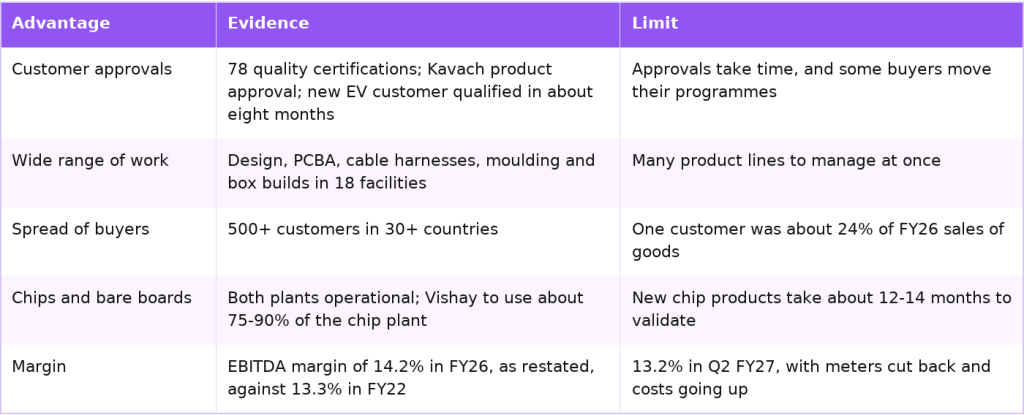
That table also shows where the moat is tested. A business that customers cannot easily replace should be able to pass on its costs. The margin over the next few quarters will show how quickly it can.
Financials: Five Years of Growth, Profit and Receivables
One quarter can mislead in a business with long build cycles, so let's look at five full years side by side. All figures are consolidated, in ₹ Cr. FY26 is shown as restated by the company in November 2026, with trade receivables including the non-current part; FY22 to FY25 are as first reported.

Revenue grew about 5.2 times in four years, from about ₹706.2 Cr in FY22 to about ₹3,680.9 Cr in FY26, and profit after tax grew about 9.4 times. Over the five years, PAT added up to about ₹1,005.1 Cr.
Receivables are the weak spot in the table. They grew far faster than revenue, to about ₹2,102.6 Cr in March 2026, and most of the FY26 jump came from the smart-meter business, where payment depends on installation. Operating cash flow was negative ₹2,784 Mn in the first half of FY27.
The balance sheet has carried that gap with new equity and, more recently, with debt. Total equity rose from about ₹203.7 Cr in FY22 to about ₹4,825.6 Cr in FY26, after the listing and the share placements that funded the new plants, while net debt was about ₹1,703.1 Cr in September 2026. Group cash flow turning positive by the end of FY27, as management has promised, is the test to watch.
"Only when the tide goes out do you discover who's been swimming naked."
— Warren Buffett
Fast growth can hide a lot. For Kaynes, the receivables line is where the meter business and the new plants show their real cost.
What FY27 and FY28 Could Look Like on Management's Numbers
So where does Kaynes go from here? Management does not give a revenue figure for the year. In November 2026 it said it expects the electronics business to grow more than 30% in FY27, about twice its market, and that the second half will be stronger in both revenue and margin.
"Our order book remains healthy, diversified, and noncancelable in nature." - Ramesh Kunhikannan, Executive Vice Chairman, May 2026
So that growth has to come mostly from EMS, with the new plants added on top, as we saw earlier. For chip packaging and bare boards together, management set a target of about ₹450-500 Cr of revenue in FY27, starting in Q3. In November it said chip packaging revenue had started, bare boards would add revenue from Q3 and both would reach full operation by Q4. It has also said the group will turn cash positive by the end of FY27.
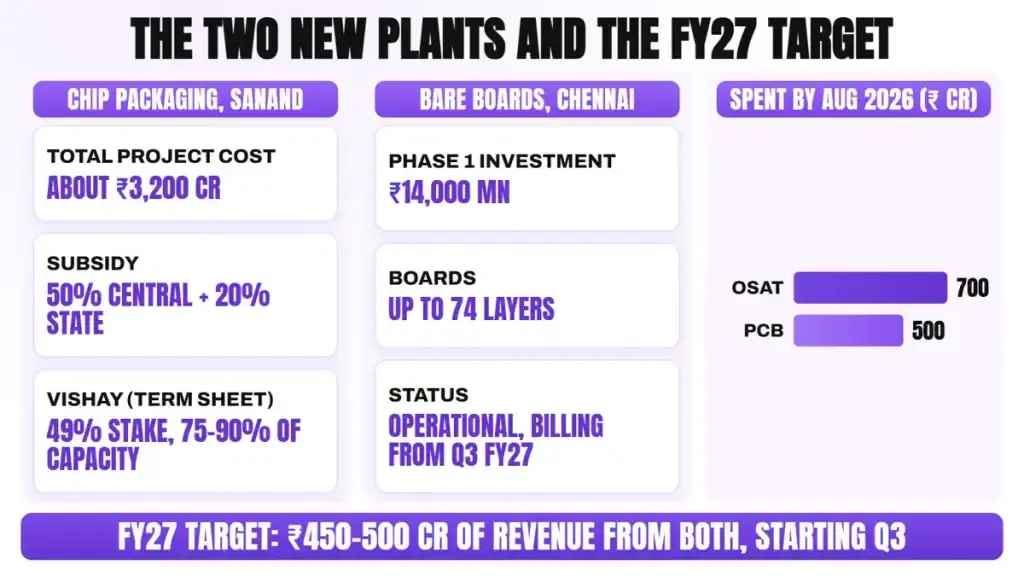
That target means both plants have to ramp quickly, and you can track that each quarter. Capex for FY27 was planned at about ₹300 Cr for chip packaging, ₹300 Cr for bare boards and ₹250 Cr for EMS. Management also plans to start releasing the extra stock of about ₹250 Cr from December, and says it will not raise money through a share placement for the next one year. A further aim is to raise exports from about 10% of revenue to more than 25% by 2030.
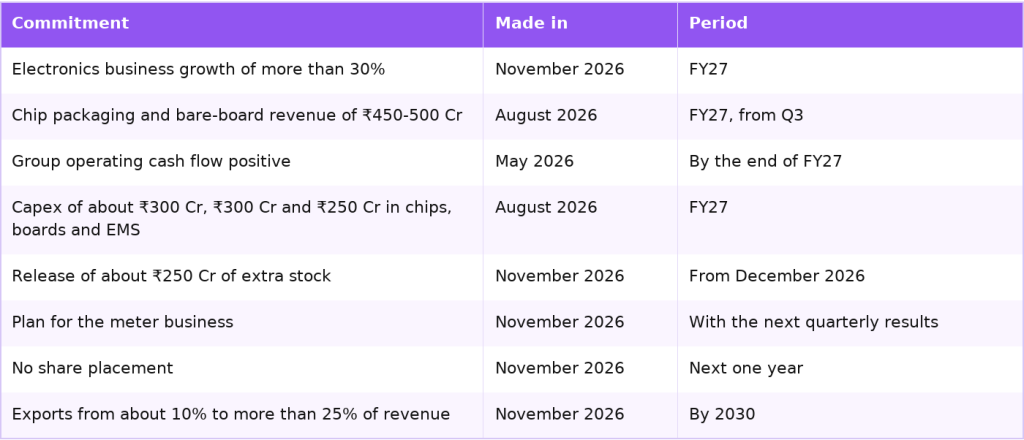
Those commitments are easier to judge against the past. So let's check what management said before against what it delivered.
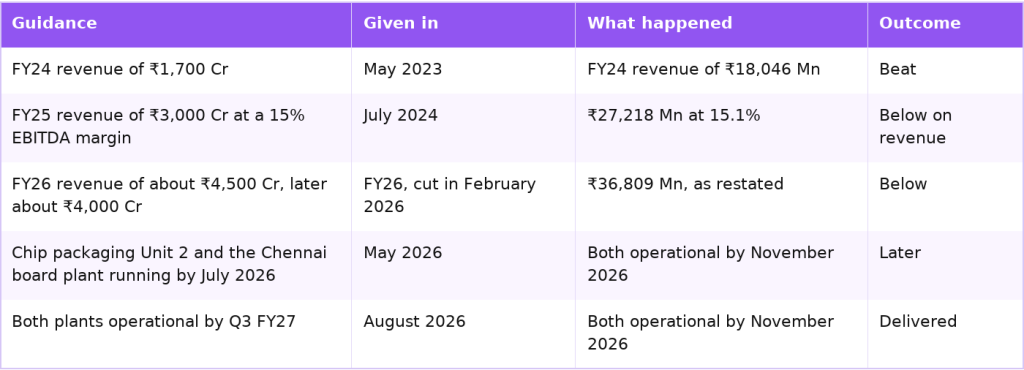
That record is mixed, as you can see. Kaynes has grown fast in every year we looked at, and it opened both new plants within the revised timeline. But its revenue and cash targets have been set ahead of what customers and utilities actually released.
Key Risks
Now let's look at what could go wrong for Kaynes Technology, because the last year has already shown several of these risks.
- Restated accounts: on 14 November 2026, Kaynes restated Q1 FY27, Q2 and H1 FY26, FY26 and its 1 April 2025 balance sheet under Ind AS 8, to correct material prior-period errors found after it moved to a new auditor, Walker Chandiok & Co LLP. Revenue had been booked on some sales before control passed to the customer, and inventory was overstated because excess overheads had been capitalised. FY26 revenue is now ₹3,680.9 Cr against ₹3,626.4 Cr first reported, mainly because one West Bengal meter contract moved to service-concession accounting, which added ₹41.8 Cr. But the FY26 EBITDA margin is now 14.2% against 15.8%. FY26 profit after tax rose to ₹392 Cr from ₹364 Cr, while Q1 FY27 profit was cut to ₹454 Mn from ₹564 Mn. Both review reports carry an emphasis of matter on the restatement, and the review conclusion is not modified.
- Earlier reporting corrections: in December 2025 Kaynes said some related-party transactions had been left out of the standalone accounts and corrected them. In May 2026 it corrected the classification of financing cash flows in its FY26 accounts. Its November 2026 press release gave the order book as ₹106,252 Mn, which the company later corrected to ₹105,635 Mn. In March 2026 its then managing director, now executive vice chairman, settled a SEBI notice under the insider trading rules.
- Receivables and cash flow: trade receivables, current and non-current, rose from ₹5,585 Mn in March 2025 to ₹21,026 Mn in March 2026, as restated, and were ₹20,615 Mn in September 2026. That is about 198 days of revenue at the first half's pace. Part of the rise comes from bills discounted with banks, which are now shown as receivables and borrowings. Net cash used in operations was ₹2,784 Mn in H1 FY27, and net working capital was 169 days on a rolling basis in September, against 163 in June.
- Debt: borrowings rose to about ₹1,809.8 Cr in September 2026, and net debt to about ₹1,703.1 Cr, from about ₹738.2 Cr in March 2026. That is about 0.35 times equity. Finance cost in Q2 FY27 was nearly three times the year-ago level.
- The meter business: payment depends on state utilities and on installation, and meter dues were still about ₹1,091 Cr in September 2026. The deal to hand over installation and upkeep is not yet signed.
- Margins: component prices rose by 15-85% for some parts, bare boards are scarce, and the rupee weakened. Costs pass through to customers with a lag, and the move away from higher-margin meters pulls the mix down. The EBITDA margin was 13.2% in Q2 FY27.
- Guidance: revenue came in below guidance in FY25 and FY26, and the FY26 target was cut once during the year. Management no longer gives a revenue figure, and in November it said some of its longer-term targets may be delayed by a couple of quarters.
- New plants: both plants are running, but their products still have to pass validation at end customers, which can take 12-14 months. The Vishay deal is so far a term sheet, and it would put about 75-90% of the chip plant's capacity with one partner.
- Customer concentration: one customer was 23.99% of FY26 sales of goods, against 13.07% in FY25. A large electric two-wheeler customer also cut its orders by about 90% in FY26.
- Tax and legal claims: contingent liabilities in the FY26 annual report include ₹130.19 Mn of income tax cases and ₹124.82 Mn of indirect tax cases, and corporate guarantees to subsidiaries of ₹23,903.60 Mn.
- Profit quality: the tax charge was about 38.5% of profit before tax in Q2 FY27, other income fell as the money raised was spent, and the share of losses from associates was ₹60 Mn in the quarter.
"After establishing all the new businesses, we were a little optimistic about their turnaround very quickly into revenues." - Jairam P. Sampath, Whole-time Director and CFO, November 2026
"Invert, always invert."
— Charlie Munger
For Kaynes, inverting means asking what would hurt most: meter dues that stay unpaid, new plants that bill later than planned, rising debt, and margins squeezed by component prices. The tracking list below shows how to watch each one.
Explore our Products
Research Framework

Emerging Titans
Combination of quantitative analysis, industry tailwinds, and management assessment - SPRINT investment philosophy

Tiny Titans
Heavy emphasis on scuttlebutt research, plant visits, and early on-ground signals
What to Track Next
If you follow Kaynes Technology, these are the signals that will show where it goes next.
- The Q3 FY27 results, and the split between core EMS and meters
- First bare-board revenue and the chip packaging ramp in Q3 and Q4 FY27, against the ₹450-500 Cr target
- Meter receivables after ₹1,091 Cr, against the ₹750 Cr level at which Kaynes says it will supply more
- The meter partner deal and the plan promised with the next quarterly results
- The definitive agreement with Vishay, expected in two to three months
- Release of the extra stock of about ₹250 Cr from December, and group operating cash flow by March 2027
- Kavach orders after the first product approval
Conclusion
Let's put it all together. Kaynes Technology has grown from a board assembler into a box-build maker with revenue of ₹36,809 Mn in FY26, as restated, and an order book of ₹105,635 Mn in September 2026. Its core EMS business grew 34% in Q2 FY27, even as meter sales were cut back. The next two quarters will show whether the meter dues come back, and whether the new plants add revenue as well as cost. At the same time, both new plants are now running, which could make it one of the few Indian companies that does bare boards, board assembly and chip packaging under one roof.
The harder part of the record is cash. The meter business still holds about ₹1,091 Cr of dues, borrowings have risen, and revenue and cash targets have been set too high more than once. What happens next depends on whether the two new plants bill as planned in Q3 and Q4 FY27, and whether the meter dues turn back into cash by the end of the year.
FAQs
What does Kaynes Technology do?
+Kaynes Technology is an electronics manufacturing services company from Mysuru. It builds circuit board assemblies and complete box-build products for automotive and EV, industrial, railway, aerospace and defence, and medical customers, and makes smart meters through GridCrest. FY26 revenue was ₹36,809 Mn, as restated.
How did Kaynes Technology do in Q2 FY27?
+Revenue grew 4.4% to ₹9,525 Mn, while EBITDA was ₹1,256 Mn at a margin of 13.2% and profit after tax was ₹398 Mn, against ₹1,157 Mn a year ago. The core EMS business grew 34% to about ₹799 Cr, while smart-meter revenue was about ₹54 Cr as Kaynes held back supplies to collect its dues. Higher depreciation, finance cost and tax took most of the profit.
What is Kaynes Technology's order book?
+The order book was ₹105,635 Mn at the end of September 2026, up 30.4% from ₹80,994 Mn a year earlier and about 2.9 times FY26 revenue. New orders in Q2 FY27 were about ₹26,122 Mn, worked out from the change in the book plus the revenue billed.
What are Kaynes Technology's OSAT and PCB plants?
+Kaynes Semicon's plant at Sanand packs and tests chips, is built for 6.3 Mn chips a day at full scale, and has started billing. Vishay has signed a term sheet to take a 49% stake at the Kaynes Semicon level and use about 75-90% of its capacity. Kaynes Circuits' bare-board plant near Chennai makes boards of up to 74 layers and starts billing in Q3 FY27. Management targets ₹450-500 Cr of FY27 revenue from the two.
Why did Kaynes Technology restate its accounts?
+After moving to a new auditor, Walker Chandiok & Co LLP, Kaynes restated Q1 FY27, Q2 and H1 FY26, FY26 and its 1 April 2025 balance sheet under Ind AS 8 on 14 November 2026, to correct material prior-period errors. Revenue had been booked on some sales before control passed to the customer, and inventory was overstated. Restated FY26 revenue is ₹3,680.9 Cr against ₹3,626.4 Cr first reported, at an EBITDA margin of 14.2% against 15.8%.
What are the main risks for Kaynes Technology?
+The main risks are meter receivables of about ₹1,091 Cr in September 2026, net debt of about ₹1,703.1 Cr, and the timing of revenue from the new plants. Component prices and the shift away from higher-margin meters weigh on the margin, which was 13.2% in Q2 FY27, and revenue came in below guidance in FY25 and FY26. One customer was 23.99% of FY26 sales of goods.

High growth stock specialist, Value Educator
Shashank Mahajan is an equity research professional with over 12 years of experience in identifying high-potential SME and micro-cap stocks at an early stage. He follows a rigorous scuttlebutt research–driven approach, combining on-ground insights with deep financial analysis. Shashank specializes in uncovering under-researched and under-owned companies with strong management quality and long-term growth potential. Through disciplined research and early identification, he focuses on spotting tomorrow’s market leaders before they enter the mainstream investor radar.
More about Shashank Mahajan →
PCBL Chemical: Carbon Black Margins and Battery Materials

KEC International: Record Orders, Weak Margin, High Debt

Sona BLW: EV Revenue Now Tops Half of Its Auto Sales

HPL Electric & Power: Smart Meters, Wires and Two Engines

Sterlite Technologies: Glass Rods to Hyperscaler Deals
Netweb vs Black Box vs Rashi: Data-Centre Hardware Compared
Explore our Products
Research Framework
Emerging Titans
Combination of quantitative analysis, industry tailwinds, and management assessment - SPRINT investment philosophy
Tiny Titans
Heavy emphasis on scuttlebutt research, plant visits, and early on-ground signals



India's Aerospace Opportunity
Global Demand. Supply Bottlenecks. Opportunities Ahead.
Don't Miss This Exclusive Webinar!
Join Value Educator to decode the key trends shaping India's aerospace sector and learn how to identify tomorrow's potential leaders in the space.
- How the aircraft value chain works, layer by layer
- Indian companies supplying global aircraft makers
- A framework to judge any aerospace company

 Orders
 Subscription
 Share with friends


Required Details
₹23999.00
(12 month subscription)
As per SEBI regulations, all users are mandated to complete the KYC that is validated for 1 year. Post payment, you will be redirected to the KYC screen


No comments yet. Be the first to comment!