
Sterlite Technologies: Glass Rods to Hyperscaler Deals

In the July to September quarter of 2025, an Indian fibre maker earned ₹1,034 Cr of revenue and kept ₹4 Cr as profit after tax. One year later, in the same quarter of 2026, the same business earned ₹2,529 Cr and kept ₹517 Cr. Over those twelve months it also signed two long-term supply deals with two of the world's largest cloud companies, worth about USD 1.11 billion and USD 1.2 billion.
That jump tells us what it sells. Optical fibre is a glass thread thinner than a hair that carries data as pulses of light. A preform is the thick rod of very pure glass that the fibre is drawn from, by heating one end and pulling it into a thread many kilometres long. Many fibres are then packed into a cable, and the cable ends are fitted with connectors so that it can plug into a rack.
Fibre makers count their output in fibre kilometres, or fkm, which means one kilometre of one fibre. That unit is why AI matters so much here. The company says a switch rack in the cloud era needed about 500 fibres, while a 72-GPU AI node needs about 12,000, heading to about 16,000 in the next designs. The buyers of these racks are called hyperscalers, which means the very large cloud companies that build and run data centres across the world. STL also tracks how much connectivity it sells with each cable, through a ratio it calls the attach rate, which means optical connectivity revenue as a share of fibre cable revenue.
That company is Sterlite Technologies Limited (NSE: STLTECH), which calls itself STL. It makes its own glass preform, draws the fibre, makes the cable and builds the connectivity products that go inside the data hall. On 31 March 2025 it moved its network-building services business, the Global Services Business, into a separate company, STL Networks Limited. So every figure in this article from FY24 onward is for STL's continuing business without that services arm, and we say so wherever older figures still include it.
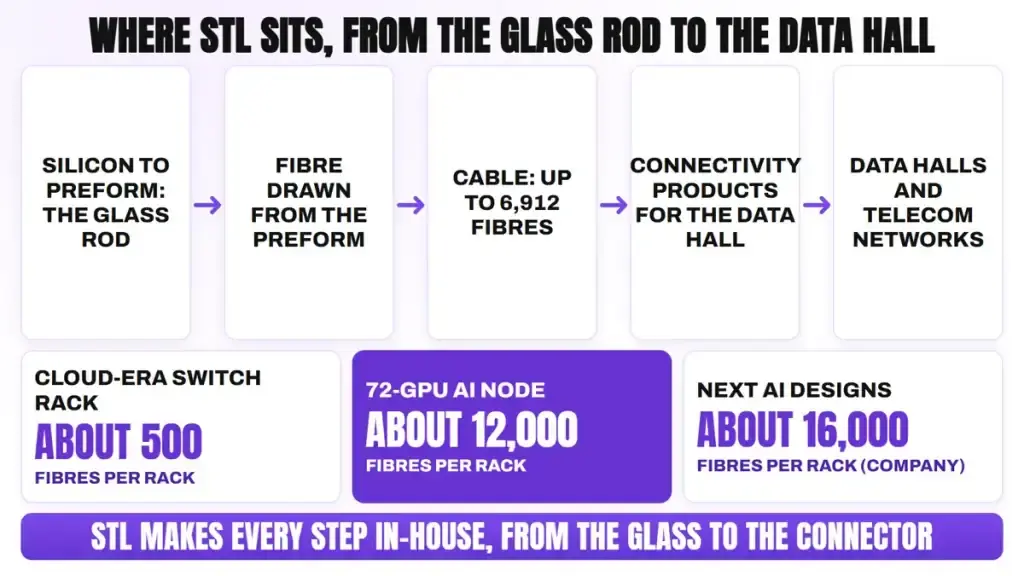
So STL sits at one clear point in the data-centre chain. It does not build the halls, the power supply or the servers. It makes the glass, the fibre, the cable and the plug-in parts that carry light between the servers, the racks and the buildings.
STL in five numbers
- Q2 FY27 revenue of ₹2,529 Cr, up 145% from a year ago
- An operational EBITDA margin of 27.1% in Q2 FY27, against 13.6% a year ago
- An open order book of ₹35,274 Cr in September 2026, from ₹7,309 Cr in March 2026
- Net cash of ₹703 Cr in September 2026, against net debt of ₹1,128 Cr in March 2026
- A target of ₹20,000 Cr of revenue in FY29 at an EBITDA margin of about 30%
So a company that earned ₹4,745 Cr in all of FY26 earned ₹4,439 Cr in the first half of FY27 alone. How did that show up in the latest numbers? Let's first understand the company, and then look at the latest quarter.
Sterlite Technologies: Company Overview
Sterlite Technologies Limited, which calls itself STL, has its registered office in Pune, Maharashtra, and has made optical fibre for more than 35 years. Anil Agarwal is the chairman and Ankit Agarwal the Managing Director, and the promoter group held 42.29% after the share placement of H1 FY27. STL makes glass preform, optical fibre, fibre cable and optical connectivity products for data centres, telecom operators, citizen networks and large enterprises, and it runs a small IT services arm, STL Digital. Its main plants are at Shendra and Waluj near Chhatrapati Sambhajinagar, with more at Dadra and Rakholi and in the US and China, and it sells in more than 100 countries. Its network services business moved to a separate company, STL Networks Limited, on 31 March 2025, so the figures here are for the continuing business. Revenue from operations was ₹4,745 Cr in FY26, and in September 2026 STL had total equity of ₹4,543 Cr and net cash of ₹703 Cr. Read this Data Centre Stocks in India 2026: Suppliers and Operators
"Behind every stock is a company. Find out what it's doing."
— Peter Lynch
STL's results changed because its buyers changed: from telecom operators to hyperscalers building AI data centres. Knowing which product line earns the money is the first step to reading its numbers.
The Quarter Revenue Rose 145%
Let's look at Q2 FY27, the July to September quarter that STL reported on 23 October 2026, when its revenue rose 145%. Revenue from operations was ₹2,529 Cr, up from ₹1,034 Cr a year ago. It was also 32% higher than the ₹1,910 Cr of Q1 FY27. The company calls it its best quarter yet, and Q1 had already been the previous best.
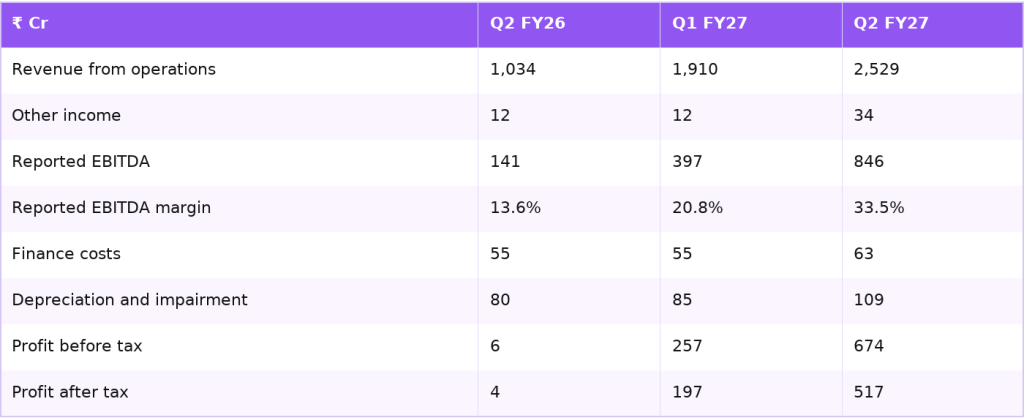
As we can see, profit grew much faster than revenue. Reported EBITDA was ₹846 Cr, but that figure includes a one-time net gain of ₹161 Cr. STL's US subsidiaries got back import tariffs that they had paid earlier in the US and charged as a cost. Leaving that out, management puts operational EBITDA at ₹685 Cr, a margin of 27.1%, which is 624 basis points above Q1. That 27.1% is the cleaner number to compare with past quarters. Read this EBITDA Explained: Uses and Limits

That chart also shows how fast the climb has been. Revenue was ₹1,257 Cr in Q3 FY26 at a margin of 10.3%, and ₹1,441 Cr in Q4 FY26 at 15.1%. Then came ₹1,910 Cr at 20.8% in Q1 FY27 and ₹2,529 Cr at 27.1% in Q2. Management links the margin to three things: plants running closer to full, a richer mix of products and customers, and a larger share of high-value connectivity products.
That margin lifted profit too. Profit after tax was ₹517 Cr, against ₹4 Cr a year ago. For the first half, revenue was ₹4,439 Cr, up 116% from ₹2,054 Cr, and operational EBITDA was ₹1,082 Cr at a margin of 24.4%. Profit after tax for the half was ₹714 Cr, against ₹14 Cr in the first half of FY26. That half-year profit is already about 12.8 times the ₹56 Cr STL earned in all of FY26.
Behind that profit is one segment. The optical networking business, which holds fibre, cable and connectivity products, earned ₹2,461 Cr in the quarter, against ₹980 Cr a year ago. Its segment EBITDA was ₹851 Cr, against ₹136 Cr. The second segment, STL Digital, earned ₹86 Cr and is still a small part of the whole.
Most of that growth came from exports and data centres. North America made up 61% of revenue in the first half of FY27, Europe 21% and the rest of the world 18%. Data centres brought in 33% of revenue in the half, and management aims to take that to 50% for the full year.
That growth showed up in cash as well. Read this Cash Flow Statement Explained Operating cash flow was ₹692 Cr in the first half of FY27, against ₹268 Cr a year earlier, and STL spent ₹257 Cr on plant and equipment. STL also raised ₹1,500 Cr through a share placement to institutions in the half, and used much of it to repay loans. Borrowings came down to ₹864 Cr in September 2026 from ₹1,827 Cr in March 2026.
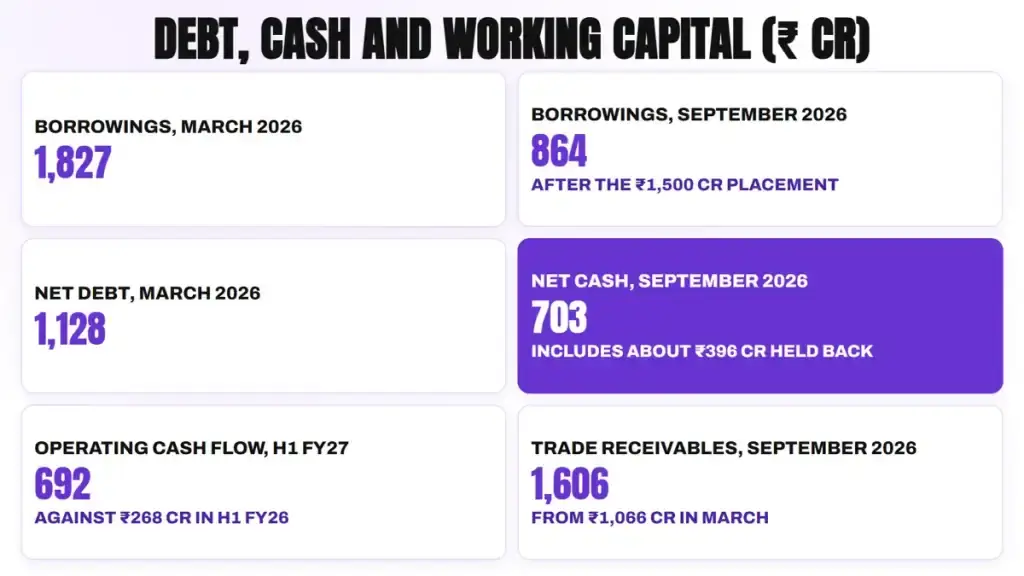
As we can see, the balance sheet changed in six months. Total equity rose to ₹4,543 Cr from ₹2,268 Cr. Management says STL now has net cash of ₹703 Cr, up from ₹483 Cr in June, and this includes about ₹396 Cr held back for a legal matter in the US. CRISIL upgraded STL's long-term rating to AA with a stable outlook, from AA-, and ICRA also rates it AA stable.
The Orders Behind the Next Few Years
Now let's look at the orders, because they show how much of the coming revenue is already booked. The open order book was ₹35,274 Cr at the end of September 2026. It was ₹18,618 Cr in June 2026, ₹7,309 Cr in March 2026 and ₹4,378 Cr in March 2025. So even after shipping ₹2,529 Cr of goods in the quarter, the book grew by about ₹16,656 Cr.

That book came from a few very large deals. In May 2026 a hyperscale partner gave STL a product award worth about USD 1.11 billion, or more than ₹10,500 Cr, for optical connectivity products from FY27 to FY29. On 1 October 2026 a second hyperscaler signed a long-term supply agreement worth about USD 1.2 billion, or more than ₹11,500 Cr, for products from calendar 2026 to 2030. In August 2026 STL also signed a USD 288 million cable deal with a leading hyperscaler and a USD 210 million deal with an international telecom infrastructure company, both for calendar 2027 to 2029.
Telecom orders came too. In August 2026 an Indian telecom operator gave STL a supply agreement worth about ₹960 Cr for optical fibre cable in FY28 and FY29. In all, STL booked orders worth ₹32,026 Cr in the first half of FY27, against ₹7,687 Cr in the whole of FY26 and ₹3,672 Cr in FY25.
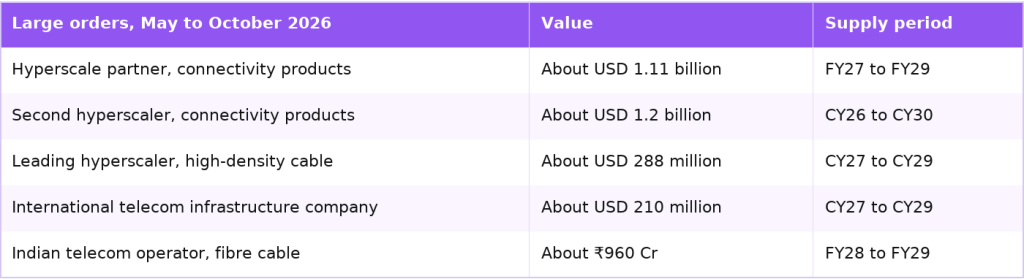
What the order book says: ₹35,274 Cr is about 7.4 times the ₹4,745 Cr of revenue in FY26. Only about ₹3,021 Cr of it is due in Q3 FY27, and the other ₹32,253 Cr is spread over Q4 FY27 and later years, so the book runs over several years, not one.
Those terms also change how each quarter is built. Management says a good part of each quarter's revenue used to come from spot orders, won and shipped in the same quarter. Now most of it comes from the scheduled backlog, and spot business is a negligible share. That gives STL steadier revenue and lets it plan its plants further ahead.
How a Telecom Fibre Maker Became a Data-Centre Supplier
Now that we have seen the quarter, let's go back and see how a telecom fibre maker became a data-centre supplier. STL has made optical fibre in India for more than 35 years. Its chairman, Anil Agarwal, has guided the company for more than 30 of those years, and Ankit Agarwal is the Managing Director. The registered office is in Pune, and the main plants are at Shendra and Waluj near Chhatrapati Sambhajinagar, with more plants at Dadra and Rakholi in India and in the US and China.
Before that change, for most of its life STL sold fibre and cable to telecom companies, and it also built whole networks for them and for government programmes through its services business. That made the group larger on paper. In FY23 the group, with services still inside, reported revenue of ₹6,925 Cr at an EBITDA margin of 13.4%. In May 2023 the board approved a plan to separate the two. The services arm moved to STL Networks Limited on 31 March 2025, and STL's shareholders received shares of STL Networks.
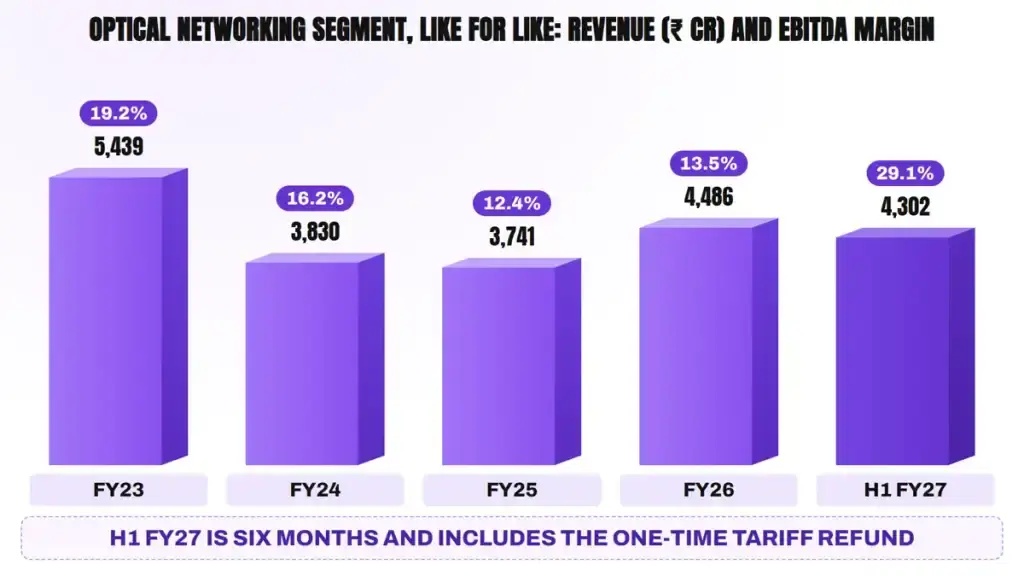
So the fair way to read STL's history is the optical networking segment alone, which reports the same business in every year.

That table shows a full cycle in one business.
"Rule No. 1: Most things will prove to be cyclical."
— Howard Marks
STL's optical business has already been through one full turn in four years. The long-term agreements are its attempt to make the next turn milder. Revenue went from ₹5,439 Cr in FY23 to ₹3,741 Cr in FY25, as fibre cable volumes went down, and the margin went from 19.2% to 12.4%. The H1 FY27 figure includes the one-time tariff refund, so its margin is a little higher than the business alone would show. Even so, the half-year revenue of ₹4,302 Cr is almost the same as all of FY26.
Those were also years of thin profit at the group level. The continuing business reported a profit after tax of minus ₹71 Cr in FY24 and minus ₹72 Cr in FY25. In both years, finance costs of ₹293 Cr and ₹241 Cr were larger than the operating profit (EBIT) of ₹213 Cr and ₹136 Cr. Net debt was ₹1,350 Cr in March 2025. Management says it spent those years cutting back on non-core areas such as wireless, and putting its effort into cable, connectivity and data centres.
That focus began to show in FY26. Revenue rose about 18.7% to ₹4,745 Cr, EBITDA was ₹628 Cr at a margin of 13.2%, and profit after tax was ₹56 Cr. Net debt came down to ₹1,128 Cr. The order book grew too, as data-centre projects in North America and long-term orders from Indian telecom companies came in. North America's share of revenue went from 25% in FY25 to 39% in FY26.
"If Q1 was historic, Q2 has raised the bar again." - Ajay Jhanjhari, Chief Financial Officer, October 2026
Two Segments and One Business Doing Most of the Work
Now let's split the business into its parts, because they are very different in size. STL reports two segments in its results. Optical networking makes fibre, cable and optical connectivity products, and STL Digital provides digital and IT services to telecom companies and enterprises.
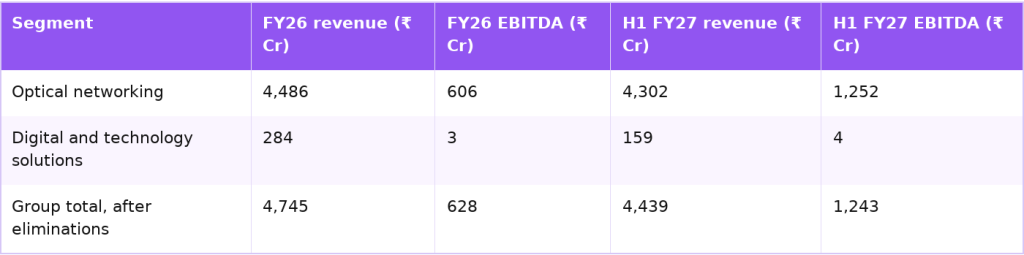
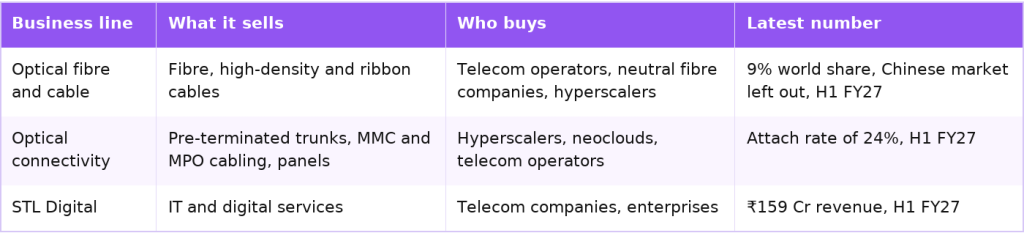
These two lines sell in very different ways. Inside optical networking, though, there are three product lines with three kinds of buyers, so let's look at those one by one.

Optical Fibre and Cable
Let's start with fibre and cable, the base of the business. STL's share of the world fibre cable market outside China went to 9% in the first half of FY27, from 7% a year earlier, on its own measure of sales volume against total demand. Its cables range from ordinary telecom cables to ribbon cables that pack up to 6,912 fibres into one jacket. Management also says it can now make cables with about 13,000 fibres.
Next comes the glass itself. STL starts from very pure silicon, turns it into silicon tetrachloride, deposits it as glass and sinters it into preform. Then it draws the fibre and makes the cable. Few fibre makers do every one of these steps in-house, and it means STL does not have to buy preform, the base of every fibre, from others. Read this HFCL vs Sterlite Technologies: Optical Fibre Compared
New fibre types sit on top of that base. Its G.654.E fibre, now fully on sale, has 30% lower signal loss, which suits long links between data centres. Its hollow-core fibre, where light travels through air in place of solid glass, offers about 30% to 47% lower latency and is now in its first commercial pilot. Its multi-core fibre carries four to seven times more data in the same space. Management expects these newer fibres to reach real scale in about 1.5 to 2 years.
Optical Connectivity and the Neuralis Range
Next, let's look at connectivity, the part that has grown the fastest. These are the products that go inside the data hall, such as pre-terminated fibre trunks, MMC and MPO cabling, fibre panels and enclosures. STL sells them for AI data centres under one name, Neuralis. The pre-terminated trunks, launched in September 2026, come built and tested in the factory, so a data centre can plug them in and go live sooner.
That range is measured by the attach rate, the ratio of connectivity revenue to fibre cable revenue. It reached 24% in the first half of FY27, up from 20% a year earlier, and management wants 25% or more this year. It is also building a new greenfield plant in India for pre-terminated products, and it supports its US buyers from a plant in South Carolina.
STL Digital
Finally, let's look at STL Digital, the smallest line. It earned ₹284 Cr in FY26 with an EBITDA of ₹3 Cr, and ₹159 Cr in the first half of FY27 with an EBITDA of ₹4 Cr. That is under 4% of group revenue. Management describes it as a business where it is building skills in technology and domain areas, and it does not drive the group's results today.
Where STL Sits in the Data-Centre Value Chain
Now let's place STL in the wider data-centre chain. A data centre needs land, power, cooling and racks before a single server goes in. Then come the servers, the GPUs and the network that joins them. STL's place is the passive part of that network: the glass, the fibre, the cable and the connectors that carry light between racks, halls and campuses.
That part has grown with AI in three ways, which the company calls scale-out, scale-across and scale-up. Scale-out means more fibre between racks, from about 500 fibres per switch rack to about 12,000. Scale-across means more links between buildings: two data centres need one link, but six need as many as 15. Scale-up means fibre inside the GPU rack, because copper reaches its limits as speeds move from 400 gigabits to 800 gigabits and then to 1.6 terabits.
That demand shows in the forecasts too. The company's deck puts world data-centre capacity at about 82 gigawatts in 2025, and about 219 gigawatts by 2030, with more than 70% of demand from AI. CRU, an industry research firm, now expects fibre demand from data centres to grow 89% in 2026, up from the 63% it expected a quarter earlier. It also expects world optical cable demand of about 851 million fkm by 2031, a growth of about 7.5% a year.
Beyond the US, India is building too. The company puts India's live data-centre capacity at about 1.8 gigawatts, after a record 258 megawatts was added in the first half of FY27. It expects that to grow to about 10.5 gigawatts by 2031. Management says STL already supplies almost all the major hyperscalers abroad, so it can follow the same buyers as they build in India.
Alongside data centres, telecom still matters. Fibre carries data from the data centre to the user, and STL also sells to telecom operators building fibre to homes, 5G networks and government programmes such as BharatNet in India and BEAD in the US. So STL sells into both ends of the same data flow, from the AI cluster to the home.
Why STL's Moat Is Hard to Copy
Now that we have seen the parts, let's understand the moat. Fibre itself can look like a commodity, since many companies around the world make it. So the question is why two hyperscalers would sign multi-year agreements with STL, and not simply buy from whoever is cheapest each quarter. Read this Economic Moat Explained
One part of the moat is the glass. STL makes its own preform, which management calls the backbone of optical fibre. A fibre maker without its own preform has to buy it from others, at a time when the company says demand is running ahead of fibre and preform supply. STL controls that step, and it calls this full chain "Glass to Gigabit".
Another layer comes from the designs. STL holds more than 805 patents filed and granted, with 49 new filings in Q2 FY27 alone. It makes cables of up to 6,912 fibres today and says it can make about 13,000. A buyer has to test and approve each new cable and connector design before it goes into a data hall, and that work takes time to repeat with a new supplier. In Q2 FY27 STL also won a patent case in Europe over its IBR cable family.
"The key to investing is not assessing how much an industry is going to affect society, or how much it will grow, but rather determining the competitive advantage of any given company and, above all, the durability of that advantage."
— Warren Buffett
Fibre demand is growing fast, but that alone does not decide STL's returns. What matters is whether its own glass, its designs and its customer ties keep buyers coming back.
Beyond the product, customer ties add a third layer. The two hyperscaler agreements run for three to five years, and purchase orders under them are released through the period. Management says it now works with customers early in the design cycle, so that STL's products are built into the customer's own plan for the data hall. It also says it sells in more than 100 countries, and that its order book is spread across data centres, telecom operators and neutral fibre companies.
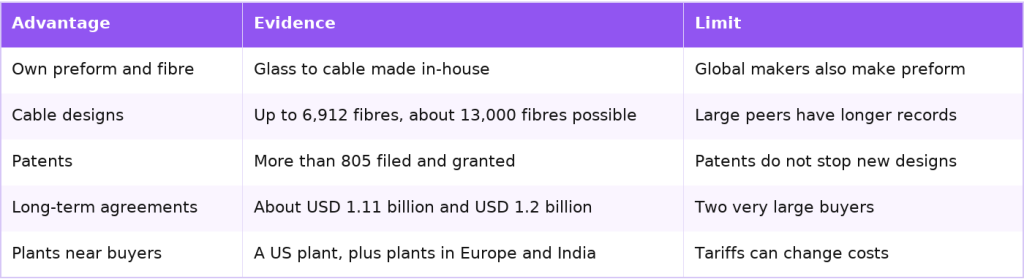
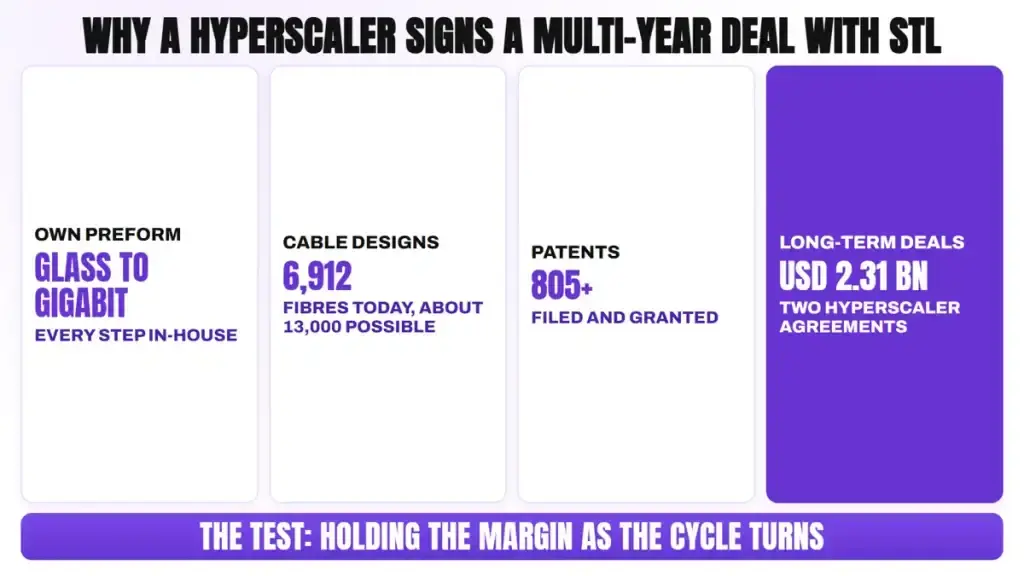
That table shows us why the margin is the real test of the moat. If buyers value the designs and the steady supply, STL should hold a high margin even as new fibre capacity comes up around the world. So far it has: the operational margin went from 13.6% in Q2 FY26 to 27.1% in Q2 FY27.
Financials: Two Flat Years, Then the Data-Centre Orders
One quarter can mislead in a business where a few large orders move the numbers, so let's look at the full years together. FY22 and FY23 are as reported then, with the services business still inside and profit from continued operations; FY24 onward are STL's continuing business without services. EBITDA includes other income, as STL reports it, and the first half of FY27 is shown for comparison.

The first two rows and the last four are different companies on paper, so part of the gap between ₹6,925 Cr in FY23 and ₹4,083 Cr in FY24 is the services business leaving the numbers, and part is lower fibre cable sales. On a like-for-like basis the continuing business went from ₹4,083 Cr in FY24 to ₹4,745 Cr in FY26, with an EBITDA margin between 11.3% and 13.2%. Finance costs of ₹293 Cr in FY24 and ₹241 Cr in FY25 were larger than operating profit, which is why those years show a loss.
Cash flow was better than profit in FY26. Operating cash flow was ₹520 Cr against a profit after tax of ₹56 Cr, and capex was ₹193 Cr, so net debt came down to ₹1,128 Cr from ₹1,350 Cr. ROCE, as the company measures it, went to 9.4% from 3.3%.
The first half of FY27 looks different again. The H1 EBITDA of ₹1,243 Cr includes the one-time ₹161 Cr tariff refund; operational EBITDA was ₹1,082 Cr at 24.4%. Operating cash flow was ₹692 Cr against a profit of ₹714 Cr, while receivables rose to ₹1,606 Cr. With the ₹1,500 Cr placement, STL turned from net debt to net cash of ₹703 Cr, just as about ₹3,000 Cr of capex begins.
"Beware of little expenses; a small leak will sink a great ship."
— Benjamin Franklin
For STL the leak was interest: finance costs ate the operating profit in FY24 and FY25. With borrowings now down to ₹864 Cr, more of the operating profit can reach shareholders.
What FY27 to FY29 Could Look Like on Management's Numbers
So where does the business go from here, on management's own numbers? In September 2026 STL laid out a plan it calls Lakshya, which means target in Hindi. It aims for ₹20,000 Cr of revenue in FY29, about 4.2 times the ₹4,745 Cr of FY26, and to be among the top five optical connectivity companies in the world. On 23 October 2026 management raised the FY29 EBITDA margin target to about 30%, from 27% earlier, and kept the revenue target.

Now let's put that target against the first half. H1 FY27 revenue was ₹4,439 Cr, so reaching ₹20,000 Cr in FY29 still needs revenue to grow a lot more over the next two and a half years. Management says the order book gives it stronger visibility on these targets than it had when it announced them. It also says it wants to deliver margins at or above the Q2 level from Q3 onward.
Beyond revenue, capacity sets the pace. On 3 September 2026 the board approved a plan to raise preform, fibre and cable capacity by about 50% by the end of FY29, at a cost of about ₹3,000 Cr. That is about ₹1,000 Cr a year from FY27 to FY29, from internal cash and debt, and it includes the new greenfield plant for pre-terminated products. STL did not disclose its existing capacity, but said its plants ran at about 70% of it.
That spending comes with a research budget too. STL plans to put about 2% of its yearly revenue into research and development. Management also says it is working on co-packaged and near-packaged optics, where fibre connects closer to the chip itself.
Beyond capacity, margins have their own guide. Management expects data centres to make up about 50% of revenue in FY27, and it wants that share to stay at 50% to 60% so the customer base stays spread out. It says data-centre products earn higher margins than telecom products, so the mix itself should lift the margin. It also expects finance costs to come down from Q3 FY27, after it paid off some loans early in Q2.
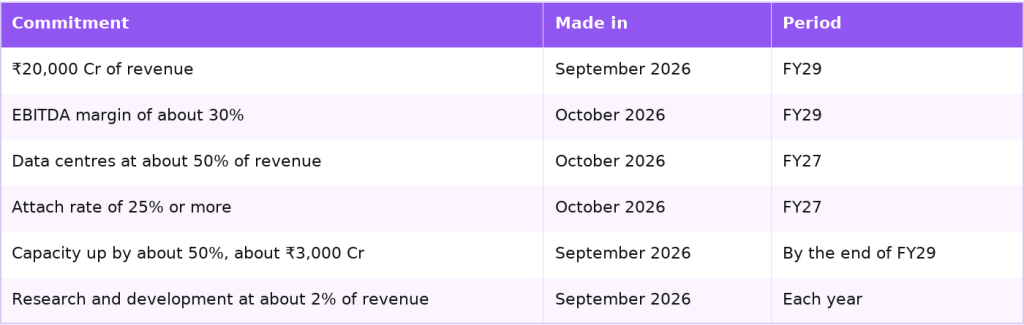
Those commitments are easier to judge against the past. So let's check what management said before against what it delivered.
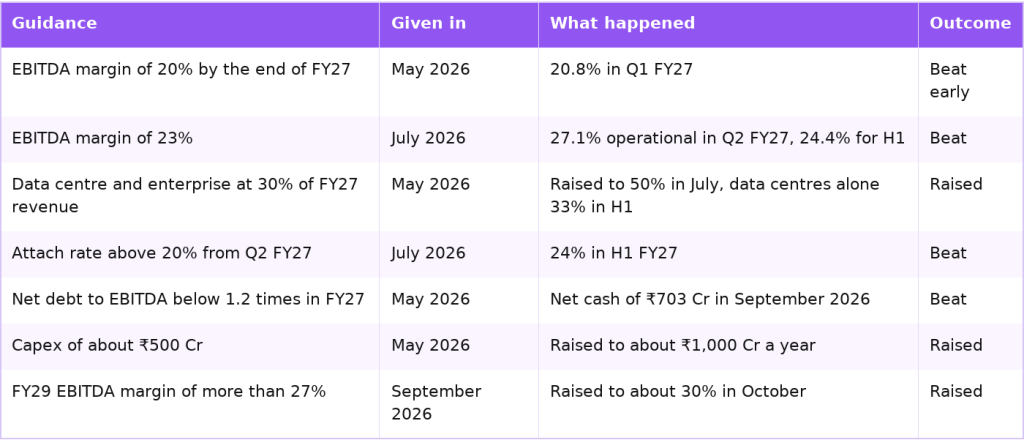
That record shows us a clear pattern. In the last two quarters, every margin and mix target was met early and then raised. The open question is no longer whether the targets are high enough, but whether plants, raw materials and buyers keep pace with them.
Key Risks
Now let's look at what could go wrong for STL, because some of these risks are already visible in the numbers.
- A few very large buyers: two hyperscaler agreements worth about USD 1.11 billion and USD 1.2 billion make up a large part of the ₹35,274 Cr order book. The USD 1.2 billion value is an estimate based on current selling prices, and purchase orders under both are released through the period. The agreements cap what each side owes if demand or supply falls short, so a buyer that cuts its AI spending could take less.
- A one-time gain in the quarter: reported EBITDA of ₹846 Cr included a ₹161 Cr tariff refund that will not repeat. Q2 FY27 also carried an impairment of ₹22 Cr on plant and equipment and ₹39 Cr of impairment losses on financial and contract assets.
- A US court case: a US jury found against STL's US subsidiary in a case brought by Prysmian, and the court confirmed an award of USD 101.25 million in August 2025, including USD 4.75 million of fees and costs. The subsidiary has appealed and deposited a bond of USD 41.53 million, and about ₹396 Cr of the net cash is held back for this matter.
- Raw materials: germanium, used in making the glass, and helium, used in drawing fibre, have been in short supply, and polyethylene cost moves with oil prices. Management says the war in West Asia raised helium and polymer costs.
- Receivables and working capital: trade receivables rose to ₹1,606 Cr in September 2026 from ₹1,066 Cr in March, and working capital took ₹441 Cr of cash in the first half. Management aims to keep net working capital at 45 to 50 days.
- Capacity on time: the plants already run at about 70% of capacity, and the 50% addition is due only by the end of FY29. If orders arrive faster than the new lines, deliveries could slip.
- The fibre cycle: this business has moved in cycles before, and the optical segment went from ₹5,439 Cr of revenue in FY23 to ₹3,741 Cr in FY25. A turn in fibre demand would hit both volume and price.
- Project delays at buyers: management says data-centre builders face local problems with land, power, water and local opposition, which can delay when they take delivery.
"So I think at a macro level, the investment plans continue to grow and scale up, but there will be execution challenges from time to time." - Ankit Agarwal, Managing Director, October 2026
"Only when the tide goes out do you discover who's been swimming naked."
— Warren Buffett
For STL, the tide is hyperscaler spending on AI. The list below sets out what would show if it went out: a few large buyers, raw materials, a US court case and the cash tied up in receivables.
Explore our Products
Research Framework

Emerging Titans
Combination of quantitative analysis, industry tailwinds, and management assessment - SPRINT investment philosophy

Tiny Titans
Heavy emphasis on scuttlebutt research, plant visits, and early on-ground signals
What to Track Next
If you follow STL, these are the signals that will show where it goes next.
- The operational EBITDA margin after 27.1%, now that the tariff refund is out of the base
- Revenue against the ₹3,021 Cr of the order book due in Q3 FY27
- The data-centre share of revenue against the 50% aim for FY27
- Receivables, net cash and finance costs after the ₹1,500 Cr placement
- Progress on the 50% capacity addition and the new pre-terminated products plant
- The US appeal in the Prysmian case
Conclusion
Let's put it all together. STL spent FY23 to FY25 watching its optical revenue go from ₹5,439 Cr to ₹3,741 Cr while it separated its services business. In the first half of FY27 it earned ₹4,439 Cr at an operational EBITDA margin of 24.4%, as hyperscalers signed multi-year agreements, and its open order book reached ₹35,274 Cr. The cautious thread is that most of this book rests on two buyers and on purchase orders that are released over time, and that fibre has moved in cycles before. The next two quarters, without the tariff refund, will show the margin the business earns on its own.
Still, the next step depends on more than one strong half year. What happens next depends on whether the two hyperscaler agreements turn into steady purchase orders, whether the new capacity arrives on time, and whether the margin holds without one-time gains.
FAQs
What does Sterlite Technologies do?
+Sterlite Technologies, or STL, makes glass preform, optical fibre, fibre cable and optical connectivity products such as pre-terminated trunks for data centres and telecom networks. It also has a small IT services arm, STL Digital. FY26 revenue from operations of the continuing business was ₹4,745 Cr.
What is STL Networks and how does it affect STL's numbers?
+STL moved its network services business, the Global Services Business, into STL Networks Limited on 31 March 2025, and STL's shareholders received STL Networks shares. So STL's figures from FY24 onward cover only the continuing optical and digital business, while FY22 and FY23 as reported still include services.
How did Sterlite Technologies do in Q2 FY27?
+Revenue rose 145% to ₹2,529 Cr. Reported EBITDA was ₹846 Cr, but it included a one-time ₹161 Cr US tariff refund; operational EBITDA was ₹685 Cr at a margin of 27.1%. Profit after tax was ₹517 Cr, against ₹4 Cr a year ago.
What is Sterlite Technologies' order book?
+The open order book was ₹35,274 Cr in September 2026, up from ₹18,618 Cr in June 2026 and ₹7,309 Cr in March 2026. It includes a USD 1.11 billion product award and a USD 1.2 billion long-term agreement with two hyperscalers. About ₹3,021 Cr of it is due in Q3 FY27.
What are STL's targets for FY29?
+Under its Lakshya plan, STL targets ₹20,000 Cr of revenue in FY29, about 4.2 times FY26, at an EBITDA margin of about 30%. It plans about ₹3,000 Cr of capex to raise preform, fibre and cable capacity by about 50% by the end of FY29.
What are the main risks for Sterlite Technologies?
+Two hyperscaler agreements make up a large part of the order book, and orders under them are released over time. Q2 FY27 profit included a one-time tariff refund, and a US court award of USD 101.25 million against its US subsidiary is under appeal. Raw materials such as germanium and helium, and receivables of ₹1,606 Cr, also need watching.

High growth stock specialist, Value Educator
Shashank Mahajan is an equity research professional with over 12 years of experience in identifying high-potential SME and micro-cap stocks at an early stage. He follows a rigorous scuttlebutt research–driven approach, combining on-ground insights with deep financial analysis. Shashank specializes in uncovering under-researched and under-owned companies with strong management quality and long-term growth potential. Through disciplined research and early identification, he focuses on spotting tomorrow’s market leaders before they enter the mainstream investor radar.
More about Shashank Mahajan →
PCBL Chemical: Carbon Black Margins and Battery Materials

KEC International: Record Orders, Weak Margin, High Debt

Sona BLW: EV Revenue Now Tops Half of Its Auto Sales

HPL Electric & Power: Smart Meters, Wires and Two Engines

Kaynes Technology: EMS, Chip Plants and ₹10,563.5 Cr Orders
Netweb vs Black Box vs Rashi: Data-Centre Hardware Compared
Explore our Products
Research Framework
Emerging Titans
Combination of quantitative analysis, industry tailwinds, and management assessment - SPRINT investment philosophy
Tiny Titans
Heavy emphasis on scuttlebutt research, plant visits, and early on-ground signals



India's Aerospace Opportunity
Global Demand. Supply Bottlenecks. Opportunities Ahead.
Don't Miss This Exclusive Webinar!
Join Value Educator to decode the key trends shaping India's aerospace sector and learn how to identify tomorrow's potential leaders in the space.
- How the aircraft value chain works, layer by layer
- Indian companies supplying global aircraft makers
- A framework to judge any aerospace company

 Orders
 Subscription
 Share with friends


Required Details
₹23999.00
(12 month subscription)
As per SEBI regulations, all users are mandated to complete the KYC that is validated for 1 year. Post payment, you will be redirected to the KYC screen


No comments yet. Be the first to comment!