
PCBL Chemical: Carbon Black Margins and Battery Materials

In the July to September quarter of 2026, India's largest carbon black maker sold about 17% fewer tonnes than a year earlier. That was not because its customers stopped buying. It was a choice. Management says it let go of spot orders where it was not making a meaningful margin, a good part of them in Southeast Asia: Sri Lanka, Bangladesh, Vietnam and Thailand. Yet its revenue rose 14% in the same quarter, and its profit after tax rose 20%.
To see why a company would give up volume like this, it helps to know what that company sells. Carbon black is a very fine black powder made by burning a heavy oil in a furnace with too little air. Most of it goes into tyres, where it makes the rubber strong and stops it from wearing out quickly. Smaller amounts go into hoses, belts and seals, and the purest grades colour plastics, inks and paints or carry electricity in cables and batteries. Its main raw material is called carbon black feedstock, a heavy oil whose price is directly linked to Brent crude.
That link to crude decides how the business earns. A large share of sales goes to tyre majors under formula-based contracts, which pass a change in feedstock cost on to the customer, but with a lag of about a quarter. So revenue moves with crude, and the number that matters is the profit the company keeps on each tonne. That is why management tracks EBITDA per tonne, which is the operating profit earned on each tonne sold. It is also why the company was willing to sell fewer tonnes at a better margin.
That company is PCBL Chemical Ltd (NSE: PCBL), formerly Phillips Carbon Black, based in Kolkata and part of the RP-Sanjiv Goenka group. It has 900,000 tonnes a year of carbon black capacity at five plants in India, and it says it is the world's 6th largest carbon black maker. It made ₹8,189 Cr of revenue in FY26. It also owns Aquapharm, which makes water-treatment, home-care and oil-field chemicals, and it is now working on battery materials through a joint venture called Nanovace.
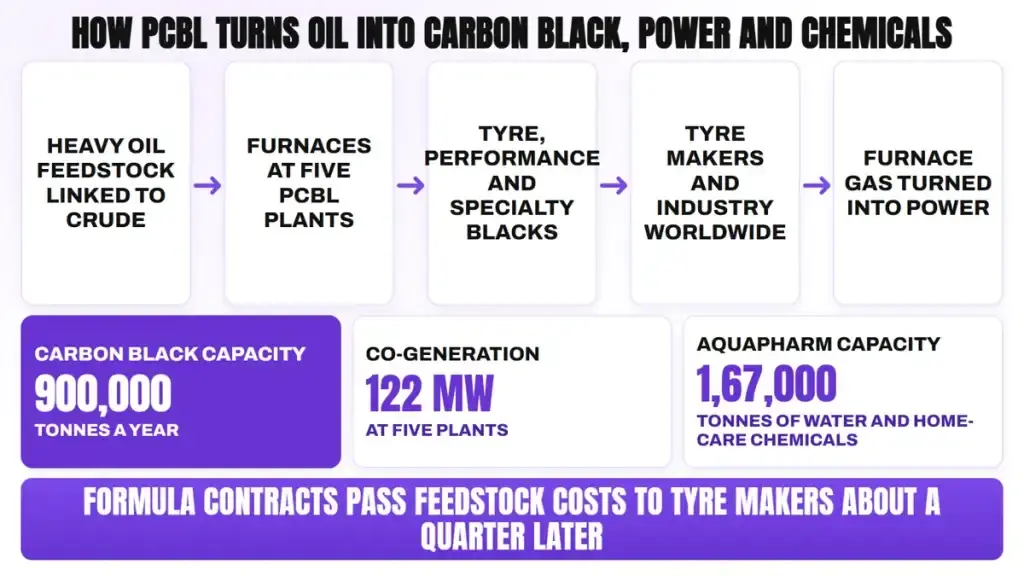
So PCBL sits early in two chains. In the old one, its carbon black goes to tyre makers for every kind of vehicle, electric vehicles included. In the new one, it wants to sell conductive carbons and silicon anode materials to the companies that make lithium-ion cells.
PCBL Chemical in five numbers
- Q2 FY27 revenue of ₹2,474 Cr, up 14%
- Carbon black capacity of 900,000 tonnes a year, with 132,000 tonnes for specialty blacks
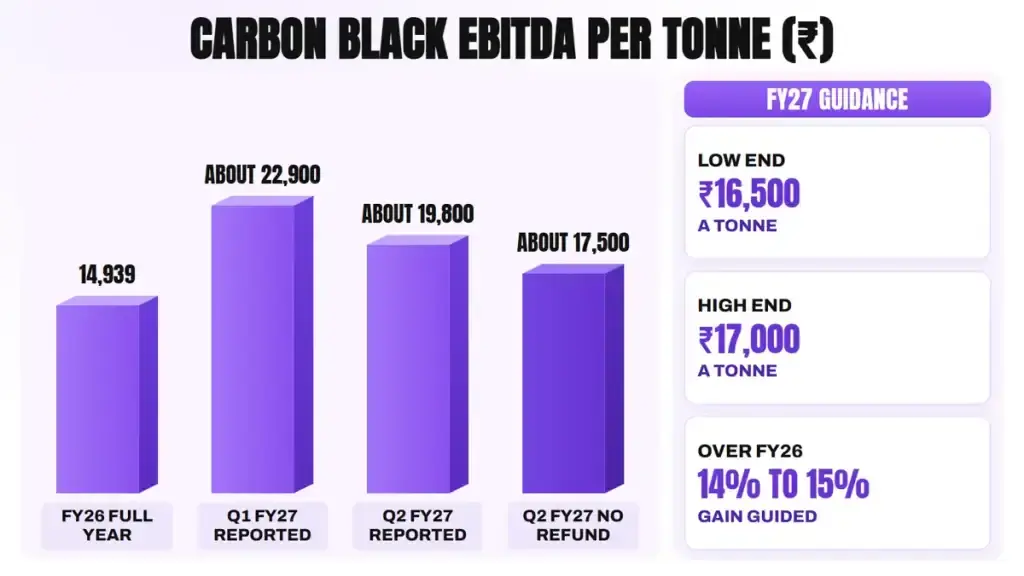
- EBITDA per tonne of about ₹17,500 in Q2 FY27 without a one-time refund, against ₹14,939 for FY26
- Aquapharm revenue of ₹1,443 Cr in FY26
- Net debt of about ₹4,691 Cr in September 2026
So a company that already sells into almost every tyre made in India now wants a place inside the battery as well. How much of that shows up in the numbers today? Let's first understand the company, and then look at the latest quarter.
PCBL Chemical: Company Overview
PCBL Chemical Ltd was established in 1960 as Phillips Carbon Black and is the carbon black company of the RP-Sanjiv Goenka group, with its registered office in Kolkata. Dr Sanjiv Goenka is its Chairman, Nilesh Koul has been Managing Director since 3 November 2025, and the promoter group held 53.38% of the company in March 2026. It makes carbon black for tyres, rubber goods and specialty uses at five plants in Mundra, Palej, Durgapur, Kochi and Chennai, with 900,000 tonnes a year of capacity and 122 MW of power plants that run on furnace gas. Through Aquapharm, which it bought in January 2024, it makes water-treatment, home-care and oil-field chemicals at four plants in India, the US and Saudi Arabia, and through Nanovace it is developing battery materials. It had 1,350 permanent employees in March 2026 and sells to more than 70 countries. Revenue from operations was ₹8,189 Cr in FY26, profit after tax was ₹198 Cr, and net debt was about ₹4,537 Cr in March 2026. Read this EV Stocks in India 2026: Battery Materials to Car Parts
"Behind every stock is a company. Find out what it's doing."
— Peter Lynch
PCBL looks like one business from outside, but it is really four: carbon black, power, Aquapharm and a battery start-up. Knowing which of them earns the money is the first step to reading its results.
The Quarter Volumes Fell 17% but Profit Rose 20%
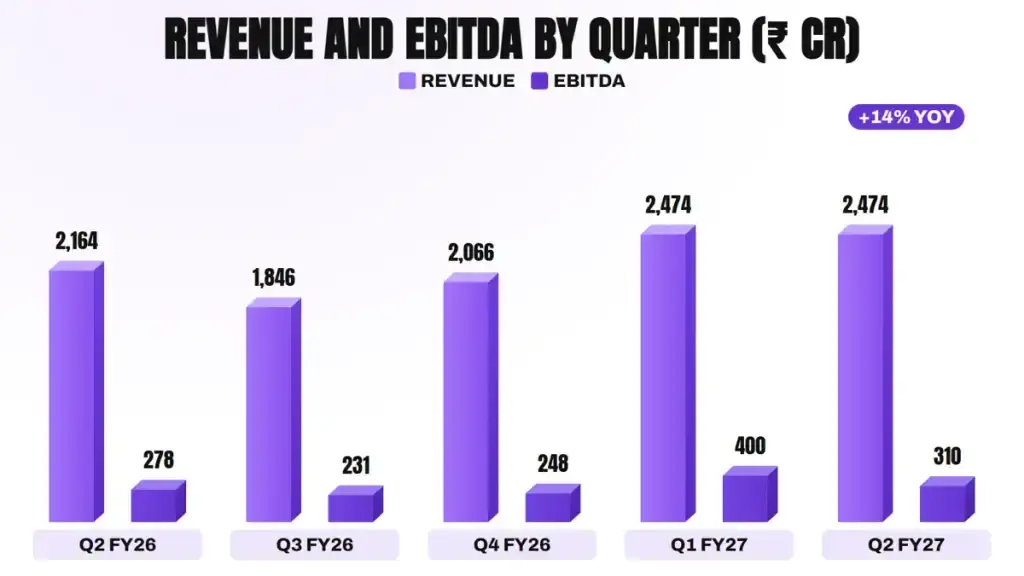
Let's look at Q2 FY27, the July to September quarter that PCBL reported on 2 November 2026. Consolidated revenue from operations was ₹2,474 Cr, about 14.4% more than the ₹2,164 Cr of a year ago and flat on Q1 FY27. EBITDA rose 12% to ₹310 Cr, and profit after tax rose 20% to ₹74 Cr.
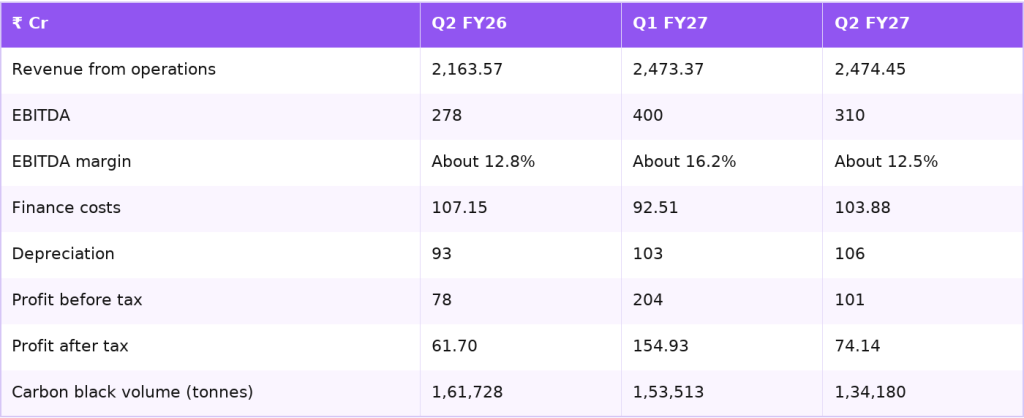
As we can see, revenue grew while tonnes came down. PCBL sold 1,34,180 tonnes of carbon black in the quarter, against 1,61,728 tonnes a year ago. Crude stayed high through the quarter, so selling prices stayed high too, and that kept revenue up even on fewer tonnes. Management also points to customers who held lean stocks while they waited for prices to soften, and to tyre makers who had bought extra in Q1 FY27 ahead of a price rise.
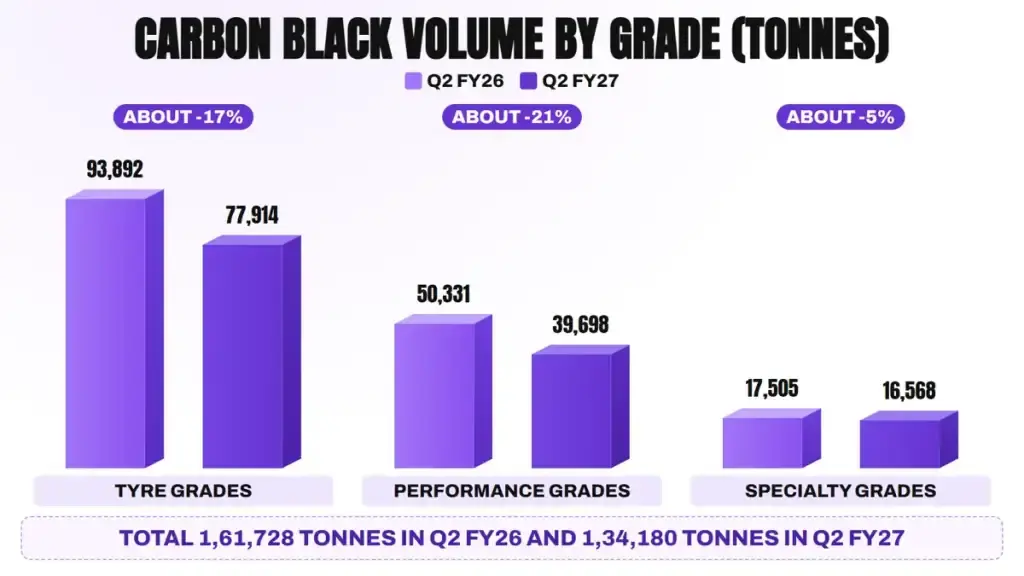
That volume change was not spread evenly. Tyre grades were about 17% lower, at 77,914 tonnes against 93,892. Performance grades, which go into hoses, belts and other rubber goods, were about 21% lower at 39,698 tonnes. Specialty grades held up best, about 5% lower at 16,568 tonnes. Domestic sales were 92,843 tonnes and exports were 41,337 tonnes, or about 31% of the total.
That choice shows up in the profit per tonne. Read this EBITDA Explained: Uses and Limits Management says carbon black earned about ₹19,800 of EBITDA a tonne in the quarter, but about ₹2,300 of that came from a one-time refund of US tariffs, worth ₹33 Cr. Without the refund, it made about ₹17,500 a tonne. That is still well above the ₹14,939 of FY26.
That refund also matters for the headline. It was about 11% of the quarter's EBITDA. Take it out, and EBITDA was about ₹277 Cr, close to the ₹278 Cr of a year ago. Profit before tax without the refund would have been about ₹68 Cr, against ₹78 Cr a year ago. So the business held its operating profit on fewer tonnes, and the refund made the year-on-year gain.
"The single most important decision in evaluating a business is pricing power."
— Warren Buffett
PCBL tested its own pricing power in Q2 FY27 by turning away low-margin orders. The next two quarters will show whether customers come back at those prices.
Beyond carbon black, the other parts moved in different directions. Aquapharm made ₹433 Cr of revenue and ₹42 Cr of EBITDA. The power business sold 108 million units at ₹5.34 a unit, against ₹3.76 a year ago, but it generated less power because the plants made less carbon black. For the first half, revenue was ₹4,948 Cr, EBITDA ₹710 Cr and profit after tax ₹229 Cr.
Where the Cash Went in the First Half
Now let's follow the cash, because the first half used more working capital than usual. Inventories almost doubled, to ₹1,981 Cr in September 2026 from ₹1,024 Cr in March. Trade receivables rose to ₹1,589 Cr from ₹1,395 Cr. Trade payables also rose, to ₹2,428 Cr from ₹1,447 Cr, which carried a part of that load.
That stock build was partly deliberate. Aquapharm says it raised its stocks of critical raw materials to protect supply, and higher crude makes every tonne of feedstock cost more. Working capital took up ₹219 Cr in the half, and operating cash flow was ₹363 Cr, against ₹822 Cr in the first half of FY26.
So the cash covered less than usual. Net capex took ₹202 Cr and dividends ₹177 Cr. Borrowings rose to about ₹4,927.4 Cr in September from about ₹4,825 Cr in March. After about ₹236.4 Cr of cash, bank balances and liquid investments, net debt was about ₹4,691 Cr, or about 1.15 times equity of ₹4,072.55 Cr.
How Phillips Carbon Black Became a Chemical Group
Now that we have seen the quarter, let's go back and see how the company got here. PCBL was established in 1960 as Phillips Carbon Black, and it is now the carbon black company of the RP-Sanjiv Goenka group. Dr Sanjiv Goenka is its Chairman, and Nilesh Koul has been its Managing Director since 3 November 2025. The promoter group held 53.38% of the company in March 2026.
For decades that company was carbon black and little else. It grew by adding furnaces near ports and tyre plants, at Mundra and Palej in Gujarat, Durgapur in West Bengal, Kochi in Kerala and a newer site at Chennai. In mid-2022 its total capacity was 603 KT. By March 2026 it was 880,000 tonnes, after a 90,000-tonne rubber black line in Tamil Nadu. By September 2026 it was 900,000 tonnes, about 49% more than in 2022.
Then, in January 2024, PCBL changed what kind of company it was. It bought Aquapharm Chemical, India's largest phosphonate maker, for ₹3,800 Cr, with effect from 31 January 2024. In FY25 it changed its name from PCBL Limited to PCBL Chemical Limited. Today Aquapharm is fully owned, 80% through PCBL and 20% through its Tamil Nadu subsidiary.
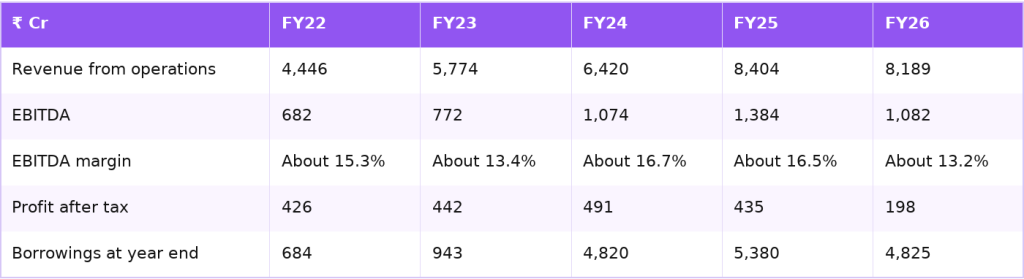
That table shows us two things. Revenue grew about 1.8 times in four years, or about 16.5% a year, as capacity grew and Aquapharm came in. But profit after tax went the other way over the same years: it was ₹198 Cr in FY26 against ₹426 Cr in FY22, about 54% lower.
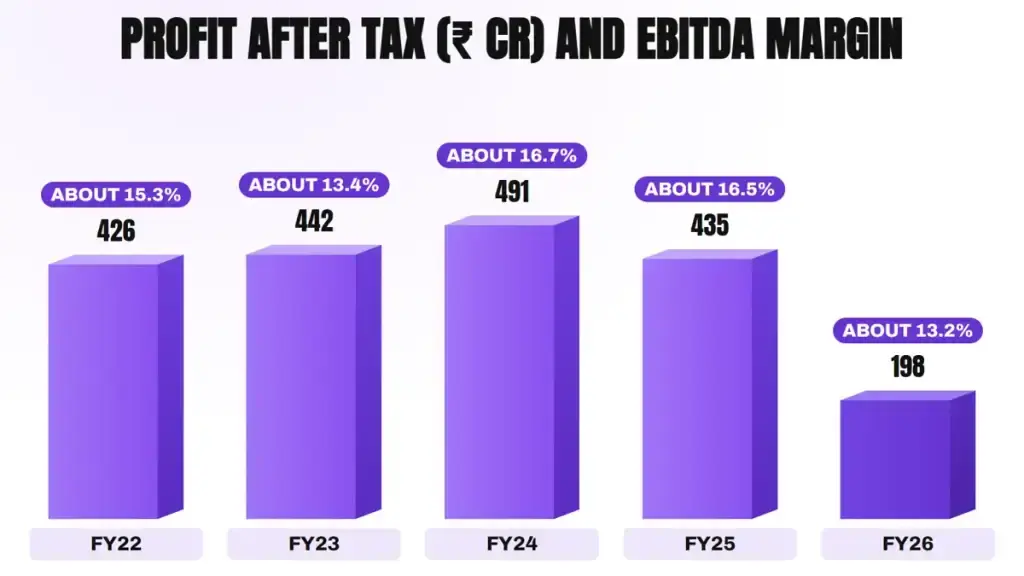
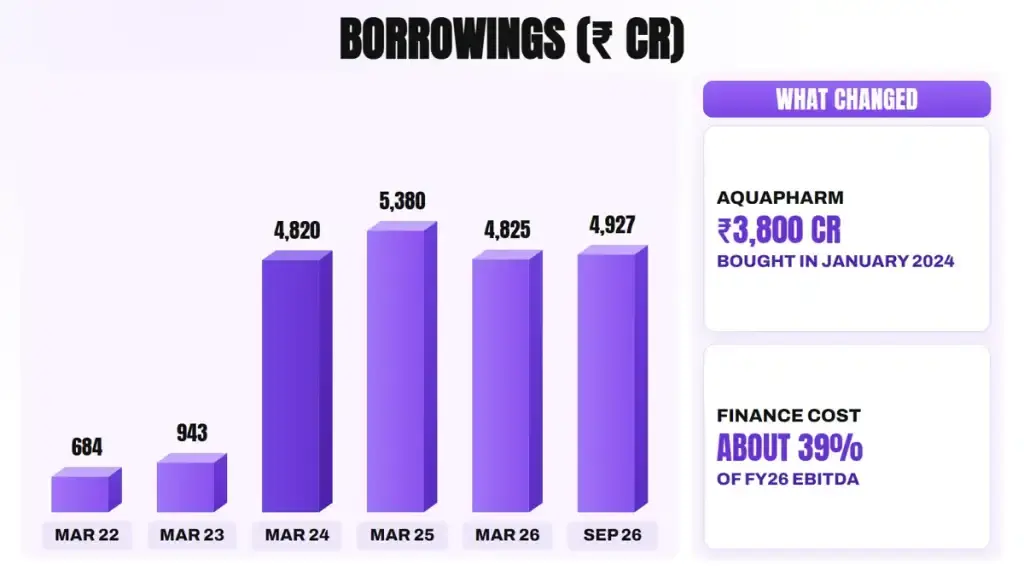
Most of that gap comes from the cost of the deal and the new plants. Read this Debt to Equity Ratio Explained Borrowings went from about ₹684 Cr in March 2022 to about ₹4,820 Cr in March 2024, about 7 times more in two years. Finance costs were ₹29.09 Cr in FY22, about 4% of EBITDA. In FY26 they were ₹423 Cr, about 39% of EBITDA.
That debt met a hard year in FY26. Management says global carbon black spreads softened, Indian capacity ran ahead of demand, US tariffs hit exports, and the West Asia conflict raised feedstock and freight costs from February 2026. Volumes still grew about 4% to a record 6,18,956 tonnes, but EBITDA per tonne was ₹14,939. On our calculation, return on capital employed was about 8.0% in FY26.
That year also brought the debt down. Net borrowings came down by ₹454 Cr in FY26, helped by ₹529 Cr released from working capital and ₹336 Cr from share warrants. Operating cash flow was ₹1,576 Cr, against ₹760 Cr in FY25.
"We are not chasing volumes. We would rather keep this capacity spare." - Raj Gupta, Chief Financial Officer, November 2026
Four Segments, One Carbon Furnace at the Centre
Next, let's split the business into its parts, because each one sells to a different buyer. Read this Segment-Wise Revenue Analysis Explained PCBL reports four segments: carbon black, power, chemicals, which is Aquapharm, and battery chemicals, which has no revenue yet.
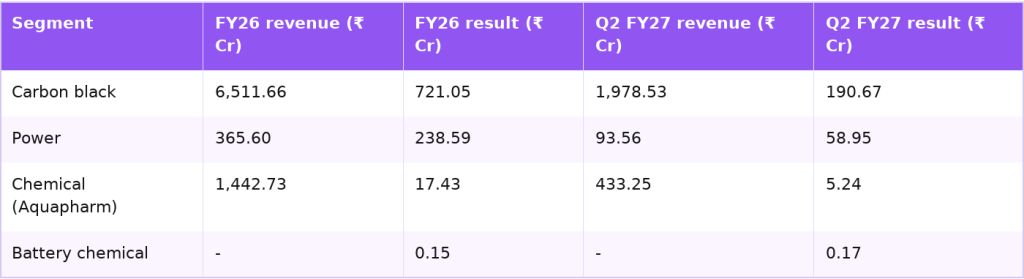
Those segment revenues are before sales between the segments, and the result is profit before interest and tax. Carbon black earned about 74% of the FY26 segment result, and power about 24%. Aquapharm brought about 17.6% of revenue but only ₹17.43 Cr of segment result.
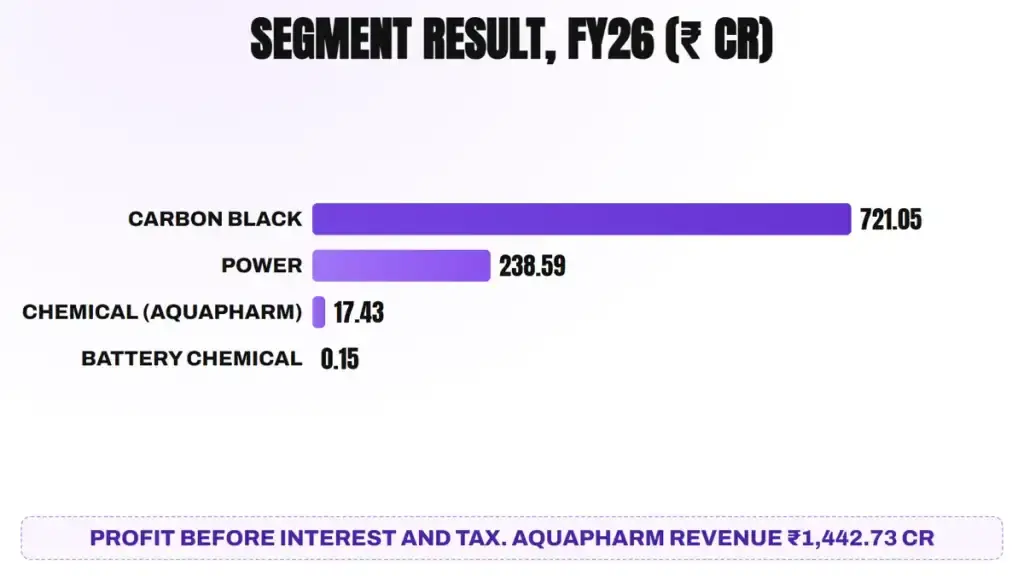
Carbon Black for Tyres, Rubber and Specialty Uses
Let's start with carbon black, which is most of the company. PCBL sells more than 110 grades in three groups. Tyre grades are the largest: 3,54,841 tonnes in FY26. Performance grades for non-tyre rubber were 1,94,480 tonnes. Specialty blacks for plastics, inks, coatings, cables and batteries were 69,635 tonnes, up about 11.5% from 62,450 tonnes.
That specialty group is where PCBL wants to grow, and management wants it to make up a steadily larger part of the business. PCBL had 1,12,000 tonnes of specialty capacity in March 2026. A new 20,000-tonne specialty line at Mundra was commissioned in Q1 FY27, which took specialty capacity to 132,000 tonnes. Management says the limit is now the special feedstock these grades need: "that is the barrier", it says, and it is tying up more of it.
Beyond specialty grades, exports are the other lever. In FY26 PCBL exported 2,35,130 tonnes, about 38% of its volume, to more than 70 countries. It has opened a warehouse in Antwerp and a US entity to stock material near customers. Management says about 40% to 50% of US volume moves by railcar, which it is now setting up, and that it is talking to some of the world's largest tyre makers about long-term supply tie-ups.
Power From the Furnaces' Hot Gas
Next, let's look at power, the most profitable part per rupee. A carbon black furnace gives off a hot gas, and PCBL burns it to make electricity at all five plants. It has 122 MW of co-generation capacity: 32 MW at Mundra, 30 MW at Durgapur, 24 MW at Chennai, 19 MW at Palej and 17 MW at Kochi. A 12 MW unit in Tamil Nadu is due in FY27, which will take it to 134 MW.
That power first runs PCBL's own plants. Management says about 40% of what it generates is used captively and 60% is sold. In FY26 it generated 839 million units and sold 511 million units at ₹4.24 a unit. Bilateral contracts made up 43% of those sales, against 31% a year earlier. The segment earned about 65% of its revenue as segment result in FY26.
Aquapharm Makes Water, Home-Care and Oil-Field Chemicals
Now let's move to Aquapharm, the business PCBL bought. It makes phosphonates, polymers and green chelates, which go into water treatment, desalination, detergents and dish-wash products, and oil and gas wells. It says it is India's largest phosphonate maker and among the top three in the world. It has 1,67,000 tonnes of capacity at four plants in India, the US and Saudi Arabia, and more than 275 products. The company shows North America at 50% of Aquapharm's business, Europe at 20% and India at 17%.
That business has not yet earned what PCBL expected. Revenue was ₹1,443 Cr in FY26 against ₹1,420 Cr in FY25, and EBITDA came to ₹162 Cr against ₹194 Cr, a margin of about 11.2%. Oil and gas sales were hit by lower US rig counts. In Q2 FY27 EBITDA was ₹42 Cr, a margin of about 9.7%, and Aquapharm also paid about ₹10 Cr more for bought-in power.
There are some new products in the pipeline. Aquapharm won its first commercial order for synthetic thickeners, and it is testing biocides and corrosion inhibitors with US oil and gas operators. Its green chelates are being qualified by customers in the US and Europe. In the Gulf, it is building a range for sea water reverse osmosis, the membrane method that is replacing thermal desalination. India has also put a provisional anti-dumping duty on two phosphonates, but management has not counted any benefit from it yet.
Battery Chemicals Through Nanovace
Finally, let's look at batteries, the newest and smallest part. PCBL is working on three conductive and anode materials. Through Nanovace, a 51% joint venture with the Australian technology partner Kinaltek, it is developing high-purity nano-silicon made by a chemical reduction process. It has a US patent for that process.
That silicon matters because of how much charge it holds. Management says silicon stores 3,579 mAh/g against 372 mAh/g for graphite, the usual anode material, but it swells by up to 300% when it charges. So PCBL is now working on silicon carbon composites, which wrap silicon in engineered carbon to control that swelling. The pilot plant at Palej has started making samples, which are in internal tests before customers evaluate them. Management says graphite anodes are not part of the plan.
Beside that silicon work, PCBL is adding two conductive carbons that help electrons move inside a battery electrode. A 1,000-tonne super conductive black line at Palej has been commissioned. A 4,000-tonne acetylene black plant, which the company says will be India's first, has approval under the government's electronics component scheme for a planned investment of about ₹329 Cr.
Where PCBL Sits in the EV Value Chain
Now let's place PCBL in the EV value chain, because it touches it at two points. One is the tyre. Every electric car, scooter and bus still runs on tyres, and management counts the shift to SUVs and EVs among the things that will lift carbon black demand. That makes PCBL an indirect supplier to EVs through tyre makers, the same way it supplies petrol and diesel vehicles.
So the other point is inside the cell, and this one is newer. A lithium-ion cell has a cathode, an anode, an electrolyte and a separator. Conductive carbons such as acetylene black and super conductive black go into the electrodes in small amounts to carry current. Silicon is mixed into the anode to store more charge, so that a cell holds more energy and charges faster.
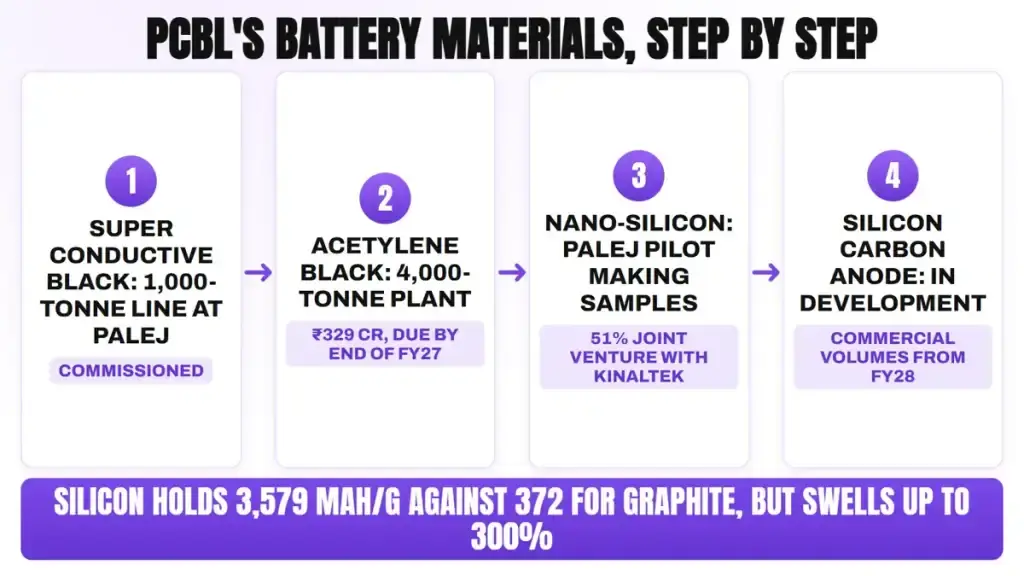
That second market is still small for PCBL. Management puts the global silicon carbon anode market at about $1.2 billion in 2025 and expects it to grow more than 25% a year through 2035. It says it will see commercial volumes from Nanovace from FY28. In Q2 FY27, the battery segment had assets of ₹297.57 Cr and no revenue.
What the battery plan says: one conductive carbon line is running, the acetylene black plant is due by the end of FY27, and nano-silicon is at the sample stage. Management expects commercial volumes only from FY28, so for now the battery business has assets but no revenue.
So for now, the EV link runs mostly through tyres. The battery business is a set of pilot lines and approvals that could become a supplier role inside India's cell plants, but it has not yet sold a tonne.
Why PCBL's Moat Is Hard to Copy
Now that we have seen the parts, let's understand the moat. Anyone with money can build a carbon black furnace, and Indian capacity ran ahead of demand in FY26. So the question is why tyre makers keep buying from PCBL, and what stops a rival from taking the same customers. Read this Himadri vs PCBL: Carbon Black and Battery Materials
One part of the moat is scale near the customer. PCBL has 900,000 tonnes a year spread across five plants that the company says it placed around customers, ports and feedstock, and it ships to more than 70 countries. A smaller rival has fewer plants from which to serve a national tyre maker.
Another layer is the power plant inside each factory. Because PCBL turns the furnace gas into electricity, its carbon black business is self-sufficient in power and sells the rest. In FY26 power earned about ₹238.59 Cr of segment result, about 24% of the total. A rival without co-generation carries a higher cost on every tonne.
That leaves the customer relationship itself. Much of PCBL's volume runs on formula contracts with tyre majors, and management says it is working with customers on technical projects and placing its grades in their product development road maps. In specialty blacks the bar is higher, because the grades need a special feedstock that management calls the barrier. PCBL also spent ₹81 Cr on innovation in FY26.
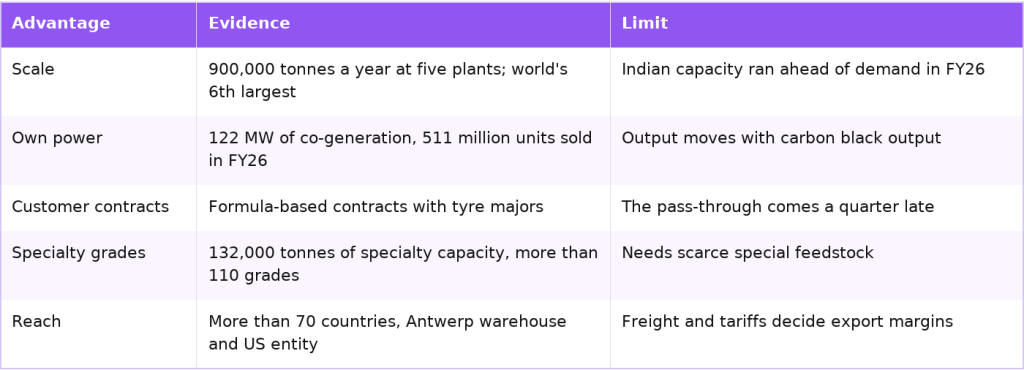
That table shows us where the moat holds and where it does not. In tyre black, scale and contracts keep PCBL inside its customers, but the price follows crude and the Indian market's spare capacity. In Q2 FY27, management says some rivals were "chasing volume", and Russian imports were cheaper than domestic prices for a while. The moat protects the customer list more than the margin.
"Your margin is my opportunity."
— Jeff Bezos
In carbon black, rivals with spare capacity and cheap imports look at PCBL's margin in exactly this way. That is why scale and own power matter more here than any single product.
Financials: Five Years of Revenue, Profit and Cash Flow
One quarter can mislead in a business whose prices follow crude oil, so let's look at five full years together. All figures are consolidated; EBITDA is as the company reports it, and FY22 EBITDA is profit before tax plus finance cost and depreciation.
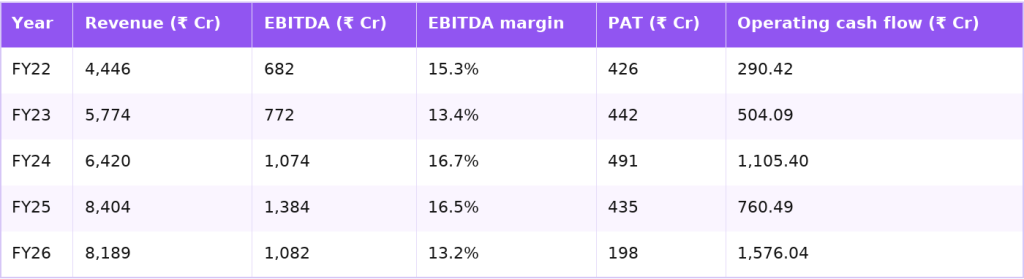
Revenue grew about 1.8 times in four years, from ₹4,446 Cr in FY22 to ₹8,189 Cr in FY26, as new capacity came in and Aquapharm was added. Profit after tax did not follow: it was ₹198 Cr in FY26, about 54% lower than in FY22, because finance costs and depreciation grew faster than EBITDA.
Cash flow tells a better story than profit. From FY22 to FY26, operating cash flow added up to about ₹4,236.4 Cr, against ₹1,992 Cr of profit after tax, because depreciation is a non-cash cost and working capital came down in FY26. Operating cash flow was ₹1,576.04 Cr in FY26 alone.
The balance sheet is where the change shows most. Borrowings rose from about ₹684 Cr in March 2022 to about ₹4,820 Cr in March 2024. Net debt was about ₹4,537 Cr in March 2026, about 1.13 times equity, and about ₹4,691 Cr in September 2026.
"Beware of little expenses; a small leak will sink a great ship."
— Benjamin Franklin
For PCBL, the leak is not small: finance costs took about 39% of FY26 EBITDA. Every rupee of debt repaid flows straight to profit, which is why the debt line matters as much as the volume line.
What FY27 and FY28 Could Look Like on Management's Numbers
So where does the business go from here? On 2 November 2026, management repeated its guidance of double-digit growth in average EBITDA per tonne over FY26. In July 2026 it had put that at a 14% to 15% gain, or about ₹16,500 to ₹17,000 a tonne. The first half came in above that: about ₹22,900 in Q1 FY27 and about ₹17,500 in Q2 FY27 without the refund.
That per-tonne gain comes with a volume warning. Management had guided about 7% volume growth for FY27, and it now says that is "a little bit challenging". In H1 FY27, carbon black volume was 2,87,694 tonnes, about 9% below the 3,15,821 tonnes of H1 FY26. It expects tyre customers to buy again in Q3 and spot prices to rise in November and December.
Beyond FY27, the plan has four parts. PCBL is targeting 1 million tonnes of carbon black capacity by FY28, with a greenfield plant on land it has bought in Andhra Pradesh. It is close to approving a coal tar distillation plant, which would give it a second feedstock besides crude-linked oil. It is running a cost programme it calls Alchemy, aimed at ₹200 Cr to ₹250 Cr of savings over 4 to 6 quarters. And it expects commercial volumes from its battery materials from FY28.
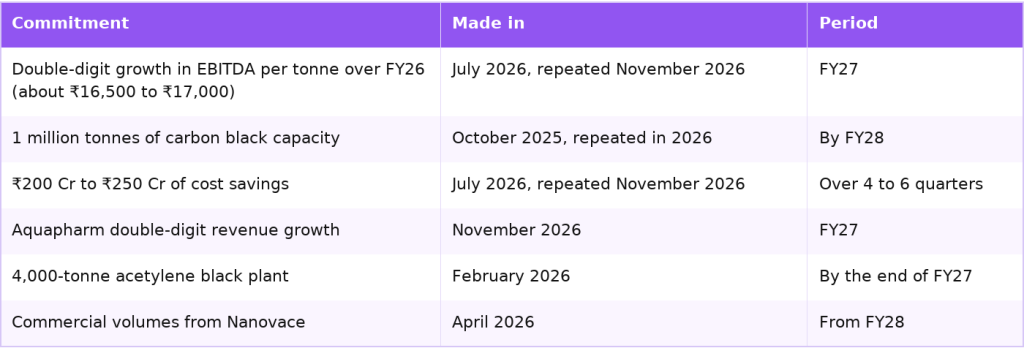
That plan has to be paid for, and the balance sheet is the constraint. In July 2026, management put this year's growth capex at about ₹100 Cr at most, with most of the Andhra spending in the next year. In November it said it might slightly postpone some capex decisions if needed, rather than chase volume. So the 1 million tonne target depends on demand coming back.
Those commitments are easier to judge against the past. So let's check what management said before against what it delivered.
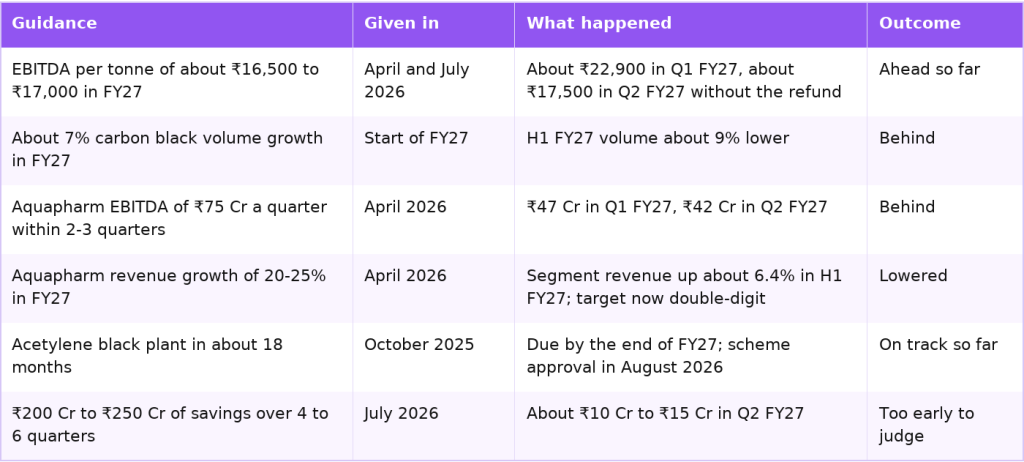
That record shows us a clear pattern. On profit per tonne in carbon black, PCBL is doing better than it promised, helped by high crude and by turning away low-margin orders. On volume and on Aquapharm, it is behind. In July 2026, Aquapharm's new CEO said it was "early days" for him on the ₹75 Cr goal. That makes Aquapharm's margin and the second-half carbon black volume the numbers to watch.
Key Risks
Now let's look at what could go wrong for PCBL, because a few of these risks already show in the latest half year.
- High debt: net debt was about ₹4,691 Cr in September 2026, about 1.15 times equity. Finance costs took about 39% of FY26 EBITDA, so a weak year in carbon black falls quickly to profit, as FY26's ₹198 Cr showed.
- Volumes are falling: H1 FY27 carbon black volume was about 9% lower, and management says its 7% growth guidance is challenging. At the Q2 FY27 pace, the plants ran at about 60% of capacity, and the plan is to add more.
- Crude and the pass-through lag: feedstock is linked to Brent crude, and formula contracts pass on a change about a quarter late. A sharp fall in crude can force PCBL to give back inventory gains, and a sharp rise ties up more cash in stock, as in H1 FY27.
- Competition and imports: Indian capacity ran ahead of demand in FY26, management says some rivals are chasing volume, and Russian imports were cheaper than domestic prices for a part of 2026.
- Freight, war and tariffs: shipping routes, war risk premiums and US tariffs decide whether exports pay. The ₹33 Cr tariff refund in Q2 FY27 will not repeat.
- Aquapharm below plan: EBITDA fell to ₹162 Cr in FY26 from ₹194 Cr, and it was ₹42 Cr in Q2 FY27 against a ₹75 Cr quarterly goal. The ₹3,800 Cr purchase is the main reason the debt rose.
- Battery materials are early: the battery segment had ₹297.57 Cr of assets and no revenue in September 2026. Silicon anodes still have to pass customer tests, and the plan expects commercial volumes only from FY28.
- Tax disputes: in March 2026, PCBL had ₹26.67 Cr of income tax matters under dispute that it does not accept as debts.
"I don't think it's possible to afford low prices for long in this industry." - Nilesh Koul, Managing Director, November 2026
"You can't predict. You can prepare."
— Howard Marks
No one can say where crude, freight or Russian supply will go next quarter. What an investor can do is watch PCBL's volumes, its profit per tonne, Aquapharm and the debt each quarter, which is what the list above sets out.
Explore our Products
Research Framework

Emerging Titans
Combination of quantitative analysis, industry tailwinds, and management assessment - SPRINT investment philosophy

Tiny Titans
Heavy emphasis on scuttlebutt research, plant visits, and early on-ground signals
What to Track Next
If you follow PCBL, these are the signals that will show where it goes next.
- Carbon black volume in Q3 and Q4 FY27, after the 2,87,694 tonnes of H1 FY27, and the export share after about 31%
- EBITDA per tonne without one-time items, against the ₹16,500 to ₹17,000 guidance
- Aquapharm's quarterly EBITDA against the ₹75 Cr goal, and the anti-dumping decision on phosphonates
- Net debt after about ₹4,691 Cr, and operating cash flow for FY27 once inventories come down from ₹1,981 Cr
- The coal tar distillation decision and the Andhra Pradesh plant's spending
- The acetylene black plant by the end of FY27, and the first customer tests of Nanovace's silicon carbon material
Conclusion
Let's put it all together. PCBL Chemical makes more carbon black than any other Indian company, and it runs its own power plants at every furnace site. In Q2 FY27 it chose to sell about 17% fewer tonnes at a better margin, and it made about ₹17,500 of EBITDA a tonne without a one-time refund, above its own guidance.
Beyond that carbon black margin, the rest of the company is less settled. Aquapharm earns far below the ₹75 Cr a quarter management hoped for, the debt taken on to buy it still costs about 39% of EBITDA, and the battery materials business is at the pilot stage. What happens next depends on whether volumes come back without giving up the margin, whether Aquapharm reaches its goal, and whether the cash from the business can bring the debt down while the 1 million tonne plan goes ahead.
FAQs
What does PCBL Chemical do?
+PCBL Chemical makes carbon black, a fine black powder that strengthens tyres and colours plastics, inks and paints. It has 900,000 tonnes a year of capacity at five plants in India, runs power plants on its furnace gas, and owns Aquapharm, which makes water-treatment and home-care chemicals. FY26 revenue was ₹8,189 Cr.
How did PCBL Chemical do in Q2 FY27?
+Revenue rose 14% to ₹2,474 Cr and profit after tax rose 20% to ₹74 Cr, even though carbon black volume was about 17% lower at 1,34,180 tonnes. EBITDA was ₹310 Cr, including a one-time US tariff refund of ₹33 Cr. Without the refund, carbon black earned about ₹17,500 of EBITDA a tonne.
Why did PCBL sell less carbon black in Q2 FY27?
+Management says it let go of spot orders that did not earn a meaningful margin, many of them in Southeast Asia. Customers also kept lean stocks while crude stayed high, and tyre makers who bought extra in Q1 FY27 bought less in Q2. Management expects tyre customers to buy again in Q3.
What is PCBL Chemical doing in battery materials?
+Through Nanovace, a 51% joint venture with Kinaltek of Australia, PCBL is developing nano-silicon and silicon carbon anode materials, and its Palej pilot plant has started making samples. It has also commissioned a 1,000-tonne super conductive black line and is building a 4,000-tonne acetylene black plant due by the end of FY27. Management expects commercial volumes from FY28.
How much debt does PCBL Chemical have?
+Net debt was about ₹4,691 Cr in September 2026, about 1.15 times equity. Borrowings rose sharply after PCBL bought Aquapharm for ₹3,800 Cr in January 2024, and finance costs took about 39% of FY26 EBITDA.
What are the main risks for PCBL Chemical?
+The main risks are high debt, carbon black volumes that were about 9% lower in H1 FY27, crude price swings that pass to customers about a quarter late, and competition from Indian rivals and imports. Aquapharm earned ₹42 Cr of EBITDA in Q2 FY27 against a ₹75 Cr quarterly goal, and the battery business has no revenue yet.

High growth stock specialist, Value Educator
Shashank Mahajan is an equity research professional with over 12 years of experience in identifying high-potential SME and micro-cap stocks at an early stage. He follows a rigorous scuttlebutt research–driven approach, combining on-ground insights with deep financial analysis. Shashank specializes in uncovering under-researched and under-owned companies with strong management quality and long-term growth potential. Through disciplined research and early identification, he focuses on spotting tomorrow’s market leaders before they enter the mainstream investor radar.
More about Shashank Mahajan →
KEC International: Record Orders, Weak Margin, High Debt

Sona BLW: EV Revenue Now Tops Half of Its Auto Sales

HPL Electric & Power: Smart Meters, Wires and Two Engines

Kaynes Technology: EMS, Chip Plants and ₹10,563.5 Cr Orders

Sterlite Technologies: Glass Rods to Hyperscaler Deals
Netweb vs Black Box vs Rashi: Data-Centre Hardware Compared
Explore our Products
Research Framework
Emerging Titans
Combination of quantitative analysis, industry tailwinds, and management assessment - SPRINT investment philosophy
Tiny Titans
Heavy emphasis on scuttlebutt research, plant visits, and early on-ground signals



India's Aerospace Opportunity
Global Demand. Supply Bottlenecks. Opportunities Ahead.
Don't Miss This Exclusive Webinar!
Join Value Educator to decode the key trends shaping India's aerospace sector and learn how to identify tomorrow's potential leaders in the space.
- How the aircraft value chain works, layer by layer
- Indian companies supplying global aircraft makers
- A framework to judge any aerospace company

 Orders
 Subscription
 Share with friends


Required Details
₹23999.00
(12 month subscription)
As per SEBI regulations, all users are mandated to complete the KYC that is validated for 1 year. Post payment, you will be redirected to the KYC screen


No comments yet. Be the first to comment!