India’s Defence Story Is Moving Up the Value Chain
India’s defence and aerospace narrative is no longer just about building more hardware. The early phase of indigenisation focused on creating domestic manufacturing capacity, but the next phase is more demanding. It is about design ownership, embedded engineering, and system integration.
That shift matters because the highest value in modern aerospace is no longer captured at the final assembly stage. It is captured much earlier, when the product is still a model, a simulation, or a design architecture. Whoever controls that layer controls the technical direction of the program.
This is why engineering R&D companies are becoming more important than they appear at first glance. They do not always sit in the spotlight, but they often sit at the heart of the product development process. AXISCADES belongs to that invisible but crucial layer.
The company is not trying to be a large scale manufacturer in the conventional sense. It is trying to become a deep engineering partner for defence, aerospace, and advanced electronics programs. That positioning makes the business more niche, more technical, and potentially more durable.
What is especially interesting is that India’s policy environment is now aligned with this kind of business model. As procurement shifts toward domestic capability and next generation systems, the need for design, simulation, and embedded expertise rises sharply. AXISCADES is positioned exactly where that demand is becoming more structural.
This is the kind of company that benefits when the market stops thinking only about volumes and starts thinking about complexity. In a sector where complexity itself becomes monetisable, engineering depth can become a long duration advantage.
The Real Business Is Built Before the Product Exists
Most investors look at aerospace and defence companies through the lens of end products. They focus on aircraft, missiles, radars, and equipment. But those products begin their life long before physical production, inside digital environments where engineering decisions are made.
That pre production layer includes conceptual design, simulation, validation, and integration planning. It is a stage where small technical decisions can create large downstream effects. A design error here can be expensive, slow, and difficult to reverse later.
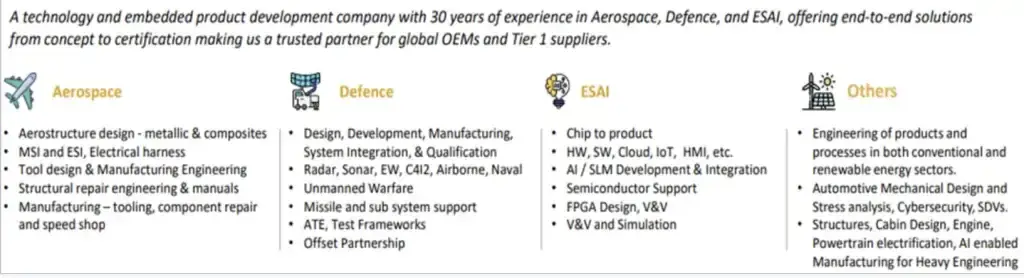
AXISCADES operates in that layer. It works on aerospace structures, defence electronics, embedded systems, and digital validation. That means the company is not simply providing manpower. It is embedded in the process where performance, reliability, and manufacturability are shaped.
This placement is economically important because the value of engineering input rises when programs become more advanced. When systems are software heavy, electronics heavy, and integration heavy, the engineering work becomes harder to replace and easier to price at a premium.
There is also a hidden commercial advantage here. If AXISCADES is involved early in the program, it is more likely to remain involved through later stages of testing, modification, and lifecycle support. That creates program stickiness rather than one time transactional revenue.
This is very different from commodity outsourcing. In commodity work, replacement is easier and pricing is weaker. In high end engineering, switching costs are real because the cost of disruption is often larger than the cost of continuing.
Segment Mix Is Telling the Entire Story
The best way to understand AXISCADES is to study where the revenue is coming from. In 9M FY26, Aerospace contributed ₹282 crore, Defence contributed ₹311 crore, and ESAI contributed ₹98 crore. Together these three segments accounted for 78 percent of revenue.
That 78 percent figure is not just a statistic. It is the clearest sign that the company’s economic centre of gravity has shifted. The high value segments are now dominating the business, while older and weaker areas are becoming less relevant in shaping the future.
The margin profile makes the same point even more sharply. Aerospace delivered an EBITDA margin of 18.3 percent, Defence delivered 23.7 percent, and ESAI delivered 24.4 percent. The combined core segment EBITDA margin stood at 21.6 percent.
This is a very different picture from the non core business. Heavy Engineering and Auto generated ₹160 crore of revenue but delivered negative EBITDA of ₹10 crore, while the Energy segment contributed ₹34 crore with ₹4 crore EBITDA. The non core total was ₹194 crore with a negative 3 percent margin.
This contrast is crucial because it shows that the company is no longer just diversified. It is actively being reweighted toward better businesses. That is the kind of reconfiguration that often improves both growth quality and valuation quality over time.
When the best segments are also the fastest growing and the highest margin, the business starts to look less like a mixed engineering firm and more like a focused high end R&D platform. That is the more interesting story.
Like this analysis? Get powerful insights like this every week. No spam.
Defence Is Becoming the Anchor Segment
Defence is now one of the clearest engines inside AXISCADES. In 9M FY26, Defence revenue reached ₹311 crore, growing 39 percent year over year. The company also stated that Defence revenue grew 50 percent in the period when measured against the prior comparable quarter.
This matters because defence work is not just another engineering vertical. It is one of the few areas where program complexity, long gestation periods, and mission critical requirements can create unusually strong client stickiness. Once a vendor is trusted, replacement becomes difficult.
The economics of defence engineering are also attractive because the work is highly specialised. Missile electronics, radar integration, handling systems, and embedded control are not work that can be commoditised easily. That naturally supports better pricing and better utilisation of specialised talent.
The second quarter release also indicated that the company saw substantial order intake in the defence sector, with expectations of continued growth from procurement by Indian defence and global OEMs. That suggests the demand environment is not isolated to one quarter.
Order book strength remains one of the most reliable indicators of future earnings, a theme we explore further in Defence Stocks with Order Books Stretching to 2035 – 2026 Picks.
The deeper point is that defence is not only growing because the market is large. It is growing because India is shifting from import dependence toward domestic design capability. That shift is exactly where a company like AXISCADES becomes relevant.
In this sense, defence is more than a revenue stream. It is the credibility layer of the business. When a company wins in defence, it sends a signal about technical trust, process discipline, and delivery quality.
Aerospace Is About Precision, Not Volume
Aerospace behaves differently from most industrial businesses. It is not a high volume market in the way consumer or mass manufacturing sectors are. Instead, it rewards technical precision, reliability, certification capability, and long development cycles.
AXISCADES Aerospace revenue reached ₹282 crore in 9M FY26, growing 28 percent year over year. The margin of 18.3 percent shows that this is not merely a scale business. It is a business where technical value is being monetised effectively.
This segment is especially important because aerospace programs have long lifecycles. Once embedded into a platform, engineering work can continue through upgrades, certification support, testing, and redesign. That extends the commercial life of the initial relationship.
There is also an important export dimension. Aerospace is one of the few sectors where Indian engineering companies can compete globally if they have the right certifications, design strength, and execution discipline. AXISCADES is clearly trying to build that kind of position.
The company’s international commercial growth in Europe and North America reinforces this point. When aerospace engineering starts crossing borders, it generally means the business is moving into a more globally recognised technical bracket.
What stands out is that this is not a mass market story. It is a narrow, technically demanding, high trust story. Businesses like this can scale, but they scale by capability, not by volume alone.
ESAI Is the Most Underestimated Growth Layer
The most interesting segment in AXISCADES may be ESAI, which covers Electronics, Semiconductors, and AI. In 9M FY26, the segment generated ₹98 crore of revenue and ₹24 crore of EBITDA, which translates to an EBITDA margin of 24.4%.
That margin matters because it suggests the company’s most advanced work is also some of its most profitable. In many defence and aerospace systems, value is shifting away from mechanical content and toward electronics, embedded systems, and software layers.
This is a major structural trend. Radar systems, communication modules, autonomous systems, missile electronics, and intelligent defence platforms all depend on electronics architecture. The engineering content is becoming more digital, and AXISCADES is trying to follow that value shift.
The acquisition of Mistral Solutions for ₹296 crore is important in this context. Mistral brought semiconductor, embedded electronics, defence, and product engineering capabilities into the group, widening the company’s technical reach in precisely the areas that are gaining strategic importance.
This is not simply M&A for size. It is capability acquisition. It expands the company’s skill base in a direction that is aligned with the future of defence and aerospace systems.
If the next generation of platforms is driven by sensing, processing, and control rather than only mechanical structure, then ESAI becomes one of the most important long term growth arenas in the business.
Be part of the
Value Educator
community
Get exclusive insights tailored to
sharpen your investment decisions.
The Company Is Quietly Becoming More Product Led
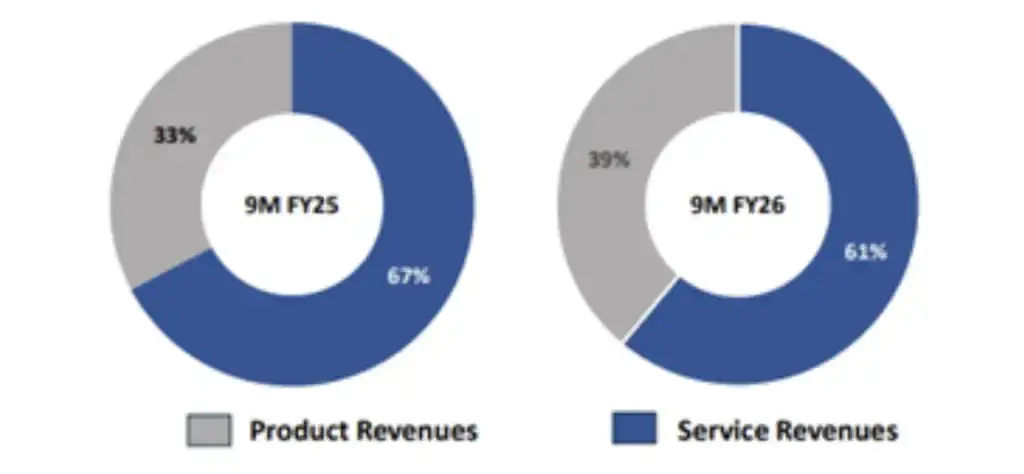
One of the strongest signals in the latest data is the company’s intention to move from services toward products and solutions. Management has indicated a target mix of 61:39 in favour of products and solutions by FY27.
That change is not cosmetic. A services heavy model generally scales with headcount, while a product or solution led model can scale with much better operating leverage. Each additional unit of revenue can require less incremental cost if the offering becomes more standardised or repeatable.
This is where valuation changes begin to matter. Product led businesses often earn higher multiples because they can grow without linear labour expansion. Investors tend to assign more value to companies that create intellectual property and repeatable solution sets.
AXISCADES is already showing early signs of this transition. The company said it has advanced facilities and infrastructure to support product driven non linear growth. That phrasing is important because it tells us the shift is not only strategic but also operational.
The integrated facility in Bangalore, with dedicated EMS, integration, testing, and MRO setups, is another clue that the company is moving closer to solution delivery rather than pure engineering support. That can deepen margins if executed well.
The key question is not whether the mix shifts. It is whether the company can build enough repeatable solutions to make the shift durable. That is where the real operating challenge lies.
Margins Are Expanding for Structural Reasons
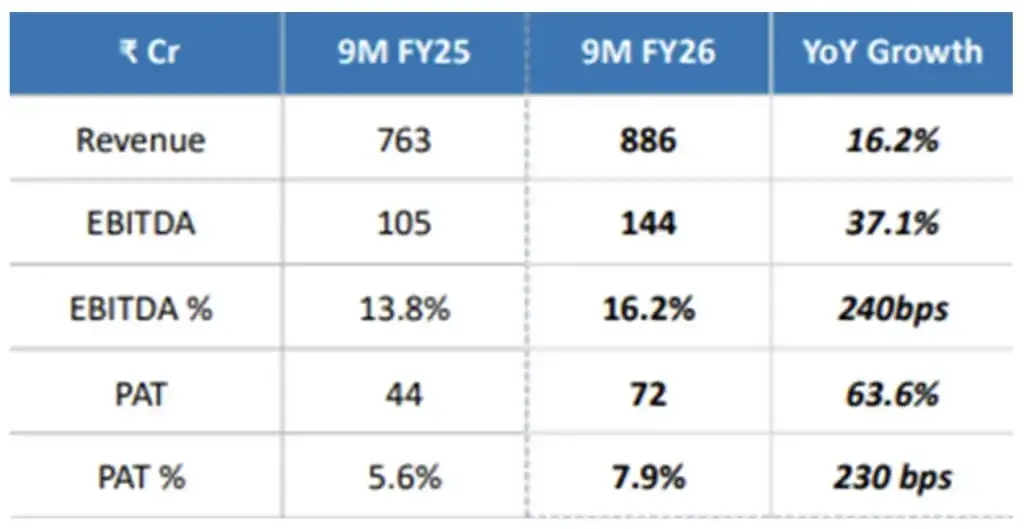
AXISCADES’ margin profile improved meaningfully in 9M FY26. Revenue rose to ₹886 crore, up 16.2 percent year over year. EBITDA rose to ₹144 crore, up 37.1 percent, while EBITDA margin improved from 13.8 percent to 16.2 percent.
PAT also rose sharply from ₹44 crore to ₹72 crore, a 63.6 percent increase. PAT margin improved from 5.6 percent to 7.9 percent. That is important because it shows profits are growing faster than revenue.
This kind of improvement usually does not happen by accident. It typically reflects a better mix of work, stronger utilisation, and a greater share of high margin programs. In AXISCADES’ case, that is exactly what the segment data suggests.
What makes this more compelling is that the company is not relying only on cost cutting. The improvement seems to be rooted in mix shift, capability expansion, and a growing contribution from the highest value verticals.
In other words, the margin story is structural, not merely cyclical. That distinction matters because structural margin improvement is more sustainable and usually deserves a better long term market view.
The Order Pipeline Gives the Story Time Depth
A strong business story needs visible demand, and AXISCADES appears to have that. The company disclosed that its international sales pipeline now exceeds USD 300 million in near term prospects, and these are said to be new customers expected to close in Q4 FY26 and Q1 FY27.
That is important because it gives the market a sense of conversion visibility rather than just abstract opportunity. Near term commercial visibility can reduce earnings uncertainty and support confidence in the growth runway.
The broader commentary is even more telling. Management referred to current forecast visibility at ₹3,400 crore and a total pipeline of ₹14,000 crore, with a 50 to 60 percent conversion ratio expected.
For an engineering company, that kind of pipeline is meaningful because the work is not usually short cycle. Once a program begins, it often flows through multiple phases of design, testing, validation, and support. That can sustain revenue for several quarters or even years.
The pipeline also appears well diversified geographically, with the company highlighting new clients across Europe and North America. That is valuable because it suggests the business is not relying purely on India driven demand.
When pipeline strength combines with margin expansion, the business starts to look much healthier than a simple services company. It begins to resemble a capability led growth platform.
Talent Is the Real Asset, Not Machinery
AXISCADES is asset light in the traditional sense. It does not need large factories to scale in the way a heavy manufacturing business would. Its main assets are engineers, design capability, process knowledge, and client relationships.
That model can be powerful because capital intensity stays moderate while returns on deployed capital can improve. But it also means the real constraint is human capital, not plant capacity.
The company reported that it had 2,812 employees and that revenue per employee rose 29 percent year over year. That is a strong sign that the business is using talent more efficiently and extracting more value from its engineering base.
It also said that over 700 professionals have been trained in aerostructures, PLM, CAE, manufacturing engineering, and tool design. That is not a random number. It suggests the company is actively building internal depth in highly specialised capabilities.
This matters because high end engineering businesses are only as strong as the quality of their people. Capability accumulation takes time, and once built, it can become a defensible advantage if the organisation retains talent well.
The hidden question for investors is whether AXISCADES can continue scaling talent without eroding margins. In niche engineering, hiring is not just a cost issue. It is a quality control issue.
Join 1,45,000+ investors discovering under-researched small caps before they rerate.
Acquisitions Have Been Used as Capability Builders
AXISCADES has not relied only on internal growth. It has also used acquisitions and strategic partnerships to strengthen its technical footprint. The acquisition of Mistral Solutions is the most obvious example, but it is not the only one.
The company also completed the acquisition of add solution GmbH, which was intended to strengthen its service offerings and broaden its access to global clients. That matters because it expands the company’s presence in markets that are harder to penetrate organically.
It has also approved the acquisition of EPCOGEN, a niche service provider in the energy space, with an eye toward Middle East and North American energy markets. Even though this is outside the core aerospace and defence narrative, it shows a deliberate pattern of building specialist capability.
The company’s strategic partnership with Cantier, a Singapore based MES specialist, is another indication that it is not thinking only in terms of labour based delivery. It is trying to widen the solution stack and improve manufacturing execution capability.
The Saltney, UK engineering design centre also fits this pattern. Rather than waiting for global opportunity to arrive, the company is placing design capability closer to international aerospace demand centres.
This acquisition and partnership strategy suggests management is not merely expanding geography. It is trying to build a larger technical moat through targeted capability addition.
The Non Core Business Still Matters, But in a Different Way
The weaker parts of the business should not be ignored, because they tell us where the company is still under pressure. Heavy Engineering and Auto generated ₹160 crore of revenue in 9M FY26 but delivered negative EBITDA of ₹10 crore.
That is a clear sign that some legacy areas are still diluting overall performance. The Energy segment, while positive, is still relatively small at ₹34 crore of revenue and ₹4 crore of EBITDA.
This matters because it shows the company is still in transition. The core segments are clearly stronger, but the legacy book has not fully been washed out of the system.
For investors, this is important because future margin expansion will partly depend on how fast the company can reduce the drag from weaker segments. A cleaner mix should translate into a cleaner earnings profile.
The good news is that the business is already showing a clear preference for core verticals. That means the negative parts are not the future story. They are the remnants of an older business structure. Their geographic revenue mix also shows their diversification and high export dominance and steady margins.
In analytical terms, the company is not yet perfect, but it is moving in the right direction. That transition phase is often where the most interesting re ratings begin.
Market Cap focus
No. of ideas in a year
Holding period
Pricing

Emerging Titans
Combination of quantitative analysis, industry tailwinds, and management assessment - SPRINT investment philosophy
Multi Cap
20-25
3+ Years
Rs. 23,999/year

Tiny Titans
Heavy emphasis on scuttlebutt research, plant visits, and early on-ground signals
Exclusively for SME's
15-20
3+ years
Rs. 31,999/year
Conclusion: The Real Question Is Not Demand, But Conversion
AXISCADES is not a generic engineering company. It is trying to build a concentrated position in the most complex layers of aerospace, defence, and advanced electronics. That is a much more interesting strategic position than being a broad based service provider.
The latest numbers show that the company has already moved a long way in that direction. Core verticals account for 78 percent of revenue, margins are rising, and the pipeline appears visible enough to support continued growth.
The company also seems to be making the harder strategic choices. It is leaning into defence, aerospace, and ESAI while allowing weaker legacy segments to become less central. That kind of portfolio discipline is often what distinguishes good companies from merely busy ones.
The real watchpoints now are execution, talent retention, and conversion of the large pipeline into realised revenue. If those pieces keep moving in the right direction, the business could keep improving in both quality and valuation.
At a broader level, AXISCADES represents something bigger than one company. It represents India’s move from being a manufacturing participant to a design and engineering participant in high complexity industries.
That is the deeper story. And that is why this company deserves attention not just as a stock, but as a signal of where India’s industrial capability is heading. Comment below “Aerospace” if you liked the article and share with your friends and family who may find this useful.
If this analysis added value, comment "Aerospace" and share your view, is Axiscades a buy, a hold, or a wait at current levels? The best investment insights come from the conversation.
FAQs
How does AXISCADES compare with Indian ER&D peers like Tata Elxsi or KPIT Technologies?
+
While companies like Tata Elxsi and KPIT Technologies focus heavily on automotive, mobility, and design-led software, AXISCADES is far more concentrated in aerospace and defence engineering. This makes its revenue less exposed to EV cycles and more aligned with long-cycle defence programs. However, it also means execution risk is higher due to the complexity and lower volume nature of projects.
Why does AXISCADES not show large order books like defence PSUs?
+
Unlike companies such as Hindustan Aeronautics Limited, AXISCADES operates in the engineering layer rather than manufacturing or system delivery. As a result, it works on program-based contracts rather than large turnkey orders. This makes traditional order book metrics less relevant, and investors need to focus more on pipeline visibility and client engagement depth instead.
Can AXISCADES benefit from global geopolitical tensions?
+
Yes, but indirectly. Rising geopolitical tensions are increasing global defence spending, especially in the US, Europe, and Asia. This leads to higher outsourcing of engineering work by global OEMs, which can benefit AXISCADES. However, the company’s growth depends on its ability to win engineering mandates, not on defence contracts directly, making the transmission of this benefit more gradual.
What role does currency movement play in AXISCADES’ profitability?
+
Given its growing international exposure, currency fluctuations can have a meaningful impact. A weaker rupee can improve realizations from export contracts, especially in aerospace and ESAI segments. However, since engineering work often involves long-term contracts, the benefit is not always immediate and depends on hedging strategies and billing structures.
Could AXISCADES eventually become an IP-led company rather than a services firm?
+
This is a key strategic possibility. With its push toward products and embedded systems, the company is gradually building intellectual property in niche areas. If it successfully scales this, AXISCADES could transition into a hybrid model combining engineering services with proprietary solutions, which would significantly enhance margins and valuation multiples over time.
About the author

Shashank Mahajan
High growth stock specialist, Value Educator
Shashank Mahajan is an equity research professional with over 12 years of experience in identifying high-potential SME and micro-cap stocks at an early stage. He follows a rigorous scuttlebutt research–driven approach, combining on-ground insights with deep financial analysis. Shashank specializes in uncovering under-researched and under-owned companies with strong management quality and long-term growth potential. Through disciplined research and early identification, he focuses on spotting tomorrow’s market leaders before they enter the mainstream investor radar.
Join 1,45,000+ investors discovering under-researched small caps before they rerate.











 Orders
 Subscription
 Share with friends


No comments yet. Be the first to comment!