
Granules India: From Paracetamol to a 65% Gross Margin
In FY23, five old molecules made up 84% of an Indian drug maker's revenue. They were paracetamol, metformin, ibuprofen, guaifenesin and methocarbamol, medicines for pain, fever, diabetes, cough and muscle spasms. Two years later, in FY25, the same five made up 62%. Over those two years revenue did not grow at all. It was ₹4,511.9 Cr in FY23 and ₹4,481.6 Cr in FY25. Yet the gross margin went from 48.9% to 61.5%, and in FY26 it reached 65.0%.
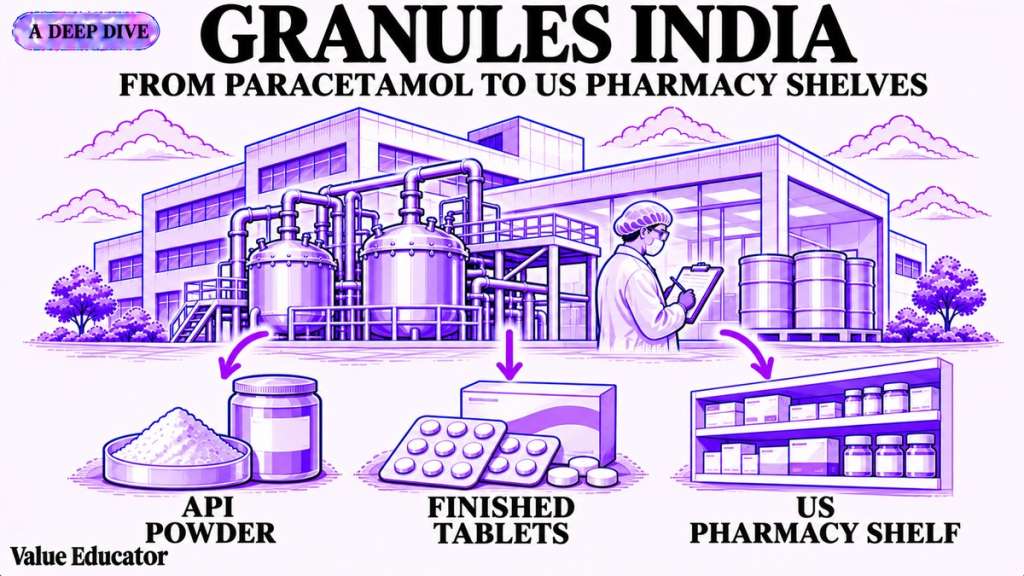
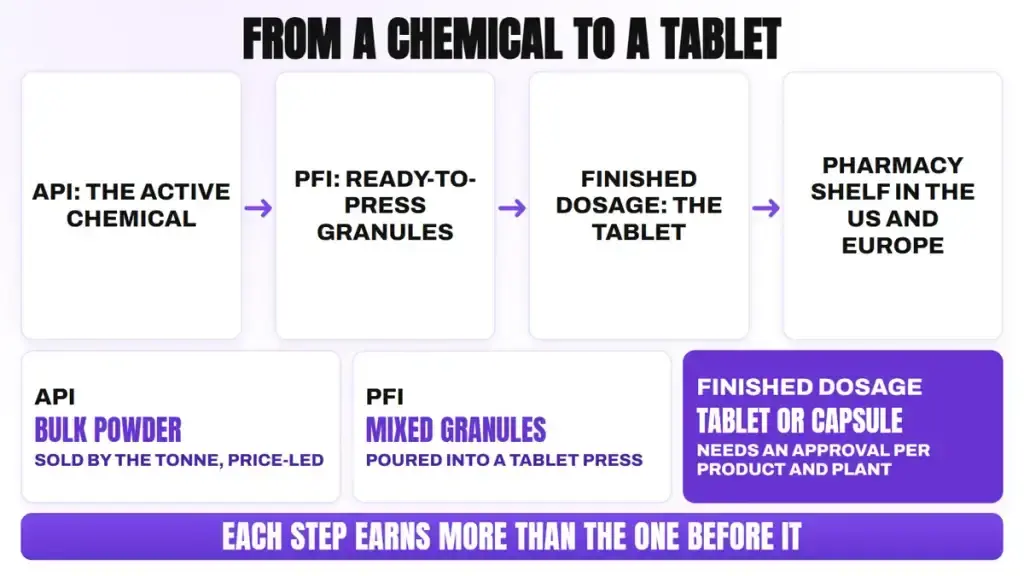
That shift matters because of how a drug reaches a patient. Every tablet starts with an active pharmaceutical ingredient, or API, which is the chemical that does the medical work, such as the paracetamol powder inside a fever tablet. A drug maker that sells only the API sells a bulk chemical, often by the tonne, to companies that make the tablets.
That API then goes one step further. A pharmaceutical formulation intermediate, or PFI, is the API already mixed with binders and fillers and made into granules, so that a tablet maker can pour it straight into a tablet press. The last step is called the finished dosage, or FD, which is the tablet or capsule itself, packed and sold under a pharmacy or retailer label.
Each step earns more than the one before it. An API sold by the tonne competes mainly on price, and Chinese and Indian plants can make the same molecule. A finished tablet sold on a pharmacy shelf in the US needs a US FDA approval for that product, from that plant. Fewer companies hold one, so the margin is higher.
That drug maker is Granules India Ltd (NSE: GRANULES). It began as a paracetamol API plant in Hyderabad four decades ago. Today it makes all three steps, plus a fourth business it bought in 2025: making peptides for other drug companies in Switzerland. It runs 10 manufacturing facilities, 7 in India, 2 in the US and 1 in Switzerland, and sells to more than 300 customers in more than 80 countries. In FY26 its revenue was ₹5,365.6 Cr, up 20%.
That move from chemical to tablet is now showing up in every line of its results. North America made up 72% of revenue in Q2 FY27, and about half of its finished dosages are now what the company calls complex generics.
Granules India in five numbers
- Q2 FY27 revenue of ₹1,560.0 Cr, up 20%
- Gross margin of 65.0% in FY26, against 50.0% in FY22
- Finished dosages at 73% of Q2 FY27 revenue
- Net cash of ₹828 Cr in September 2026
- 3 potential sole first-to-file ANDAs filed in the US
So a company once known for paracetamol by the tonne now earns most of its money from tablets on US shelves. How does that look in the latest numbers? Let's first understand the company, and then look at the latest quarter.
Granules India: Company Overview
Granules India Ltd was incorporated in 1991 and is headquartered in Hyderabad. It is a vertically integrated drug maker: it makes active pharmaceutical ingredients, pharmaceutical formulation intermediates and finished dosages, and since April 2025 it also makes peptides for other drug companies through Senn Chemicals in Switzerland. It runs 10 manufacturing facilities, 7 in India, 2 in the US and 1 in Switzerland, with approvals from regulators including the US FDA, EDQM and EU GMP authorities. It has 437 R&D scientists across 6 R&D centres, and it sells to more than 300 customers in more than 80 countries. Dr. Krishna Prasad Chigurupati is the Chairman and Managing Director, Priyanka Chigurupati is an Executive Director and Mukesh Surana is the Chief Financial Officer. Revenue from operations was ₹5,365.6 Cr in FY26, and the company held net cash of ₹828 Cr in September 2026. Read this How to Read a Profit & Loss Statement
"The stock market is a device for transferring money from the impatient to the patient."
— Warren Buffett
Granules spent two years with flat revenue while its gross margin rose by more than 12 percentage points. The change showed in the mix long before it showed in the top line.
The Quarter Revenue Crossed ₹1,500 Cr
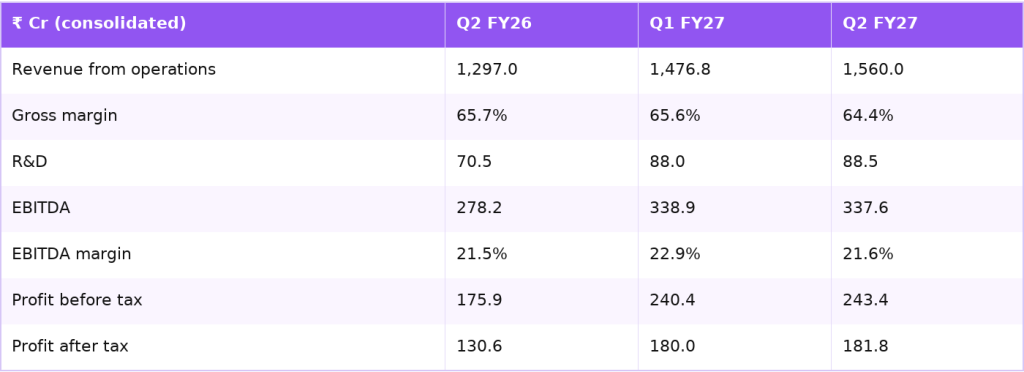
Let's look at Q2 FY27, the July to September quarter that the company reported on 2 November 2026. Revenue from operations was ₹1,560.0 Cr, up 20% from ₹1,297.0 Cr a year ago and 6% from ₹1,476.8 Cr in Q1 FY27. It was the first time quarterly revenue crossed ₹1,500 Cr.
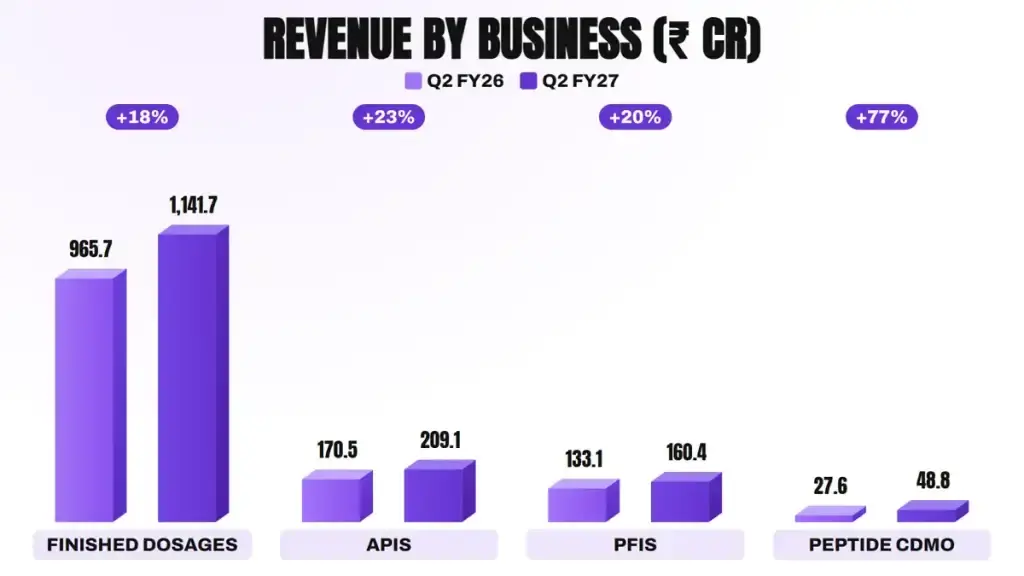
As we can see, all four businesses grew from a year ago. Finished dosages rose 18% to ₹1,141.7 Cr. APIs rose 23% to ₹209.1 Cr, and PFIs rose 20% to ₹160.4 Cr. The peptide business rose 77% to ₹48.8 Cr, though it was 19% lower than in Q1 FY27.
Beyond the businesses, the regions tell a second part of the quarter. North America brought in ₹1,125.7 Cr, up 14%, and made up 72% of revenue against 76% a year ago. Europe grew fastest, by 65% to ₹251.7 Cr, and now makes up 16% of revenue. The company says the peptide unit and a broader product range both helped Europe. The rest of the world grew 17% to ₹182.5 Cr.
Within finished dosages, the mix kept moving up. Complex generics grew 38% from a year ago and made up 47% of finished dosage revenue, against 40% in Q2 FY26. For the first half the share was 49%, and complex generic revenue grew 45%. We will see what the company means by complex generics in a later section.
But the gross margin slipped. It was 64.4%, down 134 basis points from a year ago and 126 basis points from Q1 FY27. The company blames higher input and logistics costs from the conflict in West Asia. In Q1 FY27 it had stocks in the US bought at older prices, which kept that quarter's margin near 65.6%. In Q2 the higher costs came through.
Even so, profit grew faster than revenue, and you can see why below the EBITDA line. EBITDA rose 21% to ₹337.6 Cr, in line with revenue. Read this EBITDA Explained: Uses and Limits But profit before tax rose 38% and profit after tax rose 39% to ₹181.8 Cr. Finance costs came down to ₹21.0 Cr from ₹29.2 Cr with lower debt, other income rose, and the profit margin rose to 11.7% from 10.1%.
That same pattern shows over the half year. H1 FY27 revenue was ₹3,036.7 Cr, up about 21.1% from ₹2,507.1 Cr. Profit after tax for the half was ₹361.8 Cr, up about 48.8% from ₹243.2 Cr. R&D spending was 5.8% of sales in the half.
Still, the cash lines need a closer look. Operating cash flow in Q2 FY27 was only ₹65.0 Cr, against ₹387.4 Cr in Q1 FY27 and ₹193.7 Cr a year ago. The company says it built up working capital on purpose to support growth and keep supplies steady. Net working capital was 30% of sales, against 29% in Q1. Capex in the quarter was ₹130.4 Cr, and ₹219.4 Cr for the half. Read this Cash Flow Statement Explained
Still, the balance sheet changed sharply in the quarter. In FY26 the company had issued 2,50,00,000 convertible warrants to its promoter group and other investors, and received a quarter of the money upfront. In Q2 FY27 holders of 2,49,82,906 warrants converted them into shares and paid the balance of ₹1,096.1 Cr. That moved Granules from net debt of ₹101.2 Cr in June 2026 to net cash of ₹828 Cr in September. Return on capital employed was 17.6%, against 18.0% in Q1.
"Cost pressures will persist and we are working with customers to manage them with a lag." - Dr. Krishna Prasad Chigurupati, Chairman and Managing Director, November 2026
How the Legacy Five Gave Way to Tablets
Now that we have seen the quarter, let's go back and see how the business changed. Granules grew up as a paracetamol company. It built a large paracetamol API plant at Bonthapally, near Hyderabad, and then learnt to sell the same molecules one step further down the chain, as PFIs and as finished tablets.
For years that model worked through scale. The company calls paracetamol, metformin, ibuprofen, guaifenesin and methocarbamol its legacy five. Between FY16 and FY23 these five products made up 81% to 86% of revenue every year. Granules made them in huge volumes at low cost, and its customers were other drug makers and retailers around the world.
Then two things happened in FY24 and FY25. Paracetamol API sales went down in both volume and price, and the company said demand was soft across the industry. A cyber attack in FY24 also disrupted operations. API revenue went from ₹1,341.4 Cr in FY23 to ₹618.5 Cr in FY25. PFI revenue went from ₹902.1 Cr to ₹429.4 Cr over the same two years.

Over those same years, the finished dosages business kept growing. FD revenue rose from ₹1,944.2 Cr in FY22 to ₹3,433.6 Cr in FY25, and to ₹3,989.3 Cr in FY26. So the API and PFI revenue the company lost was replaced, almost rupee for rupee, by tablet revenue. Finished dosages went from 65% of revenue in FY24 to 77% in FY25.
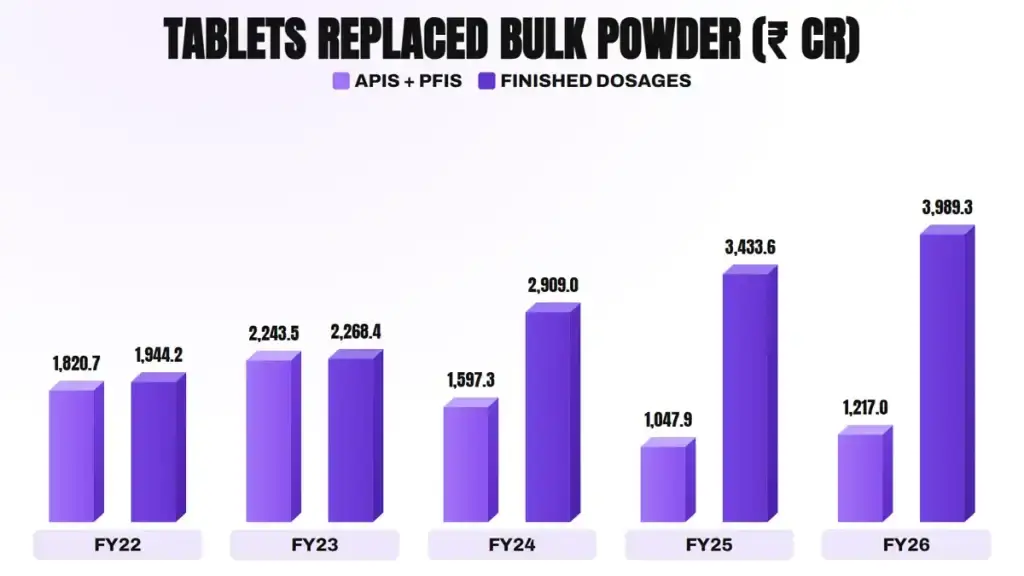
That swap shows clearly in the margins. A finished tablet carries more value per rupee of raw material than the bulk powder inside it. So as the mix moved, the gross margin rose from 48.9% in FY23 to 55.1% in FY24, 61.5% in FY25 and 65.0% in FY26. Revenue was flat for two years, but gross profit grew. The EBITDA margin moved less, from 19.0% in FY24 to 22.1% in FY26, because the company was also spending more on people and R&D.
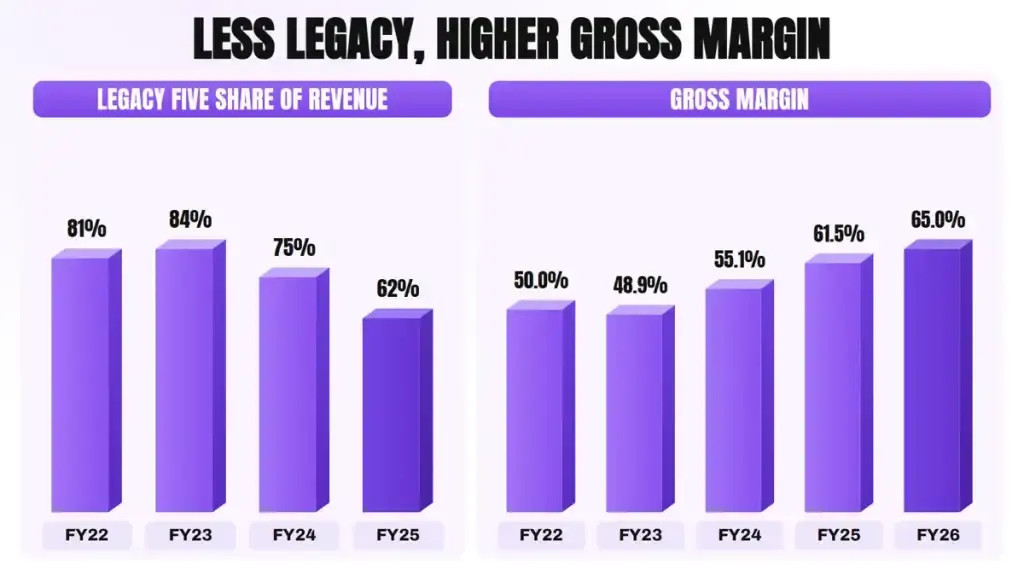
Still, the legacy five did not disappear. The company still describes paracetamol, metformin and ibuprofen as part of its core portfolio, and it still makes them in large volumes. It is also working on cleaner ways to make them. Its subsidiary Granules CZRO has developed a continuous process for para-aminophenol, the main raw material for paracetamol, and runs a pilot plant for dicyandiamide, a raw material for metformin, at Visakhapatnam. But the legacy share of revenue went from 84% in FY23 to 75% in FY24 and 62% in FY25.
Those legacy products are still exposed to cost swings. In Q1 FY27 the company held back some supplies of the legacy five because it could not pass on rising input costs to long-standing customers. That is the old business showing its limits: when costs rise, a bulk molecule has little room to raise its price.
"Know what you own, and know why you own it."
— Peter Lynch
Granules' revenue stood still for two years while its profit per rupee of sales changed. Knowing which business brings in the revenue is the first step to understanding this company.
"Granules today is no longer a company defined by volume and cost alone." - Dr. Krishna Prasad Chigurupati, Chairman and Managing Director, July 2026
Four Businesses With Four Different Margins
Now let's split the business into its parts, because each one earns differently. Granules reports one segment, pharmaceuticals, but it shows revenue for four businesses every quarter. The table below sets them side by side. Read this Segment-Wise Revenue Analysis Explained
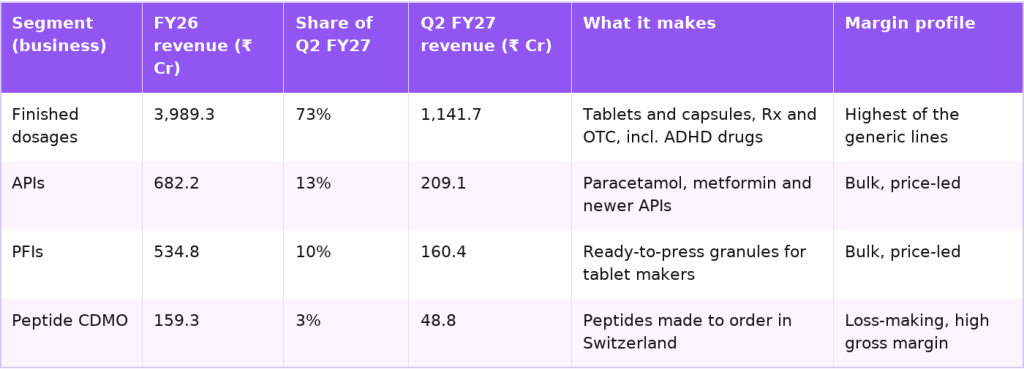
These four sound alike, but as you will see, each one asks for something different. APIs and PFIs are about cost and scale on large volumes. Finished dosages are about US FDA approvals, supply records and a portfolio that rivals cannot easily copy. Peptides are about chemistry skill and winning projects from innovator drug companies.
Finished Dosages and the US Business
Let's start with finished dosages, which bring in nearly three-quarters of revenue. The company splits them into three baskets. Integrated generics are high-volume tablets where Granules also makes the API, such as its legacy molecules. Complex generics are products that are hard to develop, hard to make or hard to get past patents. Others are opportunity products picked up when a market has a shortage.
Complex generics are where the growth comes from. Their share of FD revenue went from 40% in Q2 FY26 to 47% in Q2 FY27. A big part of this basket is drugs for ADHD, attention deficit hyperactivity disorder. In the US these are Schedule II controlled substances, which means the US Drug Enforcement Administration sets yearly quotas for the API and checks every step of making and storing them.
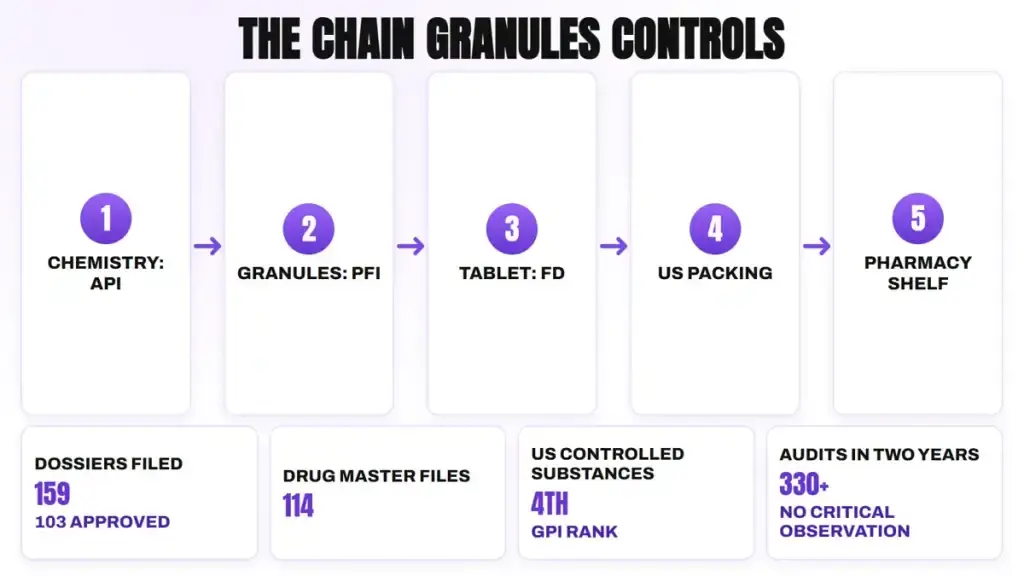
That ADHD franchise is run mostly from Granules Pharmaceuticals Inc. (GPI), its US subsidiary in Chantilly, Virginia. GPI has its own R&D centre, a plant with a capacity of 1.5 Bn doses a year and its own packaging plant. It is approved by both the US FDA and the DEA. The company says GPI has risen to the 27th largest US generic company by sales value, from 74th in FY21, and is the 4th largest in controlled substances.
That growth shows in GPI's own accounts. Its consolidated turnover was ₹3,659.0 Cr in FY26, against ₹2,931.6 Cr in FY25, and its profit after tax nearly doubled to ₹334.9 Cr from ₹169.8 Cr. Across the US, Granules says 11 of its 38 products rank first in their market and 19 rank in the top three.
Making these drugs is the hard part. Each ADHD product comes in several strengths with very low doses, so every tablet has to carry an exact, tiny amount of drug. Management says rivals often run out of stock because of manufacturing problems, while Granules keeps supplying. In a market where patients can go without treatment during shortages, steady supply wins orders.
Europe is the second market for finished dosages. Granules first sold paracetamol and metformin tablets in Hungary, Ireland, Germany and the UK, and has since filed many more products there. Europe grew 81% in FY26 to about 15% of revenue, and 49% without the Swiss peptide unit.
The API and PFI Base
Next, let's look at the API and PFI base that Granules was built on. Its Bonthapally plant has 34,560 tonnes a year of API capacity, and the group's total API capacity is 39,360 tonnes a year. APIs brought in ₹682.2 Cr in FY26, and PFIs ₹534.8 Cr.
These two businesses now do two jobs. First, they supply the company's own tablet plants, so Granules controls the cost and supply of its main raw materials. That is what makes its integrated generics cheap to make. Second, they still sell to outside customers. In Q4 FY26, API sales grew 33% because of newer APIs that Granules first developed for its own tablets and now sells outside too.
Of the two, the PFI business is the more unusual. Granules introduced the idea of selling commercial PFIs, with a six-tonne batch size that places it among the largest in India. Its Gagillapur site has 23,200 tonnes a year of PFI capacity. A customer that buys PFIs avoids mixing and granulating itself. The company calls this its "drum to hopper" model, where granules go straight from a drum into the tablet press.
Peptide CDMO Through Senn Chemicals
Now let's move to the newest business. Peptides are short chains of amino acids. Many newer medicines, including drugs for diabetes and obesity, are peptides, and they are harder to make than ordinary tablets. A CDMO, or contract development and manufacturing organisation, develops and makes such molecules for drug companies that own them.
Granules entered this business in April 2025 by buying Senn Chemicals AG of Switzerland, a peptide maker with a six-decade history, at an enterprise value of ₹450 Cr. The unit runs under the name Ascelis Peptides. Senn is known for liquid-phase peptide synthesis, and it also serves cosmetic brands that use peptides in skin care.
Its first year was a loss. Peptide CDMO revenue was ₹159.3 Cr in FY26, about 3% of the group, and its EBITDA loss was ₹44.5 Cr. Q4 FY26 was its first quarter of positive EBITDA, when revenue rose to about ₹70 Cr from ₹33 Cr. The EBITDA loss came back in FY27: ₹12.4 Cr in Q1 and ₹15.2 Cr in Q2, against ₹20.0 Cr in Q2 FY26. Management says project timing makes this business lumpy from quarter to quarter.
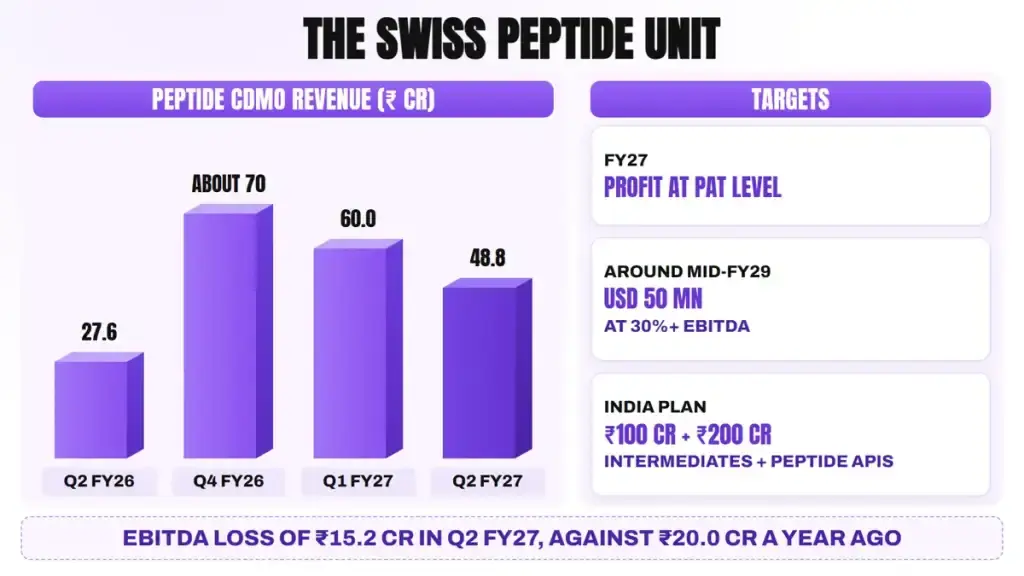
Management's target for the unit is clear. For FY27 it aims to make the peptide business profitable at the profit-after-tax level for the full year. Over a longer period it targets about USD 50 Mn of yearly revenue at an EBITDA margin above 30%, around the middle of the third year from mid-2026. It also wants three customer wins worth more than USD 10 Mn a year each.
To reach that target, the company is adding solid-phase reactors, large purification columns and freeze-drying capacity in Zurich. In India it runs a peptide R&D centre at IIT Hyderabad and has set aside land at Visakhapatnam for a peptide plant. Its first estimate is about ₹100 Cr for peptide intermediates and about ₹200 Cr for peptide APIs, spread over more than one year.
Oncology From Visakhapatnam
Finally, let's look at a business that is still small. The Visakhapatnam Unit V plant makes cancer drugs, with a finished dosage capacity of 1.1 Bn doses a year. Until now it has mostly done contract work and sold some APIs, and its revenue has been minimal.
That should change from FY28 and FY29, when Granules plans to launch its first self-developed cancer drug, fully integrated from the API, across several countries. It has 9 to 13 oncology products in different stages of development. The company's own plan calls this an "oncology reset" that restarts in FY29.
Why a Molecule-to-Tablet Chain Is Hard to Copy
Now that we have seen the four businesses, let's understand the moat. In generic drugs, anyone can copy a molecule once its patent ends. What is hard to copy is the whole chain around it: cheap chemistry, an approved plant, and a record of supplying without fault. Read this Economic Moat Explained
Granules owns more of that chain than most. It makes the API, turns it into a PFI, presses the tablet and packs it, in some cases in its own US packaging plant. When raw material prices or supplies get tight, a company that makes its own API can keep its tablets on shelves while others wait. Management calls this integration "from molecule to the tablet".
Beyond integration, approvals add a second layer. Every product needs its own approval for each plant and each country. Granules has filed 159 dossiers worldwide, of which 103 are approved and 3 tentatively approved. In the US it has filed 94 and won approval for 68. It has also filed 114 drug master files for its APIs in the US, Europe, Canada, Japan, Korea, Brazil and China. A drug master file is the API maker's confidential file that a regulator reviews before approving a tablet that uses that API.
Next, controlled substances add a third layer. A company needs DEA licences and API quotas to make ADHD drugs, and it must prove it can track every gram. Few generic makers choose to do this, and fewer do it at scale.
"In business, I look for economic castles protected by unbreachable moats."
— Warren Buffett
For a generic drug maker, the moat is not the molecule. It is the approved plant, the controlled-substance licence and the record of supplying without fault, each earned over years. That is one reason GPI could climb into the top four of US controlled-substance generics.
The newest layer is legal. Granules now files complex products under Paragraph IV, where a generic maker claims that a brand's patent is invalid or not infringed. The first company to file such a challenge can win 180 days of exclusive sales, called first-to-file. Granules has three potential sole first-to-file filings: an amphetamine extended-release tablet, sodium oxybate extended-release oral suspension and ruxolitinib extended-release tablets.
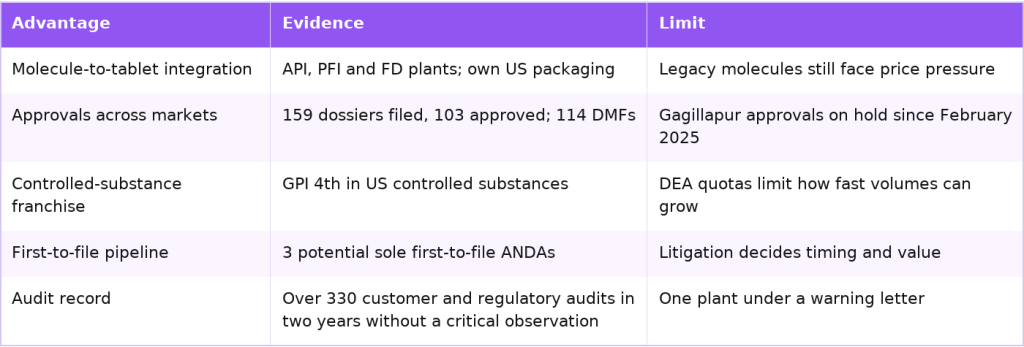
That table shows us why the US FDA is the real test of this moat. Every advantage above depends on plants staying approved. That brings us to the plant that has held the company back for two years.
Gagillapur, Genome Valley and the Waiting Launches
Now let's look at the regulatory side, because it decides how fast the pipeline turns into revenue. Gagillapur, near Hyderabad, is Granules' largest finished dosage site. It has a capacity of 26.8 Bn doses a year and also makes PFIs.
In August 2024 the US FDA inspected Gagillapur and issued six Form 483 observations, the list of problems an inspector finds. The inspection was classed as official action indicated. On 26 February 2025 the FDA issued a warning letter for the site. A warning letter does not stop sales of products already approved, and Granules kept supplying them, apart from a short voluntary pause in September 2024. But the FDA does not approve new products from a site under a warning letter.
The company spent the next year and a half on fixing the site. It started more than 140 corrective and preventive actions with outside consultants, completed cleaning validation across the PFI, MUPS and finished dosage blocks, and met the FDA in January 2026. Remediation costs, high in H1 FY26, came down to less than $1 Mn a quarter by mid-2026.
Then, in October 2026, the FDA came back. It inspected Gagillapur and issued a new Form 483. The company says none of the new observations relate to data integrity or cross-contamination, that it is responding within the deadline, and that there is no impact on making or distributing products from the site. The inspection report is still awaited.
That report matters because of what is waiting behind it. Nine applications from Gagillapur are ready to launch once the site is cleared, for products with a US market of about $11 billion. In all, Granules has 26 ANDAs under approval for a US market of about $35 Bn. That is the market size of the products, not revenue that Granules can expect.
What the Gagillapur report decides: nine applications ready to launch, for products with a US market of about $11 billion, plus a second approved site for the products now moved to Genome Valley and GPI.
In the meantime, the company moved products to other plants. Its new Genome Valley plant, run by subsidiary Granules Life Sciences (GLS), has a capacity of 10 Bn doses a year and adds about 40% to the group's formulation capacity. It passed a US FDA inspection with a voluntary action indicated result in March 2026, which means no regulatory action. Granules has also filed product transfers to GLS and GPI so that each product can be made at more than one site.

Still, GLS is ramping up slowly. Its turnover rose to ₹211.9 Cr in FY26 from ₹62.1 Cr in FY25. But its use of capacity was about 25% in Q2 FY27, and management expects it to cross 50% by March 2027. The company says that without the ramp-up investments at Genome Valley and Senn, its return on capital employed would be about 25%, against the reported 17.6%.
Financials: Five Years of Revenue, Margins and Profit
One quarter can mislead in a business where the product mix changes this much, so let's look at five full years together. Revenue here is revenue from operations, and EBITDA is as the company reports it, without other income.
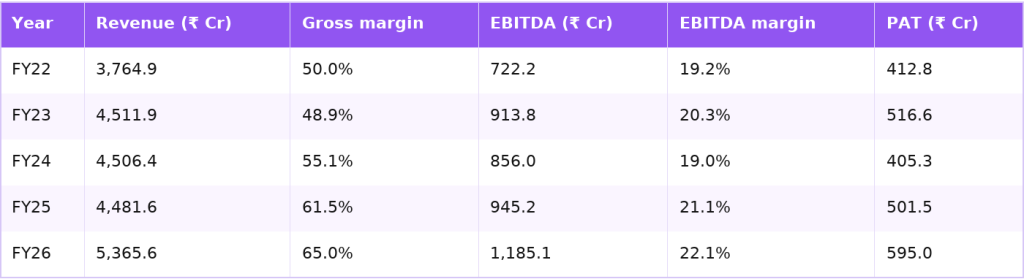
Revenue grew about 1.4 times in four years, from ₹3,764.9 Cr in FY22 to ₹5,365.6 Cr in FY26, but almost all of that came in FY23 and FY26. In between, revenue stood still for two years while API and PFI sales fell. The gross margin rose every year from FY23, from 48.9% to 65.0%, yet the EBITDA margin moved far less, from 20.3% to 22.1%, because people costs, R&D and remediation costs rose too.
Cash flow was steadier than profit. Operating cash flow was ₹866.6 Cr in FY25 and ₹793.3 Cr in FY26, against capex of ₹554.7 Cr in FY26. Net debt fell from ₹706.1 Cr in FY25 to ₹402.1 Cr in FY26, helped by ₹665.6 Cr of new equity, and the warrant money in Q2 FY27 turned it into net cash of ₹828 Cr.
Return on capital employed rose from 16.6% in FY25 to 17.6% in FY26. The new Genome Valley plant and the peptide unit are still being filled, so that return will depend on how fast they ramp up.
"In the short run, the market is a voting machine but in the long run, it is a weighing machine."
— Benjamin Graham
Granules' five-year table shows why: revenue moved in jumps, but the gross margin climbed step by step. Over time, what a company earns on each rupee of sales is what gets weighed.
What FY28 Could Look Like on Management's Numbers
So where does Granules go from here? Management has not given a revenue number for FY27. Asked about growth after Q1, the chairman said the company is confident its growth will continue. It has given numbers on margins, spending and the peptide unit instead.
On margins, management expects EBITDA margins to stay around 22-23%, against 21.6% in Q2 FY27. R&D spending should be about 5.5-6% of sales, against 5.7% in Q2. Cost inflation from West Asia will persist, and the company plans to pass it on to customers with a lag.
Alongside margins, the capital plan is spread over several years. Capex for FY27 is guided at about ₹600 Cr, of which ₹219.4 Cr was spent in H1. More than ₹200 Cr of that goes into a distribution centre in the US. Over three to four years the company expects about ₹2,000 Cr of organic capex, funded from the net-cash balance sheet. The ₹100 Cr and ₹200 Cr peptide projects in India sit on top.
Next, the launch timeline depends on the FDA. If Gagillapur is cleared, the company expects about nine US launches in FY27. It expects one to two new controlled-substance launches over the next one and a half to two years, with several more that depend on patent challenges. It also set up subsidiaries in Brazil in September 2026 and in Mexico in October 2026 adding two new markets in Latin America.
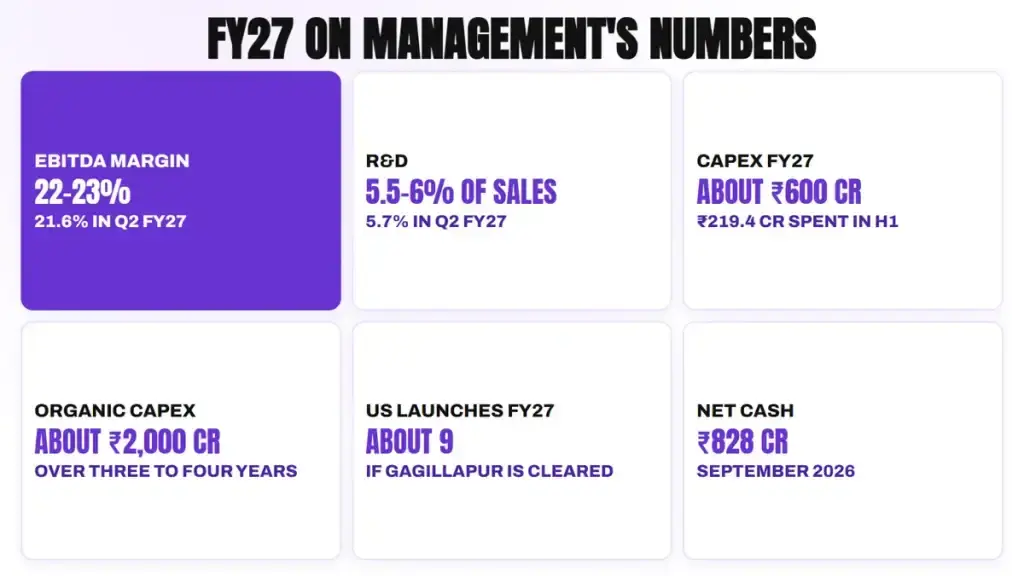
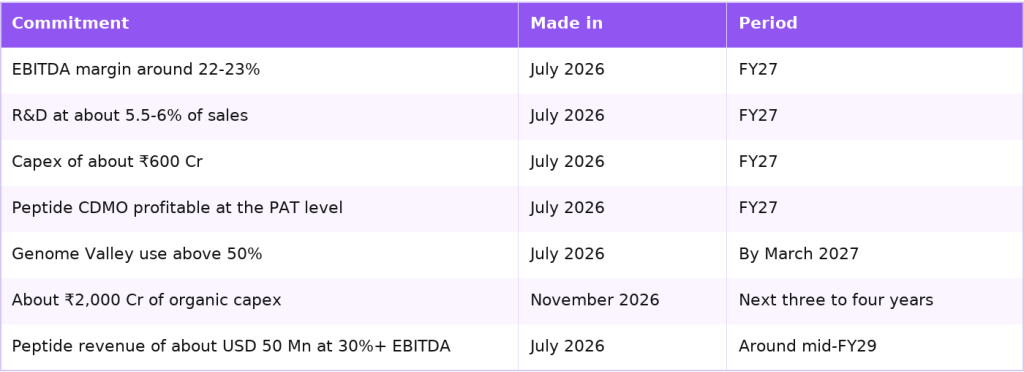
Those commitments are easier to judge against the past. So let's check what management said before against what it delivered.

That record shows us a clear pattern. The shift to finished dosages and complex generics, the main plan of the last four years, has been delivered and shows in the gross margin. The newer pieces, the peptide unit, the Genome Valley ramp-up and the R&D budget, have moved slower than planned. That makes those three the numbers to watch from here.
Key Risks
Now let's look at what could go wrong for Granules India, because some of these risks are already in the numbers.
- The Gagillapur outcome: the FDA issued a new Form 483 in October 2026 and the inspection report is awaited. If the warning letter stays, nine ready applications stay blocked.
- Input and logistics costs: the gross margin fell 134 basis points to 64.4% in Q2 FY27, as West Asia raised raw material, packing and freight costs. The company passes these on only with a lag.
- Peptide losses: the peptide unit lost ₹15.2 Cr at the EBITDA level in Q2 FY27, its revenue fell 19% from Q1, and its FY27 profit target is not yet in sight.
- Cash conversion: operating cash flow was ₹65.0 Cr in Q2 FY27, against EBITDA of ₹337.6 Cr. Net working capital is 30% of sales.
- Dependence on the US: North America is 72% of revenue. US generic prices, DEA quotas and FDA decisions all fall on one market.
- Legacy price pressure: the company had to hold back some legacy supplies in Q1 FY27 when it could not pass on costs, and API and PFI sales fell sharply in FY24 and FY25.
- Patent litigation: first-to-file products launch only after patent cases or settlements, so their timing and value are uncertain.
- Slow use of new capacity: Genome Valley ran at about 25% in Q2 FY27, which holds down return on capital until it fills.
- More shares: the warrant conversion added 2,49,82,906 shares in Q2 FY27, so profit is now spread over a larger share base.
"We cannot tell the FDA when to come, but we can be ready every single day, and we are ready." - Dr. Krishna Prasad Chigurupati, Chairman and Managing Director, July 2026
"All I want to know is where I'm going to die, so I'll never go there."
— Charlie Munger
For Granules, the places to avoid are clear from the list above: a plant that stays under a warning letter, a peptide unit that keeps losing money and costs that cannot be passed on. The tracking list below shows how to see which way each one goes.
Explore our Products
Research Framework

Emerging Titans
Combination of quantitative analysis, industry tailwinds, and management assessment - SPRINT investment philosophy

Tiny Titans
Heavy emphasis on scuttlebutt research, plant visits, and early on-ground signals
What to Track Next
If you follow Granules India, these are the signals that will show where it goes next.
- The US FDA's report on the October 2026 Gagillapur inspection, and any lifting of the warning letter
- US launches from the nine applications waiting on Gagillapur
- The gross margin after 64.4%, as input costs rise and complex generics grow
- Peptide CDMO revenue and EBITDA each quarter, against the FY27 profit target
- Genome Valley use against the 50% plan for March 2027
- Operating cash flow and working capital after the ₹65.0 Cr of Q2 FY27
- Court outcomes on the three potential sole first-to-file filings
Members can read our full Research Desk report on Granules India, with its detailed scorecard and section-by-section analysis.
Conclusion
Let's put it all together. Granules India has moved from a paracetamol and metformin powder maker to a company that earns 73% of its revenue from finished dosages. Its gross margin rose from 50.0% in FY22 to 65.0% in FY26, even in two years when revenue stood still, and Q2 FY27 revenue crossed ₹1,500 Cr for the first time. The cautious thread is the gross margin, which slipped to 64.4% as input costs rose, and the weak operating cash flow of Q2 FY27. The next two quarters, and the FDA's report on Gagillapur, will show which thread is stronger.
Still, the next step depends on more than the mix. What happens next depends on whether the FDA clears Gagillapur, whether the Swiss peptide unit turns profitable, and whether complex generics keep the gross margin up while input costs rise.
FAQs
What does Granules India do?
+Granules India is a vertically integrated drug maker. It makes active pharmaceutical ingredients such as paracetamol and metformin, ready-to-press granules called PFIs, and finished tablets and capsules sold mainly in the US and Europe. Since April 2025 it also makes peptides for other drug companies through Senn Chemicals in Switzerland. FY26 revenue from operations was ₹5,365.6 Cr.
How did Granules India do in Q2 FY27?
+Revenue from operations rose 20% to ₹1,560.0 Cr, the first quarter above ₹1,500 Cr. EBITDA was ₹337.6 Cr at a 21.6% margin, and profit after tax rose 39% to ₹181.8 Cr. The gross margin fell to 64.4% from 65.7% because of higher input and logistics costs.
Why did Granules India's gross margin rise?
+The company sold less bulk API and PFI and more finished dosages, which carry more value per rupee of raw material. The share of its five legacy molecules fell from 84% of revenue in FY23 to 62% in FY25, and the gross margin rose from 48.9% in FY23 to 65.0% in FY26.
What is the Gagillapur warning letter?
+The US FDA issued a warning letter for the Gagillapur finished dosage site in February 2025, after an inspection in August 2024. Approved products kept selling, but new approvals from the site were put on hold. The FDA inspected the site again in October 2026 and issued a Form 483; the company says none of the observations relate to data integrity or cross-contamination, and the inspection report is awaited.
What is Granules India's peptide CDMO business?
+Granules bought Senn Chemicals of Switzerland in April 2025 at an enterprise value of ₹450 Cr. The peptide business brought in ₹159.3 Cr in FY26 with an EBITDA loss of ₹44.5 Cr, and ₹48.8 Cr in Q2 FY27 with a loss of ₹15.2 Cr. Management targets a full-year profit at the PAT level in FY27 and about USD 50 Mn of revenue at above 30% EBITDA margin around mid-FY29.
What are the main risks for Granules India?
+The main risks are the outcome of the Gagillapur re-inspection, input and logistics cost inflation, continued losses in the peptide unit, weak operating cash flow in Q2 FY27, dependence on North America for 72% of revenue, and patent litigation that decides the timing of first-to-file launches.

High growth stock specialist, Value Educator
Shashank Mahajan is an equity research professional with over 12 years of experience in identifying high-potential SME and micro-cap stocks at an early stage. He follows a rigorous scuttlebutt research–driven approach, combining on-ground insights with deep financial analysis. Shashank specializes in uncovering under-researched and under-owned companies with strong management quality and long-term growth potential. Through disciplined research and early identification, he focuses on spotting tomorrow’s market leaders before they enter the mainstream investor radar.
Glenmark: The USD 700 Mn Cancer Deal and Its Brands
Pharma Stocks in India 2026: Generics, APIs and CDMOs
Natco Pharma: After Revlimid, 29 Patent Challenges
Shilpa Medicare: Cancer APIs, Films and Biosimilars
Alembic Pharma: US Plants Pay Back, Margin Hits 22.2%
Supriya Lifescience: APIs, Ambernath and a 22% Margin
Explore our Products
Research Framework
Emerging Titans
Combination of quantitative analysis, industry tailwinds, and management assessment - SPRINT investment philosophy
Tiny Titans
Heavy emphasis on scuttlebutt research, plant visits, and early on-ground signals



Modern Warfare to Multibaggers
Key Trends. Strategic Shifts. Opportunities Ahead.
Don't Miss This Exclusive Webinar!
Join Value Educator to decode the key trends shaping India's defence sector and learn how to identify tomorrow's potential leaders in the space.
- In-depth research on India's defence sector
- Live Q&A session
- Actionable takeaways for long-term investors

 Orders
 Subscription
 Share with friends


Required Details
₹23999.00
(12 month subscription)
As per SEBI regulations, all users are mandated to complete the KYC that is validated for 1 year. Post payment, you will be redirected to the KYC screen


No comments yet. Be the first to comment!