
Natco Pharma: After Revlimid, 29 Patent Challenges
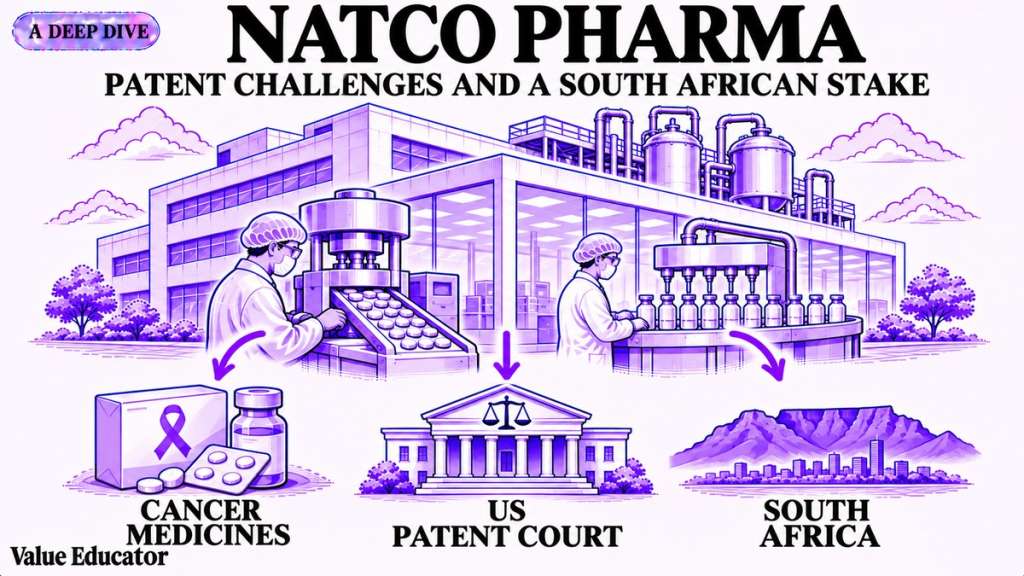
In the March 2022 quarter, a Hyderabad drug maker began selling a generic copy of Revlimid, a pill for the blood cancer multiple myeloma, in the United States. Over the next three years its total revenue rose from ₹2,043.8 Cr in FY22 to ₹4,784.0 Cr in FY25. Its profit after tax rose about eleven times, from ₹170.0 Cr to ₹1,883.4 Cr. Then the copy ran its course, and by the December 2025 quarter the company said it had sold no Revlimid at all.
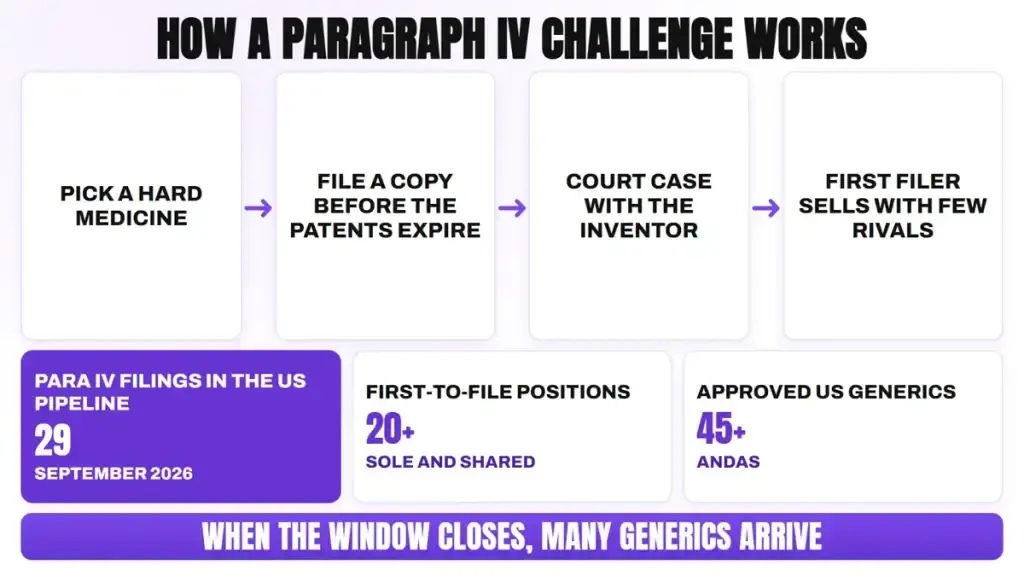
That one product came from a very particular way of making generic medicines. A generic maker usually waits for a drug's patents to expire and then sells a cheaper copy. In the US, a maker can also file to sell a copy before that, by telling the regulator that the patents are invalid or are not infringed by its version. This is called a Paragraph IV filing, and it nearly always ends in a court case with the original inventor.
That fight has a prize, and it goes mostly to whoever filed first. A company that files first is called first-to-file, or FTF, and it can earn a period in which only it, or only a handful of makers, may sell the generic. During that window prices stay high, so a single product can earn more in a year than the rest of the company. When the window closes, many generics arrive and prices fall away.
That Hyderabad company is Natco Pharma Ltd (NSE: NATCOPHARM), set up in 1981 and run today by Chairman and Managing Director V.C. Nannapaneni and Vice Chairman and CEO Rajeev Nannapaneni. It builds its business around this model. It picks hard-to-make medicines, mostly for cancer, files the challenges, and leaves the selling and the court cases in the US to larger partners. Alongside, it sells cancer and specialty medicines in India, runs subsidiaries in Brazil and Canada, makes its own active ingredients and, since 2019, sells crop protection products.
On top of that model, in the last year Natco also bought 49% of Adcock Ingram, the second-largest South African drug maker by private market share. Natco books its share of Adcock's profit, but not its revenue, because Adcock is an associate. An associate is a company in which Natco holds a large minority stake without control.
Natco Pharma in five numbers
- Q2 FY27 total revenue of ₹1,019.4 Cr, up 28.3% on the June quarter but down 30.3% on a year ago
- 29 Paragraph IV filings in the US pipeline, with over 20 first-to-file positions
- A 49% stake in Adcock Ingram, which earned US$57 million on revenue of US$592 million in its year to June 2026
- FY26 profit after tax of ₹1,418.5 Cr, against a FY27 profit guidance of about ₹750 Cr
- A rights issue of 17,058,082 shares at ₹750 each, about ₹1,279.4 Cr
So a company that earned most of its profit from one product is now resetting to a smaller base and spending heavily on what comes next. What does that base look like? Let's first understand the company, and then look at the latest quarter, which Natco reported on 13 November 2026.
Natco Pharma: Company Overview
Natco Pharma Ltd was set up in 1981 and is based in Hyderabad. It develops, makes and sells generic and specialty medicines, mostly for cancer, along with active pharmaceutical ingredients and crop protection products. It runs nine manufacturing plants in India, seven for medicines and two for agro products, and sells in more than 50 countries through 13 subsidiaries and step-down subsidiaries and an associate. In the US it works with partners such as Teva, Mylan, Lupin and Breckenridge, which sell its products and fight the patent cases. V.C. Nannapaneni is the Chairman and Managing Director and Rajeev Nannapaneni the Vice Chairman and CEO, and the company had 5,060 permanent employees in March 2026. Total revenue was ₹4,375.9 Cr in FY26, and return on equity came down from 24.7% in FY25 to 15.4% in FY26 as the lenalidomide years ended. Read this Return on Equity (ROE) Explained
"The stock market is a device for transferring money from the impatient to the patient."
— Warren Buffett
Natco's management says its best bets take eight to ten years to pay off. A company built on patent challenges asks its shareholders for the same patience.
The Quarter After the Windfall
Let's begin with the first full quarter after the windfall, with the larger Adcock stake in place. In Q2 FY27, the July to September quarter, total revenue was ₹10,194 Mn, or ₹1,019.4 Cr. That was up 28.3% from ₹794.4 Cr in the June quarter but down 30.3% from ₹1,463.0 Cr a year ago. The year-ago quarter still had lenalidomide sales, the generic name of Revlimid, and this one had almost none.
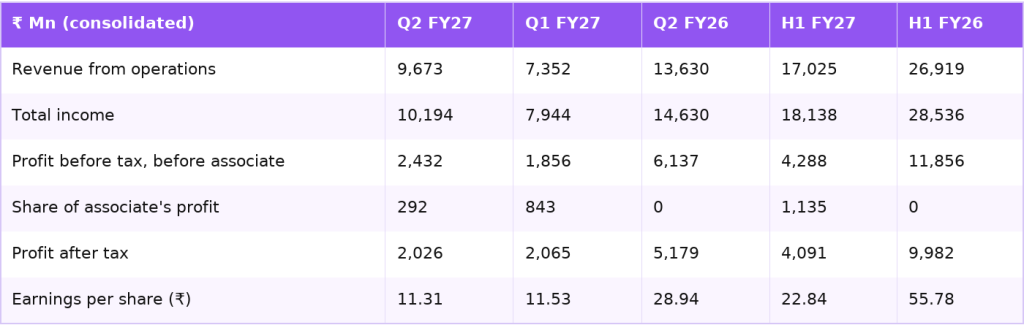
Those numbers show the reset in two ways. Revenue from operations was ₹967.3 Cr, down 29.0% from a year ago, so the size of the business has reset. Yet against the June quarter, the business before Adcock grew, with profit before tax up from ₹185.6 Cr to ₹243.2 Cr.
That growth came from the international business. International formulations, which include the US partners' profit share and the overseas subsidiaries, brought in ₹668.4 Cr. That was 40.1% more than ₹477.1 Cr in the June quarter, but 41.4% less than ₹1,140.2 Cr a year ago. Brazil, Canada and the US all add to this line, and the company does not split it by country every quarter.
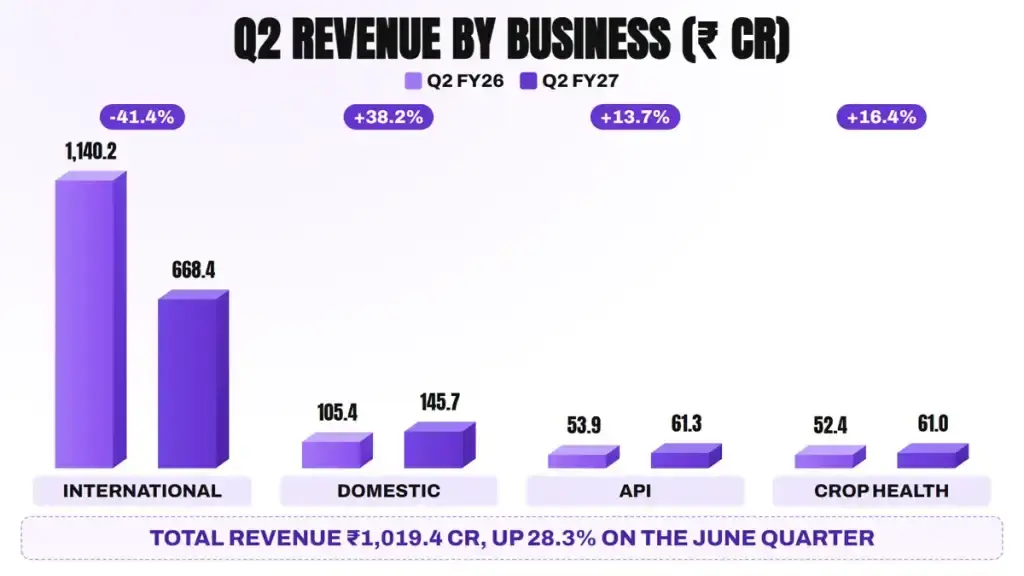
Every other business grew on a year ago. Domestic formulations rose 38.2% to ₹145.7 Cr, with sales of the diabetes and weight-loss medicine semaglutide added since its launch in the March 2026 quarter. The active ingredient business, called API, rose 13.7% to ₹61.3 Cr. Crop Health Sciences rose 16.4% to ₹61.0 Cr, and its segment result was a small profit of ₹1 Mn against a loss of ₹66 Mn a year ago.
Those businesses matter more now that the big product is gone. EBITDA, including other income, was ₹310.0 Cr at a margin of 30.4%, close to 30.9% in the June quarter. A year ago it was ₹679.2 Cr at 46.4%, when lenalidomide was still selling at high prices.
That margin held up because costs came down with revenue. Other expenses, which carry R&D, legal and selling costs, were ₹322.7 Cr against ₹413.8 Cr a year ago. Employee costs barely moved, at ₹203.6 Cr against ₹200.3 Cr. Tax took ₹69.8 Cr, a higher share than a year ago. Management has said its Indian tax rate is now about 25.16% under the new regime, while Brazil, a growing part of profit, pays more than 35%.
How Adcock Shows Up in the Profit
Next, let's look at the line below profit before tax, because that is where Adcock now sits. Natco booked ₹29.2 Cr as its share of Adcock's profit in Q2. That was after an adjustment for the provisional purchase price allocation, an accounting step that spreads part of the price paid over Adcock's brands and assets. Adcock itself earned ₹80.5 Cr on revenue of ₹1,343.8 Cr in the quarter.
That share was much smaller than in the June quarter. Then, Natco booked ₹84.3 Cr at a 35.75% holding, out of Adcock's profit of ₹242.2 Cr. Management said a strong flu season in South Africa lifted that quarter, and asked analysts not to annualise it. It said Adcock's normal profit is about ₹100 Cr a quarter, of which Natco now has a 49% share.
So profit after tax for Q2 was ₹202.6 Cr, against ₹206.5 Cr in the June quarter and ₹517.9 Cr a year ago. About 14.4% of it came from Adcock, against about 40.8% in the June quarter. For the half year, profit after tax was ₹409.1 Cr, down 59.0% from ₹998.2 Cr, and total income was ₹1,813.8 Cr, down 36.4%.
What the quarter says: Natco's own business grew from June to September, with profit before tax up from ₹185.6 Cr to ₹243.2 Cr. Adcock's share swings with South Africa's seasons, so the steadier measure is the business before the associate.
The board also declared a second interim dividend of ₹1.25 a share for FY27, after ₹1.5 in the June quarter. That brings us to the question behind every Natco number. How did one product build such a large profit, and what is left after it?
How One Cancer Drug Lifted Four Years
Now let's look at how one cancer drug lifted four years of results, and what came before it. Natco had built its US business on hard products for a decade before lenalidomide. In 2016 it launched the first generic version of Oseltamivir capsules, the flu medicine sold as Tamiflu, in the US. Later it launched generic Glatiramer Acetate 40 mg/mL, a copy of the multiple sclerosis injection Copaxone, which it says it worked on for over a decade.
Those launches set up the larger one.
"Know what you own, and know why you own it."
— Peter Lynch
With Natco, knowing what you own means knowing which products are inside an exclusive window and when that window closes. Natco began selling generic lenalidomide in the US in the March 2022 quarter, through its partner. In its own words, the product was a blockbuster it had worked on for years. The numbers that followed show how one product can carry a company.

As you can see, revenue grew about 2.3 times from FY22 to FY25, while profit grew about 11 times. That gap came from the margin. Read this EBITDA Explained: Uses and Limits A product sold at exclusive prices needs little extra cost, so the EBITDA margin climbed from 17.7% to 53.3%.
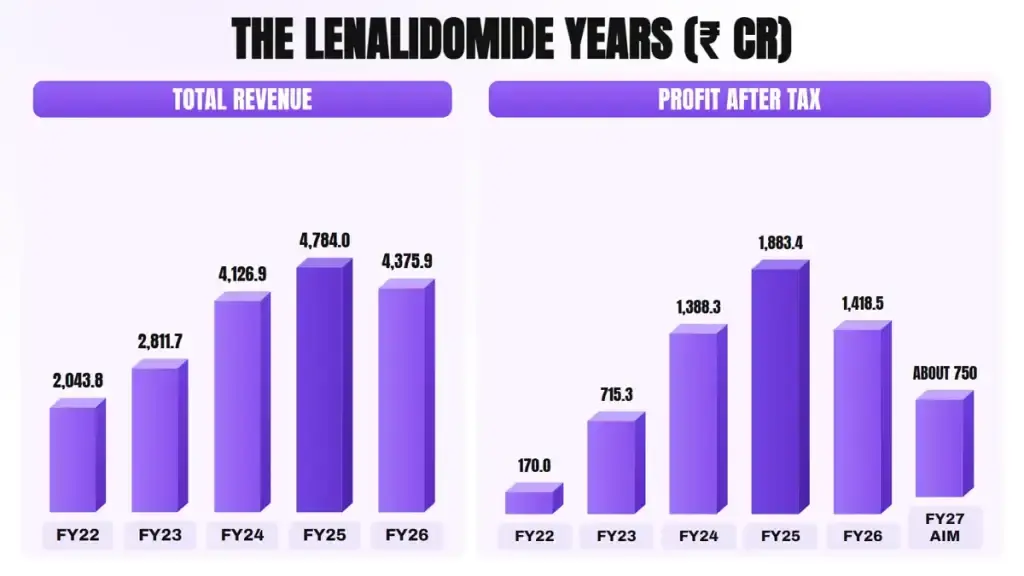
That peak also explains FY26. Total revenue was ₹4,375.9 Cr, down 8.5%, and profit after tax was ₹1,418.5 Cr, down 24.7%. The US business, which is the largest single market, brought in ₹2,381.0 Cr in FY26 against ₹3,148.7 Cr in FY25. FY26 profit also includes a one-time tax benefit of ₹115 Cr from moving to the new tax regime.
Over a longer span, the windfall sits on a larger base than it seems. In FY2010 Natco's total income was ₹461.3 Cr and its profit was ₹48.7 Cr. Even after the reset, FY26 total revenue was about 9.5 times the FY2010 figure. So where will the next profits come from? Management's answer is spread across four businesses and one large stake abroad.
Four Businesses Under One Roof
Now let's split Natco into the businesses it reports. It has two segments, pharmaceuticals and agro chemicals, but its presentations break the pharma side into three lines. Here they are with FY26 revenue and what each one does.

That mix tells you why the profit swung so much. International formulations are almost three quarters of revenue, and inside them the US is the largest market. Domestic, API and crop health together are less than a fifth.

Each of these businesses earns in a different way. The US earns from a few exclusive products at a time, while India earns from brands sold to doctors. Brazil and Canada sit in between, with their own sales teams and tenders. So let's take them one at a time. Read this Segment-Wise Revenue Analysis Explained
International Formulations, the Patent Engine
Let's start with international formulations, the largest line and the patent engine of the company. In the US, Natco has more than 45 approved generic applications, called ANDAs, and 29 Paragraph IV filings in the pipeline as of September 2026. Over 20 of those are first-to-file, either alone or shared with others.
That pipeline is where the next exclusive windows are expected to come from. The key sole first-to-file products include carfilzomib 10 mg, a myeloma injection sold as Kyprolis, and ibrutinib tablets for leukaemia, sold as Imbruvica. They also include olaparib for ovarian and breast cancer, and semaglutide pens and all strengths of Wegovy for diabetes and weight loss.
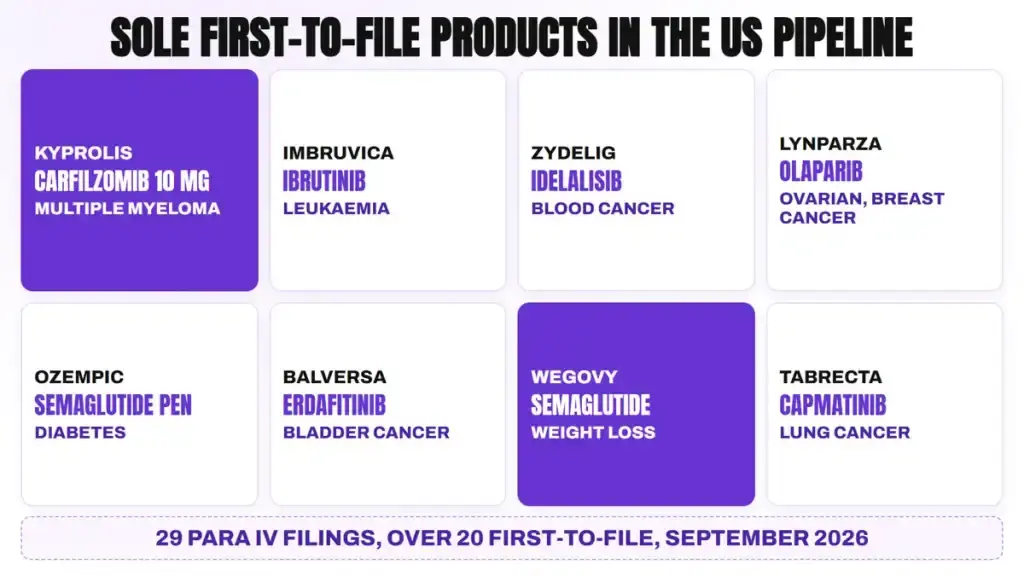
Those products move on their own clocks. Management has said the carfilzomib launch is on track, with a factory upgrade due to finish by the end of 2026, but it will not give the date. It also said in August 2026 that it has two US launches with exclusivity in the next financial year. In a second list are products filed on the earliest date the US allows for a new drug, such as apixaban, the blood thinner sold as Eliquis.
Beyond those US products, the subsidiaries now carry much of the base. Brazil's revenue was ₹178 Cr in the June quarter, up 180%, led by cancer medicines, and Canada's was about ₹56 Cr. In Brazil, Natco has been the single source of the cancer drug everolimus for four years. Canada sells more than 20 approved products, and Natco says it is among the top ten generic companies there by sales.
Domestic Formulations and Semaglutide
Next, the Indian business, which is smaller but steadier. Domestic formulations brought in ₹440.9 Cr in FY26, up 10.2%. The business runs four divisions: oncology, pharma specialty, cardiology and diabetology.
Each of those divisions leans on early launches. In cardiology, Natco says it was first to market in India with the blood thinners apixaban and dabigatran. In pharma specialty, its Velpanat brand of sofosbuvir and its combinations treats hepatitis C, where Natco calls itself a leading player.
That oncology division is where Natco made its name in India. It launched many first generic cancer medicines here, and in 2012 the government granted it a compulsory licence for Bayer's patented cancer drug Nexavar. A compulsory licence lets a company make a patented medicine without the owner's consent, in return for a royalty.
That same approach drives the newer launches. In FY26 Natco launched generic semaglutide vials in India, the first day the patent allowed. It also launched risdiplam, a medicine for the rare muscle disease spinal muscular atrophy. Management said the domestic base business, normally about ₹107 Cr a quarter, reached about ₹130 Cr in the June quarter, and it expects domestic volumes to grow about 25% this year.
That semaglutide market is crowded in India. Management says its own brand sells about ₹2 Cr a month, and the business does not lose money but does not make much either. Natco has also filed three medicine dossiers for registration through Adcock in South Africa.
Active Ingredients for Its Own Medicines
Next, let's look at the API business, which makes the active ingredients inside Natco's own medicines. API revenue was ₹234.7 Cr in FY26, up 16.3%. Natco runs two API plants, at Mekaguda in Telangana and Manali near Chennai, and holds over fifty Drug Master Files, the dossiers that let customers use its ingredients in their filings.
That business is mostly about control rather than sales. Making its own complex ingredients, including high-potency ones and peptides, lets Natco control supply for the products it files. In FY26 it cleared US regulator audits at the Chennai API plant and the Kothur formulations plant.
Crop Health Sciences and the Demerger
Now let's move to Crop Health Sciences, the crop business Natco started in 2019 to use its chemistry skills outside medicine. It launched the first pheromone-based mating disruption product for pink bollworm, a pest in cotton. A pheromone product confuses the male moths so they cannot find mates, without spraying a broad pesticide.
That business has grown fast from a small base. Revenue was ₹138.2 Cr in FY26, about 2.3 times ₹59.8 Cr in FY25. It now sells about 35 products, eight of them based on chlorantraniliprole, an insecticide, which make up about 30-35% of its revenue. In Q2 FY27, its strongest season, the segment broke even.
That mix is also moving towards products with fewer rivals. One fungicide brand, Glanz, is a product with limited competition, and management says it is selling well. Natco is also seeking registrations under a route that allows only a few makers of a product, and says the next financial year has several such launches. Management expects the business to reach about the ₹138 Cr it sold in FY26 by the end of the third quarter.
So the board has decided to separate it. In March 2026 it approved a demerger of the agro business into NATCO Crop Health Sciences Ltd, a new subsidiary. After the rights issue, the board decided in September 2026 to revise the scheme so that the share swap ratio stays the same. Management expects the demerger to take a few months longer than first planned.
Why Natco Bought Into South Africa
Now that we have seen the four businesses, let's look at the largest step Natco has taken outside them. In November 2025, its South African subsidiary bought 34.88% of Adcock Ingram for about ZAR 4.0 billion, about US$226 million. The deal valued Adcock at US$618 million, or US$4.27 a share. With small stakes it already held, Natco owned 35.75%, and Adcock was delisted from the Johannesburg exchange.
That first stake was followed quickly by a second. In July 2026 Natco bought another 13.25%, or 19,618,825 shares at ZAR 92.50 each. It paid ZAR 1,814.74 million, or ₹1,060 Cr, and now owns 49%. Bidvest, a South African group, holds the other 51%, and Natco has a first right of refusal if Bidvest sells.
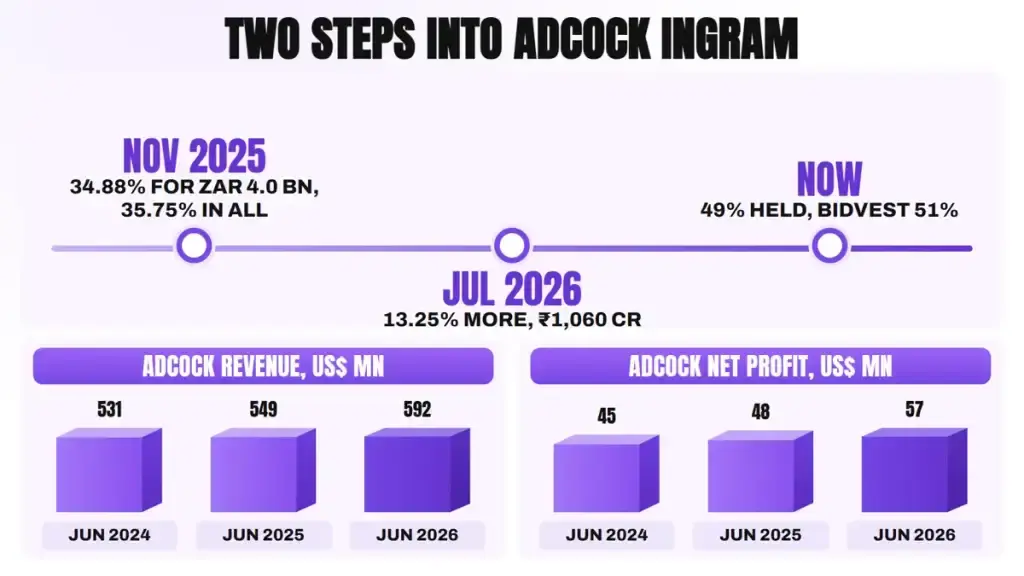
So what did Natco buy? Adcock dates back to 1890 and sells prescription, over-the-counter, hospital and consumer health products in Southern Africa. It runs three factories near Johannesburg and owns 49% of an Indian joint venture with two plants in Bangalore. Adcock says it is the only drug company in South Africa that covers all market segments, from prescription to critical care. It is the largest producer of IV fluids and blood bags in the country. Its Clayville plant makes high-volume oral liquids, and its Aeroton plant makes sterile products. Its known brands include the painkiller Panado and the allergy medicine Allergex, and its top ten products bring in about a third of its revenue.
Its numbers are steady rather than spectacular. Revenue grew from US$531 million in its June 2024 year to US$592 million in its June 2026 year. Net profit grew from US$45 million to US$57 million. For its current year, management expects revenue of about US$580-600 million and profit of about US$47-48 million, depending on the exchange rate.
"I think you always have to think of this business in an 8 to 10 year cycle, not in a 2, 3 year cycle." - Rajeev Nannapaneni, Vice Chairman and CEO, August 2026
Natco explains the deal through the mix of its earnings. Natco says its earnings now draw on five markets instead of mostly the US: India, the US, Brazil, Canada and South Africa. Management sees two links with Adcock. Natco's pipeline can be registered and sold in South Africa, and its ties with other Indian drug makers can feed Adcock's portfolio.
Natco paid for all of this from cash, almost ₹3,000 Cr over a year for the two Adcock stakes. Its net cash was about ₹1,400 Cr in August 2026. Then, in October 2026, it allotted 17,058,082 new shares through a rights issue at ₹750 each, about ₹1,279.4 Cr, in the ratio of two for every 21 held. Read this Corporate Actions Explained Management said the money was raised for acquisitions it is studying, short-term loans and capital spending.
Why the Patent Challenge Model Is Hard to Copy
Now that we have seen how Natco earns, let's understand its moat. In this business the moat is a mix of chemistry, time and courtroom stamina. Read this Economic Moat Explained Any large generic maker can copy a simple pill, but only a few can copy a complex cancer medicine early, defend the filing in court and then make it at scale.
Each step takes years to clear. Natco first picks molecules that are hard to make or hard to prove equal, such as peptides, injectables and high-potency cancer drugs. It then develops the product, runs the studies and files before others, often years before any launch. Its partners fight the patent cases and sell the product, while Natco makes it.
That last step is what keeps Natco small in people but large in results.
"In business, I look for economic castles protected by unbreachable moats."
— Warren Buffett
For a generic maker, the castle is the hard molecule and the early filing. The moat lasts only as long as the exclusive window, so it has to be rebuilt with every new product. It runs nine plants in India, seven for medicines and two for agro products, with 5,060 permanent employees. Its US partners have included Teva, Mylan, Lupin, Breckenridge and Dr. Reddy's. Natco does not need a large US sales team, because the partner sells and Natco shares the profit.
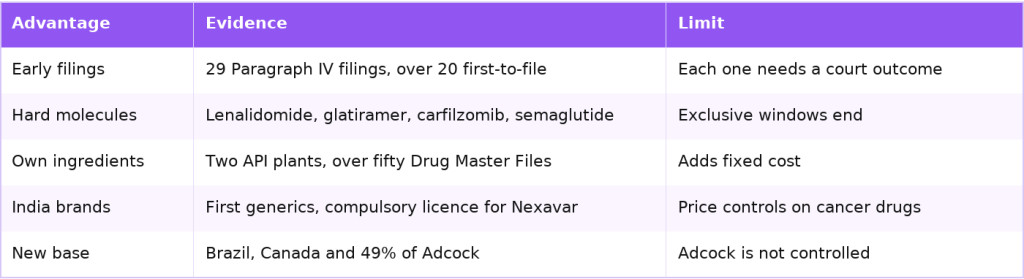
That table also shows why the moat does not give steady growth on its own. Management says its long bets pay the most. Projects eight or nine years away, it says, can return 20 to 30 times what is put in, while projects due within a year earn only about 15-20%.
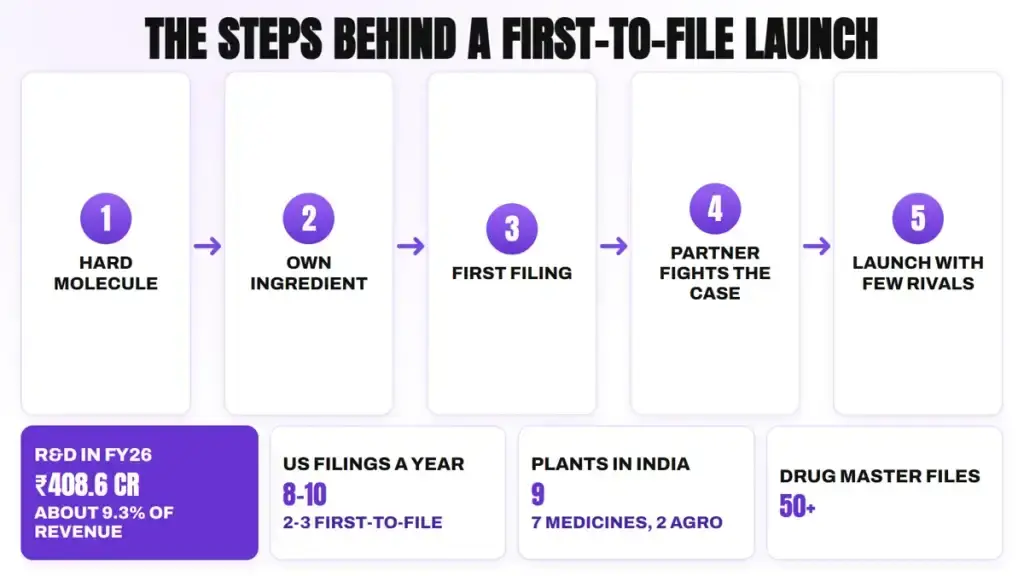
So R&D is the cost of keeping the moat. Natco spent ₹408.6 Cr on R&D in FY26, about 9.3% of total revenue, and plans about 7-9% in FY27. Management says 70-80% of that money goes to products due between 2028 and 2035. It targets 8-10 US filings a year, of which 2-3 should be first-to-file.
Beyond generics, Natco has also placed small bets on new medicines. It has put US$24.7 million into eGenesis, a US company that grows genetically edited pig kidneys for human transplant. Three patients have received such kidneys, and two stayed off dialysis for more than eight months. A 33-patient trial is due to begin in early 2027. Natco also holds stakes in Cellogen Therapeutics, which works on CAR-T cell therapies, and Stero Therapeutics, and it is testing its own head and neck cancer molecule, NRC-2694-A.
Financials: Five Years of the Lenalidomide Cycle
One quarter can mislead in a business built on exclusive launches, so let's look at five full years together. Total revenue here includes other income, as the company reports it, and the two formulation columns show where the change came from.
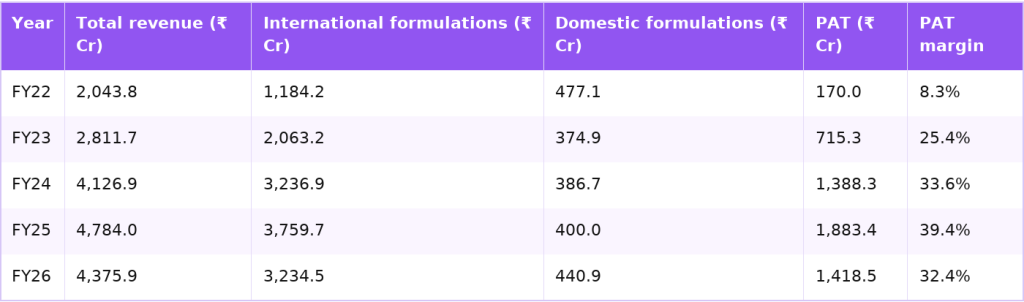
International formulations grew about 3.2 times from FY22 to FY25, from ₹1,184.2 Cr to ₹3,759.7 Cr, and that one line explains almost all of the change in profit. The PAT margin went from 8.3% to 39.4% over the same years, because an exclusive product earns a high price on little extra cost.
The Indian business moved the other way for a while. Domestic formulations were ₹477.1 Cr in FY22 and ₹374.9 Cr in FY23, and FY24 carried a ₹35 Cr charge for stock taken back from super-stockists when Natco changed its distribution model. Since then the domestic line has grown each year, to ₹440.9 Cr in FY26.
So the table shows both halves of Natco. The international line rises and falls with exclusive launches, while the domestic, API and subsidiary businesses grow more slowly underneath it.
"In the short run, the market is a voting machine but in the long run, it is a weighing machine."
— Benjamin Graham
Natco's five-year table shows a peak driven by one product. Over time, what gets weighed is how much profit the business keeps once that product is gone.
What FY28 Could Look Like on Management's Numbers
So where does Natco go from the base year? Management has given a clear frame. In May 2026 it said FY27 would be a base year with profit after tax of ₹700-750 Cr, including Adcock. After that, it expects earnings to compound by 15-25% a year from FY28, depending on exclusive launches and market share.
Those numbers are easier to judge against what has happened so far. In August 2026 management held its profit guidance at about ₹750 Cr, on gross sales of ₹3,300-3,400 Cr. With ₹409.1 Cr of profit after tax in the first half, Natco needs about ₹340.9 Cr in the second half to reach ₹750 Cr. That is about 83.3% of the first half's profit.
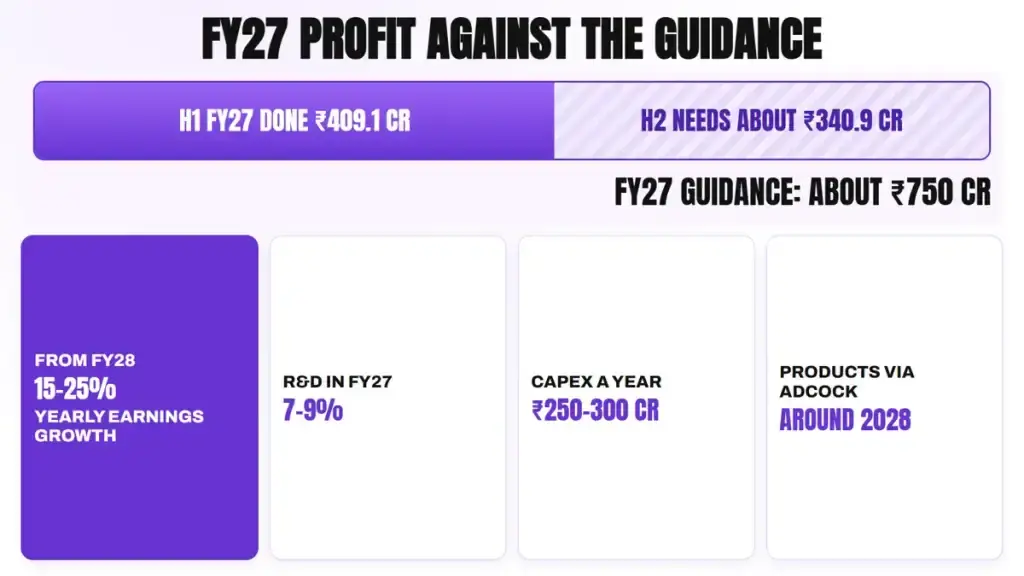
Adcock is the second number to watch in that plan, since its share now runs through every quarter. The first Natco products in South Africa could reach the market around 2028, once their registrations, which usually take 18-24 months, come through.
Where the growth is meant to come from: the base year rests on Brazil, Canada, India and Adcock. The 15-25% growth after FY28 rests on the US pipeline, where two exclusive launches are planned in FY28 and carfilzomib is on track.
That growth also needs some capital. Natco spends about ₹250-300 Cr a year on plants and equipment, and the rights issue adds cash for acquisitions. Management said in August 2026 that it was studying two deals, a smaller one in India and a very large one abroad.
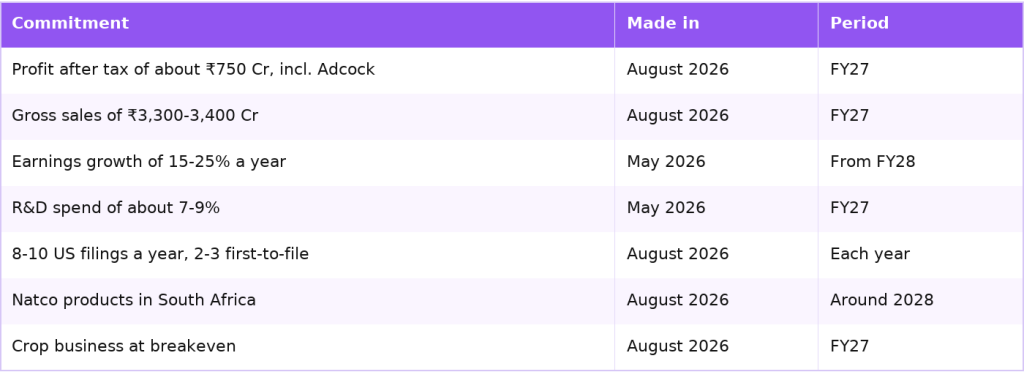
Those commitments are easier to judge against the past. So let's check what management said before against what it delivered.
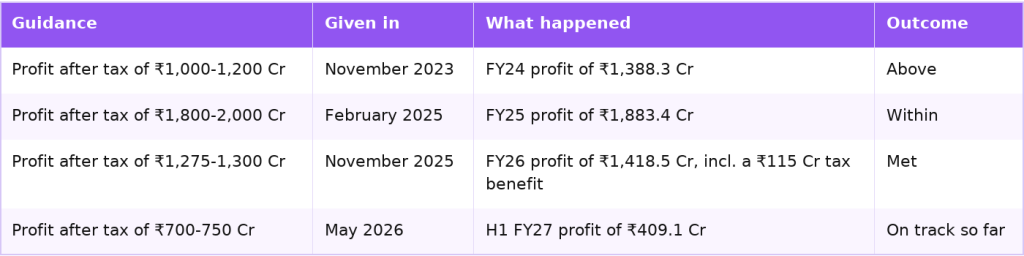
As you can see, Natco has met or beaten its profit guidance in each of the last three years. That record matters, because its business makes quarterly numbers jump and the yearly guidance is the steadier guide.
"I think you'll see a more stable compounding growth rather than the one-offs that you have seen in the past, henceforth for the next 2, 3 years." - Rajeev Nannapaneni, Vice Chairman and CEO, May 2026
Key Risks
Now let's look at what could go wrong for Natco Pharma, because some of these risks are already in the numbers.
- The end of a windfall: lenalidomide drove profit to ₹1,883.4 Cr in FY25. With it gone, FY27 guidance of about ₹750 Cr is less than half that, and Q2 FY27 profit was down 60.9% on a year ago.
- Patent cases: each exclusive launch depends on court outcomes and settlement terms. The olaparib trial and its exclusivity were still open in August 2026, and the company is defending patent infringement cases filed by inventors.
- Shared exclusivity: a first-to-file position can be shared. Pomalidomide launched in the US in FY26 with four or five others holding exclusivity, so it added little.
- US concentration: the US brought in ₹2,381.0 Cr in FY26, and its revenue swings with a few products and US tariff and pricing changes.
- Adcock without control: Natco owns 49% and Bidvest controls the rest. Adcock's profit share depends on the South African rand, flu seasons and accounting adjustments, and Q2 FY27 included a purchase price allocation charge.
- Semaglutide prices: the Indian market is crowded, and management says the brand makes little money for now.
- Crop health losses: the agro segment lost ₹19.8 Cr in FY26 and ₹5.2 Cr in H1 FY27. Natco took a ₹50 Cr impairment on agro plant and machinery in Q4 FY25, and its auditor flagged impairment of agro assets as a key audit matter in FY26.
- Dilution: the rights issue added 17,058,082 shares, about 9.5% more than the 179,109,870 shares outstanding before.
- R&D spend that pays late: most R&D money goes to products due from 2028 to 2035, so it costs profit today for uncertain launches later.
"And because you bet on a lot of these jackpots, when the jackpot comes, then earnings look good or you have an exclusivity looks good." - Rajeev Nannapaneni, Vice Chairman and CEO, May 2026
"All I want to know is where I'm going to die, so I'll never go there."
— Charlie Munger
For Natco, the places to avoid are clear from the list above: courtrooms that go the wrong way, shared exclusivity and a large stake it does not control. The tracking list below shows how to see which way each one goes.
Explore our Products
Research Framework

Emerging Titans
Combination of quantitative analysis, industry tailwinds, and management assessment - SPRINT investment philosophy

Tiny Titans
Heavy emphasis on scuttlebutt research, plant visits, and early on-ground signals
What to Track Next
If you follow Natco Pharma, these are the signals that will show where it goes next.
- Profit after tax in H2 FY27 against the ₹750 Cr guidance, before and after Adcock
- The carfilzomib launch date and the two exclusive US launches planned for FY28
- Court outcomes on olaparib and other first-to-file products
- Adcock's quarterly profit and any change in Bidvest's 51%
- Domestic revenue against the ₹130 Cr a quarter run-rate, and semaglutide pricing
- Completion of the crop health demerger and its first year as a separate business
- How the rights issue money is used, including any acquisition
Members can read our full Research Desk report on Natco Pharma, with its detailed scorecard and section-by-section analysis.
Conclusion
Let's put it all together. Natco Pharma makes money by copying hard medicines early, and for four years one of them, lenalidomide, carried the whole company to a peak profit of ₹1,883.4 Cr. That product has now run its course, and FY27 is the base year management has asked investors to judge it by.
That base is wider than before. Brazil, Canada, India and a 49% stake in Adcock now carry most of the earnings, while the US pipeline holds 29 patent challenges for the years ahead. The cautious thread is the size of the reset, with FY27 profit guidance less than half of the FY25 peak, so the next two years will show how much of the new base lasts. What happens next depends on whether those challenges turn into exclusive launches, and whether the new base can grow 15-25% a year as management expects.
FAQs
What does Natco Pharma do?
+Natco Pharma is a Hyderabad drug maker that develops and sells generic and specialty medicines, mostly for cancer, in India, the US, Brazil, Canada and over 50 countries. It also makes active ingredients and crop protection products, and it owns 49% of Adcock Ingram in South Africa. FY26 total revenue was ₹4,375.9 Cr.
How did Natco Pharma do in Q2 FY27?
+Total revenue was ₹1,019.4 Cr, up 28.3% on the June quarter but down 30.3% on a year ago, as US lenalidomide sales had ended. EBITDA was ₹310.0 Cr at a 30.4% margin, and profit after tax was ₹202.6 Cr, including ₹29.2 Cr from Adcock Ingram.
Why did Natco Pharma's profit fall after FY25?
+Natco's profit rose from ₹170.0 Cr in FY22 to ₹1,883.4 Cr in FY25, largely from generic lenalidomide (Revlimid) sold in the US through a partner. Those sales ran out by late 2025, so FY26 profit was ₹1,418.5 Cr and management guides about ₹750 Cr for FY27.
What is Natco Pharma's stake in Adcock Ingram?
+Natco bought 34.88% of Adcock Ingram in November 2025 for about ZAR 4.0 billion and another 13.25% in July 2026 for ZAR 1,814.74 million, taking its holding to 49%. Adcock earned US$57 million on revenue of US$592 million in its year to June 2026.
What is in Natco Pharma's US pipeline?
+As of September 2026, Natco had 29 Paragraph IV filings in the US, with over 20 first-to-file positions. Sole first-to-file products include carfilzomib 10 mg, ibrutinib, idelalisib, olaparib, semaglutide pens, erdafitinib, semaglutide for weight loss and capmatinib.
What are the main risks for Natco Pharma?
+The main risks are the end of lenalidomide profits, court outcomes on its patent challenges, shared exclusivity on launches, dependence on the US market, a 49% stake in Adcock that it does not control, losses in crop health and dilution from the rights issue of 17,058,082 shares.

High growth stock specialist, Value Educator
Shashank Mahajan is an equity research professional with over 12 years of experience in identifying high-potential SME and micro-cap stocks at an early stage. He follows a rigorous scuttlebutt research–driven approach, combining on-ground insights with deep financial analysis. Shashank specializes in uncovering under-researched and under-owned companies with strong management quality and long-term growth potential. Through disciplined research and early identification, he focuses on spotting tomorrow’s market leaders before they enter the mainstream investor radar.
Glenmark: The USD 700 Mn Cancer Deal and Its Brands
Pharma Stocks in India 2026: Generics, APIs and CDMOs
Granules India: From Paracetamol to a 65% Gross Margin
Shilpa Medicare: Cancer APIs, Films and Biosimilars
Alembic Pharma: US Plants Pay Back, Margin Hits 22.2%
Supriya Lifescience: APIs, Ambernath and a 22% Margin
Explore our Products
Research Framework
Emerging Titans
Combination of quantitative analysis, industry tailwinds, and management assessment - SPRINT investment philosophy
Tiny Titans
Heavy emphasis on scuttlebutt research, plant visits, and early on-ground signals



Modern Warfare to Multibaggers
Key Trends. Strategic Shifts. Opportunities Ahead.
Don't Miss This Exclusive Webinar!
Join Value Educator to decode the key trends shaping India's defence sector and learn how to identify tomorrow's potential leaders in the space.
- In-depth research on India's defence sector
- Live Q&A session
- Actionable takeaways for long-term investors

 Orders
 Subscription
 Share with friends


Required Details
₹23999.00
(12 month subscription)
As per SEBI regulations, all users are mandated to complete the KYC that is validated for 1 year. Post payment, you will be redirected to the KYC screen


No comments yet. Be the first to comment!