
Alembic Pharma: US Plants Pay Back, Margin Hits 22.2%

In FY21, an Indian drug maker earned an EBITDA margin of 30%. Its revenue that year was ₹5,393 Cr, and its EBITDA was ₹1,631 Cr. At the same time, it had about ₹1,800 Cr tied up in three new plants that were not yet making anything it could sell. Two years later, in FY23, its EBITDA was ₹680 Cr, about 12% of revenue.
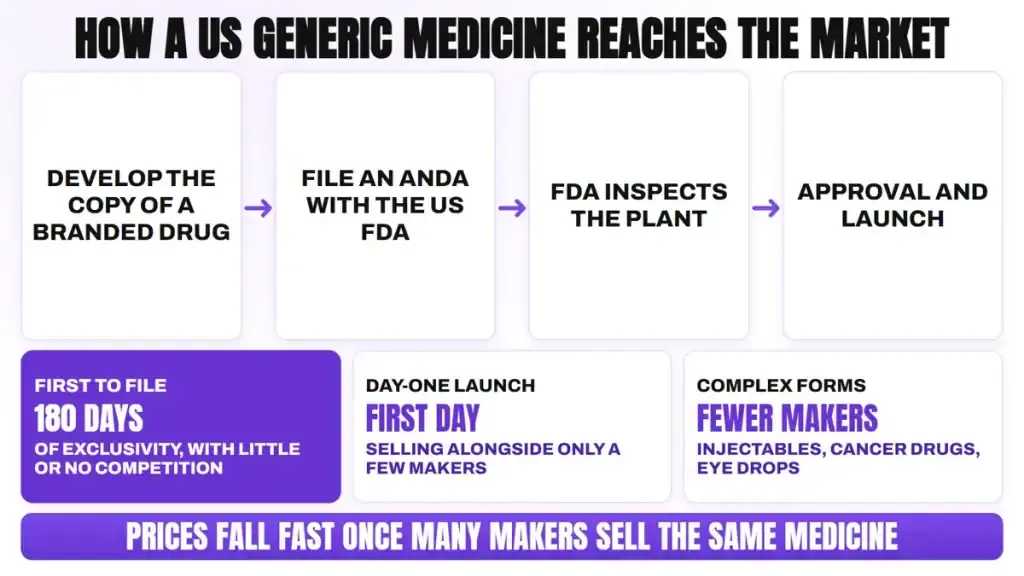
Those plants were built for one market, the United States, and that market works in a particular way. Most of what this company sells there are generic medicines, which are copies of branded drugs sold after the patent ends. To sell a generic in the US, a company files an ANDA, an abbreviated new drug application, with the US Food and Drug Administration. The plant that makes the medicine must also pass an FDA inspection. Only then can the product reach a pharmacy shelf.
That approval takes years, and prices fall fast once several makers sell the same medicine. So a company earns most on products that few others can make, such as injectables, cancer drugs and eye drops, or on products it launches first. A company that is first to challenge a patent can win 180 days of exclusivity, half a year in which it sells the generic with little or no competition.
While a new plant waits for its approvals, its staff, power and upkeep still have to be paid. For a while those costs can be added to the plant's book value as work in progress. But once the plant is declared ready, they flow through the profit and loss account, whether or not the plant is busy.
That drug maker is Alembic Pharmaceuticals Ltd (NSE: APLLTD), a Vadodara company that the Amin family founded in 1907. It sells branded medicines in India, generic medicines in the US and in other countries, and the active ingredients that go into medicines. It runs 9 manufacturing facilities and 2 R&D centres, and its team has more than 17,200 people. In FY26 its revenue was ₹7,344.9 Cr, up 10.1%.
In the July to September quarter of 2026, its EBITDA margin was 22.2%. Part of that came from one product with a short window, and part from the plants finally filling up.
Alembic Pharmaceuticals in five numbers
- Q2 FY27 revenue of ₹2,603 Cr, up 36%
- An EBITDA margin of 22.2% in Q2 FY27, against 17% a year ago
- US revenue of ₹1,003 Cr in the quarter, up 77%
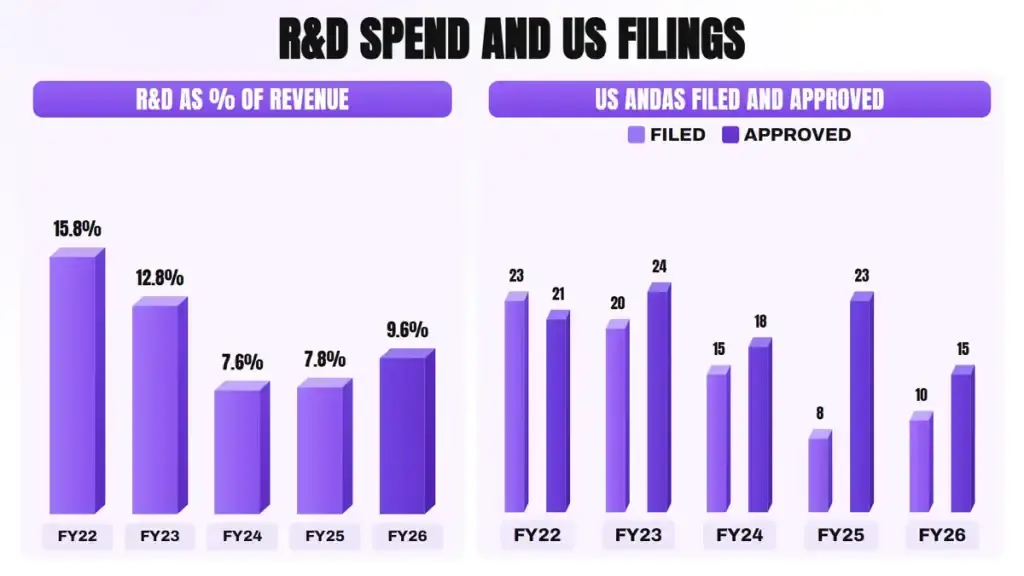
- 283 US ANDA filings, 245 approvals and 188 products launched
- FY27 revenue growth guidance raised to 20-25%, from the mid-teens
So a company that spent years carrying the cost of new plants is now earning more on them. How much of that will last? Let's first understand the company, and then look at the latest quarter.
Alembic Pharmaceuticals: Company Overview
Alembic Pharmaceuticals Ltd is a Vadodara drug maker with roots in the Alembic group, which the Amin family founded in 1907; the pharmaceutical business was demerged from the group in 2010. It develops and makes finished medicines and the active ingredients that go into them. It sells branded medicines for people and animals in India, generic medicines in the US, Europe, Canada and emerging markets, and APIs to more than 60 countries. In 2026 it also started a branded business in the US through Alembic Therapeutics. It runs 9 manufacturing facilities and 2 R&D centres, at Vadodara and Hyderabad, and its team has more than 17,200 people, including more than 5,800 medical representatives in India. Pranav Amin is the Managing Director and G. Krishnan the Chief Financial Officer. Revenue from operations was ₹7,344.9 Cr in FY26, and net debt was ₹1,236 Cr in September 2026. Read this Capital-Intensive Businesses Explained
"The stock market is a device for transferring money from the impatient to the patient."
— Warren Buffett
Alembic's new plants took years to win approvals and fill up. In a business where a single product approval can take years, patience is built into the model.
The Quarter US Revenue Rose 77%
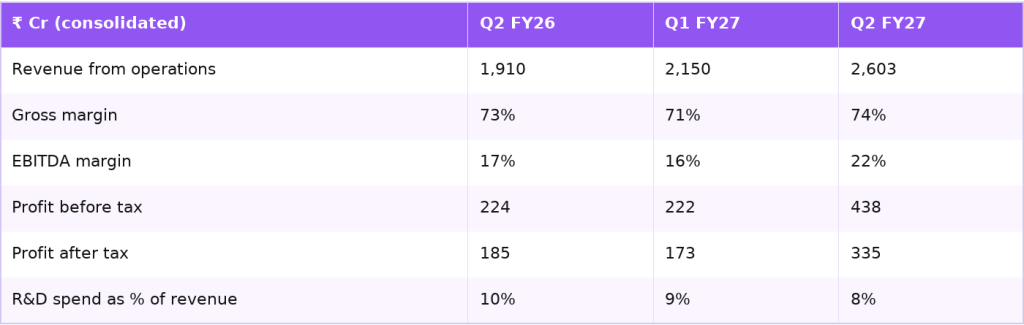
Let's look at Q2 FY27, the July to September quarter, which the company reported on 4 November 2026. Revenue from operations was ₹2,603 Cr, up 36% from ₹1,910 Cr a year ago. It was also 21% higher than the ₹2,150 Cr of Q1 FY27. Every business grew by double digits.
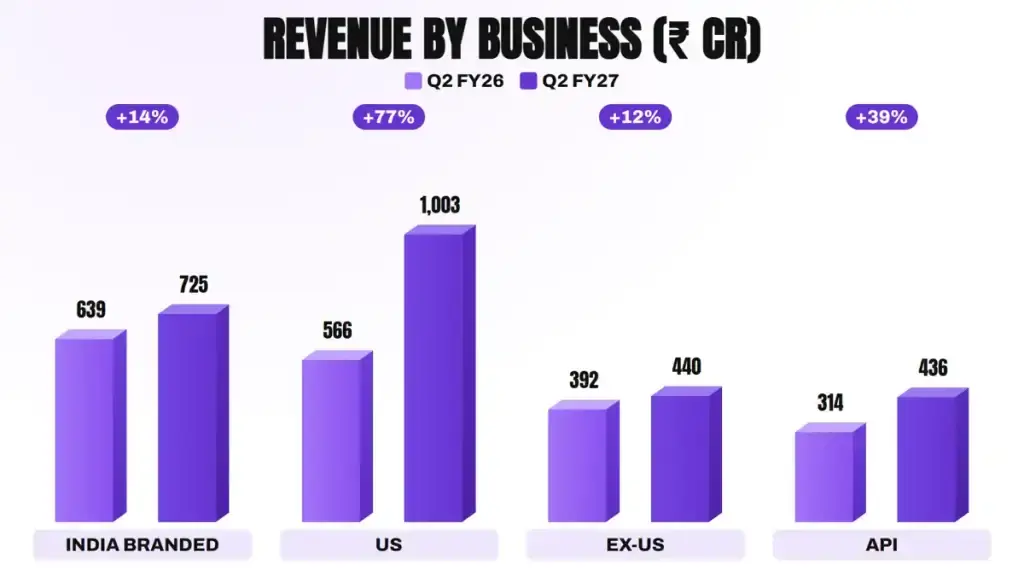
As we can see, the US did most of the work. US revenue rose 77% to ₹1,003 Cr, from ₹566 Cr a year ago. The API business, which sells drug ingredients, grew 39% to ₹436 Cr. The India branded business grew 14% to ₹725 Cr, and the business outside India and the US grew 12% to ₹440 Cr.
That revenue mix also lifted the margins. Read this Operating vs Net Profit Margin Explained The gross margin was 73.7%, up 70 basis points from a year ago, even though solvent and freight costs rose. R&D spend grew more slowly than revenue and came to 8% of sales, against 10% a year ago. So EBITDA grew 78% to about ₹578 Cr, and the EBITDA margin rose by about 520 basis points, from 17% to 22.2%.
The cost lines show where the money went. Material costs rose 33%, employee costs 15% and other expenses 33%. Part of the rise in employee and other costs came from the new US branded business, which is still hiring sales people and spending on promotion. Freight from India to the US has also cost more since March 2026, as shipping lines raised their rates.
Below the EBITDA line, profit before tax almost doubled to ₹438 Cr, from ₹224 Cr. The tax rate rose to about 24%, from 18% a year ago, because the company moved to the normal 25% tax rate in India from this year. Even so, profit after tax rose 81% to ₹335 Cr.
The first half shows the same pattern at a larger scale. H1 FY27 revenue was ₹4,753 Cr, up 31%. Profit after tax was ₹508 Cr, up 50%, and the EBITDA margin for the half was 19%. R&D spend was ₹407 Cr, against ₹332 Cr in H1 FY26.
That growth did tie up cash. Trade receivables rose to ₹1,896 Cr in September 2026 from ₹1,466 Cr in March, about ₹430 Cr more in six months. Management says the new US launches come with longer collection cycles, which should unwind over the next few quarters. Read this Days Sales Outstanding (DSO) Explained Net debt was ₹1,236 Cr, which management puts at less than one year of EBITDA. Capex in the half was about ₹250 Cr.
Bosutinib and the Rest of the US Book
Now let's look more closely at the US, because one product explains a large part of the jump. Bosutinib is a cancer medicine, and Alembic holds 180-day exclusivity on two of its strengths, 100 mg and 500 mg. It sold far more than management expected. That exclusivity runs until the end of November 2026, and management has said it does not know what the market will look like after that.
That one product does not explain all of it, though. Leaving out new launches, the base US portfolio grew 23% in Q2 FY27. In Q1 FY27 the growth without bosutinib was also in the mid-20s. Management puts this down to volume growth on older products and to products launched in the previous two quarters, where Alembic usually gains market share step by step.
Those launches keep coming. Alembic launched 10 products in H1 FY27 and now sells 188 generic products in the US. It has filed 283 ANDAs and holds 245 approvals, including 20 tentative ones. Management expects more than 30 launches over the next 18 months, and around a quarter of them are first-to-file or shared day-one launches. A day-one launch means selling on the first day a generic is allowed, alongside only a few other makers.
What the US quarter says: US revenue of ₹1,003 Cr was 77% higher than a year ago, but the base portfolio without new launches grew 23%. The first number includes a product whose exclusivity ends in November 2026. The second is closer to what the business earns on its own.
How Three Plants Pulled the Margin Down
Now that we have seen the quarter, let's go back to the plants, because they explain the last five years. In FY21 Alembic had about ₹1,900 Cr of capital work in progress. Of that, about ₹1,800 Cr was for three new plants, called F2, F3 and F4, and they were meant mainly for the US market.
Each plant made something new for the company. F2 at Panelav makes oncology tablets and oncology injectables. F3 at Karkhadi makes general injectables and eye drops. F4 at Jarod is a new plant for oral solids, which means tablets and capsules. Injectables and cancer drugs are harder to make than ordinary tablets, so fewer companies sell them in the US.
That difficulty also slowed the plants down. The pandemic delayed FDA inspections, and in FY22 the FDA issued observations at the F3 injectable plant, which the company had to fix. Management said in early 2023 that its plans had been pushed back by about two to three years, through delays at the new plants and price erosion in the US.
Until December 2022 the running costs of these plants were added to their book value. From then on they went through the profit and loss account. Management put the extra cost at about ₹60-70 Cr a quarter, while the plants were still selling very little. That is how the margin fell from 30% in FY21 to about 12% in FY23.
"In the business world, the rearview mirror is always clearer than the windshield."
— Warren Buffett
Looking back, the fall in Alembic's margin is easy to explain. At the time, it depended on approvals and inspection dates that no one could predict.

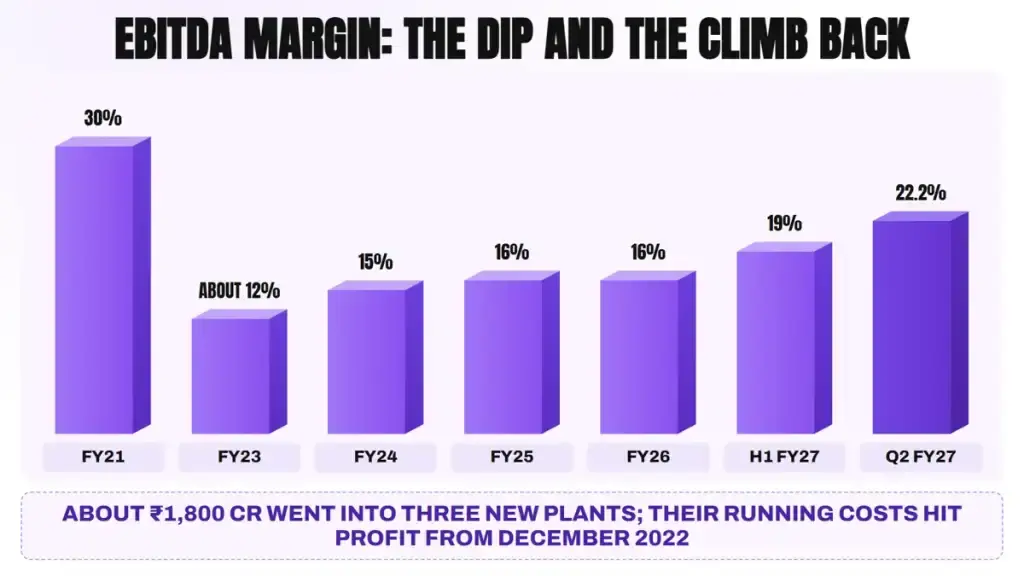
After FY23, the margin climbed back slowly, as the plants won approvals and started shipping. It reached 15% in FY24 and 16% in FY25 and FY26. EBITDA before R&D was ₹1,846 Cr in FY26, about 25% of revenue, which shows how much the company spends on R&D before profit.
The next step came from outside customers. In FY26 Alembic signed manufacturing agreements with large global drug companies to make products in its injectable and oncology plants. It expects these, along with its own products, to fill those plants over 12 to 18 months. In Q2 FY27 the API business also made contract deliveries to key customers. Management now says the use of its existing plants has already ramped up.
At the same time, one more plant came up for India. Alembic commissioned a formulation plant at Indore in 2025 for its India business, and it received WHO certification in April 2026. Management says it is fully operational and gives the India business better supply and logistics.
That building phase cost the company cash. Capex was ₹412 Cr in FY23, ₹345 Cr in FY24, ₹575 Cr in FY25 and ₹432 Cr in FY26. Operating cash flow fell to ₹88.0 Cr in FY25, as inventory and working capital rose with new launches, before it came back to ₹782.7 Cr in FY26. Gross borrowings went from ₹430 Cr in March 2024 to ₹1,361 Cr in March 2026.
"With major capex cycle now behind us, our focus is on driving returns from the existing asset base through debottlenecking and incremental line additions without significant new greenfield investment." - G. Krishnan, Chief Financial Officer, November 2026
Four Businesses With Different Growth Paths
Now let's split the company into its businesses, because each one grows at a different pace. Alembic reports one segment, pharmaceuticals, but it shows revenue for four businesses every quarter. The table below puts them side by side. Read this Segment-Wise Revenue Analysis Explained
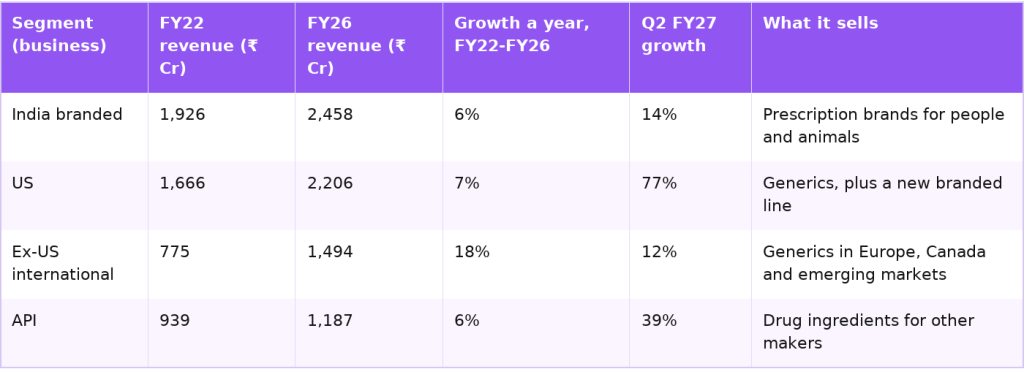
These four businesses share plants and R&D, but they earn in different ways, as you will see. India depends on doctors and sales teams. The US and other export markets depend on approvals and launch timing. The API business depends on volume and cost.

India Branded Business
Let's start with India, the largest business in FY26. Alembic ranks 20th in the Indian pharmaceutical market, with about a 1.1% share. Six of its brands sell more than ₹100 Cr each, and Azithral, Althrocin, Roxid and Gerijoint each rank first in their molecule groups. Its sales team has more than 5,800 medical representatives, and about 2,49,000 doctors prescribe its brands.
Even so, this business grew slowly for several years. Revenue rose from ₹1,926 Cr in FY22 to ₹2,458 Cr in FY26, about 6% a year. Q1 FY27 growth was 7%. Alembic is strong in acute medicines, such as antibiotics and cough and cold products, which are taken for a short time and depend on the season. Those have been weak.
That is why the company has changed how it sells. It appointed a new head of sales and marketing for human health in 2026, and it is pushing chronic medicines, which patients take for months or years, for conditions such as heart disease and diabetes. In Q2 FY27 the specialty portfolio grew about 17% to ₹379 Cr, while acute sales were flat at ₹177 Cr. Human health grew 11% in all.
Animal health is the fastest-growing part of India. It grew 23% to ₹169 Cr in Q2 FY27, and its revenue rose from ₹232 Cr in FY22 to ₹519 Cr in FY26, about 22% a year. Alembic leads in haematinics and antibiotics for livestock and poultry, with brands such as Sharkoferrol and Moxel.
Management's aim for India is simple: grow at the market rate within two to three quarters, without adding to the sales team. If that happens, each representative sells more, and management expects that to lift the India margin gradually.
US Generics
Next, let's look at the US generics business, the second-largest. Its revenue went from ₹1,666 Cr in FY22 to ₹2,206 Cr in FY26, and in H1 FY27 it was already ₹1,781 Cr. Oral solids are still the base: 165 of the 245 US approvals are tablets and capsules. The rest are spread across skin products, eye drops, injectables and inhalation.
That spread is what the new plants were for. Management says Alembic ranks first or second in most of the eye-drop products it sells, and that its skin products earn a high EBITDA margin, though that market has more competition. In Q4 FY26 and Q1 FY27 the eye-drop line was shut for a while to add capacity.
Alembic is also adding products it does not make. In November 2026 it expanded a partnership with DifGen Pharmaceuticals, a US maker of complex generics. The deal gives Alembic more than 20 products across skin patches, complex injectables and eye drops, aimed at a US market of about $5 billion. DifGen develops and mostly makes them, and Alembic sells them in return for a share of the profit. Management expects these sales to begin in FY28.
The US Branded Business at Alembic Therapeutics
Now let's look at the newest business, a branded unit in the US. In FY26 Alembic bought Utility Therapeutics for an upfront payment of about $4 million, plus milestone payments of $4 million each and a profit share with the sellers. That brought it Pivya, an antibiotic for urinary tract infections, a condition with about 30 million prescriptions a year in the US. Pivya launched in February 2026.
That branded unit, Alembic Therapeutics, now sells about 4 products, built around women's health. A third-party manufacturer makes them, so the cost is only the sales team and marketing. It brought in close to 3% of US revenue in Q2 FY27, about ₹30 Cr. Alembic has 30 to 35 sales representatives there and plans for 40 to 45.
This business costs more than it earns for now. Management expects it to cut the FY27 EBITDA margin by 150-200 basis points, and to break even by the end of FY27 or in the first half of FY28. It describes the ramp-up as a J-curve, since doctors take time to change what they prescribe.
Ex-US International Generics
Next, let's look at international generics outside India and the US, the fastest grower over four years. Revenue rose from ₹775 Cr in FY22 to ₹1,494 Cr in FY26, about 18% a year. Alembic sells there the same products it developed for the US, from the same approved plants. That way each product earns in more markets for the same R&D cost.
Europe leads that growth, supported by Canada and emerging markets such as Chile. Alembic has set up subsidiaries in Germany, the Philippines and Thailand, and a joint venture in Canada. In Q2 FY27 this business grew 12% to ₹440 Cr, and management expects mid-teens growth for FY27.
Active Pharmaceutical Ingredients
Finally, let's look at the API business, which makes the active ingredient inside a medicine. Alembic supplies APIs to more than 60 countries and has filed 153 drug master files with the US FDA. A DMF is the document an ingredient maker files so that its customers can use its API in their own US products.
That business also feeds the company's own medicines, which keeps Alembic less dependent on outside suppliers. Its revenue rose from ₹939 Cr in FY22 to ₹1,187 Cr in FY26. In Q2 FY27 it grew 39% to ₹436 Cr, led by volume and by contract deliveries to key customers. Management now expects at least high-teens growth for FY27.
Why Alembic's Moat Is Its Approved Plants and Pipeline
Now that we have seen the businesses, let's understand the moat. In generics, anyone can copy a molecule once its patent ends. What is hard to copy is a plant the US FDA has approved, a file of products waiting for approval, and the skill to make complex forms such as injectables without failing an inspection. Read this Economic Moat Explained
Alembic has built that over many years. Its plants for oral solids, oncology, injectables, eye drops, skin products and APIs have all been inspected by the US FDA, most of them between 2024 and 2026. Every new product made in those plants starts with a plant that is already approved, so the next launch costs less to bring out.
"In business, I look for economic castles protected by unbreachable moats."
— Warren Buffett
For a generic drug maker, the moat is the list of approved plants and products: each one takes years to earn, and each one makes the next launch cheaper.
R&D is the second part of the moat. Alembic spent ₹712 Cr on R&D in FY26, about 10% of revenue, mainly on injectables, peptides and drug-device combinations. It filed 10 ANDAs that year. Over time, those filings turn into launches that competitors cannot match quickly, because each one takes years of testing and approval.
In India the moat comes from brands that doctors have prescribed for decades. Azithral, an antibiotic brand, holds about 31% of its molecule group, and Alembic ranks 17th in India by prescriptions, with 137.6 million in the year to September 2026.
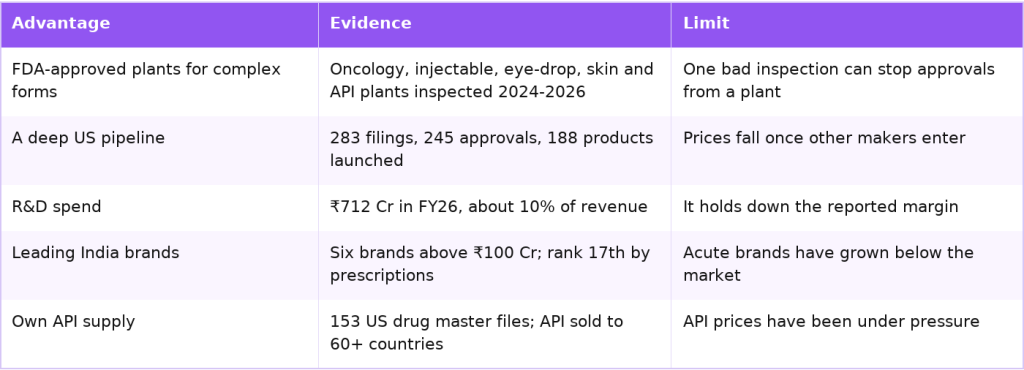
That table shows us why use of the plants is the real test of the moat. The plants and approvals are in place. The margin will now depend on how much the company sells through them.

Financials: Five Years of Revenue, Margins and Profit
One quarter can mislead in a business where a single product can lift sales for six months, so let's look at five full years together. EBITDA here is profit before interest, depreciation and tax, and it includes other income.
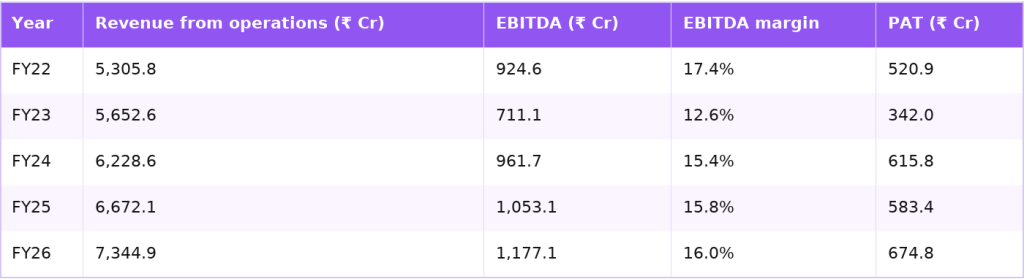
Revenue grew about 38% in four years, from about ₹5,305.8 Cr in FY22 to about ₹7,344.9 Cr in FY26. Profit did not follow a straight line. It fell to about ₹342.0 Cr in FY23, when the costs of the new plants and a write-off at the old Aleor skin business hit the accounts, and it recovered to about ₹674.8 Cr by FY26.
Cash flow was steadier than profit in most years. Operating cash flow was about ₹552.4 Cr in FY22, ₹724.0 Cr in FY23 and ₹803.2 Cr in FY24. It dropped to about ₹88.0 Cr in FY25, as working capital rose with new launches, and came back to about ₹782.7 Cr in FY26. Over the five years it added up to about ₹2,950.2 Cr, against about ₹2,736.9 Cr of profit after tax.
The company kept paying dividends through this period, about ₹216.2 Cr in each of FY25 and FY26, and the board recommended ₹12 a share for FY26. Borrowings, though, rose in FY25 and FY26 as working capital grew and Alembic bought its first US branded product.
"In the short run, the market is a voting machine but in the long run, it is a weighing machine."
— Benjamin Graham
Alembic's five-year table shows why: the profit swung with plant costs and one-off items, while revenue kept rising. Over time, the margin and the cash flow are what get weighed.
What FY28 Could Look Like on Management's Numbers
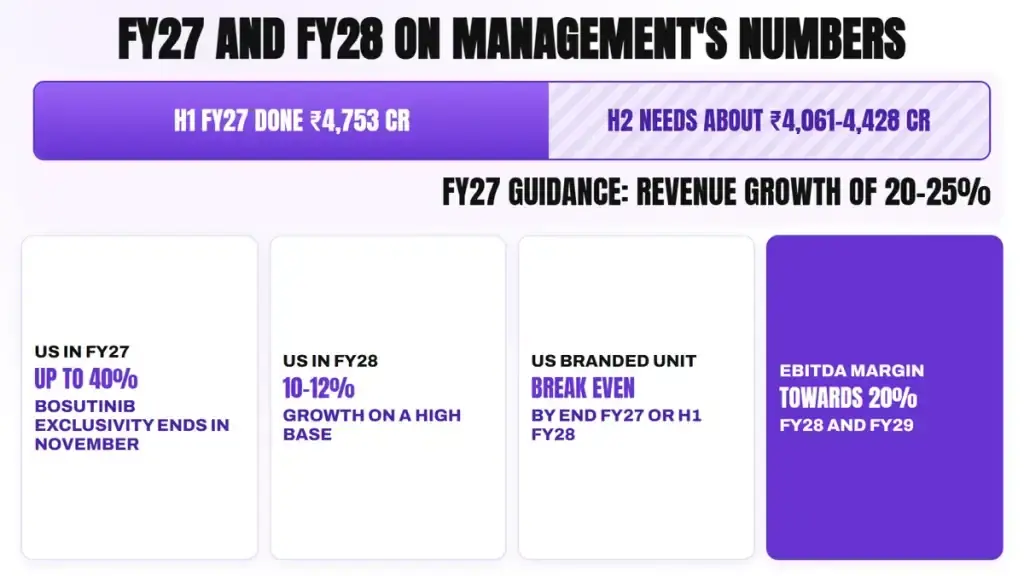
So where does the company go from here? On 4 November 2026 management raised its FY27 revenue growth guidance to about 20-25%, from the mid-teens. It now expects US revenue to grow up to 40%, API at least in the high teens, ex-US markets in the mid-teens and India at the market rate.
Now let's put that guidance against the first half. Growth of 20-25% on FY26's ₹7,344.9 Cr would mean revenue of about ₹8,814-9,181 Cr in FY27. H1 already brought in ₹4,753 Cr. So the second half needs about ₹4,061-4,428 Cr, which is about 9-19% more than H2 FY26, against 31% growth in the first half. That gap allows for the end of the bosutinib exclusivity.
The US shows the same thing. Growth of 40% would take US revenue to about ₹3,088 Cr. With ₹1,781 Cr done in H1, the second half would need about ₹1,307 Cr, about 17% more than in H2 FY26.
Beyond FY27, management has given a few more numbers. It expects the US to grow about 10-12% in FY28, from a high base, if the new launches go as planned. It expects the US branded unit to stop pulling the margin down in FY28. And it aims for an EBITDA margin close to 20% in FY28 and FY29, helped by fuller plants and by the branded unit breaking even.

Those commitments are easier to judge against the past. So let's check what management said before against what it delivered.

That record shows us a clear pattern. Revenue targets for the last two years have been met or raised. The margin target, though, has slipped before: management first spoke of 18-20% in 2023 and 2024, and the full-year margin stayed at 16% until FY26. That makes the margin after the bosutinib window the number to watch.
Key Risks
Now let's look at what could go wrong for Alembic, because some of these risks are already close.
- End of the bosutinib window: the 180-day exclusivity ends in November 2026. Prices usually fall when other makers enter, so the second half will show how much of the US jump repeats.
- US price erosion: generic prices in the US keep falling, and they were one reason the margin fell to about 12% in FY23. New launches must keep coming to offset it.
- FDA inspections: almost all of the US business depends on plants passing FDA inspections. The F3 injectable plant received FDA observations in FY22, and a warning letter at any plant could delay approvals.
- A slow India business: India grew about 6% a year from FY22 to FY26, and acute brands were flat in Q2 FY27. The return to market growth is still a plan.
- The US branded bet: Alembic Therapeutics is expected to cut the FY27 EBITDA margin by 150-200 basis points. If doctors take up Pivya more slowly, the losses will last longer.
- Working capital and debt: receivables rose by about ₹430 Cr in six months, and operating cash flow fell to ₹88.0 Cr in FY25. Net debt was ₹1,236 Cr in September 2026.
- A higher tax rate: the move to the normal 25% tax rate pushed the Q2 FY27 rate to about 24%, from 18%.
- Open legal matters: a power distribution company has alleged that Alembic's rooftop solar operations broke state regulations, a claim of about ₹38.63 Cr that Alembic is contesting in court. Indirect tax disputes under appeal add about ₹20.85 Cr.
"So I think you're right, this year will be a high base growth for us. I think next year, we're still confident to grow on this." - Pranav Amin, Managing Director, November 2026
"All I want to know is where I'm going to die, so I'll never go there."
— Charlie Munger
For Alembic, the places to avoid are clear from the list above: a price fall after the bosutinib window, a failed FDA inspection and a branded unit that takes longer to break even. The tracking list below shows how to see which way each one goes.
Explore our Products
Research Framework

Emerging Titans
Combination of quantitative analysis, industry tailwinds, and management assessment - SPRINT investment philosophy

Tiny Titans
Heavy emphasis on scuttlebutt research, plant visits, and early on-ground signals
What to Track Next
If you follow Alembic, these are the signals that will show where it goes next.
- US revenue in Q3 and Q4 FY27, after the bosutinib exclusivity ends, and the growth of the base portfolio after 23%
- The EBITDA margin against about 22.2% in Q2 FY27, and against the target of close to 20% for FY28
- Growth of the India branded business against the market, and of acute brands after a flat Q2
- Sales and losses at Alembic Therapeutics, and break-even by the first half of FY28
- Launches from the DifGen products in FY28, and the number of US launches against 30 in 18 months
- Receivables, operating cash flow and net debt after ₹1,236 Cr
Members can read our full Research Desk report on Alembic Pharmaceuticals, with its detailed scorecard and section-by-section analysis.
Conclusion
Let's put it all together. Alembic put about ₹1,800 Cr into three plants for injectables, cancer drugs and tablets, and carried their cost for years while they waited for approvals. Its EBITDA margin fell from 30% in FY21 to about 12% in FY23, and it took until Q2 FY27 to reach 22.2%. The cautious thread is the second half, where the guidance already allows for slower growth once the exclusivity ends, and the cash tied up in receivables. The next two quarters will show which thread is stronger.
Still, part of that recovery comes from one product with a short window. What happens next depends on whether the base US portfolio keeps growing after bosutinib, whether the India business returns to market growth, and whether the new US branded unit breaks even on time.
FAQs
What does Alembic Pharmaceuticals do?
+Alembic Pharmaceuticals makes and sells medicines. It sells branded medicines for people and animals in India, generic medicines in the US, Europe, Canada and emerging markets, and active pharmaceutical ingredients to more than 60 countries. FY26 revenue from operations was ₹7,344.9 Cr.
How did Alembic Pharmaceuticals do in Q2 FY27?
+Revenue from operations rose 36% to ₹2,603 Cr. US revenue rose 77% to ₹1,003 Cr, API 39% to ₹436 Cr, India branded 14% to ₹725 Cr and other international markets 12% to ₹440 Cr. The EBITDA margin was 22.2%, against 17% a year ago, and profit after tax rose 81% to ₹335 Cr.
Why did Alembic's margin fall after FY21?
+Alembic put about ₹1,800 Cr into three new plants, F2, F3 and F4, mainly for the US market. They took years to win approvals, and from December 2022 their running costs went through the profit and loss account. Together with US price erosion, the EBITDA margin fell from 30% in FY21 to about 12% in FY23.
What is bosutinib and why does it matter for Alembic?
+Bosutinib is a cancer medicine on which Alembic holds 180-day exclusivity for two strengths in the US, running until the end of November 2026. It lifted US sales in H1 FY27. Without new launches, the base US portfolio grew 23% in Q2 FY27.
What is Alembic's guidance for FY27?
+In November 2026 Alembic raised its FY27 revenue growth guidance to about 20-25%, from the mid-teens. It expects US revenue to grow up to 40%, API at least in the high teens, other international markets in the mid-teens and India at the market rate. It aims for an EBITDA margin close to 20% in FY28 and FY29.
What are the main risks for Alembic Pharmaceuticals?
+The bosutinib exclusivity ends in November 2026, US generic prices keep falling, and the US business depends on FDA inspections of its plants. The India business has grown about 6% a year since FY22, the US branded unit is expected to cut the FY27 margin by 150-200 basis points, and receivables rose by about ₹430 Cr in six months.

High growth stock specialist, Value Educator
Shashank Mahajan is an equity research professional with over 12 years of experience in identifying high-potential SME and micro-cap stocks at an early stage. He follows a rigorous scuttlebutt research–driven approach, combining on-ground insights with deep financial analysis. Shashank specializes in uncovering under-researched and under-owned companies with strong management quality and long-term growth potential. Through disciplined research and early identification, he focuses on spotting tomorrow’s market leaders before they enter the mainstream investor radar.
Glenmark: The USD 700 Mn Cancer Deal and Its Brands
Pharma Stocks in India 2026: Generics, APIs and CDMOs
Granules India: From Paracetamol to a 65% Gross Margin
Natco Pharma: After Revlimid, 29 Patent Challenges
Shilpa Medicare: Cancer APIs, Films and Biosimilars
Supriya Lifescience: APIs, Ambernath and a 22% Margin
Explore our Products
Research Framework
Emerging Titans
Combination of quantitative analysis, industry tailwinds, and management assessment - SPRINT investment philosophy
Tiny Titans
Heavy emphasis on scuttlebutt research, plant visits, and early on-ground signals



Modern Warfare to Multibaggers
Key Trends. Strategic Shifts. Opportunities Ahead.
Don't Miss This Exclusive Webinar!
Join Value Educator to decode the key trends shaping India's defence sector and learn how to identify tomorrow's potential leaders in the space.
- In-depth research on India's defence sector
- Live Q&A session
- Actionable takeaways for long-term investors

 Orders
 Subscription
 Share with friends


Required Details
₹23999.00
(12 month subscription)
As per SEBI regulations, all users are mandated to complete the KYC that is validated for 1 year. Post payment, you will be redirected to the KYC screen


No comments yet. Be the first to comment!