
Shilpa Medicare: Cancer APIs, Films and Biosimilars
In November 2023, the US FDA inspected an Indian drug maker's formulation plant at Jadcherla, in Telangana, and left 10 observations. The plant stayed under Official Action Indicated, the FDA's status for a site that has to fix its problems before new products from it can be approved. That same year, FY23, the company made a net loss of ₹31.0 Cr, and its EBITDA margin was 9.7%.
Most companies would have cut back. This one kept spending. It put about ₹225 Cr into plants and equipment in FY23, ₹172 Cr in FY24, ₹216 Cr in FY25 and ₹361 Cr in FY26, much of it on a large fermentation plant, new API and CDMO capacity and an albumin facility. And it moved the products that mattered for the US to other sites, so the Jadcherla problem would not hold back its growth.
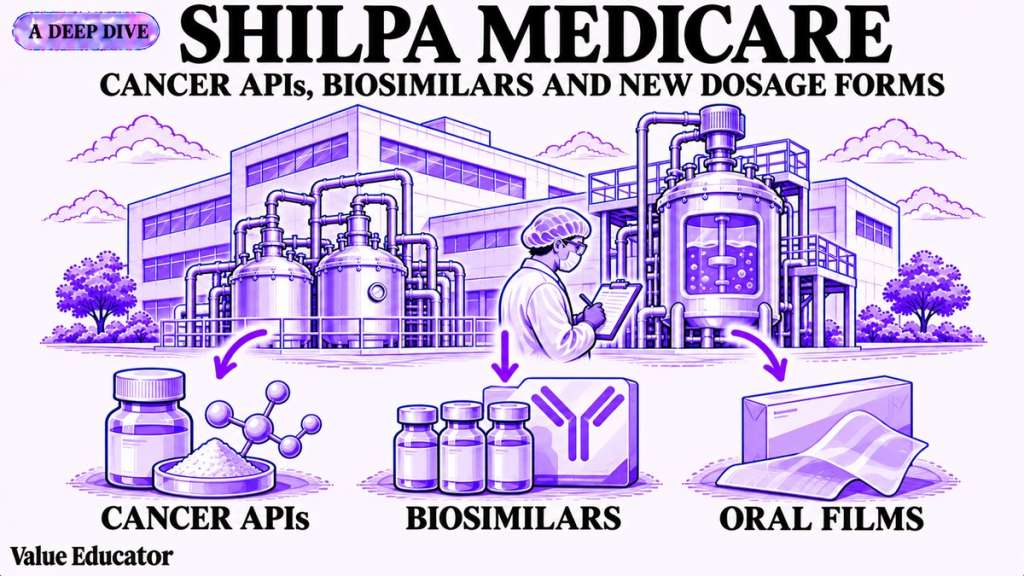
To see why that spending matters, it helps to know the four things this company makes. It starts with the active pharmaceutical ingredient, or API, which is the chemical in a medicine that does the work. A cancer API is harder to make than most, because it is toxic to handle and needs sealed, separate production blocks. Next comes the formulation, or finished dose, which is the tablet, injection, film or patch that a patient takes.
Then there are biologics, medicines made by living cells in large steel tanks, not by chemical reactions. A biosimilar is a close copy of a biologic medicine whose patent has expired, much as a generic is a copy of a chemical medicine. Last is CDMO work, short for contract development and manufacturing organisation, where the company develops and makes a drug for another company that owns it.
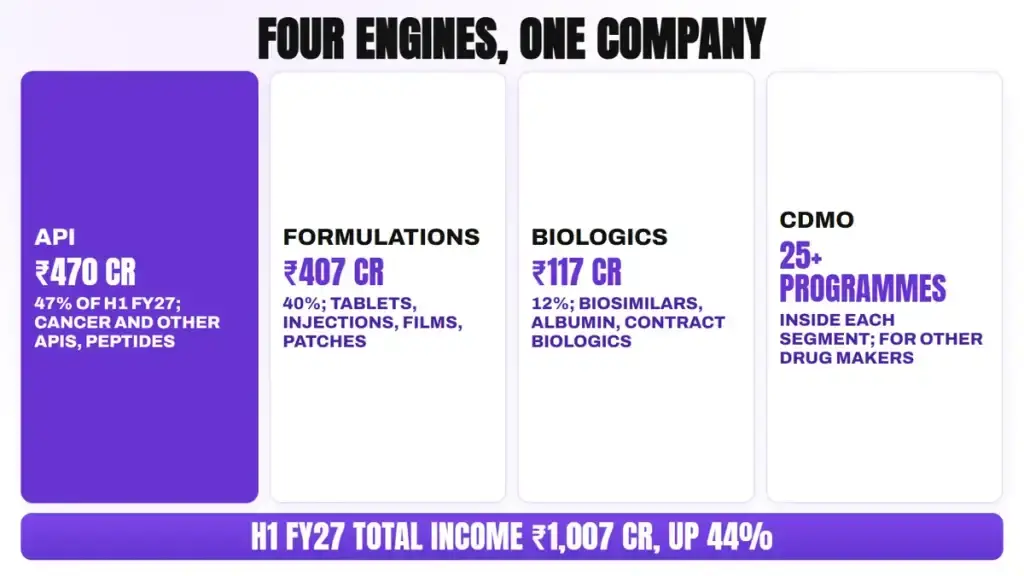
That drug maker is Shilpa Medicare Ltd (NSE: SHILPAMED). It started in 1987 in Raichur, Karnataka, as an API maker, and today it does all four. It has more than 400 R&D staff, more than 500 regulatory filings worldwide and a presence in more than 70 countries. In FY26 its revenue from operations was ₹1,538.9 Cr, and in the first half of FY27 its total income crossed ₹1,000 Cr in a half year for the first time.
So the years of building are now turning into revenue. The question is how much of that revenue is repeatable, and how much of the new capacity is still waiting for products.
Shilpa Medicare in five numbers
- H1 FY27 total income of ₹1,007 Cr, up 44%
- Q2 FY27 EBITDA of ₹151 Cr, its highest ever, at a 28% margin
- Biologics revenue of ₹65 Cr in Q2 FY27, up 150%
- Adjusted ROCE of 18.2%, against 3.4% in FY23
- 292 API drug master files and 25+ CDMO programmes for small molecules
So a company that was in the red three years ago now earns close to 30% EBITDA margins. Where is that money coming from? Let's first understand the company, and then look at the latest quarter.
Shilpa Medicare: Company Overview
Shilpa Medicare Ltd was established in 1987 and is based in Raichur, Karnataka. It began as an API maker and now works in four areas: active pharmaceutical ingredients, finished formulations, biologics and contract development and manufacturing. Its API plants are at Raichur, its formulation plants at Jadcherla in Telangana and Dabaspet near Bengaluru, its biologics plant at Dharwad and its fermentation plant at Kadechur. The group includes Shilpa Pharma Lifesciences, Shilpa Therapeutics, FTF Pharma, Shilpa Biologicals and Shilpa Biocare. It has five research centres in India with more than 400 R&D staff, more than 500 regulatory filings and a presence in more than 70 countries. Omprakash Inani is the Chairman, Vishnukant Bhutada the Managing Director, Keshav Bhutada the Executive Director and CEO of Shilpa Pharma Lifesciences, and Alpesh Dalal the Chief Financial Officer. Revenue from operations was ₹1,538.9 Cr in FY26, and net debt was ₹612 Cr in September 2026. Read this Capital-Intensive Businesses Explained
"Know what you own, and know why you own it."
— Peter Lynch
Shilpa is four businesses under one name, each with its own plants, regulators and timelines. Knowing which engine brings in the money is the first step to understanding it.
The Quarter All Three Segments Grew
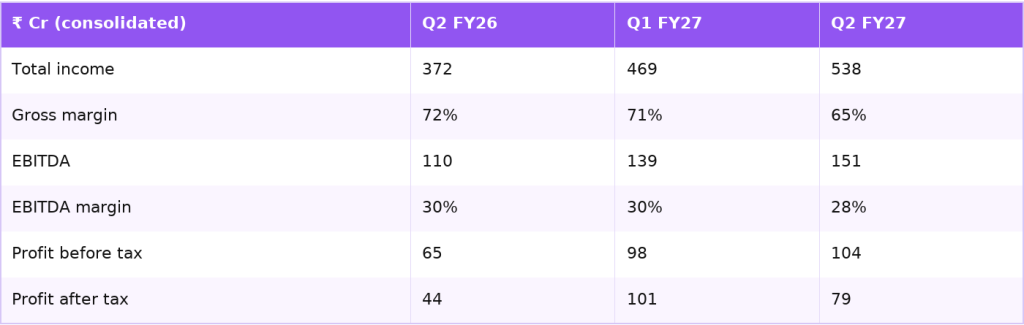
Let's look at Q2 FY27, the July to September quarter, which the company reported on 5 November 2026. Total income was ₹538 Cr, up 45% from ₹372 Cr a year ago and 15% higher than the ₹469 Cr of Q1 FY27. The company says it was its highest quarterly revenue and its highest quarterly EBITDA.
As we can see, that growth came from all three segments. API revenue was ₹254 Cr, formulations ₹210 Cr, biologics ₹65 Cr and others ₹9 Cr. Formulations grew more than 50%, and biologics grew 150%. The API business had its highest quarter ever, at ₹298 Cr including the API it supplies to its own formulation plants.
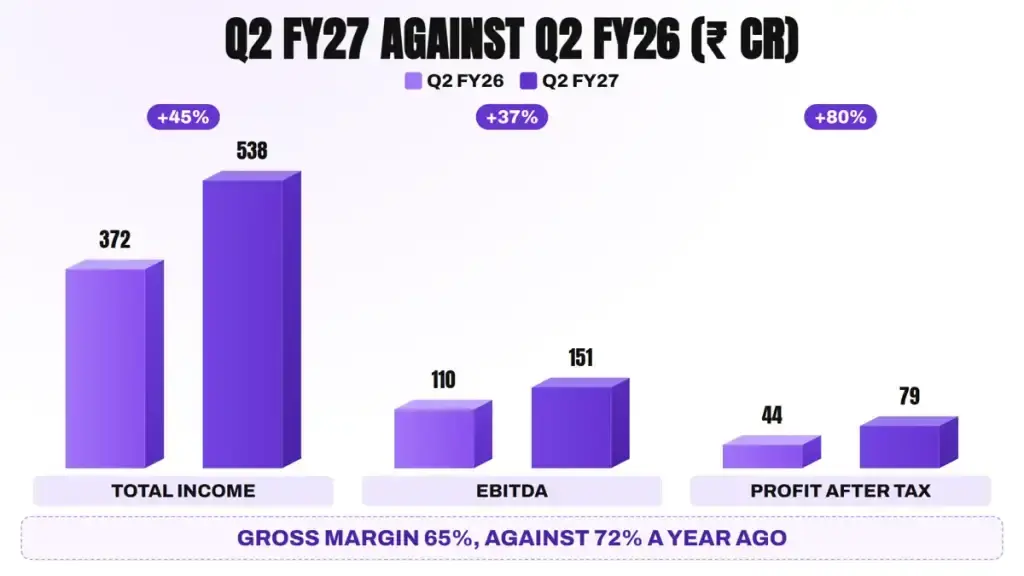
The gross margin tells a second part of the quarter. It came in at 65%, against 72% a year ago. Management gave two reasons. API sales grew fast, and API earns a lower gross margin than formulations. And raw material prices for APIs have gone up across the world. Management says this will continue until those prices settle.
Even so, EBITDA rose 37% to ₹151 Cr, because overheads grew more slowly than sales. Read this EBITDA Explained: Uses and Limits Employee costs rose 17% to ₹97 Cr, and other expenses rose 38% to ₹101 Cr, against 45% growth in income. Finance costs were ₹13 Cr, against ₹16 Cr. So profit before tax rose 61% to ₹104 Cr, and profit after tax rose 80% to ₹79 Cr.
Profit after tax was lower than the ₹101 Cr of Q1 FY27, and the reason is tax, not the business. Q1 had a share of profit from associates and a much lower tax charge, and management expects the tax rate to settle at around 25% from here.
That same pattern shows in the first half, at a larger scale. H1 FY27 total income was ₹1,007 Cr, up 44% from ₹700 Cr. EBITDA was ₹290 Cr, up 40%, at a 29% margin, and profit after tax nearly doubled, rising 98% to ₹180 Cr.
That growth also brought cash in. Operating cash flow for the half was ₹292 Cr, against ₹201 Cr a year earlier, and the company spent ₹252 Cr on capex, mostly from that cash. Read this Cash Flow Statement Explained Borrowings were ₹664 Cr in September 2026, almost the same as the ₹658 Cr of March, and management puts net debt at ₹612 Cr. Net debt is now about 1.3 times EBITDA, against 6.7 times in FY23. In July 2026, India Ratings upgraded the company's bank loan rating to IND AA- from IND A+.
How Shilpa Medicare Came Back From a Loss
Now that we have seen the quarter, let's go back and see how the company got here. Shilpa's managing director describes FY21 to FY24 as years of structural and cyclical headwinds. Many of the cancer APIs it sold were losing patents and turning into crowded generics, and a US FDA warning letter and import alert limited what it could sell into the US. Then came the Jadcherla observations in November 2023.
Through those years the company did not cut its plans. It kept paying for its biosimilar programmes, its new plants and its new delivery formats, and it restructured its balance sheet. You can see the cost of that choice in FY23, when revenue dipped to ₹1,050.1 Cr and the company ended the year in the red.
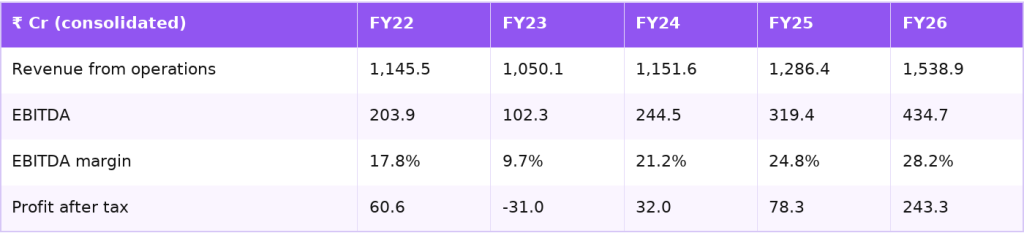
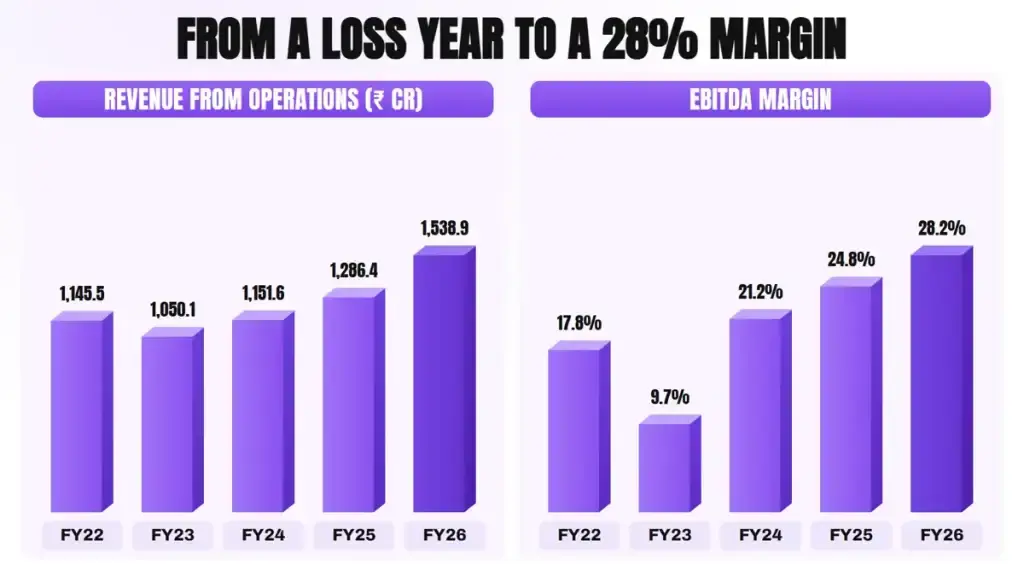
From FY24, that spending started to pay. Revenue grew in each of the last three years, but EBITDA grew much faster, from ₹102.3 Cr in FY23 to ₹434.7 Cr in FY26. The margin went from 9.7% to 28.2%. Revenue rose about 47% over those three years, while EBITDA rose more than four times. That is what happens when new, higher-margin products fill plants whose costs were already being paid.
"The big money is not in the buying and the selling, but in the waiting."
— Charlie Munger
Shilpa spent the loss years building plants before they paid. FY26 was the first year that waiting showed fully in its margins.
FY26 profit needs one adjustment, though. Profit after tax of ₹243.3 Cr includes a profit of about ₹37 Cr from selling the company's stake in Sravathi, a joint venture, and about ₹18 Cr from restating the value of an investment. The company's own adjusted profit, after the one-time items, was ₹232 Cr, up about 135%.
The return on that capital has moved too. The company reports an adjusted ROCE, which leaves out the money tied up in biologics and new biological entities that do not yet earn much. On that basis, ROCE rose from 3.4% in FY23 to 17.4% in FY26 and 18.2% in H1 FY27. On a reported basis, which includes everything, management puts ROCE at 13.3%, up from 9% in FY25.
"I want to inform all our investors that the hardest years, the years of investing ahead of revenue, are behind us. The years of harvesting are beginning." - Keshav Bhutada, CEO, Shilpa Pharma Lifesciences, November 2026
Four Engines With Four Different Payoffs
Now let's split the business, because each part earns its money in a different way. Shilpa reports one segment, pharmaceuticals, but it gives revenue for API, formulations and biologics every quarter, and CDMO work is part of each of them. Read this Segment-Wise Revenue Analysis Explained

These segments differ in more than size. The API business is the base, and it earns steady but lower gross margins. Formulations earn more, because the company adds a delivery technology or a filing route on top of its own API. Biologics is the newest and still small, but it is where the biggest plants and the largest markets sit.
The Cancer API Base
Let's start with API, the business Shilpa was built on. It runs two API plants at Raichur. Unit I has 11 manufacturing blocks with a reactor capacity of 650 KL, and Unit II has 10 blocks with 510 KL. Five blocks in each plant are for oncology. Both are approved by the US FDA and EU regulators, among others.
A cancer API needs this kind of setup because the chemicals are highly potent, which means a tiny dose is enough to harm a worker. So they must be made in sealed blocks with their own air handling, apart from other products. Few companies build this capacity, and that limits competition.
That API business brought in ₹769 Cr in FY26, and ₹985 Cr including the API used in its own formulations, up from ₹845 Cr. In H1 FY27 the non-captive API business grew about 20% to ₹470 Cr. The company has filed 292 drug master files, or DMFs, the technical dossiers that let a buyer use its API in a regulated market. It added 9 new filings in H1 FY27.
Its next step is a refreshed cancer portfolio. Shilpa has added more than 15 new oncology APIs to its pipeline, aimed at products whose patents expire through 2032, and a new oncology block is due by the end of FY27. Methotrexate, a complex cancer API, received its European CEP certificate in FY26.
Peptides are the other growth area. Peptides are short chains of amino acids, and GLP-1 diabetes and weight-loss drugs such as semaglutide belong to this class. Shilpa has 4 peptide manufacturing lines and is adding 2 more, which management calls one of the largest peptide capacities in India, due by the end of FY27. Its semaglutide DMF is ready for filing, and it can make the API by both synthetic and semi-synthetic routes.
Formulations Moving From Generics to Novel Products
Next, let's look at formulations, the second-largest segment and the fastest-growing one in FY26. Revenue rose to ₹618 Cr in FY26 from ₹474 Cr. In H1 FY27 it rose 70% to ₹407 Cr.
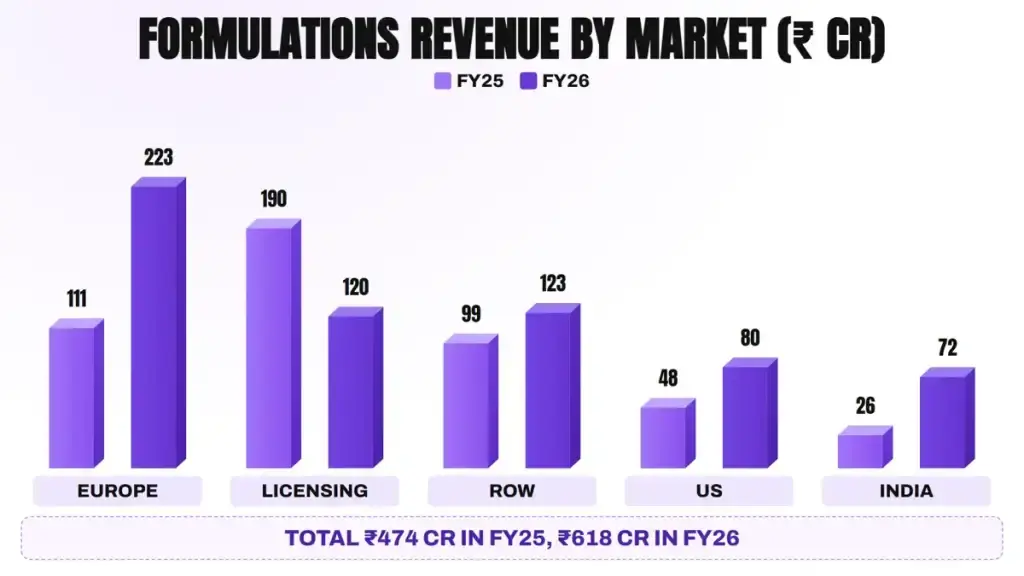
That growth came from almost every market. Europe doubled to ₹223 Cr in FY26, led by cancer generics such as Nilotinib, which Shilpa's partner launched in the EU as the first generic, through a route that does not infringe the patent. US revenue rose about 67% to ₹80 Cr, from ready-to-use cancer injections such as Pemetrexed and Bortezomib, which a nurse can give without mixing powder and liquid first. Emerging markets grew about 24% to ₹123 Cr.
India grew fastest of all, by about 177% to ₹72 Cr, because of one new product. NorUDCA, sold under the Noduca brand, is the first approved treatment in India for non-alcoholic fatty liver disease, or NAFLD. This is a condition that affects an estimated 188 million people in India. Shilpa was the first company in the world to get it approved for this use, and it markets it through three large Indian partners and its own sales team.
Only licensing income went the other way, from ₹190 Cr to ₹120 Cr. This is the money partners pay when a product is filed, approved or launched. It is lumpy by nature. Management says it expects a run rate of about ₹150 Cr a year, and that several of these deals are moving into long-term supply contracts.
Films, Patches and a Five-Day Injection
Now let's look at the part of formulations that sets Shilpa apart, which is how its medicines enter the body. At Bengaluru it runs a fully automated plant for two formats. An oral dissolving film, or ODF, is a thin strip that melts on the tongue in seconds, without water. A transdermal patch is stuck on the skin and releases the drug slowly through it over a day or more. The plant can make about 50 million films and about 30 million patches a year.

These formats matter for patients who struggle with tablets, such as older people and those with Parkinson's disease or Alzheimer's disease. They also matter for the company, because a film or a patch of an old medicine is harder to copy than a plain tablet. Shilpa was the first company to receive EU approval for tadalafil oral films through the hybrid route, a filing that relies partly on the original drug's data. Several partners will market it across Europe, with launch planned in FY28.
Its first patch is further along. The Rotigotine patch for Parkinson's disease has final EU approval, and the US filing is done, with approval expected in FY28. Its European launch slipped by about two quarters because one raw material needed an extra variation approval. Management now expects it in the first half of FY28. Two more patches, for Alzheimer's disease, are moving to final-stage studies.
The most unusual product is an injection. OERIS is a long-acting form of ondansetron, the anti-vomiting drug given to cancer patients during chemotherapy. One shot protects for up to 120 hours, or 5 days, instead of several doses. India's expert committee approved it in September 2026, it has patent protection in India until 2039, and management expects the India launch in the first half of FY28 after state licences.
Biosimilars and Recombinant Albumin
Next, let's look at biologics, the smallest segment but the one growing fastest. Revenue was ₹150 Cr in FY26, and ₹117 Cr in H1 FY27 alone, up 92%. Management says it now makes up 12% of revenue.
This business runs from a plant at Dharwad, in Karnataka. It has two 4,000-litre upstream tanks for mammalian cells, two 1,000-litre microbial suites and a pre-filled syringe line that fills 80 units a minute. The plant holds EU GMP approval.
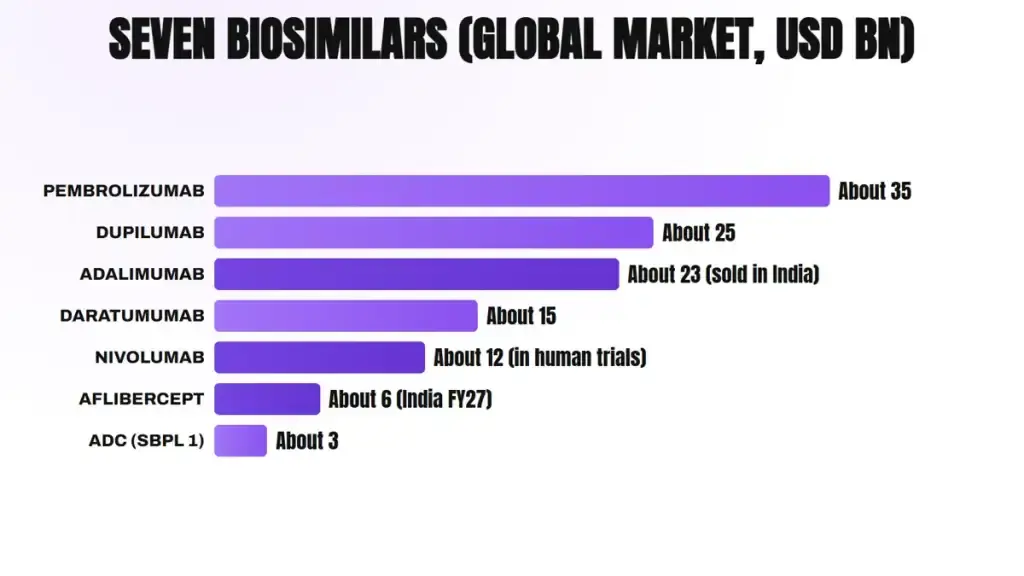
Shilpa has seven biosimilars. Each one copies a medicine with large global sales, about USD 10 billion on average. Adalimumab, for immune diseases, is already sold in India. Aflibercept, an eye injection, is due to launch in India in FY27 with partners in India and Russia. Nivolumab, a cancer immunotherapy, is now in human trials, and Orion Corporation of Finland will market it in Europe while Shilpa develops and supplies it. Pembrolizumab, the largest by global sales at about USD 35 billion, should enter human trials in the second half of FY27.
The longest bet is albumin. Human serum albumin is a blood protein used in critical care, liver disease and as a stabiliser in vaccines and other medicines, and most of the world's supply comes from donated blood plasma. Shilpa has spent over 8 years developing recombinant albumin, made by yeast in fermentation tanks, so it does not depend on blood donors. It holds patents for the process in the US and Europe, and it has built a fermentation plant at Kadechur with more than 200 KL of capacity.
Orion will market this albumin for treatment use in Europe, and Shilpa has received its first milestone payment from that deal. Phase III trials in India and Europe should start in the second half of FY27 and take 12-15 months. Management expects sales in India and Europe in FY29 or FY30.
CDMO Work for Other Drug Makers
Finally, let's look at CDMO, which is spread across the other segments. Shilpa has more than 25 small-molecule CDMO programmes and more than 5 biologics programmes, and it works with 5 big pharma companies. Its specialty CDMO revenue, which covers contract APIs, peptides and polymers, grew about 36% in Q2 FY27, helped by new clients in developed markets.
The nearest milestone is OLC, a drug for high phosphate levels in the blood, which Shilpa develops and makes for Unicycive Therapeutics of the US. Shilpa will be the exclusive maker of both the API and the finished drug. The US FDA has set a decision date of 25 March 2027, and Shilpa has already built a dedicated block for it.
Beyond OLC, 4 small-molecule programmes are under registration with global regulators, with approvals expected over the next 18-24 months. Management expects at least one of them to reach the market next year and the other three the year after. In three of the four, Shilpa supplies the API, which is a large part of what the customer buys.
Why One-Stop Integration Is Hard to Copy
Now that we have seen all four engines, let's understand the moat. Most Indian drug makers do one or two of these steps well. Shilpa does all of them in-house, from the first chemical to the finished dose.
Management describes it step by step. In API, it makes everything from the key starting material to the final API. In peptides, it makes the amino acids, runs the fermentation and then makes the peptide. In biologics, it goes from developing the cell line to filling the vial. And in antibody-drug conjugates, or ADCs, cancer drugs that join a toxic payload to an antibody, it makes the payload, the linker and the antibody and joins them itself.
That matters to a partner. A small biotech company with a new drug would rather deal with one supplier than five, because each handover adds time and another quality check. So once Shilpa is the supplier named in a partner's filing, moving to another one would mean new studies and a new approval.
"In business, I look for economic castles protected by unbreachable moats."
— Warren Buffett
For a contract drug maker, the moat is the approval itself: once a regulator has signed off on a supplier, the customer has a strong reason to stay. That is why its CDMO deals tend to run for years. Read this Economic Moat Explained
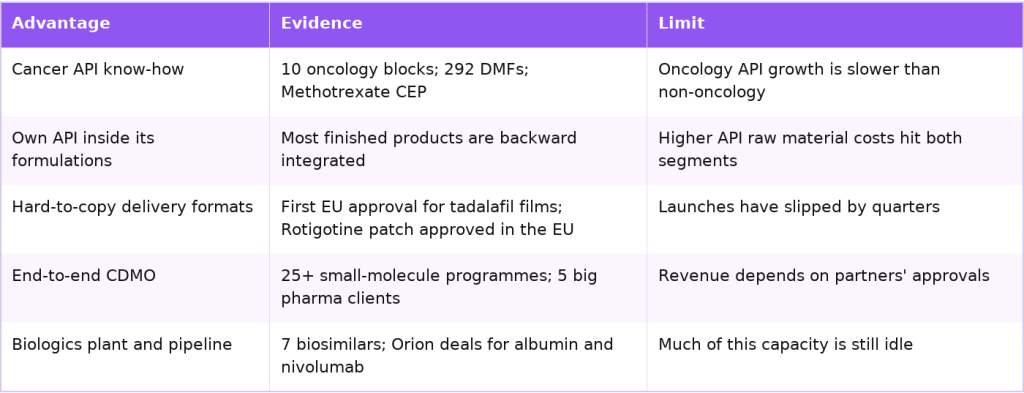
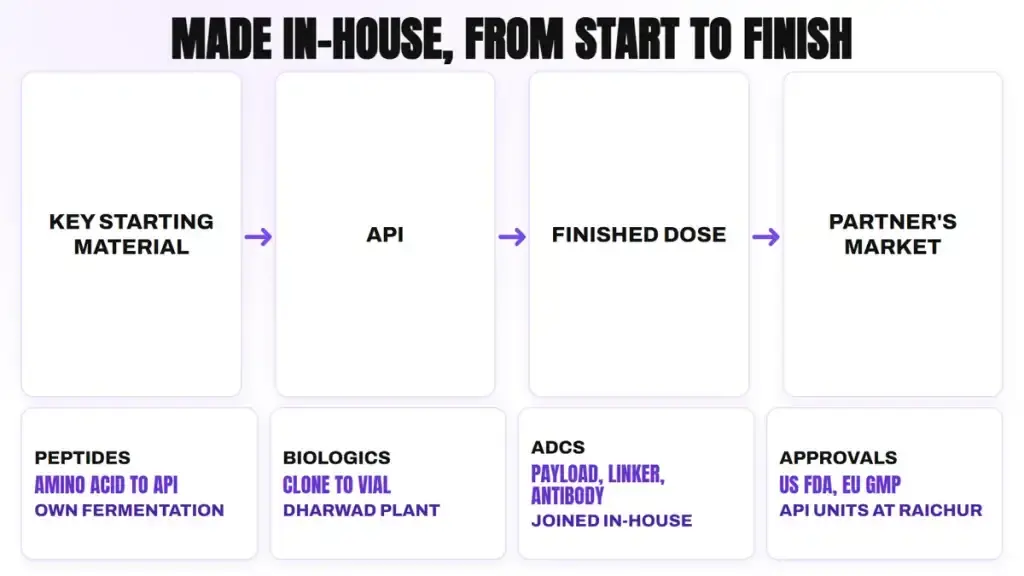
That table also shows the test for this moat. The plants are built. What they earn depends on how quickly they fill. The company itself says a large part of its gross block, in biosimilars, CDMO and new delivery formats, is still underused. That is both the opportunity and the open question.
Financials: Five Years of Revenue, Profit and Capex
The table earlier showed revenue and margins. Here is the same five years with profit before tax, profit after tax and net capex together, so we can see what the company earned against what it kept investing.
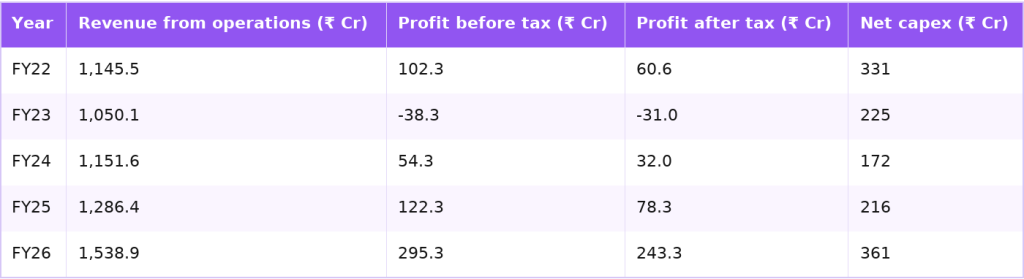
Over these five years the company spent about ₹1,305 Cr on net capex, against about ₹383 Cr of profit after tax. That gap is the story of the period: Shilpa built plants for biologics, albumin, CDMO and new delivery formats well before they earned money.
The payoff started in FY25 and became clear in FY26, when profit before tax reached about ₹295.3 Cr. Part of FY26 profit came from one-time items, including about ₹37 Cr from the Sravathi stake sale, so the company's adjusted profit after tax was ₹232 Cr. Net debt came down to about 1.3 times EBITDA in H1 FY27, from 6.7 times in FY23, which gives the balance sheet room for the launches ahead.
"In the short run, the market is a voting machine but in the long run, it is a weighing machine."
— Benjamin Graham
Shilpa's five-year table shows why: the plants were paid for years before the profit arrived. Over time, what those plants earn is what gets weighed.
What FY27 to FY30 Could Look Like on Management's Numbers
So where does the company go from here? Shilpa does not give revenue guidance. But it does publish a dated list of launches and trials, and those dates are the plan we can follow.
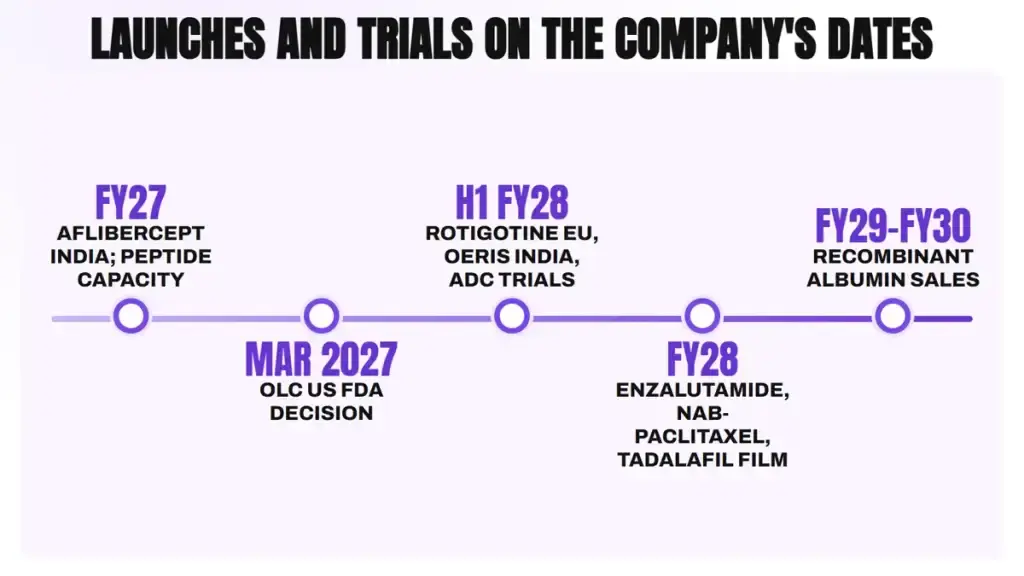
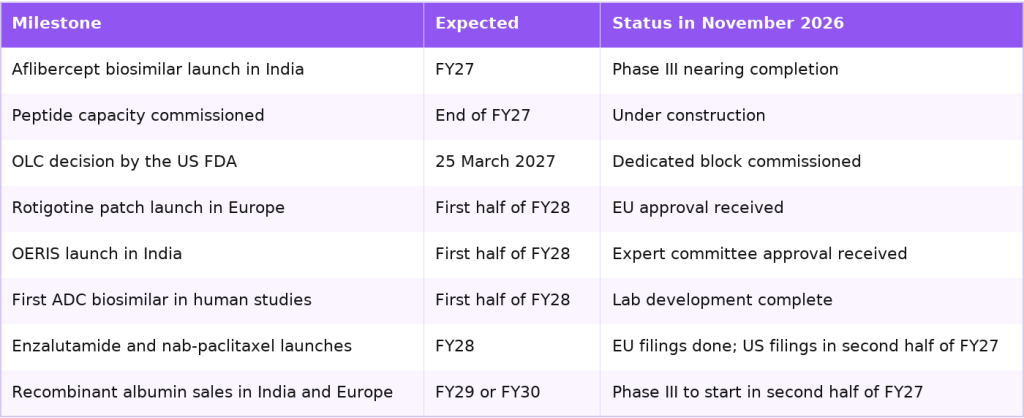
On margins, management gave a direction in May 2026. Asked whether the EBITDA margin could go back to 35%, the CFO said that 35% is an ambitious target the company would be working towards. But he also said it would take time, because a growing business also has to spend more to grow. Against that, the margin was 29% in H1 FY27.
Those plans are easier to judge against the past. So let's check what management said six months ago against where those plans stand today.
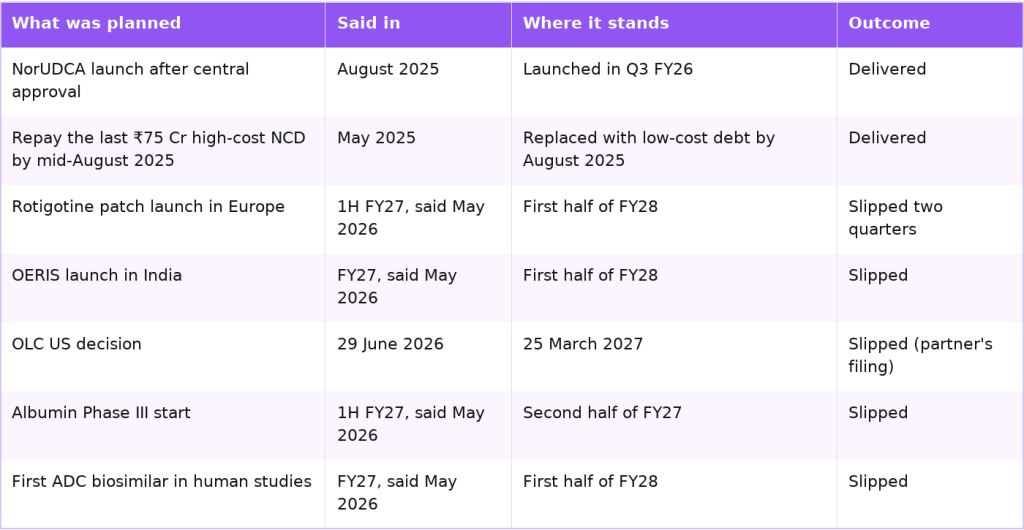
What the record says: of the seven plans in the table, two were delivered and five moved later by one or more quarters.
That record shows us a clear pattern. The money targets, such as margins, debt and cash, have been met. But almost every product date from May 2026 has moved by one or two quarters. For a company whose next growth depends on launches, the dates matter as much as the products.
Key Risks
Now let's look at what could go wrong for Shilpa Medicare, because some of these risks already showed up in the latest half year.
- Launch delays: Rotigotine, OERIS, albumin, the ADC biosimilar and OLC all moved later in the last six months. If launches keep slipping, the new plants carry their costs for longer without revenue.
- Gross margin pressure: the gross margin fell to 65% in Q2 FY27 from 72%, because API grew faster and API raw material costs rose worldwide. Management expects that pressure to last until those prices settle.
- Lumpy licensing income: licensing income fell to ₹120 Cr in FY26 from ₹190 Cr, and management does not give its share of each quarter. A quarter with fewer milestones can look weak even when sales grow.
- US regulatory status: the Jadcherla plant is still working through US FDA remediation, and the auditors flag the warning letter situation as a key audit matter for intangible assets. US products are made at contract sites for now.
- Generic competition: other generic makers have started to enter Nilotinib in Europe. Management says tenders run for one to three years, so it does not expect a big change soon.
- Idle capacity and capital work: capital work in progress rose to ₹1,051 Cr in September 2026 from ₹884 Cr in March. Much of the biologics, CDMO and novel-delivery capacity is still underused, so returns depend on filling it.
- Subsidiary insolvency case: on 9 September 2026, the NCLT admitted an insolvency case against FTF Pharma, a wholly owned formulations subsidiary, over an operational debt of about ₹2.2 Cr claimed by a supplier. The company says the impact cannot yet be quantified and is taking legal advice.
- Legal claims: claims against the group not acknowledged as debt stood at about ₹33.4 Cr in March 2026.
- Long, uncertain science: biosimilars, albumin, ADCs and the partner drugs all depend on trials and regulators. Any failed trial or rejected filing would remove part of the future revenue.
"For Rotigotine as a product, the launch got delayed by a couple of quarters. And the main reason was that there was one variation approval with the European agency for one of the raw materials." - Keshav Bhutada, CEO, Shilpa Pharma Lifesciences, November 2026
"You can't predict. You can prepare."
— Howard Marks
For Shilpa, preparing means knowing which dates have already moved and which approvals are still pending. The tracking list below shows what to watch.
Explore our Products
Research Framework

Emerging Titans
Combination of quantitative analysis, industry tailwinds, and management assessment - SPRINT investment philosophy

Tiny Titans
Heavy emphasis on scuttlebutt research, plant visits, and early on-ground signals
What to Track Next
If you follow Shilpa Medicare, these are the signals that will show where it goes next.
- The gross margin after 65% in Q2 FY27, and whether API raw material costs ease
- The US FDA decision on OLC, due 25 March 2027, and the first commercial supply
- Launch of the Rotigotine patch in Europe and OERIS in India in the first half of FY28
- Aflibercept's India launch, and the start of human trials for Pembrolizumab and the albumin Phase III
- Approvals for the 4 CDMO programmes under registration
- The outcome of the FTF Pharma insolvency case
- Capital work in progress after ₹1,051 Cr, and the EBITDA margin after 29% in H1 FY27
Members can read our full Research Desk report on Shilpa Medicare, with its detailed scorecard and section-by-section analysis.
Conclusion
Let's put it all together. Shilpa Medicare went from a net loss of ₹31.0 Cr in FY23 to a profit after tax of ₹243.3 Cr in FY26, and its EBITDA margin went from 9.7% to 28.2%. In H1 FY27 its total income rose 44%, with all three segments growing. The cautious thread is the launch calendar, where most dates set in May 2026 have moved, and the gross margin, which is under pressure from API raw material costs.
Still, the next step is about filling plants, not building them. What happens next depends on whether the delayed launches arrive on their new dates, whether the CDMO partners win their approvals, and whether the biologics plant turns seven biosimilars and recombinant albumin into steady revenue.
FAQs
What does Shilpa Medicare do?
+Shilpa Medicare makes active pharmaceutical ingredients, especially cancer APIs, and finished medicines such as tablets, injections, oral dissolving films and skin patches. It also makes biosimilars and recombinant albumin, and develops and makes drugs for other companies as a CDMO. FY26 revenue from operations was ₹1,538.9 Cr.
How did Shilpa Medicare do in Q2 FY27?
+Total income rose 45% to ₹538 Cr, its highest quarter. EBITDA rose 37% to ₹151 Cr at a 28% margin, and profit after tax rose 80% to ₹79 Cr. The gross margin was 65%, against 72% a year earlier, because API grew faster and API raw material costs rose.
What are Shilpa Medicare's oral dissolving films and patches?
+An oral dissolving film is a thin strip that melts on the tongue, and a transdermal patch releases a drug through the skin. Shilpa's Bengaluru plant can make about 50 million films and about 30 million patches a year. It received the first EU approval for tadalafil oral films through the hybrid route, and its Rotigotine patch for Parkinson's disease is approved in the EU.
What is Shilpa Medicare's biosimilar pipeline?
+Shilpa has seven biosimilars, each copying a medicine with average global sales of about USD 10 billion. Adalimumab is sold in India, Aflibercept is due in India in FY27, Nivolumab is in human trials with Orion as its European partner, and Pembrolizumab should enter human trials in the second half of FY27.
What is recombinant albumin at Shilpa Medicare?
+It is human albumin made by yeast in fermentation tanks instead of from donated blood plasma. Shilpa holds patents for the process in the US and Europe, Orion will market it in Europe, and Phase III trials in India and Europe should start in the second half of FY27, with sales expected in FY29 or FY30.
What are the main risks for Shilpa Medicare?
+Several launches, including the Rotigotine patch, OERIS, albumin trials and the first ADC biosimilar, moved later in the last six months. The gross margin is under pressure, licensing income is lumpy, the Jadcherla plant is still in US FDA remediation, and an insolvency case was admitted against its subsidiary FTF Pharma in September 2026.

High growth stock specialist, Value Educator
Shashank Mahajan is an equity research professional with over 12 years of experience in identifying high-potential SME and micro-cap stocks at an early stage. He follows a rigorous scuttlebutt research–driven approach, combining on-ground insights with deep financial analysis. Shashank specializes in uncovering under-researched and under-owned companies with strong management quality and long-term growth potential. Through disciplined research and early identification, he focuses on spotting tomorrow’s market leaders before they enter the mainstream investor radar.
Glenmark: The USD 700 Mn Cancer Deal and Its Brands
Pharma Stocks in India 2026: Generics, APIs and CDMOs
Granules India: From Paracetamol to a 65% Gross Margin
Natco Pharma: After Revlimid, 29 Patent Challenges
Alembic Pharma: US Plants Pay Back, Margin Hits 22.2%
Supriya Lifescience: APIs, Ambernath and a 22% Margin
Explore our Products
Research Framework
Emerging Titans
Combination of quantitative analysis, industry tailwinds, and management assessment - SPRINT investment philosophy
Tiny Titans
Heavy emphasis on scuttlebutt research, plant visits, and early on-ground signals



Modern Warfare to Multibaggers
Key Trends. Strategic Shifts. Opportunities Ahead.
Don't Miss This Exclusive Webinar!
Join Value Educator to decode the key trends shaping India's defence sector and learn how to identify tomorrow's potential leaders in the space.
- In-depth research on India's defence sector
- Live Q&A session
- Actionable takeaways for long-term investors

 Orders
 Subscription
 Share with friends


Required Details
₹23999.00
(12 month subscription)
As per SEBI regulations, all users are mandated to complete the KYC that is validated for 1 year. Post payment, you will be redirected to the KYC screen


No comments yet. Be the first to comment!