How a 197% Stock Rally in 2025 Signals the Start of India’s Next Big Commercial Vehicle Boom
The Stock That Nobody Saw Coming
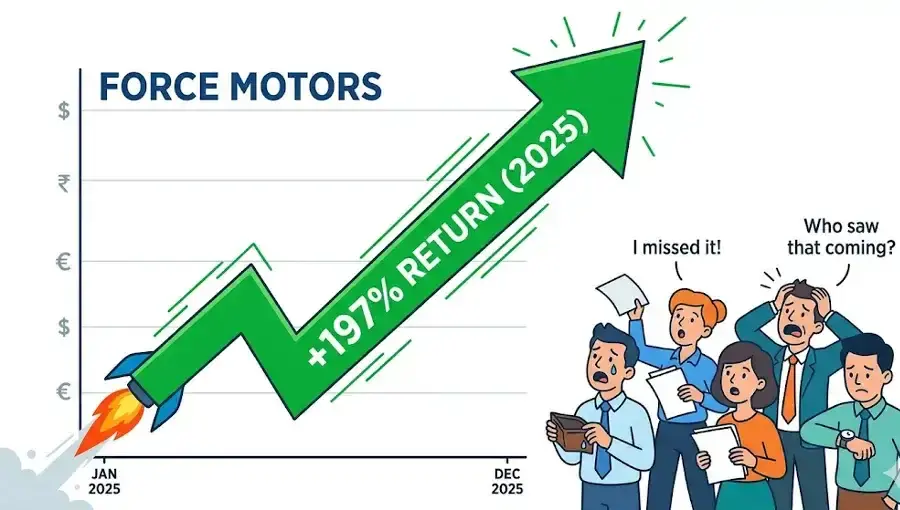
December 31, 2025. As most investors scanned through their portfolios on the last day of the year, there is one name that stood out from all — a name that very few would have even thought of at the start of 2013 — Force Motors. The stock raked in a head-scratching 197% return during calendar year 2025 after returns of 161%, and then of 80%, in 2023 and 2024. That is greater than a 1,000% cumulative three-year return from early 2023 to end of 2025. An investment of ₹10 lakh in January 2023 would have grown to more than ₹1.1 crore by December 2025.
This wasn’t a penny stock or speculative small-cap high on momentum. This was a 70-year-old automobile manufacturer with actual products, actual customers and actual profitability growing at 105% year-on-year in H1 FY26 with profit after tax at ₹535 crore.
By early 2026, the company’s market capitalization crossed ₹29,000 crore compared to a mere ₹7,000-8,000 crore at the beginning of 2023. The stock was at ₹20,400 in the last week of March 2026, and had a trailing P/E multiple which ranged between 18.73 to 23.9. What is indeed more astounding — while managing this Force Motors remained absolutely debt-free with a 0.00 debt-to-equity ratio.
Force Motors has zero debt and rising cash flows, while most firms in the auto sector run with leverage to finance capex and working capital. The company’s promoter hold stands at a comfortable 61.6%, suggesting a strong confidence among promoters and alignment with minority shareholders.
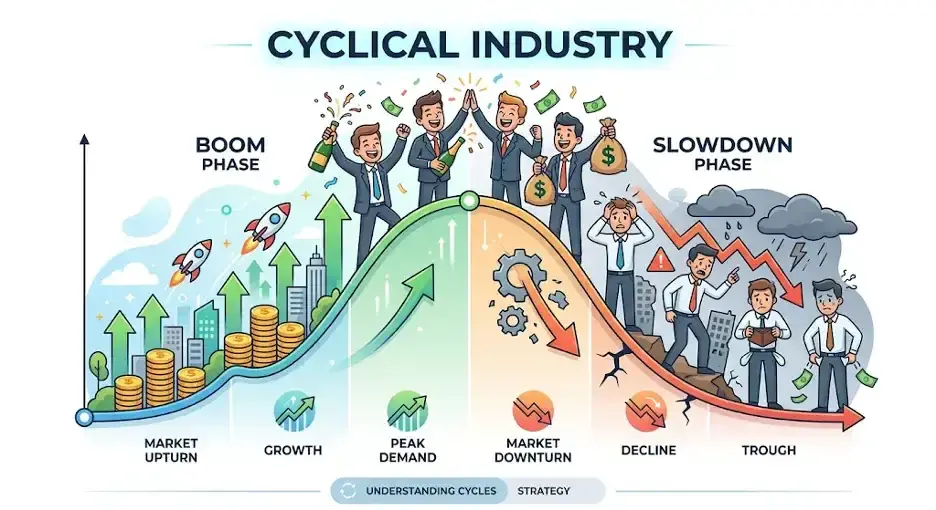
This isn’t a story about a hidden gem that retail investors discovered before institutions. This is a story about commercial vehicle demand cycles in India — how they work, why they matter, and which companies benefit most when infrastructure spending, rural connectivity, and fleet replacement cycles align. Force Motors’ 197% rally in 2025 wasn’t luck or speculation.
It was the market recognizing that India’s commercial vehicle sector is entering a multi-year upcycle driven by government infrastructure capex, formalization of fleet operators, and replacement demand for aging vehicles. The company simply positioned itself perfectly in the right sub-segments at the right time.
If you’ve ever wondered why some automotive stocks deliver 200%+ returns while others in the “same sector” barely move 20%, understanding sub-segment positioning within commercial vehicles explains everything. If you’re trying to identify the next multi-bagger in the automotive space and feel overwhelmed by 30+ listed companies, learning Force Motors’ playbook — dominate a niche, stay debt-free, diversify revenue streams — gives you the filtering criteria.
And if you thought commercial vehicle stocks were boring cyclicals that only move with GDP growth, you’re about to learn that niche players leveraging specific demand pockets (school buses, ambulances, tourism vans, defence vehicles) can compound shareholder wealth far faster than diversified automotive giants when those niches hit inflection points.
When a company holds 70%+ market share in light commercial passenger vehicles and that segment is growing 50%+ annually, the math compounds very fast.
1. The Business Model: Why Force Motors Isn’t Just Another Auto Company
Niche Dominance Over Broad Market Share
Force Motors doesn’t compete head-to-head with Tata Motors, Mahindra & Mahindra, or Ashok Leyland for overall commercial vehicle market share. The company’s estimated 2-5% share of India’s total CV market would make it look like a minnow compared to giants.
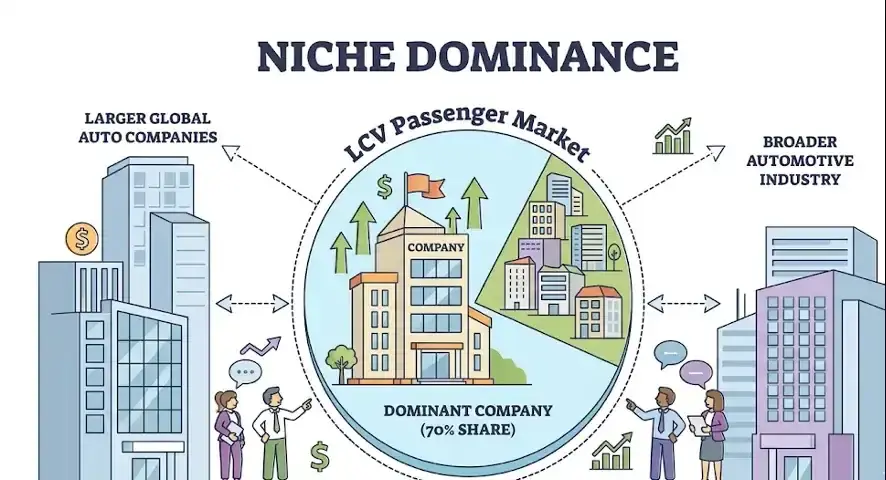
But this top-level market share number completely misses Force Motors’ actual competitive positioning. The company dominates the light commercial vehicle (LCV) passenger segment with over 70% market share through its flagship Force Traveller brand. When schools need minibuses, hospitals need ambulances, or tour operators need 13-26 seater vans, Force Traveller is the default choice in India. This isn’t competitive advantage through price wars — it’s dominance through product-market fit that took decades to build and competitors can’t easily replicate.
Opting for the Force Traveller is, if you'll pardon the use of a gangster term, not as much due to better marketing or having more dealers (even though that helps) but because the product itself evolved specifically with Indian operating conditions in mind over 40+ years. The chassis’ sturdiness for badly maintained streets, seating configurations that adhere to capacity regulations but still get as many passengers in per kilo of net vehicle weight as possible, the parts availability in tier-2 and -3 cities where competitors don’t have service networks — even residual value such that fleet operators can recoup their capital over a period of 8 to 10 years — these create switching costs that keep buyers loyal when cheaper alternatives enter the fray.
The above explains why Force Traveller continued its supremacy, even while new players attempted to kill it on pricing through the last decade. Customers are not optimizing to lowest cost upfront, they are optimizing to total cost of ownership over 10-15 year vehicle life.
The revenue diversification beyond commercial vehicles is what separates Force Motors from pure-play CV manufacturers. The company generates approximately 44% of revenue from automotive components, supplying engines and drivetrains to global OEMs including BMW and Mercedes-Benz for vehicles manufactured in India. This component business operates on contract manufacturing model with multi-year agreements, providing revenue stability that smooths out cyclicality in CV sales.
When CV demand weakens during economic slowdowns, the component contracts continue generating cash flows. When CV demand weakens in economic slowdowns, the component contracts continue to deliver cash flow. Similar to what was shown in FY25-FY26, when the demand for CV is high both segments fire sequentially generating operating leverage leading to higher growth in earnings. This leverage is evident in the 105% profit growth achieved in H1 FY26 — revenue was up 14%, so profits more than doubled as fixed costs got spread across bigger volumes with higher utilization.
The product portfolio within CVs itself shows intelligent diversification. Force Traveller dominates the workhorse passenger LCV segment. Force Urbania targets the premium 10-14 seater luxury van market for corporates and high-end tourism, recording over 100% volume growth in FY26. Force Trax serves the smaller city and rural transport market, expanding by more than 70% in FY26. Force Gurkha, the off-road SUV, secured a defence contract for 600+ units to the Indian Army and is gaining traction in the civilian adventure SUV market.
This range covers price points from ₹12-15 lakh (Trax) to ₹40-50 lakh (Urbania), capturing different customer segments without cannibalizing the core Traveller business. Most automotive companies either play at one price point or spread too thin across segments. Force Motors clusters around commercial/utility vehicles where its engineering expertise in rugged, high-utilization products creates differentiation.
For investors, Force Motors isn’t a bet on India’s overall automotive growth. It’s a bet on specific sub-segments where the company has sustainable competitive advantages: the LCV passenger segment where it’s the dominant player, the premium van segment where it’s gaining share rapidly, and the component business where it’s locked into multi-year global OEM contracts. These aren’t commoditized markets where price is the only differentiator.
Also you can see our
They’re niches where product durability, service network, and total cost of ownership drive purchase decisions, and Force Motors has spent decades building exactly those capabilities.
“The best business returns are usually achieved by companies that are doing something quite similar today to what they were doing five or ten years ago. And Force Motors has been making Traveller vans for 40 years.”
— Warren Buffett (adapted)
Like this analysis? Get powerful insights like this every week. No spam.
2. The FY26 Growth Story: Numbers That Validate the Rally
20% Sales Growth While Sector Slows
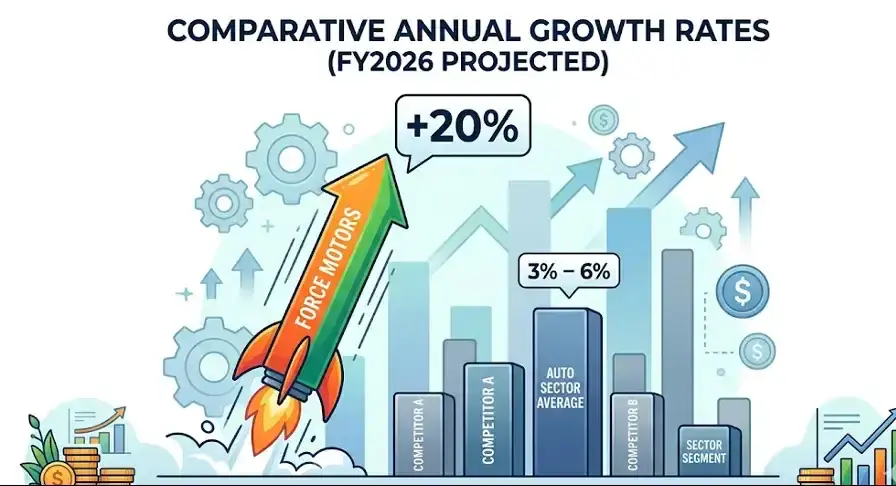
The headline numbers for FY26 validate why the stock rallied 132% in the 12 months leading up to March 2026. Domestic wholesales rose to 36,536 units in FY26 from 30,531 units in FY25 — a 19.7% year-on-year increase. March 2026 alone saw a 14% sales jump compared to March 2025, with 4,199 units sold versus 3,700 units. This growth came during a period when ICRA projected the broader automotive sector would see moderate volume expansion of just 3-6% for FY26-27, a significant slowdown from higher growth rates in FY25.
The passenger vehicle segment was forecast to grow 4-6%, the bus segment 7-9%, and LCV growth expected to moderate to 3-5%. Force Motors delivering 20% growth while the sector averaged 3-6% is the definition of market share gains and superior positioning.
Breaking down the FY26 performance by product line reveals where the growth came from. The Force Traveller maintained its dominance in the LCV passenger segment with over 70% market share, driven by sustained demand for school transport and ambulance applications. The government’s focus on rural healthcare infrastructure and the National Education Policy’s emphasis on improving school access in remote areas created a structural tailwind for Traveller sales.
These aren’t one-time purchases — schools and hospitals replace fleets every 8-12 years, creating recurring demand cycles that Force Motors captures through its installed base advantage. When a school district needs to replace aging buses, the default decision is ordering more Travellers because driver training, spare parts inventory, and maintenance familiarity are already aligned to that platform.
The Force Urbania became the breakout product of FY26, recording over 100% volume growth from FY25 levels. This premium 10-14 seater van competes in the luxury MPV segment against imports and modified Toyota Hiace vans, targeting corporate shuttle services, luxury tour operators, and high-net-worth individuals who want SUV-level comfort in a van format.
Priced at ₹30-50 lakh depending on variant and customization, Urbania carries far higher margins than the ₹15-25 lakh Traveller. The 100%+ growth signals that Force Motors successfully created a new category in the Indian market where none existed before — luxury vans that aren’t imports. The India tour and travel hospitality sector is expanding rapidly with improving highway infrastructure, and Urbania is positioned to capture premium fleet demand that previously went to improvised solutions.
Be part of the
Value Educator
community
Get exclusive insights tailored to
sharpen your investment decisions.
The Force Trax platform expanding by more than 70% indicates penetration in smaller cities and rural markets where the compact size and lower price point fit local transport needs better than full-size Travellers. The defence contract for 600+ Force Gurkha units to the Indian Army represents both revenue diversification and validation of the product’s off-road capability. Defence orders are lumpy and unpredictable, but they establish credibility for the civilian Gurkha model as a genuine off-road SUV rather than a lifestyle vehicle.
If the Army uses it in harsh terrain, adventure enthusiasts see it as authentic — exactly the positioning needed to compete against Mahindra Thar in the growing off-road recreation market.
The profit growth is where Force Motors’ operating leverage becomes visible. H1 FY26 profit after tax jumped 105% year-on-year to ₹535 crore on 14% revenue growth. This isn’t linear — it’s exponential leverage. When fixed costs (factories, R&D, corporate overhead) are already covered by base volume, incremental sales drop much higher margins to the bottom line.
The component business supplying BMW and Mercedes engines operates on steady volumes with contracted pricing, so the profit surge came from the CV segment where higher utilization and premiumization (Urbania’s growth) expanded margins. For investors, this 105% profit growth on 14% revenue growth is the signal that Force Motors has entered the sweet spot of the demand cycle where volume growth translates to disproportionate earnings expansion.
“Our favorite holding period is forever. But you can only hold forever if earnings compound faster than revenues.”
— Warren Buffett
3. The Risks Nobody Talks About: Why 197% Rallies Don’t Last Forever
Concentration, Cyclicality, and Valuation Concerns
The spike from ₹7,000 crore market cap in early 2023 to higher than the currently realised figure at ₹29,000 crore by early 2026 made a lot of people winners, while also creating risks new investors buying up current levels must be aware of. The primary and biggest risk there is product concentration — a large section of Force Motors’ revenue relies on the continued supremacy of the Force Traveller in LCV passenger segment.
Any threats to this franchise from new competitors, regulatory reforms or changes in consumer tastes could have an outsized impact on overall results. Should Tata Motors or Mahindra aggressively pursue the LCV passenger segment with competitive products utilizing their superior dealer network and inherent brand strength, Force Traveller's 70% market share could rapidly erode. Market leadership isn’t forever when competitors with 10x the resources choose to focus on your niche.
The second risk is the cyclicality of commercial vehicle demand. CV sales are highly correlated with GDP growth, infrastructure spending, and corporate capex cycles. The FY26 performance was largely aided by government infrastructure push, rural connectivity programs and pent-up replacement demand.
But these tailwinds can reverse. ICRA’s estimate of 3-6% growth for FY26-27, down from higher rates in FY25, suggests the sector is entering a softer phase. Demand for CVs can fall 15-20% in a year if the economy slows, spends on infrastructure reduces and/or fleet operators face higher financing costs from interest rate hikes. Force Motors FY26 20% growth, can quickly become in FY27-28 a 5% growth or negative growth as macro headwinds play out.
The valuation risk is perhaps most pressing for investors considering entry at current levels. The stock trades at a P/E ratio between 18.73 and 23.9 as of March 2026, commanding a premium to broader market multiples despite being in a cyclical sector. One analysis presented a starkly different outlook, projecting a significant contraction in Force Motors’ revenue (-47%) and net income (-84%) over the next year.
This forecast suggests current demand surges might not be sustainable, especially as the broader sector growth moderates and regulatory compliance costs potentially rise with stricter emission norms. If this bearish scenario materializes, the stock could give back 40-50% of its gains as earnings disappoint and the market de-rates the multiple from 20-24x to 10-12x typical for cyclical autos.
The fourth risk is dependence on the defence contract pipeline. The 600+ Gurkha units supplied to the Indian Army generated revenue and validation, but defence procurement is notoriously cyclical with no guaranteed repeat orders. Force Motors can’t build a reliable earnings stream around defence sales because orders come in unpredictable lumps.
The civilian Gurkha competing against Mahindra Thar faces brand disadvantage — Mahindra has decades of off-road heritage and a loyal enthusiast base. Gurkha needs to establish its own identity beyond “the Army vehicle,” which requires marketing spend and time. It is long way from a successful crossover to celebrating 10,000+ civilian annual sales, potentially putting Gurkha in the niche category with little return on investment.
For such investors buying at ₹8,000-10,000 levels in early 2023 has created life-changing returns with over 197% rally. The question then is whether buying at ₹20,000-22,000 in early 2026 offers a similar upside or merely sets the scene for disappointment when the cycle turns.
The market cap of ₹29,000 crore implies the market is pricing in continued strong growth and margin expansion. If that doesn’t materialize, the stock could consolidate or correct 30-40% as reality fails to meet expectations. This isn’t bearishness — it’s recognizing that 200% rallies pull forward multiple years of expected returns, and new buyers need even better execution to justify higher valuations.
Join 1,45,000+ investors discovering under-researched small caps before they rerate.
“Risk comes from not knowing what you’re doing. And buying cyclicals at peak earnings without knowing where the cycle stands is risky.”
— Warren Buffett
4. The Commercial Vehicle Demand Drivers: What Sustains Growth Beyond FY26
Infrastructure, Formalization, and Replacement Cycles
The bull case for Force Motors extends beyond FY26 if you believe India’s commercial vehicle demand is in a multi-year upcycle, not a one-year spike. Three structural drivers support this thesis: government infrastructure spending, formalization of the fleet operator market, and natural replacement cycles for aging vehicles.
The Indian government’s National Infrastructure Pipeline allocates over ₹100 lakh crore toward infrastructure development through 2030, covering highways, railways, ports, and urban infrastructure. Every kilometer of new highway creates demand for intercity buses and passenger vans. Every new tourist destination connected by road infrastructure generates fleet demand for tour operators. Force Motors’ Traveller and Urbania are direct beneficiaries of this expanded connectivity.
The formalization of fleet operators accelerated post-GST implementation and with increasing regulatory compliance requirements for commercial vehicles. Unorganized operators running 5-10 old buses are gradually replaced by organized fleet companies operating 50-100+ vehicle fleets with proper licensing, insurance, and maintenance standards. These organized players prefer branded vehicles from established manufacturers like Force Motors because financing is easier, resale value is predictable, and service network reliability matters when operating large fleets.
As the ₹50,000+ crore tour and travel hospitality sector continues formalizing, Force Motors gains market share from unorganized players who can’t meet regulatory standards. This isn’t a one-time shift — it’s a decade-long transition that creates tailwinds for the next 5-7 years.
The replacement cycle for commercial vehicles in India typically runs 12-15 years before vehicles become uneconomical to maintain. India added a lot of its LCV fleet during 2010-2014 infrastructure-led boom. Those vehicles are currently 12-16 years old and due for natural cycles of replacement, regardless of whether new infrastructure projects are beginning. Fleet operators also retire aging vehicles because after 12 years of service, the maintenance costs increase, fuel efficiency declines, and passing regulatory inspections becomes more difficult with changing emission norms.
As the customers who purchased Travellers in 2010-14 would create new demand with replacement of the vehicle post 2025 till 2028 given the old Traveller will be up for fresh replacements by then as well, during this time frame customers are likely to pick a familiar brand and define that with parts too. As an installed base, this generates recurring revenue streams that are not contingent on new market creation.
The wild card is adoption of electric vehicles in the commercial segment. Passenger cars have been given aggressive EV penetration targets, but the economics are different for the commercial vehicle sector. The high initial cost of electric light commercial vehicles (LCVs), a lack of charging infrastructure along key intercity journeys, driver concerns about battery lifetime under heavy use all hold back adoption.
As Force Motors hasn’t launched an electric version of the Traveller nor Urbania, it could face a risk if regulations require EVs sooner than anticipated. On the other hand, the commercial vehicle EV transition is going to be gradual over a period of 10–15 years, unlike that for passenger cars which is in the range of 5–7 years. This allows Force Motors for time to develop electric platforms without losing market share in the interim. The larger one is whether Force Motors still has the capital and high-technology partnerships to contest electric CVs when that shift sprints.
For the sceptical investor trying to assess whether Force Motors’ growth story is a flash in the pan or adobe-like trajectory stabilizer that can span up past FY26, the questions matrix will be: Do you believe infrastructure spending in India will stay between 8-10% of GDP till 2030, do you believe fleet formalization is here to stay for a decade performance and 2010-2014 vehicle cohort naturally creates replacement demand till FY28 worsen your better thinking enigmas then hold on to your seats because Force Motors has got plenty gas left till FY26. If any of these assumptions break — infrastructure spending slows, formalization slumps or EV adoption occurs quicker than expected — the growth story weakens and the stock needs to get re-rated lower.
“The most important thing to do if you find yourself in a hole is to stop digging. But if you’re riding a growth cycle, keep buying — until the cycle turns.”
— Warren Buffett (adapted)
CONCLUSION
The 197% rally in Force Motors this 2025 represents more than mere market exuberance — it’s a recognition of an enterprise placed well within the orbit of a propitious cycle. Its strong hold of the light commercial passenger vehicle space, along with a debt-free balance sheet and operating leverage left earnings to grow faster than revenue through periods of increasing demand. This shows the ability of cyclical businesses to produce strong performance when they benefit from industry background.
But right now the most important question for investors isn't whether or not it's a good business, it's how much do you pay and when. The more stocks rally, the wider the margin of safety narrows on a fundamental basis and future returns rely that much more heavily on execution going right (and an economic backdrop continues to grow). Although longer-term drivers like infrastructure development and fleet formalization remain supportive, the risk-reward is no longer as clearly favorable as it may have been earlier in the cycle.
This also moves the playbook away from blindly aggressive buying and more toward careful decision-making. An investor will need to weigh optimism regarding long-term growth versus downside reentry price point, position sizing, cyclical nature of the industry and individual companies. Understanding the company's trajectory within that cycle then becomes as vital as understanding the company itself.
After a 200% rally, what’s your view on Force Motors at current levels — still an opportunity or already priced in?
Comment “BUY” if you believe there’s further upside, or “WAIT” if you think a correction is likely. If you already track or hold the stock, feel free to share your reasoning as well — let’s discuss different perspectives.
Market Cap focus
No. of ideas in a year
Holding period
Pricing

Emerging Titans
Combination of quantitative analysis, industry tailwinds, and management assessment - SPRINT investment philosophy
Multi Cap
20-25
3+ Years
Rs. 23,999/year

Tiny Titans
Heavy emphasis on scuttlebutt research, plant visits, and early on-ground signals
Exclusively for SME's
15-20
3+ years
Rs. 31,999/year
FAQs
Should I buy Force Motors at ₹20,000 levels after a 197% rally?
+
The stock has already rallied significantly, pulling forward multiple years of returns. Buying at current levels requires conviction that FY27-28 growth will match or exceed FY26, which is uncertain given sector slowdown projections. Better approach: wait for 15-20% correction to ₹16,000-17,000 range, or buy 50% position now and 50% if correction comes. Chasing after 200% rallies often ends in disappointment.
What’s a fair valuation for Force Motors given cyclical nature?
+
Cyclical auto companies typically trade at 10-15x P/E during peak earnings. Force Motors at 20-24x P/E implies the market expects continued strong growth. If earnings growth slows to single digits in FY27-28, the stock could de-rate to 12-15x P/E, implying 30-40% downside even if earnings stay flat. Fair value probably lies around ₹14,000-16,000 at current earnings, making current prices optimistic.
How does Force Motors compare to Tata Motors or Ashok Leyland?
+
Force Motors is a niche player dominating specific sub-segments (LCV passenger), while Tata and Ashok Leyland are diversified giants with broad market coverage. Force Motors offers higher growth during upcycles but more volatility during downturns. Tata and Ashok provide stability with dividends. For growth, Force wins. For stability, Tata/Ashok win. Allocate accordingly.
What’s the biggest risk to Force Motors’ growth story?
+
Product concentration on Traveller is the biggest risk. If competitors successfully target that niche or if regulatory changes disadvantage Traveller’s design, the company loses its core revenue driver. The second biggest risk is cyclical downturn — CV demand can contract 20-30% during recessions, and Force Motors has no insulation from that.
Should I hold Force Motors for long term or treat it as a cyclical trade?
+
Depends on valuation. If you bought at ₹7,000-10,000, holding makes sense because even with cyclical downturns you’re far in profit. If buying at ₹20,000-22,000, treat it as a trade — book profits when it hits ₹24,000-26,000 or cut losses if it breaks ₹18,000. Cyclicals rarely reward buy-and-hold at peak valuations.
About the author

Shashank Mahajan
High growth stock specialist, Value Educator
Shashank Mahajan is an equity research professional with over 12 years of experience in identifying high-potential SME and micro-cap stocks at an early stage. He follows a rigorous scuttlebutt research–driven approach, combining on-ground insights with deep financial analysis. Shashank specializes in uncovering under-researched and under-owned companies with strong management quality and long-term growth potential. Through disciplined research and early identification, he focuses on spotting tomorrow’s market leaders before they enter the mainstream investor radar.
Join 1,45,000+ investors discovering under-researched small caps before they rerate.









 Orders
 Subscription
 Share with friends
 Logout


No comments yet. Be the first to comment!