
PNG Jewellers: A 194-Year-Old Name Goes National

Indians buy gold whatever its price. Gold prices have climbed sharply over the last five years, yet jewellery demand fell only about 8% by volume, because gold is bought for weddings, festivals and savings, not as a luxury. India is the world's second-largest gold market, and about 10 million weddings a year alone need an estimated 300 to 400 tonnes of gold.
What is changing is where Indians buy it. Organised jewellers, with branded stores, fixed prices and certified purity, had only about 6% of the market in FY07. Their share rose to about 38% in FY24 and 42% in FY26, and it is projected to reach about 55% by FY30. One rule has helped them a great deal. Mandatory BIS hallmarking, a government stamp that certifies the purity of gold, began in 2021 and gives organised jewellers an edge. Hallmarking covered about 30% of jewellery in FY21 and 72% in FY25, with a target of more than 90% by FY27.

That push has a cost side too. During FY26, the effective import duty on gold was raised to 15%, made up of 10% basic customs duty and 5% agriculture cess, from 6% earlier. Every jeweller now pays more for imported gold, so the gold that families already hold at home becomes more useful. Jewellers whose exchange schemes customers trust can bring that old gold back into use.
One family jeweller has been part of that market for almost two centuries. P N Gadgil Jewellers Ltd (NSE: PNGJL) traces its roots to 1832. The family is now in its sixth generation, and its brand, PNG Jewellers, is the second-largest organised jeweller in Maharashtra by store count. It had 80 stores in September 2026, 79 in India and one in the US.
Its growth now has two engines. One is same-store sales growth (SSSG), which simply means how much more the stores that were already open sold than a year earlier. The other is new stores. Most of the new ones will be franchise-owned company-operated (FOCO) stores, which means a local partner pays for the store and its stock while PNG runs it under its brand.
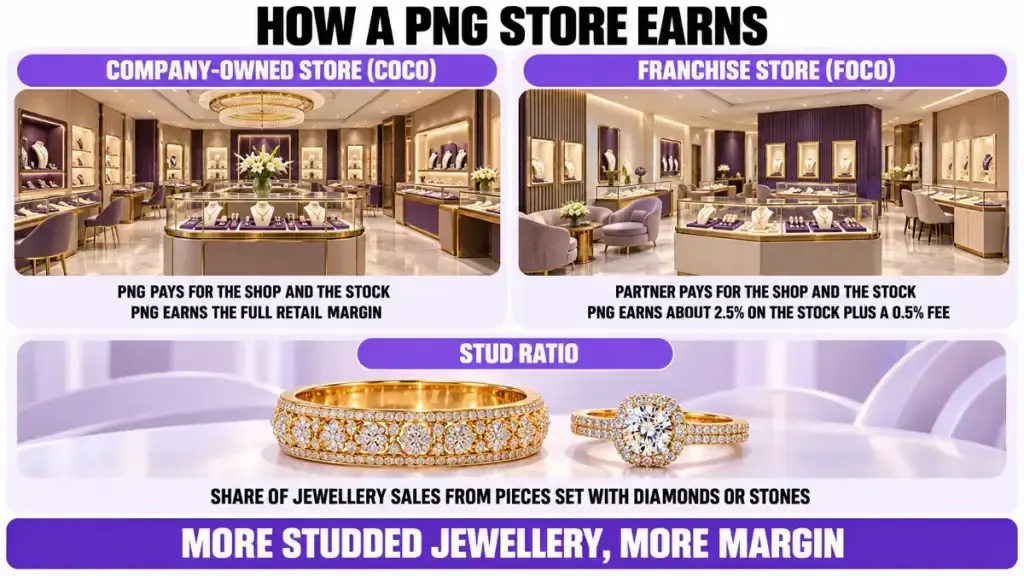
Alongside these, the company tracks its stud ratio, which means the share of its jewellery sales that come from studded pieces, those set with diamonds or other stones. Studded jewellery earns a much higher margin than plain gold, so a rising stud ratio lifts profit even when gold prices swing.
PNG Jewellers in five numbers
- Q2 FY27 revenue up 22.4%, with same-store sales up 25.5% in retail
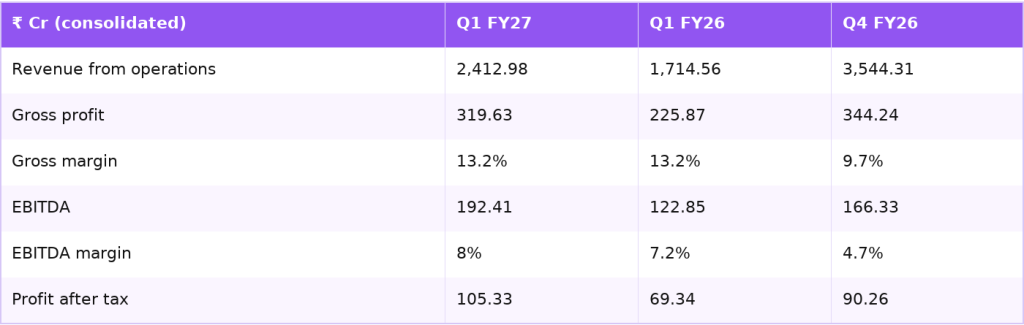
- Q1 FY27 revenue of ₹2,412.98 Cr, up 40.7%, and profit after tax of ₹105.33 Cr, up 51.9%
- 80 stores in September 2026, heading to about 103 by March 2027
- A retail stud ratio of 11.8% in Q2 FY27, against 9% a year ago
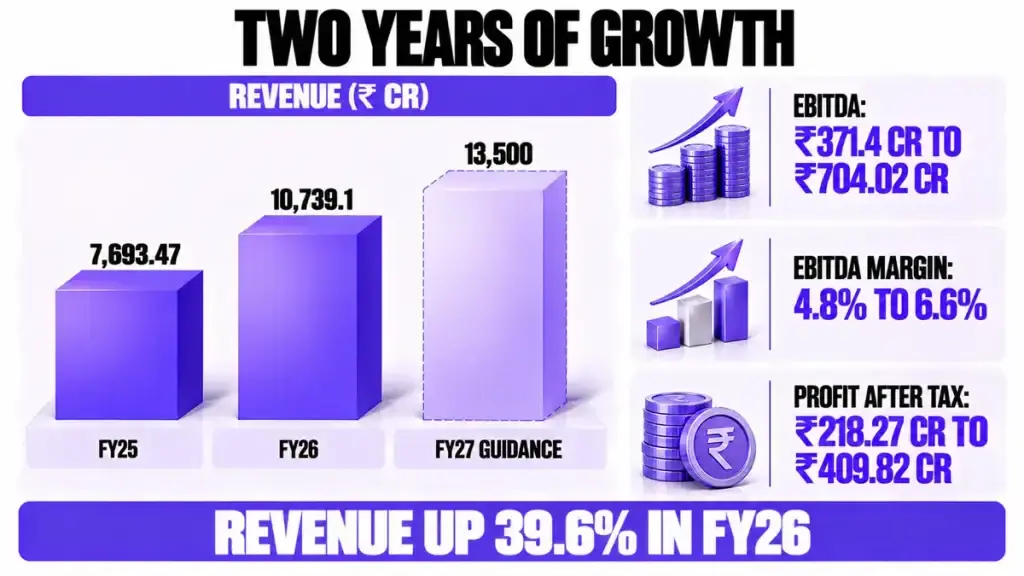
- A revenue target of ₹13,500 Cr for FY27
These numbers show a regional jeweller growing fast even with record gold prices. So what is driving it, and can the store plan keep up? Let's first understand the company, and then look at the latest quarters.
P N Gadgil Jewellers: Company Overview
P N Gadgil Jewellers Ltd, which sells under the PNG Jewellers brand, is a Pune jeweller whose roots go back to 1832. The Gadgil family is now in its sixth generation, with Dr. Saurabh Gadgil as Chairman and Managing Director. It is the second-largest organised jeweller in Maharashtra by store count, with 80 stores in September 2026: 79 in India, mostly in Maharashtra and now also in Madhya Pradesh, Uttar Pradesh, Bihar and the NCR, and one in California. It sells through its own Legacy stores, YOOU stores for lightweight jewellery, franchise stores and online. Its shares were listed on the BSE and NSE on 17 September 2024, it had 2,950 permanent employees in March 2026, and it earned ₹10,739.1 Cr of revenue in FY26. Read this Khazanchi Jewellers: A Fast-Growing SME
"Your premium brand had better be delivering something special, or it's not going to get the business."
— Warren Buffett
For a jeweller, that something special is trust in purity, price and buy-back terms. PNG has built it over 194 years in Maharashtra, and is now testing whether it travels.
Two Strong Quarters Despite Record Gold Prices
Let's look first at Q1 FY27, the April to June quarter, the latest one with full results. It was the best first quarter in the company's history, helped by weddings and a strong Akshaya Tritiya, when festive sales grew 80.3% to ₹251.4 Cr.
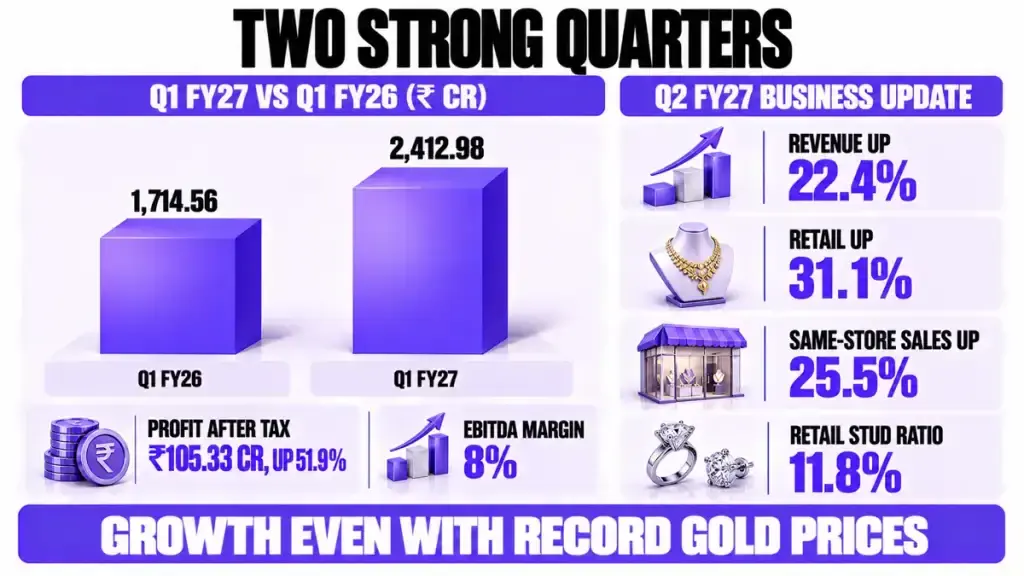
That growth came almost entirely from the company's own stores. Retail revenue grew 56.4% to ₹1,885.1 Cr, helped by same-store sales growth of 46.1%. Franchise revenue grew 7.9% to ₹290.64 Cr, about 12% of the quarter's revenue, and e-commerce 20% to ₹79.35 Cr, while the other segment, mostly bulk bullion sales to companies, came down 9.2% to ₹157.9 Cr.
Profit after tax was 4.4% of revenue, up 40 basis points from a year earlier. Costs grew far more slowly than sales. Other expenses rose only about 5%, because the company held back marketing, removed about 250 to 300 hoardings and opened no new stores in the quarter. As the CFO put it, the cost discipline was deliberate.
"So, we continue to monitor and keep our marketing cost within 1.5%, and that is what has helped to keep the cost in check." - Deepak Vijay, P N Gadgil Jewellers
Then the second quarter added more growth. In its Q2 FY27 business update of 8 October 2026, the company said revenue grew 22.4% from a year ago, even though the Navratri festival moved into Q3 this year. Retail grew 31.1%, with same-store sales up 25.5%, so most of the growth came from stores that were already open. Retail made up about 77.3% of total revenue, higher than a year earlier. Franchise revenue grew 34.7%.
One channel, e-commerce, went the other way by choice. Its revenue fell 83.6% in Q2 FY27, because the company cut low-margin gold coin sales online and pushed jewellery instead. Gold coins and bars fell to about 15.8% of retail revenue, from about 23.3% a year earlier. Revenue from coins is easy to win but earns little, so the shift raises the quality of what is sold.
Beyond coins, the mix improved in other ways too. Gold revenue grew 23.5% in Q2 FY27, diamonds 21% and silver 12%. The retail stud ratio rose to 11.8% from 9% a year earlier, and in the northern region it reached 17.4%. Customers also brought in more old gold to exchange, 38% of sales against 29% a year earlier. During Raksha Bandhan, the company sold 114% more rakhis by number and 142% more by value.
That growth sits on a fast-growing year. Revenue rose from ₹7,693.47 Cr in FY25 to ₹10,739.1 Cr in FY26, up 39.6%. EBITDA nearly doubled, from ₹371.4 Cr to ₹704.02 Cr, and the EBITDA margin rose from 4.8% to 6.6%. Profit after tax rose from ₹218.27 Cr to ₹409.82 Cr. Revenue from the jewellery business, leaving out bulk bullion sales, grew 56.4% in FY26. For the year as a whole, same-store sales grew 42.8% and inventory turned over 3.8 times.
That turnover figure matters a lot for a jeweller, because gold stock is its biggest asset. Turning stock 3.8 times a year means that, on average, a piece stays in a store for about three months before it is sold. A faster turnover needs less borrowed money for the same sales. Read this Inventory Turnover Ratio Explained
That year ended with its biggest quarter. In Q4 FY26, same-store sales grew 86%, and volumes rose as well as prices. Gold grew 27% by volume, silver 37% and diamonds 125%. The quarter's gross margin still fell about 230 basis points from a year earlier, and management pointed to a few reasons. More of the sales went to franchise stores, which earn PNG a gross margin of only about 2.5-3%. Heavy discounts on making charges during its Foundation Day and Gratitude Day offers lowered the stud ratio by about 1 point. Promotions around Gudi Padwa also raised marketing costs and trade discounts. For the full year, management says it still held to its estimate of about 12% gross margin and a PAT margin of about 3.75-4%.
That growth also earned the company a better credit rating. During Q4 FY26, its long-term rating was upgraded to A+ stable from A, and its short-term rating was reaffirmed at A1. FY26 was also the year PNG crossed ₹10,000 Cr of revenue, two years after its shares were listed on the BSE and NSE on 17 September 2024. By March 2026, it had used all the money raised in its IPO for the purposes it had stated.
Those results also depend on gold prices, which shape the margin. Part of PNG's stock is hedged, which means it uses financial contracts to protect against falls in the gold price. When prices rise, these hedges add gains that lift reported margins, about ₹45 Cr in Q3 FY26 and ₹20 Cr in Q4 FY26. The company hedged about 70% of its stock in Q1 FY27, aims for about 80% by Q2, and plans to be fully hedged next year, which should make margins steadier.
Its stores are also productive for their size, as you can see from the averages. In Q1 FY27, an average store earned ₹30.94 Cr of revenue and ₹1.35 Cr of net profit, and each square foot earned about ₹1,01,427. The average bill was about ₹92.3 thousand, and inventory turned over about 3.7 times a year, close to the 3.5 to 4 times the company guided after it stopped bulk refinery sales.
The Store Plan Behind the Growth
So where will the next growth come from? Most of it comes from a long store plan, which management has set out for three years.

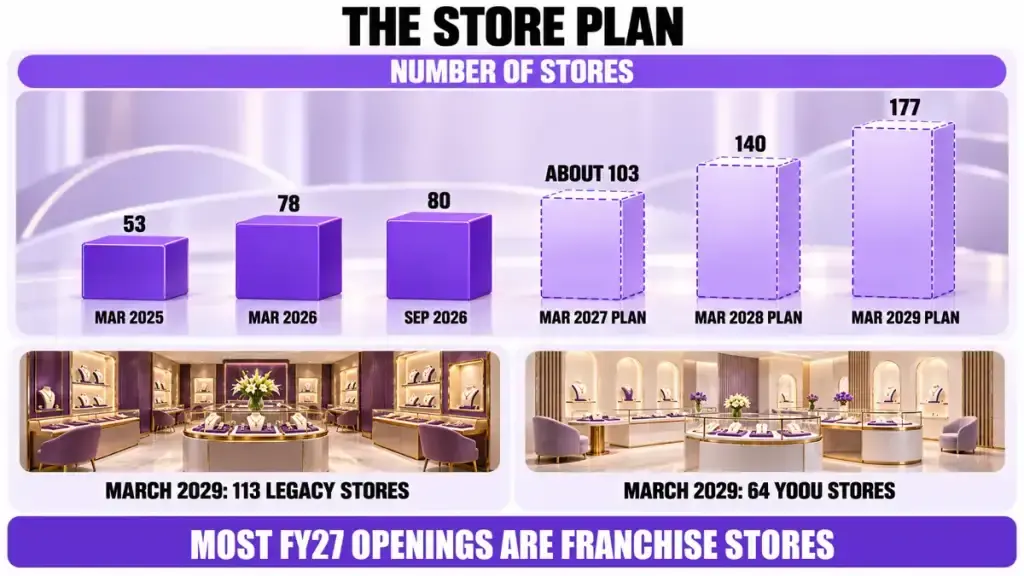
That plan also changes the shape of the network. Franchise stores were about 23% of all stores in March 2025, and on the plan they would be about 39% by March 2027. The plan has a clear pace. PNG opened 25 stores in FY26 and plans about 25 in FY27, then about 37 a year for the next two years. By March 2029, it expects 113 of its 177 stores to be Legacy stores, the traditional PNG format, and 64 to be YOOU stores, its lightweight brand. In FY27, most new stores will be franchise stores, after FY26, when more were company-owned.
That rollout is weighted to the second half. The company opened two stores in Q2 FY27, a Legacy store in Gurugram and a YOOU store in Amanora Mall, Pune. A store in Ayodhya was due to open by mid-October and one in Prayagraj by early November. It has already secured 10 more store commitments, six Legacy and four YOOU, mostly in northern and central India.
Four Ways PNG Sells Jewellery
Let's now see how PNG sells. The company reports four segments, and its own stores are by far the largest.
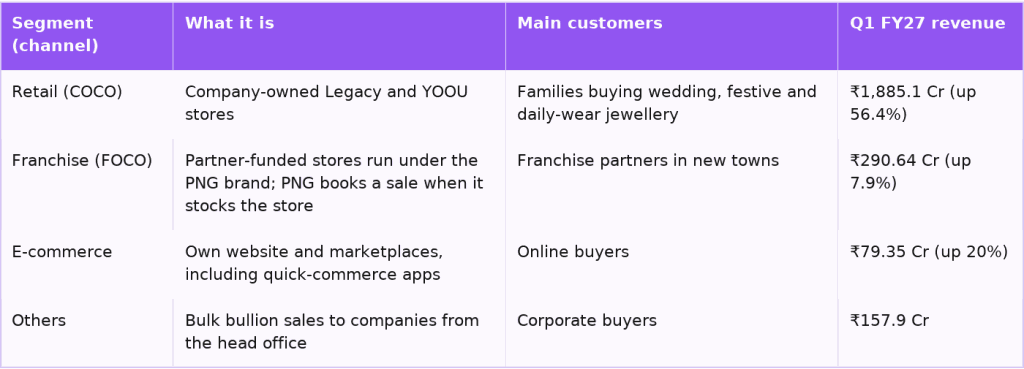

These channels earn very different margins. A company-owned store earns the full retail margin but needs PNG's own money for the stock and the shop. A franchise store earns PNG less at the gross level, because PNG sells the stock to the partner, but costs it almost nothing to run, since the partner pays the rent and staff. That is why management expects gross margins to dip a little as franchise stores grow, while profit before tax keeps rising. Franchise sales earn PNG a gross margin of about 2.5-3%, but almost all of it reaches the bottom line. Read this Operating vs Net Profit Margin Explained
So inside retail, the product mix matters too. In Q1 FY27, the retail stud ratio rose to 10.9%, from 9.9% in the previous quarter. With a stud ratio of about 10-11%, management says the retail gross margin should be about 12.5-13.5%. Every point of extra studded jewellery adds to that, because diamonds and stones carry far higher making margins than plain gold.
Legacy Stores in Maharashtra
Let's begin with the core, the Legacy stores in Maharashtra. Western India is the second-largest region for jewellery in the country, and Maharashtra is where PNG's name is best known. The company has worked with temple trusts such as Shrimant Dagadusheth Halwai and Chaturshrungi for more than three decades, and it is known for traditional Maharashtrian designs alongside bridal and festive jewellery.
Those stores grew fastest this year. Retail same-store sales grew 46.1% in Q1 FY27 and 25.5% in Q2 FY27, which means the existing stores are selling much more to the same towns. Management admits that a new store can take some sales from a nearby PNG store, but says each store also wins new customers and keeps growing.
The collections give these stores their range. PNG offers 41,851 different products across gold, diamond, silver and platinum, and it launches named collections for different occasions, from Saptam, inspired by the seven wedding vows, to Tulika, a handcrafted kundan collection inspired by Uttar Pradesh. Its diamonds are certified by labs such as IGI, SGL and HKD.
New Regions in the North and Centre
Next, let's look at the newer markets, which are where the stud ratio is highest. PNG entered Madhya Pradesh, Uttar Pradesh and Bihar in FY26, and it opened its first NCR store in Gurugram in Q2 FY27. Its new stores in northern and central India already run stud ratios of 15-18%, well above the mature Maharashtra stores, and the northern region reached 17.4% in Q2 FY27.
Those markets now stretch across several states. In Uttar Pradesh, PNG opened stores in Gorakhpur and Varanasi in FY26, and its network there also includes Lucknow and Kanpur, with Patna in Bihar and Indore in Madhya Pradesh.
Those regions cost money to enter. In FY26, the company spent about ₹40-50 Cr on its launch in Uttar Pradesh and on new celebrity endorsements, which management treats as one-time costs that will not repeat this year. The new territories still make up only about 3% of retail sales, so their higher margins will show only as they grow.
YOOU, the Lightweight Brand
Now let's move to PNG's second brand. It opened the first stores of LiteStyle by PNG, a sub-brand of lightweight jewellery for daily wear aimed at younger buyers, in Kharadi and Wakad in Pune in the April to June 2025 quarter. In Q2 FY27, it renamed the brand YOOU, to give it a more distinct identity of its own. With the new name, it covers 9, 14, 18 and 22 karat gold, and it targets younger professionals who wear jewellery to work and social gatherings, not just at weddings.
That brand is meant to be mostly studded. Its stud ratio was 32.9% in Q1 FY27, and management plans to raise studded stock to about 80% of each store's inventory, which would take the stud ratio to about 50-60%. Its gross margin is about 18-20% today, and management expects about 30-35%, in line with the industry, once the mix shifts. It plans 64 YOOU stores by March 2029 and about 100 over the following years.
These stores are also cheaper to open. When the brand was planned, management described them as smaller stores of 1,000 to 1,500 sq ft with a capex of about ₹7-8 Cr, against an inventory of about ₹40 Cr for a full-size PNG store. It expected a lightweight store to break even in 9 to 12 months.
Why the stud ratio matters so much: plain gold jewellery is priced close to the gold itself, so it earns a thin margin. Studded jewellery is priced on design, so each point of stud ratio adds more profit than a point of gold sales.
Franchise Stores, the Asset-Light Route
Next, let's look at how most new stores will be built. In a franchise store, the partner pays for the shop and the stock, and PNG runs it under its own brand and systems. Management has described how these stores work. A franchise store is about 1,500 to 2,000 sq ft, carries about ₹11-12 Cr of stock, and typically reaches a turnover of about ₹40-42 Cr in 20 to 24 months, with an EBITDA margin of about 5-6% for the partner. For PNG, a franchise sale works like a wholesale sale with a margin of about 2.5%, plus a franchise fee of about 0.5%.
That model has a timing effect on revenue. PNG books a sale when it stocks a franchise store, and the partner replenishes stock weekly or when needed. So franchise revenue can move from quarter to quarter with stocking, which explains why it grew 7.9% in Q1 FY27 and 34.7% in Q2. Management now tracks the franchise stores' own sales to customers more closely, as this channel becomes a bigger part of growth.
E-commerce and Coins
Finally, let's look at the online and coin business, which PNG is deliberately reshaping. It sells on its own website, on marketplaces and on quick-commerce apps. Online, the focus has now moved from coins to jewellery, so this channel will look smaller for a while but should earn more on each sale.
Coins still matter in the stores. In Q1 FY27, 53% of the customers who bought gold bars and coins at PNG later turned that into jewellery, up from 46% a year earlier. So a coin sale is often the first step to a jewellery sale, rather than a low-margin sale on its own.
The Store in California
Let's also look beyond India, where PNG has one store, in California. It opened the store in Sunnyvale in August 2008, and it runs it through its US subsidiary, PNG Jewelers Inc. In FY26, this subsidiary had a turnover of about ₹104.61 Cr and a profit after tax of about ₹8.48 Cr. That means it kept a little over 8% of its turnover as profit.
That store is small next to the Indian business, but it made a profit in FY26, and it shows that the brand can travel with its customers. Management has said that India offers far more opportunity for now, so it will look at adding about one store a year abroad, with North America as the region.
The Trust That Others Cannot Copy
Now that we have seen how PNG sells, let's understand why customers keep coming back. It starts with trust. Jewellery is one of the largest purchases a family makes, and buyers want to know the purity, the price and the buy-back terms. A name that has sold jewellery for 194 years carries weight that a new chain has to earn. Read this Economic Moat Explained

That trust also shows in what customers do. Old gold exchange rose to 38% of sales in Q2 FY27, which means more families are bringing their own gold to PNG to swap for new pieces. Management says that about 55-60% of jewellery and wedding shopping now happens through old gold, as families use their old gold like currency to buy new pieces. Old gold exchange also helps the country, since it puts gold already lying in homes back into use and cuts the need for fresh imports.
"It takes 20 years to build a reputation and five minutes to ruin it."
— Warren Buffett
For PNG, those 20 years have been closer to two centuries. A family that brings its old gold to a jeweller is trusting it with savings, not just making a purchase.

"Customers continued to gravitate towards lightweight jewellery, studded products, and old gold exchange trends and that continues to favor trusted organized players with strong brand and transparent pricing." - Saurabh Gadgil, P N Gadgil Jewellers
That brand is also backed by marketing that reaches beyond Maharashtra. PNG has appointed Madhuri Dixit and Ranbir Kapoor as brand ambassadors, and Sara Tendulkar for its lightweight brand. It has also been named among India's top 10 workplaces in retail for the third year in a row, which helps it keep store staff, who matter a great deal in a business built on trust.
Its systems then make new stores quicker to open. Purchasing is centralised, with fixed stock levels for each store and purchase orders every two weeks, and the head office checks the quality of all stock before it reaches the stores. That standard process is what lets PNG plan to open about 37 stores a year in FY28 and FY29.
Behind those stores, as we can see, sits a large network of makers. PNG works with 181 active supplier partners, including 112 supplier vendors in different regions and 69 exclusive karigars, the craftsmen who make its own designs. Its top three karigars have worked with PNG since 1971. That mix of outside vendors and long-standing craftsmen lets it keep its traditional designs while making enough stock for a growing network.
Its people matter just as much. The company had 2,950 permanent employees in March 2026, and about 41% of them were women. Staff turnover was about 22% in FY26, against 20% a year earlier, which is common in retail but means that training new store staff never stops.
Those staff work for a family that still runs the business. Dr. Saurabh Gadgil is Chairman and Managing Director, and Parag Gadgil and Radhika Gadgil are Whole-time Directors. Aditya Gadgil, of the next generation, joined the board in January 2026 as a non-executive director, and Deepak Vijay became Chief Financial Officer the following day. The nine-member board has three women directors.
Financials: Five Years of Growth, Margins and Cash
Two strong quarters can flatter any retailer, so let's look at five full years together. These are consolidated figures from the company's annual reports and latest presentation.
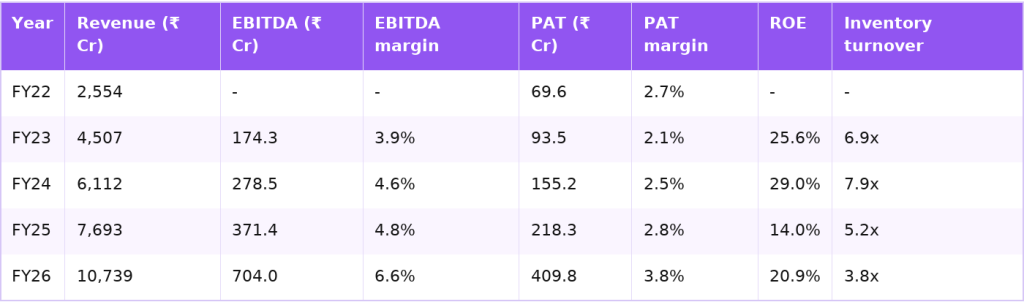
Revenue grew about 4.2 times in four years, from ₹2,554 Cr in FY22 to ₹10,739 Cr in FY26, and profit after tax about 5.9 times, from ₹69.6 Cr to ₹409.8 Cr. The EBITDA margin rose every year from FY23, from 3.9% to 6.6%, as more of the sales came from the company's own stores and from studded jewellery, and less from low-margin bulk bullion.
ROE fell to 14.0% in FY25, because the IPO in September 2024 added a large amount of new equity, and it recovered to 20.9% in FY26 as profit nearly doubled. Inventory turnover fell from 7.9 times in FY24 to 3.8 times in FY26. That fall reflects the end of fast-moving bulk refinery sales and the stock needed for 25 new stores, not slower sales in the stores.
Cash is the weak spot. Consolidated operating cash flow was negative in both FY25 and FY26, at about ₹675 Cr and ₹717 Cr, because the company put far more money into gold stock for new and existing stores than it earned. That is why borrowings, including gold metal loans, were about ₹1,500-1,550 Cr, and why the shift to franchise stores, where partners pay for the stock, matters so much.
"Never invest in any idea you can't illustrate with a crayon."
— Peter Lynch
PNG's idea is easy to draw: more stores, a richer mix and more trust. The harder part to draw is the cash, because every new company-owned store needs a large stock of gold before it sells anything.
What FY27 Could Look Like on Management's Numbers
So what could all of this add up to for you as a reader following PNG? Management's FY27 guidance is revenue of ₹13,500 Cr, an EBITDA margin of 7-7.5% and a PAT margin of about 4%.

That target means a lot of growth, and we can work out how much. ₹13,500 Cr would be about 25.7% more than FY26's ₹10,739.1 Cr. With ₹2,412.98 Cr done in Q1, the company needs about ₹11,087.02 Cr over the rest of the year. The second half usually carries the big festive and wedding months, so most of that is expected in Q3 and Q4.
That timing should help this year. The Hindu calendar had an extra month, Adhik Maas, which pushed some weddings later, so management expects Q2 and a large part of Q3 to benefit. Adhik Maas itself brought only routine sales, because silver, the item usually bought then, stayed expensive. Navratri also falls in Q3 this year, so the festive and wedding months should both land in the second half.
Those margins add up the same way. A 7% EBITDA margin on ₹13,500 Cr would mean about ₹945 Cr of EBITDA, against ₹704.02 Cr in FY26. A 4% PAT margin would mean about ₹540 Cr of profit after tax, against ₹409.82 Cr. Management says its underlying PAT margin, leaving out hedging gains, should be about 4.1-4.25%, and that other expenses should stay at about ₹400 Cr, roughly 3% of sales.
Beyond FY27, management has a longer path. It targets a PAT margin of about 4.5-4.7% by FY29 as franchise stores grow. It also plans to bring its borrowings, about ₹1,500-1,550 Cr including gold metal loans, down by ₹500-600 Cr by FY29 and to become debt-free in four to five years.
It has also raised fresh equity. In August 2026, after its Q1 results, PNG raised ₹700 Cr through a qualified institutions placement (QIP), which means a sale of new shares to large institutional investors. It issued 1,14,94,252 new shares, about 8.5% more than it had in March 2026. Management had said the QIP would also bring the promoters' holding down to the level required for listed companies. Read this High Promoter Holding: What It Signals
Those borrowings come in two parts. Bank borrowings, leaving out gold metal loans, were about ₹1,200 Cr in Q1 FY27, the same as in March. Gold metal loans, where a bank lends gold instead of cash and the jeweller repays in gold, add about ₹300-400 Cr. As franchise partners pay for the stock in their own stores, more of the new stores can be added without new borrowing.
The Plan for FY27 and Beyond
Those numbers rest on a plan with several parts, so let's list what management has committed to. Most of it is about stores, margins and debt, and each item has a date we can track.

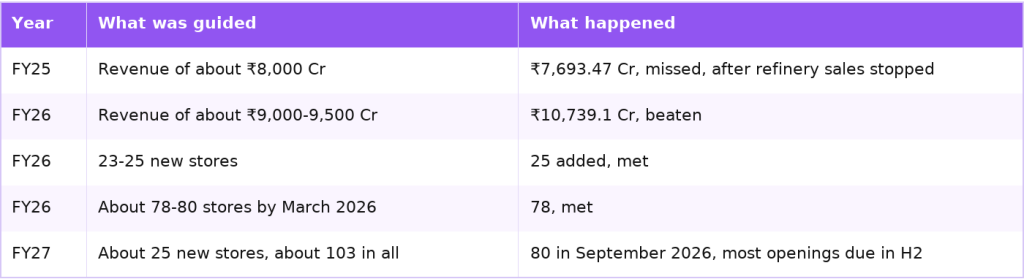
These commitments come with a record we can check, and it is not perfect. In its Q2 FY25 results, management targeted revenue of about ₹8,000 Cr for FY25 and about ₹9,500 Cr for FY26. FY25 came in at ₹7,693.47 Cr, short of that target, in a year when the company stopped bulk refinery sales because they earned it no margin.
That miss was followed by a strong beat. In August 2025, management guided FY26 revenue of about ₹9,000-9,500 Cr, and the company delivered ₹10,739.1 Cr. It guided 23-25 new stores and about 78-80 stores by March 2026, and it ended FY26 with 78 stores after adding 25.
"Know what you own, and know why you own it."
— Peter Lynch
For PNG, knowing why means tracking store openings, same-store sales and the stud ratio each quarter against the targets in the table above.
Key Risks
No business grows in a straight line, so let's look at what could go wrong for PNG.
- Gold prices: very high gold prices can make customers buy lighter jewellery or wait, and sharp falls in price can hurt the value of unhedged stock.
- Hedging gains: part of FY26's margin came from hedging gains as gold rose. As the company moves to full hedging, those gains will shrink, so margins must rise from mix and costs instead.
- Thin margins: a PAT margin of about 4% leaves little room for mistakes in pricing, stock or costs.
- Debt and stock: borrowings of about ₹1,500-1,550 Cr, including gold metal loans, fund a large inventory, so higher interest rates or slower sales would hurt.
- Execution of new stores: most FY27 openings are due in the second half, and new regions spend money on brand building before they earn.
- Import duty: the effective import duty on gold rose to 15% from 6% during FY26, which raises input costs for the whole industry.
- Competition: larger national chains and regional jewellers are expanding in the same markets, and franchise partners can choose other brands.
- Concentration in Maharashtra: most stores and sales are still in one state, and the new territories are only about 3% of retail sales.
- Share dilution: the August 2026 QIP added about 8.5% to the share count, so profit per share will grow more slowly than profit unless the new money earns well.
"Only when the tide goes out do you discover who's been swimming naked."
— Warren Buffett
For a jeweller with thin margins and a large gold stock, the tide is the gold price and the cost of borrowing. The signals below will show early whether the plan is holding.
Explore our Products
Research Framework

Emerging Titans
Combination of quantitative analysis, industry tailwinds, and management assessment - SPRINT investment philosophy

Tiny Titans
Heavy emphasis on scuttlebutt research, plant visits, and early on-ground signals
What to Track Next
If you follow PNG, these are the signals that will show whether the plan is on track.
- Q2 FY27 results, due by mid-November 2026, against the 22.4% growth in the business update
- Store openings in Q3 and Q4 towards about 103 by March 2027
- The Navratri and Diwali season in Q3, which moved out of Q2 this year
- The share of old gold exchange, which was 38% in Q2 FY27
- The retail stud ratio moving above 11.8%, and YOOU's stud ratio rising towards 50%
- EBITDA margin for FY27 against the 7-7.5% guidance
- Borrowings coming down, and how the ₹700 Cr raised in the QIP is used
Conclusion
Let's step back and put it all together. PNG Jewellers has turned a 194-year-old family name into a fast-growing organised jeweller, and in the first half of FY27 it grew strongly even with record gold prices. Its own stores are selling much more, its mix is moving towards studded and lightweight jewellery, and coin sales are shrinking by design.
So the next two years will test the store plan. PNG wants to more than double its store count by FY29, mostly through franchise partners in new regions, while lifting margins and cutting debt. If the new stores perform like the Maharashtra network, the name could travel well beyond its home state. For you as a reader, the store openings in the next two quarters are the clearest test. If the rollout slows or new regions take longer to earn, growth will lean again on the existing stores. The cautious thread is cash: operating cash flow was negative in FY25 and FY26 as stock grew, and margins are thin. The next few quarters, starting with the Navratri and Diwali season and the store openings in the second half, will show which thread wins.
FAQs
What does P N Gadgil Jewellers do?
+P N Gadgil Jewellers is a Pune jeweller with roots in 1832 that sells gold, diamond, silver and platinum jewellery under the PNG Jewellers brand. It had 80 stores in September 2026, 79 in India and one in California, and earned ₹10,739.1 Cr of revenue in FY26.
How did PNG Jewellers perform in Q1 and Q2 FY27?
+In Q1 FY27, revenue grew 40.7% to ₹2,412.98 Cr and profit after tax 51.9% to ₹105.33 Cr, with retail same-store sales up 46.1%. In its Q2 FY27 business update, revenue grew 22.4%, with retail same-store sales up 25.5%.
How many stores does PNG plan to open?
+PNG plans about 103 stores by March 2027, 140 by March 2028 and 177 by March 2029. Most new stores in FY27 will be franchise-owned company-operated stores, where a partner pays for the store and its stock while PNG runs it.
What is the stud ratio and why does it matter?
+The stud ratio is the share of jewellery sales from studded pieces set with diamonds or other stones. Studded jewellery earns a much higher margin than plain gold, so a rising stud ratio lifts profit. PNG's retail stud ratio was 11.8% in Q2 FY27, against 9% a year earlier.
What is PNG Jewellers' guidance for FY27?
+Management guides FY27 revenue of ₹13,500 Cr, an EBITDA margin of 7-7.5% and a PAT margin of about 4%. It targets a PAT margin of about 4.5-4.7% by FY29 and plans to reduce borrowings by ₹500-600 Cr by FY29.
What are the main risks for PNG Jewellers?
+The main risks are swings in gold prices, smaller hedging gains as the company moves to full hedging, thin margins, borrowings that fund a large gold stock, store openings bunched in the second half, higher import duty, competition, concentration in Maharashtra and dilution from the August 2026 QIP.

High growth stock specialist, Value Educator
Shashank Mahajan is an equity research professional with over 12 years of experience in identifying high-potential SME and micro-cap stocks at an early stage. He follows a rigorous scuttlebutt research–driven approach, combining on-ground insights with deep financial analysis. Shashank specializes in uncovering under-researched and under-owned companies with strong management quality and long-term growth potential. Through disciplined research and early identification, he focuses on spotting tomorrow’s market leaders before they enter the mainstream investor radar.

Zen Technologies: Revenue Fell After a Big Win





TD Power: 93% of New Orders Now Come From Abroad
Explore our Products
Research Framework
Emerging Titans
Combination of quantitative analysis, industry tailwinds, and management assessment - SPRINT investment philosophy
Tiny Titans
Heavy emphasis on scuttlebutt research, plant visits, and early on-ground signals


 Orders
 Subscription
 Share with friends


Required Details
₹23999.00
(12 month subscription)
As per SEBI regulations, all users are mandated to complete the KYC that is validated for 1 year. Post payment, you will be redirected to the KYC screen


No comments yet. Be the first to comment!