
Data Patterns: India's Radar Designer and Its Waiting Orders

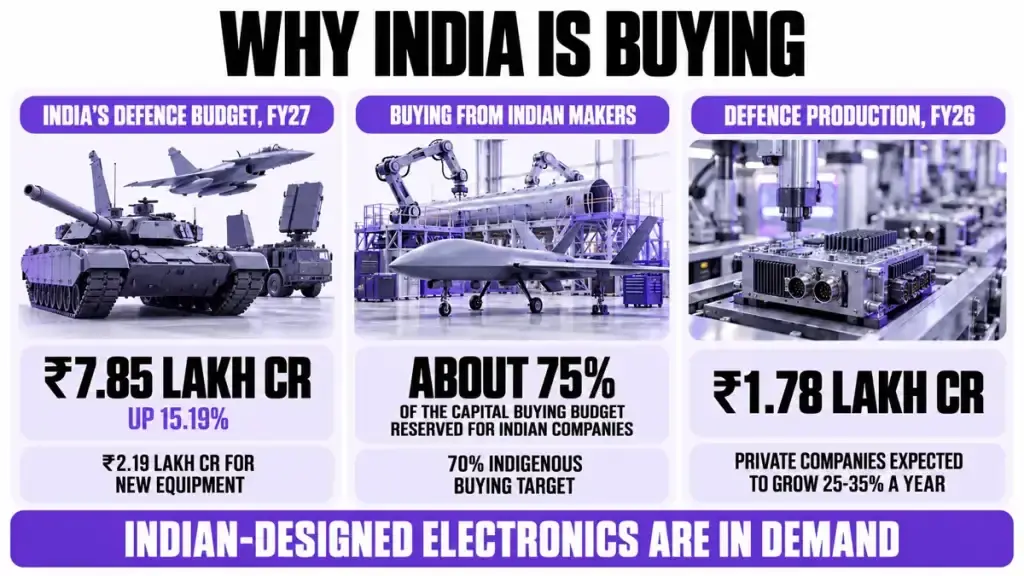
India's defence budget for FY27 is the largest it has ever been. In the Union Budget 2026-27, the government gave the Ministry of Defence ₹7.85 lakh Cr, up 15.19% from the year before, and ₹2.19 lakh Cr of it is for buying new equipment. Roughly 75% of that buying budget is now reserved for Indian makers. That rule matters most for the parts of a weapon that India has long imported, and the electronics are high on that list.
These electronics are what make a modern fighter, missile or air-defence unit work. A radar finds the target, a computer decides what to do, and a set of receivers and jammers protects the platform from the enemy's radars. That last job is called electronic warfare, which simply means using radio signals to listen to, locate and confuse an enemy's radars and communications. For decades, India imported much of these electronics, and the countries that designed them kept the know-how.
One Chennai company has spent almost three decades building that know-how in India. Data Patterns (India) Ltd (NSE: DATAPATTNS), founded in 1998, designs and makes radars, electronic warfare systems, avionics for military aircraft, and fire-control electronics for the BrahMos missile. It owns the designs of what it builds. Its customers are DRDO laboratories, Hindustan Aeronautics, Bharat Electronics, BrahMos Aerospace and the Ministry of Defence.
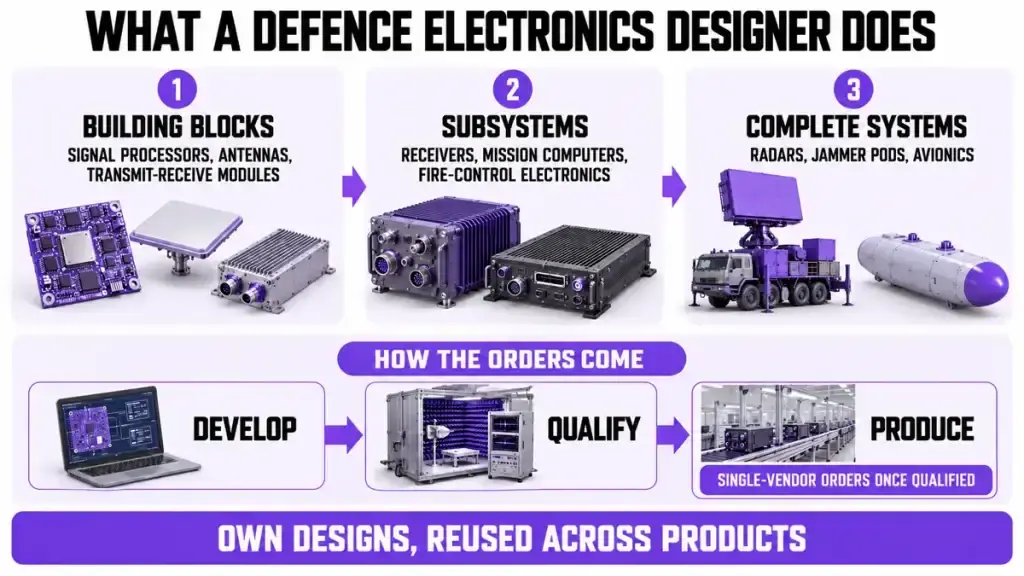
Those customers buy from it in three steps. A customer first pays it to develop and qualify a product, which takes years. Once the product passes, the orders that follow are often a single-vendor order, which means the customer buys from Data Patterns alone because no one else has a qualified design. The company also spends its own money on new products, so it can bid for the next large programme with a design that is already working.
Data Patterns in five numbers
- FY26 revenue of ₹924.8 Cr, up 30.6%, after growing about 31% a year since FY22
- An EBITDA margin of 40.1% in FY26
- An order book of ₹927.7 Cr on 30 June 2026, or ₹2,654 Cr with July orders and orders agreed but not yet signed
- About ₹2,000 Cr of further orders expected in FY27
- No debt, and about ₹465.9 Cr of cash, bank balances and investments in June 2026
These numbers show a company growing fast, but its signed orders cover only about one year of revenue. So what is waiting to be signed, and what will it take to get there? Let's first understand the company, and then look at the latest quarter.
Data Patterns (India): Company Overview
Data Patterns (India) Ltd was founded in Chennai in 1998. It designs and makes defence and aerospace electronics: radars, electronic warfare systems, avionics for military aircraft and helicopters, fire-control and test systems for the BrahMos missile, and automated test equipment. It owns the designs of what it builds, from the circuit boards to the software, and keeps design, assembly, testing and integration on one campus of about 10.28 acres in Chennai. It had 1,112 engineers in June 2026, no borrowings, and earned ₹924.8 Cr of revenue in FY26. Its main customers are DRDO laboratories, HAL, Bharat Electronics, BrahMos Aerospace and the Ministry of Defence. Read this Defence Electronics Stocks to Watch (2026)
"Behind every stock is a company. Find out what it's doing."
— Peter Lynch
With Data Patterns, what the company does is clear: it designs defence electronics that India used to import. What is less clear is when its customers will sign for them, and that is what the numbers below are about.
Why One Quarter Says Little About Data Patterns
Let's look at Q1 FY27, the April to June quarter, because it shows how this business earns its money. Revenue was ₹116 Cr, up 16.8% from a year ago. That is only about 12.5% of FY26 revenue, so one quarter tells us very little on its own.


That pattern comes from how the company is paid. Its revenue is booked only after the customer's inspection team comes and accepts each product. In Q1 FY27, some products were ready, but the inspectors did not come because their own programmes had moved. The chairman explained it simply.
"We are not a quarter-to-quarter business. We are a yearly business and all the projects are long term." - S. Rangarajan, Data Patterns
The same pattern runs through FY26, as you can see in the quarter split. The first quarter gave 10.7% of the year's revenue, the second 33.2%, the third 18.7% and the fourth 37.3%. So a slow first quarter is normal here, and the year is the better unit to judge.
That yearly view also explains the margin. The gross margin, what is left after materials, was a high 78.9% in Q1 FY27. But salaries and other overheads stay the same each quarter, whatever the deliveries. Employee costs rose to ₹42.5 Cr as the company hired 82 more people in the quarter. Other expenses rose to ₹17.6 Cr, which included repairs at the campus and a provision of about ₹2 Cr on old receivables. So the EBITDA margin came in at 27%, and management still expects 35-40% for the full year.
That full year gives the clearer picture. Revenue grew from ₹310.85 Cr in FY22 to ₹924.8 Cr in FY26, about 31% a year. EBITDA was ₹371 Cr in FY26, a margin of 40.1%, and profit after tax was ₹271.4 Cr, up 22.3%. Profit grew more slowly than revenue for two reasons. Other income was lower, at ₹28 Cr against ₹46.3 Cr, and depreciation went up to ₹23 Cr.

There was one unusual quarter in FY26. In Q2, the company delivered a ₹180 Cr contract that it had taken at a competitive price, and that quarter's gross margin was only 39%. Management said it took the order for the long-term opportunities it opens, and that it does not expect more such low-margin contracts. Over FY26 as a whole, the gross margin was still 63.2%.
That revenue also comes from different kinds of work, and the mix shows where the company stands. In FY26, production orders gave 58% of revenue, development contracts 37% and services 5%. A year earlier, development was 43%. Development work is paid in milestones while a product is designed and tested, and it leads to production orders once the product is qualified. So a rising share of production means more products are moving from design to delivery.
That long wait for each acceptance also shapes the cash. Trade receivables were ₹727.77 Cr in March 2026, against revenue of ₹924.8 Cr for the year. Customers are mostly government bodies, and they pay after acceptance and their own approvals. So operating cash flow was ₹80.15 Cr in FY26, after an outflow of ₹89.88 Cr in FY25, even though the company earns a high margin on every sale. Read this Cash Flow Statement Explained
Even so, you will find the balance sheet strong. The company has no borrowings. It held ₹422.7 Cr of cash, bank balances and investments in March 2026 and ₹465.9 Cr in June 2026. Most of this came from a ₹500 Cr share sale to institutions in March 2023, and the company has used it to fund new products. Read this How to Read a Balance Sheet In September 2026, CRISIL reaffirmed its A+ rating and moved the outlook to Positive.
The Orders Waiting to Be Signed
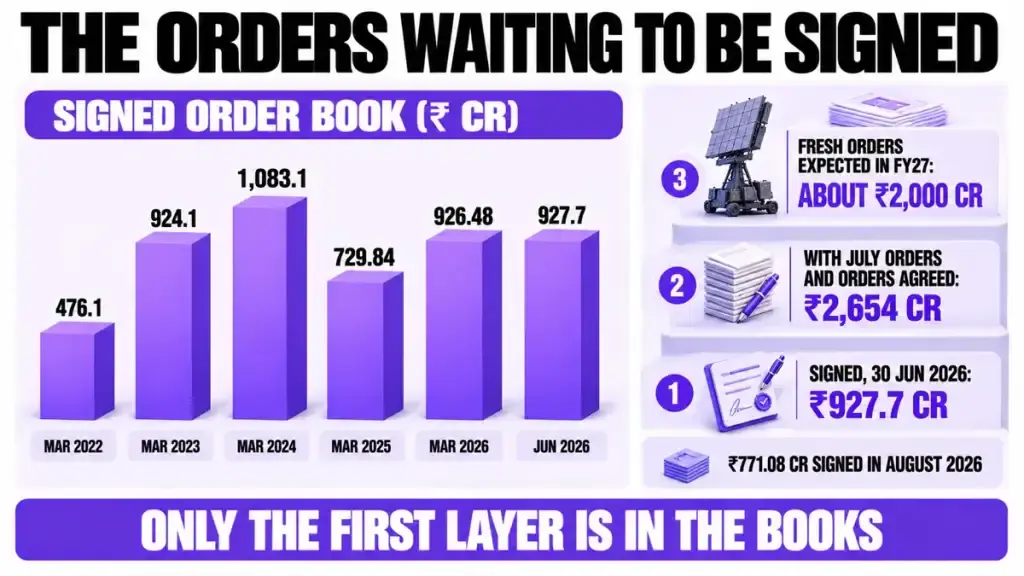
So where will the next revenue come from? We can find the answer in three layers of orders, and only the first one is in the books.
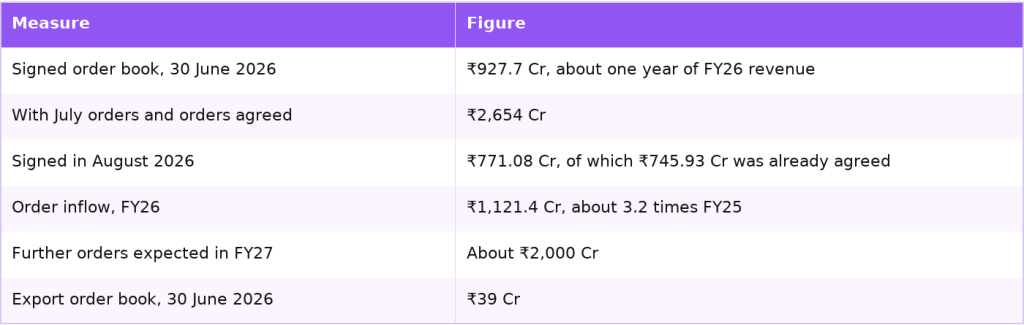
The first layer is the signed order book. It was ₹476.1 Cr in March 2022 and grew to ₹924.1 Cr in March 2023 and ₹1,083.1 Cr in March 2024. It was ₹729.84 Cr in March 2025 and ₹926.48 Cr in March 2026, after ₹1,121.4 Cr of new orders in FY26. In June 2026, it stood at ₹927.7 Cr, about the same as one year of revenue.
The second layer is orders that are agreed but not signed. The company had finished price negotiations on several contracts in a large programme, but the programme itself was stretched by more than 1.5 years. Including these and the orders received in July, the company put its order book at ₹2,654 Cr at the end of July 2026. About ₹1,726 Cr of that was not in the June order book.
We can see this layer building for some time. In May 2026, the company put its order book at about ₹2,062 Cr including agreed orders, and about ₹1,090 Cr of that was agreed but not signed. It also listed about ₹1,900 Cr of further single-vendor contracts, based on products it had already supplied, that could be signed during FY27. By the end of July, the total with agreed orders had grown to ₹2,654 Cr.
Since then, part of that layer has turned into contracts. On 20 August 2026, the company told the exchanges it had received ₹771.08 Cr of orders since the end of July. That included ₹585.76 Cr from Bharat Electronics for radar electronics. Of the ₹771.08 Cr, ₹745.93 Cr had already been counted among the orders agreed but not signed. The other ₹25.15 Cr were new.
The third layer is orders still to be won. Management expects about ₹2,000 Cr of fresh orders in FY27, over and above the ₹2,654 Cr. These include a large single-vendor contract from HAL where the company is the lowest bidder, and an order for the BrahMos seeker.
The orders behind these numbers also show which products customers are buying. The largest orders of FY26 and Q1 FY27 came from a mix of customers and products.

These orders also show the gap the company wants to close. Management's aim is an order book of at least three years of revenue within one to two years. On FY26 revenue of ₹924.8 Cr, that would mean about ₹2,774 Cr of signed orders, about three times today's book. With that much in hand, revenue would depend far less on when each inspection team arrives.
Why the signatures matter more than the designs: most of the products behind these orders are already built or qualified. What decides the next two years is how fast the government signs the contracts, not whether the company can make the equipment.
What Data Patterns Makes
Let's now see what fills those orders. Data Patterns reports one segment, defence and aerospace electronics, but it gives a split of revenue by product. Radars and avionics together made up about two-thirds of FY26 revenue.
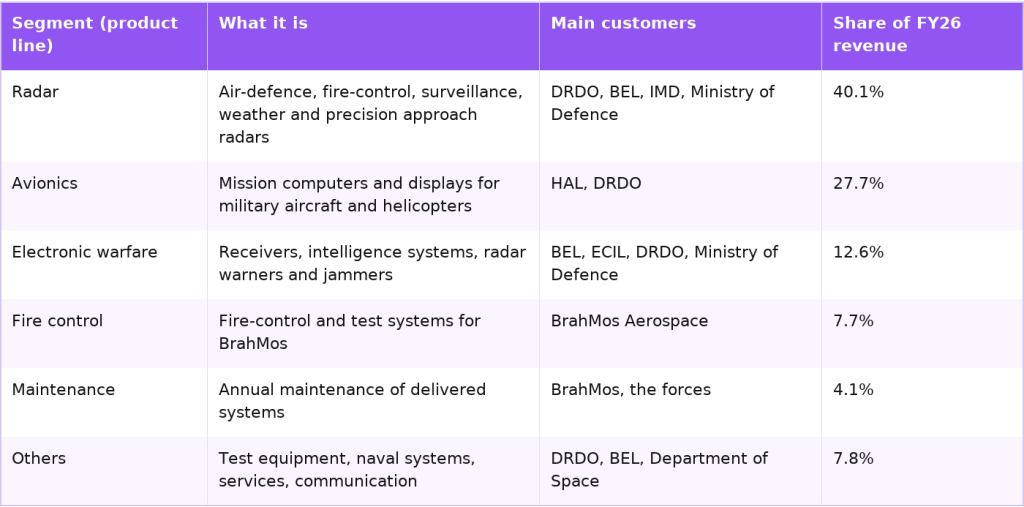
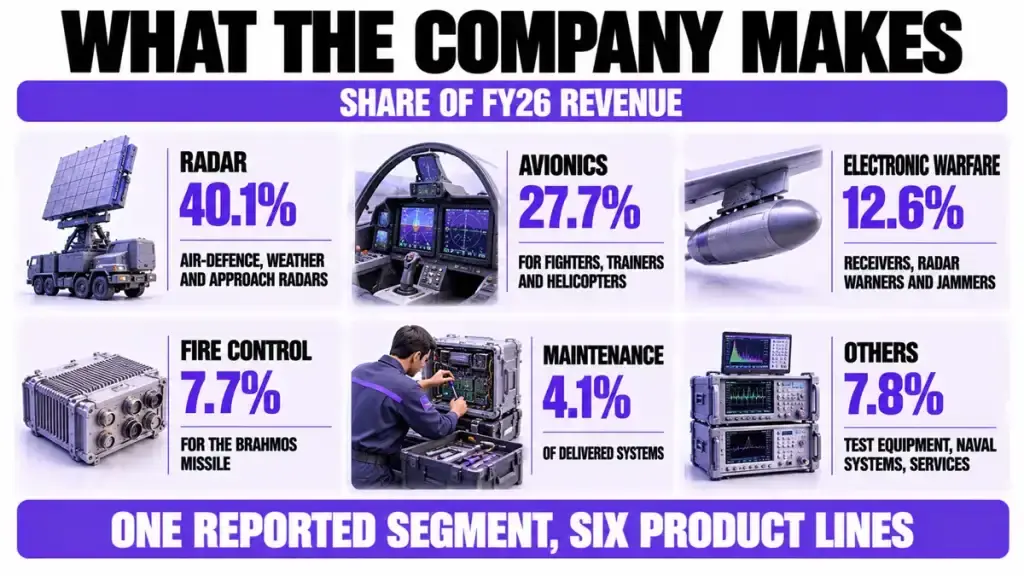
That mix, as you can see, moves from quarter to quarter with deliveries. In Q1 FY27, avionics was 41.3% of revenue and radar 27.8%. By customer, DRDO gave 26.7% of the quarter's revenue, HAL 22.1%, export customers 12.8%, BrahMos 12.7% and Bharat Electronics 7.5%.
As you can see, those shares leave room for smaller lines too. The company makes automated test equipment, which checks that missiles, radars and other systems work before they are used. It gave 2.6% of FY26 revenue and 7% in Q1 FY27, helped by orders from BrahMos and the Department of Space.
Beyond these customers, the sector around the company is growing in its favour. India's defence production reached about ₹1.78 lakh Cr in FY26. The Ministry of Defence aims to buy 70% of its needs from Indian sources. After Operation Sindoor, the forces are pushing to strengthen air power and underwater systems, with electronic warfare high on that list. One study expects private defence companies to grow about 25-35% a year, against under 20% for the public-sector companies.
Radars, the Largest Business
Let's begin with radars, which gave about 40% of FY26 revenue. Every air-defence system, warship and fighter needs a radar to find targets, and many Indian programmes now ask for radars designed in India. The company started with building blocks for radars, such as signal processors, antennas and transmit-receive modules. It now delivers complete radars.
Its range covers almost every use. It has delivered nine precision approach radars to the Ministry of Defence for the Army and the Navy. These guide aircraft down to the runway in bad weather. It also exported one to a European country, which completed its site acceptance test in FY26. It makes coastal surveillance radars, fire-control radars and radars for drones, and it has used gallium nitride amplifiers, a newer and more efficient radar technology, since 2014.
Its newest orders are larger, as you can see from two recent ones. In FY26, the India Meteorological Department ordered 32 Doppler weather radars from it, worth about ₹288.3 Cr, for development and service. In August 2026, Bharat Electronics placed a ₹585.76 Cr order for radar electronics, for radars that Bharat Electronics builds for the forces.
The biggest step, however, is a full air-defence radar. The company designed the whole system itself, from the electronics and software to the cooling and the moving platform. Management says it is the first company in India to build such a radar, and that the customers who received it see it as important for India's defence. It expects contracts for such radars worth a few thousand crore over the next 1.5 to 2 years, beyond the ₹2,000 Cr it already expects.
It is also building a fire-control radar for the MiG-29 and Su-30 fighters. The hardware is ready. The software, which first came from a partner, did not work out, so the company is now writing its own and also talking to the Russian makers of these fighters. Management expects a clearer path within a few months, and flight trials after that.
Avionics for Indian Aircraft
Next, let's look at avionics, which gave about 28% of FY26 revenue and 41.3% in Q1 FY27. Avionics are the electronics inside an aircraft, such as its mission computers, displays and control units. India now builds its own fighters, trainers and helicopters, and each of them needs avionics that HAL can buy in India.
The company supplies avionics for the Tejas light combat aircraft, the intermediate jet trainer and the light utility helicopter. In FY26, HAL placed a ₹76.7 Cr production order for avionics, and DRDO placed a ₹65 Cr development order. The company already holds orders for mission systems on the Tejas Mk2, and it has quoted for the avionics on the next batch of Tejas aircraft.
Beyond these orders, HAL is now the largest single opportunity in the pipeline. The company is the lowest bidder on a large HAL contract, and because no one else has a qualified design, it is a single-vendor contract. Management says it is not part of the ₹2,654 Cr, and that HAL now wants deliveries over two to three years. An HAL order moves at the pace of the aircraft programme, so its revenue would come in over several years.
Electronic Warfare and the Su-30 Jammer Pod
Now let's move to electronic warfare, which gave 12.6% of FY26 revenue but holds the company's biggest bet. Modern air forces fight in a crowded radio space. A fighter has to know when an enemy radar is tracking it, and it has to jam that radar before a missile locks on. The company has built receivers covering 1 MHz to 40 GHz, systems that collect and decode enemy signals, and radar warning receivers.
These products go to land, air and sea. The company has delivered communication and electronic intelligence systems for vehicles, reconnaissance aircraft and aerostats. It delivered the original products for Himshakti, an electronic warfare system that Bharat Electronics built for the Army. In FY26, ECIL ordered ₹84 Cr of electronic warfare equipment, and the Ministry of Defence placed a ₹65.7 Cr development order.
Still, the biggest bet is a jammer pod for the Su-30, a fighter the Air Force flies in large numbers, about 270 aircraft. A jammer pod is a container fitted under the wing that protects the aircraft by jamming enemy radars. The company has built the whole pod with its own money: the casing, the cooling, the electronics and the software that decides what to jam. Customers who have seen it are satisfied with the progress, and qualification on the Su-30 is expected before December 2026, followed by flight trials.
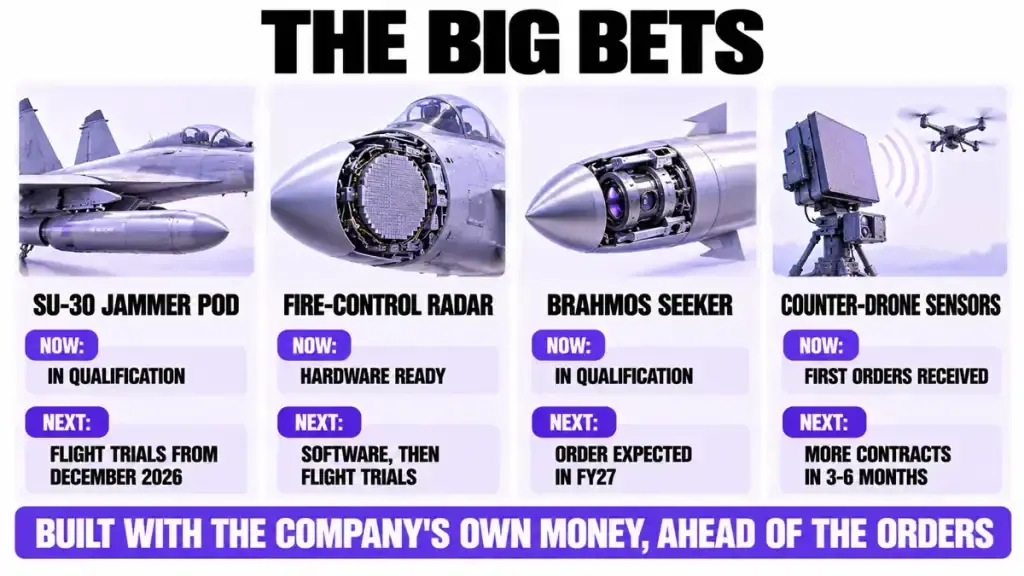
After the trials, management says production contracts could come in about two years. It would not give the value, but it says it is working on really large opportunities and took money from its share sale to fund such programmes.
"And we're not waiting for a contract. We're developing products, taking it to trial, go through flight trials, get it ready so that by the time some contracts happen, they are there." - S. Rangarajan, Data Patterns
The company also expects work on electronic warfare suites for other aircraft upgrades and for DRDO's airborne surveillance programmes. For the Navy's MiG-29 fighters, it is upgrading the existing jammers, and it expects flight trials of that work soon.
BrahMos and Missile Electronics
Next, let's look at the company's oldest major customer, BrahMos Aerospace. BrahMos is the supersonic cruise missile India makes with Russia, and the company has supplied its fire-control systems, launcher electronics and test systems since 2006. Fire control gave 7.7% of FY26 revenue, and BrahMos gave 12.7% of Q1 FY27 revenue.
That work has grown into a steady set of orders. In FY26, BrahMos ordered ₹46 Cr of fire-control systems, ₹45.9 Cr of maintenance and ₹42.6 Cr of missile electronics. The maintenance work comes with an uptime guarantee, so it pays for keeping delivered systems ready. Management expects volumes to rise as BrahMos sells more missiles at home and abroad, because changing a qualified supplier is slow and costly.
The next step is the seeker, the part in the nose of the missile that finds and tracks the target. The company has developed radio-frequency and infrared seekers, and its BrahMos seeker was tested successfully. The product is now in qualification, and management expects the order within FY27. That would take the company from the ground systems around the missile to a part of the missile itself. Read this Missile and Ammunition Stocks: 2026 Outlook
Counter-Drone, Naval and Export Work
Finally, let's look at the newer areas, which are small today but growing. Drones have become a big part of modern conflict, and the forces need sensors to find and stop them. The company does not sell the full counter-drone system. It supplies the sensors: radars that detect drones, receivers that decode their signals and find their direction, and jammers that cut their links.
That approach has already brought its first orders. The company received its first orders for drone-detection radars in Q1 FY27. The Ministry of Defence plans to try 10-20 systems from each of several suppliers, and many of them have asked the company for sensors. Management expects more contracts within three to six months.
Next, the company wants to grow with the Navy. It supplies DRDO with subsystems for sonars and communication links to sonobuoys, and it received its first DRDO orders for two naval radars. The Coast Guard needs about 30 radar systems of a type the company has designed, and it hopes to win that contract. A naval officer working with it in Delhi is looking for more naval applications.
Beyond India, exports were ₹61.8 Cr in FY26, about 7% of revenue. For years, the company has made signal processors for airborne radars for a UK company. It is now redesigning an antenna for a European fighter programme, due in six to eight months, and it is in talks with large US companies on civil aircraft upgrades. European defence makers face a shortage of engineers, so a fast design partner in India is useful to them. The export order book was ₹39 Cr in June 2026.
Beyond exports, space is another option the company is weighing. It built a nano-satellite that was launched in 2017, and it makes satellite subsystems and ground stations. Management says it has the money and the skills to build satellites, but it wants a clear revenue model first, because many space start-ups are offering their work almost free. It expects to decide how to proceed within three to four months.
Alongside exports and space, the company is also buying a supplier. In August 2026, it signed an agreement to buy all of ST Advanced Composites, a Chennai maker of radomes and composite structures, for about ₹10 Cr. A radome is the protective cover over a radar's antenna. Owning that work lets the company offer a whole radar, cover included, rather than parts of one.
The Designs Nobody Else Has Qualified
Now that we have seen each product line, let's understand why customers keep returning to Data Patterns. It starts with design ownership. The company designs every product in-house and owns the intellectual property, from the circuit boards to the software. So when the forces need a radar or a jammer designed in India, it can bid with its own product rather than a licensed foreign one.
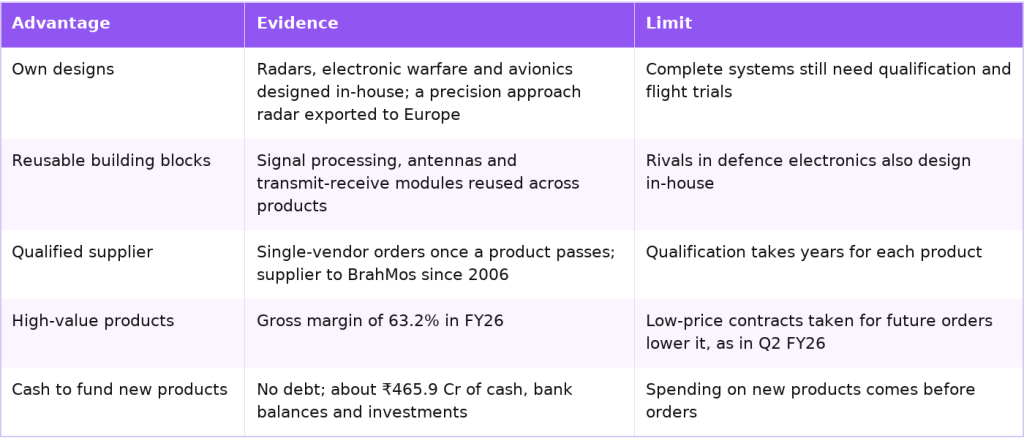
Those designs rest on a set of reusable building blocks. Signal processors, antennas and transmit-receive modules that the company has already proven can be reused in a new radar or receiver. That makes each new product faster and cheaper to develop, and it is how a company of this size can work across radars, electronic warfare, avionics and missiles in parallel.
Each of those products, once qualified, is hard to replace. Qualification means the customer has tested the product against its specifications, often in flight or field trials, over several years. A customer that has done this rarely starts again with a new supplier for the same part. Read this Economic Moat Explained That is why the company gets single-vendor orders, and why it has stayed with the BrahMos programme for about two decades.
"In business, I look for economic castles protected by unbreachable moats."
— Warren Buffett
Data Patterns' castle is its library of qualified designs. Each product that passes years of trials becomes a single-vendor order that a rival cannot easily take.
That proof also comes from its people. The company had 1,112 engineers in June 2026, and many of its senior staff have been with it for more than two decades. It keeps all design, assembly, testing and integration on one campus of about 10.28 acres in Chennai. Its electronics line can assemble about 600 boards a day, and its test facilities cover the electromagnetic tests that defence products must pass.
That team, as we found, is not only electronics engineers. Management says more than 100 of its engineers are mechanical designers, who designed the moving platforms, cooling and positioning systems of its air-defence radar. So the company can take on a whole system rather than only the electronics inside it.
Its cash then pays for what comes next. The company has invested more than ₹135 Cr in new products, such as the jammer pod, the fire-control radar and the seekers, which are now at an advanced stage. It plans ₹150-200 Cr of capital spending over the next two years for buildings, clean rooms and an integration facility. And it can do all of this without borrowing, which matters when a new product takes years to reach an order.
Financials: Five Years of Growth, Margins and Cash
One slow quarter can hide a lot in this business, so let's look at five full years together. These figures are from the company's latest presentation.

Revenue grew about 3 times in four years, from ₹310.8 Cr in FY22 to ₹924.8 Cr in FY26, about 31% a year, and profit after tax grew about 2.9 times. The EBITDA margin stayed between about 38% and 45% in every year, which is high for a hardware maker and shows how much of the value lies in the company's own designs.
ROE fell from 24% in FY22 to 15-17% in the years after, not because the business earned less but because the ₹500 Cr share sale of March 2023 added a large amount of equity, much of it still held as cash and investments. That cash is also why the company carries no debt.
Cash flow is the weakest number in the table. Over the five years, operating cash flow added up to about ₹165 Cr, against about ₹893 Cr of profit, or under 20%. Two of the five years used cash. The reason is the way the company is paid: customers pay only after inspection and their own approvals, so trade receivables reached ₹727.77 Cr in March 2026, close to a full year of revenue.
"The big money is not in the buying and the selling, but in the waiting."
— Charlie Munger
Data Patterns asks for patience twice: first while a product is qualified, and then while the government signs the order and pays for it.
What the Next Two Years Look Like on Management's Numbers
So what could all of this add up to for you as a reader following Data Patterns? Management's guidance for FY27 is revenue growth of 20-25% with an EBITDA margin of 35-40%. On FY26 revenue of ₹924.8 Cr, that would mean about ₹1,110-1,156 Cr of revenue in FY27.
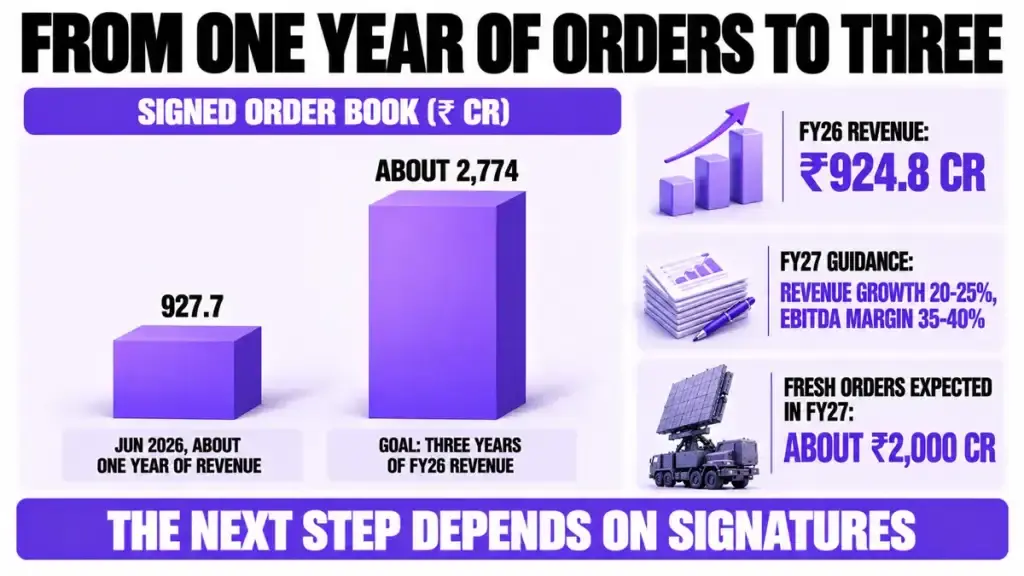
Those targets look reachable on what is already in hand. Even before the orders of July, the June book of ₹927.7 Cr and the ₹771.08 Cr signed in August come to about ₹1,699 Cr. Not all of that will turn into revenue within FY27, because some HAL and radar work runs over two or three years. But it covers the guided revenue more comfortably than the company's books did a year ago.
Beyond FY27, the larger goal is the three-year order book we saw earlier. Getting there needs the remaining agreed orders to be signed, the ₹2,000 Cr of fresh orders in FY27 to come through, and the HAL and BrahMos seeker orders to land.
Beyond that, management sees a much larger market. It puts the market for the products it has developed or is developing at about ₹30,000 Cr. Repeat orders on products it has already delivered add about ₹10,000-12,000 Cr, for an addressable market of about ₹40,000 Cr. It would not say over how many years this market would open up.

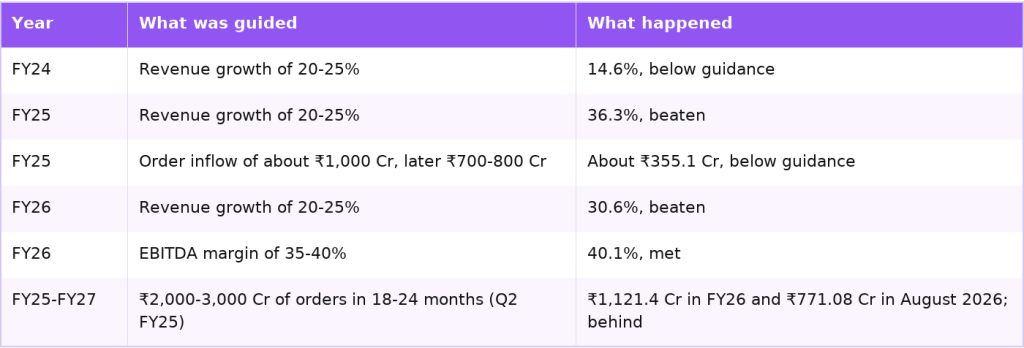
These commitments come with a record we can check. The company has met its margin targets every year we checked. Revenue growth came in below the 20-25% guided in FY24, at 14.6%, and then beat it in FY25 and FY26. Order targets have been the hardest to meet, because they depend on when the government signs.
"Know what you own, and know why you own it."
— Peter Lynch
For Data Patterns, knowing why means tracking the signatures more than the designs: the agreed orders, the HAL contract and the BrahMos seeker order.
Key Risks
No business grows in a straight line, so let's look at what could go wrong for Data Patterns.
- Signing delays: the agreed orders waited more than 1.5 years because the programme behind them was stretched. If the remaining agreed orders, the HAL contract or the BrahMos seeker order slip, the order book will stay near one year of revenue.
- Lumpy revenue: revenue is booked only after the customer inspects and accepts each product. When inspections are delayed, a quarter can show much lower revenue and margins, as Q1 FY27 did with an EBITDA margin of 27%.
- Cash tied up with customers: trade receivables were ₹727.77 Cr in March 2026 against FY26 revenue of ₹924.8 Cr. Operating cash flow was ₹80.15 Cr in FY26 against profit of ₹271.37 Cr, and an outflow in FY25.
- Few customers: three customers gave ₹509.12 Cr, or about 55%, of FY26 revenue, and most of them are government bodies whose budgets and timing the company does not control.
- Money spent before orders: the jammer pod, the fire-control radar and the seekers have been funded by the company. If they do not pass trials, or the orders go to a rival such as Astra Microwave or Bharat Electronics, that spending will not pay back. The fire-control radar still needs working software.
- Imported parts: many critical components come from global suppliers, so supply problems abroad can delay deliveries.
- Costs in slow quarters: salaries and overheads stay fixed while revenue swings, and the company keeps hiring engineers ahead of orders.
"You can't predict. You can prepare."
— Howard Marks
Government signing dates cannot be predicted. What an investor can do is watch the few numbers below that will show early whether the plan is slipping.
Explore our Products
Research Framework

Emerging Titans
Combination of quantitative analysis, industry tailwinds, and management assessment - SPRINT investment philosophy

Tiny Titans
Heavy emphasis on scuttlebutt research, plant visits, and early on-ground signals
What to Track Next
If you follow Data Patterns, these are the signals that will show whether the plan is on track.
- The remaining agreed orders being signed, after ₹745.93 Cr in August 2026
- The HAL single-vendor contract and the BrahMos seeker order in FY27
- Fresh orders in FY27 against the ₹2,000 Cr management expects
- Qualification and flight trials of the Su-30 jammer pod from December 2026
- FY27 revenue growth of 20-25% and an EBITDA margin back in the 35-40% range
- Trade receivables and operating cash flow as the larger orders are delivered
Conclusion
Let's step back and put it all together. Data Patterns spent almost three decades learning to design defence electronics in India, from circuit boards to complete radars. That work now earns it single-vendor orders, a 40% margin and revenue that has tripled in four years. But its signed orders still cover only about one year of revenue, so each quarter depends on when the inspectors arrive.
So the next two years will show whether that changes. Large orders are agreed, the HAL and BrahMos orders are close, and the jammer pod is heading for flight trials. If they are signed and pass on time, the company could hold three years of orders and grow far beyond its size today. If they keep slipping, revenue will keep following the pace of government signatures. The cautious thread is cash: over five years, operating cash flow was under a fifth of profit, and receivables are close to a year of revenue. The next few quarters, starting with the remaining agreed orders and the Su-30 jammer pod trials, will show which thread wins.
FAQs
What does Data Patterns (India) do?
+Data Patterns is a Chennai company founded in 1998 that designs and makes radars, electronic warfare systems, avionics for military aircraft, fire-control and test systems for the BrahMos missile, and automated test equipment. It owns its designs and sells mainly to DRDO, HAL, Bharat Electronics, BrahMos Aerospace and the Ministry of Defence.
Why do Data Patterns' quarterly results swing so much?
+Revenue is booked only after the customer's inspection team accepts each product, so deliveries can move between quarters. In FY26, the first quarter gave 10.7% of the year's revenue and the fourth 37.3%. Management says it is a yearly business, not a quarterly one.
How big is Data Patterns' order book?
+The signed order book was ₹927.7 Cr on 30 June 2026, about one year of revenue. Including July orders and orders agreed but not yet signed, the company put it at ₹2,654 Cr at the end of July 2026. It received ₹771.08 Cr of orders in August 2026, mostly from that agreed list.
What is the Su-30 jammer pod?
+It is a container fitted under the wing of the Su-30 fighter that protects the aircraft by jamming enemy radars. Data Patterns built it with its own money. Qualification on the Su-30 is expected before December 2026, followed by flight trials, and management says production contracts could come in about two years.
What is Data Patterns' guidance for FY27?
+Management guides revenue growth of 20-25% with an EBITDA margin of 35-40% in FY27, and expects about ₹2,000 Cr of fresh orders beyond those received and agreed. It aims for an order book of at least three years of revenue within one to two years.
What are the main risks for Data Patterns?
+The main risks are delays in government signing, lumpy revenue tied to inspections, cash tied up in receivables, dependence on a few government customers, money spent on new products before orders, imported components and fixed costs in slow quarters.

High growth stock specialist, Value Educator
Shashank Mahajan is an equity research professional with over 12 years of experience in identifying high-potential SME and micro-cap stocks at an early stage. He follows a rigorous scuttlebutt research–driven approach, combining on-ground insights with deep financial analysis. Shashank specializes in uncovering under-researched and under-owned companies with strong management quality and long-term growth potential. Through disciplined research and early identification, he focuses on spotting tomorrow’s market leaders before they enter the mainstream investor radar.

Zen Technologies: Why Revenue Fell After Its Biggest Win

KSH International: The Wire Inside India's Transformers

Krishna Defence: The Steel Behind India's Warship Hulls

PNG Jewellers: A 194-Year-Old Name Goes National

Axiscades: From Services to Missile and Radar Electronics

TD Power: 93% of New Orders Now Come From Abroad
Explore our Products
Research Framework
Emerging Titans
Combination of quantitative analysis, industry tailwinds, and management assessment - SPRINT investment philosophy
Tiny Titans
Heavy emphasis on scuttlebutt research, plant visits, and early on-ground signals


 Orders
 Subscription
 Share with friends
 Logout


Required Details
₹23999.00
(12 month subscription)
As per SEBI regulations, all users are mandated to complete the KYC that is validated for 1 year. Post payment, you will be redirected to the KYC screen


No comments yet. Be the first to comment!