
Krishna Defence: The Steel Behind India's Warship Hulls

India's navy is building ships faster than at any time in its history. It has 68 warships and vessels on order, worth about ₹2 lakh Cr together, and it wants a fleet of 175 to 200 warships by 2035, up from 132 today. Mega shipbuilding orders of about ₹2.35 trillion are expected over FY26 and FY27. India also wants to be among the world's top five shipbuilding nations and a hub for ship repair within the next decade. Every one of those ships starts with a steel hull, and the hull needs special steel sections that India once bought from Russia.
Those sections hold the hull together. A warship's hull is made of steel plates, and each plate is stiffened from the inside by long steel ribs. The best rib for this job is a bulb bar, which simply means a flat steel bar with a rounded bulb along one edge. That shape gives it about three times the strength-to-weight ratio of an ordinary steel angle, so navies around the world use it to save weight without losing strength.
Those hulls also need the right welding material. A weld consumable is the wire or electrode that melts to join two pieces of steel. For warships and submarines it must have a precise chemistry so that the joint is as strong as the steel itself. Getting that chemistry right is difficult, and for years these were imported too.
One Gujarat company now makes both in India. Krishna Defence and Allied Industries Ltd (NSE: KRISHNADEF) started in 1997 as a maker of stainless steel dairy equipment and entered defence around 2006. It did so through a transfer of technology, which means a government lab such as DRDO's DMRL handed over the know-how to make a product. The company then manufactured it. It is a naval-approved source for bulb bars, and most Indian shipyards are its customers.

The company has grown by replacing imports one product at a time. After bulb bars came weld consumables, ballast bricks for submarines and armoured steel profiles for the Army's T-90 tanks. It now has stakes in companies working on underwater drones, composite doors for warships and smart ammunition.
Krishna Defence in five numbers
- Q1 FY27 EBITDA margin of 26.3%, its highest ever, against 18.6% a year ago
- Q1 FY27 net profit of ₹11.67 Cr, up 32.9%
- FY26 revenue of ₹244.78 Cr, up 29.1%
- An order book of ₹117 Cr and a tender pipeline of ₹289 Cr in June 2026
- A plan to grow revenue at 30% or more a year for the next three to five years
These numbers show a company earning far more on each rupee of sales, even in a quarter when sales came in lower. So what drove the margin, and can the orders keep up? Let's first understand the company, and then look at the latest quarter.
Krishna Defence and Allied Industries: Company Overview
Krishna Defence and Allied Industries started in 1997 at Kalol in Gujarat as a maker of stainless steel dairy equipment. It entered defence in 2006 through a transfer of technology from DMRL, a DRDO lab, and now makes bulb bars and other shipbuilding steel for the Indian Navy and its shipyards, special weld consumables, low-magnetic ballast bricks for submarines and armoured steel profiles for the Army's T-90 tanks, mainly at its 1,50,000 sq ft plant in Halol. It holds stakes in companies working on ship design, radio-over-fibre modules, composite warship doors, underwater drones and smart ammunition. It listed on the NSE's Emerge platform for small companies, moved to the main board on 30 December 2025, and earned ₹244.78 Cr of revenue in FY26. Read this SME Stocks That Created Millionaires
"Time is the friend of the wonderful business, the enemy of the mediocre."
— Warren Buffett
For Krishna Defence, time has worked through approvals. Each product it has qualified with the navy or the army took years to earn, and each one keeps bringing repeat orders as new ships and tanks are built.
The Quarter of Record Margins
Let's look first at Q1 FY27, the April to June quarter, when margins hit a record. Revenue fell 15.2% from a year ago, but EBITDA rose 20.3% and net profit 32.9%, because the company kept much more of every rupee it earned.

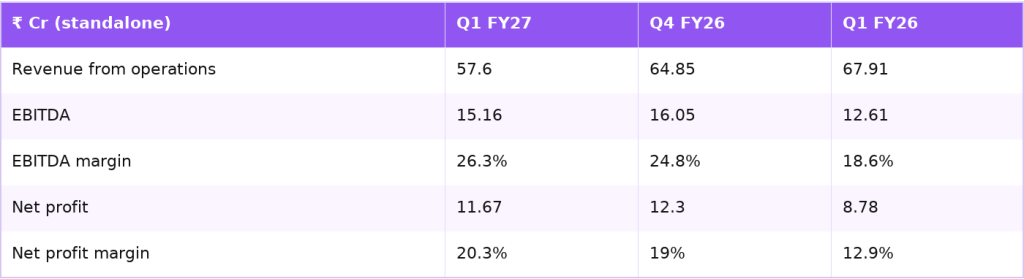
Below EBITDA, the quarter was clean too. Other income more than tripled, depreciation was ₹1.09 Cr and interest stayed very small, so profit before tax rose 27.6% to ₹14.9 Cr. Earnings per share were ₹7.81, against ₹6.23 a year ago.
That jump in margin came from the cost of materials. The cost of goods sold fell 25.3% to ₹32.68 Cr, much faster than revenue, while employee costs rose only 3.7% and other expenses fell 29.1%. Management has said the mix explains most of it. Bulb bars were once almost everything the company sold, and now armoured steel profiles and weld consumables, which earn higher margins, make up a bigger share.
That lower revenue has a cause too. During Operation Sindoor, the government's focus moved to emergency buying, and as a result, orders that would have come between April and September 2025 were pushed back by about five months. Shipyards have also started placing orders in smaller batches with delivery in about six months, instead of 12 to 18 months. So revenue now moves more from quarter to quarter.
Shipyards now want suppliers to deliver faster, and the company says it can, because it raised its capacity in 2025. The total quantity ordered has stayed about the same, but each order is smaller.
"So, there's no change in the ground reality that is there and, in the projection, but there was a pause for four or five months for the reasons that I told you for." - Ankur Shah, Krishna Defence
That timing shows in the half-years. Revenue was ₹120.47 Cr in H1 FY26, and the full year came to ₹244.78 Cr, so the second half was about the same as the first. Management prefers more even quarters, since a heavy fourth quarter, once about 40% of a year's revenue, strains its people, money and machines.
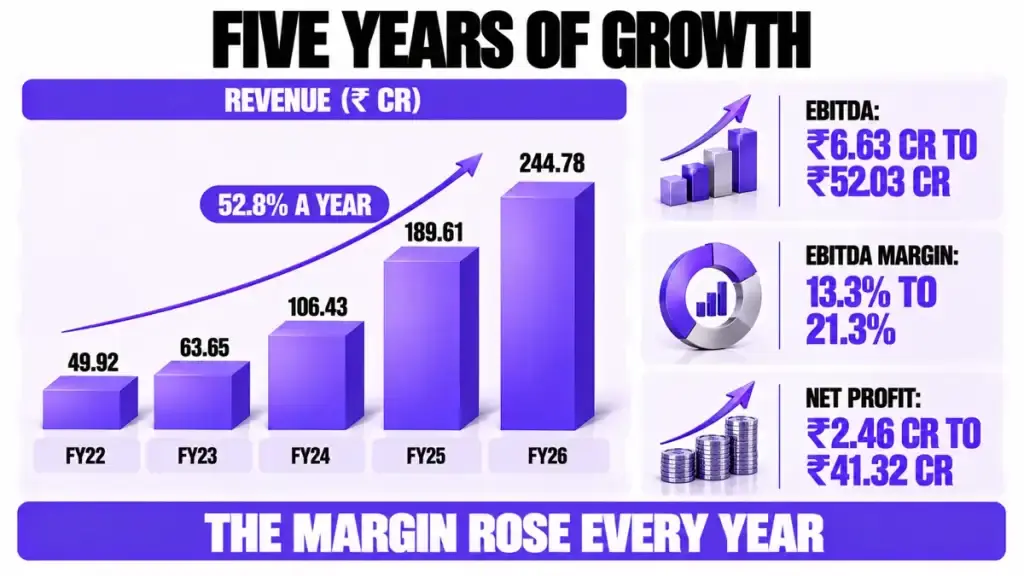
Those swings matter less over a longer span, where the growth has been fast. Revenue rose from ₹49.92 Cr in FY22 to ₹244.78 Cr in FY26, a compound growth of 52.8% a year. EBITDA grew from ₹6.63 Cr to ₹52.03 Cr, and net profit, including the company's share of its associates, from ₹2.46 Cr to ₹41.32 Cr. The EBITDA margin rose every year, from 13.3% in FY22 to 21.3% in FY26.
FY26 alone shows how much of that came from the margin. Revenue grew 29.1%, but EBITDA grew 69.9% and standalone net profit 73.1%, to ₹38.12 Cr. Depreciation rose 49% to ₹4.1 Cr as the expanded Halol plant came in, and interest fell sharply as the company repaid most of its borrowings.
As you read the numbers, note that FY26 was also a year of firsts for the accounts. Krishna Defence moved from the NSE's SME platform to its main board on 30 December 2025. March 2026 is its first balance sheet under Ind AS, the accounting standards that larger listed companies follow. The figures in this article are taken from its latest presentation.
That balance sheet is strong. The company built up about ₹65 Cr of fixed deposits during FY26. In March 2026, it had about ₹31.08 Cr of cash and bank balances plus ₹76.87 Cr of long-term deposits, about ₹107.95 Cr together. Borrowings were only about ₹2.06 Cr in March 2026, against shareholders' funds of ₹193.53 Cr. Inventory came down to ₹16.31 Cr from ₹72.42 Cr a year earlier, as large orders were delivered. Operating cash flow was about ₹86.05 Cr in FY26, against an outflow of about ₹10.91 Cr in FY25. Read this Cash Flow Statement Explained The plant has grown on that balance sheet too. Property, plant and equipment rose to ₹33.76 Cr in March 2026 from ₹21.97 Cr a year earlier. Trade receivables rose to ₹34.68 Cr from ₹18.94 Cr, as more of the year's sales came late in the year. In September 2026, the company's BBB/Positive rating on ₹69 Cr of bank facilities was reaffirmed.
How the Product Mix Lifted the Margin
That margin rise has a clear source, and you can trace it to what the company sells. A few years ago, it sold mainly bulb bars. In the first half of FY26, bulb bars were about 65-70% of defence revenue, weld consumables about 15% and armoured steel profiles about 20%. Management says the profiles and weld consumables earn higher margins.
That shift shows in the margin, year by year. The EBITDA margin was 16.1% in FY25, 21.3% in FY26 and 26.3% in Q1 FY27. Management expects it to keep rising as the product mix holds and as more sales run through the same plant, though it warns against expecting a jump of five points every year.
The Orders That Feed the Plant
So where will the next revenue come from? We can see it in the order book and in the tenders already bid.


Those numbers have a pattern. The company started FY26 with about ₹190 Cr of orders, executed about ₹244 Cr during the year and ended with about ₹100 Cr. Management says the pipeline is made of tenders where its bids have already been accepted. It expects most of it to turn into orders in the first half of FY27. Some of it has already done so.
Two orders have come since then. In June 2026, the Ministry of Defence ordered ₹45.64 Cr of special steel products for a shipbuilding project, to be executed within eight months. In August 2026, it placed another order of about ₹20 Cr for special steel products.
Behind those orders sit the navy's new ships. Management lists the next-generation corvettes, landing platform docks, multipurpose vessels and mine countermeasure vessels among the projects that have been cleared and are moving through approvals. All of them need bulb bars and weld consumables for their hulls.
Steel for Ships, Tanks and Submarines
Those navy projects all need steel, so let's now see what Krishna Defence sells. Most of its revenue comes from defence products, and within defence, a few steel products make up most of it.
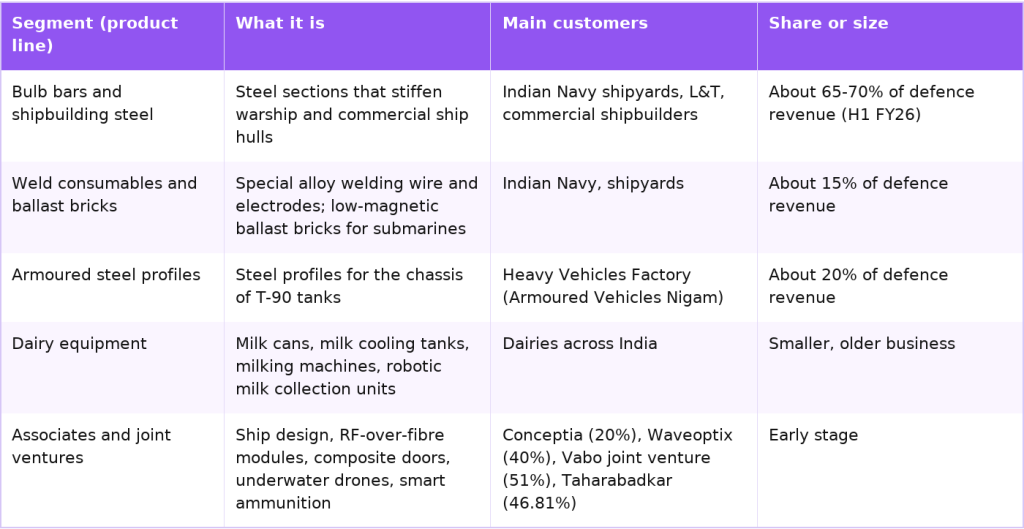
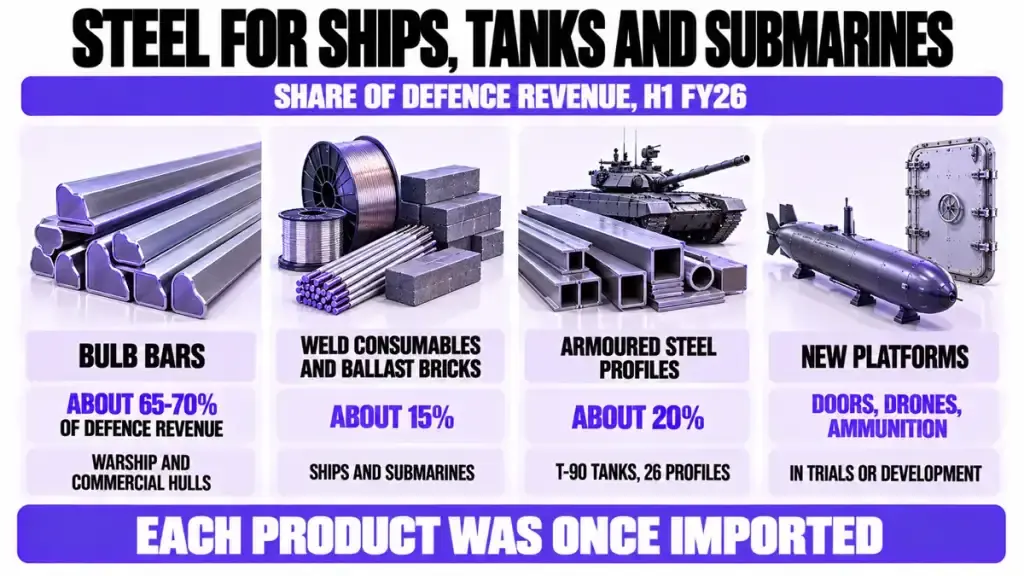
These products share one skill, special steel. The company develops the alloys, makes the sections and tests them against defence specifications, at its 1,50,000 sq ft plant in Halol. In February 2026, it also signed an agreement with the Ministry of Steel under the PLI scheme for alloy and stainless steel grades used in defence and other critical uses, which supports more of this work in India.
Bulb Bars for Warship Hulls
Let's begin with the largest product, bulb bars. India's navy has 68 ships on order, and its shipyards are expanding fast. Mazagon Dock plans ₹40-50 billion of capital spending to double its capacity, and Cochin Shipyard is spending ₹27.7 billion on upgrades. Garden Reach is expanding to build 28 vessels side by side.

Those shipyards are expanding because the whole defence budget is. India's defence budget for FY26 was raised to ₹6.81 trillion, up 9.5%. The Defence Acquisition Council approved ₹8.45 trillion of purchases over FY22 to FY25, about 3.3 times the previous three years. India's defence production grew 18% to ₹1.54 lakh Cr in FY25, and the government aims for ₹3 lakh Cr by 2029. Defence exports rose 12% to ₹23,622 Cr in FY25, to more than 85 countries, with a target of ₹50,000 Cr by 2029. India's coastline was also re-measured at 11,098.81 km, about 48% longer than before, which widens what the navy has to watch.
Those shipyards are also the company's customers. Its defence clients include Mazagon Dock, Cochin Shipyard, Garden Reach, Goa Shipyard, Hindustan Shipyard and L&T, along with the Indian Navy, the Indian Army and DRDO.
Krishna Defence has supplied bulb bars to the navy for many years. It became a transfer-of-technology partner of DMRL, the DRDO lab in Hyderabad, in 2006, and it later developed and delivered shipbuilding steel sections to the Indian Navy. Its bulb bars won the Defence Technology Absorption Award from the Ministry of Defence. Before this, these bulb bars were imported from Russia. Read this Mazagon, GRSE, Cochin: Shipbuilding Stocks
To meet demand, the company doubled its bulb bar capacity in April 2025, from about 2,000-2,500 tonnes a year to about 4,000-4,500 tonnes. It has also bought a 50,000 sq ft plot next to its Halol plant for the next expansion, and the expanded Halol facility is now running.
Bulb bars are also opening a commercial market. Commercial shipbuilders use the same shape, and the company now holds the certifications they need from classification societies such as DNV, ABS, IRS and BV. It has started supplying other profiles for commercial shipbuilding, which could add customers beyond the navy.
Weld Consumables and Ballast Bricks
Next, let's look at the products that join and balance the ships. The company's special alloy welding wire and electrodes have precisely controlled amounts of titanium, nitrogen and nickel. They are used to weld surface ships and underwater platforms, including robotic long seam welding of hulls, and they were approved after certification by specialists from Russia. The electrodes are also used in hard-to-reach parts of a ship and for repairs on board. It signed three transfer-of-technology agreements with DIPAS, a DRDO lab, for weld consumables used in critical naval applications.
Next to the weld wire, ballast bricks are the other product here. Submarines use them as weights to get the right buoyancy and balance. The company's bricks have very low magnetic permeability, which makes the vessel harder to detect. The same bricks suit scientific vessels that take ocean measurements, and they resist corrosion in seawater. Management is now developing more grades of weld consumables, for platforms that India still imports them for.
So if you add up the steel products, you can see why the navy matters so much. Bulb bars, weld wire and ballast bricks all go into the hulls of ships and submarines, and together they make up most of the company's defence revenue.
Armoured Steel Profiles for Tanks
Now let's move to the Army, the company's newer defence customer. The T-90, the Indian Army's main battle tank, uses special steel profiles in its chassis, and these were also Russian designs. Krishna Defence supplies them to the Heavy Vehicles Factory in Chennai, part of Armoured Vehicles Nigam.
That business is widening. In Q4 FY26, the customer raised the number of profiles it buys from the company from 17 to 26. In Q1 FY27, the company also developed and supplied ready-to-use components for armoured platforms, moving from steel sections towards finished parts.
The Army buys one more product from it, for the mountains. The improved space heating device is a room heater for high-altitude posts, where temperatures can fall to about minus 40 degrees. It runs on solar power, kerosene or batteries and is designed to give off no carbon monoxide, and it was developed with a DRDO lab.
Why indigenisation matters here: each of these products was once imported. Once a part is made and approved in India, the forces prefer to keep buying it there, because it is cheaper, quicker to get and safe from foreign supply shocks.
New Platforms in Doors, Drones and Ammunition
Next, let's look at the newer businesses, which are not yet in revenue but could matter later. Composite doors and hatches for warships come closest to production. Steel doors on ships are heavy and hard to maintain, and most European navies have moved to lighter composite ones. Krishna Defence formed a 51:49 joint venture with VABO Composites of the Netherlands, and it commissioned the Kalol facility in Q1 FY27. The doors are in the last phase of trials with the Indian Navy, and they have passed pressure and fire tests. Management sees export potential for them in Southeast Asia, the Middle East and Europe.
Those doors are near production, while underwater drones are further out. The company is building what it calls India's largest autonomous underwater vehicle, in partnership with the Navy and DRDO. It has also taken a transfer of technology from the National Institute of Oceanography in Goa. In Q1 FY27, it set up X Sub Robotic with Planys of Chennai and Conceptia of Bangalore to develop such vehicles. A new facility in Chennai will have a testing tank of about 1,50,000 litres and about 85,000 sq ft for assembly and integration. It will also have quick access to the sea for trials. Management says the Navy has set aside about USD 1 billion for this space, though it is too early to say how much of it the company can address.
"So we are not building in any projection from the AUV or the smart weapon to go with because these are under development kind of products which may take time and which may get delayed." - Ankur Shah, Krishna Defence
Beyond the drones, smart ammunition is the longest bet. In Q1 FY27, the company bought a 46.81% stake in Taharabadkar Solutions, which won an iDEX challenge and has a ₹25 Cr grant from the Indian Navy to develop smart ammunition for naval guns. The Navy now imports this kind of ammunition from Leonardo of Italy, and it is funding the development so that it can buy it from an Indian maker. Management expects development to take two to three years. The company also has a design win for an aircraft arresting gear, which stops an aircraft that overshoots the runway. It is also in advanced talks with a foreign company to make underwater surveillance platforms in India.
Those platforms are not the only new work, and several other products are in development too. The company has made a few large castings for critical naval platforms, and it is working on components for hull structures and for aircraft. It also wants to make in India the special steel used in imported weapons and ammunition.
Those new areas rest on two associate companies. Conceptia, in which the company holds 20%, designs ships and submarines, and earned about ₹80 Cr of revenue in FY26. Waveoptix, 40% owned and set up in August 2023, makes modules that carry radio signals over optical fibre for the forces, and earned about ₹22-23 Cr. Its products are used in submarine radio communication and in electronic warfare direction-finding systems. Conceptia also gives the company a way into marine and offshore engineering, for vessels from small coastal ships of 1,000 DWT up to ocean-going ships of 4,00,000 DWT.
Dairy Equipment, Where It Began
Finally, let's look at the business the company started with. It still makes stainless steel milk cans, milk cooling tanks, milking machines and a patented robotic milk collection unit that helps stop adulteration. The company does not report the dairy business separately, but it serves dairies across India from the Kalol plant. Its milk cans and storage vessels are made from food-grade stainless steel, and its milk tanks follow international standards. So the dairy side still uses the same steel-working skills as the defence side.
The Approvals Nobody Else Has
Now that we have seen the products, let's understand why customers keep coming back. It starts with approvals that took years to earn. The company is a registered and approved vendor to the Indian Navy for shipbuilding steel sections, and it supplies all the main shipyards. Its weld consumables passed a demanding certification, and its armoured profiles are qualified for the T-90.

Those approvals came step by step. The company started in 1997 at Kalol with a small team making stainless steel products. It entered defence in 2006 through the DMRL transfer of technology, and later signed three more technology agreements with DIPAS. It listed on the NSE's Emerge platform for small companies and moved to the main board in December 2025.
We can see the value of that history in how the company now works with DRDO. Each new product starts as a development order, goes through trials and certification, and only then turns into regular supply. That cycle takes years, which is why the products it has already qualified matter so much.
Each approval is hard to win and slow to replace. A navy or a shipyard that has tested a bulb bar or a weld wire for its warships rarely changes the supplier. A new one would have to go through the same tests.
"In business, I look for economic castles protected by unbreachable moats."
— Warren Buffett
Krishna Defence's moat is small but real: approvals for steel that goes into warships, submarines and tanks, which a rival would need years of trials to match. So once the company is in, it tends to get the repeat orders as each new class of ship is built. Read this Economic Moat Explained

Its own research facilities back this up. Besides the Halol plant, it has an RF, optics and electronics R&D centre of about 2,000 sq ft in Bengaluru and a 4,000 sq ft unit there for military cable assemblies.
That position also comes from its team and partners. Its engineers have an average age of 29, and its board includes a former Indian Navy rear admiral. Its stakes in Conceptia and Waveoptix add ship design and defence electronics skills, so it can offer more than steel over time.
Its balance sheet then gives it room. With very little debt and about ₹107.95 Cr of cash and deposits, the company can fund new products and joint ventures from its own money. The VABO joint venture, for example, needs only about ₹4-5 Cr from its side.
Financials: Five Years of Growth and Margins
We have already seen the start and end points of this growth. Here are all five years side by side, as the company shows them in its latest presentation. FY22 and FY23 are standalone figures, and FY24 to FY26 are consolidated.
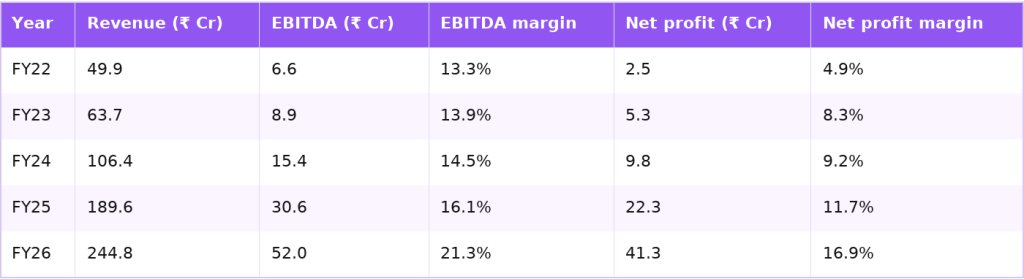
Revenue grew about 4.9 times in four years, a compound growth of 52.8% a year, and net profit grew about 17 times, from ₹2.5 Cr to ₹41.3 Cr. Both margins rose in every one of the five years. The EBITDA margin went from 13.3% to 21.3%, and the net profit margin from 4.9% to 16.9%, as armoured profiles and weld consumables took a bigger share of sales and more revenue ran through the same plant.
Cash has been less steady than profit. In FY25, operations used about ₹10.91 Cr of cash, because inventory built up to ₹72.42 Cr for large orders. In FY26, as those orders were delivered and inventory fell to ₹16.31 Cr, operating cash flow was about ₹86.05 Cr, more than double the year's profit. With borrowings of only about ₹2.06 Cr against shareholders' funds of ₹193.53 Cr in March 2026, growth has been funded almost entirely without borrowing.
"The person that turns over the most rocks wins the game."
— Peter Lynch
Krishna Defence is a small company that few investors follow. Its five-year numbers are worth turning over, along with the order book that has to support the next five.
What FY27 Could Look Like on Management's Numbers
So what could all of this add up to for you as a reader following Krishna Defence? Management has said it aims to grow revenue at 30% or more a year for at least the next three years, using only its existing products. It also expects margins to keep rising, though not by five points every year.
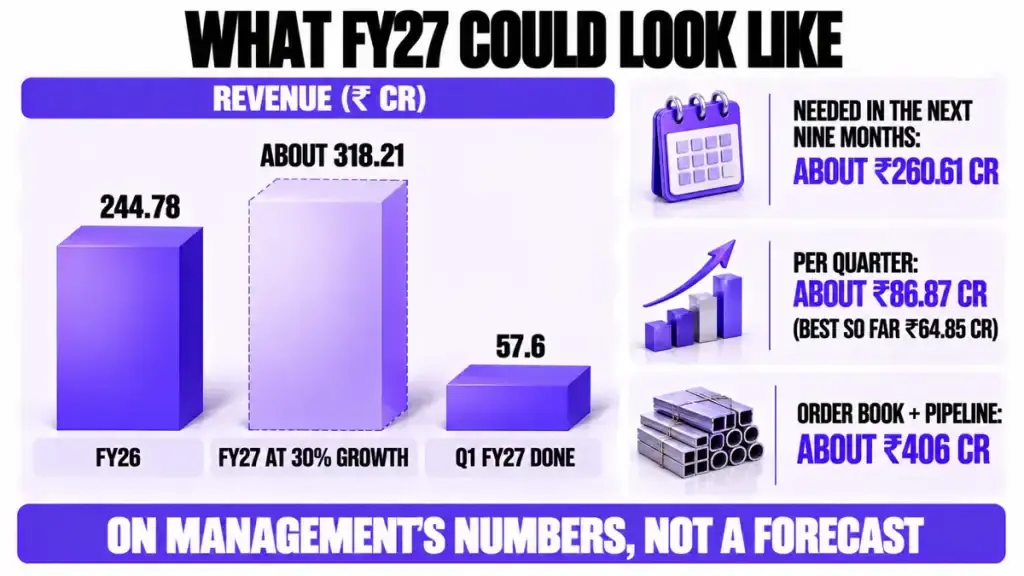
That target lets us work out what FY27 needs. Growth of 30% on FY26 revenue of ₹244.78 Cr would mean about ₹318.21 Cr in FY27. With ₹57.6 Cr done in Q1, the company would need about ₹260.61 Cr in the remaining nine months, or about ₹86.87 Cr a quarter. Its best quarter so far, Q4 FY26, was ₹64.85 Cr.
Those quarters need orders, and as we can see, the orders could support that. The June 2026 order book of ₹117 Cr and the tender pipeline of ₹289 Cr add up to about ₹406 Cr. If most of the pipeline turns into orders in the first half, as management expects, and is delivered within the year, the target is within reach. If the pipeline converts slowly, FY27 will fall short of it.
That plant also earns more as it fills up, and margins and the associates add to the picture. If the product mix stays as it is, management expects the margin to follow a similar path in FY27, with operating leverage helping as more sales run through the plant. It also says Conceptia plans to grow about 20% in FY27 and Waveoptix about 30%, which would add to the company's share of their profits.
The Plan for FY27 and Beyond
Those numbers rest on a plan with several parts, so let's list what management has committed to. Most of it is about growth, margins and the new platforms, and each item has a date we can track.
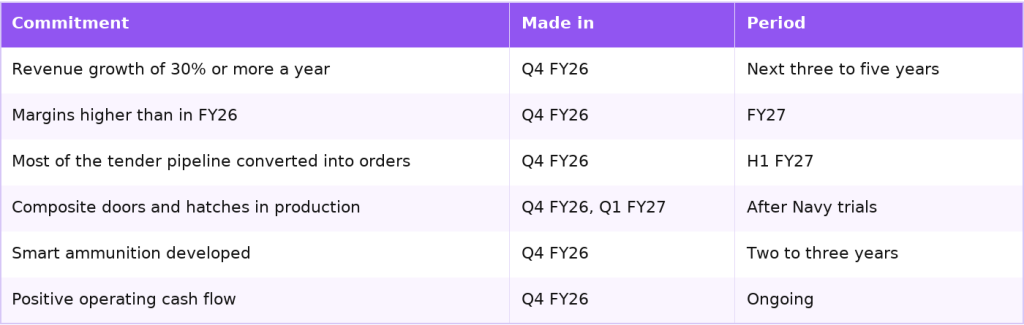
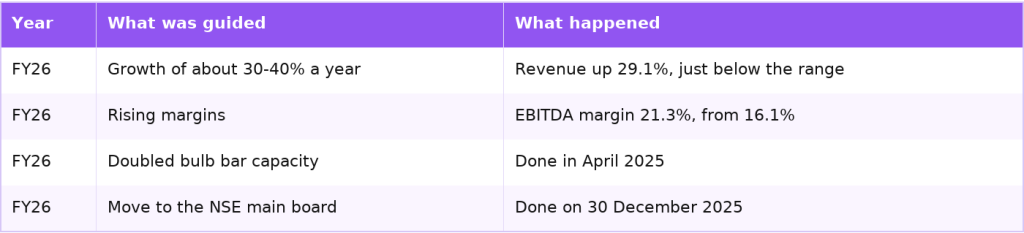
These commitments come with a record we can check. In May 2025, management said it saw growth of about 30-40% a year for the next three to five years, and FY26 revenue grew 29.1%, just below that range. Margins, however, beat expectations, as the EBITDA margin rose to 21.3% from 16.1% and then to 26.3% in Q1 FY27.
"Know what you own, and know why you own it."
— Peter Lynch
For Krishna Defence, knowing why means tracking each quarter's orders from the tender pipeline and whether the margin holds as the product mix shifts.
We should also remember what this target leaves out. The plan does not count any revenue from the underwater drones, the smart ammunition or the arresting gear. So if any of them reach production in the next few years, they would add to growth rather than be needed for it.
Key Risks
No business grows in a straight line, so let's look at what could go wrong for Krishna Defence.
- Lumpy orders: revenue depends on when the navy and shipyards place orders. Q1 FY27 revenue fell 15.2% from a year ago, and orders were pushed back by about five months during Operation Sindoor.
- A thin order book: the order book of ₹117 Cr covers only part of the about ₹318 Cr that 30% growth would need, so the pipeline has to convert quickly.
- Few customers: the navy, its shipyards and the Heavy Vehicles Factory buy almost everything the company makes.
- Margins may not hold: the record margin came from a richer mix and lower material costs. If bulb bars rise again as a share of sales, or steel prices move, margins could fall back.
- New products take time: the underwater drones, smart ammunition and composite doors are all still in development or trials, and management itself says they may be delayed.
- Changes in the accounts: FY26 was the first year under Ind AS, and profit figures differ between filings (net profit including associates of ₹41.32 Cr against ₹38.12 Cr standalone), so comparisons across years need care.
- Associates and joint ventures: about ₹3.19 Cr of FY26 profit came from the company's share of its associates, which it does not run directly, and the new joint ventures will need money and management time before they earn.
- Management changes: the company secretary resigned in August 2026, and a small company relies heavily on a few key people.
"You can't predict. You can prepare."
— Howard Marks
Order timing in defence cannot be predicted. What an investor can do is watch the few numbers below that will show early whether the plan is slipping.
Explore our Products
Research Framework

Emerging Titans
Combination of quantitative analysis, industry tailwinds, and management assessment - SPRINT investment philosophy

Tiny Titans
Heavy emphasis on scuttlebutt research, plant visits, and early on-ground signals
What to Track Next
If you follow Krishna Defence, these are the signals that will show whether the plan is on track. Read this Research a Stock in 1 Hour: A Checklist
- Q2 FY27 results, due by mid-November 2026, and revenue after ₹57.6 Cr in Q1
- New orders from the ₹289 Cr tender pipeline
- The EBITDA margin staying above FY26's 21.3%
- Navy approval and first orders for the composite doors and hatches
- Progress on the autonomous underwater vehicle and the smart ammunition
- First commercial shipbuilding orders for bulb bars
Conclusion
Let's step back and put it all together. Krishna Defence has spent two decades learning to make special steel products that India's navy and army once imported, from bulb bars for warship hulls to profiles for tanks. Those products now earn it a record margin, and the navy's shipbuilding plans give it a long list of future platforms to supply.
So the next few quarters will show whether orders can keep up with that ambition. The company needs a much faster pace of revenue in the rest of FY27 to grow 30%, and its pipeline has to turn into orders quickly. If the navy's new ships move through approvals on time, Krishna Defence is well placed to supply them. If orders slip again, revenue will follow the navy's timing, not the company's plan. The cautious thread is the order book: ₹117 Cr covers only part of what 30% growth needs, so the tender pipeline has to convert quickly. The Q2 FY27 results and the next few navy orders will show which thread wins.
FAQs
What does Krishna Defence and Allied Industries do?
+Krishna Defence is a Gujarat company, started in 1997, that makes bulb bars and other shipbuilding steel for the Indian Navy and its shipyards, special weld consumables, low-magnetic ballast bricks for submarines and armoured steel profiles for T-90 tanks. It also still makes stainless steel dairy equipment.
What is a bulb bar?
+A bulb bar is a flat steel bar with a rounded bulb along one edge, used as a rib to stiffen the steel plates of a ship's hull. It gives about three times the strength-to-weight ratio of an ordinary steel angle. India once imported these from Russia.
Why did Krishna Defence's margin rise to a record in Q1 FY27?
+The EBITDA margin rose to 26.3% from 18.6% a year earlier because the product mix shifted towards higher-margin armoured steel profiles and weld consumables, and the cost of goods sold fell faster than revenue. Revenue itself fell 15.2% as orders came in smaller batches.
How big is Krishna Defence's order book?
+The unexecuted order book was ₹117 Cr in June 2026, with a tender pipeline of ₹289 Cr where its bids had been accepted. The Ministry of Defence placed orders of ₹45.64 Cr in June 2026 and about ₹20 Cr in August 2026 for special steel products.
What growth does management expect?
+Management aims to grow revenue at 30% or more a year for at least the next three years using only existing products, and expects margins to keep rising, though not by five points every year. Growth of 30% would mean about ₹318 Cr of revenue in FY27.
What are the main risks for Krishna Defence?
+The main risks are lumpy navy and shipyard orders, an order book that covers only part of the growth target, dependence on a few defence customers, margins that depend on product mix, new products still in trials, changes in its accounts after moving to Ind AS, and reliance on a few key people.

High growth stock specialist, Value Educator
Shashank Mahajan is an equity research professional with over 12 years of experience in identifying high-potential SME and micro-cap stocks at an early stage. He follows a rigorous scuttlebutt research–driven approach, combining on-ground insights with deep financial analysis. Shashank specializes in uncovering under-researched and under-owned companies with strong management quality and long-term growth potential. Through disciplined research and early identification, he focuses on spotting tomorrow’s market leaders before they enter the mainstream investor radar.

Zen Technologies: Why Revenue Fell After Its Biggest Win

Data Patterns: India's Radar Designer and Its Waiting Orders

KSH International: The Wire Inside India's Transformers

PNG Jewellers: A 194-Year-Old Name Goes National

Axiscades: From Services to Missile and Radar Electronics

TD Power: 93% of New Orders Now Come From Abroad
Explore our Products
Research Framework
Emerging Titans
Combination of quantitative analysis, industry tailwinds, and management assessment - SPRINT investment philosophy
Tiny Titans
Heavy emphasis on scuttlebutt research, plant visits, and early on-ground signals


 Orders
 Subscription
 Share with friends
 Logout


Required Details
₹23999.00
(12 month subscription)
As per SEBI regulations, all users are mandated to complete the KYC that is validated for 1 year. Post payment, you will be redirected to the KYC screen


No comments yet. Be the first to comment!