
KSH International: The Wire Inside India's Transformers

India is building transformers faster than ever, and it still cannot build enough of them. The country's transformer manufacturing capacity is expected to rise from about 110 GVA to 300 GVA by 2027-28. Transformer makers such as Hitachi, Siemens and CG Power already have order books booked through 2029-30. In 2025-26, India added 52,537 MW of power generation capacity up to 31 January 2026, and every new plant needs transformers to send its power into the grid.
Every one of those transformers needs a lot of copper wire. A transformer works by passing electricity through coils, and the coils are made of winding wire, which simply means copper or aluminium wire wrapped in insulation so that it can be wound tightly without the turns touching each other. The quality of this wire decides how much power a transformer can carry, how hot it runs and how long it lasts. In a large power transformer, a fault in one coil can put the whole unit out of service for months.
For the largest transformers, ordinary wire is not enough. They use a continuously transposed conductor (CTC), which is a bundle of many thin insulated copper strips that keep swapping position along the length of the cable. That swapping spreads the current evenly across the strips, so the coil runs cooler and wastes less power. A CTC goes through five or six precision steps, against about two for an ordinary round wire.
One Maharashtra company has made these wires since 1979. KSH International Ltd (NSE: KSHINTL) makes magnet winding wires for power transformers, motors, generators, compressors and electric vehicles. It was one of the first companies to introduce CTC in India, almost 20 years ago, and it is the only Indian company approved to supply CTC for 400 kV HVDC converter transformers. It sells to more than 120 customers, including Hitachi Energy, CG Power, BHEL, GE Vernova and Siemens Energy.
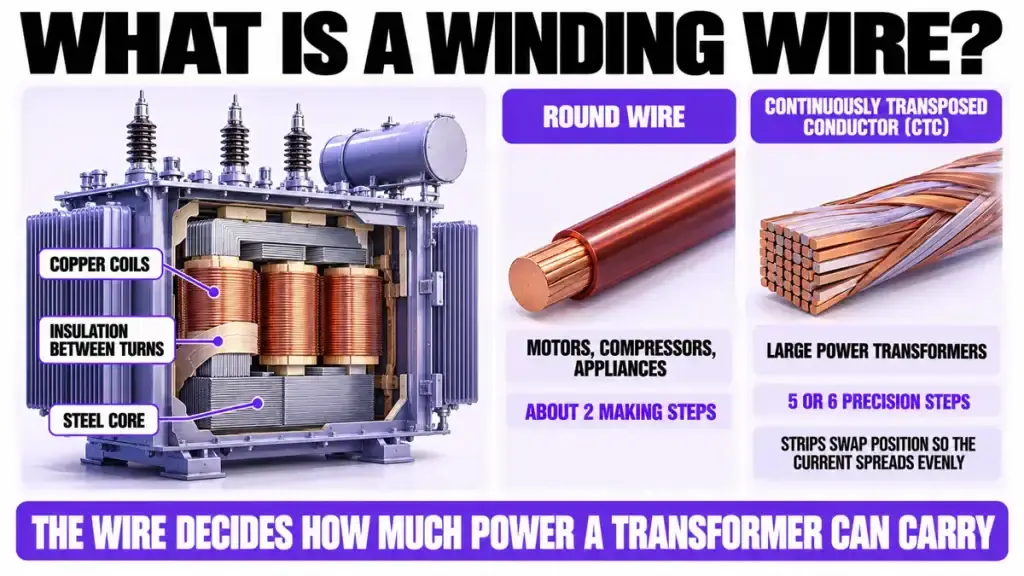
Its business model is simple to follow. KSH buys copper only after a customer places an order, so the price of copper and the exchange rate are passed through to the customer. What KSH really earns is the value it adds on each tonne of wire. That is why the company tracks EBITDA per ton, which means its operating profit on every tonne it sells, rather than its margin as a share of revenue.
KSH in five numbers
- Q1 FY27 revenue of ₹1,164.2 Cr, up 108.4% from a year ago
- EBITDA per ton of ₹93,325, against ₹65,885 a year ago
- Installed capacity of 43,445 tonnes, rising to 59,045 tonnes by March 2027
- A five-year supply framework with Hitachi Energy for its plants in India and abroad
- About 27% of FY26 revenue from exports to 24 countries
These numbers show a wire maker growing at a rare pace. So what is driving it, and how much of it can last? Let's first understand the company, and then look at the latest quarter.
KSH International: Company Overview
KSH International was founded in 1979 to make winding wires in India for the power sector. It makes specialized magnet winding wires, including continuously transposed conductors (CTC) and paper-insulated wires, for power transformers, traction motors and generators, and standard round enamelled wires for motors, compressors, appliances and electric vehicles. It runs four plants in Maharashtra, at Taloja, Chakan (two) and Supa, close to the JNPT port, with 43,445 tonnes of yearly capacity in June 2026. It sells to more than 120 customers and exports to 24 countries. KSH listed on 23 December 2025, its promoters held 74.58% after the IPO, and it earned ₹3,107 Cr of revenue in FY26. Read this KSH International: Wires for Electrification
"The simpler it is, the better I like it."
— Peter Lynch
KSH's model is simple to follow. It passes copper through to the customer and earns a fixed amount on each tonne of wire, so tonnes sold and profit per tonne tell most of the story.
The Quarter That Doubled KSH's Revenue
Let's look first at Q1 FY27, the April to June quarter. Revenue from operations more than doubled from a year ago, and profit grew almost as fast.

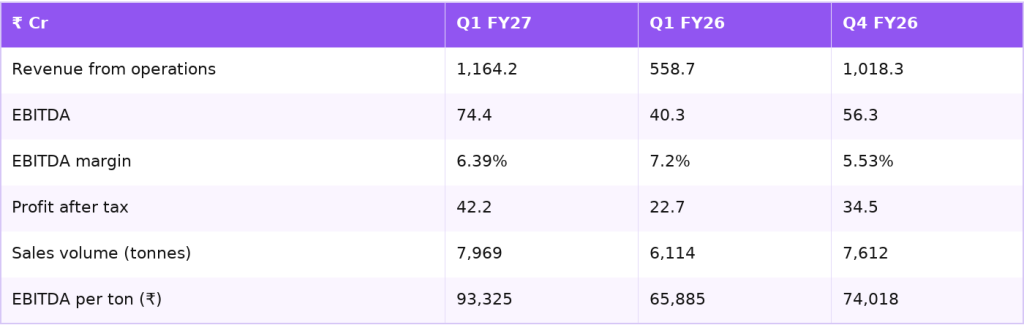
That jump came from three sources together. Sales volume grew 30% to 7,969 tonnes. Copper prices were higher, which lifts revenue without lifting profit. And the mix moved towards higher-value wires, which is where most of the profit growth came from. Revenue from specialized wires grew 113% from a year ago, standard wires grew 83%, and exports grew 76%.
Those three sources explain why the EBITDA margin looks low next to the profit growth. Most of the revenue is the copper price passed through to the customer, so the margin as a share of revenue moves with copper, not with how well the business is run. In Q1 FY27, the EBITDA margin was 6.39%, against 7.2% a year ago, but EBITDA per ton went up from ₹65,885 to ₹93,325.

Below EBITDA, the new plant shows up in the costs. Depreciation rose to ₹8.4 Cr in Q1 FY27 from ₹3.3 Cr a year ago, as Supa started running. Finance costs rose to ₹17.3 Cr from ₹7.3 Cr, because more copper was in stock and with customers as sales doubled. Other income added ₹8.2 Cr. Even after these, profit before tax grew 69.9% to ₹56.9 Cr.
That ₹93,325 per ton had a clear cause. During the quarter, CTC reached its highest share of revenue in several years, and CTC earns the most per tonne. KSH had also set up its new capacity first for specialized wires. Exports, which are all specialized wires, were higher, and some new customers paid better rates than older long-term ones. The rupee, which has been trading lower against the dollar, also helped.
How KSH Earns on Each Tonne
So how does a copper price change the margin but not the profit? The company gives a simple example of its own. Suppose KSH adds ₹100 thousand of value to each tonne and spends ₹40 thousand a tonne to run its plants. Then it earns ₹60 thousand of EBITDA per tonne whatever copper costs.
What changes with copper is only the revenue. If copper costs ₹800 thousand a tonne, the EBITDA margin in that example is 7.5%. At ₹900 thousand it is 6.7%, and at ₹1,100 thousand it is 5.5%, even though KSH earns exactly the same amount on every tonne. That is why we look at profit per tonne and volume to judge the business, and treat the margin percentage with care. Read this EBITDA Explained: Uses and Limits
That way of looking also makes the last five quarters easier to read. You can see revenue and EBITDA rising each quarter, with the margin moving around in between.

That rise in EBITDA also shows in profit per tonne, which followed the same climb. EBITDA per ton was about ₹60,000 in Q4 FY25, about ₹64,500 in Q3 FY26, about ₹74,000 in Q4 FY26 and ₹93,325 in Q1 FY27. Volume rose from about 5,900 tonnes in Q4 FY25 to about 7,400 tonnes in Q3 FY26, about 7,600 tonnes in Q4 FY26 and 7,969 tonnes in Q1 FY27. Each step came from more specialized wires and more exports.
That climb is now expected to settle. As more capacity for standard wires comes in over the next quarters, CTC's share of the mix will return closer to normal. So the company says it is comfortable with about ₹75,000 per ton for FY27 as a whole. In May 2026, it had pointed to the range set by about ₹68,000 in FY26 and ₹74,000 in Q4 FY26.
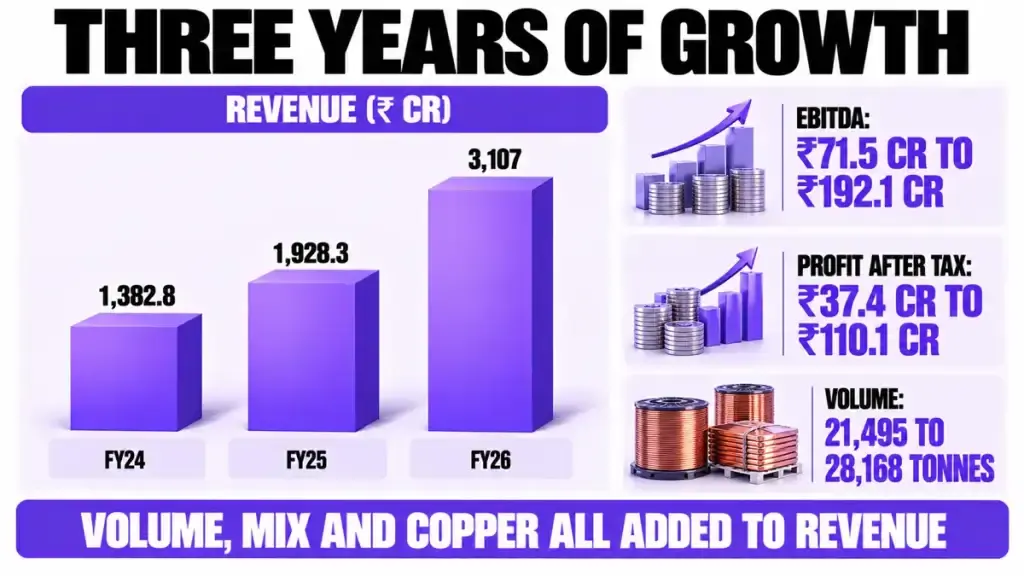
That full year shows how fast KSH has grown. Revenue rose from ₹1,382.8 Cr in FY24 to ₹1,928.3 Cr in FY25 and ₹3,107 Cr in FY26. EBITDA went from ₹71.5 Cr to ₹122.5 Cr and then ₹192.1 Cr, and profit after tax from ₹37.4 Cr to ₹68 Cr and ₹110.1 Cr. Volume grew more slowly, from 21,495 tonnes in FY24 to 28,168 tonnes in FY26, because higher copper prices and a richer mix both added to revenue.
That growth needed money, and the IPO in December 2025 supplied it. KSH listed on 23 December 2025. It sold new shares worth ₹420 Cr at ₹384 each, and the promoters sold shares worth about ₹206.35 Cr more. In December 2025, the company repaid ₹225.9 Cr of debt, and its debt-to-equity ratio came down to 0.39 in March 2026 from 1.21 a year earlier. The promoters held 74.58% of the company after the IPO. Read this High Promoter Holding: What It Signals
That IPO also changed the balance sheet, as you can see from a year ago. Shareholders' equity rose from ₹298.5 Cr in March 2025 to ₹808.1 Cr in March 2026. Total debt was ₹316.2 Cr in March 2026 and ₹481 Cr in June 2026, mostly loans for working capital as sales grew. Return on equity was 19.9% in FY26, lower than before only because the IPO added so much new equity.
Working capital is also moving the right way. A wire maker carries copper in stock and waits to be paid, so cash gets tied up as it grows. KSH's average working capital days came down to 60 in Q1 FY27, from 65 in Q4 FY26 and 71 a year ago. Management aims for 30-35 days, close to the industry level, over several quarters, so that the company can generate cash from operations even while it grows fast.
The Capacity Behind the Growth
So where will the next tonnes come from? Most of the growth capacity is coming from a new plant at Supa in Maharashtra, which is doubling what KSH can make.
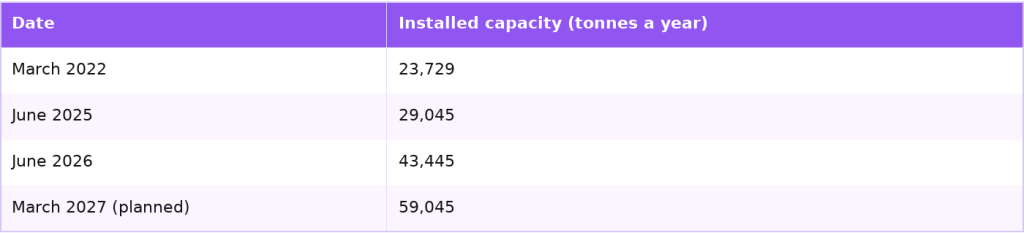
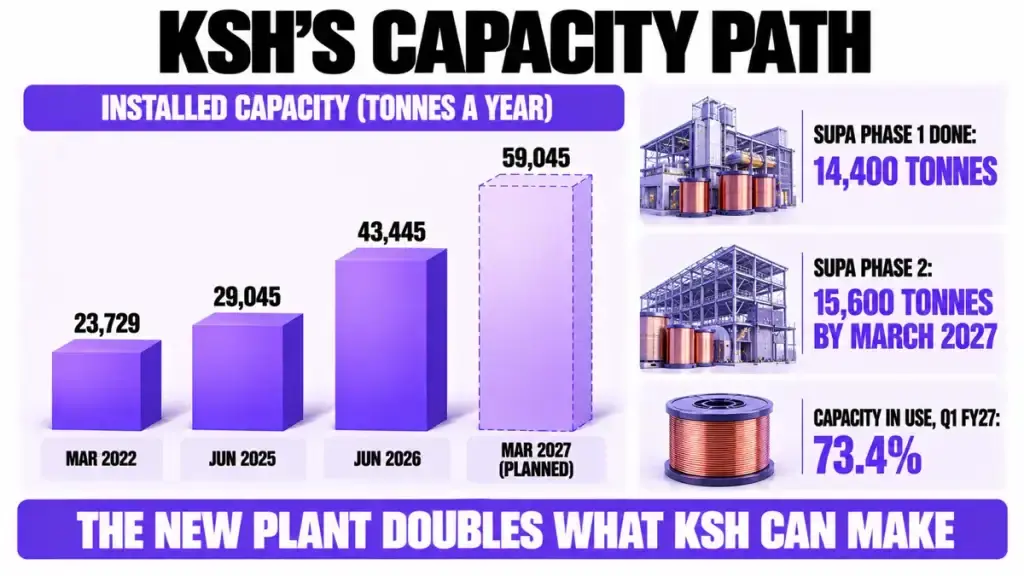
That capacity plan is half done. KSH has finished 14,400 tonnes of the 30,000 tonnes planned at Supa, and it expects the remaining 15,600 tonnes by March 2027, with the next part coming in Q2 FY27. Once this is complete, management says KSH will be the second-largest winding wire maker in India. The board has also allowed management to look at buying another 10 acres of land at Supa for later expansion.
Supa is now the company's fourth and largest plant. KSH also has a plant at Taloja and two at Chakan, all in Maharashtra and close to the JNPT port near Mumbai, which keeps the cost of shipping exports down. Supa itself is within about 250 km of several large transformer makers' plants, including CG Power and Siemens.
You can think of the plan as two steps. The first step, Phase 1, is already running and filling up. The second step, Phase 2, adds the rest by March 2027, so FY28 would be the first full year with all of it.
Those new lines are also filling up. KSH used 73.4% of its capacity in Q1 FY27, against 64.8% in FY26, when Supa's capacity was available for only part of the year. In August 2026, KSH also commissioned an upcast facility at Chakan with 5,000 tonnes of capacity. It turns the company's own copper scrap back into copper rod for its wires, which should save some cost and waste.
Two Kinds of Wire, One Copper Pass-Through
Those plants make two kinds of wire, so let's now see what KSH actually sells. The company reports two product groups, specialized and standard magnet winding wires, and both pass copper through to the customer in the same way.
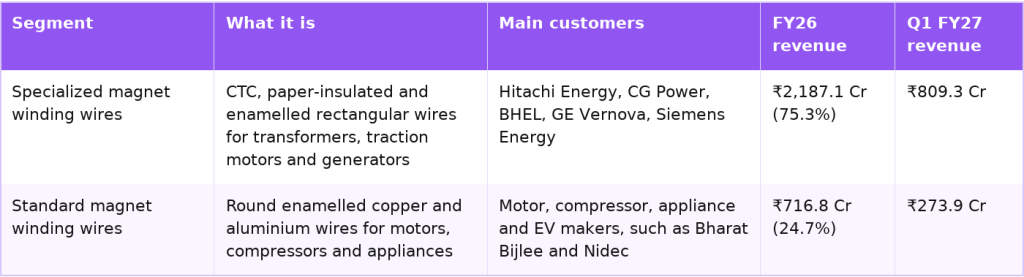
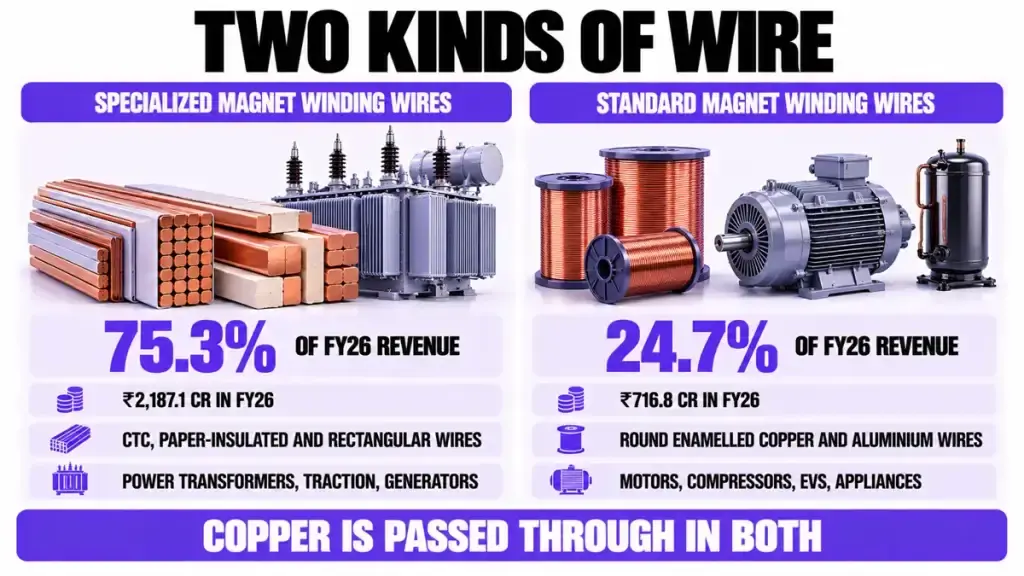
Inside these two groups sit several products. Specialized wires include paper-insulated rectangular copper and aluminium wires, bunched paper-insulated copper wires, enamelled rectangular wires and CTC. Standard wires are round enamelled copper and aluminium wires. Copper carries current better and is preferred where performance matters, while aluminium is cheaper but needs more material for the same job.
These two kinds of wire differ in more than shape. Specialized wires are made to each transformer maker's design, go through long approvals and earn more per tonne. Standard wires are made on automated lines in larger volumes, and they compete more on scale and price. Within specialized wires, CTC earns the most, and it makes up more than half of that business.
Both kinds of wire also sit inside a large market. The global magnet wire market was about USD 36.66 billion in 2025, and it is projected to reach about USD 49.27 billion by 2031, growing about 5.05% a year. India's magnet wire market is expected to exceed USD 2.60 billion by 2030.
Specialized Wires for Power Transformers
Let's begin with the larger business, wires for power transformers. India's power system is growing on several fronts. The country expects to add about 450 GW of generation capacity over 2025-30, and renewable energy's share of installed capacity is expected to rise from 34% to about 51% by 2029-30. Since wind and solar farms are often far from cities, they need new transmission lines, and transmission spending is estimated at ₹9.1 trillion over 2022-32. India has also committed to 500 GW of renewable energy capacity by 2030, and much of that power will travel along new high-voltage corridors.

All of that needs transformers, and lead times for large transformers now run to several years. Management says the main shortage today is in transformer-making capacity and other critical inputs, where expansions are still under way. The transformer makers are expanding. Most of them, in India and abroad, have order books of three to five years, so they want their suppliers to grow with them. Read this TARIL: The Transformer Maker With ₹6,630 Cr of Orders As the managing director put it, the link is direct.
"So to put it simply, more transformers require more winding wires." - Rajesh Hegde, KSH International
Those transformers need many kinds of wire, and KSH has a clear lead at the top end, as we can see from its range. It supplies wires for 765 kV transformers and reactors, traction transformers for the railways, and generators for wind and hydro plants. Over the last two or three quarters, more than 25% of its CTC volume went to transformers of the higher voltage classes, such as 765 kV and HVDC.
HVDC is where that lead is widest. HVDC means high-voltage direct current, the technology India uses to carry large amounts of power over long distances, such as from remote solar and wind sites to cities. KSH has supplied wires for several HVDC transformers in India and abroad. In FY26, it began supplying wire for 37 HVDC transformer windings, the first domestic sourcing of HVDC winding wire in four years. These were the first new HVDC orders after several years, and more wind and solar projects are yet to be awarded.
That record also earned KSH its biggest customer step, which came this quarter. KSH signed a five-year supply framework with Hitachi Energy to supply winding wires to its plants in India and some of its plants abroad. The quantities and prices are still being worked out, but the agreement gives KSH more visibility as it fills its new capacity. Management says other transformer makers are discussing similar long-term deals, since they want to lock in supply while their own order books are full.
Why the long-term deals matter: transformer makers with years of orders cannot afford to run short of qualified wire. A framework agreement turns KSH from a supplier they buy from order by order into one they plan around.
Who Buys the Wire
So who buys the wire behind these numbers? You can see the range in the names. Hitachi Energy, Siemens Energy, GE Vernova, CG Power and BHEL make power transformers and reactors for utilities and industry. Suzlon makes wind turbines, whose generators need specialized wires. Bharat Bijlee and Nidec make motors, which use standard wires. KSH serves more than 120 such companies in India and abroad.
Those customers buy for very different end uses. Power and renewables take the largest share, but the same wires also go into railway traction transformers and traction motors, hydro generators, diesel generator alternators, data centres, EVs and home appliances. KSH is an approved supplier to RDSO, the railways' design body, so its wires can go into locomotive transformers.
That spread helps KSH balance its plants. When transformer orders are strong, it can run more lines on specialized wires, as it did in Q1 FY27. When motor and appliance demand picks up, it can shift towards standard wires. Either way, most of its revenue still comes from large power transformers, which gave about 75% of revenue.
Standard Wires for Motors, Compressors and Vehicles
Next, let's look at the standard wires, which gave about a quarter of FY26 revenue. These are round enamelled wires used in motors, compressors, alternators and appliances. KSH focuses on uses where precision matters, such as EV motors, air-conditioner compressors and alternators for diesel generator sets.
These uses are growing, and several trends are lifting this business together. Alternators for diesel generator sets are now used in data centres. New BIS standards are pushing buyers to source standard wires from Indian makers instead of importing them. Standard wire revenue grew 83% in Q1 FY27, close to the 80% growth in Q4 FY26, as KSH added new customers with its Supa capacity.
Beyond these, electric vehicles are a longer opportunity. Demand from two-wheeler and three-wheeler motors is already strong. Management expects meaningful volumes from cars and buses from about FY28-FY29, and says KSH has to be part of those vehicle programmes now to supply them later.
That EV future is why KSH has added a new product. In FY26, it signed an exclusive licence with HPW Metallwerk of Germany to make and sell its globally patented extruded PEEK wires in India. These are high-performance insulated wires for EV traction motors that run at higher voltages and temperatures. It is also making rectangular wires for EV traction motors.
Exports to 24 Countries
Now let's move to exports, which are all specialized wires for transformer makers. KSH is the largest exporter of winding wires from India, and it sells to 24 countries, including the Middle East, Europe and the US. Exports made up about 27% of FY26 revenue. The Middle East, Europe and the US each gave about 8-11% of total revenue.
That export share has room to grow. Exports grew 76% in Q1 FY27, helped by more business from existing customers and by new transformer makers added over the last two quarters. Management's aim is to take exports back to their earlier peak of about 40% of revenue over time. Global transformer makers face the same shortage as Indian ones, and many are looking for suppliers outside China. The global transformer market has a historically large gap between supply and demand, with lead times of several years, and the shortage is not only in transformers but also in their parts. Indian makers of specialized winding wires are natural beneficiaries as buyers spread their supply chains.
Those export lanes also need managing. KSH serves six to seven countries in the Middle East. During the conflict in the region in the last months of FY26, some shipments to customers deep in the Gulf were rerouted, which delayed them by a few weeks, and management said the effect was not material.
The Qualifications Nobody Else Has
Now that we have seen both businesses, let's understand why customers keep returning to KSH. It starts with qualifications, the approvals that few wire makers have. Before a transformer maker uses a new wire, it has to test and approve it. Large utilities such as Power Grid, NTPC and NPCIL, and the railways' RDSO, also approve the suppliers to their equipment. KSH is on these approved lists, and each approval takes years to earn.
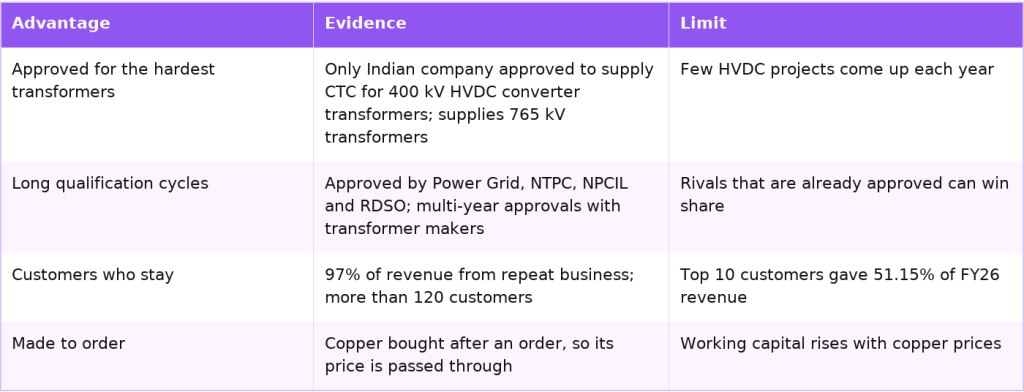
Those approvals come from precision. CTC has to be made to tight limits, because a fault in a large transformer is very costly for the utility that owns it. The company's view on quality is part of how it wins repeat orders.
"Our long-term mantra has been that quality has to be built into everything we produce, not something that gets inspected at the end." - Rajesh Hegde, KSH International
That record also explains why so few companies compete at the top. Many companies make winding wire, but as the voltage class rises towards 765 kV and HVDC, far fewer are approved. No other Indian company is currently qualified to supply CTC for HVDC converter transformers, and that is where KSH earns the most per tonne. Read this Economic Moat Explained
That lead took decades to build. KSH was founded in 1979 to make winding wires in India for the power sector. It chose to build specialized wires when the Indian market for them was still small, and it started making CTC almost 20 years ago to replace imports. It then added plants at Taloja and Chakan, and in FY26 Supa became its fourth and largest.
Its customers then add to the lead. With 97% of revenue from repeat business, KSH learns each transformer maker's designs and grows with it. The customer base is also spreading out, since the share of the top 10 customers has been coming down. Its board brings transformer know-how too. One independent director worked at BHEL and received the Vishwakarma National Award for his contribution to the Indian transformer industry.
Its plants then add a cost edge. All four plants are close to the JNPT port and to many customers, so freight costs stay low. The upcast facility recycles copper scrap, and a rooftop solar plant at Supa supplies part of its power. In a business that earns a fixed amount per tonne, every saving on cost per tonne adds to profit.
So when you look at KSH, it helps to think of three layers of advantage. We have the approvals, which take years and keep rivals out of the top voltage classes. We have the customers, who stay for decades and now sign long-term deals. And we have the plants, which keep the cost per tonne low. Each layer makes the next one stronger.
"In business, I look for economic castles protected by unbreachable moats."
— Warren Buffett
KSH's castle has three walls: approvals that take years, customers that stay for decades, and plants that keep the cost per tonne low.
Financials: Four Years of Volume, Profit and Returns
KSH has been listed only since December 2025, and its presentations go back to FY23, so here are the four years it reports, side by side.
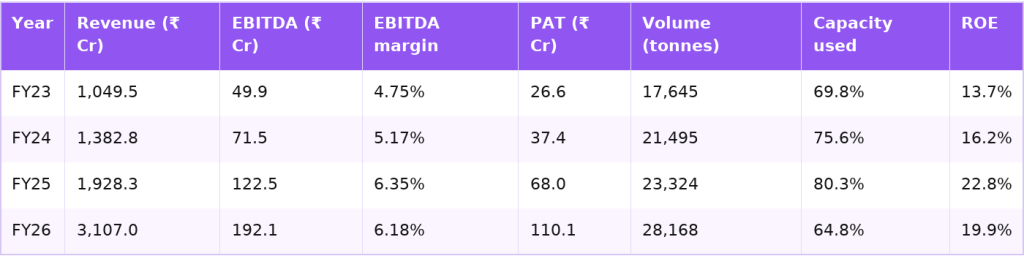
Revenue grew about 3 times in three years, from ₹1,049.5 Cr in FY23 to ₹3,107 Cr in FY26, a growth rate of about 43.6% a year. Volume grew much less, about 60%, from 17,645 tonnes to 28,168 tonnes, because higher copper prices and a richer mix both added to revenue. EBITDA grew about 3.9 times and profit after tax about 4.1 times, so profit grew faster than both volume and revenue.
That gap is the story of profit per tonne. Dividing EBITDA by the tonnes sold gives about ₹28,000 a tonne in FY23 and about ₹68,000 in FY26, as KSH sold more CTC, more exports and more specialized wire. Capacity use fell to 64.8% in FY26 only because Supa's new capacity was counted for part of the year.
ROE rose from 13.7% in FY23 to 22.8% in FY25, and eased to 19.9% in FY26 because the IPO added a large amount of new equity. The same IPO money cut the debt-to-equity ratio to 0.39 in March 2026 from 1.21 a year earlier, though working-capital debt rose again to ₹481 Cr by June 2026 as sales doubled.
"Price is what you pay. Value is what you get."
— Warren Buffett
For KSH, value comes from two numbers multiplied together: the tonnes it can sell from its new plants and what it earns on each one.
What FY27 Could Look Like on Management's Numbers
So what could all of this add up to for you as a reader following KSH? Management has given two numbers for FY27. It expects volume growth at about the 26% of the last 12 months, and it is comfortable with an EBITDA per ton of about ₹75,000.
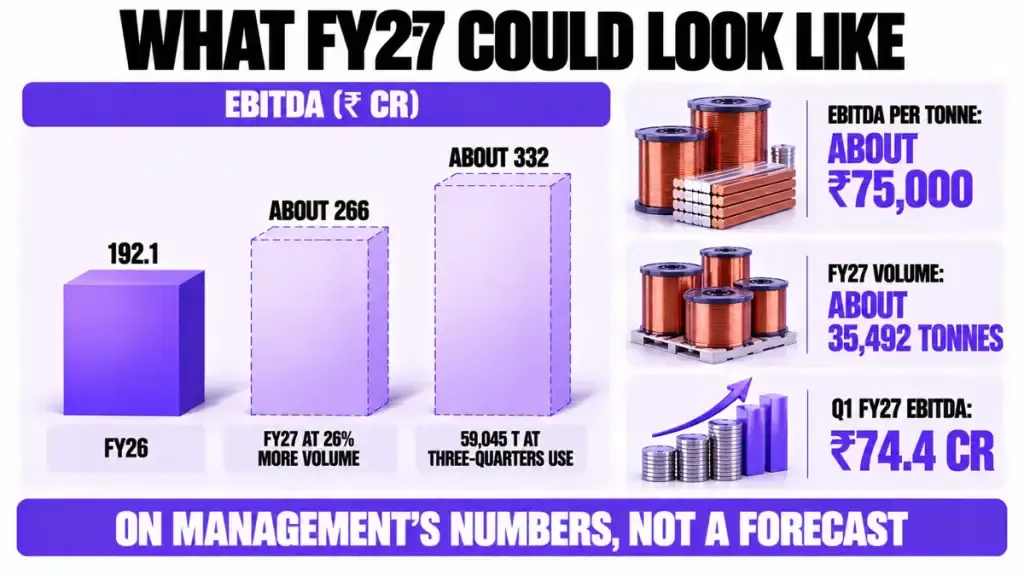
We can put these two numbers together. If FY27 volume grows 26% from FY26's 28,168 tonnes, KSH would sell about 35,492 tonnes. At ₹75,000 a tonne, that would mean EBITDA of about ₹266 Cr, against ₹192.1 Cr in FY26. In Q1 FY27 alone, KSH earned ₹74.4 Cr of EBITDA. If it simply repeated that quarter four times, it would earn about ₹297.6 Cr in the year, so the estimate of about ₹266 Cr assumes that profit per tonne settles lower as the mix changes.
That sum also needs the new capacity, which sets a higher ceiling. With 59,045 tonnes in place by March 2027, KSH could sell about 44,284 tonnes a year if it used three-quarters of its capacity, close to the 73.4% of Q1 FY27. At ₹75,000 a tonne, that would mean EBITDA of about ₹332 Cr a year. Higher fixed costs at Supa will take part of this, as management has said.
The Plan for FY27
Those two numbers rest on a plan with several parts, so let's list what management has committed to. Most of it is about capacity, profit per tonne and cash, and each item has a date we can track.
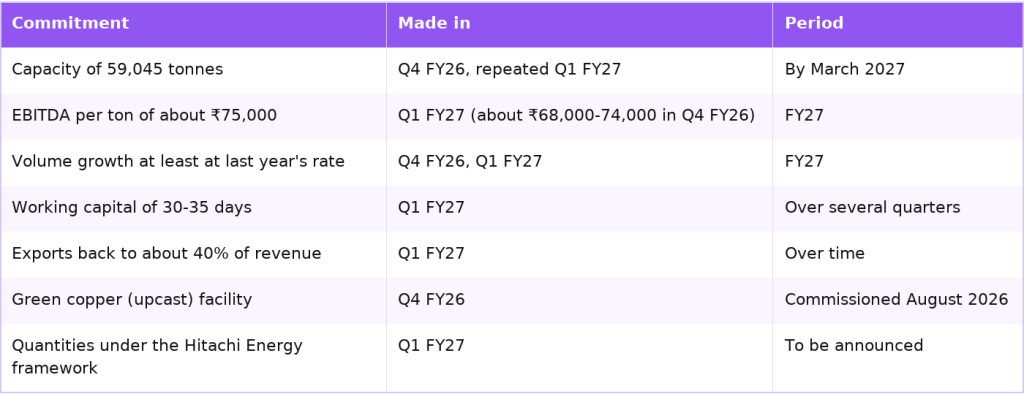
These commitments are recent, since KSH has been listed only since December 2025, so we have a short record to check. Even so, the record so far gives us a first test of how closely the company does what it says. What it has said so far it has done. Phase 1 at Supa was completed in FY26, and the upcast facility started as one of the IPO's aims, ahead of the H2 FY27 timeline in its annual report. EBITDA per ton rose from about ₹68,000 in FY26 to ₹93,325 in Q1 FY27, above the range it gave in May 2026. Exports grew 76% in the same quarter, ahead of the company's aim of a larger export share, and working capital days came down for two quarters in a row, as promised.
"Know what you own, and know why you own it."
— Peter Lynch
For KSH, knowing why means tracking tonnes sold, profit per tonne and working capital days every quarter.
Key Risks
No business grows in a straight line, so let's look at what could go wrong for KSH.
- Mix returning to normal: the ₹93,325 per ton of Q1 FY27 came partly from a record share of CTC. As standard wire capacity comes in, EBITDA per ton could fall towards ₹75,000 or below.
- Customer concentration: the top 10 customers gave 51.15% of FY26 revenue, so a slowdown at a few large transformer makers would hit KSH quickly.
- Copper and working capital: higher copper prices tie up more cash in stock and receivables. Debt rose from ₹316.2 Cr in March 2026 to ₹481 Cr in June 2026, and finance costs were ₹17.3 Cr in Q1 FY27.
- Customer delays: some transformer makers that are building new plants have delayed picking up their orders by a few weeks.
- Industry capacity: management notes that winding wire capacity across the industry has expanded and begun catching up with demand, which could pressure rates over time.
- Capacity execution: Phase 2 at Supa has to come in on time, and higher fixed costs at the new plant will weigh on profit until it fills up.
- Currency and exports: a weaker rupee helped Q1 FY27. A stronger rupee, trade barriers or conflict in export markets would cut that help.
- Thin margins: the EBITDA margin is about 6%, so small changes in costs or prices have a large effect on profit.
"You can't predict. You can prepare."
— Howard Marks
Copper prices and the product mix cannot be predicted. What an investor can do is watch the few numbers below that will show early whether the plan is slipping.
Explore our Products
Research Framework

Emerging Titans
Combination of quantitative analysis, industry tailwinds, and management assessment - SPRINT investment philosophy

Tiny Titans
Heavy emphasis on scuttlebutt research, plant visits, and early on-ground signals
What to Track Next
If you follow KSH, these are the signals that will show whether the plan is on track.
- Q2 FY27 results, due by mid-November 2026, and EBITDA per ton against about ₹75,000
- New Phase 2 capacity at Supa coming in during Q2 and the rest by March 2027
- Quantities and prices under the Hitachi Energy framework, and any similar agreements
- More HVDC and 765 kV orders as India awards its transmission corridors
- Exports moving towards about 40% of revenue
- Working capital days moving from 60 towards 30-35
Conclusion
Let's step back and put it all together. KSH makes the wires inside the coils of India's largest transformers, and it is the only Indian company approved to supply CTC for HVDC converter transformers. Transformer makers have years of orders and want suppliers who can grow with them, which is why KSH's volumes, profit per tonne and exports all rose together in Q1 FY27.
So the next year will show how much of that pace can last. Capacity is doubling, a five-year framework with Hitachi Energy is in place, and management is comfortable with ₹75,000 a tonne. If the new lines fill up and the mix holds, KSH could earn far more than it does today. If CTC's share settles faster than volumes grow, profit per tonne will settle lower too. The cautious thread is the mix: the record ₹93,325 a tonne came partly from an unusually high share of CTC, and management itself expects about ₹75,000 for the year. The Q2 FY27 results and the next phase at Supa will show which thread wins.
FAQs
What does KSH International do?
+KSH International, founded in 1979, makes magnet winding wires: specialized wires such as CTC for power transformers, traction motors and generators, and standard round enamelled wires for motors, compressors, appliances and EVs. It sells to more than 120 customers, including Hitachi Energy, CG Power, BHEL, GE Vernova and Siemens Energy.
What is a continuously transposed conductor (CTC)?
+A CTC is a bundle of many thin insulated copper strips that keep swapping position along the cable, spreading the current evenly so the transformer coil runs cooler and wastes less power. KSH is the only Indian company approved to supply CTC for 400 kV HVDC converter transformers.
Why does KSH track EBITDA per ton instead of margin?
+KSH buys copper only after an order and passes its price to the customer, so revenue moves with copper while its earnings depend on the value added per tonne. EBITDA per ton was ₹93,325 in Q1 FY27, against ₹65,885 a year earlier, while the EBITDA margin fell to 6.39% from 7.2%.
How is KSH expanding capacity?
+Installed capacity rose to 43,445 tonnes a year in June 2026 and is planned to reach 59,045 tonnes by March 2027, as the new Supa plant in Maharashtra adds its second phase. KSH also commissioned a 5,000-tonne upcast facility at Chakan in August 2026 to recycle copper scrap.
What does management expect for FY27?
+Management expects volume growth at about the 26% of the last 12 months and is comfortable with an EBITDA per ton of about ₹75,000 for FY27. It also aims to bring working capital to 30-35 days and exports back to about 40% of revenue over time.
What are the main risks for KSH International?
+The main risks are profit per tonne falling as the mix returns to normal, customer concentration, copper-driven working capital and debt, delays at customers' new plants, growing industry capacity, execution of Phase 2 at Supa, currency and export risks, and thin margins.

High growth stock specialist, Value Educator
Shashank Mahajan is an equity research professional with over 12 years of experience in identifying high-potential SME and micro-cap stocks at an early stage. He follows a rigorous scuttlebutt research–driven approach, combining on-ground insights with deep financial analysis. Shashank specializes in uncovering under-researched and under-owned companies with strong management quality and long-term growth potential. Through disciplined research and early identification, he focuses on spotting tomorrow’s market leaders before they enter the mainstream investor radar.

Zen Technologies: Why Revenue Fell After Its Biggest Win

Data Patterns: India's Radar Designer and Its Waiting Orders

Krishna Defence: The Steel Behind India's Warship Hulls

PNG Jewellers: A 194-Year-Old Name Goes National
Axiscades: From Services to Missile and Radar Electronics
TD Power: 93% of New Orders Now Come From Abroad
Explore our Products
Research Framework
Emerging Titans
Combination of quantitative analysis, industry tailwinds, and management assessment - SPRINT investment philosophy
Tiny Titans
Heavy emphasis on scuttlebutt research, plant visits, and early on-ground signals


 Orders
 Subscription
 Share with friends
 Logout


Required Details
₹23999.00
(12 month subscription)
As per SEBI regulations, all users are mandated to complete the KYC that is validated for 1 year. Post payment, you will be redirected to the KYC screen


No comments yet. Be the first to comment!