
Zen Technologies: Why Revenue Fell After Its Biggest Win

Small drones have changed how wars are fought. In the fighting between Armenia and Azerbaijan, in Ukraine and in Operation Sindoor in May 2025, cheap drones spotted targets, guided artillery and attacked equipment worth many times their price. Shooting each of them down with an expensive missile makes little sense. So armies everywhere, including India's, now want a cheaper and faster way to stop them.
That need has created a new kind of equipment. A counter-drone system simply means a set of sensors and weapons that finds a hostile drone and stops it before it can do harm. It works in four steps. A radar and radio sensors detect the drone, and a camera confirms what it is. A jammer then cuts the drone's link to its pilot or confuses its GPS, and if that fails, a gun or another drone destroys it.
These systems also need soldiers who can run them under pressure, and that brings in a second kind of equipment. A training simulator lets a soldier practise with a weapon, a vehicle or a sensor without firing real ammunition or wearing out real machines. Armies use simulators for everything from rifle drills to tank battles, because live training is slow, costly and sometimes too dangerous to repeat.
Both kinds of equipment come from one Hyderabad company, Zen Technologies (NSE: ZENTEC), founded in 1993. For about three decades it has supplied the Indian Army with tank, gunnery, small-arms and driving simulators, and since 2021 it has sold counter-drone systems. Its counter-drone systems were used in Operation Sindoor, and after that the government placed almost ₹800 Cr of anti-drone orders with it.
The company designs its products itself and owns the designs, so they count as IDDM. IDDM means Indian-designed, developed and manufactured, the highest preference category in Indian defence buying. Zen does not run heavy factories. It designs the systems, buys most of the hardware, and then integrates and tests them. After that, it keeps earning under an annual maintenance contract, which is the yearly fee the Army pays to keep each simulator working.

Zen in five numbers
- FY26 revenue of ₹688 Cr, down 29.4% from a record ₹973.6 Cr in FY25
- About ₹1,175 Cr of new orders in FY26, about 4.5 times the FY25 inflow of about ₹264 Cr
- Order book of ₹1,239 Cr on 30 June 2026, plus ₹177.5 Cr and ₹295 Cr of orders since then
- A target of ₹4,000 Cr of revenue over FY27 and FY28 together
- About ₹1,217 Cr of cash and bank balances, and no debt
Earlier, in June 2025, when we last wrote about Zen, management was aiming for more than ₹6,000 Cr of revenue over FY26 to FY28. Since then, a company whose product worked in a real conflict saw its revenue fall, and the target has become ₹4,000 Cr for FY27 and FY28 together. So what happened, and what has to go right? Let's first understand the company, and then look at the year revenue fell.
Zen Technologies: Company Overview
Zen Technologies was founded in Hyderabad in 1993 and is led by its Chairman and Managing Director, Ashok Atluri. For about three decades it has supplied the Indian Army with tank, gunnery, small-arms and driving simulators, and since 2021 it has also sold counter-drone systems, which were used in Operation Sindoor. It designs its products itself, so they qualify as Indian-designed, developed and manufactured (IDDM). Since February 2025 it has bought or invested in companies that make naval simulators, electronic warfare equipment, drones and drone motors. Its own team had 421 professionals in March 2026, it had about ₹1,217 Cr of cash and bank balances and no debt in June 2026, and it earned ₹688 Cr of revenue in FY26. Read this Best Defence Stocks in India for 2026
"In the short run, the market is a voting machine but in the long run, it is a weighing machine."
— Benjamin Graham
Zen is a good test of that idea. Its product worked in a real conflict, yet its revenue fell the next year, because what the weighing machine measures is orders turned into deliveries.
The Year Revenue Fell After Operation Sindoor
Let's look first at how revenue moved over the last four years. Zen's revenue grew from about ₹219 Cr in FY23 to about ₹440 Cr in FY24 and to a record ₹973.6 Cr in FY25. In FY26 it fell to ₹688 Cr. Through this swing, the operational EBITDA margin, which leaves out other income, stayed high, at about 38.4% in FY25 and about 36% in FY26.
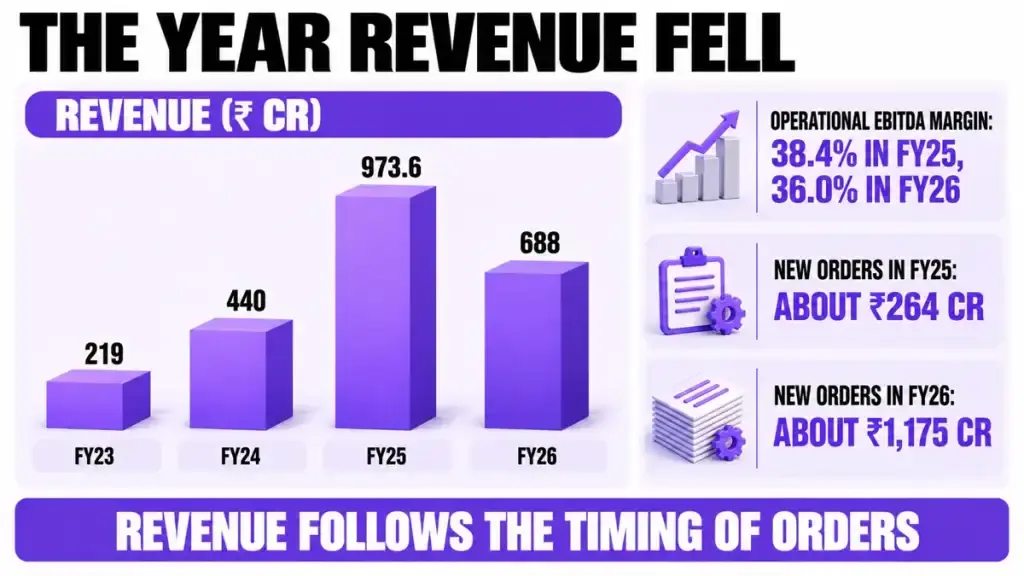
That fall had a simple cause, and it lies in how Zen gets paid. Its revenue follows the timing of a few large government orders, and most orders have to be delivered within a year. In FY25, Zen won only about ₹264 Cr of new orders, against the ₹1,200-1,300 Cr it had expected. So it entered FY26 with an order book of only about ₹692 Cr, too small to repeat the record year.
Then Operation Sindoor changed the Army's priorities. Emergency orders for counter-drone systems went out quickly, while regular buying of simulators slowed. New orders came back strongly in the second half of FY26, but most of them will turn into revenue only in FY27. So the products worked and the orders came, just one year later than the revenue line needed them.
Profit held up better than revenue because of the cash Zen holds. Profit after tax for Zen's own shareholders was about ₹193 Cr in FY26, after minority interests. Other income, mostly interest on the cash, added about ₹85.4 Cr to profit. That interest is real money, but it does not come from selling anything. Read this How to Read a Profit & Loss Statement
That same gap shows in the latest quarter. In Q1 FY27, the April to June quarter, revenue fell about 10.5% from a year ago, and margins came down sharply on the lower sales.

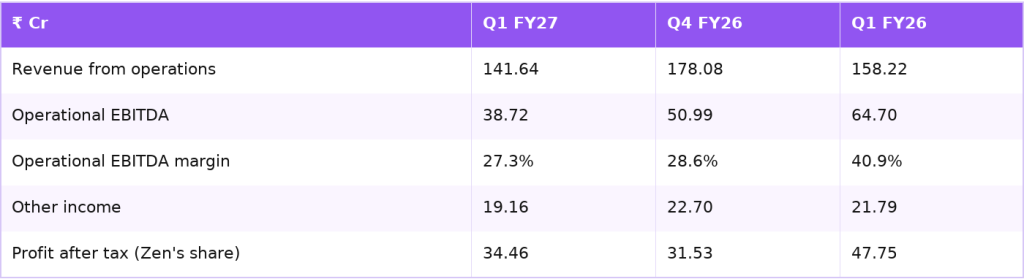
Against the previous quarter, Q4 FY26, revenue fell about 20.5%, but profit after tax rose from ₹31.5 Cr to ₹34.5 Cr, as Q4 had carried higher provisions. Some of the margin drop from a year ago came from one-off items. The Q1 FY26 margin was lifted by ₹7.65 Cr of FY25 provisions that were released. This quarter, by contrast, carried about ₹2.9 Cr of extra warranty provisions and about ₹4.2 Cr more spending on research and development. It also took a ₹3.4 Cr loss from a fire at a subsidiary, which is insured.
But the bigger reason is volume. Zen's gross margin stayed at 72.9%, in line with earlier quarters, so it still earns a high price on what it sells. Its costs for engineers, research and offices, however, do not shrink when sales fall. When revenue drops by a tenth, a large part of the drop comes straight out of EBITDA, which is why EBITDA fell about 40% on a revenue fall of about 10.5%. The same effect works in reverse when sales rise, and that is what management is counting on. Read this EBITDA Explained: Uses and Limits
Revenue was flat through FY26, at ₹158.22 Cr, ₹173.57 Cr, ₹177.83 Cr and ₹178.08 Cr in the four quarters, before Q1 FY27 dropped to ₹141.64 Cr. Orders were far less even. Zen won ₹64.26 Cr in Q1 FY26, ₹94.05 Cr in Q2, ₹585.55 Cr in Q3 and ₹431.36 Cr in Q4, then only ₹44.62 Cr in Q1 FY27. Management says FY27 revenue will be weighted to the second and third quarters, since the orders won from October 2025 are due for delivery within about a year.
Those deliveries are also why working capital rose. Zen's own measure was 196 days in March 2026 and 257 days in June 2026, as it built stock and paid suppliers in advance for FY27 deliveries. Debtor days were 122 in June. Management expects the figure to come back to 140-150 days over time.
Even so, cash moved in a better direction. Operating cash flow was about ₹245 Cr in FY26, against about ₹31 Cr in FY25, as Zen collected money owed by its customers. Receivable days fell from 161 in December 2025 to 119 in March 2026. Zen has no borrowings and held about ₹1,217 Cr of cash and bank balances in June 2026, most of it from a ₹1,000 Cr share sale to institutions in FY25. CRISIL reaffirmed its A/Positive rating on Zen's bank facilities in August 2026.
The Orders Behind the Order Book
So if revenue fell, where will next year's revenue come from? We can see it in the orders Zen won from October 2025. Each large order is reported to the stock exchanges, and the filings show exactly which products the Army is buying.

These orders explain how the order book moved. It fell to about ₹692 Cr in March 2025 and was still about ₹675 Cr in September 2025. It then rose to about ₹1,083 Cr in December 2025 and about ₹1,336 Cr in March 2026. In June 2026 it stood at ₹1,239 Cr, after a quarter in which very few new orders came in. You can see how lumpy this is in one comparison. The two simulator orders after June, worth ₹472.5 Cr together, are more than ten times the ₹44.6 Cr of new orders in the whole June quarter.
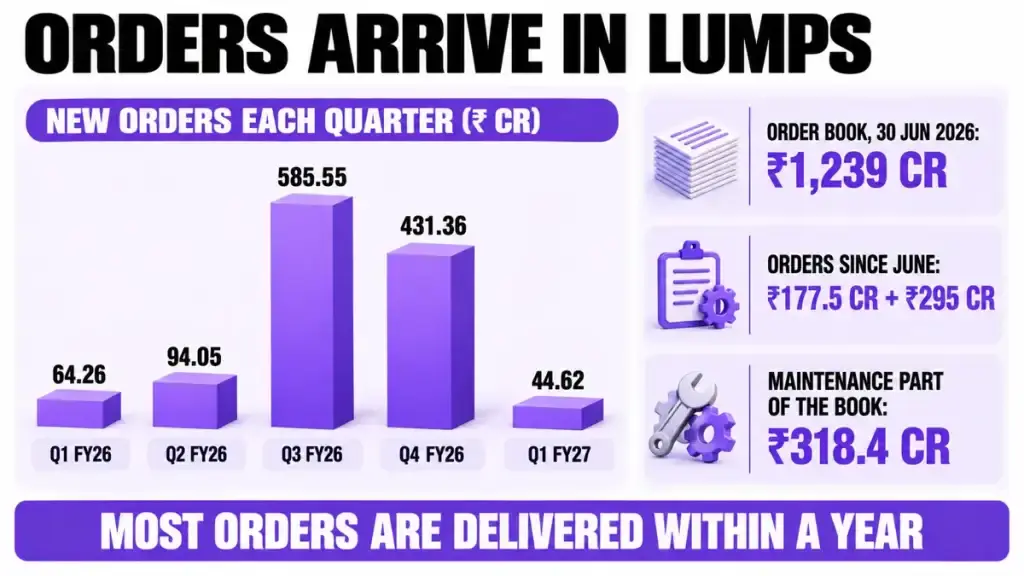

This split inside the book matters too. About ₹318 Cr comes from annual maintenance contracts, which usually start from about the third year of a simulator's ten-year life. This part turns into revenue slowly but steadily. The equipment part, about ₹921 Cr, drives the swings, because Zen delivers it within a year of each order.
Five Businesses Under One Roof
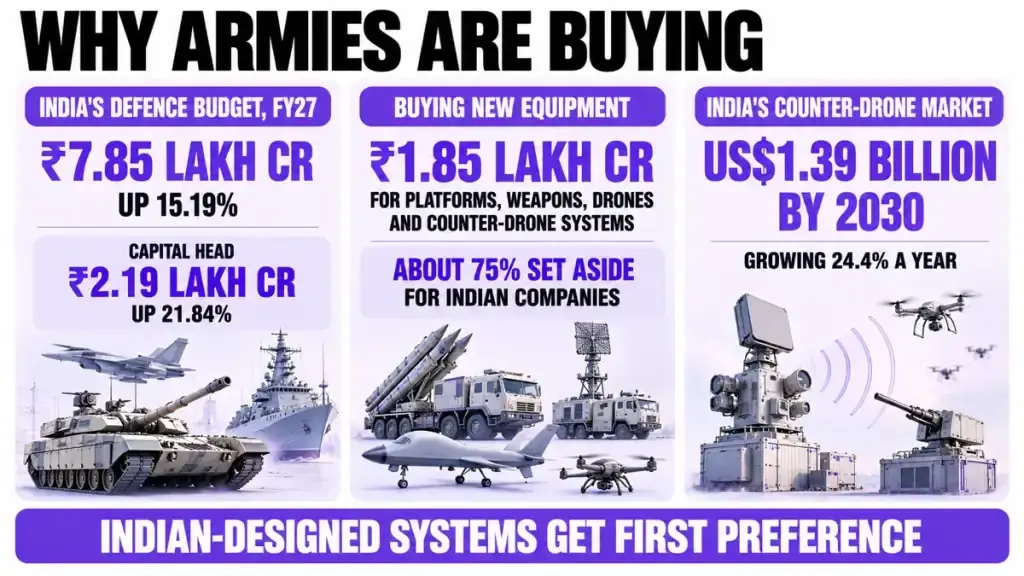
Those orders come from five businesses under one roof, so let's look at what each one sells and to whom. India's spending gives the backdrop. The Ministry of Defence received about ₹7.85 lakh Cr in the FY27 budget, up about 15.19%, and ₹2.19 lakh Cr of that is under the capital head, up 21.84%. About ₹1.85 lakh Cr of it goes to buying platforms, weapons, drones and counter-drone technology.
These budgets now favour Indian makers. About 75% of the capital acquisition budget is set aside for Indian companies. India's defence production reached about ₹1.54 lakh Cr in FY25, and defence exports were a record ₹23,622 Cr that year. In FY26, production rose again to a record ₹1.78 lakh Cr, up 15.6% from the year before.
Here, Zen reports a single segment, so there is no official split of its revenue by business. It does give numbers for its group companies, and these show how much the acquisitions have changed it in two years.
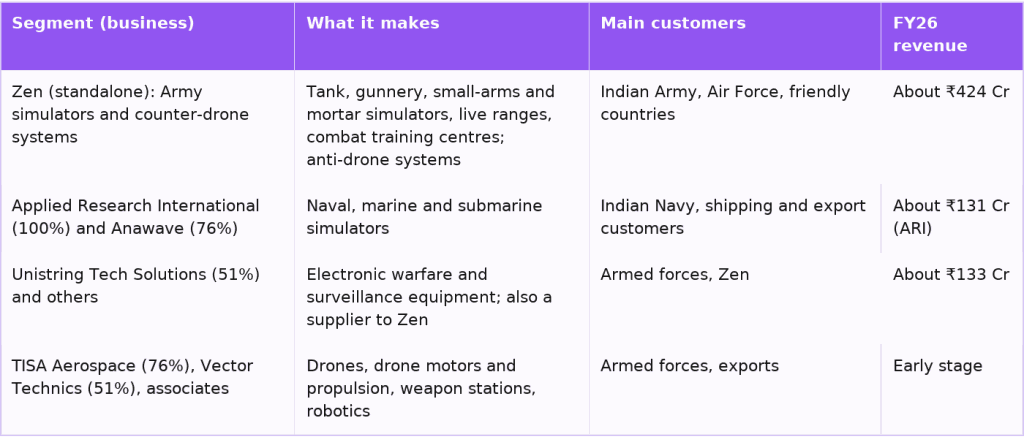
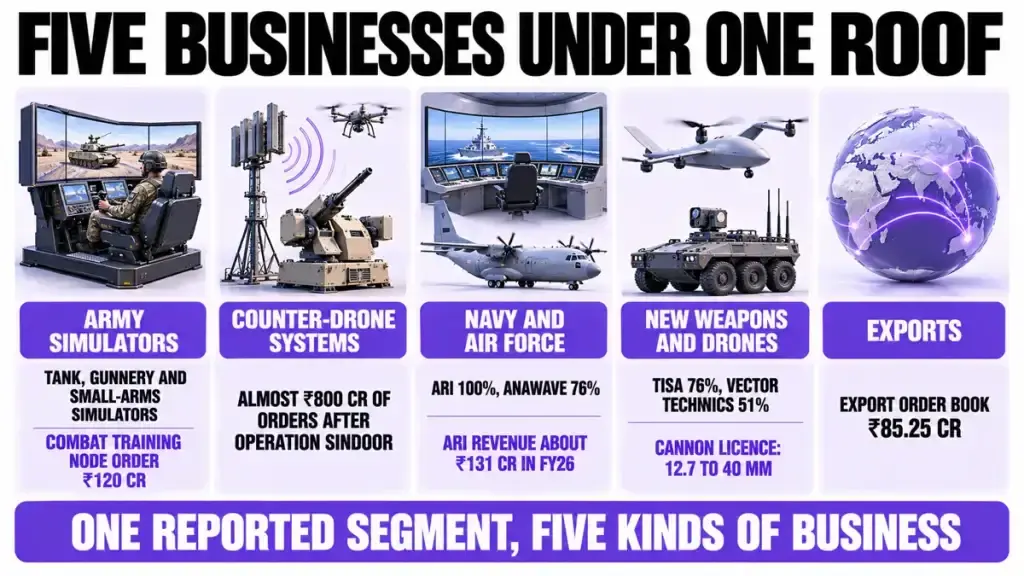
That change shows in a single comparison. In FY25, almost all revenue came from Zen itself, about ₹931 Cr out of ₹973.6 Cr. In FY26, the subsidiaries added about ₹264 Cr while Zen's own revenue fell about 54% to about ₹424 Cr. So the group is no longer only a simulator and anti-drone company, and each of its businesses now has its own customer and its own pace of orders.
Training Simulators for the Army
Let's begin with the business Zen started with, the Army simulators. The Army is changing how it trains. It is moving towards combat training nodes, large centres that combine live firing with simulated battles. Whole units can practise together there while saving wear on real tanks and guns.
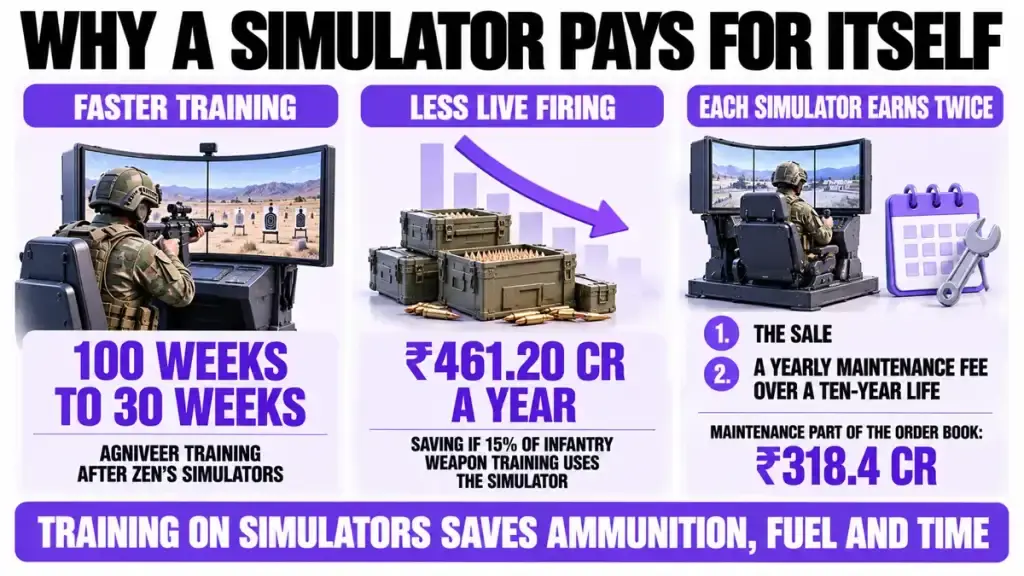
Those centres exist because simulators save money that live training burns. Every round fired in practice, every hour a tank runs and every barrel worn out has a cost. Some situations are also too dangerous to practise with real weapons at all. Agniveers are the soldiers India now recruits for a four-year term under its short-service scheme, so their training has to be fast. Zen says the Agniveer training programme was cut from 100 weeks to 30 weeks after its simulators were used. It also says that using its infantry weapon training simulator for just 15% of training could save the armed forces about ₹461.20 Cr a year.
That saving explains why Zen's range now covers almost every stage of a soldier's training. It makes tank driving and gunnery simulators, crew gunnery trainers, and small-arms and mortar simulators, including a patented 60 mm mortar simulator. It also makes containerised live-firing ranges with smart targets, and moving targets for tank crews.
At the top of the range sits the Combat Training Node, a full training centre where soldiers, vehicles and command posts practise together. Zen won the order for India's first such node, at the Infantry School in Mhow, for ₹120 Cr in December 2025. It will hold more than 60 simulators.
Each simulator earns Zen money twice. The Army first buys the simulator, and then, from about the third year, it pays an annual maintenance fee over the simulator's ten-year life. That is why maintenance makes up about ₹318 Cr of today's order book. Every new simulator adds to a base of future revenue that does not depend on new tenders. In October 2025, the government also rewrote its rules for buying spares and services, a category worth about ₹1 lakh Cr a year, to make such purchases simpler for the forces.
Why the maintenance tail matters: a simulator sale is not a one-time event for Zen. It starts a fee that runs for most of the simulator's life, so every year of simulator orders lifts revenue for years after the delivery itself.
New tenders, however, were slow in FY25 and FY26, and only now are simulator orders picking up. Zen won ₹108 Cr for tank simulators in November 2025, ₹177.5 Cr for T-90 simulator upgrades in July 2026 and ₹295 Cr for simulators in August 2026. Management expected ₹700-800 Cr of simulator orders in FY27, and the two orders since June already add up to about ₹472 Cr of that. It also expects about ₹2,000 Cr of its ₹4,000 Cr two-year revenue target to come from simulators.
Counter-Drone Systems
Next, let's look at the business that made Zen known beyond the Army, counter-drone systems. Demand here comes from what drones have done in recent wars. Swarms of cheap drones and long-range attack drones have hit bases, ships and power plants, so armies now need layers of protection around everything they own. India's counter-drone market is projected to grow 24.4% a year to reach about US$1.39 billion by 2030.
Zen entered this market early. It launched its anti-drone system in 2021 and won its first order in 2022. Its version of the four steps we saw earlier uses its own Hawkeye camera, which has detection ranges of 8 km to 15 km. Its jammers cover a wide band of radio frequencies, from 70 MHz to 12 GHz.
Even after jamming, some drones keep coming, so Zen adds hard kill. It uses remote weapon stations and the Army's L70 and ZU-23 guns, older air-defence guns that the Army already has in service, to shoot them down. The system comes in vehicle-mounted, fixed, man-portable and high-altitude versions, and Zen launched a high-altitude man-portable model in July 2026.
These systems were used in Operation Sindoor, and the orders followed quickly. Management says the government placed almost ₹800 Cr of anti-drone orders on Zen after the operation. The filings show ₹37 Cr for systems with hard kill and ₹289 Cr for upgrades of systems already in service, both in October 2025. They also show ₹404 Cr in January 2026, of which about ₹332 Cr was for anti-drone systems.
"The government itself, as you have seen, that they almost placed Rs.800 Crores worth of anti-drone orders on us post Op Sindoor and there are a lot of upcoming tenders."
Those orders came with little competition, but that is changing. Zen faces one large Indian rival, Bharat Electronics, which also owns counter-drone designs that qualify as IDDM. Read this PSU vs Private Defence Stocks for 2026 Larger, less urgent deployments of systems designed by DRDO, the government's defence research body, usually go to Bharat Electronics. Zen wins the urgent orders that need delivery within months.
So far, in recent anti-drone tenders, Zen was the only bidder that qualified. Management expects more competition as requirements widen and says Zen will lose some tenders. Meanwhile, it is waiting for new counter-drone tenders worth at least a couple of thousand crore.
Why the tenders matter more than the technology: Zen's systems have already worked in combat. What decides its revenue now is when the forces issue tenders, how large they are and how many rivals qualify.
Naval and Air Force Simulators
Now let's move to Zen's newer customers, the Navy and the Air Force. Training on a warship, a submarine or an aircraft costs even more than training on a tank. Every hour uses fuel and wears out a platform the forces need for operations. Some emergencies, such as flooding in a submarine or an engine failure in flight, cannot be practised safely on the real thing at all.
For these forces, Zen bought its way in. It bought most of Applied Research International (ARI) in February 2025 and the remaining 24% in October 2025. ARI makes ship-bridge, engine-room and submarine simulators, and it earned about ₹131 Cr in FY26. In November 2025, Zen also bought 76% of Anawave Systems and Solutions, which adds naval simulation and radio-frequency skills.
Both companies give Zen a way into a force it barely served before. Management expects ARI and Unistring together to earn about ₹365 Cr in FY27, well above their FY26 level.
The Air Force is newer still. Zen has built a simulator for the C-295, the transport aircraft that Airbus and Tata are making in India. Management says its talks with aircraft makers on more Air Force simulators are at an advanced stage, which would add a third service to Zen's customer list.
New Weapons and Drones
Next, let's see where Zen is going beyond training and protection, into weapons and drones of its own. In April 2026, Zen received licences to make 12.7 mm, 23 mm, 30 mm and 40 mm cannons, the calibres used on armoured vehicles, ships and air-defence guns. With its associate AiTuring Technologies, in which it holds 49%, it is developing 30 mm programmable ammunition that can be set to burst near a target. The two are also building a close-in weapon system that combines a gun and missiles. Management expects the ammunition to be in production from about FY28.
Beyond guns, Zen is also making drones that hunt other drones. Its HyperStrike interceptor flies at up to 400 km per hour and can loiter for five minutes before it strikes, over a range beyond 20 km. Management expects production in FY27. In the same months, Zen launched the Vrishabh unmanned ground vehicle, which carries a 150 kg payload and has more than 85% Indian content. It also launched the Zen Suraksha cyber-security suite and a smart border system.
These products use parts that come partly from Zen's own group. TISA Aerospace, in which Zen holds 76%, builds drones. Vector Technics, 51% owned, makes drone motors, speed controllers and propulsion, with capacity for 3 lakh units a year. Management says it could earn about ₹300 Cr if large drone orders come. Unistring Tech Solutions, also 51% owned, makes electronic warfare equipment and sells hardware to Zen, about ₹75.7 Cr of it in FY26. Bhairav Robotics, in which Zen holds 45.33%, works on robots for the forces.
Exports
Now let's look at the last part of the business, exports, which have been the most uneven of all. We have seen how domestic orders swing, and export orders swing even more. Zen sells simulators and anti-drone systems to the Middle East, Africa, South-East Asia and CIS countries, and it has a branch in Abu Dhabi. Exports were more than half of revenue in FY23 and over a third in FY25, but only about a tenth in FY26, because a few large export orders landed in FY23 and FY25. Export orders were about ₹85 Cr of the order book in June 2026.
Those swings also show in the cash. Zen's own foreign-exchange earnings were about ₹255.7 Cr in FY26, even though exports were only about a tenth of revenue that year, because payments for earlier export deliveries arrived later.
The next step for exports is the US. Zen sees a market of about USD 10 billion there for the kinds of simulators it makes. Until it gets US clearances, it plans to sell as a subcontractor to large US defence companies. Management calls its ambition modest and says it would be happy with about USD 100 million of yearly revenue from the US by the third year.
"We have very modest ambition that, even if we touch $100 million in the third year, we should be very happy with that result."
The Moat That Keeps the Army Coming Back
Now that we have seen all five businesses, let's understand why the Army keeps buying from Zen even in a slow year. It starts with who owns the designs. Because Zen designs its systems with its own money and owns the intellectual property, its products qualify as IDDM, and Indian defence buying gives that category the first preference. In recent anti-drone tenders, management says every other bidder was disqualified.
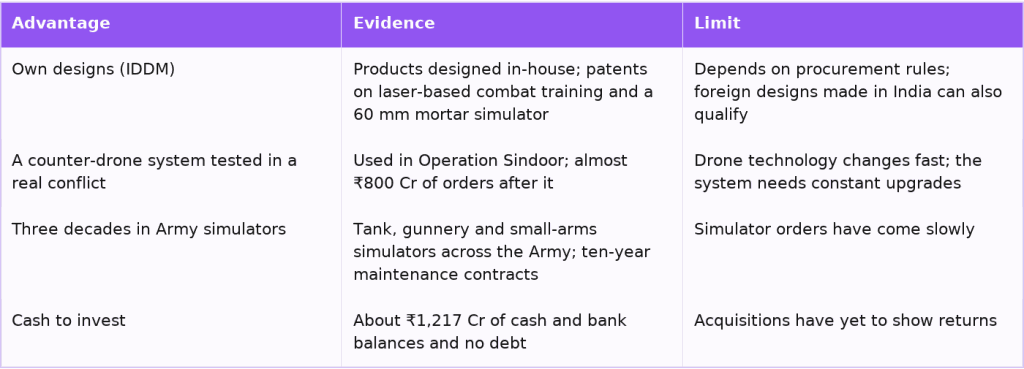
Those designs are also protected at the patent office. In 2025, a competing patent was revoked in Zen's favour, and Zen was granted patents for laser-based combat training and its 60 mm mortar simulator. These patents matter because a rival that copies a training method cannot easily sell it to the same Army. Read this Economic Moat Explained
Beyond paperwork, field use adds a different kind of proof. A counter-drone system that worked during a real conflict is easier for a buyer to trust than one that has only passed trials. The follow-on orders after Operation Sindoor show that trust.
"In business, I look for economic castles protected by unbreachable moats."
— Warren Buffett
Zen's castle is built from its own designs, its patents and three decades inside Army training. The walls are tested every time a new tender lets rivals bid.
That trust also comes from three decades of simulators, which the Army knows well. You will find Zen's simulators in many units, and each one comes with years of maintenance. So Zen's engineers stay in regular contact with the people who write the next requirement.
That work needs few factories but many engineers. Zen's own team had grown to 421 professionals by March 2026, and its capital spending stays small because it buys most of its hardware. Most of its money goes into people and design, not machines.
Its cash then pays for what comes next. Zen spent about ₹45.4 Cr on research and development in FY26, about 6.6% of revenue, and it can fund new products and acquisitions without borrowing. That matters in a market where a new kind of drone can make last year's system old within months.
Financials: Four Years of Swings
Zen's numbers move with a few large orders, so a single year can mislead. Here are the last four years side by side, on a consolidated basis.

Revenue grew about 4.4 times in two years, from about ₹219 Cr in FY23 to ₹973.6 Cr in FY25, and then fell 29.4% to ₹688 Cr in FY26. The table shows why. Order inflow of about ₹1,369 Cr in FY24 became the record revenue of FY25, and the weak inflow of about ₹264 Cr in FY25 became the fall of FY26. Revenue follows orders with a lag of about a year.
Profit looks steadier than revenue, and the reason is cash. Profit after tax here includes minority interests; Zen's own share in FY26 was about ₹193 Cr. About ₹85.4 Cr of other income in FY26, mostly interest on the money raised in the ₹1,000 Cr share sale of FY25, held up profit while sales fell. That income will shrink as the cash goes into acquisitions.
Cash flow improved in FY26 to about ₹245 Cr, as Zen collected money owed by customers. The operational EBITDA margin, which leaves out other income, was about 38.4% in FY25 and about 36% in FY26, so the business still earns well on what it sells.
"Accounting is the language of business."
— Warren Buffett
For Zen, the language needs careful reading: the operating margin, the other income and the order inflow each tell a different part of the story.
What the Next Two Years Look Like on Management's Numbers
So what could all of this add up to for you as a reader following Zen? Management's guidance gives a clear target. It expects ₹4,000 Cr of revenue over FY27 and FY28 together and an operational EBITDA margin in the mid-30s. It also expects an order book of about ₹2,500 Cr at the end of FY27, after this year's deliveries.
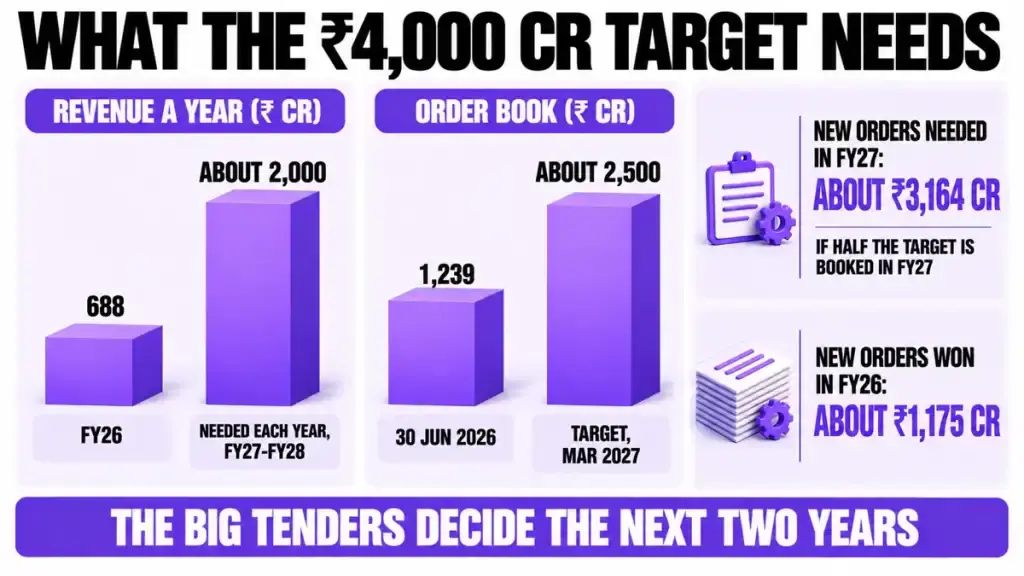
These targets are large next to Zen's recent revenue. ₹4,000 Cr over two years means about ₹2,000 Cr a year, nearly three times FY26 revenue of ₹688 Cr and about twice the record ₹973.6 Cr of FY25. The order book of ₹1,239 Cr in June 2026 covers only part of that.
We can also work out what the order book target implies. Suppose Zen books half of the ₹4,000 Cr, about ₹2,000 Cr, in FY27. To end the year with ₹2,500 Cr of orders after that, it would need about ₹3,164 Cr of new orders in FY27, starting from about ₹1,336 Cr in March 2026. That is about 2.7 times the roughly ₹1,175 Cr it won in FY26. It is also more than twice its best year so far, FY24, when it won about ₹1,369 Cr.
That size would also move margins a lot. A margin of about 35% on ₹2,000 Cr of revenue would mean about ₹700 Cr of operational EBITDA in a year, close to three times the roughly ₹247 Cr of FY26. Because the gross margin is already about 72.9%, most of any extra revenue would reach EBITDA, as the Q1 FY27 fall showed in reverse.
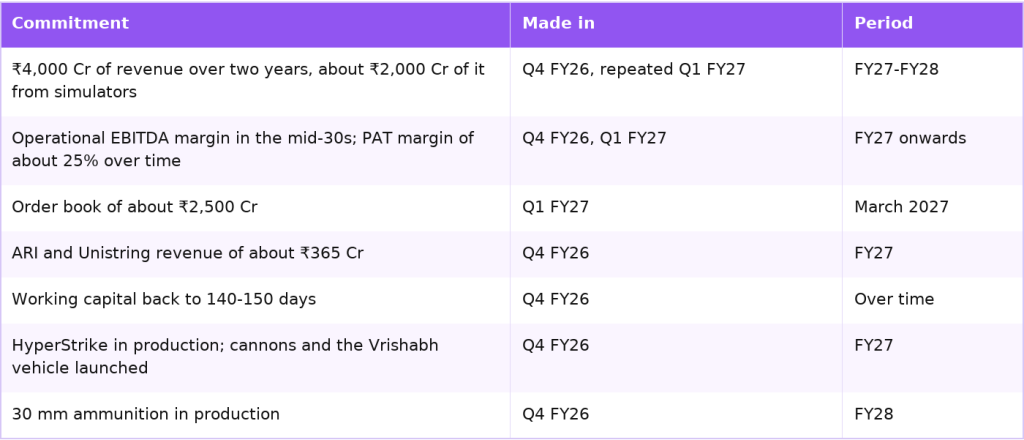
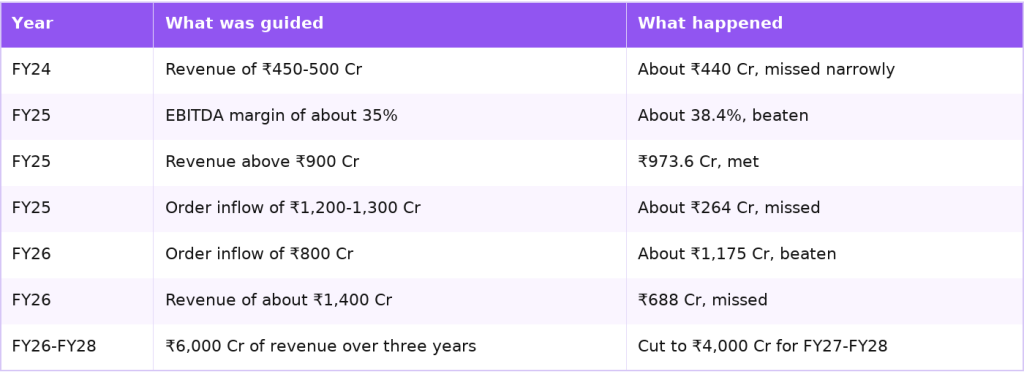
These commitments come with a mixed record behind them. Of ten targets we checked for FY24 to FY28, Zen met or beat five, missed four and cut one. It hit its margin targets every year. Revenue and order targets, however, were missed or lowered whenever government orders slipped.
"Know what you own, and know why you own it."
— Peter Lynch
For Zen, knowing why means tracking new tenders and orders each quarter, because they decide revenue far more than the technology does.
That pattern shows most clearly in the three-year plan we described at the start. After FY26 revenue came in at ₹688 Cr, the target became ₹4,000 Cr for FY27 and FY28 together, about ₹1,312 Cr below what was left of the old plan.
Key Risks
No business grows in a straight line, so let's look at what could go wrong for Zen.
- Order timing: revenue depends on a few large government orders. When tenders are delayed, revenue falls, as it did in FY26 after FY25's inflow of about ₹264 Cr.
- Guidance record: revenue and order targets have been missed or cut before. Meeting ₹4,000 Cr needs about ₹2,000 Cr a year, against ₹688 Cr in FY26.
- Few customers: the Ministry of Defence gives most of the revenue. Three customers made up about 61% of FY25 revenue and about 56.9% of FY26 revenue.
- Competition: more companies are building counter-drone systems, and Bharat Electronics competes with DRDO designs. Management expects to lose some tenders as requirements widen.
- Margins on low revenue: costs stay the same when sales fall, so margins drop fast in slow quarters. The operational EBITDA margin was 27.3% in Q1 FY27, against a target in the mid-30s.
- Earnings quality: other income was about ₹85.4 Cr in FY26, against profit of about ₹193 Cr for Zen's shareholders, and it will shrink as the cash goes into acquisitions. FY25 operating cash flow was also restated from about minus ₹146.3 Cr to about ₹31 Cr after about ₹177 Cr of bank-deposit movements were moved to investing activities. The auditor named revenue recognition, the timing of when a sale is booked, as a key audit matter for FY26.
- Acquisitions: Zen has bought several small companies since February 2025 and plans more. Their returns are not yet proven. In July 2026, the board extended the deadline to spend the unused share-sale money on acquisitions from August 2026 to August 2028.
- Working capital: the 257 days of June 2026 tie up cash until FY27 deliveries are made and paid for.
- Promoter holding: it fell from 55.07% in March 2024 to about 49.05% in FY26, as the share sale added new shares and a former whole-time director was reclassified from promoter to public. The dividend was ₹1 a share for FY26, down from ₹2 for FY25.
"You can't predict. You can prepare."
— Howard Marks
Tender timing cannot be predicted. What an investor can do is watch the few numbers below that will show early whether the plan is slipping.
Explore our Products
Research Framework

Emerging Titans
Combination of quantitative analysis, industry tailwinds, and management assessment - SPRINT investment philosophy

Tiny Titans
Heavy emphasis on scuttlebutt research, plant visits, and early on-ground signals
What to Track Next
If you follow Zen, these are the signals that will show whether the plan is on track.
- New counter-drone tenders being issued, and how many of them Zen wins against Bharat Electronics
- Simulator orders reaching the ₹700-800 Cr expected in FY27, after ₹177.5 Cr in July and ₹295 Cr in August 2026
- Revenue picking up in Q2 and Q3 FY27, as management expects
- The order book moving from ₹1,239 Cr towards about ₹2,500 Cr by March 2027
- The operational EBITDA margin returning to the mid-30s as revenue rises
- Working capital coming down from 257 days towards 140-150 days
- First production of HyperStrike, the cannons and the 30 mm ammunition
Conclusion
Let's step back and put it all together. For three decades, Zen has trained the Indian Army's soldiers on simulators, and in the last five years it has built counter-drone systems that worked in a real conflict. That proof brought orders, but the orders arrived late, so FY26 revenue fell even as the order book doubled. The coming quarters will show how much of that book turns into revenue.
After those quarters, the next two years will test the plan. Zen needs about ₹2,000 Cr of revenue a year to meet its own target, and its order book today covers only part of that. If the large counter-drone and simulator tenders come through on time, its own designs, its record with the Army and its cash put it in a strong position to win them. If they slip again, revenue will follow the order timing, as it did in FY26. The cautious thread is the record: revenue and order targets have been missed or cut before, and the new target needs about ₹3,164 Cr of orders in FY27. The next few quarters of tenders and orders will show which thread wins.
FAQs
What does Zen Technologies do?
+Zen Technologies is a Hyderabad company founded in 1993 that makes training simulators for the Indian Army, Navy and Air Force, and counter-drone systems that detect, jam and destroy hostile drones. Its products are designed in-house and qualify as IDDM, the highest preference category in Indian defence buying.
Why did Zen's revenue fall in FY26?
+Zen won only about ₹264 Cr of new orders in FY25, so it entered FY26 with a small order book. After Operation Sindoor, the Army placed emergency counter-drone orders while regular simulator buying slowed, and most of the new orders came in the second half of FY26. Revenue fell 29.4% to ₹688 Cr.
How big is Zen's order book?
+The order book was ₹1,239 Cr on 30 June 2026, of which ₹920.6 Cr was equipment and ₹318.4 Cr annual maintenance. Zen then won ₹177.5 Cr of simulator upgrade orders in July 2026 and ₹295 Cr of simulator orders in August 2026.
What is Zen's revenue target?
+Management expects ₹4,000 Cr of revenue over FY27 and FY28 together, about ₹2,000 Cr of it from simulators, with an operational EBITDA margin in the mid-30s and an order book of about ₹2,500 Cr at the end of FY27. Earlier it had aimed for more than ₹6,000 Cr over FY26 to FY28.
Who competes with Zen in counter-drone systems?
+Zen's main Indian rival is Bharat Electronics, which also owns counter-drone designs that qualify as IDDM. Larger, less urgent deployments of DRDO-designed systems usually go to Bharat Electronics, while Zen wins urgent orders. Management expects more competition as requirements widen.
What are the main risks for Zen Technologies?
+The main risks are the timing of government orders, a guidance record with missed and cut targets, dependence on the Ministry of Defence, rising competition, margins that fall in slow quarters, reliance on other income, unproven acquisitions, high working capital and a falling promoter holding.

High growth stock specialist, Value Educator
Shashank Mahajan is an equity research professional with over 12 years of experience in identifying high-potential SME and micro-cap stocks at an early stage. He follows a rigorous scuttlebutt research–driven approach, combining on-ground insights with deep financial analysis. Shashank specializes in uncovering under-researched and under-owned companies with strong management quality and long-term growth potential. Through disciplined research and early identification, he focuses on spotting tomorrow’s market leaders before they enter the mainstream investor radar.

Data Patterns: India's Radar Designer and Its Waiting Orders
KSH International: The Wire Inside India's Transformers

Krishna Defence: The Steel Behind India's Warship Hulls

PNG Jewellers: A 194-Year-Old Name Goes National
Axiscades: From Services to Missile and Radar Electronics

TD Power: 93% of New Orders Now Come From Abroad
Explore our Products
Research Framework
Emerging Titans
Combination of quantitative analysis, industry tailwinds, and management assessment - SPRINT investment philosophy
Tiny Titans
Heavy emphasis on scuttlebutt research, plant visits, and early on-ground signals


 Orders
 Subscription
 Share with friends
 Logout


Required Details
₹23999.00
(12 month subscription)
As per SEBI regulations, all users are mandated to complete the KYC that is validated for 1 year. Post payment, you will be redirected to the KYC screen


No comments yet. Be the first to comment!