
Axiscades: From Services to Missile and Radar Electronics

India now makes far more of its own weapons than it did a decade ago. Defence production reached a record ₹1.78 lakh Cr in FY26, up 15.6% in a year, and private companies made 24% of it. Exports touched ₹38,424 Cr. A growing share of that value comes from electronics: the radars, computers and control units that tell a missile or a fighter jet what to do.
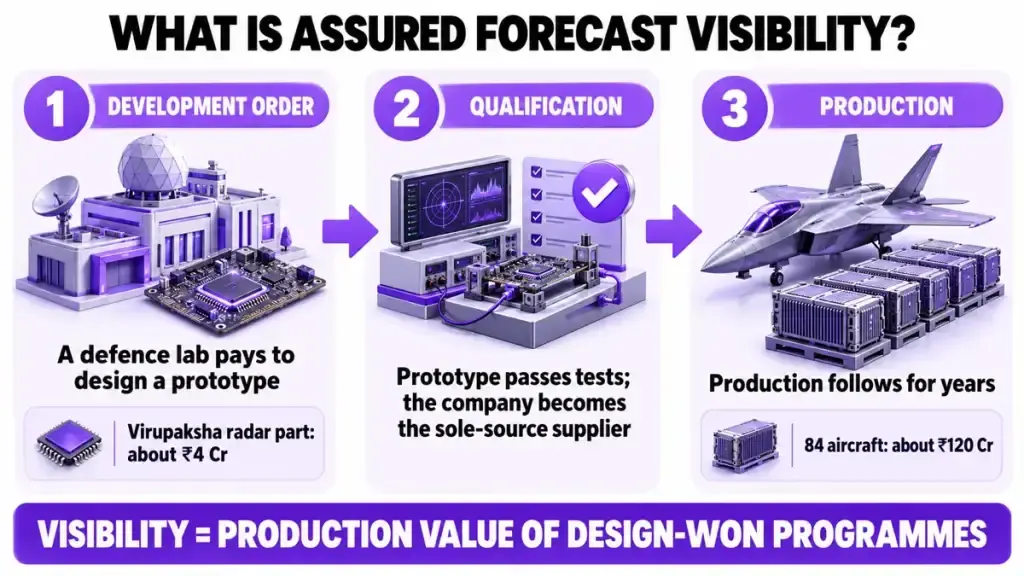
Those electronics are bought in a particular way. A defence lab first pays a company a small sum to design and build a prototype. If the prototype passes its tests, that company becomes the sole-source supplier, which simply means the only approved maker of that part for the life of the programme. Winning that first design contract is called a design win, and the production orders that follow can be worth 30 times the design fee.
One Bengaluru company has collected many of these design wins. AXISCADES Technologies Ltd (NSE: AXISCADES), founded in 1990, grew up as an engineering services company that drew and tested parts for global aircraft and machinery makers. Through its subsidiary Mistral Solutions, it also built a defence electronics business that supplies radar, electronic warfare and missile electronics to DRDO, HAL and BEL. In services, its engineers bill clients by the hour. In defence, it earns from hardware that it designs once and then supplies for years.
In 2026, the company decided to keep only the second model. It agreed to sell its engineering services businesses to Akkodis, a global engineering firm, for about ₹2,256 Cr in total. That money is now going into factories for defence electronics, aircraft parts and satellites. To show what it can expect from defence, the company reports assured forecast visibility, which means the production value of programmes where it has already won the design and is a qualified sole-source or limited-source supplier.
So the company you would study today is quite different from the one of two years ago. Defence is now the largest business that stays, and an electronics and AI arm called XiDA is the most profitable one.
Axiscades in five numbers
- Defence revenue of ₹125 Cr in Q1 FY27, more than double a year ago
- Assured forecast visibility of ₹4,557 Cr, to be delivered before FY30
- About ₹2,256 Cr in total for the two businesses being sold to Akkodis
- XiDA EBITDA margin of 29.7% in Q1 FY27
- ₹234 Cr paid for 90% of Cloud Wave, an aircraft parts maker
That is a lot of change for one company in one year. So how much of the new business already shows in the numbers? Let's first understand the company, and then look at the latest quarter, the first one after the decision to sell.
AXISCADES Technologies: Company Overview
AXISCADES Technologies was founded in Bengaluru in 1990 and grew up as an engineering services company for global aircraft and machinery makers. Through its subsidiary Mistral Solutions, it also built a defence electronics business that designs and supplies radar, electronic warfare and missile electronics to DRDO, HAL, BEL and MBDA. In 2026 it agreed to sell its engineering services businesses to Akkodis for about ₹2,256 Cr in total, with about 2,200 employees moving with them. What stays is defence, XiDA (electronics for global chip and AI companies), aerospace manufacturing through the newly bought Cloud Wave Technologies, and a new space division. The whole company earned ₹1,159 Cr of consolidated revenue in FY26, before the sale. Read this Defence Electronics Stocks to Watch (2026)
"Should you find yourself in a chronically leaking boat, energy devoted to changing vessels is likely to be more productive than energy devoted to patching leaks."
— Warren Buffett
Axiscades has chosen to change vessels. It is selling the services business that billed by the hour and moving to hardware that it designs once and supplies for years.
The First Quarter of the New Axiscades
Let's look first at Q1 FY27, the April to June quarter, the first quarter of the new Axiscades. From this quarter, the company reports the businesses it is selling as discontinued operations, and the businesses it keeps as continuing operations.
Those continuing businesses grew fastest. Their revenue was ₹183.4 Cr, against about ₹94.4 Cr a year ago, a rise of 94.2%. Leaving out ADD Solutions, a small European unit the company plans to exit, they grew about 100%, to about ₹181 Cr from about ₹90 Cr.

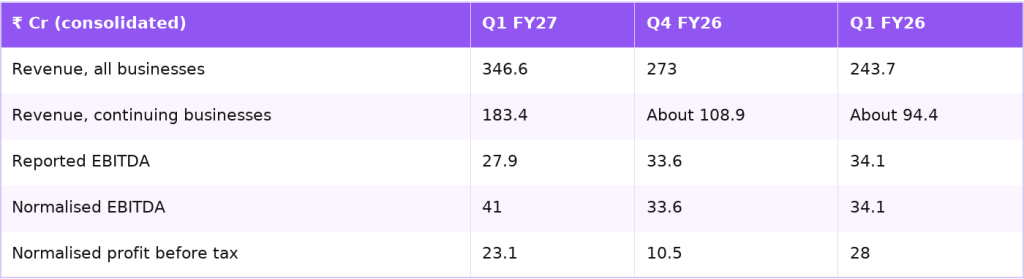
The whole company, with the businesses being sold, also had its highest revenue ever, as you can see in the table. Revenue from operations was ₹346.7 Cr, up 42.2% from a year ago and up 27% from the March quarter. About ₹60 Cr of this came from deliveries that had moved out of FY26.
That record revenue came with the one-time costs of the sale. Reported EBITDA was ₹27.9 Cr, at a margin of 8.1%, and the company reported a loss after tax of ₹14.8 Cr, against a profit of ₹20.9 Cr a year ago. Three items explain the gap. The company set aside ₹9.62 Cr against an old defence receivable, ₹3.50 Cr for currency hedges that will not move to Akkodis and ₹21.81 Cr of deal costs, shown as an exceptional item.
Those three items are what management removes to get its normalised numbers. Before them, EBITDA was ₹41 Cr at an 11.8% margin, up 20.5% from a year ago. Normalised profit before tax was ₹23.1 Cr, and normalised profit after tax was ₹20.2 Cr. The deal costs so far are about half of the ₹45 Cr the company expects to spend on the sale in all.
"This is the business we actually ran, and it earned money while paying for its own transformation." - Shashidhar SK, Group CFO, AXISCADES
That transformation is meant to bring a cheaper cost base. Group employee costs came to 44.1% of revenue in Q1 FY27, against 53% a year ago, even as the company hired managers for its new factories. In services, most of the cost is people. In manufacturing, more of the cost is materials and machines, and so each engineer can support more revenue.
Those hires are also why the continuing businesses earned only ₹8.7 Cr of EBITDA in the quarter, or ₹18.3 Cr before the receivable provision. That was not yet enough to cover their ₹8.9 Cr of finance costs and ₹8.8 Cr of depreciation. The services businesses go to Akkodis free of cash and debt, while the group's borrowings stay with Axiscades. So closing the sale and paying down debt is the first job for the rest of the year.
That job is already moving. Shareholders approved both sales on 27 July 2026. Management planned Phase 1 by the end of August, bringing about ₹192 Cr, and Phase 2 by 30 November 2026, bringing about ₹718 Cr more in net proceeds. On completion, the company expects to book a gain of about ₹1,255 Cr. Meanwhile, cash on the balance sheet rose 78% in the quarter to ₹81 Cr, and property, plant and work in progress grew by ₹40.1 Cr, or 29.5%, as the new plants went up.
"In closing, I will say the results declared are expensive for a quarter but will compound for the next 40 quarters." - Shashidhar SK, Group CFO, AXISCADES
How the Sale Changes the Company
So how does the sale change the company? Let's see what is being sold and what stays. In FY26, consolidated revenue was ₹1,159 Cr, up 12.4%, and EBITDA was ₹178 Cr, up 24.6%, at a margin of 15.3%. Three businesses that the company calls core made ₹904 Cr of it, about 78%. The rest was engineering services for heavy engineering, energy and automotive clients.
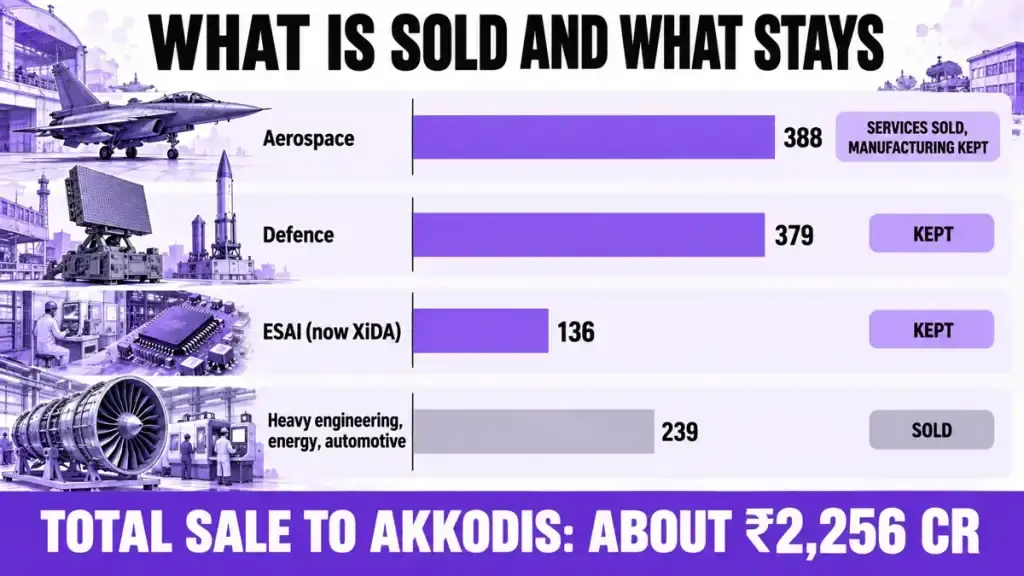
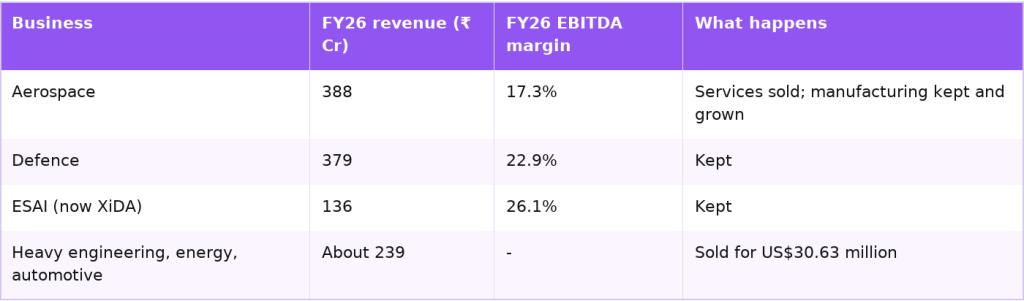
That table shows why the sale makes sense to management. The businesses that stay already earned higher margins than the group average. Read this Segment-Wise Revenue Analysis Explained Aerospace services, the largest piece being sold, earned about ₹74 Cr of EBITDA a year. In its place, the company is building aircraft parts manufacturing, which it sees as stickier work under long contracts.
That choice also changes who works for the company. About 2,200 employees are moving to Akkodis with the services businesses. The work that stays is design and manufacturing at the company's own sites, with fewer and more specialised people.
That decision was explained by management. Management said it had two options for services: buy more services companies to grow, or sell to a global leader. It chose to sell because the price was good, and because the money could fund its plans without issuing new shares.
That FY26 base also explains the year's profit. Profit before tax rose 29.8% to ₹114 Cr, while profit after tax was ₹72 Cr against ₹75 Cr in FY25. Tax rose to about ₹42 Cr from ₹12 Cr, because FY25 had a one-time tax reversal of ₹10.01 Cr. Before exceptional items, profit after tax was ₹83 Cr, up 27.6%.
Three Businesses That Stay
Now let's look at the three businesses that make up the new Axiscades. Each one sells to a different kind of customer, and each is at a different stage.
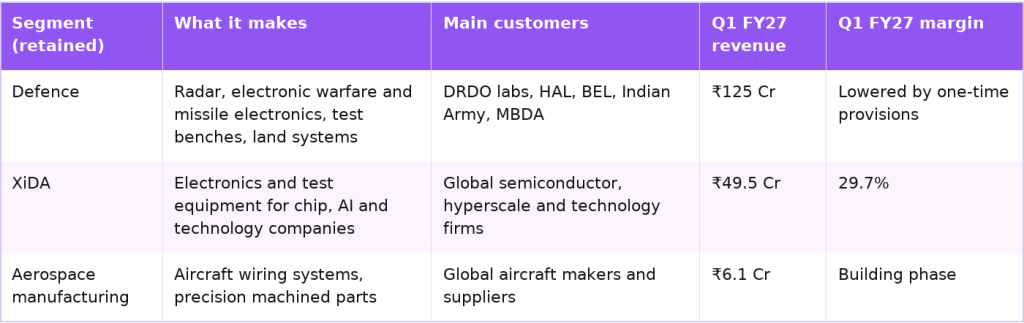
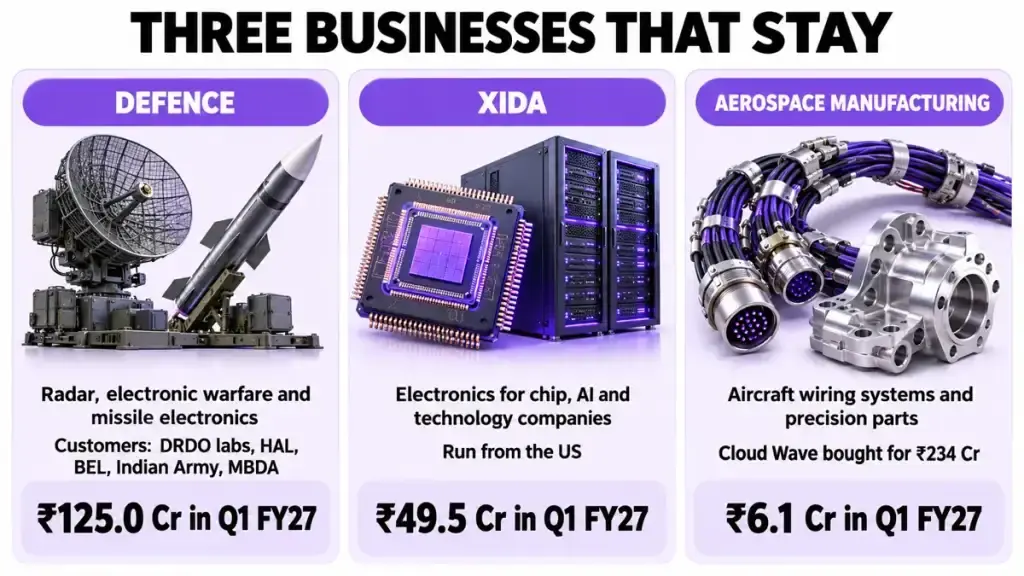
These three can sound alike, but you can tell them apart by who sets the design. Defence builds subsystems to an Indian lab's or a foreign missile maker's needs, and it earns through long production runs. XiDA designs and builds hardware for global technology companies, mostly from the US. Aerospace manufacturing makes parts to an aircraft maker's drawing, and the company is only now building it through an acquisition.
Defence Electronics for Radars and Missiles
Let's begin with defence, which is now about two-thirds of continuing revenue, and with the programmes you are likely to have read about. India's defence budget was ₹6.81 lakh Cr, and the forces want more of it spent at home. In September 2025, the Ministry of Defence signed a ₹62,370 Cr contract with HAL for 97 more Tejas Mk1A fighters, with deliveries from 2027-28 over six years. Those jets will carry the Uttam radar, an Indian AESA radar, which means a radar that steers its beam electronically through many small transmitters instead of a moving dish.

That radar is one place where Axiscades already supplies parts. After Q1 FY27, it won a sole-source order for the antenna beam control of the Uttam radar, the unit that tells each transmitter when to fire. HAL had already placed two Tejas Mk1A orders on Mistral in February 2026: one worth about ₹80 Cr, and another worth about ₹25 Cr for single board computers. The company makes both at its new Devanahalli Aero Land (DAL) plant near Bengaluru airport.
Those Tejas orders are part of a wider pattern of design wins. In July 2025, DRDO's radar lab LRDE gave the company a development order of about ₹4 Cr for the exciter-receiver unit of the Virupaksha radar, which goes into upgraded Su-30MKI fighters. An exciter-receiver unit means the part that creates the radar signal and reads the echo that comes back. Once the prototype passes, production for 84 aircraft could be worth about ₹120 Cr over 3-5 years.
That model repeated in other programmes over the year. In September 2025, DRDO's CASDIC lab ordered a prototype control unit for the Su-30MKI cooling system, with forecast production of 600 units worth ₹150 Cr over five years. BEL ordered a digital beam forming unit for the Kusha long-range radar, with a production quantity of 75 over five years. By the end of FY26, the company counted 21 active defence design programmes.
Those programmes make up the company's assured forecast visibility. It stood at ₹4,350 Cr at the end of FY26. In Q1 FY27, new design wins added ₹332 Cr, and the quarter's ₹125 Cr of deliveries came off, leaving ₹4,557 Cr. Management expects to deliver it before FY30, which is about three years, with some spillover into a fourth.
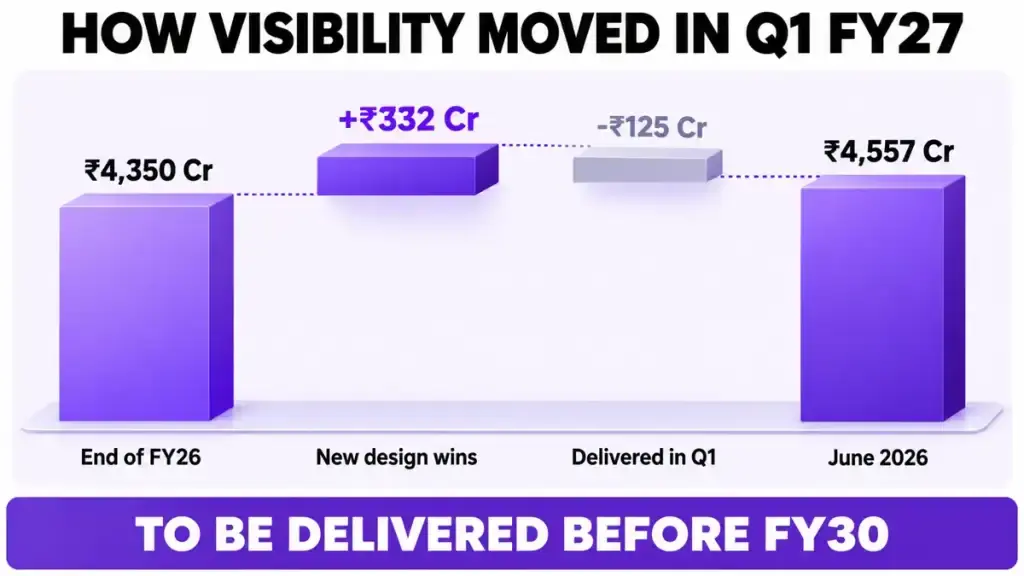
That visibility now includes four more sole-source wins after June. They cover on-board computers for an anti-tank missile, a PCM encoder for a missile programme, the Uttam antenna beam control and an exciter-receiver processor for a marine helicopter. In the quarter itself, DRDO's CHESS lab also technically selected the company for the transfer of technology of a 30 kW laser weapon.
Those wins sit alongside firm orders that are already running. In August 2025, the Indian Army ordered 212 tank transporter trailers of 50 tonnes, to be supplied over two years. In September 2025, the Army ordered 12 man-portable counter-drone systems. In May 2026, a DRDO lab placed a ₹6.9 Cr order for a mobile mast, a tall extending tower that lifts a radar antenna on a truck.
Beyond India's labs, there is MBDA, the European missile maker. Axiscades has worked with it for ten years, starting with test benches for the MICA missile. Those benches check that a missile and its launcher work before the forces use them. Read this Missile and Ammunition Stocks: 2026 Outlook The company now plans to deliver about five test benches a year for the next three years, moving from MICA and Meteor to the CAMM and Aster missiles. Management also expects Make in India work linked to the Rafale programme, including local assembly of missiles.
Why design wins matter here: a defence lab pays a few crore for a prototype, and the production order that follows is often 30 times larger. Once a part is qualified on a fighter or radar, the customer rarely changes the supplier for the life of that programme.
That pipeline is why management expects defence revenue to grow more than 75% a year in FY27 and the years after. Beyond the ₹4,557 Cr, it sees opportunities of about ₹24,000 Cr across unmanned systems, missiles, radars and electronic warfare. These are not orders yet. Those opportunities are programmes where the company is bidding or developing, such as seekers for the BrahMos-NG missile, with business expected from FY28.
XiDA, Electronics for Global Technology Companies
Next, let's look at XiDA, the business that earned the best margin in Q1 FY27. XiDA is the new name of the electronics, semiconductors and AI unit, called ESAI until FY26. XiDA now runs from the US through XiDA Inc., because that is where its customers and engineers are.
That US base brought in two large customers this year. Through a business transfer from a partner, XiDA now serves the world's largest semiconductor equipment maker, with manufacturing and test work, and one of the world's largest AI and hyperscale technology companies, with precision hardware and data centre work. The company has not named the two yet. The transferred business brought ₹15.2 Cr of revenue and ₹7 Cr of EBITDA in Q1 FY27, a margin of 46.2%.
That transfer lifted the whole unit. XiDA's revenue grew 62.9% to ₹49.5 Cr, and its EBITDA grew 114.5% to ₹14.7 Cr, a margin of 29.7%. In FY26, XiDA had earned ₹136 Cr of revenue at a 26.1% margin. Its older customers include Texas Instruments, Axon and Aptiv. A global wireless chip leader also placed a recurring production order of USD 3.5 million, with an expected run-rate of at least USD 0.5 million a month.
That base is meant to keep growing fast. Management expects XiDA to grow more than 100% in FY27, through these customers and through acquisitions. A business making electronics for global chip and AI companies from India also fits a wider shift, as those companies look for suppliers outside China.
Aerospace Manufacturing, Rebuilt Through Cloud Wave
Now let's turn to aerospace, the business the company is rebuilding from the ground up. Its services arm, which designed and tested parts for aircraft makers, is going to Akkodis. What stays is manufacturing, which earned ₹6.1 Cr of revenue in Q1 FY27 against an EBITDA loss of ₹5.4 Cr, because the company hired a 30-member leadership team before the revenue.
"We have put a 30-member aerospace leadership team in place ahead of the acquisition and ahead of the revenue, because aerospace qualification runs in years, not quarters." - KP Mohanakrishnan, Deputy CEO, AXISCADES
That team was hired for an acquisition. On 10 September 2026, Axiscades completed the purchase of 90% of Cloud Wave Technologies, a Bengaluru precision manufacturer founded in 2014, for about ₹234 Cr in cash. Cloud Wave runs seven units that machine metal parts, form sheet metal, make tools and print parts in 3D for aerospace, defence and semiconductor customers. It holds AS9100D, the quality standard aircraft makers ask of their suppliers. Its audited turnover was ₹107.78 Cr in FY26, and the company expects it to earn about ₹180 Cr in FY27 at a 22% EBITDA margin.
That purchase is the first step of a larger plan. With a second acquisition under study and organic growth, management targets a yearly run-rate of ₹375 Cr of revenue and ₹84 Cr of EBITDA by Q4 FY27. That EBITDA would replace the ₹74 Cr given up with aerospace services. The plan then reaches about ₹1,000 Cr of aerospace revenue by FY29.
That growth will also need a larger home. The company plans a Centre for Advanced Manufacturing of 2,40,000 sq ft on 20 acres at Devanahalli, about six kilometres from its other campus. It will serve aerospace, defence, space and electronics, and its land allotment is in process.
Its first full aircraft contract shows the kind of work it wants. EEA Aircraft of Portugal chose Axiscades to design and build the full wiring system of the LUS222, a new 19-seat aircraft, from design through series production. The company estimates the programme at more than US$100 million over 10 years. It is the company's first contract that covers both the design and the manufacture of an aircraft system.
Space, the Fourth Platform
Finally, let's look at space, the newest and smallest part of the plan. The company set up a Space Division in FY26. Its first project is a space situational awareness initiative with Aldoria, a French company that tracks satellites and debris in orbit.
That division now has money and a building. The company has set aside ₹300 Cr of the sale proceeds for space: ₹120 Cr for facilities and training, and ₹180 Cr for two planned joint ventures. It has started building a satellite manufacturing, assembly, integration and testing facility at the Devanahalli Atmanirbhar Complex. Management wants to make satellite buses, the frame and systems that carry a satellite's instruments, and payloads with global partners.
The Parts That Are Hard to Copy
Now that we have seen all four businesses, let's understand why the parts in these programmes are hard to copy, and hard for a rival to win back. It starts with how a lab or platform maker buys defence parts. It gives a small development order, the supplier builds a prototype, and the part goes through months of tests on the ground and in the air.
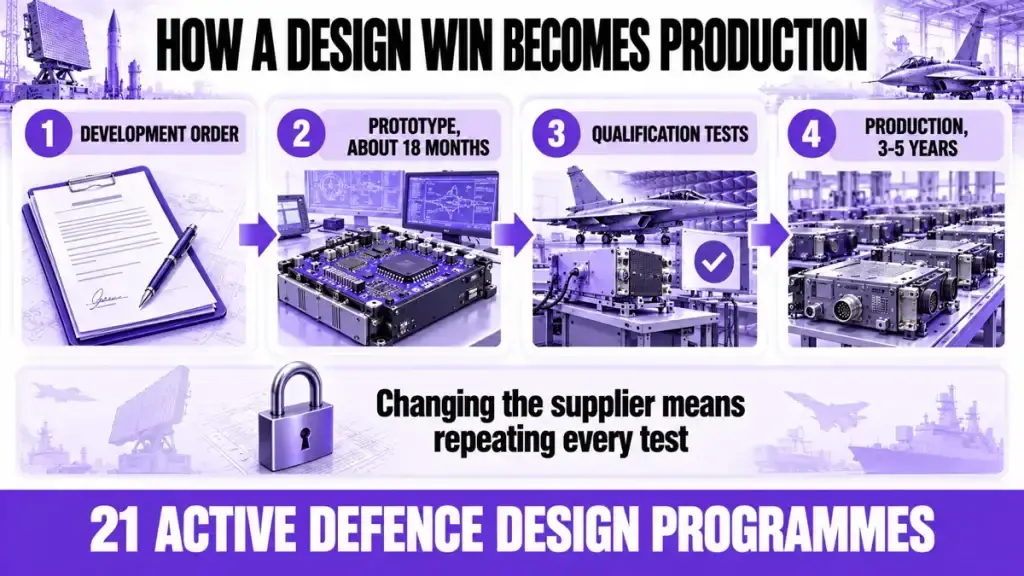
That process takes time, as the Virupaksha order shows. The development stage is planned at 18 months, and production follows over 3-5 years. Once a part is qualified on a fighter, changing the supplier would mean repeating those tests, and the aircraft cannot wait. Read this Economic Moat Explained That is why the company counts only qualified sole-source or limited-source programmes in its forecast visibility.
"In business, I look for economic castles protected by unbreachable moats."
— Warren Buffett
In defence electronics, the moat is the qualification itself. A part that has passed its tests on a fighter or a radar tends to stay with its supplier for the life of the programme.

That depth comes from Mistral Solutions, which designs radar, electronic warfare and avionics electronics in Bengaluru. Its work runs from the radio front end, where the signal starts, to the computers that process it. So when a lab needs a new receiver or beam controller, the company can design the circuit, write the software and build the unit. On the Uttam antenna beam controller, management says it covers the complete design and the production.
That design ability now has a factory to match. DAL, the Devanahalli Aero Land campus, runs electronics assembly lines, test labs and an MBDA test bench centre. Nearby, the company is building the 20-acre Devanahalli Atmanirbhar Complex, with 11 hangars planned to be running by 1 January 2027. In Hyderabad, it completed the purchase of 32,847 sq m of land in July 2026 for a Missile Atmanirbhar Complex, close to the city's missile makers.
That combination of design and building is also what separates Axiscades from many rivals. Several Indian companies can build a circuit board to a drawing, and a few can design a radar subsystem. Fewer can do both, own the test labs and carry the part from a lab's first prototype into years of production. Listed peers such as Data Patterns and Astra Microwave compete for the same kind of radar and electronic warfare work. Read this Astra Microwave: The Radar Order That Doubled Its Book That competition is one more reason the company counts only programmes where it is already qualified.
Those plants also tie the businesses together. Cloud Wave's metal parts can go into defence systems and XiDA's equipment, and the defence teams can use the same test labs. Management calls Cloud Wave the metal manufacturing backbone of its defence and electronics work.
Financials: Five Years Before the Sale
These five years show the whole company, including the services businesses now being sold, so they describe where Axiscades is coming from rather than what it will look like. The figures are consolidated, from the company's annual reports and presentations.

Revenue grew about 1.9 times in four years, from ₹608 Cr in FY22 to ₹1,159 Cr in FY26, a growth rate of about 17.5% a year. The EBITDA margin moved between 11% and 17%. FY23 included a one-time benefit of about ₹13 Cr, and FY26 carried about ₹11 Cr of deal costs. Profit was held back for years by exceptional items, including a loss in FY23, before reaching ₹75 Cr in FY25 and ₹72 Cr in FY26.
Cash flow was steady until FY26. Operating cash flow was positive in each of the first four years, and above reported profit in most of them, but it turned slightly negative in FY26 as receivables rose to about ₹411 Cr from ₹302 Cr. Equity grew from ₹344 Cr in March 2023 to ₹734 Cr in March 2026, helped by a share sale to large investors in FY24, while net debt rose to ₹230.98 Cr by March 2026 as the new plants were built.
The businesses that stay were the more profitable part of this base. In FY26, defence earned a 22.9% EBITDA margin and ESAI, now XiDA, 26.1%, against 15.3% for the whole company.
"It's far better to buy a wonderful company at a fair price than a fair company at a wonderful price."
— Warren Buffett
Axiscades is trying to turn itself from a fair company into a better one. These five years are the starting point, and FY27 is the first year the new shape will show in full.
What FY27 Could Look Like on Management's Numbers
So what could all of this add up to? Management has given a revenue plan for FY27, an EBITDA target and growth rates for each business, so we can put them side by side.
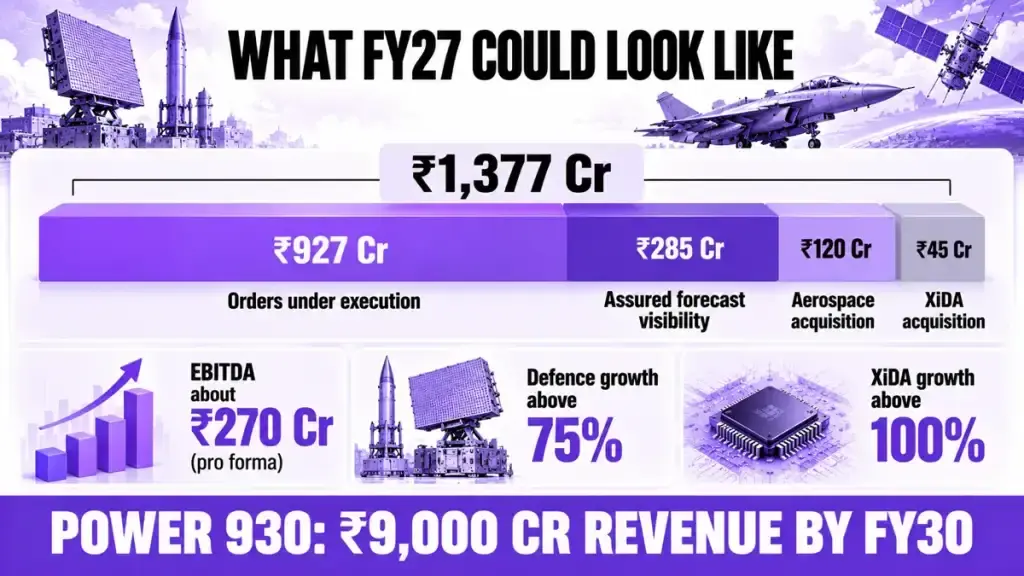
That plan starts with ₹1,377 Cr of revenue from the continuing businesses in FY27, on a pro forma basis, which means as if the acquisitions had been owned for the full year. Of this, ₹927 Cr comes from orders already in execution, including the ₹142 Cr held over from FY26. Another ₹285 Cr comes from assured forecast visibility, and ₹165 Cr from the two acquisitions.

On that revenue, management guides EBITDA of about ₹270 Cr, also pro forma. It expects profit after tax of about half of that, or about ₹135 Cr, and possibly more as the sale proceeds cut debt and interest. You can compare that with about ₹178 Cr of EBITDA in FY26, when the services businesses were still part of the company.
That plan also leans on the defence growth rate. Q1 FY27 defence revenue of ₹125 Cr, repeated for four quarters, would be ₹500 Cr a year, already more than the ₹379 Cr of FY26. Defence deliveries in India are usually heavier in the second half, because customers inspect and accept more units near the year end.
Beyond FY27, the long-term goal is called Power 930. It aims for ₹9,000 Cr of revenue and ₹960 Cr of profit after tax by FY30. Management says that at an EBITDA margin above 25%, about ₹7,200 Cr of revenue would be enough to reach the profit goal.
That goal is to be funded from the sale, not from new shares. The company plans about ₹1,200 Cr for the Devanahalli complex, about ₹300 Cr for the Hyderabad missile complex and about ₹120 Cr for DAL, of which about ₹100 Cr is already spent. It will time this spending to the sale proceeds, which arrive in FY27, FY28 and FY29.
The Plan for FY27 and Beyond
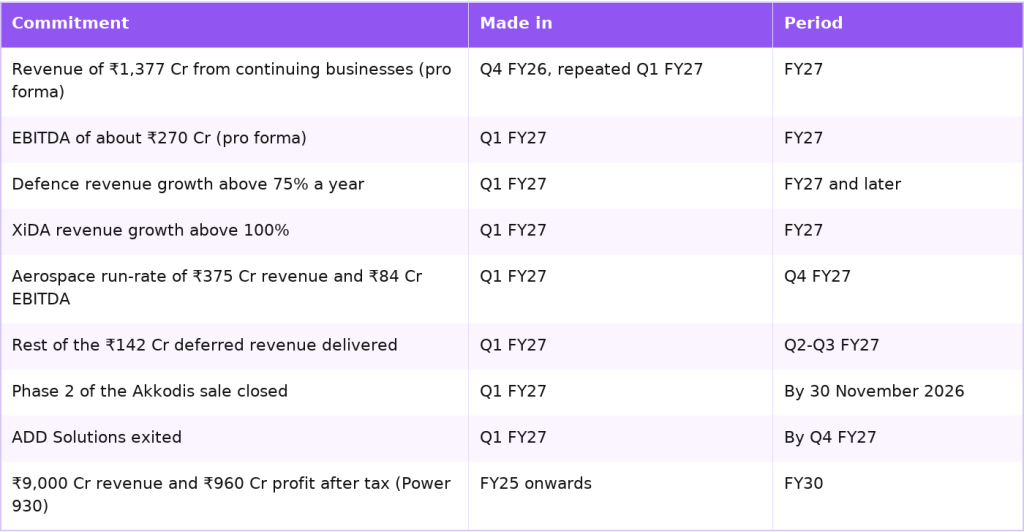
So let's list the plan for FY27 and beyond, as management has committed to it. Most of these items can be checked within the next three quarters.
These commitments come with a record we can check, and FY26 shows a gap between plan and delivery. In May 2025, management set FY26 growth targets of at least 35% for aerospace, 75% for defence and 60% for ESAI. Aerospace grew about 21%, defence 25% and ESAI 9%. Most of the shortfall came from the ₹142 Cr of deliveries that moved into FY27.
"Know what you own, and know why you own it."
— Peter Lynch
For Axiscades, knowing why means checking each quarter whether defence revenue, the sale proceeds and the aerospace run-rate are arriving on the dates in the table above.
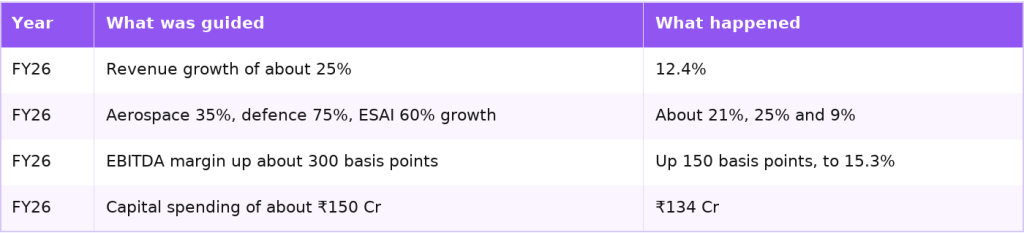
That record matters when you read the FY27 plan. Those delayed deliveries had three parts: ₹45 Cr from a defence manufacturing programme, ₹84 Cr from a defence electronics programme and ₹12.60 Cr from an aerospace and defence contract. Of the ₹142 Cr, about ₹60 Cr reached customers in Q1 FY27, and the company plans the rest for Q2 and Q3.
Key Risks
No transformation of this size is smooth, so let's look at what could go wrong for Axiscades.
- Closing the sale: the plan depends on the Akkodis money. If Phase 2 slips beyond November 2026, the company will rely longer on bridge loans of up to ₹100-150 Cr.
- Losses in the transition: the continuing businesses reported a loss in Q1 FY27 and did not yet cover their interest and depreciation. That gap closes only as revenue grows into the new cost base.
- Visibility is not an order book: the ₹4,557 Cr depends on labs, HAL and the forces placing production orders on time. Budget delays can push revenue into later years.
- Delivery delays: ₹142 Cr of FY26 revenue slipped because of scarce components and customer inspections. Defence deliveries are lumpy and can move between quarters.
- Cash and receivables: operations used ₹1.36 Cr of cash in FY26, against ₹88.34 Cr generated in FY25, and receivables rose to about ₹411 Cr from ₹302 Cr. The Q1 FY27 provision of ₹9.62 Cr was for an old defence receivable.
- Acquisitions: Cloud Wave and the XiDA transfer are new, and more purchases are planned. Paying too much, or failing to integrate them, would hurt returns.
- Debt and pledges: net debt rose to ₹230.98 Cr in March 2026. The ₹200 Cr of debentures for Cloud Wave are to be secured partly by a pledge of shares in Mistral and other subsidiaries.
- Guidance record: FY26 growth and margin came in well below the targets set in May 2025.
"You can't predict. You can prepare."
— Howard Marks
None of these risks can be timed in advance. What an investor can do is watch the few numbers below that will show early whether the transition is slipping.
Explore our Products
Research Framework

Emerging Titans
Combination of quantitative analysis, industry tailwinds, and management assessment - SPRINT investment philosophy

Tiny Titans
Heavy emphasis on scuttlebutt research, plant visits, and early on-ground signals
What to Track Next
If you follow Axiscades, these are the signals that will show whether the new company is taking shape.
- Q2 FY27 results, due by mid-November 2026, and the first quarter with Cloud Wave
- Closing of Phase 2 of the Akkodis sale by 30 November 2026, and the ₹1,255 Cr gain
- Defence revenue against the target of more than 75% growth for FY27
- Assured forecast visibility moving beyond ₹4,557 Cr, and new production orders
- Aerospace manufacturing moving towards ₹375 Cr of yearly revenue by Q4 FY27
- Receivables and operating cash flow, after the sale proceeds arrive
Conclusion
Let's step back and put it all together. Axiscades is selling the services business that built it, for about ₹2,256 Cr, and using the money to become a maker of defence electronics, aircraft parts and technology hardware. In its first quarter in the new shape, defence revenue more than doubled and XiDA earned a 29.7% margin, while the costs of the change pushed the company into a reported loss.
So FY27 is the year the plan has to show up in results. The company has ₹4,557 Cr of design-won defence programmes, a new parts maker in Cloud Wave and money arriving from the sale. If it turns those programmes into deliveries on time, the smaller company could earn more than the larger one did. If deliveries or the sale slip, the transition will take longer. The cautious thread is execution: FY26 growth fell well short of the targets set in May 2025, and the continuing businesses did not yet cover their interest and depreciation in Q1 FY27. The next few quarters, starting with the close of the Akkodis sale by November 2026, will show which thread wins.
FAQs
What does AXISCADES Technologies do?
+AXISCADES is a Bengaluru company founded in 1990. After selling its engineering services businesses, it keeps defence electronics through Mistral Solutions, XiDA (electronics and test equipment for global chip and AI companies), aerospace manufacturing through Cloud Wave Technologies, and a new space division.
Why is Axiscades selling its services business to Akkodis?
+Management chose to sell rather than buy more services companies, because the price was good and the money could fund its manufacturing plans without issuing new shares. The sale is worth about ₹2,256 Cr in total, and the company expects to book a gain of about ₹1,255 Cr on completion.
What is assured forecast visibility?
+It is the production value of defence programmes where Axiscades has already won the design and is a qualified sole-source or limited-source supplier. It stood at ₹4,557 Cr at the end of Q1 FY27, and management expects to deliver it before FY30.
How did Axiscades perform in Q1 FY27?
+Revenue from operations was ₹346.7 Cr, its highest ever. Continuing businesses grew 94.2% to ₹183.4 Cr, defence revenue more than doubled to ₹125 Cr, and XiDA earned a 29.7% EBITDA margin. One-time sale costs led to a reported loss of ₹14.8 Cr, while normalised EBITDA was ₹41 Cr.
What is Axiscades' guidance for FY27?
+Management expects ₹1,377 Cr of revenue from continuing businesses on a pro forma basis, EBITDA of about ₹270 Cr, defence growth above 75% and XiDA growth above 100%. Its long-term Power 930 goal is ₹9,000 Cr of revenue and ₹960 Cr of profit after tax by FY30.
What are the main risks for Axiscades?
+The main risks are delays in closing the Akkodis sale, losses during the transition, production orders arriving later than the forecast visibility suggests, lumpy defence deliveries, rising receivables, integration of acquisitions, higher debt and pledges, and a guidance record that fell short in FY26.

High growth stock specialist, Value Educator
Shashank Mahajan is an equity research professional with over 12 years of experience in identifying high-potential SME and micro-cap stocks at an early stage. He follows a rigorous scuttlebutt research–driven approach, combining on-ground insights with deep financial analysis. Shashank specializes in uncovering under-researched and under-owned companies with strong management quality and long-term growth potential. Through disciplined research and early identification, he focuses on spotting tomorrow’s market leaders before they enter the mainstream investor radar.

Zen Technologies: Why Revenue Fell After Its Biggest Win

Data Patterns: India's Radar Designer and Its Waiting Orders
KSH International: The Wire Inside India's Transformers

Krishna Defence: The Steel Behind India's Warship Hulls

PNG Jewellers: A 194-Year-Old Name Goes National
TD Power: 93% of New Orders Now Come From Abroad
Explore our Products
Research Framework
Emerging Titans
Combination of quantitative analysis, industry tailwinds, and management assessment - SPRINT investment philosophy
Tiny Titans
Heavy emphasis on scuttlebutt research, plant visits, and early on-ground signals


 Orders
 Subscription
 Share with friends
 Logout


Required Details
₹23999.00
(12 month subscription)
As per SEBI regulations, all users are mandated to complete the KYC that is validated for 1 year. Post payment, you will be redirected to the KYC screen


No comments yet. Be the first to comment!