
The Silent Gatekeeper of India's Power Grid

The Small Component Behind a Large Grid Story
If electricity is produced at a coal plant, solar park or wind farm, or industrial captive unit, the electricity is not sent directly into the grid in its usable form. To safely carry the electricity over transmission lines and ultimately to users, the voltage and current must be controlled. That's what transformers do. However, each time power passes in and out of a transformer, it requires a safe path of insulation. This is accomplished by a bushing.
This is the business that Yash Hi-Voltage does. Transformer bushings are one of the most important components in a power transformer and the company is producing the capacitive bushings in particular. A bushing is like a small component of a big transformer, but not in proportion. The ground is connected to the transformer tank, so that high voltage current can pass through the grounded transformer tank without arc, leakage and failure. The bushing, when it fails, can cause failure of the transformer. The failure of a transformer can cause the substation to fail. Bushing reliability is key to grid reliability in an expanding grid, driven by renewables, data centres and railways, EVs and industrial growth.
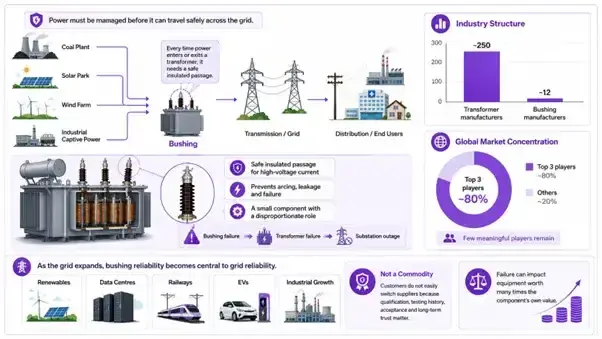
The "numbers" tell you why this is a differentiated business. Currently, there are approximately 250 manufacturers of transformers in the world and only about 12 bushing manufacturers. The market is dominated by three players – Hitachi, Trench and GE – who account for almost 80 percent of the market. Yash is one of the very few remaining decent players. This concentration is not due to the fact that the product is bulky. That's because the product needs technical credibility, history of testing, customer qualification and trust over a long period of time.
Yash is not selling a good or service. It is selling a part that can affect equipment valued many times that of the part itself. This is why it's hard for transformer OEMs and utilities to change suppliers. The moat is not just for manufacturing, it's also for acceptance, reliability and qualification.
Understanding the Product: Why Bushings Matter
A transformer bushing is a part of the transformer that is used for the purpose of conducting current in and out of the transformer while ensuring it is insulated. It has a built-in conductor (Aluminum pipe, copper pipe or copper stem according to the needs). The bottom of bushing is filled with transformer oil and the outer part should resist outside electrical stress, heat, moisture, and environment.
Simply, think of a bushing as a place where electricity goes safely through a wall. The grounded metal tank is called the wall in a transformer. The inside can have a very high current. Yash said that the conductor inside a bushing is capable of carrying a voltage of 220000 and 460000 volts, and current up to 25000 amperes. With such levels, voltage can produce electrical stress and current can create a high level of heat. The bushing must provide a path for the current that is free of hazards, and must also control the electric field.
The most important category is capacitive bushings. They are generally made up of porcelain and metal components, and a condenser core formed of wound paper and foils. These foils generate capacitance that can provide a more even distribution of voltage. This is important since uneven voltage concentration may cause insulation failure.
In the case of a power transformer, the bushings may represent approximately 5-8% of the transformer cost, and even more in some instances. Resin impregnated paper bushings have higher realisations, whereas oil impregnated paper bushings had a smaller percentage of transformer cost, in the past. The component is a very small, but very high failure-sensitive part in the whole bill of material for the transformer. The typical number of bushings used per transformer is around 7 per transformer, with 3 bushings typically used on a transformer to handle high voltage, low voltage, and a tertiary or neutral bushing.
read more: Top Power Sector Stocks with Strong Earnings Visibility
This is why transformer manufacturers do not like to make bushings. The management employed a simple analogy: Tata is good at making cars, it is not good at making tyres. Likewise, transformer OEMs make transformers and the bushing manufacturers make bushings. The product needs special expertise, qualification, and liability management. A bushing defect can cause a transformer to fail, potentially affecting the entire transformer warranty. OEMs thus look for trusted and reliable suppliers.
Product Mix: OIP, RIP and High-Current Bushings
Yash’s portfolio is built around three broad product categories: OIP bushings, RIP bushings and high-current bushings.
OIP, or oil-impregnated paper bushings, are the older technology. The condenser core is impregnated with transformer oil. These bushings have worked reliably for decades but carry fire-related risk because of the oil content. OIP contributes around 14 percent of Yash’s revenue today. This is the segment gradually being replaced globally.
RIP, or resin-impregnated paper bushings, are the modern standard. In RIP bushings, epoxy resin replaces oil as the insulating medium. This makes the product fire-safe, compact and suitable for indoor substations and gas-insulated applications. RIP bushings carry a price premium of around 60 to 70 percent over OIP for the same voltage class. At higher voltage classes, such as 330 kV to 550 kV, RIP bushings can cost up to four times the OIP equivalent. RIP contributes around 82 percent of Yash’s revenue today.
High-current bushings are a specialised category used where extreme current handling is required. The volume is smaller, but the margin profile is stronger. Management indicates that high-current bushings can generate EBITDA margins of around 45 percent, which is materially higher than the blended company margin.
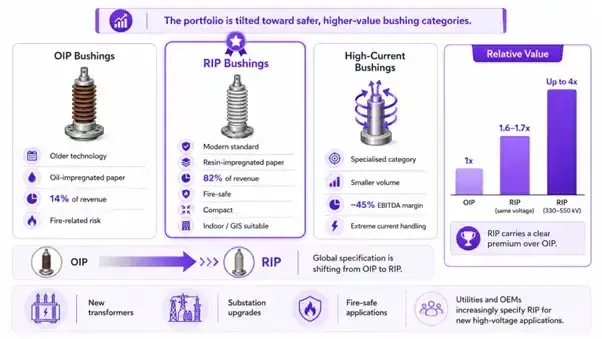
The industry shift from OIP to RIP is one of the most important structural factors in the Yash story. Utilities and OEMs are increasingly specifying RIP for new high-voltage transformers, substation upgrades and applications where fire safety and compact design matter. Yash is already positioned toward this transition, with most of its revenue coming from RIP bushings.
read more: Why Power Sector Stocks are Booming – Data & Trend Analysis
Market Position: A Dominant Domestic Player in a Constrained Industry
The overall bushing market in India today is approximately Rs 1,500 crore. The part Yash covers, capacitive bushings for 33kV to 245kV, is of the order of Rs 700 crore. Yash is well-positioned in this target market.
Yash has approximately 70 percent market share for bushings of up to 245 kV in India, and its EBITDA margins are at approximately 20 to 22 percent. It has almost 35 to 40 percent market share in OIP bushings up to 245 kV and EBITDA margins of approximately 13 to 15 percent. The company has a meaningful position and margins in high current bushings of about 45 per cent.
This market share is important because bushings are a product that requires a lot of qualification. Utilities and transformer OEMs are not easily moved if they trust a supplier. New suppliers need to undergo type tests, visits to the supplier's facilities, registration with the supplier, trial orders and repeat tests. Management have stated that the introduction of a new make can take 2-3 years to be accepted by a utility or transformer OEM.
Yash provides products to Indian transformer OEMs like, Voltamp, TARIL and Atlanta Electricals. It also provides to big customers like Hitachi, GE in India. This is very important as even some of the world's leading bushing manufacturers don't produce the RIP bushings in India on a large scale. BHEL is not a part of RIP and CG Power is still a domestic competitor. There is global competition, but imported bushings cost freight, duties, and have longer delivery times and higher logistical complexity. Yash can be an alternate domestic supplier in urgent situation with quick response and cost benefits.
Hence, the value of Yash's role. It is located at the crossroads of limited supply from around the world, a burgeoning domestic transformer industry and a demand for reliable high voltage components.
Yash's present shape dates back to 2008, when Keyur Patel bought a moribund bushing maker called Yash for a few lakhs. There was wrong calculation of return on investment earlier and the company had taken on debt and the revenue was in lakhs. Keyur Patel kept his name the same, Yash which means glory or Kirti in Sanskrit and went on and recouped the business over the next 15 years.
Origin Story and Management Credibility
Yash's present shape dates back to 2008, when Keyur Patel bought a moribund bushing maker called Yash for a few lakhs. There was wrong calculation of return on investment earlier and the company had taken on debt and the revenue was in lakhs. Keyur Patel kept his name the same, Yash which means glory or Kirti in Sanskrit and went on and recouped the business over the next 15 years.
This history is particularly relevant, because the company's moat is created over time. With bushings, there is no quick fix when it comes to credibility. It is achieved with the consistency of manufacturing, reliability of products, customer approvals, repeat orders. The company has established ties with domestic energy suppliers, private transformer manufacturers and exporters. Nowadays, Yash exports to approximately 60 countries. Management's goal is to become one of the top five bushing players on the planet in the long-term. This is a very optimistic target, but not a weak base. The firm has a dominant domestic market share in RIP bushings up to 245 kV, has a robust export market presence, a new factory to increase its capacity to 550 kV and a clear strategy to localize key manufacturing.
What's important to note is that Yash isn't an inexperienced newcomer capitalising on a short-term power sector boom. It has worked for nearly 20 years to foster acceptance in an industry where technical trust plays a key role in growth.
The Swiss Relationship and the Export Unlock
Historically, Yash has been involved with MGC Moser-Glaser of Switzerland from the Pfiffner Group. MGC was holding a 25.7 percent stake in Yash and Keyur Patel a 2.5 percent stake in Pfiffner's Indian subsidiary. This relationship has proven useful for Yash in technology and procurement of the input, particularly of RIP bushing cores from Switzerland.
But there was a Non-Compete clause attached to the arrangement which prevented Yash from competing in MGC's markets with the export of RIP bushings. This was important because RIP is Yash's most powerful and valuable product category.
The cross-shareholding was unwound in 2024. Keyur sold his stake in Pfiffner India to them and MGC sold its stake in Yash to Keyur. The relation now has been turned into a buyer-supplier one, where Yash still purchases some cores or components whereas develops its own capability.
The important strategic change is that the non-compete clause expired in March 2026. This will allow for Yash to export RIP bushings without restriction. Export realisations are better than domestic pricing. Management suggests that the export price may be 30 to 40 per cent higher for the same kV class as the domestic price. In OIP, the export pricing is in the range of Rs 220 to Rs 240, when the India pricing is Rs 100.
So, the expiration of the non-compete clause is a big unlock. It enables Yash to penetrate into the export markets with the top product category at higher realisations. This won't happen automatically, as exporting your product will take time to qualify your customers, but it creates an additional medium-term margin and revenue lever.
read more: A SME Company Riding India’s Power Infrastructure Expansion
Capacity Build: From 245 kV to 550 kV
The transmission lines are to be upgraded from 245kV to 550kV.The capacity to be expanded is 245kV to 550kV.
The biggest transformation that is happening now is Yash's capacity and capability development. The current Baroda facility handles 24kV to 245kV and is able to accommodate 9,000 - 10,000 bushings per year in both OIP and RIP. Utilisation of the plant is above 80%. The existing plant is expected to produce about Rs 200 crore revenue and the debottleneck will provide an additional 30-40 per cent capacity to the existing plant. This can boost the existing plant's revenue potential to Rs 250-270 crore.
The new greenfield plant is situated about 20 kilometres away from the existing Baroda plant. Built on 4 acres and around 1.2 lakh sq.ft. of constructions. The capex comes to over Rs 100 crore, of which Rs 85 crore comes from the IPO proceeds. The new plant is about 1.5 times the capacity of the current factory and can create a revenue of Rs 300 crore if it is utilised at its maximum capacity.
It's not just about capacity. The new plant boosts Yash's voltage capacity from 245 kV to 550 kV. It enables the company to branch out into more "high-dollar" products and a worldwide addressable market. The plant will include approximately 5,000/6,000 bushings of capacity, primarily RIP bushings at the higher voltage classes.
The new facility also will bring the vital production components closer to home. Yash imports bushing cores today all the way from Switzerland or China, some of which may be precision components and are usually imported via air freight. After a core manufacturing is internalized, transportation cost and dependence on imports should decrease. A large margin driver from FY28 onwards.
The new plant's trial production is slated for H1 FY27, with commercial production in H2 FY27. The first use is expected to be at approximately 30 - 35% utilisation, and maximum utilisation is expected to be achieved after 2.5 - 3 years. The combined peak utilisation of the existing and new plants can produce revenue of Rs 550-600 crore.
Margin Architecture: Why the Best Margin Phase May Be Ahead
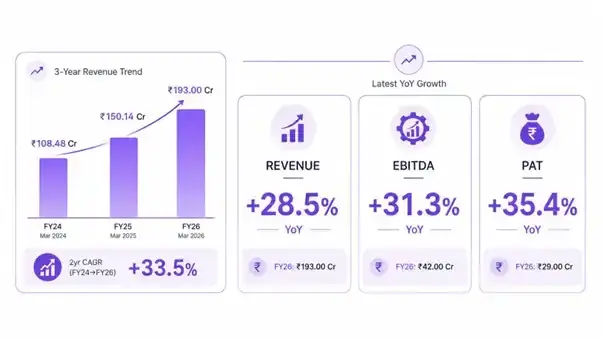
In its current margins, Yash is in sync with its product mix. RIP bushings' EBITDA margin is approximately 20%-22%. Approximate percentage percentages for OIP bushings: 13 to 15 percent. Around 45 percent can be obtained from high current bushings. The near term margin profile could be stable or improve with a gradual margin expansion from FY28 onwards.
The first margin driver is in-house core manufacturing. The cores have the disadvantage of dependence on the suppliers, freight cost, and longer lead time. A domestic core manufacturing capability would help to drive down costs and provide increased quality and delivery assurance for Yash.
The next margin driver is exports. Prior to this, Yash was already exporting to 60 countries but the export segment had been restricted due to the non-compete arrangement to export RIP bushings. The restriction has now been removed, so the company can now sell RIP bushings in the export market where realisations are higher. Just a relatively small change in the export mix can enhance margins.
Thirdly, the higher-voltage products are the brand drivers of the margins. The transition from 245 kV to 550 kV brings about better realisation per unit. The higher the voltage, the more complex is the bushing, the tougher it is to qualify and the fewer the number of qualified competitors. The product mix should gradually be moving towards higher value products as the greenfield plant increases output.
This will be a journey with execution risk. Type testing, customer approvals and vendor development and production stabilisation may take some time. However, if Yash pulls the trigger, the margin profile post FY28 may be even better than the existing blended margin profile.
read more: Top Power Sector Stocks in India for 2026
Addressable Market: A Small Player in a Large Global Opportunity

The term Addressable Market refers to a small market, which presents a large opportunity, in the global market.
The current global value of capacitive bushings is around Rs 25,000 crore. The market in the range of above 250 kV is approximately Rs 15,000 crore. Yash currently sells in the 33kV to 245kV segment and is thus able to address a global market of the size of Rs 10,000 to Rs 12,000 crore. The addressable market of the greenfield plant is around Rs 15,000 to Rs 16,000 crore with the 550 kV capacity.
The management also suggests that by 2035, the global bushing market could be of the order of Rs 40,000 crores with Yash's addressable range at 550 kV being in the range of Rs 25,000 to Rs 30,000 crores. The total bushing business in India is in the range of Rs 1,500 crore and Yash's share of the market is in the range of Rs 700 crore. As the per capita power consumption is rising and the grid investment is gaining pace, the Indian market can rise to Rs 6,000 to Rs 7,000-crore in the coming years.
Today, Yash represents approximately 1% of the global addressable market. Management's vision is to expand revenue eight to 10 times in 8 to 10 years, and to become a global top 5 player. This is a lofty goal, but the market is not the reason the company can't meet it. Bottleneck is execution: qualification, capacity ramp, export relationships and supply chain reliability.
Demand Drivers: Grid, Renewables, Data Centres, Railways and Replacement
The market opportunity has structural demand drivers. The demand for power is on the increase in India due to data centres, EVs, railway expansion, solar parks etc. Renewable targets have moved from 500 GW by 2030 to 900 GW by 2035. The total investment required in transmission infrastructure under the National Electricity Plan is estimated to be approximately Rs 9.6 trillion until the end of 2032. Bushings are used in every transformer and substation improvement
This is why Yash's demand cycle is deemed to be structural and not cyclical. It is associated with long-term grid expansion, integration of renewables and replacement demand and increased reliability needs.
The demand drivers include Grid, Renewables, Data Centres, Railways and Replacement.
However, the requirement for bushings wherever transformers are used makes them a benefit to all major power infrastructure trends to which Yash stands to benefit.
The first driver is the power grid expansion. India is developing new T&D infrastructure and various schemes like RDSS are generating new replacement and upgrade demands across the grid. When installing equipment at higher voltage levels, demand for better quality capacitive bushings increases.
The second driver is the integration of renewable energy. Pooling substations and transformers are needed in solar parks of Gujarat and Rajasthan. Generator transformers are necessary for wind farms. Specialised transformer equipment is also needed for hybrid solar-wind projects. Bushings are necessary for each of these transformers.
The third is data centres. Hyperscale data centres demand continual power and increased equipment reliability. Yash has now created specialized bushing products for data centres and is also taking orders for the same. Data centre operators will look for reliable suppliers because of the value of reliability.
The fourth driver is the railways. The electrification and development of high-speed rail require transformers and hence bushings. The segment is already covered by the presence of Yash.
Replacement and retrofitting are also important. The transformer and the bushing will typically last about 25 years, but can fail prematurely. If moisture is allowed in during maintenance, cracked porcelain or silicon parts due to physical damage, replacement may be needed. The larger the installed base, the larger the replacement market.
In addition, the replacement of the global grid offers another opportunity. The UK is getting rid of its grid in the next 10-12 years, Yash has a partnership in distribution with Electrolink UK. The US, Europe and the Middle East are also investing in grid improvements. Management feels there is a 12 to 13-year demand visibility for bushings due to the time it takes for them to qualify a new supplier and there is only a limited number of credible manufacturers of bushings.
read more: Private Power vs PSU Power Stocks: Which Is Better in 2026?
Order Book, Pricing Power and Seasonality
Yash’s order book is valued at Rs 300 crore, and the execution time is estimated to be from 1.5 to 2 years. This is a good visibility against current revenue in the Rs 150 to 180 crore bracket.
Pricing power is the more important metric. Management expressed that for the next 7–8 years they are not going to get into a price war and have declined orders when prices were not acceptable. This is possible because there are only a few suppliers of bushings and there are no easy ways to qualify the bushings. Changing to an unknown bushing supplier is not an easy task for an OEM with warranty and reliability concerns.
Seasonality exists in the business as well. Management has signaled that there should be a 40/60 split between H1 and H2 revenues, with H2 being generally stronger, as many of the utility spending cycles will be in H2. Partly due to the commercialization of the new plant, H2 FY27 is likely to be materially better than H1.
It's a solid strength indicator that the company is able to select orders. Management has stated that the demand is substantial and order flow is robust, but it must be able to choose orders with regard to capacity and execute them in an orderly fashion. A specialised component business cannot afford to be seen as keeping up with orders; reliability is key.
Inorganic Option: Sukrut Electric
Yash is also pursuing inorganic growth avenue in Sukrut Electric Company, Pune. Yash's investment in Sukrut was in conjunction with Quality Power Equipment for a 50 per cent stake. Sukrut is involved in making the components of transformers, and additionally has a small business in the distribution of bushings.
The strategy is cross-selling. Yash and Sukrut are different customer bases and Quality Power is a technical and customer relationship base. Sukrut has a turnover of around Rs 30 crore and its growth is expected to be significant according to management. The expectations are 5-7 times in the next 3-5 years and 5-6 times or even 8-10 times for a longer horizon from management's perspective.
This is considered an opportunity within the ecosystem, not its core income stream. Yash's core investment thesis is unchanged: its bushing capacity expansion, export unlock and margin improvement. But Sukrut can help to establish a larger base of transformer components over time.
Risks: What Could Delay the Story
The first risk is that of qualification timing at 550kV. The new plant will enable Yash's capability up to 550 kV, but utilities and transformer OEMs will have to approve the product before its scale-up for commercialization. Requires time for type testing and for customer qualification. In the event of delayed approvals, revenue contribution from greenfield may be pushed further into FY28.
Complexity in the supply chain is the second danger. Multiple parts from various suppliers needed for bushings. Whole batches can be trapped if one of the inputs is delayed. Yash has already seen times where stock piles increased due to a component not being received. The higher the voltage class, the more stringent the requirements for the discipline of the supply chain are.
The third risk lies in the vendor's qualification for localisation. To manufacture core products in-house is a large margin lever, but the manufacturing process needs to meet the strict quality requirements. Timing of equipment stabilisation, vendor approval, and process qualification can be a barrier to margin expansion.
Fourth Risk is Customer Concentration. While Yash has many transformer manufacturers as customers, relationships with large OEMs are important. The loss of a major client, for whatever reason, can impact a company's quarterly performance.
The fifth risk is the timing of export ramping. Export revenue from the building is, of course, now over, but site visits, technical acceptance, sample testing, and type approvals will be needed to ensure this. Management feels that the export revenue for RIP will be significant after about 1.5 years. There's a big opportunity but it's going to be a slow evolution.
The sixth risk is execution discipline. The company is transitioning from 245 kV to 550 kV, constructing a new plant, localising cores, increasing exports and looking to inorganic growth. Every initiative makes good sense, but since they are all to be executed simultaneously, there is increased complexity in execution.
Explore our Products
Research Framework

Emerging Titans
Combination of quantitative analysis, industry tailwinds, and management assessment - SPRINT investment philosophy

Tiny Titans
Heavy emphasis on scuttlebutt research, plant visits, and early on-ground signals
Conclusion: The Silent Gatekeeper
There are several good reasons for investing. First, there's a small number of bushing manufacturers, with approximately 12 in the world and three spanning almost 80% of the market. Second, Yash holds its domestic market share of the RIP bushings market up to 245 kV, about 70% of the domain. Third, the company is on the right side of the shift from OIP to RIP. Fourth, the non-compete expiry opens up RIP exports, where realisations are better. Fifth, the greenfield plant is engineered for 550 kV – a voltage level that is both increasing and becoming more mainstream.Fifth, core manufacturing moves in-house with the greenfield plant. Sixth, the total revenue potential could rise to Rs 550-600 crore at combined peak capacity.
There are some dangers in the story. Qualification timelines, reliability of the supply chain, customer approvals, export ramp-up and localisation execution need to be carefully monitored. The direction is obvious, however. The world, India should look for grid capacity, transformers and everything else that is high voltage and reliable. In a slim but lucrative niche of that ecosystem sits Yash.
The bushing is the gateway to the heart of a substation, and the transformer is the heart. While Yash has a significant stake in that gateway in India, it is now trying to expand its footprint around the world. After all, that's what sets the company apart from investors looking into the power infrastructure value chain.
FAQs
Why is the bushing business more attractive than it looks from the outside?
+Because bushings are small in cost but critical in failure impact. A bushing may form only a small part of a transformer’s cost, but if it fails, the entire transformer can fail. This makes customers highly cautious while selecting suppliers, creating strong entry barriers and sticky relationships.
Why don’t large transformer manufacturers make bushings themselves?
+Bushings require specialised design, testing, insulation expertise and long qualification history. Transformer companies usually prefer buying from proven suppliers instead of building a complex component capability in-house. Also, outsourcing shifts component-level accountability to a specialist supplier.
Why is the shift from OIP to RIP important for Yash Hi-Voltage?
+OIP is the older oil-based technology, while RIP is fire-safe, compact and better suited for modern substations. RIP also carries a 60 to 70 percent premium over OIP for the same voltage class. Since most of Yash’s revenue already comes from RIP, the company is positioned on the right side of this technology transition.
What is the real growth unlock from the new greenfield plant?
+The greenfield plant is not just adding capacity. It increases Yash’s technical ceiling from 245 kV to 550 kV, opening access to a larger and higher-value market. It also brings core manufacturing in-house, which can reduce import dependence and support margin expansion over time.
What should investors track most closely in Yash Hi-Voltage?
+The key monitorables are qualification progress for 550 kV products, ramp-up of the greenfield plant, export traction after the RIP non-compete expiry, and margin improvement from in-house core manufacturing. Demand is strong, but execution will decide how much of the opportunity converts into revenue and profit.

High growth stock specialist, Value Educator
Shashank Mahajan is an equity research professional with over 12 years of experience in identifying high-potential SME and micro-cap stocks at an early stage. He follows a rigorous scuttlebutt research–driven approach, combining on-ground insights with deep financial analysis. Shashank specializes in uncovering under-researched and under-owned companies with strong management quality and long-term growth potential. Through disciplined research and early identification, he focuses on spotting tomorrow’s market leaders before they enter the mainstream investor radar.

Zen Technologies: Revenue Fell After a Big Win




PNG Jewellers: A 194-Year-Old Name Goes National

Explore our Products
Research Framework
Emerging Titans
Combination of quantitative analysis, industry tailwinds, and management assessment - SPRINT investment philosophy
Tiny Titans
Heavy emphasis on scuttlebutt research, plant visits, and early on-ground signals


 Orders
 Subscription
 Share with friends


Required Details
₹23999.00
(12 month subscription)
As per SEBI regulations, all users are mandated to complete the KYC that is validated for 1 year. Post payment, you will be redirected to the KYC screen


Brilliant Explanation!