
Economic Moat Explained

Every few years, the market falls in love with a new set of “can’t-miss” companies. They raise money quickly, expand at a blistering pace, and before long their names are everywhere—investor meetings, business channels, podcasts, and endless social media threads. People start calling them “disruptors,” the kind of companies that are supposedly rewriting how the whole industry works. For a while, the excitement around them becomes so loud that it feels like they can’t possibly fail, as if nothing in the market could slow their momentum.
Then reality quietly steps in. Growth loses momentum. Rivals copy the model. Expenses creep up. Fresh capital isn’t as easy to find. And the same company that once dominated headlines starts downsizing, merging for survival, or slowly fading from memory. We’ve seen this story play out more times than we admit. But not every company lives on hype.
Some businesses move differently. They rarely chase the spotlight. They may not double revenues overnight. Yet year after year, they’re still standing. They’ve survived crashes, inflation spikes, policy changes, tech disruptions, and waves of new competition, and somehow, they keep going.
It’s easy to say, “They just have good management.” Sure, leadership matters. But management changes. Strategies evolve. Markets shift. Plenty of smart teams have still lost. It’s also easy to point to profits. But high profits attract attention. And attention attracts competition. In most industries, when money is easy to make, someone eventually shows up to take a share of it.
So what keeps a small group of companies standing when others fall?
The difference is that some businesses build themselves in a way that makes attacking them painful. Their customers don’t leave easily because switching is inconvenient or risky. Their scale allows them to operate at costs others can’t match. Their brand carries a level of trust that takes years, sometimes generations, to build. Their distribution networks, licenses, or relationships act like locked gates.
When those advantages are in place, competitors can’t just be slightly better. They have to overcome years of accumulated strength. That’s expensive. It’s slow. And often, it’s not worth the fight.
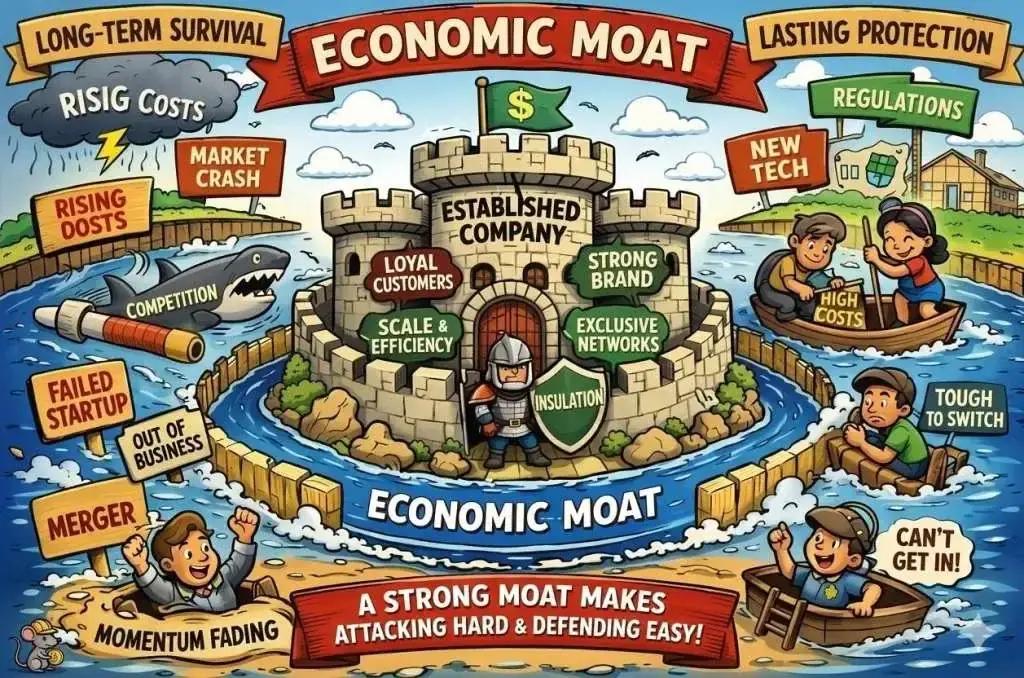
Investors have a simple term for this kind of protection: an economic moat.
It’s the difference between a company that has momentum and one that has insulation. Momentum can fade. Insulation, if built well, holds. And once you start paying attention to
that distinction, you realize that long-term survival isn’t random. The businesses that endure aren’t lucky. They’re protected.
For readers who are new to the stock market, understanding concepts like competitive advantage, compounding, and long-term business quality becomes much easier with a strong foundation in basic market concepts. If you’re just getting started, you may find this helpful: A Beginner's Guide to the Indian Stock Market.
What is an Economic Moat?
Picture an old stone castle.
High walls. Heavy gates. And around it, a deep stretch of water. That water wasn’t for decoration. It was there for one reason: to make attacking the castle difficult. An army couldn’t just march up and knock on the door. They had to find a way across first. That delay alone often made the attack pointless.
An economic moat is the business version of that water.
It’s the buffer that keeps competitors from walking in and taking what they want. Without it, a company might have a great product and strong profits today, but nothing stops someone else from copying it tomorrow and selling it cheaper.
With a moat, it’s different.
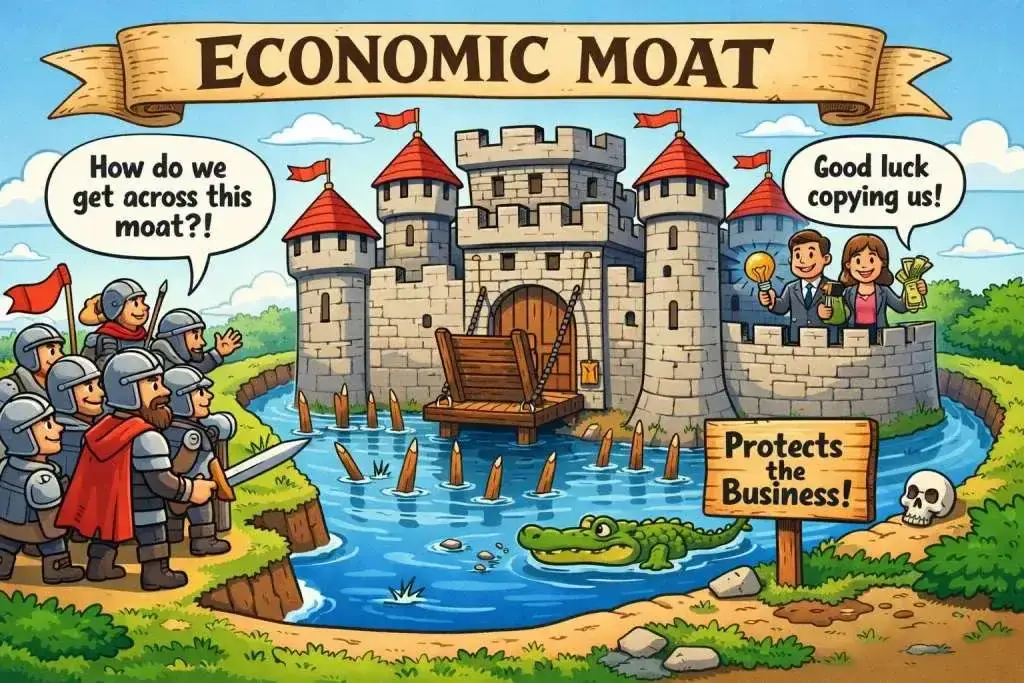
Maybe customers are so used to the product that switching feels like a hassle. Maybe the company is so large that it can produce at a cost others can’t match. Maybe its brand carries a level of trust that took years to earn. Or maybe its distribution network is so deeply rooted that newcomers can’t break in easily.
The Five Classic Types of Economic Moats
People in investing love the term economic moat. It sounds clever, almost academic. But if you forget the jargon for a moment, the idea is actually very ordinary. Some companies are just difficult to compete with. That’s it. No mystery. No complex theory. They have something, sometimes obvious, sometimes subtle, that keeps competitors from casually walking in and wrecking the business.
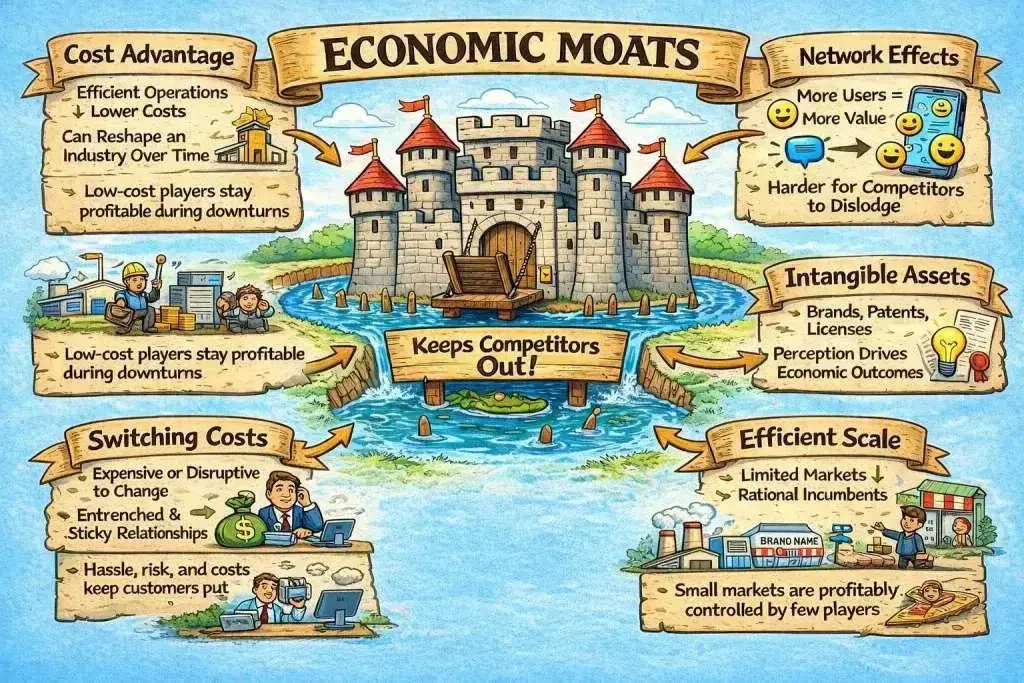
- A cost advantage is probably the easiest to grasp, even though it rarely gets people excited. There is nothing glamorous about operational efficiency. No dramatic story, no flashy innovation. Often, it’s just a company that manages its expenses better than others. Tighter processes, better sourcing, fewer leaks. Boring on the surface. Yet when an industry runs into trouble, this “boring” trait suddenly becomes decisive. High-cost players start feeling pain very quickly. The low-cost operator doesn’t panic. That gap, repeated over the years, can completely reshape an industry.
- Network effects behave in a way that feels slightly counterintuitive at first. The product becomes more valuable not because it changed, but because more people started using it. Users attract users. Activity attracts activity. And once that cycle gains momentum, it creates a strange kind of gravity. Competing products may be perfectly good, sometimes even better, but dislodging an established network turns out to be far harder than building one from scratch. People underestimate how sticky familiarity can be.
- Intangible assets are harder to grasp because you can’t physically touch or see them. Taking a brand name is essentially a feeling in people’s minds. Yet that feeling shapes real decisions. People trust certain names, feel comfortable choosing them, and sometimes willingly pay extra just because it feels safer or better. Patents and licenses operate differently, but their impact can be just as strong. They don’t rely on emotion; they rely on permission. They decide who is allowed to compete and who isn’t. That kind of control can quietly protect profits for years. But not every well-known name is automatically a smart investment.
For long-term investors, recognizing these structural advantages is often the first step in identifying companies that can create extraordinary returns over time. In fact, many historical wealth creators share common patterns that investors can study.Our research breakdown is:
7 Powerful Traits of Every Multibagger Stock – A Data-Based Study explores these patterns in detail.
4. Switching costs rarely get discussed outside professional circles, which is odd given how influential they are. In theory, customers should constantly migrate to superior options. In practice, people avoid hassle. Changing systems, vendors, or platforms can be disruptive, sometimes risky. Even modest friction, like retraining staff, moving data, and adjusting workflows, can discourage movement. From a business perspective, that hesitation is incredibly valuable. It buys time, stabilizes revenues, and quietly weakens competitive threats.
Thinking in terms of moats changes how companies are evaluated. Instead of being impressed by growth or narratives, attention shifts to endurance. How easily can competitors attack? How fragile are margins? How replaceable is the offering? Markets evolve constantly, and advantages decay faster than they appear to from a distance. Without structural defenses, strong performance can fade with surprising speed.
With them, the story looks very different: steadier, more resilient, sometimes quietly extraordinary.
Case Study: Asian Paints – A Textbook Economic Moat
Asian Paints is one of the cleanest and most brutal examples of a moat in India. Not flashy. Not hype-driven. But devastatingly powerful. At first glance, the paint industry appears to be a classic commodity business. Paint is not a patented technology; the manufacturing process is widely understood, and no obvious barriers are preventing new players from entering. Logically, this should be an industry where competition constantly pressures prices and destroys profitability. Yet for decades, Asian Paints has maintained dominant market leadership and strong financial performance. The reason lies not in the product itself, but in an invisible structural advantage that many investors initially overlook.
The paint business looks boring until you actually think about how a paint shop works. A dealer has to handle a ridiculous number of shades. Customers don’t plan ahead; they walk in and expect a specific colour right away. If it isn’t available, they usually just leave. There’s no loyalty in that moment. A missed shade is a missed sale.
Because of this, dealers care a lot about one thing: not running out of stock. Fancy branding doesn’t help them if popular colours are unavailable. Even small disruptions hurt. Imagine telling multiple customers in a day that their shade isn’t there, it’s bad for business, and embarrassing for the shop owner.
Asian Paints figured this out long ago. Instead of obsessing over pushing more paint into the market, the company chose a different path. It focused on solving the everyday problems of its dealers. If dealers felt supported and stress-free, sales would follow naturally.
Deliveries became reliable. Stock refills were predictable. Inventory stopped feeling like a gamble. Dealers no longer had to anxiously guess which shades might run out during peak demand. That quiet operational discipline built trust. And over time, that trust became far more powerful than any aggressive sales pitch.
After a few years of that experience, something interesting happens. The dealer gets comfortable. Business feels more predictable. Fewer angry customers, fewer urgent calls to suppliers, fewer headaches. At that point, choosing a supplier is no longer just about price. Switching to another brand means stepping into uncertainty — maybe deliveries won’t be as fast, maybe certain colours won’t move as efficiently, maybe stock planning becomes messy again.
For a dealer running a small business, that uncertainty is a real risk. Saving a bit on pricing doesn’t always compensate for operational stress. So many dealers simply stick with what works. Not out of emotion or brand obsession, but because their day-to-day business runs more smoothly.
This is the part outsiders often miss. Asian Paints didn’t win just because of paint quality. It became deeply tied to how dealers operate. Ordering patterns, restocking cycles, working routines, everything started aligning with the company’s systems. Competitors could offer similar products, but breaking established habits and trust is hard.
Over long periods, advantages like this show up in performance. Stable dealer relationships, steady demand flow, and fewer disruptions naturally support healthier economics. Nothing dramatic, nothing magical, just a business that made itself very difficult to replace.
That’s what an economic moat often looks like in the real world. Not some futuristic technology or secret formula, but a company becoming so reliable and integrated into everyday decisions that changing course feels unnecessarily risky.
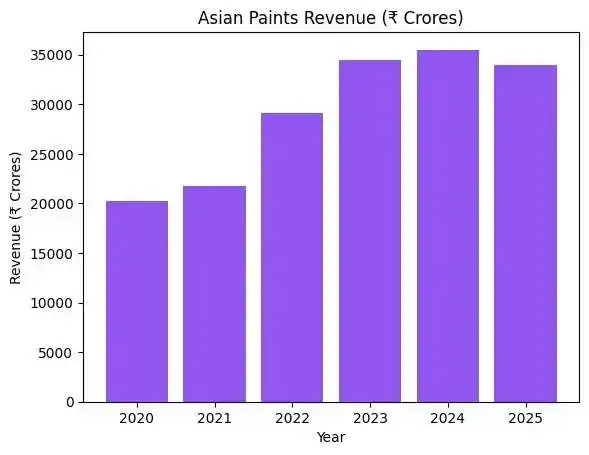
Looking at the numbers from 2020 through 2024, it’s clear the company really found its stride. It’s a classic comeback story—shaking off the COVID-era slump and watching demand for its products finally catch fire again.
The real "magic" happened between 2021 and 2023. That’s a massive growth spurt. Whether they managed to push through some price hikes or just leaned heavily on their distribution network to flood the market, whatever they did clearly worked. They weren't just growing; they were sprinting.
By the time we hit 2024, things started to level off a bit. It’s the "big ship" syndrome—once you reach a certain scale, it’s physically impossible to keep doubling in size every year. As for that tiny dip in 2025? Honestly, I wouldn't lose sleep over it. It feels more like the market taking a breather than a red flag. When you zoom out and realize how much higher the revenue is now compared to just a few years ago, the company is still in a very strong position.
Overall, the long-term trend still indicates a resilient and growing business as compared to its peers like Berger Paints, Akzo Nobel, etc., which are prone to face massive ups and downs in business because they may lack a moat in the industry.
Warning Signs of a Fake or Weak Moat
There’s a very common assumption in investing: if a company is growing fast or reporting impressive numbers, it must have some sort of durable advantage. The logic feels reasonable. Strong performance looks like evidence. But business outcomes are rarely that tidy. A company can appear exceptionally strong for years while benefiting from conditions that are temporary, fragile, or easily challenged.
Margins often tell the more uncomfortable story. Businesses with genuine competitive strength usually display some stability in profitability. Not perfection, but resilience. When margins steadily compress, especially without a clear external shock, it’s worth pausing. Something is changing. Competitive pressure may be increasing. Customers may be resisting prices. Costs may be rising faster than expected. Whatever the cause, persistent deterioration rarely aligns with the idea of a well-protected business.
Customer behavior, though less dramatic than financial metrics, is equally telling. People move on when leaving feels easy. When customer loyalty is weak, the signs usually show up quickly. People leave the moment a better deal appears, switch brands without much thought, and often respond more to discounts than to the product itself. That’s rarely a comfortable signal for a business. It usually means customers don’t see a meaningful difference between the available options. They’re not staying because they genuinely prefer the brand. Most of the time, they’re simply choosing whatever is cheaper or more convenient at that moment. And when that’s the case, keeping customers becomes a constant battle rather than a natural outcome of the business.For a while, revenue can still look healthy. Promotions bring in users, growth numbers seem fine, and everything appears stable on the surface. But underneath, the connection with customers may be weak.
Returns on capital introduce another layer of nuance. Growth by itself proves very little. What matters is how efficiently that growth converts into economic value. When a company must commit increasing amounts of capital to sustain expansion, the quality of the opportunity deserves scrutiny. Expansion can look impressive while quietly becoming less rewarding.
Then there’s the issue of temporary tailwinds, one of the easiest traps for investors. Favorable cycles, regulatory shifts, or bursts of demand can temporarily inflate results. During such periods, even structurally ordinary businesses may look extraordinary. The real test usually arrives later, when conditions normalize and profitability either holds up or fades.
Narratives complicate matters further. Markets are naturally drawn to powerful stories: innovation, disruption, bold ambition. Stories are exciting and easy to remember. Solid competitive advantages, on the other hand, are quiet and often overlooked. They don’t make flashy headlines, but they matter far more than we think.
Over long periods of time, it’s not the narrative that decides who survives; it’s the underlying strength of the business. Competitive realities slowly overpower hype. A company can have a brilliant vision and still struggle if others catch up or execute better.
In the end, assessing moat strength requires a degree of restraint. Surface-level success — growth, popularity, visibility — offers limited protection against disappointment. The more useful question remains deceptively simple and slightly uncomfortable: what actually prevents competitors from chipping away at this company’s economics? When that answer feels uncertain or unstable, caution becomes less about pessimism and more about discipline.

Moats and Long-Term Investing – The Compounding Engine
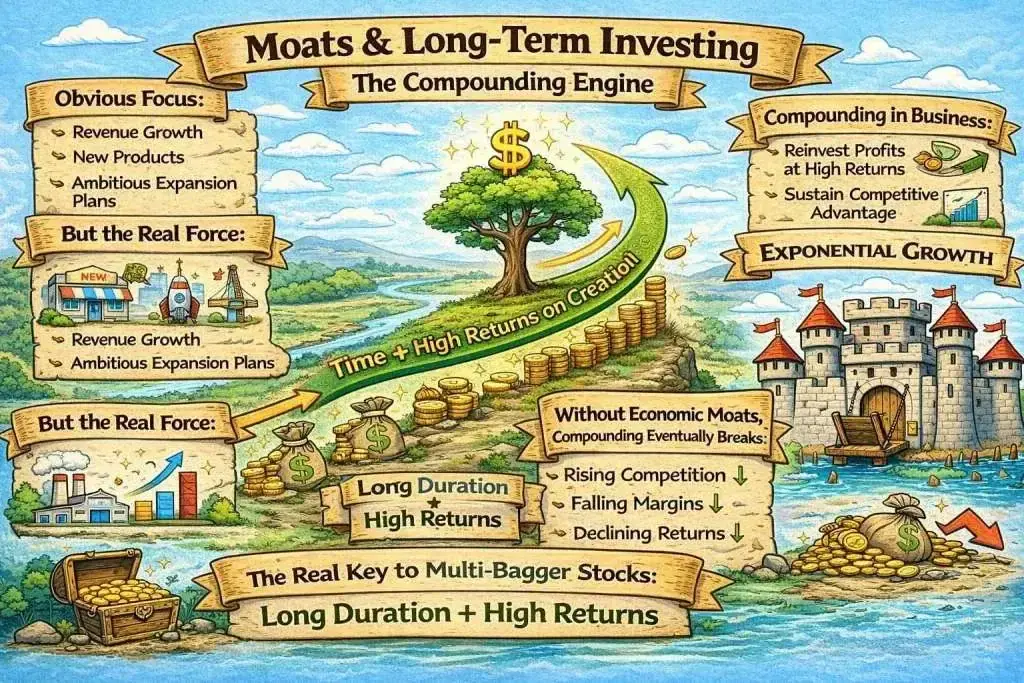
When people discuss long-term stock market winners, the spotlight usually falls on visible things: revenue growth, new products, and ambitious expansion plans. Those are easy to talk about. The quieter force behind truly exceptional outcomes is less glamorous but far more decisive: a company’s ability to keep reinvesting its profits at attractive rates for many years without its economics being competed away.
Compounding in business is conceptually simple. A firm earns profits, puts those profits back to work, and ideally earns even more on the expanded base. What makes the process powerful isn’t complexity; it’s repetition. Done consistently, the effect builds slowly at first. Almost boringly. Then, over longer stretches, the curve bends in ways that surprise people who focus only on short-term growth.
If you want to understand why reinvestment and time create exponential wealth in the stock market, it’s worth studying how compounding actually works in practice.This concept is explored deeply in:The Power of Compound Interest: How to Create Wealth in the Stock Market.
This is where competitive advantage stops being an abstract idea and starts mattering in a very practical sense. High returns are never invisible. They attract attention. Competitors respond, capital flows in, and imitation begins. Without some form of protection, excess profitability tends to shrink. Returns drift toward average levels. The compounding engine doesn’t explode overnight; it simply loses efficiency, year by year.
Businesses with genuine moats tend to experience a different trajectory. Structural advantages, whether rooted in cost, customer behavior, networks, or market structure, make aggressive competition harder or less rewarding. Because rivals cannot easily erode economics, these companies often retain the rare ability to redeploy capital at healthy returns long after others would see theirs fade. The difference compounds quietly, then dramatically.
Viewed this way, economic moats are not just defensive features. They are what allow compounding to persist. They extend the lifespan of attractive reinvestment opportunities and protect the conditions required for exponential value creation. For patient investors, that persistence, not short bursts of growth, is what ultimately drives extraordinary outcomes.
Common Investor Mistakes When Evaluating Moats
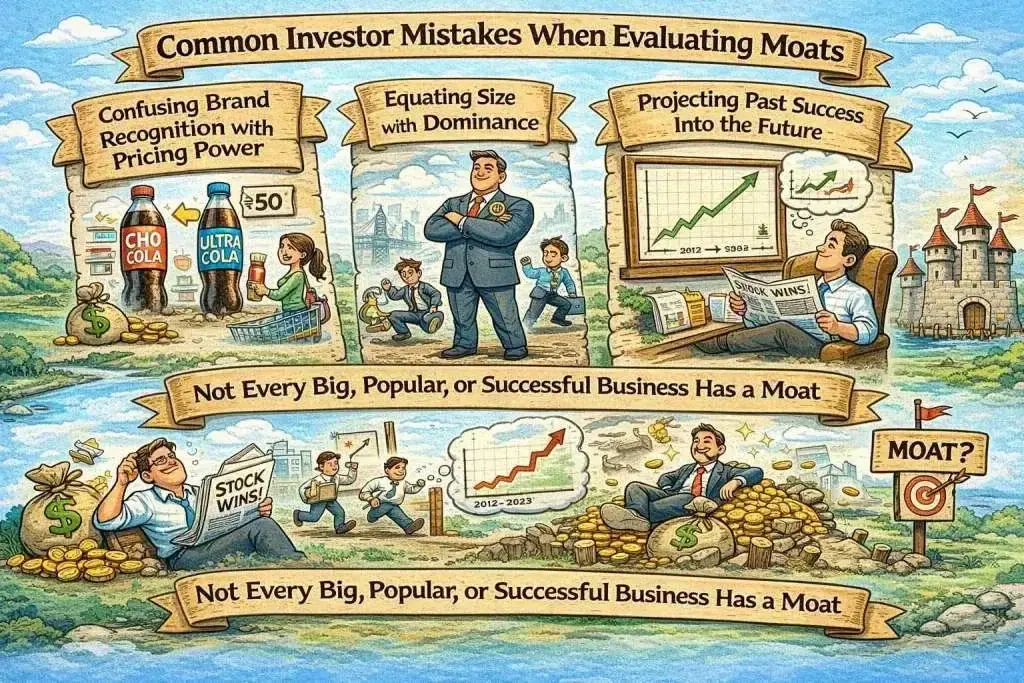
Thinking about economic moats sounds easy until you try to apply the idea to real companies. Investors naturally gravitate toward what’s visible: well-known brands, large businesses, impressive past performance. The problem is that visibility often feels like proof of strength, even when it isn’t.
Brand recognition is a classic example. A company can be famous, heavily advertised, and still have very little control over pricing. Customers may recognize the name yet switch without hesitation the moment a cheaper alternative appears. Familiarity alone doesn’t tell you much about competitive protection.
Company size can be just as misleading. Big firms look dominant by default, but scale doesn’t automatically prevent competitors from chipping away at profits. Many large businesses operate in markets where products are easily copied and pricing pressure never really disappears. Past success adds another layer of confusion. Strong growth or profitability tends to create an assumption of durability, as though competitive advantages naturally persist. In reality, industries shift, rivals adapt, and what once looked secure can weaken gradually rather than dramatically.
It’s also easy to mistake a well-run company for a well-protected one. Good management and operational efficiency matter, but they don’t always translate into structural defenses. Without barriers that discourage competition, attractive economics rarely remain untouched for long. At its core, a moat isn’t about popularity or reputation. It’s about whether competitors face genuine difficulty in attacking the business. That distinction is subtle, but it’s where many investment judgments quietly go wrong.
Explore our Products
Research Framework

Emerging Titans
Combination of quantitative analysis, industry tailwinds, and management assessment - SPRINT investment philosophy

Tiny Titans
Heavy emphasis on scuttlebutt research, plant visits, and early on-ground signals
CONCLUSION and CTA
Markets don’t reward confidence forever. A business can look incredibly strong, surrounded by growth, praise, and optimism, and still turn out to be far more fragile than it first appeared. Conditions shift. Rivals react. What once felt like dominance starts looking like something that needed very specific circumstances to survive. Investors see this pattern again and again, though it never feels obvious at the moment.
That’s why the notion of an economic moat is useful, not as a grand theory, but as a simple filter. Some companies are just harder to disturb. Customers hesitate before leaving. Competitors find replication more painful than expected. Advantages accumulate quietly, almost invisibly. None of this makes a firm invincible, but it does change how easily its economics can be chipped away.
In the end, endurance in business is rarely accidental. Markets are too competitive, too adaptive, for survival to be explained by luck alone. Companies that remain relevant for decades usually do so because something about their structure discourages easy attacks. Spotting that protection early is uncomfortable, uncertain work — but it often marks the line between a temporary success story and a business that keeps compounding long after the excitement fades.
If this article helped you understand how great businesses protect their profits, comment “MOAT” below, and keep exploring more of our research-based work on our website.
If you’re trying to build the skill of identifying such businesses quickly, frameworks can help simplify the process. Our guide: A fundamental checklist: How to research a stock in 1 hour, walks through a structured way to evaluate companies before investing.
FAQs ( Frequently Asked Questions )
Can Moats Disappear?
+An economic moat can look strong for years and still disappear if the world changes. Nokia was once the king of mobile phones, but when smartphones became more about software and ecosystems than hardware, it couldn’t keep up. Kodak faced a similar fate; it focused too long on film while digital photography took over. Technology doesn’t care about past success; it rewards those who adapt. As investors, we should never assume today’s advantage will automatically survive tomorrow.
How to Identify Moats in Financial Statements?
+Strong business usually shows up as consistently high ROCE over many years, not just one lucky spike. Margins don’t jump around wildly; they stay steady or slowly improve, which means competitors aren’t constantly attacking. Cash flow is healthy and repeatable, not just “profit on paper.” Debt is under control because the company doesn’t need to borrow heavily to survive. And when it raises prices, customers don’t run away; you’ll see that in stable volumes and margins. Real moats don’t shout; they quietly show up in the financials year after year.
Why is an economic moat important for investors?
+Economic Moats protect profits for years. Companies without moats face price wars, lose customers easily, and have unstable earnings, whereas companies with moats can raise prices, maintain high margins, and generate steady cash flow. That's why long-term wealth is built in moat businesses and thereby protects the people invested in the business.
How does moat relate to valuation?
+Companies with strong moats usually trade at premium valuations. Investors are willing to pay higher multiples for predictable and durable earnings. However, overpaying even for a strong moat can reduce returns. The key is buying quality businesses at reasonable prices.
What is a brand moat?
+A brand moat happens when customers trust and emotionally connect with a company’s products. Strong branding allows premium pricing and repeat purchases. It reduces price sensitivity and builds loyalty over decades. This moat is powerful but requires consistent quality and marketing to sustain.

High growth stock specialist, Value Educator
Shashank Mahajan is an equity research professional with over 12 years of experience in identifying high-potential SME and micro-cap stocks at an early stage. He follows a rigorous scuttlebutt research–driven approach, combining on-ground insights with deep financial analysis. Shashank specializes in uncovering under-researched and under-owned companies with strong management quality and long-term growth potential. Through disciplined research and early identification, he focuses on spotting tomorrow’s market leaders before they enter the mainstream investor radar.

Glenmark: The USD 700 Mn Cancer Deal and Its Brands

Pharma Stocks in India 2026: Generics, APIs and CDMOs

Granules India: From Paracetamol to a 65% Gross Margin

Natco Pharma: After Revlimid, 29 Patent Challenges

Shilpa Medicare: Cancer APIs, Films and Biosimilars

Alembic Pharma: US Plants Pay Back, Margin Hits 22.2%
Explore our Products
Research Framework
Emerging Titans
Combination of quantitative analysis, industry tailwinds, and management assessment - SPRINT investment philosophy
Tiny Titans
Heavy emphasis on scuttlebutt research, plant visits, and early on-ground signals



Modern Warfare to Multibaggers
Key Trends. Strategic Shifts. Opportunities Ahead.
Today at 7:00 PM IST. Room opens 30 minutes before.
Don't Miss This Exclusive Webinar!
Join Value Educator to decode the key trends shaping India's defence sector and learn how to identify tomorrow's potential leaders in the space.
- In-depth research on India's defence sector
- Live Q&A session
- Actionable takeaways for long-term investors

 Orders
 Subscription
 Share with friends


Required Details
₹23999.00
(12 month subscription)
As per SEBI regulations, all users are mandated to complete the KYC that is validated for 1 year. Post payment, you will be redirected to the KYC screen


No comments yet. Be the first to comment!