
PEG Ratio: A Better P/E for Growth Stocks
“Growth stocks can appear to be cheap or expensively valued depending on the metric used. The P/E ratio is only showing half the picture and concealing the true cost of growth expectations. That is when the PEG ratio enters the picture and cuts through the noise. It lets you know if you are really paying for growth or simply paying for hype.”
The initial impression of a stock with a relatively low P/E ratio is similar to stumbling upon a designer product at a discounted price. It’s simple, comfortable, and works for many people. And that’s exactly the reason many people use it. It’s simple because it’s common sense: if a stock has a relatively low price compared to its earnings, it means it’s a hidden gem. But simple is not how the stock market works for long. Underneath the relatively low P/E ratio, there may be a more complex story waiting to be unraveled.

This is where things start to get interesting. Let’s consider two companies operating side by side. One is growing, increasing its revenues, market share, and momentum for future growth. The other is stagnant, growing at a slow and steady pace. Let’s consider both these companies to have similar P/E ratios. On paper, both might appear to be equally attractive propositions. But in reality, they could not be any different. The only thing that could be different is growth. If investors do not consider growth as an important factor, they might end up getting caught in a common trap.This is exactly where the PEG ratio comes into play. Instead of simply looking at what a company is currently earning, it links the price you pay with the growth you expect in the future. In a market where future growth is everything for public companies, even a small change can make all the difference. The PEG ratio is here to bring sense to the market, to help you distinguish real growth opportunities from overhyped ones. After all, at the end of the day, investing isn’t just about finding cheap stocks, it's about understanding whether the growth you pay for is actually worth it.
Now that we’ve seen the gap, let’s understand the tool that actually fills it.
Read More: 10 Stock Market Terms Every Beginner Must Know Before Investing
What is PEG Ratio: The Improved Version of P/E for Growth Stocks
The Price/earnings to growth ratio or the PEG ratio can be said to be a better way of determining the true value of the stock compared to the P/E ratio. The P/E ratio offers a quick glance at what you will get out of your investment in terms of income but it lacks a very important part in the equation. And with investors always speculating on what kind of growth a particular company or stock has to offer in the future, it can get very misleading if growth is not taken into consideration. And that’s where the PEG ratio comes in – it’s like a continuation of the P/E ratio, only with growth taken into consideration.
Read More: What is Debt to Equity Ratio? Why it Matters for Small Cap Investing
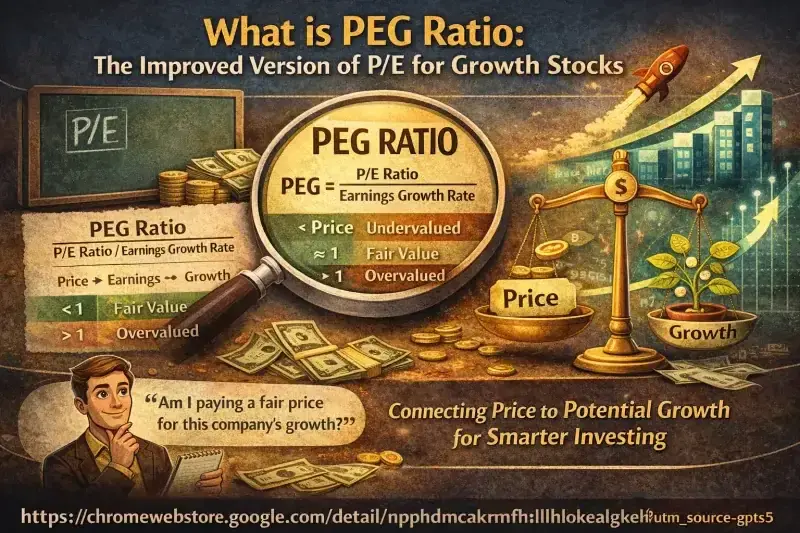
the company could potentially make in the coming years. The PEG ratio is a way of answering a question that should be on the mind of every investor: "Am I getting a fair return on my investment in the growth of this company?" A company with a high P/E ratio may appear to be overpriced at first glance. However, if the company is growing rapidly and increasing its profits, then the high P/E ratio could actually be a fair one. On the other hand, a company with a low P/E could appear to be a bargain. However, if the company is not growing or is actually declining, then the low P/E could end up being a trap.
The PEG ratio, which stands for Price/Earnings to Growth ratio, can definitely be regarded as a more intelligent measure of the P/E ratio. While the P/E ratio indeed offers an idea about what you are buying in relation to earnings, it fails to give you one key element of the puzzle: the growth that this specific company will achieve in the coming years. The true power of the PEG ratio is not the formula per se but the thought process that it generates. It is a reminder for investors to think more critically and not blindly believe in numbers because, in the end, numbers are often misleading. It is a bridge between the price of a company and its potential growth because it is not just a logical formula but one that is also smart.
But understanding the definition isn’t enough. Let's connect it back to how investors actually think and act.
Read More: The P/E Ratio Decoded: Trailing vs. Forward, and What is a "Good" P/E?
The Improved Version of P/E for Growth Stocks
When investors first enter the stock market, one of the most common metrics they come across is the P/E (Price-to-Earnings) ratio. It’s simple, widely used, and easy to understand. At its core, the P/E ratio tells you how much you are paying for every unit of a company’s earnings. Naturally, a lower P/E often feels like a better deal almost like buying something valuable at a discount. But as straightforward as it seems, the P/E ratio has a major limitation: it only looks at the present and ignores the future.
This limitation becomes even more important when dealing with growth stocks. This means that these firms are likely to outperform the average rate of growth, frequently plowing back any income made into new ventures. Here, paying attention solely to earnings may lead one astray. A firm with a higher P/E ratio and therefore appears to be costly may turn out to be justified by its rapid growth, while a firm with a lower P/E ratio, especially if not growing at all, may turn out to be worthless after all.

That’s exactly why the PEG (Price/Earnings to Growth) ratio is considered an improved version of the P/E ratio. It builds upon the P/E by incorporating the company’s expected growth rate into the equation. Instead of just asking whether a stock is cheap or expensive, the PEG ratio helps investors understand whether the price they are paying is justified by the company’s growth potential. In simple terms, it connects today’s price with tomorrow’s possibilities. The true strength of the PEG ratio lies in its ability to alter the mindset of the investor. It makes one think outside the box and analyze from a broader perspective. This is especially important in today’s market environment, which is largely influenced by anticipation and potential. For a stock investment strategy to be effective, it cannot simply rely on purchasing cheap stocks. Instead, it needs to be able to recognize stocks that have solid growth prospects relative to their prices.
All of this sounds good in theory but how does it actually work in real life? Let’s walk through a simple story.
Read More: Comparable Company Analysis (Comps): A Relative Valuation Method
Case Study: A Tale of Two Investments
Rohit had just started getting into the stock market, and like most beginners, he was trying to keep things simple. He had come across the P/E ratio and liked how easy it was to understand just find stocks with a low P/E and you’re probably getting a good deal. It sounded practical. After all, who doesn’t like buying something cheap?

One evening, while casually scrolling through stock data, he came across two companies Alpha Ltd. and Beta Ltd. Both had a P/E ratio of 20. “That’s convenient,” he thought. “Both look fairly priced. It shouldn't be too hard to pick one.”He was about to decide, but then he paused. One statement that he had come across flashed through his mind: "Numbers never lie... but they never tell the entire truth." That statement stuck with him, and so he felt compelled to take some more time trying to figure out what exactly went beyond those numbers.
And that’s when things started to look different.
Alpha Ltd. was clearly on a growth path. Its earnings were expected to grow around 20% every year, and the company seemed to be expanding steadily to new markets, better performance, and everything pointed toward momentum. Beta Ltd., on the other hand, wasn’t doing badly but it wasn’t really growing either. Its growth was around 5% a year. Stable, yes. But not exciting.
Now, those same P/E ratios didn’t feel so “equal” anymore.
While digging further, Rohit came across the PEG ratio. At first, he wasn’t sure if he needed another formula, but once he understood it, it actually felt quite logical. It simply connected price with growth. So he gave it a try.
For Alpha Ltd., the PEG ratio came out to be 1. That seemed reasonable.
For Beta Ltd., it was 4. That didn’t look so good.
That’s when it really clicked.
What looked similar at first glance turned out to be completely different once growth was taken into account. Alpha was growing and fairly priced. Beta looked okay on the surface, but didn’t really justify its valuation when growth was considered.
Rohit didn’t jump into a decision right away. Instead, he just sat back for a bit, thinking. Not because he had found the “perfect stock,” but because he had understood something more important.
Investing isn’t just about finding stocks that look cheap. It’s about knowing what you’re actually paying for.
From that point on, he stopped depending on just one number. He started looking a bit deeper, trying to understand the full picture how price and growth fit together. Because that’s where better decisions usually come from.
So what does all of this really mean for you as an investor? Let’s bring it all together.
Read More: The Multibagger Framework: A Step-by-Step Guide to Finding 10x Stocks
Explore our Products
Research Framework

Emerging Titans
Combination of quantitative analysis, industry tailwinds, and management assessment - SPRINT investment philosophy

Tiny Titans
Heavy emphasis on scuttlebutt research, plant visits, and early on-ground signals
Conclusion
In the world of investing, simple numbers can often be misleading. The P/E ratio, while useful, only tells part of the story; it shows what you are paying today but ignores what you might gain tomorrow. And in a market where future growth drives valuations, ignoring that piece can lead to poor decisions. This is where the PEG ratio proves its value. It goes a step further by connecting price with growth, helping investors understand whether a stock is truly worth its valuation. It doesn’t just refine the P/E ratio it adds meaning to it. Rather than merely running after companies with lower P/E ratios while ignoring those with higher ratios, investors may choose to be more judicious. In the end, what PEG represents isn't merely numbers but mindset. The metric serves as a reminder for investors to dig deeper and see through surface-level figures by considering the big picture. This is because intelligent investing does not mean searching for cheap companies but rather understanding their true value.
Like this, Subscribe for more practical insights, and comment “WEALTH” below with your own experiences or questions!
Investor FAQs & Screening Tips
1. What should be the value of an ideal PEG ratio?
+Answer: An optimal PEG ratio should be about one. In case it's less than one, it means that the stock is undervalued. On the contrary, when it's more than one, then the stock may be too expensive. It should be noted that it doesn't necessarily have to be true in all cases.
2. Is it applicable for all types of stocks?
+Answer: No, the ratio cannot be applied to all stocks. Indeed, the ratio is most appropriate for stocks that grow and will have increasing earnings in the future. Mature or cyclical stocks will probably have meaningless results.
3. Why should not only P/E be relied upon?
+Answer: The reason for this is the fact that P/E does not take into consideration future growth of the stock and evaluates it based on current earnings only. Thus, it misrepresents stocks with low growth, while overpricing those with high rates.
4. What are some disadvantages associated with the PEG ratio?
+Answer: One major disadvantage is that it is dependent on future growth rates, which may not necessarily be correct. Therefore, a PEG ratio may turn out to be erroneous. Therefore, it should be combined with other methods of analysis.
5. In what way can people new to investing utilize the PEG ratio while stock screening?
+Answer: People who have just started investing can utilize PEG ratio by identifying stocks whose P/E and PEG ratios are at or below one. They should then conduct further fundamental analysis to ensure that they make an informed decision.

High growth stock specialist, Value Educator
Shashank Mahajan is an equity research professional with over 12 years of experience in identifying high-potential SME and micro-cap stocks at an early stage. He follows a rigorous scuttlebutt research–driven approach, combining on-ground insights with deep financial analysis. Shashank specializes in uncovering under-researched and under-owned companies with strong management quality and long-term growth potential. Through disciplined research and early identification, he focuses on spotting tomorrow’s market leaders before they enter the mainstream investor radar.

Zen Technologies: Why Revenue Fell After Its Biggest Win

Data Patterns: India's Radar Designer and Its Waiting Orders

KSH International: The Wire Inside India's Transformers

Krishna Defence: The Steel Behind India's Warship Hulls

PNG Jewellers: A 194-Year-Old Name Goes National

Axiscades: From Services to Missile and Radar Electronics
Explore our Products
Research Framework
Emerging Titans
Combination of quantitative analysis, industry tailwinds, and management assessment - SPRINT investment philosophy
Tiny Titans
Heavy emphasis on scuttlebutt research, plant visits, and early on-ground signals

Download your free E-book - Beyond the radar
Master your micro-cap investing with our tailor-made E-book. Beyond the radar. Download now!


 Orders
 Subscription
 Share with friends
 Logout


Required Details
₹23999.00
(12 month subscription)
As per SEBI regulations, all users are mandated to complete the KYC that is validated for 1 year. Post payment, you will be redirected to the KYC screen


No comments yet. Be the first to comment!