
Power Mech Projects: Plant O&M and ₹56,729 Cr of Orders

On 9 September 2026, Vedanta Power gave a Hyderabad company a five-year contract worth ₹970 Cr to run and maintain its 2x600 MW Sakti thermal plant in Chhattisgarh. On 29 September, Moxie Power Generation gave the same company a ₹549.37 Cr contract to run its 2x600 MW Tuticorin plant for 60 months. On 19 October, Vedanta Aluminium added ₹327.35 Cr for a 130 MW captive plant in Odisha. That is about ₹1,847 Cr of plant upkeep work in six weeks.
That work has a name. Operation and maintenance, or O&M, means running a power plant day to day for its owner and keeping its boilers, turbines and pumps in shape. A coal plant runs for 25 years or more, so the O&M contract keeps coming back long after the plant is built.
Building the plant is the earlier job. Erection is putting the boiler, turbine and generator together on site, and commissioning is the testing that proves the plant can run before it is handed over. Around the main machines sits the balance of plant, or BOP, which is the coal handling, ash handling, water and cooling systems that a plant needs to work.
Today all of this work comes from one company, Power Mech Projects Ltd (NSE: POWERMECH). It started in 1999 with a gas turbine overhaul and has grown into a group that builds plants, runs them, lays roads and water lines, and now digs coal. It runs O&M for about 36,246 MW across 26 plants, and calls itself the country's largest operation and maintenance provider for power plants.
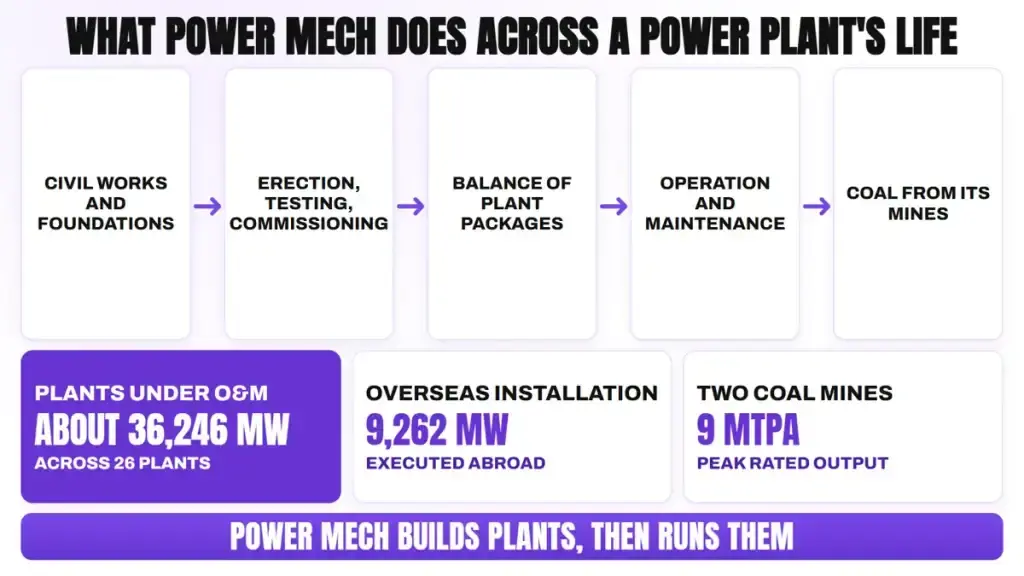
Its newest line is mining. A mine developer and operator, or MDO, is a contractor that opens a mine and runs it for the owner for decades, and is paid for each tonne it delivers. Power Mech holds two such contracts, for Central Coalfields and SAIL, worth ₹39,243 Cr of its order book in September 2026.
Power Mech Projects in five numbers
- Q2 FY27 revenue of ₹1,609 Cr, up 30%
- An order backlog of ₹56,729 Cr, or ₹17,486 Cr without the mines, in September 2026
- O&M for about 36,246 MW across 26 power plants
- FY26 revenue of ₹6,061.6 Cr and profit after tax of ₹411.7 Cr
- An FY27 order inflow target of ₹12,000 Cr, with ₹4,801 Cr won so far
So a company best known for putting boilers together is turning into one that runs plants and mines for decades. Let's first understand the company, and then look at the latest quarter to see how that shows up in the numbers.
Power Mech Projects: Company Overview
Power Mech Projects Ltd was incorporated in 1999 and is based in Madhapur, Hyderabad. Sajja Kishore Babu founded the company and is its Chairman and Managing Director, and executive director Sajja Rohit leads overseas work, business development and strategy. The company erects, tests and commissions power plants, runs and maintains them, builds civil works such as plant foundations, roads, railways and water lines, and operates two coal mines as a mine developer and operator. It listed on the BSE and NSE in the middle of the last decade, and its long-term bank facilities are rated CARE A+ with a stable outlook. The group had about 50,000 people in August 2026, including about 4,000 engineers and supervisors. Revenue from operations was ₹6,061.57 Cr in FY26, and the order backlog stood at ₹56,729 Cr in September 2026. Read this Power Sector Stocks in India 2026: List by Value Chain
"Know what you own, and know why you own it."
— Peter Lynch
Power Mech is four businesses in one: plant construction, O&M, civil work and coal mining. Each earns money in a different way, so knowing which one drives the results is the first step to reading them.
The Quarter Revenue Grew 30%
Let's look at Q2 FY27, the July to September quarter that Power Mech reported on 11 November 2026. Revenue from operations was ₹1,609.34 Cr, up 30% from ₹1,237.87 Cr a year ago. It was a little below the ₹1,623.68 Cr of Q1 FY27.

Those numbers follow the company's own method, which counts other income inside EBITDA and works out the margin on total income. Read this EBITDA Explained: Uses and Limits EBITDA rose 18% to ₹186.85 Cr. Its margin was 11.55%, up from 10.78% in Q1 but below the 12.65% of a year ago. After tax, profit rose 12% to ₹87.75 Cr.

As you can see in that chart, the year has moved in steps. Before the rise, revenue was about ₹1,293.4 Cr in Q1 FY26 and ₹1,237.87 Cr in Q2 FY26. It then rose to ₹1,419.56 Cr in Q3 and ₹2,110.73 Cr in Q4, the last quarter of the year. FY27 has started at a higher level, with ₹1,623.68 Cr and ₹1,609.34 Cr.
Beyond the total, the mix of that revenue changed a lot. The O&M business, which the company now calls Industrial Services, brought in ₹570 Cr, up from ₹378 Cr. Civil work, now called Infrastructure Construction, brought in ₹582 Cr against ₹332 Cr. Plant construction, called Industrial Construction, brought in ₹372 Cr against ₹497 Cr. Mining added ₹85 Cr, against ₹31 Cr a year ago.
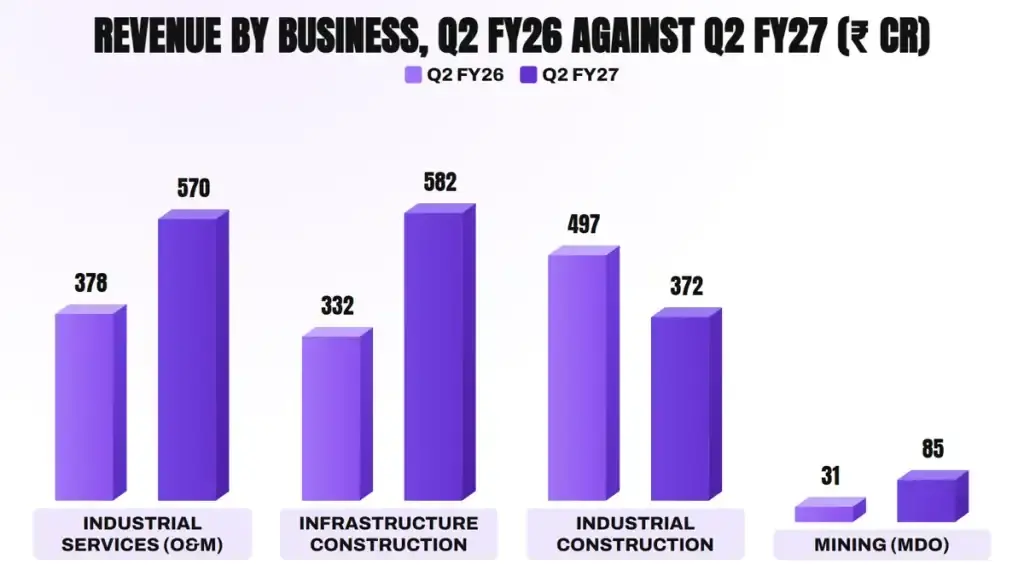
That mix also leaned toward India and toward power. In Q1 FY27, 96% of revenue came from India and 4% from abroad. Power plants made up 54% of that revenue and other sectors 46%, against a 64% power share in FY26.
That margin path is worth a closer look, so let's go through it. In Q1 FY26 the margin was 13.98%, helped by about ₹51 Cr of one-time revenue from seized mineral quantities in a royalty project. Since then it has come down each quarter to 10.78% in Q1 FY27, before rising to 11.55% now.

Management gave three reasons for the lower Q1 margin. One was that diesel, steel and gas cost more after the Middle East conflict began. Another was a change in royalty rules, which cut the margin on the royalty project from about 14% to about 10%. And the first coal mine was removing more overburden, the soil and rock above the coal, as it opened new seams. Then, in Q2, the margin improved as new orders ramped up.
Beyond EBITDA, two costs grew faster than revenue. Depreciation rose to ₹24.92 Cr from ₹17.42 Cr, and finance cost to ₹33.51 Cr from ₹28.40 Cr. So profit before tax grew 13%, less than revenue.
That same pattern shows over the half year. Revenue for the half, H1 FY27, was ₹3,233.01 Cr, up 28%. Its EBITDA was ₹362.84 Cr at an 11.17% margin, against 13.33% in H1 FY26. Profit for shareholders, after the share of partners in subsidiaries, rose 28% to ₹163.61 Cr.
That growth also needed cash. Most of it went into inventories, which rose to ₹549.86 Cr in September 2026 from ₹264.27 Cr in March. Capital work in progress rose to ₹575.98 Cr from ₹181.66 Cr, as the company builds a coal washery at its second mine. Operating cash flow for the half was about ₹2.85 Cr negative, and borrowings rose to about ₹1,176.5 Cr from about ₹651.3 Cr in March.
The Orders Behind the Next Three Years
Now let's look at the orders, because they show how much of the coming work is already booked. The order backlog is the value of signed contracts not yet billed. Power Mech gives two numbers: one with the two mining contracts, and one without them, since mining revenue comes in over 25 years or more.
In September 2026 the backlog was ₹56,729 Cr with the mines and ₹17,486 Cr without them. That second number is about 2.9 times FY26 revenue. Management says a typical construction job runs two to three years, and an O&M contract three to five years.
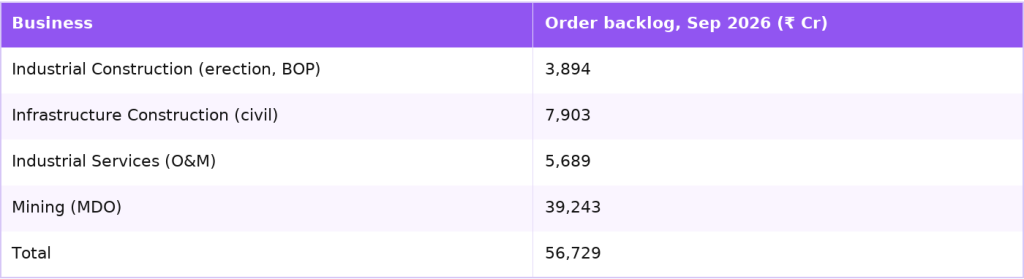

As we can see, that backlog has grown slowly but steadily. Without the mines it was ₹14,387 Cr in March 2025, ₹15,898 Cr in March 2026, ₹16,229 Cr in June 2026 and ₹17,486 Cr in September. Its O&M part grew fastest. It was ₹3,322 Cr in June 2026 and ₹5,689 Cr in September, after the Vedanta and Moxie contracts.
Beyond the backlog, new orders are the number to watch. Power Mech won ₹1,864 Cr of orders in Q1 FY27 and ₹1,890 Cr in Q2. With ₹1,046 Cr more in Q3 so far, it had ₹4,801 Cr by mid-November, or 40% of its ₹12,000 Cr target for the year.

That jump in FY24 came from the mining contracts. Since then the inflow has stayed between ₹6,347 Cr and ₹8,479 Cr a year. In FY26 it would have been higher, but a ₹1,563 Cr battery storage order from the West Bengal power utility was cancelled.
What the order book says: without the mines, the ₹17,486 Cr of work is about 2.9 times FY26 revenue. With construction jobs running two to three years and O&M contracts three to five, that book covers much of the work for the next few years, as long as new orders keep coming.
How a Gas Turbine Crew Became a Power Plant Builder
Now that we have seen the quarter, let's go back to where the company began. Sajja Kishore Babu, a mechanical engineer with more than 37 years in power, founded Power Mech in 1999. Its first job was overhauling a gas turbine for a large utility. He is still the Chairman and Managing Director, and Sajja Rohit, an executive director, leads overseas work, business development and strategy.
That first decade was about power plants. In those years the company erected boilers and turbines for BHEL and others, and took on maintenance contracts at large plants. Its first O&M job for a public sector owner was at Singareni Collieries. Between 2010 and 2015 it moved into civil work, railways, water and overseas markets, and in the middle of that decade it listed on the BSE and NSE, with its share offer oversubscribed 38 times.
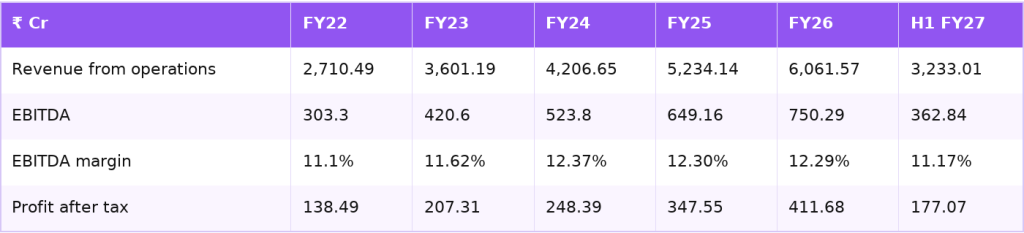
As you can see, revenue grew about 2.2 times from FY22 to FY26, or about 22.3% a year. Profit after tax grew about three times. Its EBITDA margin rose from 11.1% to about 12.3% and then stayed there for three years.
Beyond profit, cash flow has moved less evenly. Read this Cash Flow Statement Explained From FY22 to FY26, operating cash flow added up to about ₹949.7 Cr, against about ₹1,353.42 Cr of profit after tax, or about 70%. In FY25 it was only ₹0.74 Cr, as trade receivables rose by ₹422.57 Cr in the year. In FY26 it came back to ₹387.45 Cr, as collections improved.
Those same years also changed what Power Mech is. From 2020 it moved into mining, took on full BOP packages instead of only erection work, and grew its O&M book. In FY26 it won its largest single order so far, a ₹2,550 Cr BOP package from BHEL for an 800 MW unit at Singareni. In April 2026 it won the O&M of the Mumbai Monorail, its first job in urban transport.
"If it's only power plant construction, erection, testing, commissioning, we believe we have maximized our execution potential." - Rohit Sajja, Executive Director, August 2026
Four Businesses Under One Roof
Now let's split the business into its parts, because each one earns money in a different way. Read this Segment-Wise Revenue Analysis Explained Power Mech reports one segment in its accounts, but its results deck shows revenue for four businesses. In Q2 FY27, O&M and civil work each brought in more than a third of revenue.

These lines sound different, but as you will see, they share the same crews, cranes and site skills. A team that erects a boiler can later maintain it, and the civil team that pours its foundations can build a coal handling plant next door.
Industrial Construction, From Boilers to Full BOP Packages
Let's start with the oldest line, plant construction. Here Power Mech erects, tests and commissions boilers, turbines and generators, mostly as a sub-contractor to BHEL or to the plant owner. The company says it can work on 14 to 15 boilers of 800 MW at the same time.
That line has reached its limit, management says, so erection alone will grow only 5% to 7% a year. The growth is now in BOP packages, where Power Mech takes the whole job of designing, buying and building the systems around the main machines. Management says the erection and BOP work together can grow 20% to 22%. The Singareni package is the first such job, and it keeps about 40% of the value as in-house work.
That shift shows up in this quarter. Plant construction revenue was ₹372 Cr, against ₹497 Cr a year ago. The Athena project of Vedanta was stopped for three to four months after an accident at the site, and the Udupi flue gas job was near completion. Work at Athena has since resumed.
Beyond Athena, the BOP push is where management wants most new orders. For FY27 it is aiming for one or two more BOP packages, with BHEL's tenders as the main source. The company also does flue gas desulphurisation, or FGD, which means fitting a plant with a system that removes sulphur from its exhaust. Its first FGD job was a 500 MW unit at Vindhyachal.
Industrial Services, the O&M Business
Next, let's look at O&M, which management calls its margin driver. Power Mech runs plants for private owners such as Adani, Vedanta and JSW, and for some state utilities. It has more than 24,000 people in this business alone.
That business earns an operating margin of about 18%, management says, against 10% to 11% for the core construction work. It is also light on working capital. Its main cost is a month of salaries, since there is little material to buy.
That demand follows new plants. Management expects 8,000 to 10,000 MW of new thermal capacity a year, and puts the new O&M opportunity from it at ₹800-1,000 Cr a year. Private owners usually hand out O&M of new plants, and some state utilities have started doing so too. O&M revenue was about ₹1,760 Cr in FY26, and the company targets about ₹2,089 Cr in FY27.
Those new plants are already turning into contracts. In FY26 Power Mech took on about 4,100 MW of new O&M work, including a captive power plant for Hindustan Zinc. In Q2 FY27 it added the Vedanta and Moxie plants, and a three-year contract for the ash and coal handling plants at TGGENCO's Yadadri station in Telangana.
That O&M skill also reaches beyond power plants. Its ₹279 Cr Mumbai Monorail contract covers 15 stations. Management sees metro O&M as a new market, as India's metro routes grow from about 1,095 km to about 2,000 km.
Infrastructure Construction, the Civil Business
Now let's move to civil work, now the largest line. It covers plant foundations and structures, cooling towers and coal handling plants, plus roads, railway electrification, metro depots and drinking water lines under the Jal Jeevan Mission. Its revenue was ₹582 Cr in Q2 FY27, up about 75%.
That growth comes from large plant jobs. For JSW's Salboni plant in West Bengal, Power Mech won about ₹850 Cr of civil and structural work. It also does civil work for Adani plants at Mahan, Mirzapur and Raipur. Outside power, the civil backlog in June 2026 included about ₹780 Cr of railway work and about ₹1,000 Cr of roads and drinking water.
Mining, the Long Contracts
Finally, let's look at mining, the smallest line by revenue and the largest by order book. Power Mech runs the Kotre Basantpur Pachmo (KBP) coal mine for Central Coalfields under a 25-year, ₹9,294 Cr contract. It also runs the Tasra coking coal mine for SAIL under a 28-year, ₹30,383 Cr contract. Together they have a peak rated output of 9 million tonnes a year.
"Time is the friend of the wonderful company, the enemy of the mediocre."
— Warren Buffett
Contracts that run for 25 to 28 years reward a contractor that keeps its costs and output in line year after year. They punish one that does not, so the mining margin is the number to follow.
That mining work is only starting. KBP began earning revenue in November 2025, and mining brought in ₹84 Cr in Q1 FY27 and ₹85 Cr in Q2. At Tasra, Power Mech is building a washery, a plant that cleans coking coal before it goes to a steel mill. It is due to start around November or December 2026, management says.
That ramp-up shows in the tonnes too. KBP's contract calls for 1.5 million tonnes a year, but the client is ready to take about 3 million tonnes in FY27, and management plans 4-4.2 million tonnes in FY28. In Q1 FY27, KBP brought in ₹57.54 Cr and Tasra ₹26.34 Cr. For FY27, management expects about ₹350 Cr from KBP and ₹150 Cr from Tasra.
Where Power Mech Fits in the Power Value Chain
Now let's place Power Mech in the wider power chain. A thermal plant starts with a developer, such as NTPC, Adani or JSW, that orders the boiler, turbine and generator from a main contractor, mostly BHEL or L&T. Those main contractors then hand out the site work: civil, erection and BOP packages. Power Mech wins much of its work at this level, and then bids for the O&M once the plant runs.

We can see that this chain is busy again. Management says it tracks about 58,000 MW of thermal capacity ordered from BHEL and L&T over the last three years. It also names the owners' plans: Adani wants to take its capacity from 18,330 MW to 42,000 MW, NTPC its coal capacity from 67 GW to 91 GW, and JSW from 5,658 MW to 30,000 MW. Management also cites the government's plan to raise capacity from 228 GW to 291 GW by 2032.
Those plans turn into a pool of tenders for Power Mech. In August 2026 management put its near-term opportunity at ₹25,000-30,000 Cr, of which about ₹20,500 Cr is in power. It says it wins 60% to 65% of the power bids it takes part in.
Beyond power, management is also bidding in mining and steel. It says NMDC plans to invest about ₹70,000 Cr to expand its iron ore mining, and Power Mech has teamed up with thyssenkrupp to bid jointly for some of those jobs. New steel plants planned by JSW, ArcelorMittal and SAIL are on its list too.
Those tenders come from a handful of large owners, and the ties show up in the backlog. In June 2026 Power Mech had about ₹5,300 Cr of work across five BHEL projects, about ₹2,400 Cr across 14 Adani projects and ₹1,551 Cr across six Vedanta projects. Private owners such as Adani and JSW pay within 15 to 30 days of a bill, management says, and BHEL within 30 days.
Beyond coal, the same skills reach a few newer areas. Power Mech is doing ₹563 Cr of civil work for the 2x700 MW Kaiga nuclear units, and works with BHEL on about 1,400 MW of nuclear capacity. Overseas, it has about 1,500 people in the Middle East and a long O&M contract for a captive power plant in Nigeria. In FY26 its contract receipts from Abu Dhabi were ₹228.81 Cr and from Nigeria ₹74.60 Cr.
Why Power Mech's Moat Is Hard to Copy
Now that we have seen the parts, let's understand the moat. After all, many contractors can pour concrete or lift a boiler drum. So the question is why plant owners keep giving Power Mech the work, and why a new rival cannot easily take it.
"In business, I look for economic castles protected by unbreachable moats."
— Warren Buffett
For a contractor, the castle is its record and its people. The question for Power Mech is whether that record lets it earn a higher margin as O&M and mining grow.
One part is scale of people. Management says the group had about 50,000 people in August 2026, including about 4,000 engineers and supervisors, up from about 40,000 a year earlier. Hiring and training that many skilled workers, and moving them between sites, takes years. Power Mech also owns 80% to 90% of the cranes and equipment it needs, and hires only the largest ones.
Another layer comes from the plant record. It has delivered more than 208 projects for over 80 clients in 27 years. Its O&M book of about 36,246 MW is about 16% of India's coal-based capacity, and the company calls it the largest such position in the country. A plant owner who hands over a 600 MW unit wants a contractor that has run many such units before.
Then there is the link between building and running. When Power Mech erects a plant, it learns its machines, and that helps it win the O&M later. Management says private owners such as Adani and JSW prefer it for its delivery record, and its 14 open Adani projects point the same way.
Beyond people and records, Power Mech has added digital tools. It runs a computerised maintenance management system and sensor-based fault diagnostics at the plants it maintains, which it says help raise plant availability for its O&M clients.
That record also counts with lenders. CARE rates Power Mech's long-term bank facilities A+ with a stable outlook, which helps when a large contract needs bank guarantees.

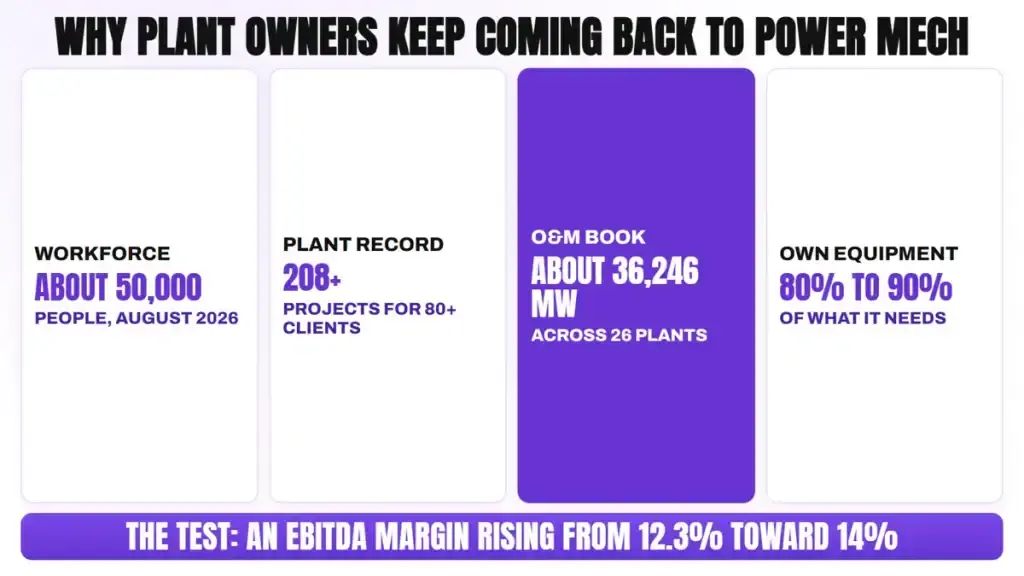
That table also shows us the test of the moat. If owners value Power Mech's record, its margin should rise as O&M and mining grow. So far the margin has held near 12.3% for three years, but not risen.
Financials: Five Years of Revenue, Margins and Cash Flow
One quarter can mislead in a contracting business, where billing bunches up at the end of the year, so let's look at the full years together. EBITDA here follows the company's own method, which includes other income and works out the margin on total income; the first half of FY27 is shown for comparison.

Revenue grew about 2.2 times in four years, from ₹2,710.49 Cr in FY22 to ₹6,061.57 Cr in FY26, or about 22.3% a year, and profit after tax grew about three times. The EBITDA margin rose from 11.1% in FY22 to about 12.3%, and then held there from FY24 to FY26.
Cash flow has lagged profit. From FY22 to FY26, operating cash flow added up to about ₹949.7 Cr, against about ₹1,353.42 Cr of profit after tax, or about 70%. It was only ₹0.74 Cr in FY25, when trade receivables rose by ₹422.57 Cr, and it recovered to ₹387.45 Cr in FY26. Work done but not yet certified for billing rose to ₹1,050.74 Cr in March 2026.
The balance sheet has started to carry more debt. Borrowings rose to about ₹1,176.5 Cr in September 2026 from about ₹651.3 Cr in March, as the company built the Tasra washery and carried more inventory, against total equity of ₹2,718.43 Cr. Whether the mines and new O&M contracts turn that spending into cash is the next test.
"Never invest in any company before you've done the homework on the company's earnings prospects, financial condition, competitive position, plans for expansion, and so on."
— Peter Lynch
For Power Mech, that homework means reading the cash flow statement next to the profit and loss account, because unbilled work and new debt show up there first.
What FY27 and FY28 Could Look Like on Management's Numbers
So where does the business go from here? In August 2026 management guided FY27 revenue of ₹7,300 Cr. That would be about 20.4% more than the ₹6,061.57 Cr of FY26. It also guided an EBITDA margin of 12.5% and order inflow of ₹12,000 Cr.
That margin path is meant to keep rising. Management targets a gain of about 0.5% a year, to about 14% around 2030, as mining and O&M make up more of revenue.
As we saw earlier, mining is the main lever. Management expects ₹500 Cr of mining revenue in FY27, then ₹1,100-1,200 Cr in FY28 as Tasra reaches its full output. It guides a mining EBITDA margin of 15% to 17% in FY28 and 21% to 23% from FY29, against about 15% now.
Now let's put that target against the first half. That first half brought ₹3,233.01 Cr of revenue. Reaching ₹7,300 Cr needs about ₹4,067 Cr in H2. That is about 15.2% more than H2 FY26. Mining brought in ₹169 Cr in H1, so it needs about ₹331 Cr more in H2 to reach ₹500 Cr.
That kind of H2 jump has happened before. In FY26, the second half brought about ₹3,530.3 Cr of revenue against ₹2,531.29 Cr in the first half, about 39.5% more, with Q4 alone at ₹2,110.73 Cr.

That growth also needs funding. Management says its present bank limits and staff can support up to ₹10,000 Cr of revenue, with ₹100-120 Cr of capex a year for new orders. The Tasra washery and its coal handling plant need more, which is why borrowings rose in H1.
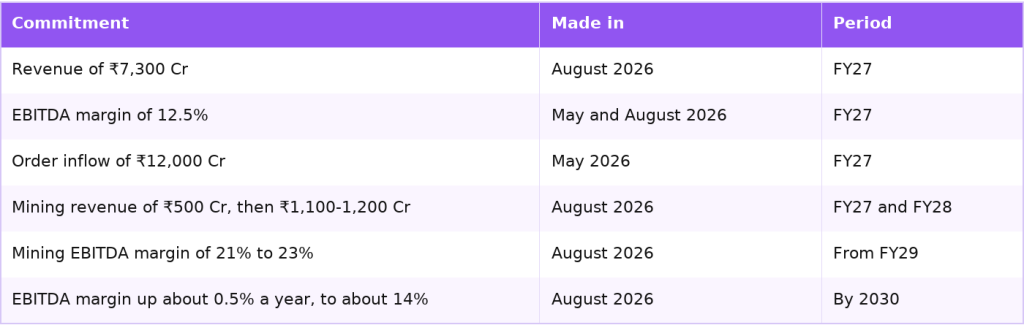
Those commitments are easier to judge against the past. So let's check what management said before against what it delivered.

That record shows us a clear pattern. Margins have come in where management said, but revenue and order inflow came in below target in both FY25 and FY26, and the FY27 revenue target is lower than first planned. In FY26 the gap had specific causes, such as unpaid water bills in Uttar Pradesh and the cancelled storage order. Still, it is a reason to read the FY27 targets with care.
Key Risks
Now let's look at what could go wrong for Power Mech, because some of these risks have already shown up in the last year.
- Order inflow below target: inflow came in at about 53% of target in FY25 and 72% in FY26, and stood at 40% of the FY27 target by mid-November. BHEL's tendering has been delayed, and package sizes can change.
- Cash tied up in unbilled work: uncertified revenue, work done but not yet approved for billing, rose to ₹1,050.74 Cr in March 2026 from ₹806.92 Cr. Water bills in Uttar Pradesh went uncertified in FY26 because central funds were not allocated.
- Rising debt: borrowings rose to about ₹1,176.5 Cr in September 2026 from about ₹651.3 Cr in March, and operating cash flow was negative in H1 FY27. The group also had capital commitments of ₹1,015.74 Cr and bank guarantees of ₹2,807.58 Cr in March 2026.
- Mining ramp-up: mining has to grow from ₹169 Cr in H1 to ₹1,100-1,200 Cr in FY28. A delay at the Tasra washery, or more overburden than planned, would push out both revenue and the higher margin.
- Margin pressure: the margin was 11.17% in H1 FY27, against guidance of 12.5%. Price variation clauses cover most cost increases, but they kick in with a lag, and public sector clients may need claims or arbitration.
- Royalty rule change: the royalty project brought in about ₹700 Cr in FY26, and its margin dropped from about 14% to about 10% after the government changed how penalties are shared.
- Thermal concentration: power made up 54% of Q1 FY27 revenue, and most of the O&M and erection book is coal-based. A slowdown in thermal orders would hit several lines together.
- Site safety and disputes: an accident at the Athena site stopped work for three to four months. The company also has claims and counter-claims pending in several contract disputes.
- Overseas exposure: the Middle East conflict raised diesel, steel and gas costs, and has made new work in the region harder to plan.
"Overall, the stripping ratio is within the agreed quantity ratio only, but one quarter you will have a higher OB cost and lower coal production, which get normalized in the subsequent quarters." - N. Nani Aravind, Chief Financial Officer, August 2026
"Risk comes from not knowing what you're doing."
— Warren Buffett
Power Mech has run power plants for decades, but running two large coal mines is newer work. The risks below show where that learning curve, and the company's cash, will be tested.
Explore our Products
Research Framework

Emerging Titans
Combination of quantitative analysis, industry tailwinds, and management assessment - SPRINT investment philosophy

Tiny Titans
Heavy emphasis on scuttlebutt research, plant visits, and early on-ground signals
What to Track Next
If you follow Power Mech, these are the signals that will show where it goes next.
- H2 FY27 revenue against the ₹7,300 Cr target, which needs about ₹4,067 Cr in the half
- The EBITDA margin against 12.5%, after 11.17% in H1
- Order inflow against ₹12,000 Cr, after ₹4,801 Cr so far, and the O&M backlog after ₹5,689 Cr
- The start of the Tasra washery, and mining revenue against ₹500 Cr for FY27
- Borrowings after about ₹1,176.5 Cr, uncertified revenue, and operating cash flow in H2
- New BOP packages after the ₹2,550 Cr Singareni job
Conclusion
Let's put it all together. Power Mech Projects has grown revenue from ₹2,710.49 Cr in FY22 to ₹6,061.57 Cr in FY26, with an EBITDA margin near 12.3% for three years. Its O&M book is growing fast, with about ₹1,847 Cr of new contracts in six weeks, and its two mines add ₹39,243 Cr of long-term work. The cautious thread is cash: operating cash flow was negative in H1 FY27, and borrowings rose to about ₹1,176.5 Cr. The next two quarters, with the Tasra washery start and the second-half revenue push, will show which thread is stronger.
Still, the next step depends on a few things going right at the same time. What happens next depends on whether the Tasra washery starts on time, whether order inflow finally meets its target, and whether the cash tied up in unbilled work and new borrowings turns back into cash.
FAQs
What does Power Mech Projects do?
+Power Mech erects, tests and commissions power plants, and then runs and maintains them for their owners. It also builds civil works such as plant foundations, roads, railways and water lines, and runs two coal mines as a mine developer and operator. FY26 revenue from operations was ₹6,061.57 Cr.
How did Power Mech Projects do in Q2 FY27?
+Revenue from operations rose 30% to ₹1,609.34 Cr. EBITDA rose 18% to ₹186.85 Cr at an 11.55% margin, and profit after tax rose 12% to ₹87.75 Cr. O&M revenue was ₹570 Cr and civil revenue ₹582 Cr.
What is Power Mech's order backlog?
+The order backlog was ₹56,729 Cr in September 2026. Of this, ₹39,243 Cr is from the two coal mining contracts, which run for 25 to 28 years, and ₹17,486 Cr is construction and O&M work, about 2.9 times FY26 revenue.
How big is Power Mech's O&M business?
+Power Mech runs O&M for about 36,246 MW across 26 power plants, about 16% of India's coal-based capacity. O&M brought in ₹570 Cr in Q2 FY27, and management puts its operating margin at about 18%. In September and October 2026 it won O&M contracts worth about ₹1,847 Cr from Vedanta and Moxie Power.
What are Power Mech's targets for FY27 and FY28?
+Management guides FY27 revenue of ₹7,300 Cr, an EBITDA margin of 12.5% and order inflow of ₹12,000 Cr. H1 FY27 revenue was ₹3,233.01 Cr, so about ₹4,067 Cr is needed in the second half. It expects ₹500 Cr of mining revenue in FY27 and ₹1,100-1,200 Cr in FY28.
What are the main risks for Power Mech Projects?
+Order inflow came in below target in FY25 and FY26, and uncertified revenue rose to ₹1,050.74 Cr in March 2026. Borrowings rose to about ₹1,176.5 Cr in September 2026 and operating cash flow was negative in H1 FY27. The mining ramp-up and the Tasra washery also have to go to plan.

High growth stock specialist, Value Educator
Shashank Mahajan is an equity research professional with over 12 years of experience in identifying high-potential SME and micro-cap stocks at an early stage. He follows a rigorous scuttlebutt research–driven approach, combining on-ground insights with deep financial analysis. Shashank specializes in uncovering under-researched and under-owned companies with strong management quality and long-term growth potential. Through disciplined research and early identification, he focuses on spotting tomorrow’s market leaders before they enter the mainstream investor radar.
More about Shashank Mahajan →
PCBL Chemical: Carbon Black Margins and Battery Materials

KEC International: Record Orders, Weak Margin, High Debt

Sona BLW: EV Revenue Now Tops Half of Its Auto Sales

HPL Electric & Power: Smart Meters, Wires and Two Engines

Kaynes Technology: EMS, Chip Plants and ₹10,563.5 Cr Orders

Sterlite Technologies: Glass Rods to Hyperscaler Deals
Explore our Products
Research Framework
Emerging Titans
Combination of quantitative analysis, industry tailwinds, and management assessment - SPRINT investment philosophy
Tiny Titans
Heavy emphasis on scuttlebutt research, plant visits, and early on-ground signals



India's Aerospace Opportunity
Global Demand. Supply Bottlenecks. Opportunities Ahead.
Don't Miss This Exclusive Webinar!
Join Value Educator to decode the key trends shaping India's aerospace sector and learn how to identify tomorrow's potential leaders in the space.
- How the aircraft value chain works, layer by layer
- Indian companies supplying global aircraft makers
- A framework to judge any aerospace company

 Orders
 Subscription
 Share with friends


Required Details
₹23999.00
(12 month subscription)
As per SEBI regulations, all users are mandated to complete the KYC that is validated for 1 year. Post payment, you will be redirected to the KYC screen


No comments yet. Be the first to comment!