
Universal Cables: An Old Cable Maker Reinvented
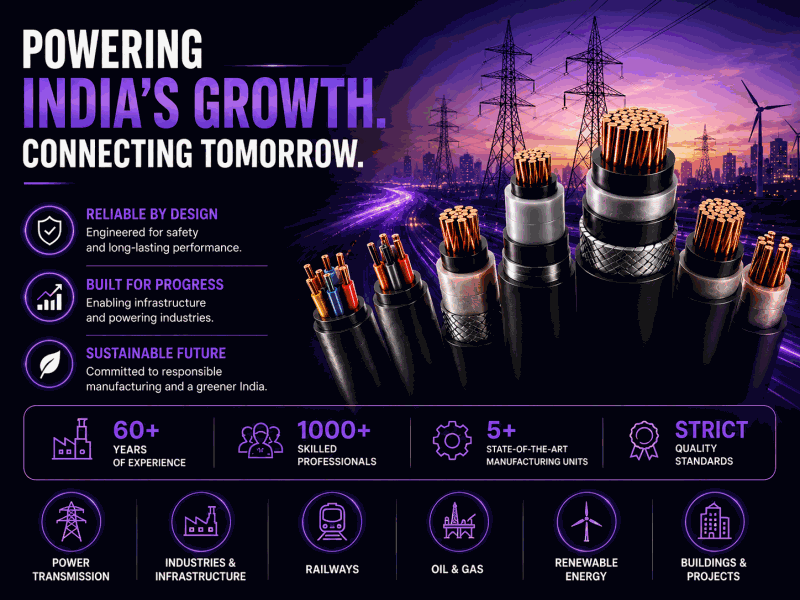
THE QUIET REINVENTION OF AN OLD-LINE CABLE MAKER
What if the real story isn't the cable?
What if I told you that one of the most interesting industrial stories in India isn't sitting in front of consumers at all?
You won't see its products on a retail shelf. The company is Universal Cables, part of the MP Birla Group. You probably won't notice them while using your phone, driving to work, or switching on a light. But behind power stations, renewable-energy projects, transmission networks and increasingly crowded urban infrastructure, there is a critical layer of equipment that has to work reliably — often without anyone thinking about it.
And this is where the story gets interesting.
For years, this company looked like a fairly traditional cable manufacturer. A business exposed to copper and aluminium prices, infrastructure cycles and the ups and downs of industrial capex. Nothing particularly exciting on the surface. But underneath that simple description, the company was quietly changing where it wanted to compete.
Instead of simply chasing more volumes, it started moving toward higher-voltage, more technically demanding and higher-value products. It invested in specialised manufacturing capabilities, built technical partnerships, developed credentials in extra-high-voltage projects and gradually expanded beyond simply manufacturing cables.
The timing may now be turning in its favour. India's electricity demand is rising, renewable capacity is expanding, transmission infrastructure needs to be upgraded, and underground power transmission is becoming increasingly important in land-constrained areas. At the same time, newer power systems are creating demand not just for cables, but for equipment that can help maintain the quality and stability of electricity.
And the numbers are beginning to tell the story. After years of uneven performance, the company has reached its highest-ever revenue, while EBITDA and PAT have grown much faster than sales. Its order book has expanded sharply, capacity is being added, and the contribution from higher-value businesses is increasing.
“The production of electricity... is an enormous business. And it's not going away.”
Charlie Munger
But here's the important part: this is not simply a story about India's power sector growing.
The real question is whether a company that spent years building technology, capacity and customer credentials can now convert that groundwork into higher margins, stronger cash flows and better returns on capital.
Because if it can, we may be looking at something very different from the conventional cable manufacturer that the market once saw.
Imagine a city that needs more electricity, but there is no easy corridor left for another overhead line. Imagine a renewable project generating power hundreds of kilometres away from the people who need it. The electricity may be invisible, but the infrastructure carrying it is not optional.
That is where Universal Cables enters the story.
Universal Cables is not simply riding India's power-capex cycle. It has spent years moving from conventional cable manufacturing toward higher-value EHV infrastructure, and FY2026 is the first clear financial evidence that the strategy may be working.
“The power and energy sectors are the biggest constituents of the infrastructure sector.”
Shri Narendra Modi
What is Universal Cables really becoming?
Universal Cables has been in the cable business for decades. Its portfolio spans low-, medium-, high- and extra-high-voltage power cables, wires and conductors, capacitors, harmonic filters and related turnkey projects.That sounds ordinary until you ask a different question: where in this value chain does the company want to compete?
The answer increasingly points upward — toward products where reliability, testing, engineering, certifications and execution matter more than simply producing the cheapest kilometre of cable.
The simple comparison
Commodity end: volume, price and manufacturing efficiency dominate.
Higher-end EHV end: technology, qualification, reliability and project credentials matter much more.
That distinction is the starting point for understanding the company.
Product Portfolio: From Everyday Wires to High-Voltage Infrastructure
What makes the company interesting is the breadth of its product portfolio. It is not dependent on a single cable category. Its portfolio spans low-, medium- and extra-high-voltage power cables, alongside control and instrumentation cables, specialty and elastomeric cables, conductors and capacitors. Its manufacturing capabilities extend from 1.1 kV to 500 kV for XLPE power cables, giving it exposure across multiple layers of the electrical infrastructure chain.At the lower end of the portfolio are LV and MV power cables, PVC cables and control cables, which serve applications ranging from utilities and industrial facilities to railway signalling and distribution networks. The company also offers instrumentation cables, designed for industrial measurement and control applications, along with specialty and elastomeric cables for more demanding use cases.
But the more strategically important part of the portfolio sits at the top end — Extra High Voltage (EHV) cables. The company has capabilities extending up to 400 kV, with VCV-based manufacturing infrastructure dedicated to EHV production. Over the years, it has built credentials across a broad EHV product range, including both domestic and export markets.
The portfolio also extends beyond cables. Its capacitor business covers low- and high-voltage power capacitors, capacitor banks, APFC panels and power-quality solutions, including Static VAR Generators and Active Harmonic Filters. This gives the company exposure to a broader problem in modern power systems: not just transmitting electricity, but improving power quality, reactive-power management and grid efficiency.
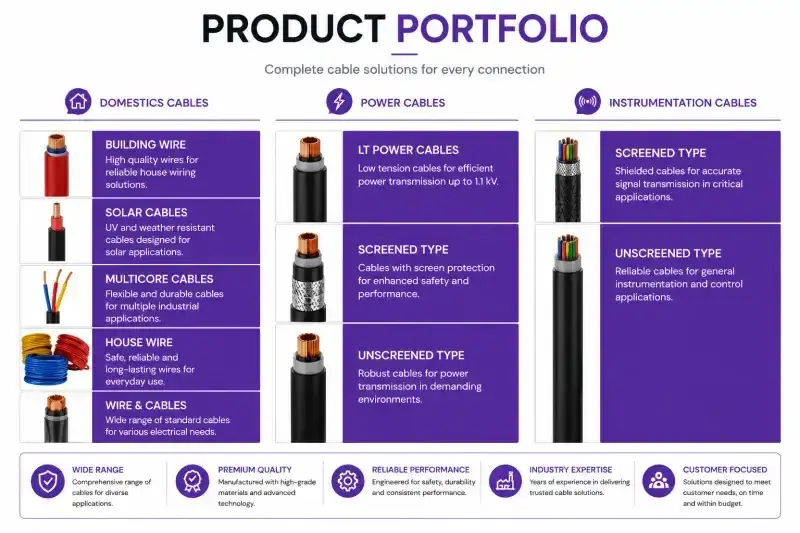
And this is where the portfolio becomes strategically interesting. The company can participate in a customer's electrical infrastructure at multiple levels — from conventional power distribution and industrial control to high-voltage transmission and specialised power-quality solutions. It also offers turnkey underground transmission capabilities covering design, cable supply, laying, jointing, installation, testing and commissioning, including projects up to 400 kV.
So the portfolio is not simply wide — it is gradually becoming more valuable. The lower-voltage products provide breadth and a diversified customer base, while EHV cables and power-quality solutions offer the potential for better realisations, stronger technical barriers and greater value per project. That shift toward higher-value products is one of the most important things to watch in the company's evolution. https://valueeducator.com/small-cap-stocks/top-power-sector-stocks-in-india-for-2026
“The economic transmission of power ... is of all-surpassing importance to man.”
— Nikola Tesla
Manufacturing Process
The manufacturing process is built around multiple layers of quality control rather than a single final inspection. It begins with the procurement of key materials such as aluminium/copper, XLPE and PVC, followed by in-house testing before the materials enter the production line. The conductors then move through twisting, insulation and resistance checks, followed by laying, inner seating and armouring.The process continues through outer seating, final testing and dispatch, creating
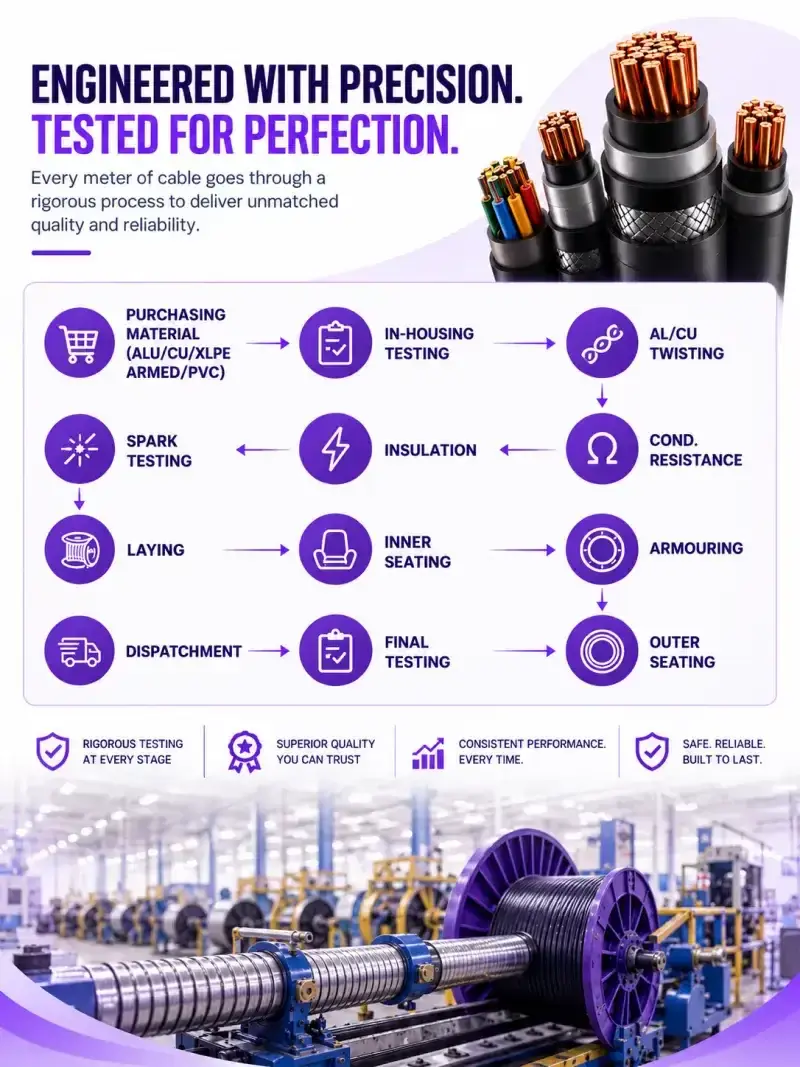 multiple checkpoints before the finished cable reaches the customer. This matters particularly for power and specialised cables, where consistency in conductivity, insulation and mechanical protection can directly influence long-term reliability.
The broader takeaway is simple: the product is only as reliable as the process behind it. By controlling testing and production stages across the manufacturing chain, the company can maintain tighter quality standards and build the credentials required to serve demanding industrial, infrastructure and power customers.
Why move up the value chain?
A cable is not valuable merely because it contains copper or aluminium.In critical power infrastructure, the real value is in making sure the system works reliably for years.
That creates a barrier that is easy to underestimate. A new competitor cannot simply announce an EHV factory and instantly become a credible supplier.
From Factory to Credential
It's advanced technology powers a specialised manufacturing plant, where every product undergoes rigorous testing before receiving official certification. This commitment to quality has resulted in a strong track record of successful projects, which in turn has earned the trust of our customers. That trust is reflected in the steady stream of repeat orders the company receive.
Universal Cables has spent years building that chain. Its technical relationships have included NKT in Germany for 400 kV EHV XLPE underground cables, while its broader technical ecosystem has included Furukawa Electric and Viscas.
This is why the company's history matters. The moat, if it exists, was built before the current power-investment cycle became obvious. intact for Decades. https://valueeducator.com/fundamental-analysis-basics/economic-moat-explained
The difficult years mattered
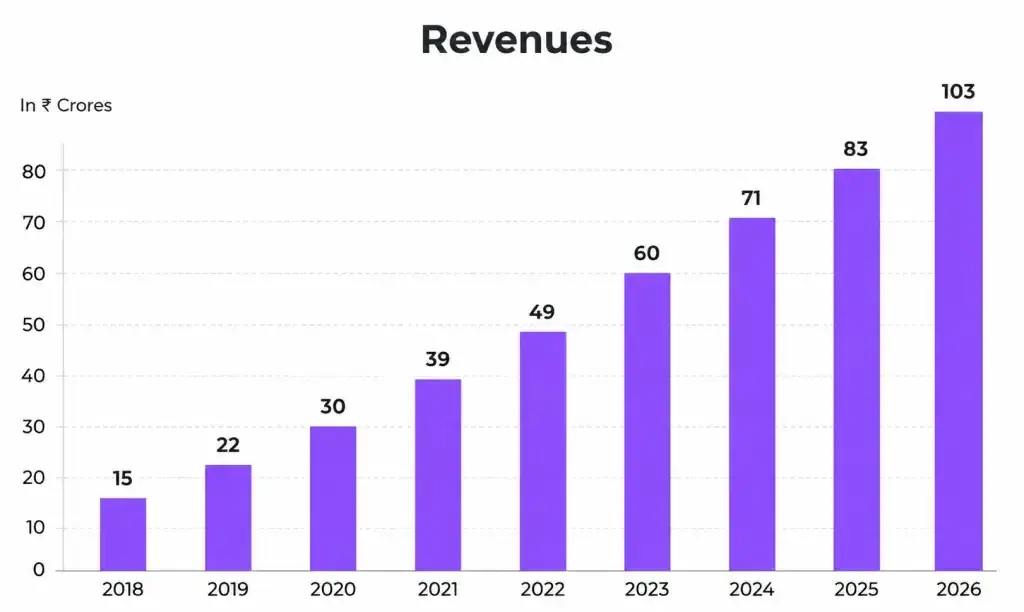
The strategy was not built in a straight line. In FY2020-21, COVID disruption hit project execution, logistics and industrial activity. Revenue fell from about ₹1,569 crore to ₹1,281 crore. EBITDA dropped from about ₹181 crore to ₹104 crore, while PAT fell to roughly ₹12 crore.It would have been easy to look at those numbers and conclude that the business was simply cyclical. But the next few years tell a different story.FY2022-23: the first proof
Revenue recovered to roughly ₹2,202 crore. EBITDA reached about ₹203 crore and PAT rose to approximately ₹63 crore. Management pointed to manufacturing expansion, better product mix, higher utilisation, lower scrap, raw-material management and supply-chain improvements. The important lesson was not merely that revenue came back.The Signal
When utilisation and product mix improve together, earnings can grow much faster than revenue.The year that looked weak — but wasn't necessarily
FY2023-24 looked disappointing on the surface. Revenue declined to around ₹2,021 crore and profitability also weakened.
But the company was simultaneously upgrading its EHV manufacturing capability. Its VCV lines were taken through planned shutdowns for upgrades, with increased rated capacity available after the work.
For an industrial company, this changes the interpretation.
A temporary revenue sacrifice can make sense if it removes a bottleneck that would otherwise limit future growth.Then the numbers finally caught up, FY2024-25 brought revenue back to roughly ₹2,414 crore, with EBITDA around ₹202 crore and PAT around ₹57 crore. More importantly, EHV growth was becoming visible. Then FY2025-26 delivered the clearest signal yet.
FY2026 IN THREE NUMBERS
Revenue: ₹3,023 crore | EBITDA: ₹289 crore | PAT: ₹97 crore
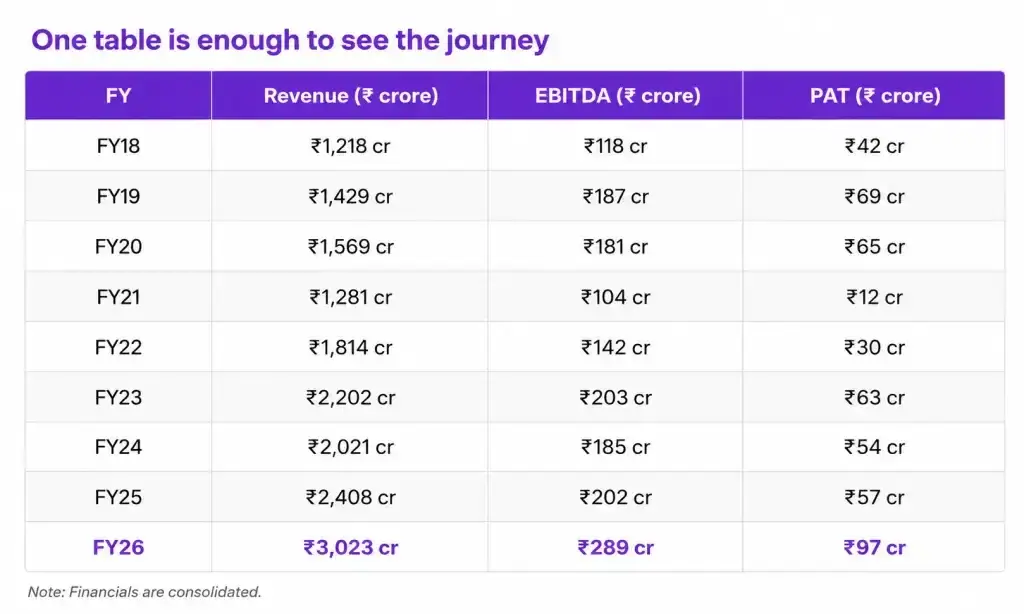
Revenue grew about 25.5% year on year. EBITDA grew roughly 42.8%. PAT grew roughly 68.5%. EHV cable revenue grew about 33%.
That gap between revenue growth and profit growth is the part worth watching.
It suggests the business is beginning to benefit from operating leverage and a richer product mix. https://valueeducator.com/fundamental-analysis-basics/ebitda-explained-limitations
Why EHV is the centre of the story
EHV is where the Universal Cables story becomes more interesting than a simple cable-volume story.The company has capability up to 400 kV and has executed major underground EHV projects. It has highlighted projects involving 400 kV underground transmission and has referenced international EHV work as well.
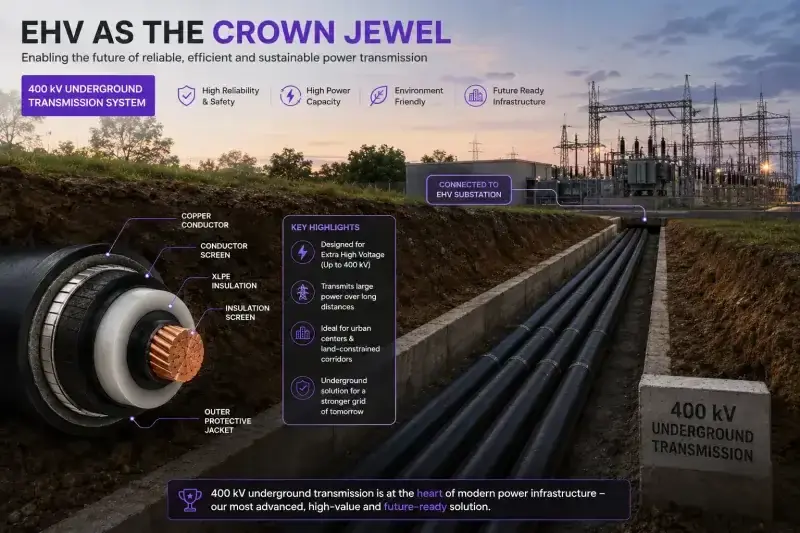
A successful project does more than generate one year's revenue. It can become a reference point for the next tender.
The Compounding Loop
Large project → reference credential → stronger bidding position → larger orders → higher utilisation → more cash → more capacityThat is why project credentials can be more valuable than simply adding tonnes of manufacturing capacity.
“We're building things that are essential to society, and people need our services.”
Warren Buffett
The second engine is hiding beside the cable business
Universal Cables is also building a Quality Power Solutions business covering capacitors, capacitor banks, harmonic filters, automatic power-factor-control systems and related solutions.In FY2025-26, Quality Power Solutions turnover exceeded ₹179 crore and grew by roughly 78%.
The strategic shift is subtle but important: the company is moving from selling a product toward participating in a broader electrical infrastructure solution.
That matters because renewable-heavy power systems can create additional requirements around reactive power, harmonics and grid stability.
Capacity: the bet behind the story
Demand alone does not create earnings. A company must have the capacity to serve it.Universal Cables has been expanding its Satna and Goa facilities, with the planned investment increased to more than ₹505 crore. The expansion is aimed at LV, MV and HV/EHV cable capacity, with additional CCV capability planned.
The company has also described the benefit of being able to shift production between voltage categories depending on demand.
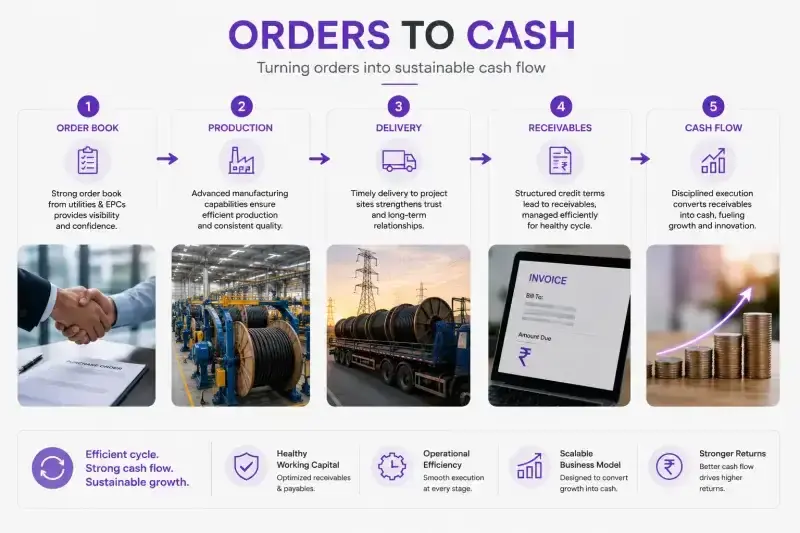
In simple terms: management is trying to make the factory more flexible at the same time that it is making it larger. The order book is the bridge between hope and earnings. This is where the story becomes measurable. CARE Ratings reported a combined cable and EPC unexecuted order book of approximately ₹1,792 crore as of March 2025. By December 2025, that figure had risen to about ₹2,889 crore, with another roughly ₹300 crore of orders in the pipeline. That is a major increase in the revenue visibility available to the business. But an order book is not cash. The next step is execution.
And here is where investors need to be careful
Cable manufacturing and EPC can consume working capital. Universal Cables' FY2026 balance sheet showed roughly ₹608 crore of inventory and ₹1,144 crore of trade receivables.At the same time, debt-equity increased to about 1.28x from 1.00x, while debt-service coverage weakened to about 0.70x from 1.17x. https://valueeducator.com/fundamental-analysis-basics/ebitda-explained-limitations
This does not automatically invalidate the growth story. It tells us what the next test is.
THE REAL TEST
Can the company turn higher revenue and EBITDA into operating cash flow quickly enough to support the capital cycle? https://valueeducator.com/fundamental-analysis-basics/days-sales-outstanding-dso-explained
The MP Birla Group changes the risk equation
Universal Cables is part of the MP Birla Group ecosystem, and CARE Ratings has highlighted the group's demonstrated support for the company.
Group-company funding and promoter support have helped provide flexibility during the current expansion cycle.
That is not the same thing as having no financial risk. It simply means the company is not operating in isolation while it funds a large capacity programmer. Why the timing may be favorable
India's electricity demand is rising. Renewable generation is expanding. Transmission networks need investment. Urban corridors are becoming harder to build through. Large industrial projects and data centers need reliable power.
These trends all point toward more investment in transmission, distribution, underground cabling and power-quality infrastructure. The opportunity is therefore not simply 'more electricity'. It is the increasing complexity of moving and managing that electricity. The investor mistake: looking at the wrong number
There is a common investing mistake with industrial companies: looking only at revenue growth.
A company can grow revenue rapidly and still destroy shareholder value if it needs too much working capital, earns poor returns on new assets or relies excessively on debt.
The opposite can also happen. A company may spend heavily for a few years, depress near-term cash flow, and then unlock much better economics once the new capacity is utilised.
Universal Cables currently sits in that second debate.
The investor's job is not to cheer the capex. It is to determine whether the capex earns its keep.
Five numbers I would watch every year
EHV mix - Is EHV becoming a larger and more profitable part of revenue? . Capacity utilization . Are the new assets translating into higher throughput? - EBITDA margin . Can the business sustainably move above the 10% area? - Working-capital cycle . Is growth being funded by operating cash or by increasingly expensive borrowing? - ROCE . After the expansion, can returns on capital move toward the mid-teens?
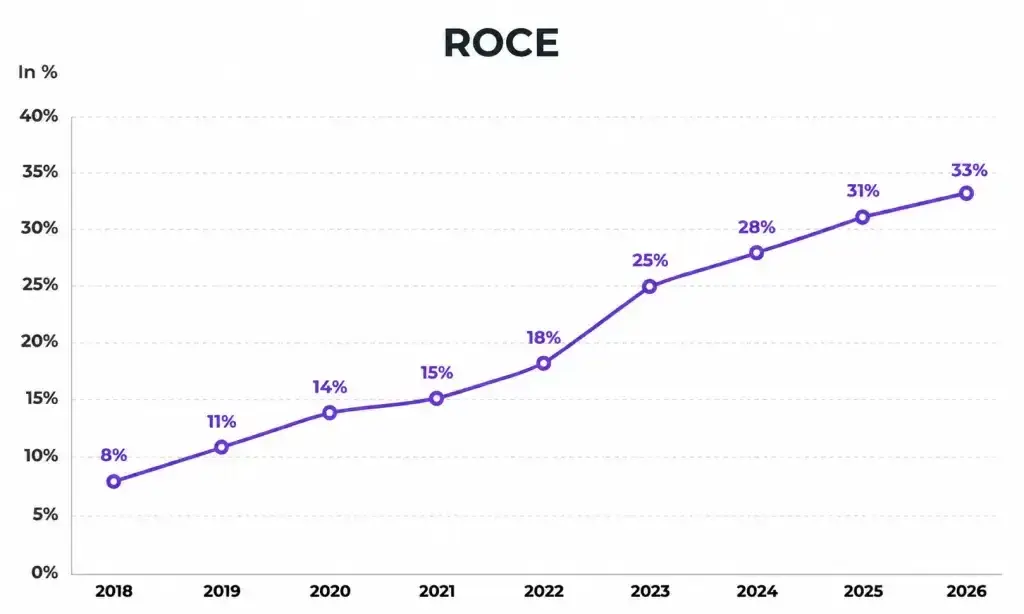
The bull case vs. the bear case
The bull case
EHV mix rises, new capacity ramps, the order book converts, Quality Power Solutions keeps growing, margins expand and working capital normalises.
In that scenario, Universal Cables could evolve from a cyclical cable manufacturer into a higher-quality infrastructure compounder.
The bear case
Capex ramps slower than expected, EPC receivables stretch, debt remains elevated, commodity volatility hurts margins and new capacity is underutilised.
Then operating leverage works in reverse — and the same fixed-cost structure that creates upside can compress returns.
“The stock market is a device for transferring money from the impatient to the patient.”
Warren Buffett.
Key Risks for Universal Cables
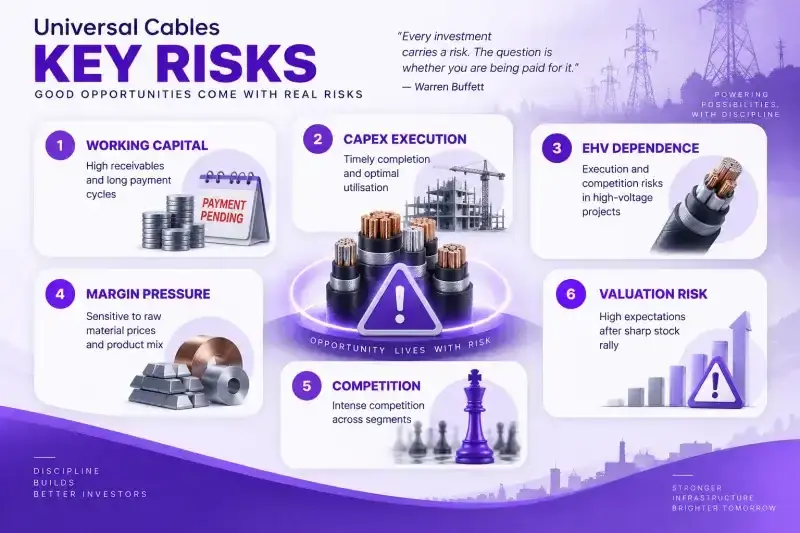
Working Capital: Universal remains a working-capital-intensive business, with long collection cycles in power and EPC projects. Faster growth without corresponding improvement in cash conversion could increase borrowing requirements.
Capex & Execution: The company's growth thesis depends on successfully commissioning new capacity and improving utilisation. Any delay or under-utilisation could dilute returns on the capital invested.
EHV Concentration: A significant part of the re-rating is based on EHV growth. Execution delays, quality issues, competitive bidding or slower EHV adoption could weaken the expected margin expansion.
Margin Sustainability: Recent profitability has benefited from a favourable product mix and higher EHV contribution. Sustaining these margins through commodity cycles and competitive pressure remains critical.
Valuation: After the sharp stock-price rerating, expectations are substantially higher. Even if the underlying business continues to grow, a slower-than-expected improvement in ROCE, margins or cash flows could lead to multiple compression.
The risk in one sentence
Universal's biggest risk is no longer whether it can grow — it is whether it can convert that growth into sustainable high-ROCE, high-cash-flow earnings fast enough to justify the valuation.
Explore our Products
Research Framework

Emerging Titans
Combination of quantitative analysis, industry tailwinds, and management assessment - SPRINT investment philosophy

Tiny Titans
Heavy emphasis on scuttlebutt research, plant visits, and early on-ground signals
The Client Base
The client base is one of the strongest signals of the company’s credibility. Its products have found acceptance across large industrial, infrastructure, energy, engineering and government-linked organizations, including names such as Johnson Controls, ONGC, BHEL, SAIL, DRDO, IndianOil, Tata Power, Maruti Suzuki, Siemens, Indian Railways, NALCO and CRPF.
What makes this important is not simply the number of logos, but the quality and diversity of the customer base. These are organizations operating in environments where reliability, safety, technical specifications and consistent product performance are critical. Winning and retaining such customers can therefore act as a meaningful validation of the companhighery's manufacturing capabilities and product quality.
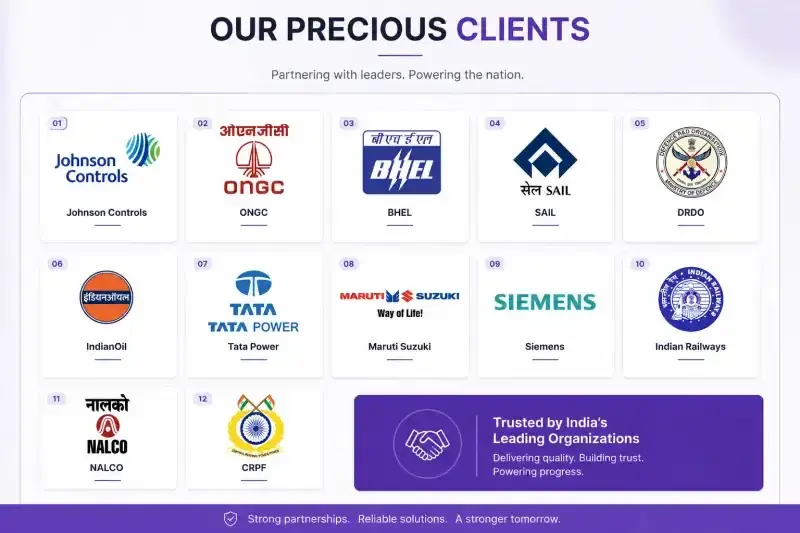
The customer mix also provides end-market diversification. Exposure across oil & gas, power generation and transmission, steel, railways, defence, automobiles, industrial automation and other infrastructure applications reduces dependence on any single industry cycle.
Conclusion
Universal Cables has spent years moving toward high-end EHV infrastructure; FY2026 is the first strong evidence that technology, capacity, product mix and India's power-investment cycle are beginning to converge into earnings leverage.
The transformation is not finished. Capacity is still being added. The order book still has to be executed. Working capital still needs discipline. Debt still needs to be absorbed by earnings and cash flow.
That is exactly why the next phase is interesting.
The question is no longer simply whether Universal Cables can sell more cable. The question is whether it can convert technical capability into capacity, capacity into orders, orders into margins, margins into cash and cash into higher returns on capital. If that chain holds, the company may deserve to be viewed very differently from the conventional cable manufacturer it once appeared to be.
The most important thing to watch now is not revenue. It is whether the company's new capacity converts into higher margins, stronger cash generation and ultimately higher ROCE.
Because that is what will determine whether today's expensive-looking stock eventually grows into its valuation — or whether investors have already paid for too much of the future.
The story is attractive. The valuation demands discipline
“...the value of an asset... cannot over the long term grow faster than its earnings do.”
Warren Buffett
FAQs
What is the core investment thesis for Universal Cables?
Answer: Universal Cables is attempting to move from conventional cable manufacturing toward higher-value EHV cables and power-quality solutions. The thesis depends on rising EHV mix, capacity utilisation, order-book conversion, improving margins, cash generation and ultimately higher ROCE.
Why is EHV the most important part of the story?
+EHV cables require greater technical capability, testing, qualification and project-execution credentials. Universal Cables has capability up to 400 kV, and successful EHV projects can become reference credentials for future tenders. This creates the potential for a stronger competitive position than in more commoditised cable categories.
What makes Universal Cables' product portfolio attractive?
+The company has a diversified portfolio covering LV/MV/HV/EHV power cables, control and instrumentation cables, specialty cables, conductors, capacitors and power-quality solutions. This gives it exposure across several parts of the electrical-infrastructure ecosystem.
What is the significance of the order book?
+The order book increased from approximately ₹1,792 crore in March 2025 to ₹2,889 crore by December 2025, with additional orders in the pipeline. This improves medium-term revenue visibility. However, the article stresses that an order book is not cash — execution, margins and payment terms determine its actual economic value.
What is the biggest financial risk?
+Working capital and cash conversion are major risks. Cable and EPC businesses can require significant inventory and receivables. If revenue grows but receivables and inventory grow even faster, the company may need additional borrowing to fund that growth.

High growth stock specialist, Value Educator
Shashank Mahajan is an equity research professional with over 12 years of experience in identifying high-potential SME and micro-cap stocks at an early stage. He follows a rigorous scuttlebutt research–driven approach, combining on-ground insights with deep financial analysis. Shashank specializes in uncovering under-researched and under-owned companies with strong management quality and long-term growth potential. Through disciplined research and early identification, he focuses on spotting tomorrow’s market leaders before they enter the mainstream investor radar.

Zen Technologies: Revenue Fell After a Big Win



PNG Jewellers: A 194-Year-Old Name Goes National
Explore our Products
Research Framework
Emerging Titans
Combination of quantitative analysis, industry tailwinds, and management assessment - SPRINT investment philosophy
Tiny Titans
Heavy emphasis on scuttlebutt research, plant visits, and early on-ground signals


 Orders
 Subscription
 Share with friends


Required Details
₹23999.00
(12 month subscription)
As per SEBI regulations, all users are mandated to complete the KYC that is validated for 1 year. Post payment, you will be redirected to the KYC screen


No comments yet. Be the first to comment!