
Stock Apps: Intraday vs Long-Term Investing

The stock market does not benefit all equally, but it favors players who understand how to play the game according to their natural tendencies. While some people enjoy making money from intraday transactions that occur within seconds, others prefer to make profits through investments in the long term with a lot of patience and the power of time working for them. However, what people fail to realize is that, apart from strategy, success in any game requires a good set of tools. Apps used in the stock market may either boost your natural abilities or highlight areas that require improvement. This read will introduce you to the best stock market apps available for intraday and long-term investments.
The integration of mobile devices into our daily life has brought a change in the methods used to access the stock market and perform transactions. Today, it is impossible to operate within the stock market without having applications for conducting trades and tracking trends. However, not every application is suitable for all purposes; certain applications deal exclusively with intraday trades, whereas others are better suited for investments. One should distinguish between these concepts to select a suitable app.

Intraday trading is associated with high demands for a trader’s constant attention when it comes to performing specific actions and analyzing different aspects of the market and its statistical data. As a result, the trader needs appropriate tools for building charts and technical indicators, along with a certain decision-making skill in view of received data. Stock market applications intended for intraday trading are believed to operate efficiently and provide users with all necessary information at the cost of their work and effort.
Nevertheless, while intraday trading includes profitable decision making through analysis of market dynamics, long-term investing consists of wealth creation through correct asset management. In most situations, people who want to make a long-term investment look for a platform which possesses all the features needed for analysis of the market dynamics. While intraday trading necessitates making timely decisions, long-term investment requires consistency, great insight, and usability. The ideal stock market platform for this venture will be the one which focuses on reliability, achievement, and decision-making. In summary, choosing the right stock market venue is solely dependent on the individual investor’s preferences and needs. Whether it be short-term trading or investing in stocks for a longer period of time, awareness of the differences between both options can guide him/her in making the right choice for his/her investment.
Having now come to understand the vital role played by stock trading apps, we are going to begin by looking at one of the quickest ways to trade, which is intraday trading.
Read More: A Fundamental Checklist: How to Research a Stock in 1 Hour
What is Intraday Trading
This refers to a type of trading strategy whereby individuals acquire and dispose of securities within one trading day while making sure that no security remains open at the end of the trading day. This differs from normal methods of investing, which entails keeping the investments for a considerable duration of time. This type of trading entails the exploitation of price movements in the shortest time possible due to elements like market demands, news, or overall sentiments.
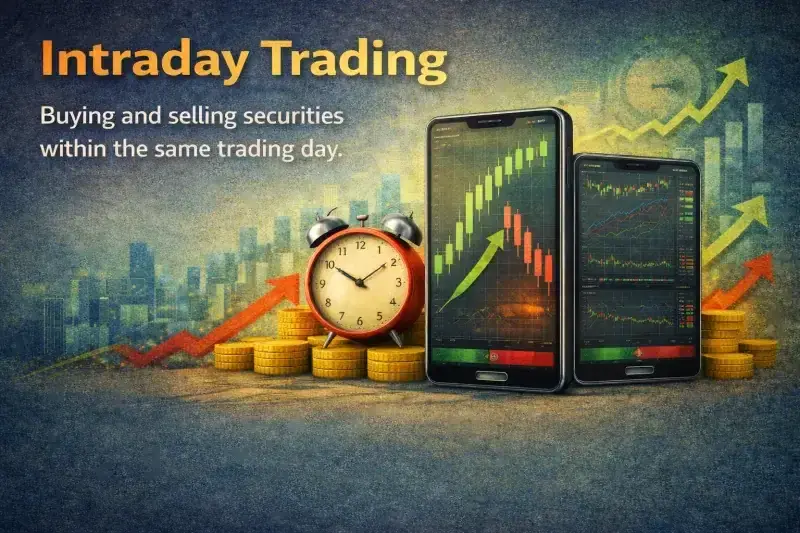
Intraday trading demands intensive technical analysis and charting skills to be successful. Individuals require timely decisions since profitable trades come and vanish quickly. However, intraday trading poses higher risks compared to other forms of trading since it relies significantly on leverage and market fluctuation. In addition, intraday traders should have the capacity to monitor market trends constantly during the trading period.
While intraday trading focuses on quick profits and fast decisions, not everyone prefers this high-speed approach. Let’s now explore the more patient and strategic path long-term investing.
Read More: Beyond Revenue Growth: 10 Mid-Cap Stocks Where Profits Compound
What is Long-Term Investing
Long-term investing is a strategy that involves buying stocks or any other type of financial instruments and keeping them in an investor’s portfolio for a significant amount of time, usually varying from a few months up to years. In contrast with intraday trading, here the attention is not paid to temporary movements in stock prices, but rather to their long-term development as well as the growth potential of strong fundamentally based corporations

The key elements to successful long-term investing include such techniques as fundamental analysis taking into account various aspects of a company’s activities like its performance and profitability in addition to its prospects. What is important about this approach to investments is that it implies patience and determination, while having a certain financial target as well as being ready for market volatility. As opposed to intraday trading, it is quite low-risk and does not involve continuous monitoring of stocks’ performance.
Understanding intraday trading is just one part of the equation; the real advantage comes from using the right tools. Let’s look at the best apps designed specifically for intraday traders in India.
Read More: How GDP Growth Impacts Corporate Earnings and Stock Markets
Top Intraday Trading Apps in India
1. Millions – The Gen Z Investor’s Choice
Millions is a new-age investing app from Raise Financial Securities, the company behind the
popular Dhan trading platform. It has been designed with young and first-time investors in mind,
and its aim is to make investing feel simple instead of confusing or intimidating. The app allows
users to invest in direct mutual funds, stocks, ETFs and IPOs from a single place.
The platform’s main strength is the simplicity of getting started. Investors can begin a SIP with as
little as ₹500, and mutual funds can be browsed by AMC as well as by categories such as equity,
debt, hybrid and index funds. Besides, the app has in-built calculators that help users estimate
how long it may take to reach goals.
Another significant advantage is the quick onboarding, as a demat account can be opened in less
than 10 minutes with just a PAN, Aadhaar, bank details and a photo. As far as pricing is concerned,
on Millions, investors can start investing in mutual funds, stocks and IPOs with zero charges.
Millions also allows its users to map their financial goals, such as buying a car, saving for a house,
or funding an education, directly to their portfolios, shifting the focus from random stock picking
to structured wealth building. On the whole, Millions is a good fit for first-time investors and young
professionals who want to build wealth gradually through SIPs rather than through frequent
trading.
2. Zerodha Kite – The Advanced Trader’s Choice
As far as intraday trading in India is concerned, there is no doubt that Zerodha Kite is among the best platforms for carrying out such trades efficiently. It provides an ideal blend of simple design and highly advanced features, which makes it an attractive platform not only for new but even professional traders who value speed and efficiency above everything else.Another major benefit of Zerodha Kite is its array of features. The platform supports zero brokerage on equity delivery transactions, which makes it very economical even for the investors who plan to hold their investments for years. For day traders, the platform is equipped with powerful technical indicators along with charts where more than 100 indicators can be used to analyze market trends. The platform also integrates very well with Coin for the management of mutual funds and with Varsity, which is an education portal from Zerodha itself.
With respect to pricing, Zerodha Kite remains fair and convenient. Free equity delivery transactions can be expected, but intraday orders have a price of ₹20 per trade or 0.03%, whichever is lesser. The Futures & Options transactions have a fixed cost of ₹20 per executed trade. Opening an account requires ₹300, and annually you will pay a maintenance fee of ₹300. The first year's maintenance is often free. It must be emphasized that the cost mentioned above varies according to different services.
Thus, from the standpoint of the above-mentioned points, Zerodha Kite is suitable for active traders and investors looking for quality tools that do not require any premium costs.
3. Groww – The Beginner’s Choice
Groww is among the most widely used financial apps in India, with a large market share owing to the millions of people who use it. This massive success is mainly due to the company’s straightforward philosophy, which aims to make investing available to all. Groww has managed to achieve this goal by simplifying the investing process and making it much easier to navigate for a whole new generation of investors.The platform’s main strength is the simplicity of its user interface, which does not have any unnecessary details that may confuse users. Besides, the website provides numerous educational resources that help newcomers learn about mutual funds, stocks, and other investments. Another significant advantage is the convenience of account creation, which is fast and paperless. Furthermore, the app is available on all leading operating systems, providing users with the same high level of performance regardless of their preferred platform.
As far as pricing is concerned, Groww makes sure that everything is straightforward and clear. Equity delivery transactions are free, making Groww appealing to long-term investors. On the other hand, there is a flat charge of ₹20 or 0.1% per transaction (whichever is less) for intraday deals. Furthermore, there is a fixed price of ₹20 per deal for Futures and Options (F&O) transactions. Moreover, Groww is free from all types of account opening charges as well as annual maintenance fees, thus, making it one of the best platforms for novices.
On the whole, Groww emerges as the best platform for novice investors who wish to venture into the world of stocks without any confusion and complications.
4. Upstox – Recommended for its Speed
With the backing of an enthusiastic industrial group, Upstox has emerged as a platform that is dedicated to offering high-speed trade execution at a nominal cost. As a result, Upstox has become popular among intraday traders as it offers them a hassle-free experience due to its high-speed trading capabilities and ease of use.Some of the features of Upstox include its ability to provide fast order execution, which is particularly useful during volatile times, as prices keep fluctuating in a matter of seconds. Furthermore, it also offers zero brokerage on the delivery of equities, thus making it attractive for long-term investment as well. It also has the provision to integrate TradingView and ChartIQ, which are powerful analytical tools based on charting techniques for traders who prefer technical analysis.
Concerning the fees, Upstox adopts a highly competitive and transparent system. While delivery orders attract zero brokerage, intraday transactions are subject to either ₹20 or 0.05% of total order value, whichever is lower. Concerning options, a fixed fee of ₹20 per executed trade is levied. The other benefit of using Upstox is the absence of any AMC and free demat accounts.
All in all, Upstox is highly recommended to active traders. Thanks to its fast performance and competitive pricing, Upstox stands out among the best platforms in India.
5. Angel One – The Research Powerhouse
Among the various trading applications available today, Angel One has managed to stand out with its unique combination of low-cost trading and high-quality research and advisory services. While most platforms limit themselves to trading functionalities only, Angel One takes the next step forward by providing advice, recommendations, and other information to enable its users to make better-informed decisions.The best feature of this platform includes the provision of free investment advisory services as well as detailed research reports that can help users understand various stocks and sectors as well as general market trends. Other facilities offered by Angel One include auto-investment for mutual funds that helps users develop disciplined portfolios. There is also the benefit of a personalized dashboard that enables users to keep track of the stocks in which they are interested. Besides these, Angel One also provides various investment products such as equities, derivatives, commodities, and mutual funds.
On pricing, Angel One makes sure that their pricing strategy is both straightforward and reasonable. Trading for equity delivery is free of any charges while intraday and F&O trades incur a fixed ₹20 fee for every trade order placed. Moreover, account opening with Angel One is free, even though the yearly maintenance fee is ₹500, but this might not be levied in some cases. Generally, Angel One is the most appropriate trading platform for people interested in investing based on advice and research recommendations.
As traders need fast and efficient solutions, investors require simplicity and great research possibilities. Let us check out the best apps for long-term investments.
Read More: How to Read a Balance Sheet Like a Professional Investor
Explore our Products
Research Framework

Emerging Titans
Combination of quantitative analysis, industry tailwinds, and management assessment - SPRINT investment philosophy

Tiny Titans
Heavy emphasis on scuttlebutt research, plant visits, and early on-ground signals
Long-Term Investment Platforms in India
1.Motilal Oswal Financial Services - A Trusted Name For Long - Term Investing
Motilal Oswal Financial Services (MOFSL) was founded in 1987 and is one of the well-known stockbroking firms in India. Motilal Oswal has a good reputation for its high-quality business of generating wealth. This company has earned a good reputation over the years through its various services, such as retail stock broking, portfolio management services, and investment in mutual funds. The platform is known for high growth and equity schemes.One of the major benefits of investing through MOFSL is that it does not charge any fee to open an account for its users. AMC is usually provided free of cost during the first year and then charges in the range of ₹199 to ₹400 per year depending upon the selected plan. The equity delivery fees in MOFSL are charged between 0.25% and 0.50%. Intraday and futures brokerage fees are charged at 0.025% to 0.05%. However, some flat-fee structures like ₹20 per lot can also be offered. The demat transaction fee is about 0.025% or ₹30 per debit transaction.
The firm offers various platforms to meet diverse requirements of users like the MO Investor App, MO Trader App, and web platforms. Asset management-wise, the firm is quite popular because of its unique offering in specialized funds like midcap, large & midcap, and index funds.
In conclusion, Motilal Oswal Financial Services Limited is ideal for those investors who wish to make a career in long-term investment plans and have trust in the research and financial services background of the firm.
2. ICICI Direct – Integrated Banking and Investment Solution
ICICI Direct is one of India’s most trusted platforms for long-term investing, offering a seamless 3-in-1 account that integrates Trading, Demat, and Banking services. This integration provides convenience, security, and ease of fund transfers, making it a preferred choice for investors who value a well-established financial ecosystem. The platform offers zero account opening fees for online activation, making it easy for users to get started.In terms of account maintenance, the Annual Maintenance Charges (AMC) are generally ₹700 + GST per year from the second year, while the first year is typically free. However, under special plans like NEO/iValue, the AMC is reduced to ₹300 per annum starting from the first year. The platform also includes certain additional charges such as DP/sell charges of ₹20 + GST per debit transaction and call & trade charges of ₹50 per order. It is important to note that if the trading account remains inactive or does not maintain sufficient balance for AMC, it may become dormant.
There are various brokerage plans provided by ICICI Direct based on different requirements of investors. The MoneySaver Plan, which acts as the default plan, adopts a brokerage rate based on percentages of 0.29% for equity delivery and 0.029%–0.03% for intraday, F&O, and commodities without requiring a prior subscription. On the other hand, the Prime Plan is based on subscription rates (at least ₹999) that bring down brokerage fees to around 0.22% or less, apart from the AMC fees being reduced. If one wants to opt for discount brokerage rates, then NEO/ Value Plan comes handy with an average of ₹20 per trade on intraday, F&O, and commodities with reduced AMC.
In summary, ICICI Direct caters to investors looking to invest in the long run and having preference for a consolidated banking/trading service.
3. HDFC Securities – A Reliable Full-Service Investment Platform
HDFC Securities Ltd. is a popular full-service brokerage that allows for trading and Demat services with various options available. Credibility and safety of the ecosystem have been established as the main characteristics of the platform; it is designed mainly for long-term investors who appreciate analytical information and integrated services. Another advantage is the 3-in-1 account (Trading, Demat, Banking), which can be received when associated with HDFC Bank.Free registration for a Demat account is provided most of the time on the website, but occasionally there may be charged fees up to ₹999 (part of premium packages). The Annual Maintenance Charges (AMC) of a basic package amount to ₹750 per annum, and AMCs of the other packages Preferred/Classic vary from ₹0 to ₹500 per annum, being waived if at least one transaction was carried out during the year. Users with a Premium Account Infiniti/Imperia are able to fully waive their AMCs. As for transaction fees, demat debit charges make 0.04% of each transaction, minimum fee starts from ₹30-₹40 per transaction.
HDFC Securities’ brokerage model relies heavily on plans, where the stock delivery fee usually lies between 0.20% and 0.50%, depending on the chosen plan. The company’s website provides access to a broad range of financial instruments, such as stocks, derivatives, and mutual funds, which can be accessed from both desktop and mobile devices. Besides, HDFC Securities is famous for its excellent research papers, strict security policies, and excellent customer service, thus making it a trustworthy platform.
Moreover, HDFC Securities provides HDFC SKY, an alternative trading app that is specifically designed for those traders who want to trade at a lower cost without sacrificing the trustworthiness of the company’s environment.
In general, HDFC Securities is a platform that is recommended for long-term investors.
4. Groww – A Cost-Effective Platform for Modern Investors
Groww is one of the prominent discount brokers in India that has become extremely popular due to its straightforward pricing model and ease of investing through its platform. Groww provides a free demat account, zero AMC fees, and also zero fees for direct mutual fund investments, making it very convenient for both new investors and long-term investors.When it comes to the charges, the pricing strategy used by Groww is one that is competitive. The charges for opening the account are ₹0, and the AMC charges are ₹0 as well. Thus, there are no maintenance charges that are involved. For traders, the charges will be the minimum between ₹20 and 0.05% for equity delivery, intraday, and F&O trading; however, for F&O brokerage, the charges will be fixed to ₹20 per order only. In terms of the mutual fund investments, there are no commissions and transaction charges involved. The demat charges will be ₹13.5 per scrip debit.
Other than pricing, Groww gives importance to the seamless online experience. This is because it provides a very simple and intuitive mobile application as well as a website. Moreover, the variety of products available through its website includes stocks, direct mutual funds, IPOs, ETFs, and Futures & Options. Closing account also doesn’t require paying for active maintenance, making it all the more easier for the customers. In case of mutual fund, any exit loads are charged by AMCs (Asset Management Companies) in case of withdrawal within one year of purchase, not by Groww.
In summary, Groww is more suitable for long-term investment and people who wish to invest without much difficulty.
After understanding both the methods and their respective toolkits, one must ask which of these two is riskier. Here, let’s compare risks involved in trading vs. investments.
Read More: What is Market Capitalization? Large, Mid, Small Cap Explained
Risk Comparison between Intraday Trading and Long-Term Investing
Intraday Trading
Intraday trading is associated with high risks mainly owing to market instability and the use of leverage. As intraday traders are trying to earn money by exploiting small price fluctuations that occur within one day, it means that any drop in prices can cause huge losses. Besides, using leverage can increase gains and losses as well. Hence, intraday trading is characterized by a considerable degree of unpredictability and requires quick actions to make decisions.
Long-Term Investing
Conversely, long-term investing can be called a relatively low-risk investing strategy because it implies that people invest their money over the long term. Although the stock market might demonstrate volatility, it usually grows over time, and therefore, investors will have enough time to recover after losing money during certain periods. Besides, the best way for investors to lower risks is to buy shares of fundamentally good firms and diversify their portfolio.
Risk is one factor, but costs can silently impact your returns over time. Let’s understand how charges differ between intraday trading and long-term investing.
Read More: How to Stay Emotionally Strong During Market Crash
Effect of Charges on Trading Vs Investing Gains
Intraday Trading
For intraday trading, there tend to be higher expenses and charges, and this is attributed to how often trades are made. Intraday traders usually make several purchase and selling decisions during one day, resulting in numerous costs for every trade made, including broker charges, transaction costs, and taxes. Although each charge may be negligible at first glance, they can add up to huge amounts due to many trades that need to be done. Also, other costs like STT, exchange costs, and margin charges contribute to higher expenses.
Long-Term Investing
Conversely, long-term investing has lower expenses because it does not involve many transactions. Intraday investors keep their stocks for a considerable amount of time, meaning they incur low charges when it comes to brokerage. There may also be certain expenses like account maintenance charges or taxes for capital gains, but these tend to be minor compared to those from trading activities.
To make things even clearer, let’s bring all the major differences together in one simple comparison.
Read More: Zerodha vs Groww vs Upstox – Which App is Best for Beginners in 2026?
Key Differences: Intraday Trading vs Long-Term Investing
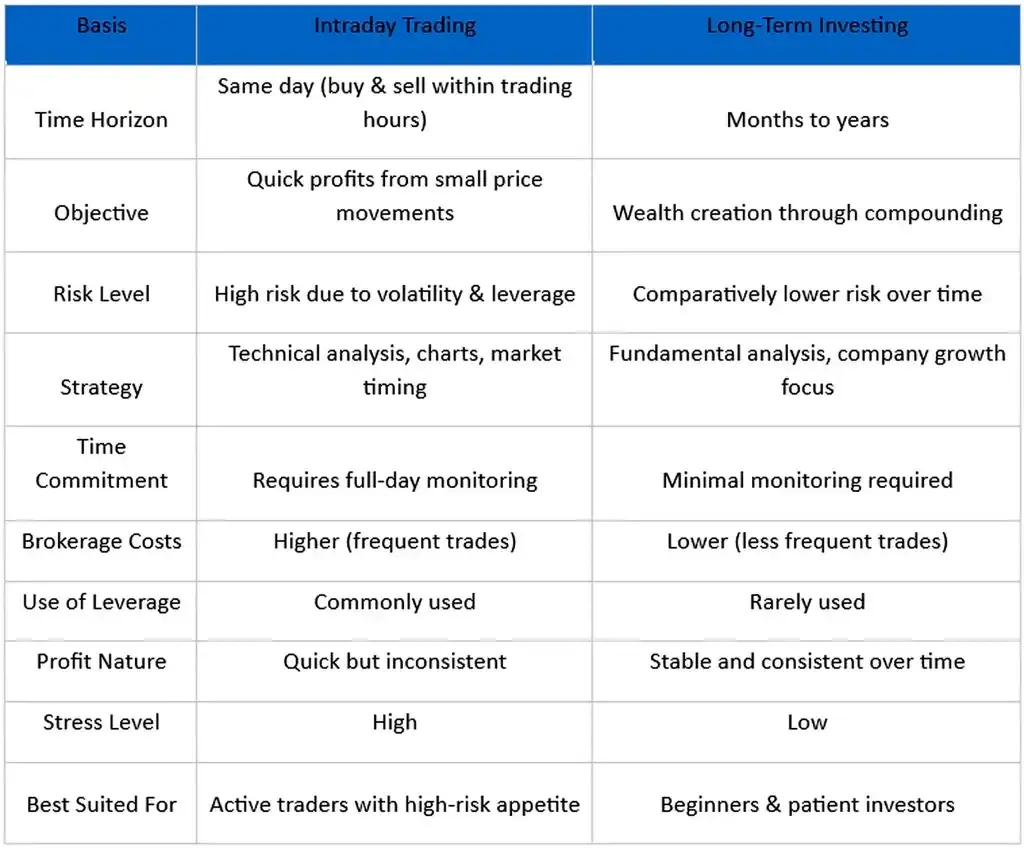
Concepts are easier to understand with real-life examples. Let’s see how two individuals chose different paths and what they learned from their journey.
Read More: Risk vs Reward: Why Investor Psychology Matters More Than Returns
Case Study: The Right Trading Application Versus Investment
Two friends named Rahul and Sneha have been in the stock market business since they first entered the scene simultaneously, yet with different motivations and techniques. In this case, Rahul wanted to make money through intraday trading, whereas Sneha was into making investments.
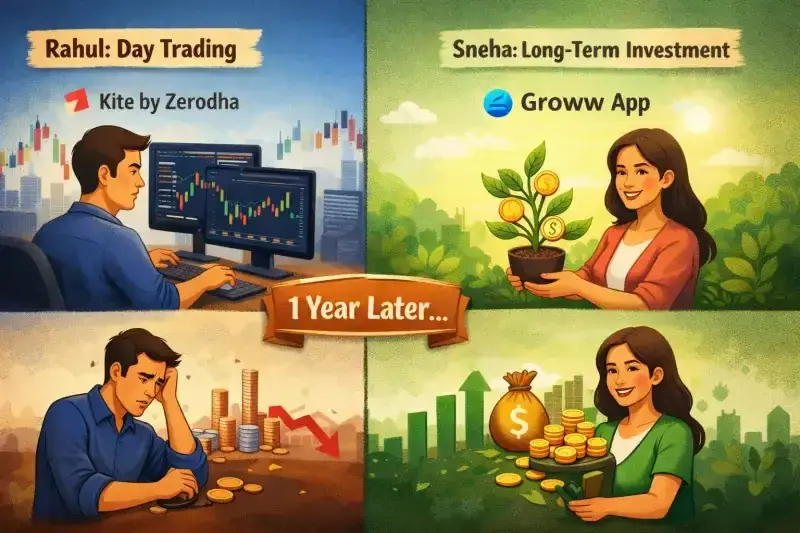
Rahul selected one of the best trading applications such as the Kite Platform by Zerodha that offers instant news, quick transactions, and excellent charting tools. Each day, Rahul used to watch the market trends and place his orders accordingly, yet some days he made profits whereas other times he suffered losses because of market fluctuations and heavy charges on transactions. With time, Rahul came to the realization that intraday trading needs more than skills.
However, Sneha chose a more convenient application like Groww for long-term investments. She invested in robust firms and mutual funds and held on to them for some time. Unlike Rahul who checked the stock market on a daily basis, Sneha rarely did that and concentrated on her long-term investment plans. As a result, her expenses were relatively low due to fewer transactions, which enabled her to get compound interest.
A year later, both Rahul and Sneha acquired significant experience. While Rahul learned about the stock market profoundly, he understood the possible risks and hard work needed for trading. At the same time, Sneha witnessed positive portfolio growth while spending less time and effort. Both stories teach us one crucial lesson: the selection of a stock market application must correspond to one's objectives and willingness to participate in it actively.
After understanding strategies, tools, risks, and real-life outcomes, it’s time to bring everything together and see what truly matters.
Read More: Why Mid Cap Stocks are the Sweet Spot for Long-Term Investors
Conclusion
Selecting the appropriate stock market application holds immense importance in determining how successful a particular investor would be in their journey. It is well-known from above that day-trading and long-term investment involve completely different things. For example, day-traders need applications which facilitate fast transactions, have real-time stock market data, and offer complex charts. On the other hand, long-term investors need platforms which do not have much complexity, have easy-to-understand research and portfolio options. It cannot be said that one platform suits all types of investors. Instead, the best platform to use varies from person to person depending upon one's financial goals, risk-taking capability, and time available for investments. Hence, beginners can choose Groww, while experienced traders might prefer to use Kite or Upstox Pro.
Like this, subscribe for more practical insights, and comment “WEALTH” below with your own experiences or questions!
Investor FAQs & Screening Tips
1. Which app is best for beginners in the stock market?
+Answer: For beginners, apps with a simple interface and educational support are ideal. Platforms like Groww are easy to use and help users understand basic investment concepts. They also provide smooth onboarding and portfolio tracking, making the learning process less overwhelming for new investors.
2. Is intraday trading better than long-term investing?
+Answer: Intraday trading is suitable for those who can actively monitor the market and handle high risk, while long-term investing is better for individuals seeking stable and gradual wealth creation. The choice depends on your financial goals, time availability, and risk appetite rather than one being universally better.
3. What factors should I consider before choosing a stock market app?
+Answer: Key factors include brokerage charges, ease of use, research tools, security, and speed of execution. Traders should focus on real-time data and charting features, while long-term investors should prioritize portfolio tracking and fundamental analysis tools.
4. How do charges affect overall returns in trading and investing?
+Answer: Frequent trading leads to higher brokerage and transaction costs, which can reduce net profits over time. In contrast, long-term investing involves fewer transactions, resulting in lower costs and better wealth accumulation through compounding.
5. Can I use the same app for both trading and long-term investing?
+Answer: Yes, many apps like Zerodha Kite, Angel One, and Upstox Pro support both trading and investing features. However, the experience may vary, so it’s important to choose an app that aligns well with your primary objective.

High growth stock specialist, Value Educator
Shashank Mahajan is an equity research professional with over 12 years of experience in identifying high-potential SME and micro-cap stocks at an early stage. He follows a rigorous scuttlebutt research–driven approach, combining on-ground insights with deep financial analysis. Shashank specializes in uncovering under-researched and under-owned companies with strong management quality and long-term growth potential. Through disciplined research and early identification, he focuses on spotting tomorrow’s market leaders before they enter the mainstream investor radar.

Zen Technologies: Why Revenue Fell After Its Biggest Win

Data Patterns: India's Radar Designer and Its Waiting Orders

KSH International: The Wire Inside India's Transformers

Krishna Defence: The Steel Behind India's Warship Hulls

PNG Jewellers: A 194-Year-Old Name Goes National

Axiscades: From Services to Missile and Radar Electronics
Explore our Products
Research Framework
Emerging Titans
Combination of quantitative analysis, industry tailwinds, and management assessment - SPRINT investment philosophy
Tiny Titans
Heavy emphasis on scuttlebutt research, plant visits, and early on-ground signals


 Orders
 Subscription
 Share with friends
 Logout


Required Details
₹23999.00
(12 month subscription)
As per SEBI regulations, all users are mandated to complete the KYC that is validated for 1 year. Post payment, you will be redirected to the KYC screen


No comments yet. Be the first to comment!