When Global Brokerages Make Big Calls During Weak Demand — And Why Contrarian Timing Works
The Upgrade That Defied the Data
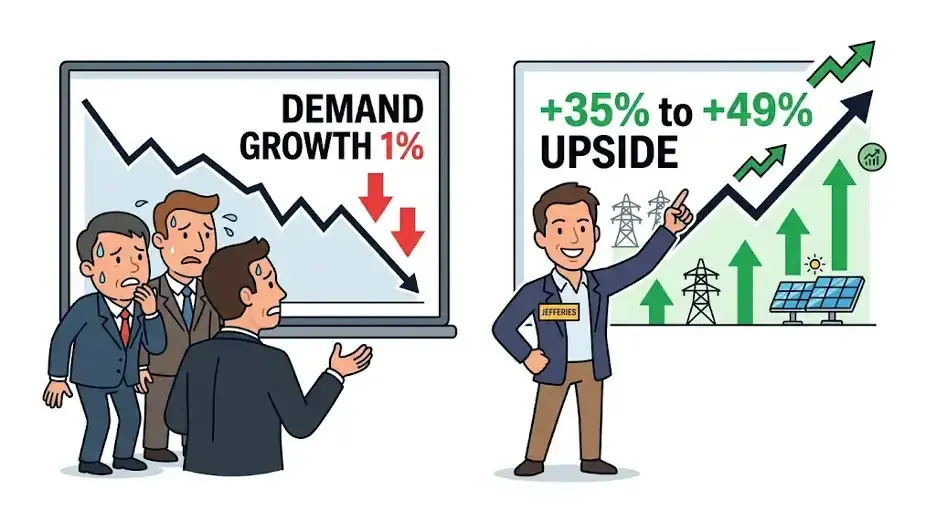
January 2, 2026. India’s power demand numbers for the fiscal year were terrible. From April 2025 to February 2026, electricity consumption grew just 1% — the weakest growth in years. Extended monsoons had crushed demand. Industrial activity was sluggish. Residential cooling loads stayed low through an unusually wet summer. Analysts across brokerages were cutting earnings estimates for power companies. The narrative was uniformly negative — “demand slowdown will persist,” “thermal utilization will stay depressed,” “avoid power sector until visibility improves.”
Into this pessimism, Jefferies dropped a sector report that went completely against consensus. The global brokerage named NTPC and JSW Energy as its top picks for 2026, assigning “Buy” ratings with target prices implying 35% and 49% upside respectively. NTPC was given a ₹440 target versus its then-trading price of ₹325. JSW Energy got a ₹700 target against ₹470 market price. These weren’t token 10-15% targets or “hold” ratings. These were conviction calls with massive upside potential during a period when the sector looked weakest.
This is the kind of contrarian timing that separates brokerages who make clients real money from those who just follow the herd. When demand data is terrible and everyone is selling, that’s precisely when value investors should be buying — if the underlying thesis for long-term growth remains intact. Jefferies wasn’t ignoring the weak demand. They were looking through it to what comes next — capacity additions, regulated returns, renewable transition, and the structural shift toward higher electricity consumption from data centers and EVs.
The market’s response validated the contrarian call. NTPC jumped 4% on January 2 when the report was released, hitting ₹349.30 — the highest level since October 2025. JSW Energy surged 2.5% to ₹514.55, extending gains for the third consecutive session. In the days following, both stocks outperformed the sector significantly. By mid-March 2026, NTPC had climbed further to ₹370-380 range, already capturing 15-20% of the projected upside. JSW Energy crossed ₹520 multiple times, up 10%+ from the January call. Investors who followed Jefferies’ contrarian buy signal during peak pessimism captured these gains while those who waited for “better demand visibility” missed the entire move.
If you’ve ever wondered why retail investors consistently buy near tops and sell near bottoms, this case study explains the psychology perfectly. If you’re trying to figure out when to enter power stocks and feel paralyzed by conflicting data points, understanding how global brokerages time sector calls will shift your framework entirely. And if you thought brokerage reports are just marketing fluff without real alpha, the data on NTPC and JSW Energy post-Jefferies upgrade shows that contrarian calls from credible research houses create actionable trading opportunities. This isn’t about blindly following every broker recommendation. It’s about recognizing when a well-researched contrarian thesis backed by capacity expansion data and earnings visibility contradicts prevailing sentiment — because those setups create the highest risk-reward entry points.
When Jefferies upgrades power stocks to “Buy” with 35-49% targets during 1% demand growth, they’re not betting on this quarter’s numbers. They’re positioning for what demand looks like 12-18 months out.
Like this analysis? Get powerful insights like this every week. No spam.
1. NTPC: The ₹440 Target and Why 35% Upside Makes Sense
Scale, Capacity Additions, and Regulated Returns
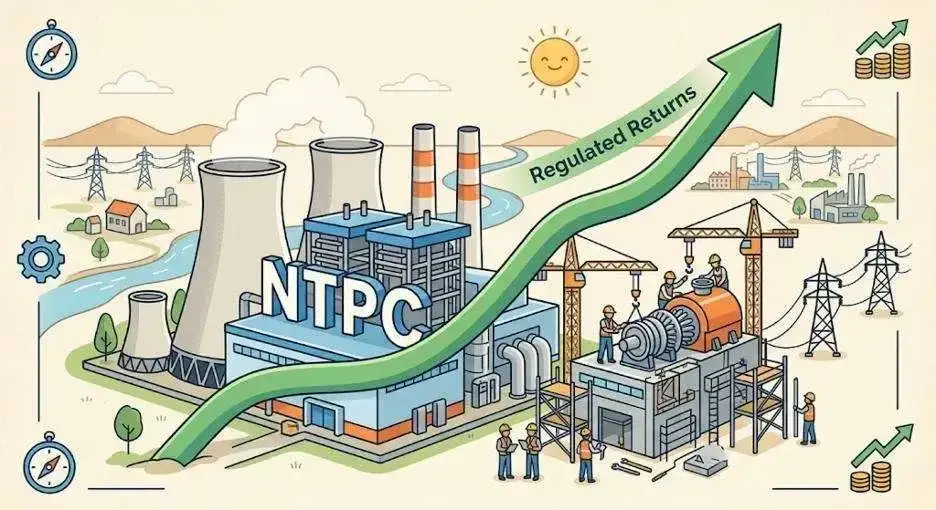
The ₹440 target price of NTPC as per Jefferies in comparison to the ₹325 trading price in early January 2026 is a 35 upside and what is interesting is how this valuation framework is used to justify this target. NTPC was also reported to be trading at 9.4x EV/EBITDA (FY26) estimates that fall to 8.1x by FY 28 with capacity additions and expansion of the EBITDA base. The performance of a firm having regulated 15.5% on thermal plants and 14% on hydro at sub-10x EV/EBITDA is historically low. In context, in the 2017-2019 power sector bull run when demand was growing at the same rate Jefferies predicts in 2026-27, NTPC was trading at 11-12x EV/EBITDA. To just get the ₹400-420 range, you only need to go back to that historical average valuation. Include the increase in the earnings as a result of capacity additions and ₹440 turns out to be not an aggressive value.
NTPC capacity expansion story is what distinguishes them among smaller thermal generators. NTPC had 79.9 GW of overall capacity as of FY25. This company has directed to the addition of 11.8 GW in the FY26 and 9.9 GW in the FY27 i.e. more than 21 GW of new capacity within a span of two years which translates to an increase of capacity by 27 percent. More to the point, the renewable capacity will experience a steep growth within the three years sinceNTPC is aiming to achieve 60 GW of renewables by 2032.
This blend of 100 percent thermal to a balanced thermal-renewable portfolio will deal with the largest risk that investors are concerned about with NTPC, which is stranded asset risk in response to the coal plant closures. With renewable capacity development on scale, NTPC is certain to take both short-term thermal demand and long-term clean energy transition without necessarily making the decision between the two. Such a capacity growth is included in the earnings estimates of Jefferies with EBITDA expected to increase to more than ₹65,000 crore by FY28 after starting at about ₹50,000 crore in FY26. That is 30% EBITDA growth in two years, which has not been achieved by expanding the margins or raising the prices, but capacity additions.
The regulated return structure is what makes NTPC’s investment case unique compared to merchant-exposed private players. NTPC doesn’t need merchant power prices to spike to ₹12/kWh for earnings to grow. It earns fixed returns on equity regardless of market conditions, as long as plants run and contracts get signed.
This means downside is protected during weak demand periods like April 2025 to February 2026, while upside accumulates steadily as new capacity gets commissioned. When demand does recover — which Jefferies expects in FY27 driven by data centers, EVs, and normalized monsoons — NTPC will have 20+ GW of additional capacity ready to monetize. The company isn’t chasing demand, it’s building capacity ahead of demand, which is exactly what you want to see in an infrastructure business. Companies that wait for demand visibility before deploying capital enter late, overpay for equipment, and miss the first 2-3 years of cash flows.
For investors evaluating the ₹440 target, the key question isn’t whether NTPC hits that exact price by year-end 2026. It’s whether the 27% capacity growth over FY26-27, the renewable transition toward 60 GW, and the regulated return framework justify a higher valuation than 9.4x EV/EBITDA. If you believe India’s electricity demand will compound at 5-6% annually over the next decade — which is conservative given GDP growth targets and electrification trends — then owning the largest, most stable power generator trading at a discount to historical valuations is a rational bet. The 35% upside to ₹440 is a bonus if it materializes quickly. The real return comes from holding NTPC for 3-5 years as capacity compounds at 10-12% annually and the market gradually re-rates the stock from 9x to 11x EV/EBITDA. That’s a 50-60% total return over three years with minimal volatility compared to merchant-exposed alternatives.
“In the short run, the market is a voting machine. In the long run, it’s a weighing machine. And NTPC’s capacity is getting heavier every quarter.”
— Benjamin Graham (adapted)
2. JSW Energy: The ₹700 Target and 49% Upside Thesis
Growth at Scale with Merchant Upside Optionality
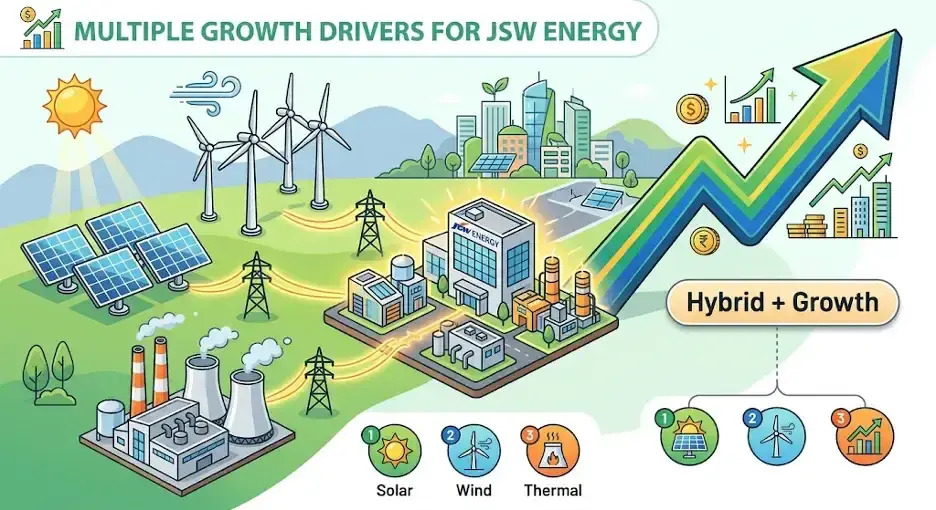
Jefferies’ ₹700 target for JSW Energy versus the ₹470 trading price in January 2026 represents a stunning 49% upside — the highest among major power stocks covered in the report. This aggressive target reflects JSW Energy’s differentiated business model compared to NTPC. JSW isn’t a pure regulated utility. It’s a hybrid growth story combining long-term PPAs for stability with merchant exposure for upside, balanced across thermal, hydro, wind, and solar. By September 2025, JSW Energy had a capacity of 13.2 GW and another 12.4 GW under construction and 4.6 GW of development pipeline. The company publicly has made a commitment of achieving 30 GW within 2030 which means that the company will have increased capacity more than two times within the next four years. This isn’t incremental growth — it’s transformation at scale.
The valuation framework supporting the ₹700 target hinges on JSW’s EBITDA trajectory. Jefferies values JSW Energy at 13.1x EV/EBITDA for FY26 estimates, declining to 10.7x by FY28 as new capacity comes online and the EBITDA base expands. The math is straightforward — if JSW successfully commissions even 8-10 GW of the 12.4 GW under construction by FY28, EBITDA could jump 60-80% from FY26 levels. Apply a 12x EV/EBITDA multiple to that higher EBITDA base, and you get to enterprise values supporting ₹650-750 per share.
Be part of the
Value Educator
community
Get exclusive insights tailored to
sharpen your investment decisions.
The execution risk is real — commissioning 8-10 GW in 2-3 years requires flawless project management, equipment availability, and financing. But JSW’s track record de-risks this concern. The company already has doubled the capacity, which was 4.5 GW, to more than 10 GW in five years, which indicates that it is capable of working at this rate. Recent accomplishments have seen it sign a 25 year PPA of 400 MW with Karnataka DISCOMs at tariff of ₹5.78/kWh, cutting down open capacity to 5% and securing long-term revenue certainty.
What really separates JSW from pure-play thermal or renewable companies is optionality. During summer peaks when merchant prices spike to ₹10-12/kWh, JSW’s uncontracted thermal capacity prints money. In March 2026, when evening merchant prices breached the ₹10/kWh ceiling 13 times as peak demand hit 225 GW, JSW’s merchant exposure delivered windfall profits that NTPC’s regulated structure couldn’t capture. During monsoons or off-peak periods when merchant prices collapse, JSW’s long-term PPAs covering 95% of capacity provide stable cash flows.
This barbell strategy — 95% locked-in contracts for stability, 5% merchant for upside — creates an asymmetric payoff. Downside is protected by PPAs. Upside is leveraged to merchant pricing during supply-demand tightness. Few power companies operate this model as effectively as JSW.
The renewable pivot adds another layer of optionality. JSW’s locked-in energy storage capacity of 29.4 GWh — including 26.4 GWh of hydro pumped storage and 3 GWh of battery storage — positions the company as a leader in solving renewables’ intermittency problem. Pure solar and wind deliver power 6-8 hours daily during sunny or windy periods. Hybrid projects with storage can deliver 16-18 hours by storing excess generation and releasing during evening peaks.
This round-the-clock renewable power commands premium PPAs from corporate offtakers willing to pay ₹6-7/kWh versus ₹4-5/kWh for intermittent solar. JSW’s early-mover advantage in hybrid+storage projects creates a moat that takes competitors years to replicate. For investors, the ₹700 target represents a bet on JSW executing its 30 GW capacity roadmap, merchant pricing staying favorable during summer peaks, and the hybrid+storage model commanding valuation premiums as ESG and corporate renewable demand accelerates.
“Compound interest is the eighth wonder of the world. He who understands it, earns it. In power, compound capacity growth earns it.”
— Albert Einstein (adapted)
3. Why Jefferies Called It During Weak Demand (And Why That’s Brilliant)
Contrarian Timing Creates Alpha
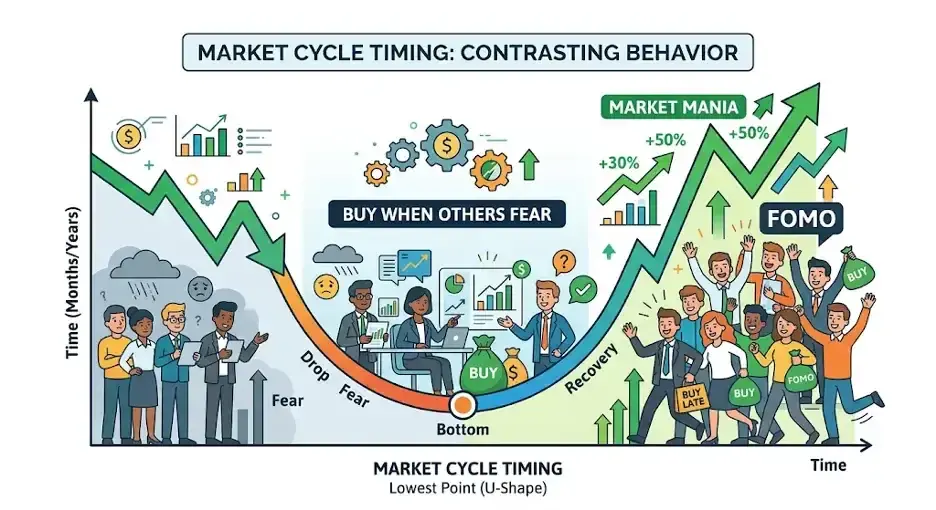
The genius of Jefferies’ January 2, 2026 “Buy” calls on NTPC and JSW wasn’t the target prices — any analyst can plug growth rates into a DCF model and arrive at fair values. The genius was the timing. Power demand from April 2025 to February 2026 grew just 1%, the weakest in years. Consensus estimates had been slashed. Retail investors were selling. Mutual funds were underweight the sector. Into this maximum pessimism, Jefferies went aggressively bullish. Why? Since they were looking at leading indicators rather than lagging data. Extended monsoons, a transitory, weather phenomenon, not an underlying demand collapse, explained weak demand in FY26. Patterns in the past indicate that heavy monsoons dampen the electrification by cutting back the cooling loads, industrial activity, but demand rebounds the next summer when conditions are returned to normal.
Jefferies expects power demand growth of 5-6% CAGR to be achieved in the medium term through structural drivers that cannot be impacted on by a single year of monsoon shocks. The increase in data center capacity will contribute to a rise of 5-7 GW of new electricity demand by 2028 as workloads of AI/ML and cloud computing explode in India.
The EV penetration will come to 30 percent of newly sold vehicles by 2030, which will contribute an additional 10-15 GW of charging capacity. Incremental demand comes with industrial electrification - the utilization of the grid instead of diesel and furnace oil. The penetration of residential appliances has been on the increase due to the increase in income and the rate of urbanization. These tendencies do not turn back due to a single wet year. They compound over decades. By calling NTPC and JSW during the demand trough, Jefferies positioned clients to buy when valuations were depressed and sentiment was terrible, maximizing entry-point value.
The playbook isn’t unique to power sector. Contrarian calls work across industries when you can separate temporary cyclical weakness from permanent structural deterioration. Banks in March 2020 during COVID looked terrible on lagging NPL data, but forward-looking analysts who modeled recovery bought aggressively. IT services in 2023 faced demand slowdown from global recession fears, but those who looked through to AI/digital transformation capex cycles bought near lows.
Jefferies applied the same framework to power — acknowledge the near-term weakness, model the structural recovery drivers, and make the call when nobody else will. The risk is being early. If demand stays weak through all of 2026 and renewable PPAs don’t materialize, Jefferies’ targets won’t hit. But the reward — capturing 35-49% upside by correctly timing the inflection — far outweighs the risk of being early by 2-3 quarters.
For retail investors, the lesson is clear: don’t avoid sectors just because recent data is bad. Inquire as to whether the weakness is cyclical or structural. When it is cyclical and the fundamental business building blocks (capacity additions, regulatory returns, competitive moats) are still there, a low demand makes up of buying opportunities. Jefferies did the work — analyzing capacity pipelines, modeling renewable transition, forecasting data center demand. Retail investors can piggyback on that research by following credible brokerage calls when they go against consensus. Not every contrarian call works, but the ones that do deliver outsized returns precisely because you’re buying when everyone else is selling.
“Be fearful when others are greedy, and greedy when others are fearful. And when Jefferies is greedy during weak demand, pay attention.”
— Warren Buffett (adapted)
Join 1,45,000+ investors discovering under-researched small caps before they rerate.
4. Other Brokerages Agree: The Upside Thesis is Real
JM Financial, Bernstein, and Axis Direct Pile On
Jefferies wasn’t alone in calling power stocks during early 2026. JM Financial issued “Buy” ratings on NTPC (₹420 target), JSW Energy (₹614 target), and Adani Power (₹177 target) in mid-March 2026, explicitly citing summer demand surge expectations. The brokerage flagged that peak demand on March 10 hit 225 GW with evening thermal plant utilization at 95%, creating supply-demand tightness that benefits merchant-exposed companies. Bernstein initiated coverage on power stocks in late March with “Outperform” ratings on Adani Power (₹177 target, 18% upside), JSW Energy (₹575 target, 19% upside), and Tata Power (₹443 target, 15% upside). Bernstein’s thesis focused on India’s electrification drive prioritizing thermal, nuclear, and grid-linked assets over pure renewables.
Axis Direct highlighted 270 GW projected peak demand for summer 2026 — an 8% increase over the May 2024 all-time high of 250 GW — and named NTPC, JSW Energy, NLC India, and Coal India as top picks.
The convergence of multiple global and domestic brokerages on bullish power sector calls during Q1 2026 signals something beyond individual analyst opinions. It reflects institutional positioning for a sector that had been ignored in 2025 due to weak demand but was set up for a strong recovery in 2026-27. When Jefferies, JM Financial, Bernstein, and Axis Direct all say “Buy” within weeks of each other, institutions start accumulating.
FII data supports this — foreign institutional investors deployed $497 million into Indian power stocks in February 2026, driven by rising electricity demand forecasts from AI and data centers. GMR Power surged 19.5%, Torrent Power jumped 14%, Adani Green Energy climbed 11%, NTPC rose 8%, and JSW Energy gained 6.1% in February alone. This wasn’t retail-driven momentum. It was institutional accumulation following brokerage upgrade cycles.
The consensus targets across brokerages also provide valuable cross-validation for investors trying to assess fair value. Jefferies has NTPC at ₹440. JM Financial has it at ₹420. The average of these two credible brokerages is ₹430, providing a reasonable bull-case target. For JSW Energy, Jefferies says ₹700, JM Financial says ₹614, Bernstein says ₹575. The average is roughly ₹630, suggesting 25-30% upside from March 2026 levels around ₹500. When multiple brokerages with different methodologies arrive at similar valuations, it increases conviction that the thesis isn’t built on aggressive assumptions. These firms are using DCF models, comparable company analysis, and sum-of-the-parts valuations to triangulate fair value. The fact that they converge around similar ranges indicates the upside is data-driven, not speculative hope.
For investors, the key takeaway is diversification of information sources. Don’t rely on a single brokerage report to make investment decisions. But when 3-4 credible research houses independently arrive at bullish conclusions on the same stocks within weeks, it signals the sector has turned. The institutions read these reports, cross-check the data, and deploy capital. Retail investors who track brokerage calls can follow this smart money without doing months of primary research themselves. Read the Jefferies report for capacity addition data. Check the JM Financial report for summer demand thesis. Review the Bernstein report for policy and regulatory insights. Combine these viewpoints, and you get a 360-degree understanding of why power stocks offer 25-35% upside in 2026.
“In investing, what is comfortable is rarely profitable. And going bullish during 1% demand growth isn’t comfortable — but it’s profitable.”
— Robert Arnott (adapted)
Market Cap focus
No. of ideas in a year
Holding period
Pricing

Emerging Titans
Combination of quantitative analysis, industry tailwinds, and management assessment - SPRINT investment philosophy
Multi Cap
20-25
3+ Years
Rs. 23,999/year

Tiny Titans
Heavy emphasis on scuttlebutt research, plant visits, and early on-ground signals
Exclusively for SME's
15-20
3+ years
Rs. 31,999/year
Conclusion + Cta
Most retail investors either blindly trust brokerage reports or completely ignore them — Most retail investors tend to either distrust brokerage reports completely or follow them without question. A more effective approach lies somewhere in between — using credible research from global institutions like Jefferies as an informed reference point, rather than a direct buy or sell signal.
Such reports are built on extensive analysis, including capacity expansion plans, renewable energy transitions, demand projections from emerging sectors like data centers, and detailed financial modeling. For individual investors, these insights can serve as a valuable starting point to understand broader market trends and sectoral shifts.
An important takeaway from the January 2 recommendation is the role of timing in investing. The call was made when market sentiment was weak and demand growth appeared limited. However, this is often when long-term opportunities begin to form. Early identification of such phases allows investors to benefit before trends become widely recognized.
Ultimately, the key decision is not whether specific price targets are achieved, but whether one believes in the long-term growth potential of India’s power sector. Factors such as increasing electricity demand, renewable adoption, and infrastructure development suggest a structural shift that investors may consider while forming their outlook.
As investors, it is important to go beyond headlines and develop a habit of analyzing research critically. Try to understand the reasoning behind such reports, compare multiple viewpoints, and build your own informed perspective before making investment decisions.
FAQs
Should I buy NTPC and JSW at current levels or wait for correction?
+
As of March 25, 2026, NTPC trades around ₹380 (versus Jefferies ₹440 target) and JSW Energy around ₹494 (versus ₹700 target). Both have already rallied 15-20% from January levels when Jefferies issued the calls. If you believe the capacity addition thesis and summer demand surge forecast, there’s still 15-40% upside from current levels. Trying to time 5-10% corrections to enter often means missing 30-40% rallies. Better approach: buy 50% position now, keep cash for averaging down if corrections happen.
Why should I trust brokerage targets when so many are wrong?
+
Not all brokerage calls are equal. Jefferies, JM Financial, and Bernstein are global/credible research houses with reputation risk if they make reckless calls. Their power sector reports run 30-50 pages with detailed capacity data, EBITDA projections, and sensitivity analysis. These aren’t pump-and-dump marketing pieces. When multiple credible brokerages converge on similar targets independently, the probability they’re all wrong decreases. Use brokerage research as input, not gospel. Verify the key assumptions yourself (capacity additions, demand growth, valuations) before investing.
Which is safer — NTPC or JSW Energy?
+
NTPC offers lower return potential (15-25% over 12 months) with minimal volatility due to regulated business model and government ownership. JSW offers higher return potential (30-50%) but with more volatility from merchant pricing exposure and execution risk on capacity additions. For conservative investors or core portfolios, NTPC is safer. For aggressive growth allocations, JSW captures more upside. Optimal strategy: 60% NTPC, 40% JSW within your power sector allocation for balanced risk-reward.
What if demand doesn’t recover as Jefferies expects?
+
Then the stocks don’t hit target prices in 2026, but the long-term thesis doesn’t break. NTPC’s regulated returns mean it compounds earnings at 8-10% annually regardless of demand volatility. JSW’s locked-in PPAs covering 95% of capacity provide downside protection. Worst case, you own quality power companies at reasonable valuations that deliver 10-15% annual returns even if the bull case doesn’t materialize. The downside is limited, while upside from demand recovery is 35-50%. That’s an asymmetric setup favoring buyers.
Should I avoid power stocks if FII selling starts?
+
Short-term FII flows are noise. FIIs deployed $497 million into power stocks in February 2026, but they could easily reverse and sell $300 million in April if macro conditions change. Don’t chase FII flows — they’re fickle. Focus on fundamentals: capacity additions, demand growth, valuations. If those check out, own the stocks regardless of FII activity. The best buying opportunities often come when FIIs are selling and retail is panicking, creating temporary dislocations that long-term investors exploit.
How do I track if Jefferies’ thesis is playing out?
+
Monitor quarterly capacity addition data for NTPC and JSW. Check monthly peak demand numbers (POSOCO publishes daily all-India demand). Track merchant power prices during evening hours (IEX publishes day-ahead market data). If capacity additions stay on track, peak demand keeps hitting new highs, and merchant prices spike during summer, the thesis is intact. If capacity delays, demand disappoints, or merchant prices stay subdued, re-evaluate. Investing isn’t set-and-forget — track the thesis quarterly and adjust if fundamentals change.
About the author

Shashank Mahajan
High growth stock specialist, Value Educator
Shashank Mahajan is an equity research professional with over 12 years of experience in identifying high-potential SME and micro-cap stocks at an early stage. He follows a rigorous scuttlebutt research–driven approach, combining on-ground insights with deep financial analysis. Shashank specializes in uncovering under-researched and under-owned companies with strong management quality and long-term growth potential. Through disciplined research and early identification, he focuses on spotting tomorrow’s market leaders before they enter the mainstream investor radar.
Join 1,45,000+ investors discovering under-researched small caps before they rerate.














 Orders
 Subscription
 Share with friends


No comments yet. Be the first to comment!