
Asset Allocation 101: Reduce Your Risk

he Night Markets Fell and Why Two Investors Slept Differently
Portfolios bleeding, screens flashing red, and panic spreading faster than the virus itself — March 2020 wasn’t just a market fall, it was a stress test of conviction.
Markets had been falling for days, but that evening the decline was huge. Global indices were deep in the red, and News channels ran crisis tickers without pause
Past midnight, Arjun sat glued to his screen, refreshing prices like a ritual. The red wouldn’t fade. Down 34% from its peak, his portfolio felt less like numbers — and more like a knot tightening in his chest. Every fall felt personal. He began calculating how many years of savings had evaporated in a matter of weeks.
Across the city, Meera checked her portfolio too. She saw red numbers as well. Her equity holdings had fallen sharply. But her overall portfolio decline was closer to 16 %.
She closed the app, uneasy but calm enough to sleep.
A year later, markets had recovered. Meera’s portfolio had regained losses and compounded further. Arjun had exited near the bottom and re-entered months later, carrying both emotional and financial scars.
To understand the psychological side of navigating drawdowns, read: How to Stay Emotionally Strong During Market Crash.
They owned many of the same assets.
They believed in long-term investing.
So what created such different outcomes?
The answer was not stock selection. It was not market timing.
It was Asset allocation.
Most investors believe success comes from picking the best-performing stocks. But decades of portfolio research suggest something counterintuitive. The majority of long-term portfolio performance variation is explained not by security selection but by how capital is allocated across asset classes.
Asset allocation is not glamorous. It does not produce exciting headlines. But it quietly determines whether investors survive market cycles long enough to benefit from compounding.
" The essence of investment management is the management of risks, not the management of returns. " — Benjamin Graham
Before understanding allocation, however, we must first understand the force it is designed to manage. Risk.
Understanding Risk Beyond Losing Money

Ask an average investor what risk means, and the response is immediate. Losing capital.
While permanent loss is certainly a form of risk, professional portfolio management views the concept far more broadly.
Risk is uncertainty. It is the variability between expected outcomes and experienced outcomes. It is the possibility that financial goals may not be met within the required time frame.
Risk manifests in several ways.
Market risk reflects the possibility of broad market declines. Interest rate risk impacts fixed income instruments. Inflation risk erodes purchasing power. Liquidity risk affects the ability to exit investments. Behavioral risk emerges when investors abandon strategies mid cycle.
An investor whose portfolio falls 30 % but eventually recovers may not have suffered permanent loss. Yet the volatility and emotional pressure experienced during the fall still represent risk.
Institutional investors formalize these concerns through risk objectives written into an Investment Policy Statement.
These objectives define acceptable levels of volatility and loss probability. They guide asset allocation decisions.
Two frameworks are commonly used.
Relative Risk Objectives
Relative risk introduces a benchmark into the equation.Rather than focusing on absolute losses, the portfolio is evaluated relative to a market index or peer universe.
An asset manager may be tasked with outperforming a benchmark by 2 % annually. Another mandate may restrict underperformance to within 4 % of an index. Banks often frame objectives relative to cost of funds.
Relative frameworks emphasize competitiveness rather than pure preservation.
Mutual funds and institutional equity portfolios commonly function within these kinds of structural frameworks. In reality, most advanced portfolios combine absolute and relative constraints, seeking to balance growth objectives with tolerance for drawdowns
But regardless of framework, risk must first be quantified.
Measuring Risk Through Standard Deviation
The most widely used statistical proxy for investment risk is standard deviation.Standard deviation shows how calm — or chaotic — the journey has been around the average return.
Imagine two elevators to the twentieth floor: one glides up smoothly, barely making a sound…
Whereas, the other jolts, halts, dips, and rushes upward unpredictably before getting there.
They reach the same floor, but the ride feels completely different.
Standard deviation captures that journey.
Higher deviation indicates greater volatility and emotional strain.
Modern Portfolio Theory in Action: The Two Layers of Risk — And How Diversification Reduces One of Them
So, for the sake of this article, you can think of standard deviation as meaning risk. But what makes this concept powerful is understanding what that risk is made up of. Total portfolio risk, as measured by standard deviation, is not one uniform block. It has two layers.One form is company-specific, or unsystematic risk, the kind that arises from within a business itself. Management decisions, leverage, product failures, or regulatory actions can all shape it, often in ways that affect only that firm.
The other is market, or systematic risk. This comes from forces far larger than any single company, interest rates, recessions, liquidity cycles, and geopolitical shocks that ripple across the entire market at once. Modern Portfolio Theory, introduced by Harry Markowitz, helped formalise this divide. It demonstrated that while market risk cannot be eliminated, company-specific risk can be significantly reduced through diversification.
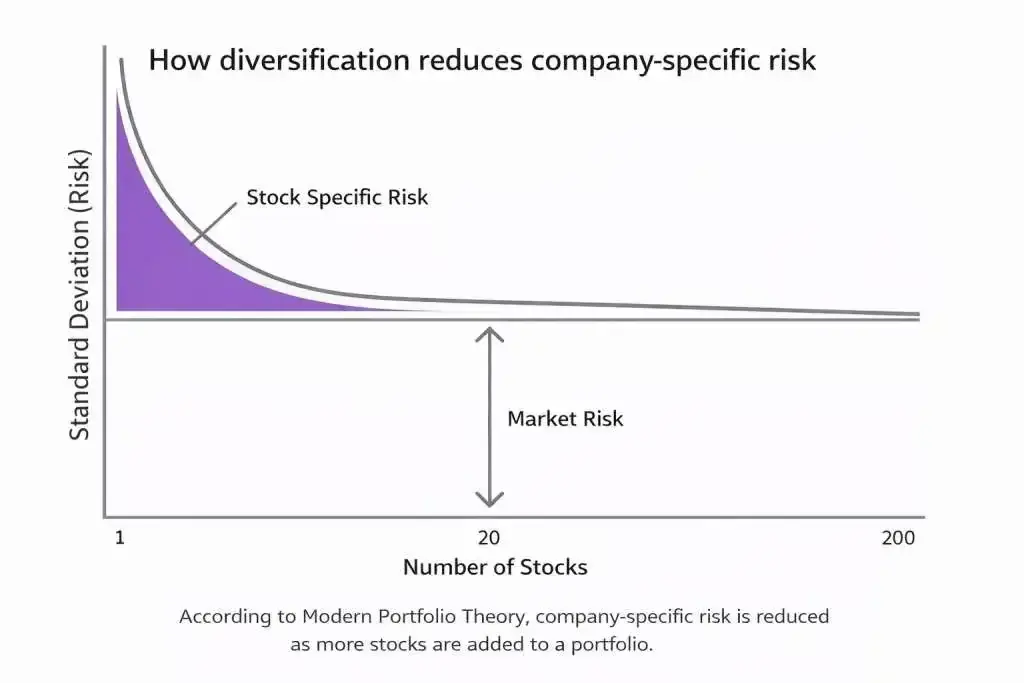
Modern Portfolio Theory, introduced by Harry Markowitz, showed that while market risk cannot be eliminated, company-specific risk can be significantly reduced through diversification. As investors add more stocks to a portfolio, unsystematic risk begins to decline because no single company has the power to disproportionately damage overall returns.
Research and portfolio modelling suggest that you come very close to achieving optimal diversification after adding roughly 20 well-diversified stocks.
What is special about the 20-stock mark?
To explore how portfolio breadth influences risk reduction, read: Portfolio Diversification — How Many Stocks Should You Hold?
Finding Your Risk Appetite
Risk appetite determines how much volatility an investor can endure without abandoning a strategy.It has three dimensions.
Time horizon plays the first role. Longer horizons allow investors to ride out volatility. A twenty-five-year-old saving for retirement can absorb drawdowns far better than someone nearing retirement.
Income stability influences the second dimension. Salaried professionals may withstand equity volatility better than entrepreneurs with cyclical cash flows.
The third dimension is psychological. Some investors can remain invested during 40 % drawdowns. Others panic at 10 %.
Risk capacity is financial. Risk tolerance is emotional. Both must align.
Why Risk Misalignment Destroys Wealth

When portfolios exceed tolerance thresholds, investors react emotionally.
They sell during downturns. They abandon long-term strategies. They miss recoveries.
The COVID crash illustrated this vividly. Markets collapsed rapidly but recovered equally fast.
Those who remained invested benefited from the rebound. Those who exited converted temporary volatility into permanent loss.
Managing risk, therefore, means constructing portfolios that investors can stay invested in.
This is where asset allocation emerges as the structural solution.
What Is Asset Allocation?

Asset allocation gets talked about in very technical language, but the idea itself is quite simple. It is just the practice of spreading your money across different kinds of investments so risk and return stay balanced.
It is not really about trying to pick the single best-performing asset. The real objective is to make sure that if one part of the portfolio goes through a difficult phase, it does not end up hurting everything else.
Most investors spread their money across equities, fixed income, gold, cash, and sometimes real estate — not for decoration, but for balance. These assets dance to different economic tunes, rarely moving in perfect sync.
Debt instruments sway with interest rates and inflation, while gold steps forward when uncertainty rises, currencies wobble, or geopolitics flare. Because these forces rarely move together, assets don’t either — and that’s exactly what gives allocation its quiet strength.
Think of it like a cricket team: you can’t win with only star batsmen. Without bowlers, fielders, and players who can adjust to the pitch, the side falls apart. Real strength comes from balance, not just brilliance.
Portfolios work similarly. It is the allocation that brings that balance and keeps the overall structure stable.
How to Do Asset Allocation Effectively
Asset allocation is not about dividing money randomly across assets. It starts with knowing why you are investing and continues with staying disciplined over time. A clear process keeps allocation practical and consistent.Step 1 — Defining the objective behind the allocation.
Allocation begins with purpose, not assets.Are you investing for retirement, a house purchase, children’s education or long-term wealth creation? Each goal carries a different time horizon and therefore a different risk structure. A retirement goal decades away can tolerate higher equity exposure, while a near-term goal requires stability.
Start with constraint mapping:
- Time horizon
- Return requirement
- Risk tolerance
- Liquidity needs
- Income versus growth focus
Institutional investors formalize this through an Investment Policy Statement before deploying capital.
Step 2 — Assess Risk Capacity vs Risk Tolerance
Risk capacity is financial. It reflects income stability, savings buffers, and emergency reserves.Risk tolerance is emotional. It reflects how you react during drawdowns.
An investor may have the ability to take risks but not the comfort to endure them. Effective allocation must respect both dimensions.
Risk objectives are often framed as:
- Absolute risk — limiting losses
- Relative risk — performance vs benchmarks
Step 3 — Choose Asset Classes and Allocation Mix
Once objectives are clear, allocation moves into construction.Equities act as the growth engine but carry volatility. Fixed income provides stability and income. Gold serves as a crisis hedge. Cash offers liquidity and optionality. Some portfolios include alternatives such as REITs or international equities.
This forms the Strategic Asset Allocation — the long-term portfolio base.
Step 4 — Implement Allocation Through Investment Vehicles
Strategic allocation defines what to own. Implementation defines how to own it.At this stage, investors translate asset class weights into investable instruments:
- Direct equities vs mutual funds vs ETFs
- Government vs corporate bonds
- Physical gold vs gold ETFs or sovereign bonds
- Domestic vs international vehicles
Security selection should consider cost, taxation, liquidity, and credit quality.
To understand insider conviction signals within equity allocation, read: Why Promoter Buying is the Strongest Signal in Stock Markets.
Institutional portfolios also weigh active versus passive exposures.
This step operationalizes the allocation blueprint into a live portfolio.
Step 5 — Rebalance to Maintain Discipline
Over time, market movements distort allocations. A strong equity rally, for example, can quietly push portfolio risk higher than intended.Rebalancing simply brings things back in line. It means trimming what has run up and adding to areas that have fallen behind. This helps you buy low, sell high, and keep the portfolio’s risk aligned with your original goals.
How Different Assets Behave Across Cycles
Market cycles are inevitable. Economic expansion is followed by contraction. Liquidity booms are followed by tightening phases. Inflation cycles rise and fall.Different assets respond differently to these environments.
Equities usually do well when the economy is growing, companies are reporting strong earnings, and liquidity is easy. But in crises or recessions, they often fall sharply as expectations around future earnings start getting cut back.
Debt instruments behave differently. High-quality bonds often remain stable during market stress and may even appreciate when interest rates fall. This makes them natural stabilizers in diversified portfolios.
Gold occupies a unique position. It does not generate income, yet it becomes attractive during financial stress, currency depreciation, and geopolitical uncertainty. Investors view it as a store of value when confidence in financial systems weakens.
Cash, while offering the lowest return potential, plays an important psychological and tactical role. It preserves liquidity and provides investors the ability to deploy capital when markets fall.
When viewed together, this differentiated behavior creates a powerful stabilizing effect.
Diversification emerges not from owning many securities, but from owning assets that behave differently under stress.
" Diversification is protection against ignorance. " — Warren Buffett
Asset Class Volatility Comparison
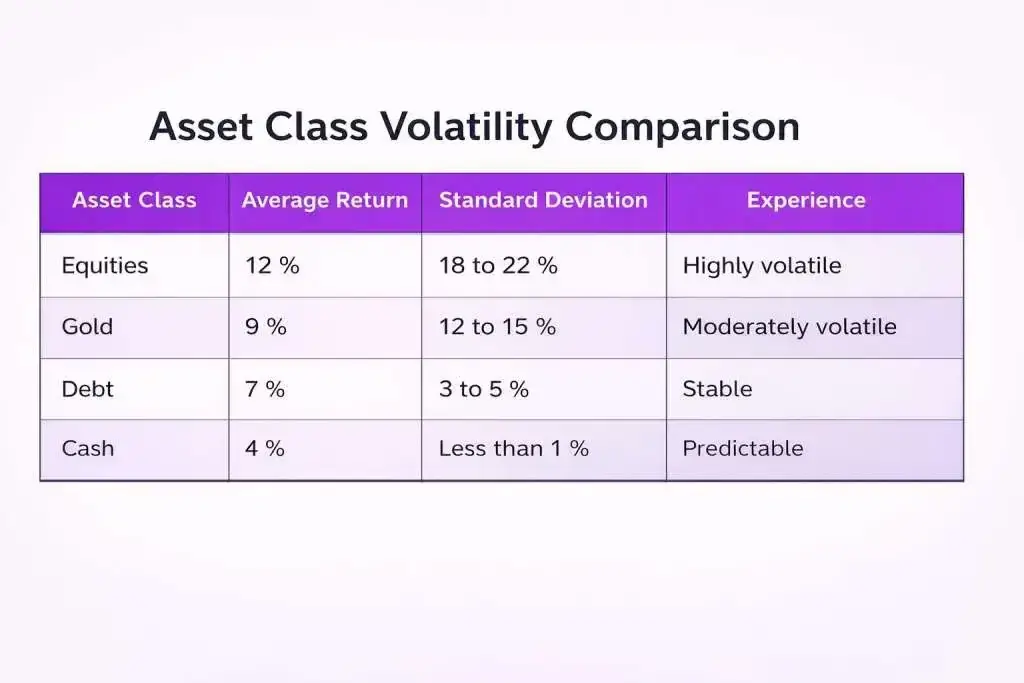
Equities offer superior long-term returns but demand emotional resilience.
Even informed investors struggle if portfolio volatility exceeds their emotional tolerance.
Correlation and the Mathematics of Risk Reduction
The stabilizing effect of allocation is rooted in correlation.Correlation measures how assets move relative to one another. A correlation of one implies assets move perfectly together. A correlation of zero implies no relationship. A negative correlation implies assets move in opposite directions.
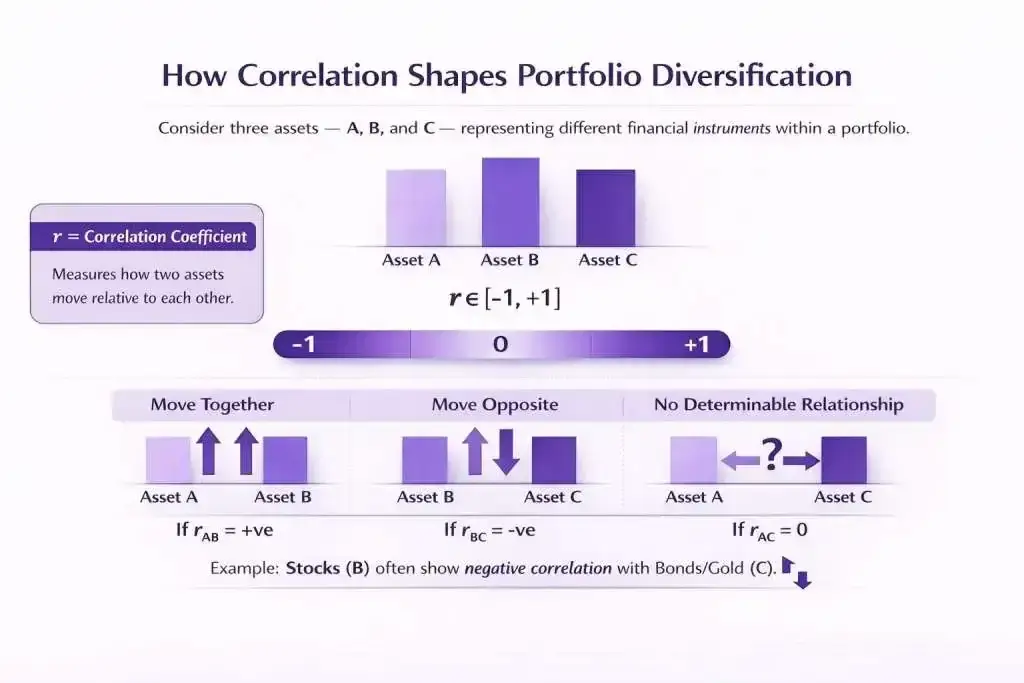
The correlation visual shows how the relationship between assets influences diversification, the coefficient “r” ranges from −1 to +1
- +1 correlation → Assets move perfectly together
- 0 correlation → No systematic relationship
- -1 correlation → Perfect opposite movement
Historically, equities and bonds have often exhibited low or negative correlation during economic downturns. When growth expectations fall, central banks typically reduce interest rates. Falling rates boost bond prices, cushioning equity losses.
Gold tends to exhibit low correlation with equities as well. During crises, when risk assets fall, gold often attracts safe-haven flows.
Inflationary environments introduce another dynamic. Real assets such as commodities and real estate tend to perform better when inflation rises, offsetting weakness in financial assets.
Because these relationships are imperfect, diversified portfolios experience lower volatility than concentrated ones.
It is important to note that diversification does not eliminate risk. It redistributes risk across different drivers and time periods, making the portfolio journey smoother.
A Numeric Illustration of Return Smoothing
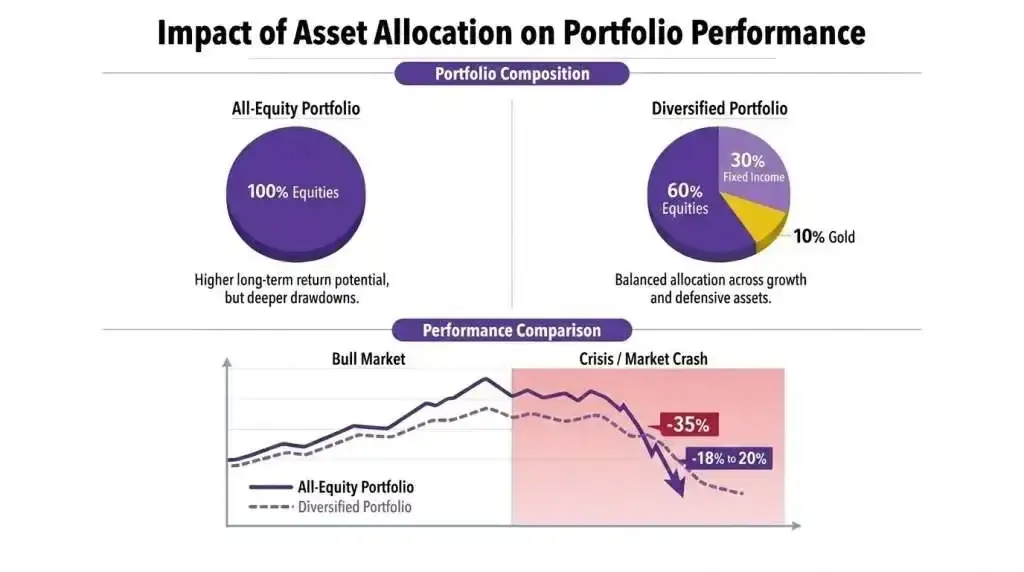
To understand the practical impact of allocation, consider two portfolios.
The first portfolio is entirely invested in equities. Over long time horizons, this portfolio may generate higher average returns. However, it is also exposed to deep drawdowns during crises.
The second portfolio allocates 60% to equities, 30% to fixed income, and 10% to gold.
During bull markets, the diversified portfolio may underperform a pure equity portfolio. However, during downturns, its losses are significantly lower.
For instance, if equities fall 35 % during a crisis, the diversified portfolio may decline only 18 to 20%, depending on bond and gold performance.
Recovery periods shorten because the portfolio does not need to climb out of as deep a loss.
This smoothing effect is critical because compounding accelerates when drawdowns are limited.
Strategic Asset Allocation and Institutional Thinking
Inside large investment institutions, portfolio construction begins long before capital reaches markets. It starts with defining purpose.Pension funds map future liabilities. Endowments outline spending needs. Insurance pools assess duration obligations. These priorities are formalized within an Investment Policy Statement, a document that defines objectives, constraints, and acceptable risk boundaries.
Only after this groundwork is complete do portfolio architects construct the strategic asset allocation.
Strategic allocation represents the long-term structural blueprint of the portfolio. It determines how capital is distributed across growth assets, stabilizing assets, and inflation hedges in line with return expectations and risk tolerance.
The process is deeply analytical. Research teams evaluate long-term return assumptions, volatility histories, and cross-asset correlations. Securities within a single asset class often move together, driven by common economic forces. Across asset classes, relationships weaken. Bonds respond to interest rates, commodities to supply dynamics, and real estate to inflation cycles.
This divergence is intentional. Diversification is achieved not by owning many securities, but by combining assets that behave differently under stress.
As Harry Markowitz observed, “Diversification is the only free lunch in investing.”
Historically, portfolios centered on equities, bonds, cash, and real estate. Over time, institutions expanded into private equity, hedge funds, commodities, and infrastructure to enhance return sources and resilience.
A typical structure may allocate the majority to growth assets, with smaller portions directed toward downturn protection and inflation hedging. The objective is not simply return generation, but structural durability across economic regimes.
Tactical Asset Allocation and Active Positioning
While strategic allocation provides the foundation, tactical allocation introduces controlled flexibility.Portfolio managers monitor macro conditions for temporary dislocations. Sector exposures may rise during commodity upcycles. Gold allocations may increase amid geopolitical stress. Equity weights may be reduced when valuations appear extended.
These adjustments are incremental rather than structural. They represent short term deviations from long term targets designed to capture opportunity or manage emerging risk.
However, flexibility introduces active risk. Tactical decisions can underperform passive allocations if misjudged.
Institutions manage this through risk budgeting frameworks that distribute permissible risk across strategic allocation, tactical positioning, and security selection.
In practice, strategic allocation defines direction, while tactical allocation refines positioning as the journey unfolds. Together, they create portfolios that remain stable in structure yet responsive to changing market environments.
To see how timing frameworks interact with allocation shifts, read: Technical vs Fundamental Analysis — Which One Should You Follow?
Allocation Models for Individual Investors
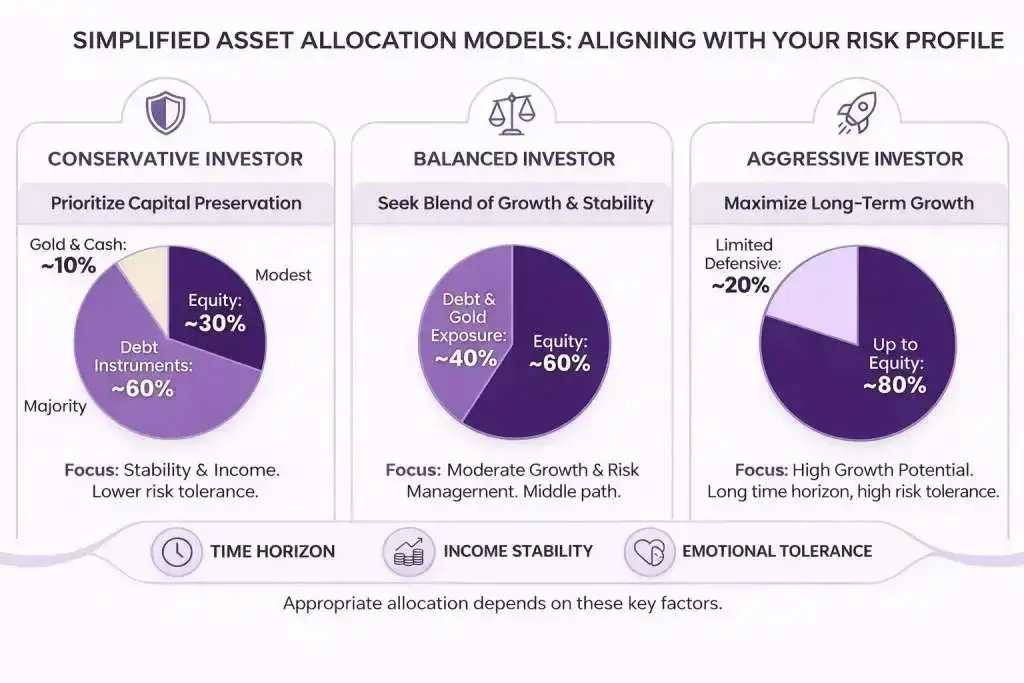
While institutional frameworks are complex, individual investors can adopt simplified allocation models aligned with their risk profiles.
Conservative investors typically prioritize capital preservation. Their portfolios may allocate roughly 30 % to equities, with the majority directed toward debt instruments and modest allocations to gold and cash.
Balanced investors seek a middle path. A 60 % equity allocation combined with debt and gold exposure often provides a blend of growth and stability.
Aggressive investors, usually younger with long-term horizons, may allocate up to 80 % to equities, maintaining limited defensive exposure.
These allocation models are illustrative examples only and do not represent personalized investment advice or recommended portfolio allocations.
The appropriate allocation ultimately depends on time horizon, income stability, and emotional tolerance.
Rebalancing and Maintaining Allocation Discipline
Asset allocation is not a one-time exercise.
Rebalancing restores original proportions.
This may involve trimming outperforming assets and reinvesting proceeds into underweighted segments. The process enforces a disciplined buy low, sell high behavior.
Rebalancing can be conducted annually or triggered when allocations deviate beyond predetermined thresholds.
To understand how, read: What is Rebalancing? Why and When You Should Adjust Your Portfolio.
Allocation Lessons from Indian Market Cycles
Indian market history offers compelling evidence of allocation benefits.During the Global Financial Crisis of 2008, equity markets experienced deep drawdowns. Diversified portfolios containing fixed income and gold exhibited significantly lower declines.
The COVID crash of 2020 presented similar dynamics. Equity-heavy portfolios fell sharply while multi-asset allocations cushioned losses.
More recently, the global rate tightening cycle tested bond markets, yet diversified allocations continued to offer relative stability compared to concentrated equity exposures.
Across cycles, the lesson remains consistent. Diversification reduces volatility and accelerates recovery.
Closing Reflection
Asset allocation rarely attracts attention.It does not promise multibagger returns or overnight wealth creation. It operates quietly in the background, shaping portfolio behavior across market cycles.
Yet its importance cannot be overstated.
Allocation determines whether investors remain invested during downturns. Remaining invested determines whether compounding can work uninterrupted.
Wealth is rarely destroyed by markets alone. It is destroyed when unmanaged risk forces investors out of the journey prematurely.
Asset allocation, when thoughtfully constructed and consistently maintained, transforms volatility from a threat into a manageable variable.
And in investing, survival is often the most underrated edge.
Look at your current allocation today. Does your portfolio rely on one asset to drive returns, or is risk distributed across multiple sources?
Comment “DIVERSIFIED” if your approach prioritizes balance, or “SINGLE-ASSET” if growth depends heavily on equities. It will be interesting to see how investors are thinking about risk.
Explore our Products
Research Framework

Emerging Titans
Combination of quantitative analysis, industry tailwinds, and management assessment - SPRINT investment philosophy

Tiny Titans
Heavy emphasis on scuttlebutt research, plant visits, and early on-ground signals
FAQs
What is Asset Allocation and Portfolio Rebalancing?
+Asset allocation is the process of dividing investments across asset classes like equities, debt, gold, and cash to balance risk and return. Portfolio rebalancing is the periodic adjustment of these weights to restore the original allocation. As markets move, asset proportions drift — rebalancing ensures the portfolio stays aligned with its intended risk profile.
How Should Asset Allocation Be Based on Your Investment Goals?
+Asset allocation should always reflect the time horizon and purpose of the investment. Long-term goals, such as retirement, allow higher equity exposure, while short-term goals require stability through debt and liquid assets. The closer the financial need, the lower the portfolio’s tolerance for volatility.
What Are the 4 Types of Asset Allocation?
+The four common asset allocation strategies are strategic, dynamic, tactical and core-satellite. Strategic allocation sets the long-term baseline mix. Dynamic allocation adjusts continuously with market cycles. Tactical allocation involves short-term deviations to capture opportunities. Core-satellite combines a stable core portfolio with smaller high-return satellite investments.
What Factors Influence the Ideal Asset Allocation Strategy?
+Time horizon, risk tolerance, income stability, and return expectations are the primary drivers of allocation. Liquidity needs, tax consideration,s and life stage also influence how aggressively or conservatively capital should be invested.
What Are Some Common Asset Allocation Mistakes?
+Frequent mistakes include excessive equity exposure, ignoring debt allocation, over-diversification, failing to rebalance, and chasing past-performing assets. These errors often increase risk without improving long-term returns.

High growth stock specialist, Value Educator
Shashank Mahajan is an equity research professional with over 12 years of experience in identifying high-potential SME and micro-cap stocks at an early stage. He follows a rigorous scuttlebutt research–driven approach, combining on-ground insights with deep financial analysis. Shashank specializes in uncovering under-researched and under-owned companies with strong management quality and long-term growth potential. Through disciplined research and early identification, he focuses on spotting tomorrow’s market leaders before they enter the mainstream investor radar.

Atlanta Electricals: Capacity Nearly Quadrupled in a Year

Kirloskar Oil Engines: Data Centres, Nuclear and the Navy

Yash Highvoltage: Bushing Maker With ₹760 Cr of Orders

Quality Power: Reactor Maker With a ₹1,945.5 Cr Order Book

Azad Engineering: Turbine Blades, Jet Engines and Orders

Cyient DLM: Aircraft Electronics and a Record Order Book
Explore our Products
Research Framework
Emerging Titans
Combination of quantitative analysis, industry tailwinds, and management assessment - SPRINT investment philosophy
Tiny Titans
Heavy emphasis on scuttlebutt research, plant visits, and early on-ground signals



Modern Warfare to Multibaggers
Key Trends. Strategic Shifts. Opportunities Ahead.
Don't Miss This Exclusive Webinar!
Join Value Educator to decode the key trends shaping India's defence sector and learn how to identify tomorrow's potential leaders in the space.
- In-depth research on India's defence sector
- Live Q&A session
- Actionable takeaways for long-term investors

 Orders
 Subscription
 Share with friends


Required Details
₹23999.00
(12 month subscription)
As per SEBI regulations, all users are mandated to complete the KYC that is validated for 1 year. Post payment, you will be redirected to the KYC screen


No comments yet. Be the first to comment!