
Market vs Limit vs Stop-Loss Orders

Market Order, Limit Order, Stop-Loss Order: Which One to Use and When?
"Entering a trade without an exit plan isn't investing its skydiving without checking your chute. Stop gambling with your savings and start engineering your way out before things get ugly."
A Market Order gets you a seat, and a Limit Order gets you a bargain but honestly? It’s the Stop-Loss that keeps you from going broke when the market turns against you.
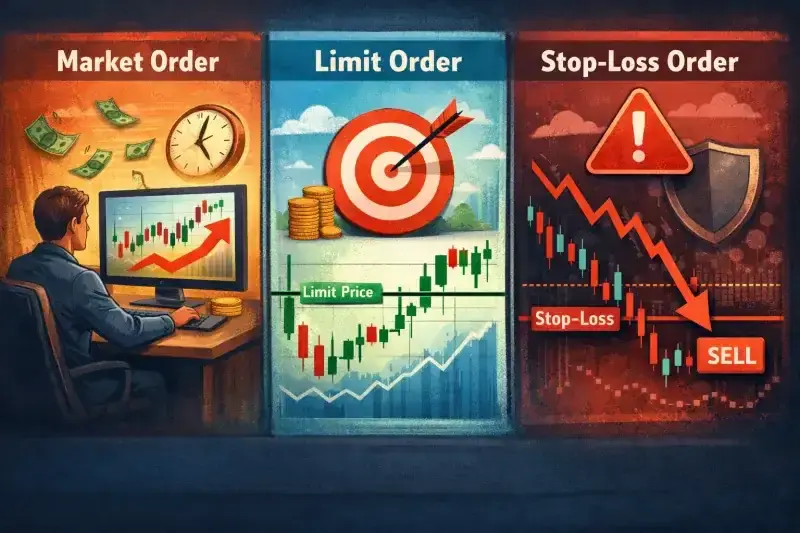
A Market Order is that blank check that guarantees you’ll get the asset, but in a fast-moving market, you might pay a "panic tax" known as slippage, where you end up buying much higher than the price you saw on your screen. On the other hand, a Limit Order lets you set the terms; you’re the patient hunter waiting for the price to hit your target. You gain total control over your entry price, but you risk missing the trade entirely if the market decides to take off without you. The real game changer, however, is the Stop-Loss.
This is your automated emergency exit, and it’s the only thing that keeps a bad day from turning into a total portfolio disaster. While a Limit Order is about greed (getting the best price), a Stop-Loss is about survival. It sits in the background like a silent bodyguard, ready to sell your position the moment the "danger zone" is hit.
By mastering these three tools, you stop reacting to the market’s every move and start dictating the rules of your own engagement. You aren't just "hoping" for a win anymore; you’re building a system that protects your cash while you sleep, ensuring that "price gaps" or overnight crashes don't catch you off guard.
But before we can build a strategy that protects your capital, we first need to define the basic tools in your trading toolkit.
Read More: 10 Stock Market Terms Every Beginners Must Know Before Investing.
What is a Market Order, Limit Order, and Stop-Loss Order
Market Order:
A Market Order is essentially your "buy or sell right now" button. It’s an instruction to the exchange to execute your trade immediately at whatever the current price happens to be in the market. When you use this, you aren't negotiating on the price; you are prioritizing speed above everything else. It’s the tool you reach for when you need to be in or out of a position instantly, like when an asset is skyrocketing, and you don't want to be left behind, or when you need to exit a crashing trade before things get worse.
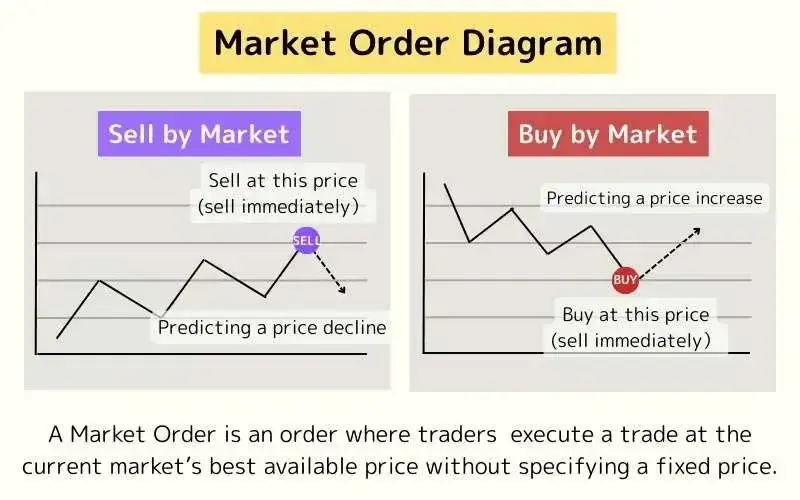
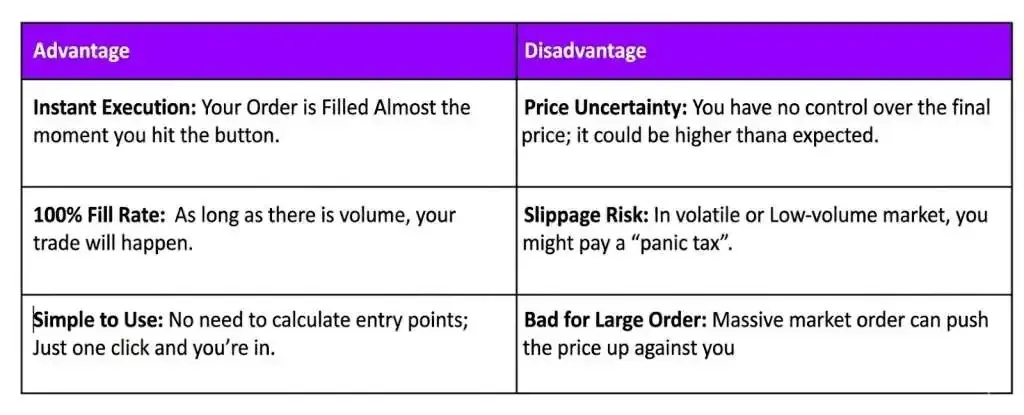
However, the trade-off for this instant execution is a lack of price control. In the split second it takes for your order to process, the price can move, a phenomenon known as slippage. This is especially common in volatile markets where the price you saw on your screen might be slightly different from the price you actually get. Because you’re agreeing to take the "next available" price, a market order guarantees that your trade will happen, but it doesn't guarantee exactly how much you’ll pay or receive for it.
The Real-World Example
Imagine you are tracking a stock currently trading at ₹2,500. You see some breaking news and realize you need to buy it immediately before the price shoots up. You place a Market Buy Order for 10 shares. Within a fraction of a second, the exchange matches you with the nearest sellers. Because the market is moving fast, you might get 5 shares at ₹2,500 and the other 5 at ₹2,500.50. The trade is finished instantly, and you are now a shareholder.
Advantages & Disadvantages
Speed is great when you’re in a rush, but what if you’re a patient hunter looking for the perfect deal? That’s where the Limit Order comes in.
Read More: How Stock Prices Actually Move: Bid, Ask, and the Invisible Auction
Limit Order:
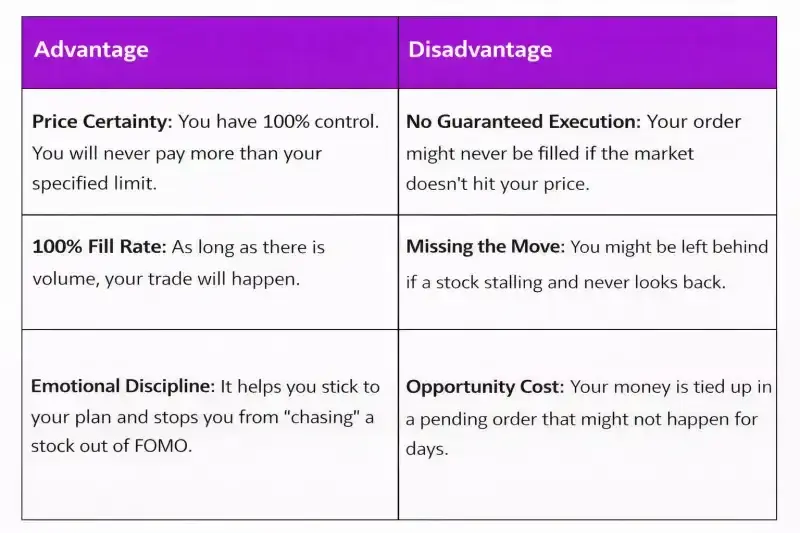
Is your way of telling the market, "I’m only doing this deal on my terms." Unlike a market order, where you just grab whatever is available, a limit order lets you set a maximum price you're willing to pay as a buyer, or a minimum price you're willing to accept as a seller. It’s essentially a "waiting game" where your order sits in the exchange's book until the market price moves exactly to your specified level.
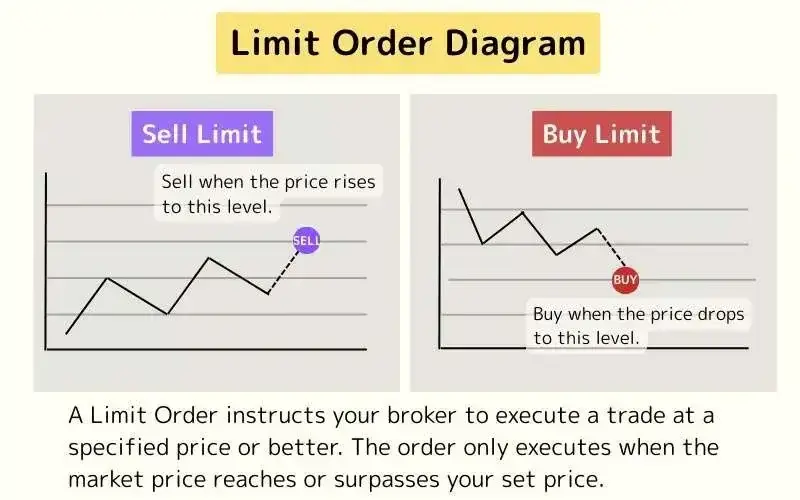
The big trade-off here is that you prioritize the quality of the price over the speed of the trade. While it gives you total peace of mind that you won't overpay due to a sudden price spike, there is no guarantee the trade will actually happen. If the stock price misses your limit by even a single paisa and then takes off, your order will simply sit there unfulfilled while the opportunity passes you by.
The Real-World Example
Imagine you are watching a stock currently trading at ₹410. Your research tells you that ₹410 is a bit too expensive, but if it dips to ₹400, it becomes a "must-buy.
"Instead of watching the screen all day, you place a Limit Buy Order at ₹400.
- If the price hits ₹400, the exchange automatically buys it for you. You got the exact deal you wanted.
- If the price only drops to ₹402 and then rallies to ₹450: Your order is never triggered. You still have your cash, but you missed out on the profit.
Advantages & Disadvantages
Getting in at the right price is important, but staying in the game is even more critical. To do that, you need a silent bodyguard watching your back.
Read More: How to Stay Emotionally Strong During Market Crash
Stop-Loss Order:
Is essentially your "emergency exit" strategy. It’s an automated instruction you give to your broker to sell a stock if the price drops to a specific level that you’ve pre-determined. While Market and Limit orders are mostly about how you get into a trade, the Stop-Loss is strictly about survival. It sits quietly in the background like a silent bodyguard, doing nothing as long as the price stays healthy, but springing into action the moment things go south.
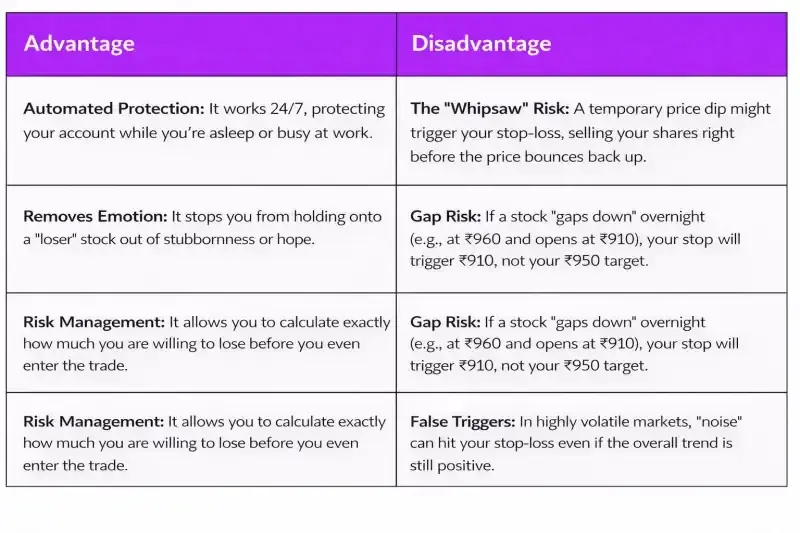
The real beauty of this order type is that it completely removes emotion from the equation. Most traders lose money because they "hope" a falling stock will eventually bounce back, watching a small 2% loss turn into a 20% disaster.
A Stop-Loss prevents this by forcing you to admit you were wrong at a price you can afford. It’s the difference between a controlled exit and a total portfolio blowout, allowing you to protect your capital even when you aren't staring at the screen.
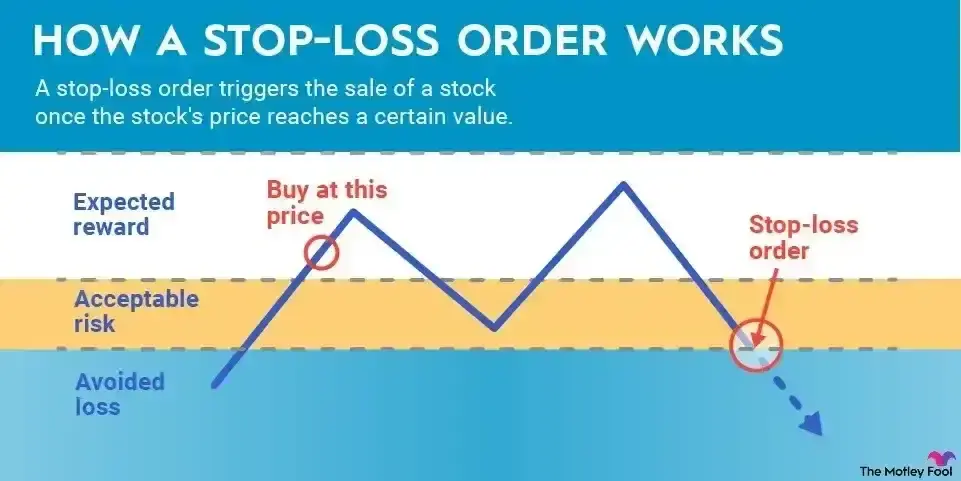
The Real-World Example
Let’s imagine you buy a stock at ₹1,000, hoping it will go to ₹1,200. However, you know that if it drops below ₹950, your original "buy" reason is no longer valid.
You place a Stop-Loss Sell Order at ₹950.
- Scenario A: The stock price climbs to ₹1,100. Your Stop-Loss does nothing.
- Scenario B: A bad earnings report comes out while you're at lunch, and the price crashes to ₹900. The moment the price hit ₹950, your broker automatically sold your shares. You lost ₹50 per share, but you saved yourself from the extra ₹50 loss that everyone else suffered.
Advantages & Disadvantages
 Now that we know what these tools are, how do we decide which one to use when the market bell rings?
Read More: How to start Investing in Stock Market with just ₹1,000
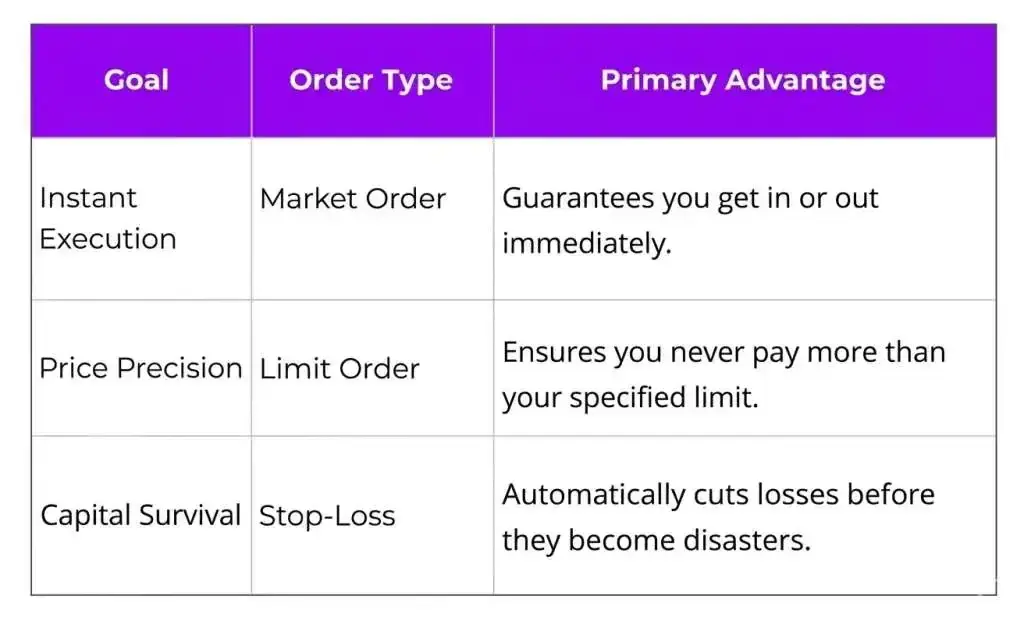
1. Market Order: Use for Speed
A Market Order is your "buy/sell right now" button. You use this when getting into or out of a trade; immediacy is more important than the exact price you pay.
- Best When: You are in an emergency exit from a crashing stock or chasing a "rocket ship" that is moving too fast to wait.
- The Reality: You might suffer from slippage, where the price you actually get is slightly worse than the one you saw on your screen.
2. Limit Order: Use for Control
A Limit Order is your "negotiator." You set a specific price, and the trade only happens if the market meets your terms.
- Best When: You have a clear entry target (like buying on a dip) or a specific profit goal.
- The Risk: There is no guarantee your order will fill. If the price misses your limit by a few cents and then rallies, you'll be left standing on the sidelines.
3. Stop-Loss Order: Use for Protection
A Stop-Loss is your "emergency exit." It’s an automated instruction you give to your broker to sell a stock if the price drops to a specific level that you’ve pre-determined.
- Best When: On every single trade. It’s the only way to ensure a small mistake doesn't turn into a total account blowout while you're busy or asleep.
- The Benefit: It removes the emotional struggle of "hoping" for a recovery and ensures you admit you were wrong at a price you can afford.
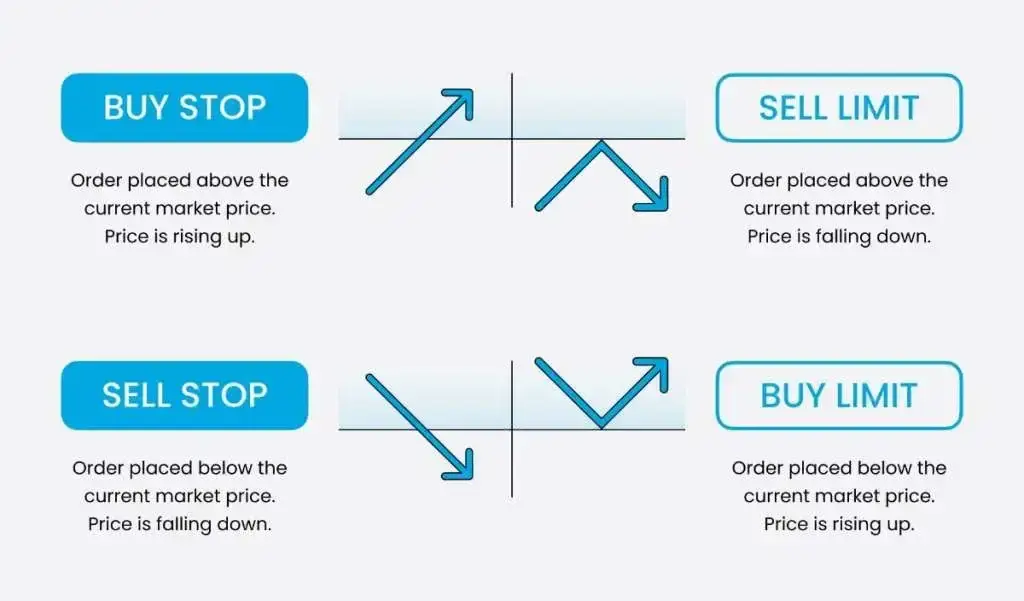
Read More: Best Stocks Under ₹100 that Have Strong Balance Sheets
Case Study in Strategy vs. Luck:
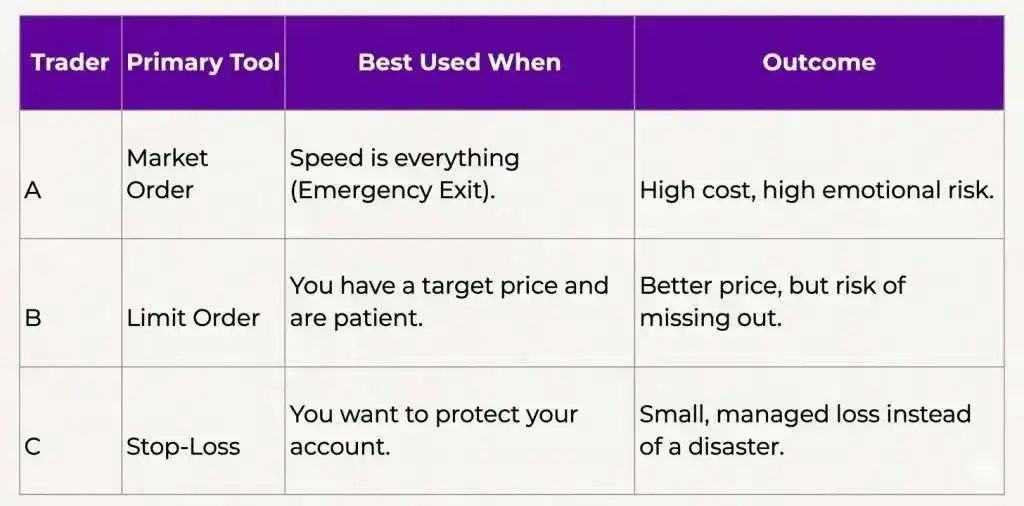
The Tale of Three TradersTo see how these orders actually work when the market is moving, let's look at a scenario involving Reliance Industries, which we'll say is currently trading at ₹2,500. Three friends, all convinced the stock is headed for ₹2,800, decide to jump in, but their choice of order type leads to three very different outcomes.
1. Trader A: The Panic Buyer (Market Order)
Trader A hears a rumor and feels like he’s going to miss the boat. He doesn't care about the price; he just wants "in" right now. He hits the Market Buy button for 100 shares.- The Reality Check: Because the market was moving fast, he didn't actually get ₹2,500. By the time his order hit the exchange, he was filled at an average of ₹2,508 due to slippage.
- The Blowout: He never set a safety net. When the stock unexpectedly dipped to ₹2,300, he froze. Instead of cutting his losses, he sat there "hoping" it would bounce back. By the time he finally gave up and sold at the bottom, he had wiped out ₹20,800 of his capital.
2. Trader B: The Disciplined Hunter (Limit Order)
Trader B is the patient one. He refuses to pay a single paisa more than what he thinks the stock is worth. He sets a Limit Buy Order at ₹2,490.- The Win: As luck would have it, the stock dipped slightly to ₹2,490 before taking off. His order was filled exactly at his price, instantly putting him ₹1,000 ahead of Trader A.
- The Risk: He got lucky this time. If Reliance had stayed at ₹2,500 and shot straight to ₹2,800, Trader B would have made zero profit. His order would have just sat there "untouched" while the opportunity of a lifetime passed him by.
3. Trader C: The Professional Strategist (Stop-Loss)
A Stop-Loss is your "emergency exit." It’s an automated instruction you give to your broker to sell a stock if the price drops to a specific level that you’ve pre-determined.- The Crash: A week later, a surprise global market crash happens overnight. The stock price plunges.
- The Survival: The moment Reliance touched ₹2,400, Trader C’s broker automatically sold his shares. While Trader A was busy "hoping" and losing 20% of his account, Trader C was already out of the market with a small, calculated 4% loss. His money stayed safe in his pocket, leaving him ready to buy back in at a massive discount when the dust settled.
With the calculations mastered and the real-world lessons clear, let’s bring everything together.
Read More: Small Cap & Micro Cap Stocks in India: Opportunity vs Risk
Explore our Products
Research Framework

Emerging Titans
Combination of quantitative analysis, industry tailwinds, and management assessment - SPRINT investment philosophy

Tiny Titans
Heavy emphasis on scuttlebutt research, plant visits, and early on-ground signals
Conclusion and CTA
Mastering these three order types is the exact moment you stop gambling and start trading like a professional. While most beginners obsess over finding that one "perfect" stock, successful investors know that how you enter and exit a position is what actually determines if you'll stay in the game for the long haul.
By using Market Orders for speed, Limit Orders for precision, and Stop-Losses for non-negotiable protection, you effectively remove the two biggest killers of wealth: indecision and emotion. You are no longer at the mercy of every random market tick. Instead, you finally have a system that works for you, one that protects your hard-earned capital even when you aren't glued to the screen.
If this guide helped you think more systematically about your trades, comment “WEALTH” below with your own stories or questions!
Investor FAQs & Screening Tips
1. Can I change a Limit Order after placing it?
+Answer: Yes, you can modify or cancel a Limit Order as long as it hasn't been "filled" (executed) by the exchange yet. If the stock price is moving away from your target and you're worried about missing the move, you can manually adjust your price or convert it to a Market Order to get in instantly.
2. Why did my Stop-Loss trigger if the price only touched it for a second?
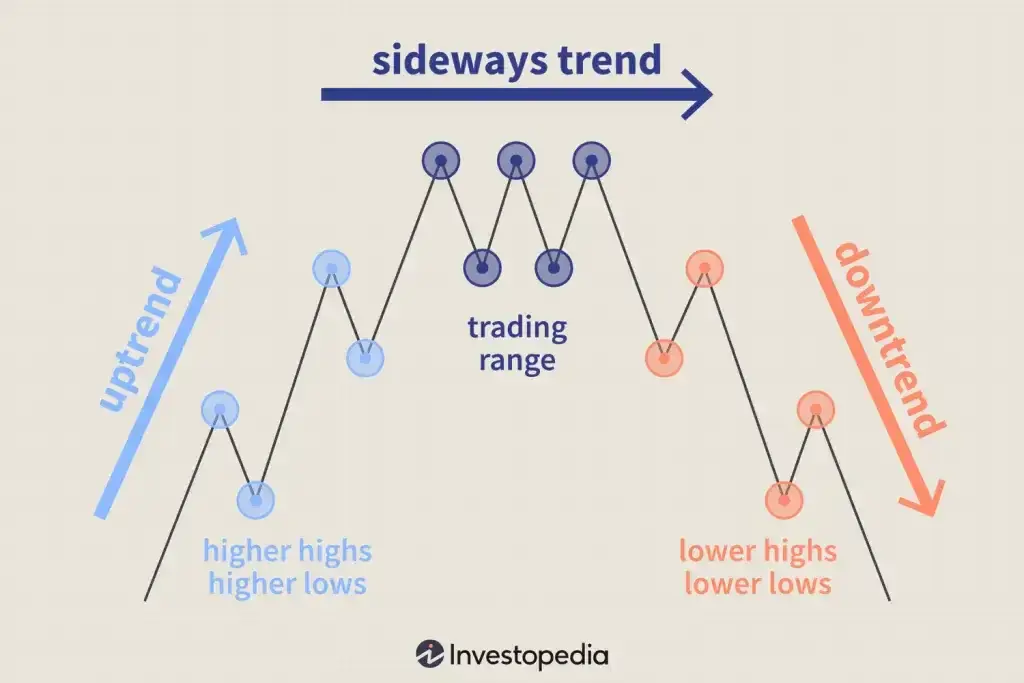
+Answer: The exchange executes a Stop-Loss the moment a single trade occurs at your trigger price. In volatile markets, a "wick" on a candle might hit your price and bounce back immediately. To avoid getting "shaken out" by tiny movements, try placing your Stop Loss slightly below major support levels rather than right on them.
3. Is it better to use Market Orders for Penny Stocks?
+Answer: Actually, Market Orders are very dangerous for Penny Stocks or low-volume "SME" shares. Because these stocks have very few buyers and sellers, a Market Order can cause a massive price spike, making you buy at a much higher price than intended. For these illiquid stocks, always use a Limit Order to protect your entry.
4. Can I use a Stop-Loss for long-term "Buy and Hold" investing?
+Answer: While long-term investors usually ignore daily volatility, a "trailing" Stop-Loss can be a great way to lock in profits. As your stock grows from ₹100 to ₹500, you can move your Stop-Loss up to ₹450. This way, if a major market crash happens, you exit with your wealth intact instead of riding the stock all the way back down.
5. How do I screen for stocks that are "safe" for Market Orders?
+Answer: Look for stocks with high "Average Daily Volume" or a very narrow "Bid Ask Spread" on apps like Groww or Zerodha. Stocks like Reliance or HDFC Bank have so much trading activity that Market Orders usually result in almost zero slippage. If the gap between the Buy and sell prices is large, stick to Limit Orders.

High growth stock specialist, Value Educator
Shashank Mahajan is an equity research professional with over 12 years of experience in identifying high-potential SME and micro-cap stocks at an early stage. He follows a rigorous scuttlebutt research–driven approach, combining on-ground insights with deep financial analysis. Shashank specializes in uncovering under-researched and under-owned companies with strong management quality and long-term growth potential. Through disciplined research and early identification, he focuses on spotting tomorrow’s market leaders before they enter the mainstream investor radar.

Zen Technologies: Revenue Fell After a Big Win




PNG Jewellers: A 194-Year-Old Name Goes National

Explore our Products
Research Framework
Emerging Titans
Combination of quantitative analysis, industry tailwinds, and management assessment - SPRINT investment philosophy
Tiny Titans
Heavy emphasis on scuttlebutt research, plant visits, and early on-ground signals


 Orders
 Subscription
 Share with friends


Required Details
₹23999.00
(12 month subscription)
As per SEBI regulations, all users are mandated to complete the KYC that is validated for 1 year. Post payment, you will be redirected to the KYC screen


No comments yet. Be the first to comment!