
10 Stock Market Terms for Beginners
Everyone seemed to be talking about Paytm when it went public in 2021. Many first-time investors were excited — it was a big brand, a name they knew, something they trusted.
But when the stock started trading, the price didn’t rise like they expected. Some investors who bought in early saw their share value drop almost immediately.
For someone new to investing, this was confusing and even a little scary.
The company was strong, the business was everywhere — so why did the stock fall?
“Company achhi thi, phir bhi price gir gaya?”

This is where many beginners realize a key lesson: the stock market doesn’t move just because a company is popular or familiar. Prices can shift for many reasons, and understanding these reasons is what helps investors make sense of the market — even before thinking about buying or selling.
This is often the moment beginners realise that markets move on expectations, not familiarity.
Why More People Are Turning to the Stock Market
The stock market is not a gambling platform or a shortcut to quick money. At its core, it is a place where ordinary people get the opportunity to own parts of real businesses. When these businesses grow profits over time, shareholders participate in that growth. This simple idea is what has made the stock market one of the most powerful long-term wealth creation tools in history.
Traditional saving methods rely on fixed income. You exchange time for money and then protect that money. The stock market works differently. It allows capital to compound alongside business growth. Over long periods, this difference becomes massive. Salaries and savings grow linearly, but equity grows exponentially.
This is precisely why participation in the stock market has increased sharply in recent years. More people now realise that saving alone is not enough to beat inflation or build long-term wealth. However, more participation does not mean easier money.
In fact, it often means the opposite.
As more investors enter the market, narratives spread faster than understanding. Popular stocks become crowded trades. Prices start reflecting excitement rather than fundamentals. So while participation has increased, genuine investing skill has not increased at the same pace. More investors do not mean better returns. Markets reward discipline, not crowd size.
Till 2020, India had around 40 million demat accounts.
In just the next four years, this number surged to over 190 million.
This is why understanding the right concepts matters far more than simply opening a demat account.
Why Knowing the Basics Matters More Than Stock Tips
Most beginners enter the stock market through tips, reels, or headlines. Very few slow down to understand the language of investing itself. Long-term returns are actually shaped by a small number of fundamental ideas that subtly determine whether wealth gradually erodes or compounds over time.
Every idea that follows is based on a single, straightforward lens: what it means, why it matters, and how real-world investors frequently misinterpret it.
1. Market Capitalisation (Market Cap): Why Company Size Matters More Than Most People Think
The share price multiplied by the number of shares is market capitalisation, or market cap, but it represents much more than just a figure. It tells you about the risk, potential returns, and stability of a company.


The large-cap firms, such as Asian Paints and HDFC Bank, have been in business for many decades, are established and have a history of stability and relatively consistent earnings. Their brand recognition, as well as the backing of institutions and a sustainable income stream, make them candidates for conservative investors who value safety and accumulating wealth.
The mid-cap firms, for instance, Page Industries and Jubilant Foods, are also experiencing growth and improving the quality of their businesses. However, as a result of this, these firms usually provide much higher potential for growth, although their relative level of risk is moderate.
The micro-cap and small-cap companies, such as Indigo Paints in its early days and Laurus Labs, can offer substantial returns; however, these companies tend to be more volatile on that road, and many extreme price fluctuations may occur due to operational errors, or a lack of governance may exist.
Read the complete framework on “How to Analyze a Mid Cap Company – Complete Framework”
Even within the same sector, growth potential and stock behaviour can vary sharply based on company size.
A large-cap FMCG company such as HUL will provide 12-13% returns. Its industry is mature with high market share itself. The growth is steady through enhanced pricing power. Variations in volumes will add to it. This leads to relatively stable stock movement.
A mid-cap company such as Techno Electric can generate 15–20% long-term returns during favourable power sector upcycles, driven by higher infrastructure spending, order inflows, and execution momentum. However, returns tend to be uneven. During weak capex or power cycles, returns can compress to single digits, with long periods of consolidation before the next upturn.
A smaller company like Ajmera Realty may deliver 20–30% returns in strong housing booms, but these returns are far less predictable. Performance can vary sharply depending on interest rates, demand conditions, and the real estate cycle, which is why small-cap stocks tend to swing much more aggressively. Higher return potential almost always comes with higher volatility.
As Warren Buffett famously said, “Price is what you pay; value is what you get.”
This distinction becomes critical when investors confuse price with market capitalisation.
Many beginners assume a low-priced stock must be a small company, and a high-priced stock must be a large company. This is a dangerous misunderstanding. As an example, Suzlon Energy has a low stock price of about ₹50-55 per share, but the company has a large market capitalisation due to the large number of shares that are available for trading (outstanding). In contrast, MRF has a fairly high stock price (approximately ₹1,50,000-₹1,55,000), but its market capitalisation does not compare to this price and is very low in relation to the number of shares outstanding.
Market cap is not about how cheap or expensive a single share looks.
It looks at the real size of the business, risk level, and type of return an investor really can expect. A good understanding of this principle helps an investor make decisions with regard to his/her patience and risk profile rather than acting on something like excessively high returns or seemingly low prices.
2. Portfolio: Why One Stock Is Never Enough
Many beginners believe that finding a single winning stock is enough, but this is rarely the case. Don’t put all your eggs in one basket. Concentrating capital in one stock exposes you to tangible risk. Even the most resilient businesses go through weak cycles, and without diversification, patience is difficult to maintain.

A well-diversified portfolio balances preservation, income generation, and upside if desired. For instance, combining large-cap stability from HDFC Bank with the growth potential of AU Small Finance Bank allows investors to participate in upside while cushioning against volatility.
The experience of mid and small-cap banks like Yes Bank and IndusInd Bank offers a powerful cautionary tale. Early investors were encouraged by rapid growth and rising prices, but governance and balance-sheet issues changed the outcome dramatically. In Yes Bank’s case, the stock eventually collapsed by nearly 99% from its peak, falling close to ₹10 at its worst, wiping out years of paper gains.
Investors who were heavily concentrated suffered permanent capital damage. In contrast, those who held a diversified mix—large, stable banks alongside smaller allocations to mid and small-cap growth banks—experienced far smaller drawdowns and were able to recover much faster.
Even legendary investors like Peter Lynch relied on diversification, accepting that some investments would fail while others would compound strongly.
Real wealth is rarely created by a single perfect pick. It is built through diversification, patience, and several good decisions compounding together over time, not by relying on one stroke of luck.
3. Price vs Valuation: Why a Falling Price Doesn’t Always Mean a Bargain
Beginners often mistake a falling stock price for a bargain or a rising price for overvaluation. Price is simply what a stock costs today, reflecting recent market movements, sentiment, and expectations.
The stock market is very similar to a pendulum in its behaviour. It rarely stays perfectly balanced. Instead, prices constantly swing between two extremes — overvaluation driven by optimism and undervaluation driven by fear. The market rarely prices a company exactly at its true value; it overshoots in both directions. Understanding where the pendulum is swinging matters far more than reacting to price alone.
Valuation, on the other hand, estimates what a company is truly worth based on its future profits, growth potential, and business sustainability.
For example, Paytm’s stock fell sharply after its IPO even though the company was popular and widely used. This showed that a stock can decline despite a strong brand or business presence — because the price had moved to the overvalued extreme of the pendulum and then corrected. The price didn’t tell the full story; expectations did.
The P/E (Price-to-Earnings) ratio facilitates the use of stock pricing in relation to its earnings.
- This suggests that higher P/E ratios are associated with expectations of strong growth.
- A lower P/E can indicate slower growth, increased risk, or cyclical risk.
For example, Hindustan Unilever, a large-cap FMCG firm, is seen to trade at a higher P/E ratio owing to the stable earnings and robust pricing power that the firm enjoys.
On the other hand, the P/E of a cyclical business such as JSW Steel tends to be lower because of the volatility in the stock price due to the sharp fluctuations of the profit cycle. The PEG Ratio takes into account growth when adjusting P/E. A highly P/E-valued stock with extremely rapid earnings growth could be considered to be priced correctly when viewed from a PEG perspective.
For example, a fast-growing mid-cap consumer company may appear expensive on P/E alone, but its PEG can indicate fair valuation given future growth potential.
Understanding price versus valuation helps beginners avoid chasing “cheap-looking” stocks or getting excited by sudden price moves. Instead, it trains them to recognize where the market’s pendulum is swinging — and to invest with realistic expectations rather than emotion.
4. Margin of Safety: Why Even Good Analysis Needs a Buffer
Even the strongest companies can go through rough phases. This is precisely the reason investors look at something called the ‘Margin of Safety’. This essentially means purchasing stocks at a point where a mistake does not affect your investment.
It is like having a bridge built to withstand the maximum load of 10,000 kg.
Although it is capable of handling a truck of 9,900kg, the risk is extremely high because there is barely any leeway. A small crack, extra load, or stress can cause failure.
On the other hand, a 7,000 kg truck crosses comfortably and safely over the same bridge, even during stress.
That buffer is the margin of safety.
In investing, buying a business well below its fair value gives you that buffer. When the stock market experiences instability or uncertainty with regard to business earnings, the use of asset class diversification to offer you a psychological "buffer" will help you remain calm rather than succumb to panicking behaviours regarding your investments. This buffer will also allow for greater wealth accumulation through the continual preservation of your capital over time.
5. Business Cycle: Timing Matters More Than You Think
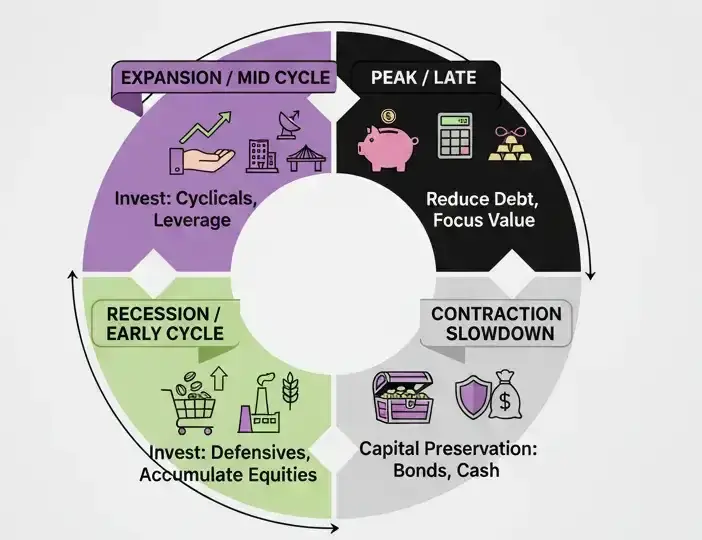
No business is on an exponential growth curve forever; every company goes through growth, peak, slowdown, and recovery phases. The timing of the cycle can affect how stocks perform, sometimes as much as the quality of the company itself.
Infrastructure and power companies tend to do well early to mid-cycle in an economic upturn when government spending and private capex begin to increase. As new projects are announced and execution begins, order flows improve, and earnings visibility rises, supporting stock performance.
On the opposite end of the spectrum, the fast-moving consumer goods (FMCG) companies like Unilever and ITC are seen as stable investment sectors due to continuous consumer purchasing of essential products e.g. food, personal care items, and home goods, regardless of larger economic conditions.
While FMCG stocks tend to have stability in consumption levels, there is also an opportunity for cyclical sectors (i.e commodities/metals) to exhibit volatility. Companies like JSW Steel are experiencing great gains and losses in profitability depending upon the price of steel and demand for steel, as well as overall economic conditions.
Steel stock prices generally do well as the economy starts to grow, when construction and infrastructure in the economy are experiencing an increase. If investors buy into a steel stock when the price is at its highest point or near its peak in the cycle, they may have limited or negative returns simply because the timing of the investment was less than optimal, not because of poor underlying business fundamentals.
Understanding business cycles helps beginners recognise why some stocks move faster at certain times, why others remain steady, and how timing can affect returns without reflecting the company’s quality.
6. Volatility: Why Price Swings Aren’t the Enemy
Volatility often scares beginners. Prices swing sharply, headlines turn negative, and the instinct is to sell. But volatility is not the same as risk. Real risk comes from owning a business you don’t understand.
Take Tata Consultancy Services as an example. The stock can move as much as 5% to 10% within a week based on the overall mood for technology globally, exchange rate changes, or fears of recession within the U.S. However, the fundamental strengths related to customers, margins, and demand are the same. For a prepared investor, these swings are noise, not danger.
Volatility progresses and becomes even greater for mid and small-cap stocks. In the latter half of 2023, there was a sharp downturn in the stock market price of Polycab when there were searches at the income tax department. There has been a heavy correction in the stock price, but this has been based not on the collapse of the business but on uncertainty.
Even the best investors experience brutal markets. Berkshire Hathaway’s stock market value has fallen by over 50% at least four different times over the years. Yet Warren Buffett was still able to become one of the most admired investors of all time. The difference was not avoiding volatility, but understanding the businesses he owned.
Managing volatility requires three things: conviction in the business, diversification to control damage, and a margin of safety at the time of purchase. As Buffett famously said, “Be fearful when others are greedy, and greedy when others are fearful.” When understood correctly, price swings stop being threats—and start becoming opportunities.
7. Bull & Bear Markets: Understanding Market Mood Swings
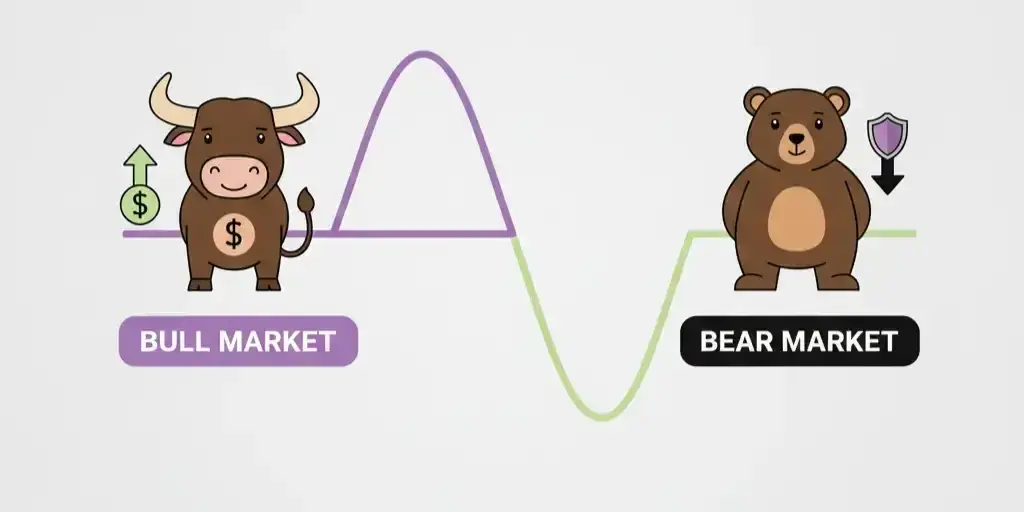
Bull and bear markets are more than just terminologies of rising and falling prices; they are moulders of wealth creation. Optimism hails in bull markets, pushing up the prices, luring investors to indulge in chasing hot stocks or overpay. Bear markets are flags of fear and falling prices; most times, it leads the amateur investor to sell in a panicking mood. But bear markets create an opportunity-strong businesses go on sale, and disciplined investors can buy at attractive valuations.
The 2020 pandemic crash illustrates this. Small and mid-cap stocks tumbled heavily, hammering distressed investors, but those who held on and selectively invested reaped a windfall when markets turned around. The key to figuring out markets is to understand market sentiment, besides fundamentals and business cycles.
8. Compounding: The Slow, Magical Wealth Multiplier
Compounding is not about quick gains—it’s about giving quality investments time to grow on top of past growth. As explained in our compounding article, the real power comes from staying invested through cycles, reinvesting returns, and avoiding unnecessary exits. Early on, the results will be very unimpressive, but eventually, the compound effect will accelerate aggressively as returns begin to make more returns. Therefore, patience will count more than timing and activity.
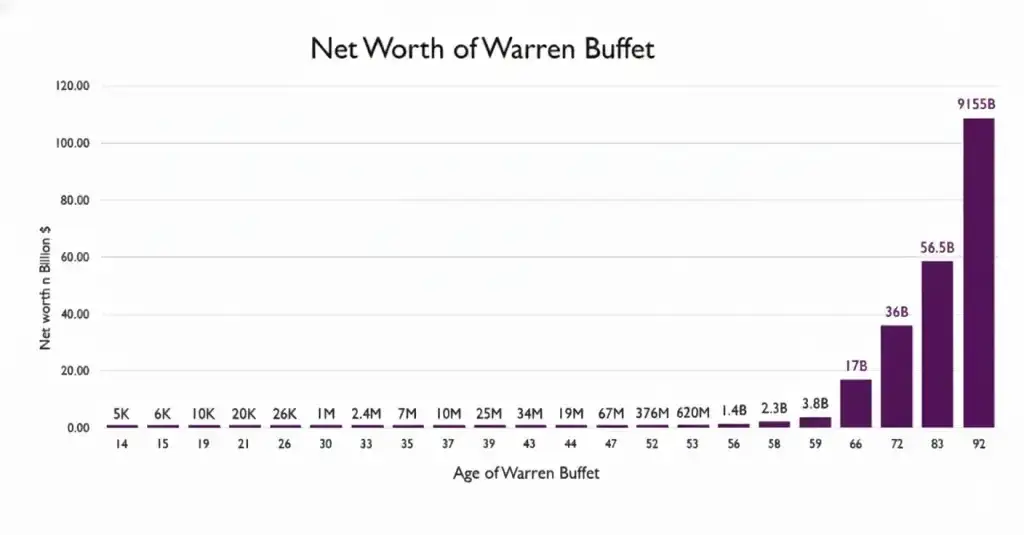
Warren Buffett was asked once about the secret to his success. He didn’t mention intelligence or knowledge — he said time. By starting early and staying invested for decades, compounding kept working quietly in the background, which is why most of his wealth came much later in life, not overnight.
9. Scuttlebutt: Listening Before the Numbers Show Up
Scuttlebutt is about gathering insights from the ground—customers, suppliers, employees—before the numbers reflect reality. Early investors in Asian Paints and Britannia noticed demand trends, product popularity, and distribution growth before quarterly results showed it, gaining an edge over those who waited for the data.
At Value Educator, we follow a similar approach through SPRINT, our structured investment process. By combining on-the-ground research with careful analysis, we aim to identify promising opportunities early while managing risk.
Philip Fisher emphasised that “the best investors are not the ones who read the most numbers, but who observe the world most keenly.” Observing trends, conversations, and business signals allows us to anticipate opportunities and risks, rather than merely reacting to past financial statements.
10. Return Metrics: ROE, ROCE, and EPS — Measuring Business Performance

Return metrics help us understand how efficiently a company uses its resources and generates profit.
ROE (Return on Equity) shows how much profit a company generates from the money invested by shareholders. A higher ROE usually means the company is using equity effectively. Think of it as how well a company turns your invested rupee into more rupees.
ROCE (Return on Capital Employed) looks at profit relative to all the money a company uses — equity plus debt. It tells us how efficiently a company is using all of its capital, not just shareholder funds. (Bajaj, CFI)
EPS stands for Earnings Per Share. It represents the available profit for every share. An increase in profits on a per-share basis allows a company to build wealth for its investors.
For instance, Nestle India has maintained a high RoE along with increased EPS, which is an indication of efficient management of capital and profitable performance. In contrast, Vedanta Limited, a metals and mining company, has lower ROE and more volatile EPS due to fluctuating commodity prices. Although there appears to be a “cheap” element to it in certain instances, its actual returns can be unstable over a period of time.
The more detailed way to interpret the ROE would be through the DuPont analysis framework that decomposes the ROE formula into three pieces:
- Profit margin: the amount of profit the company retains from its sales.
- asset turnover (how well it uses assets to generate sales),
- Financial leverage (how much debt is used to boost returns).
By looking at these components, beginners can see why some companies achieve higher ROE — whether it’s strong sales, efficient use of assets, or smart use of leverage.
A combination of portfolio diversification, market cap understanding, valuation, and margin of safety, when combined with return figures, creates a comprehensive tool to assess businesses. These figures enable investors to look beyond the price of a business and concentrate on quality and sustainability.
These ten ideas give you the building blocks, but knowledge of them individually is not sufficient. In order to implement these ideas and make disciplined long-term investment decisions, what is required is a simple framework that can interlock all ten ideas.
A Simple Investment Thinking Framework for Beginners
Investing in the stock market or any other financial market can seem like a puzzle if you attempt to relate concepts individually. This is where a framework that’s easy to repeat and rely on becomes a necessity, a kind of mindset that helps you stick to disciplined and methodical decisions. The first way to make these decisions methodically begins by asking the following questions for every possible investment:
1. Where is the business in its cycle?
All companies and industries undergo the stages of growth, maturity, slowdown, and recovery. The identification of the position of a firm relative to its cycle becomes essential to timing your investment.
For instance, firms in the FMCG sector may experience stable demand, yet even such firms have cycles. During periods of rising input costs or weak rural demand, margins can come under pressure despite stable sales. Buying FMCG stocks when valuations are stretched at peak optimism often leads to muted returns. . In contrast, accumulating them during temporary slowdowns—when costs are high or demand sentiment is weak—has historically delivered better long-term outcomes.
Recognising business cycles helps you avoid overpaying at the top and protects your capital while waiting for compounding to work.
2. What expectations are priced in today?
Price and valuation are not the same. The price of a stock shows what the market paid for it today, reflecting both its past performance and what investors expect in the future. Sometimes, even if a company reports strong earnings, the stock can fall if the market had already expected even better results.
Valuation helps investors understand whether the current price already accounts for those future expectations. For example, a small-cap stock may jump sharply when it exceeds expectations because the market hadn’t fully priced in the growth, while a large-cap stock might fall despite solid results if the market had anticipated even higher performance.
By looking at valuation, beginners can judge whether a stock is fairly priced relative to its growth prospects, rather than simply chasing low numbers or short-term movements.
3. What can go wrong from here?
All investments bear risks such as mismanagement, economic downturn, competition, and industrial challenges. This is useful information since you can avoid all the mentioned risks.
Moreover, by using diversification in portfolios and a margin of safety, you can face difficulties without becoming anxious. For example, people who invested in Yes Bank with well-diversified portfolios, besides investing in other banks, were less affected compared to those who invested in only one failing bank.
4. How long will the thesis take to play out?
Investing is a game of the long haul. Even excellent business investments require time to mature and see compound values and market reality. Short-term market fluctuations are notorious pitfalls that tend to deceive novice investors.
An investor holding the Asian Paints stock since the early 2000s will experience the compounding of wealth, while the one trading continuously for short-term gains will possibly underperform.
5. How does this fit within the overall portfolio?
No investment exists in isolation. There should be a rationale for the presence of each stock within the portfolio. It could serve the purposes of stability, growth, or optionality. Diversification by industry groups, market capitalisation, and kinds of risks helps to ensure that even if there is a mistake in the portfolio strategy, achieving the long-term objective is not hampered.
Armed with these five questions, the novice simplifies complexity by distinguishing signal from noise, by taking risk ahead of return, and by developing a repeatable strategy that functions well during bull markets and bear markets. Although the framework is clear, most new investors tend to make mistakes where theory meets reality. Knowing what to do is different; it's knowing what not to do that separates successful investors from those who fail.
Common Beginner Mistakes: A Reality Check
Here are the most common pitfalls:
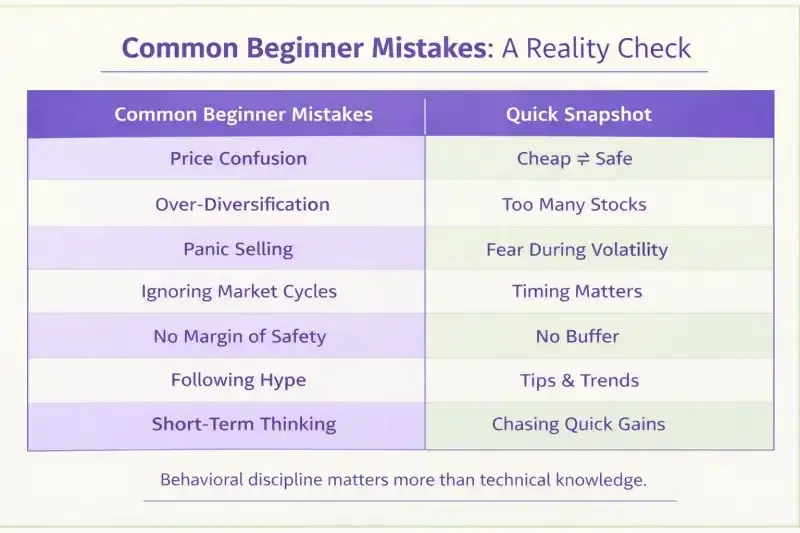
Read the full article on common mistakes every small-cap investor makes and how to avoid them here.
The common thread? Behavioural discipline outweighs technical knowledge. Understanding terms is only useful when consistently applied with patience, research, and composure.
Explore our Products
Research Framework

Emerging Titans
Combination of quantitative analysis, industry tailwinds, and management assessment - SPRINT investment philosophy

Tiny Titans
Heavy emphasis on scuttlebutt research, plant visits, and early on-ground signals
Conclusion: Think Like a Business Owner, Not a Trader
Most beginners don’t struggle in the stock market because they lack intelligence or effort—they struggle because they enter without understanding how markets actually work. Tips, headlines, and price movements are loud, but long-term outcomes are shaped quietly by a few core ideas applied consistently over time.
Learning stock market concepts is not about memorising definitions or predicting prices. It’s about building the right habits early—thinking in probabilities, respecting risk, staying patient through volatility, and allowing compounding to work across cycles. When these foundations are in place, confidence replaces fear, and discipline replaces reaction.
If this guide helped simplify how you view the stock market, comment “FOUNDATIONS” below. Like the post to support beginner-focused, fundamentals-led investing, share it with someone starting their journey, and comment with one concept from this article that changed how you think about investing.
The strongest investors are not the fastest—but the ones who understand the game before they play it.
“Invest smart, stay curious, and remember: with our SPRINT philosophy, real investing is a journey, not a race.”
FAQs ( Frequently Asked Questions )
Should beginners learn stock market terms?
+What are basic stock market terminologies?
+How many stock market terms should beginners know?
+Stock/Share - This symbolizes ownership in a business organization.
Share Price – The market value of a share of the company.
Market Capitalization - The total market value of a firm’s outstanding stocks.
Bull Market: The time period in which the market price increases.
Bear Market: This is when a market is experiencing falling prices.
Dividends: These are profits distributed to shareholders.
Volatility – Degree of price fluctuation.
Portfolio – Collection of different shares owned by an investor.
P/E Ratio (Price-to-Earnings) – Price relative to company earnings.
Liquidity - The ease of buying or selling a stock.
Risk-Return Trade-off – The relationship between the level of risk taken and the potential return earned, higher returns usually involve higher risk, while lower risk generally means lower returns.
Why is it important to know stock market terms?
+What are the most commonly used terms?
+- Stock/Share - This symbolizes ownership in a business organization.
- Share Price – The market value of a share of the company.
- Market Capitalization - The total market value of a firm’s outstanding stocks.
- Bull Market: The time period in which the market price increases.
- Bear Market: This is when a market is experiencing falling prices.
- Dividends: These are profits distributed to shareholders.
- Volatility – Degree of price fluctuation.
- Portfolio – Collection of different shares owned by an investor.
- P/E Ratio (Price-to-Earnings) – Price relative to company earnings.
- Liquidity - The ease of buying or selling a stock.
- Risk-Return Trade-off – The relationship between the level of risk taken and the potential return earned, higher returns usually involve higher risk, while lower risk generally means lower returns.
What knowledge is needed to trade in the stock market?
+
High growth stock specialist, Value Educator
Shashank Mahajan is an equity research professional with over 12 years of experience in identifying high-potential SME and micro-cap stocks at an early stage. He follows a rigorous scuttlebutt research–driven approach, combining on-ground insights with deep financial analysis. Shashank specializes in uncovering under-researched and under-owned companies with strong management quality and long-term growth potential. Through disciplined research and early identification, he focuses on spotting tomorrow’s market leaders before they enter the mainstream investor radar.

Glenmark: The USD 700 Mn Cancer Deal and Its Brands

Pharma Stocks in India 2026: Generics, APIs and CDMOs

Granules India: From Paracetamol to a 65% Gross Margin

Natco Pharma: After Revlimid, 29 Patent Challenges

Shilpa Medicare: Cancer APIs, Films and Biosimilars

Alembic Pharma: US Plants Pay Back, Margin Hits 22.2%
Explore our Products
Research Framework
Emerging Titans
Combination of quantitative analysis, industry tailwinds, and management assessment - SPRINT investment philosophy
Tiny Titans
Heavy emphasis on scuttlebutt research, plant visits, and early on-ground signals



India's Aerospace Opportunity
Global Demand. Supply Bottlenecks. Opportunities Ahead.
Don't Miss This Exclusive Webinar!
Join Value Educator to decode the key trends shaping India's aerospace sector and learn how to identify tomorrow's potential leaders in the space.
- How the aircraft value chain works, layer by layer
- Indian companies supplying global aircraft makers
- A framework to judge any aerospace company

 Orders
 Subscription
 Share with friends


Required Details
₹23999.00
(12 month subscription)
As per SEBI regulations, all users are mandated to complete the KYC that is validated for 1 year. Post payment, you will be redirected to the KYC screen


No comments yet. Be the first to comment!