
Himadri vs PCBL: Carbon Black and Battery Materials

Every tyre on an Indian road is black because of carbon black, a fine powder that makes rubber strong and helps it last. Two listed Indian companies make a lot of it. PCBL Chemical, the former Phillips Carbon Black of the RPSG group, calls itself India's largest carbon black player and has about 9,00,000 tonnes a year of capacity. Himadri Speciality Chemical has about 2,50,000 tonnes, but it also distils coal tar, from which it makes its own feedstock, and it is India's leading maker of coal tar pitch for aluminium smelters.
Investors compare the two for a second reason too. Both now want a place in lithium-ion batteries. Himadri is building cathode and anode powders, the two largest parts of a cell. PCBL is building conductive blacks and nano-silicon for anodes. In the quarter to 30 September 2026, the two looked very different: Himadri earned ₹231 Cr of profit in the quarter on ₹1,691 Cr of revenue, while PCBL earned ₹74 Cr on ₹2,474 Cr.
Figures as of 20 November 2026. This page is research, not a recommendation to buy or sell any stock.
Himadri vs PCBL at a Glance
| Measure | Himadri Speciality Chemical | PCBL Chemical |
|---|---|---|
| Business | Coal tar distiller: coal tar pitch, carbon black, naphthalene and oils, plus battery materials in development | Carbon black (tyre, performance and speciality grades) and power from waste heat, plus water and oilfield chemicals through Aquapharm |
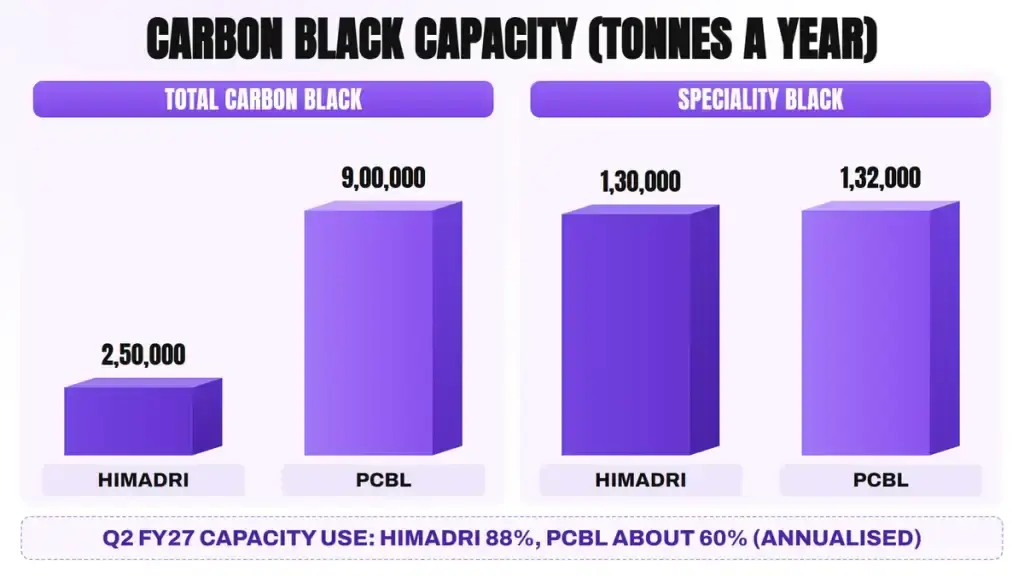
| Plants and capacity | 8 plants in India and China; 6,00,000 tonnes a year of coal tar distillation; 2,50,000 tonnes of carbon black, of which 1,30,000 tonnes can make speciality grades | 9 plants (7 in India, 1 in the USA, 1 in Saudi Arabia); 9,00,000 tonnes of carbon black, including 1,32,000 tonnes of speciality black (June 2026); 122 MW of co-generation |
| FY26 revenue | ₹4,661 Cr | ₹8,189 Cr |
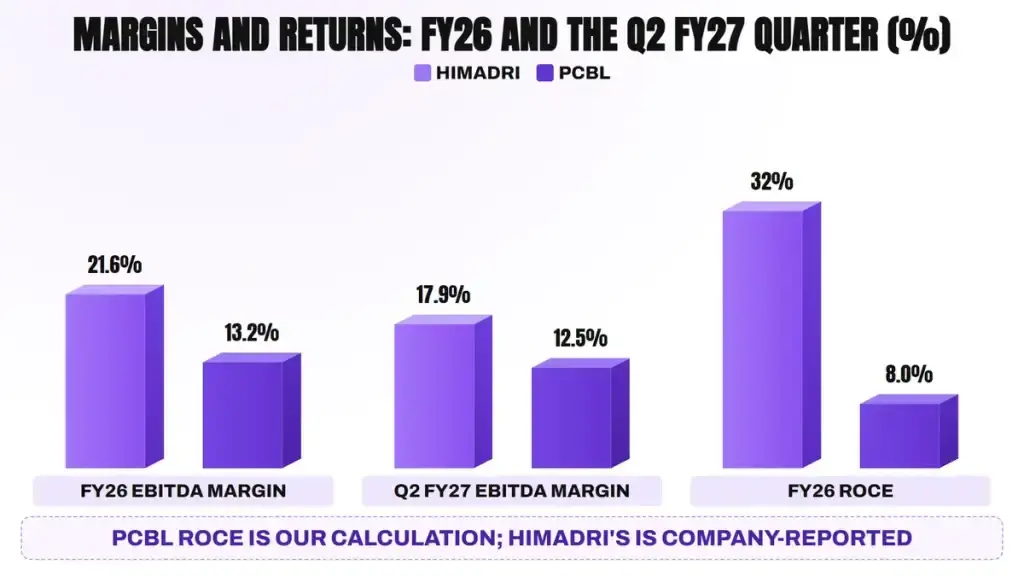
| FY26 EBITDA margin | About 21.6% | About 13.2% |
| FY26 profit after tax | ₹755 Cr | ₹198 Cr |
| Returns, FY26 | ROCE 32%, ROE 18% | ROCE about 8.0% and ROE about 4.9% (our calculation) |
| Net debt, 31 March 2026 | Net cash of about ₹94 Cr | Net debt of about ₹4,537 Cr |
| Net debt, 30 September 2026 | About ₹520 Cr | About ₹4,691 Cr |
| Order book | Not disclosed: it sells products, not projects | Not disclosed: it sells products, not projects |
| Q2 FY27 revenue growth | 57.93% | 14% |
| Customers and reach | Aluminium smelters, graphite electrode makers, tyre and rubber makers; 61 countries | Tyre makers and rubber goods makers; 70+ countries |
| Key risk | Battery plans running late: the 40,000-tonne cathode plant moved to the end of FY28 | High debt and falling carbon black volumes: Q2 FY27 volume down about 17% |
The table shows the main split. PCBL is close to twice Himadri's size by revenue, but Himadri made about 3.8 times PCBL's profit in FY26 and has almost no net debt.
How the Two Business Models Differ
Himadri: a coal tar company that also makes carbon black
Himadri buys coal tar, a thick by-product of the coke ovens at steel plants, and splits it into parts at a scale of 6,00,000 tonnes a year. The heaviest part is coal tar pitch, the binder for the carbon blocks used in aluminium smelters, where Himadri claims a 65% share of the Indian market. Another part is an oil that feeds its own carbon black plants. That gives it a clean, steady feedstock, which management says is what speciality carbon black needs.
Its carbon black arm has grown fast. It added 70,000 tonnes of capacity, sells 70+ speciality grades, and ran at 88% of capacity in Q2 FY27, with 88% to 95% expected. Prices are passed on to customers with a short lag, so Himadri tracks profit per tonne rather than margin percentage. In Q2 FY27 it earned ₹20,990 of EBITDA per tonne across all its products, against ₹17,910 a year earlier. Exports were 33% of sales. You can read the full story in our Himadri Speciality Chemical analysis.
PCBL: a carbon black giant with a chemicals arm
PCBL makes only carbon black in its core business, from carbon black feedstock oil that it buys, much of it shipped in from overseas. In Q2 FY27 it sold 134,180 tonnes: 77,914 tonnes of tyre grades, 39,698 tonnes of performance grades and 16,568 tonnes of speciality grades. About 31% of the volume went abroad. The heat from its furnaces runs 122 MW of power plants. It uses about 40% of that power itself and sells the other 60%; in Q2 FY27 it sold 108 million units at ₹5.34 a unit.
PCBL also fully owns Aquapharm, which makes chemicals for home care, water treatment and oil and gas wells. Aquapharm had ₹1,443 Cr of revenue in FY26, about 17.6% of PCBL's total, and ₹162 Cr of EBITDA. In Q2 FY27 it had ₹433 Cr of revenue and ₹42 Cr of EBITDA.
So the two earn in different ways. Himadri earns on a chain it controls from coal tar onwards. PCBL earns on scale in carbon black, plus power sales and a second chemicals business, but it buys most of its main raw material.
Latest Quarter: Q2 FY27 Side by Side
Himadri reported on 16 October 2026 and held its call on 22 October 2026. PCBL reported and held its call on 2 November 2026.
| Q2 FY27 (Jul-Sep 2026) | Himadri | PCBL |
|---|---|---|
| Revenue | ₹1,691 Cr, up 57.93% | ₹2,474 Cr, up 14% |
| EBITDA | ₹303 Cr, up from ₹238 Cr | ₹310 Cr, up 12% from ₹278 Cr |
| EBITDA margin | About 17.9% (about 22.2% a year earlier) | About 12.5% (about 12.8% a year earlier) |
| Profit after tax | ₹231 Cr, up 31.33% | ₹74 Cr, up 20% |
| Volume | 1,46,806 tonnes of all products, up about 8% | 134,180 tonnes of carbon black, down about 17% from 1,61,728 |
| EBITDA per tonne | ₹20,990 (all products) | About ₹19,800 for carbon black, or about ₹17,500 without a one-off US tariff refund |
| H1 FY27 profit after tax | ₹460 Cr | ₹229 Cr |
Himadri's revenue jumped, but ₹140 Cr of it came from tyre trading at its Birla Tyres unit, which earned only ₹1 Cr of EBITDA, which is why its margin percentage fell even as profit per tonne rose. Its carbon black plants stayed busy.
PCBL's quarter was harder. It chose to give up spot orders where it was not making a decent margin, mainly in Southeast Asia, and some tyre customers ran down the stock they had built in Q1. It also booked a ₹33 Cr refund of US tariffs. That is about 11% of its Q2 FY27 EBITDA; without it, EBITDA would have been about ₹277 Cr, roughly flat on the ₹278 Cr of a year earlier. Management kept its guidance of double-digit growth in EBITDA per tonne over FY26, but said its earlier target of about 7% volume growth now looks hard.
Segments in Q2 FY27
Both companies split their results into segments. Himadri's carbon segment is broader than PCBL's: it holds coal tar pitch, oils and naphthalene as well as carbon black, so it is the closest match available, not an exact one.
| Q2 FY27 segment (₹ Cr) | Revenue | Profit before interest and tax | Margin |
|---|---|---|---|
| Himadri: carbon materials and chemicals | 1,539.02 (1,067.21 a year earlier) | 251.64 (201.31) | About 16.4% (about 18.9%) |
| PCBL: carbon black | 1,978.53 (1,694.53) | 190.67 (162.55) | About 9.6% (about 9.6%) |
| Himadri: power | 33.32 | 29.84 | About 90% |
| PCBL: power | 93.56 (106.87) | 58.95 (76.82) | About 63% |
| PCBL: chemicals (Aquapharm) | 433.25 (394.95) | 5.24 (11.92) | About 1.2% |
| PCBL: battery chemicals | No revenue yet | 0.17 | Not meaningful |
PCBL's carbon black segment grew revenue about 16.8% even as its volume fell, because prices were higher, and it kept a similar margin. Its power segment earned less, as lower production meant less power to sell, even though it got ₹5.34 a unit against ₹3.76 a year earlier. Aquapharm's profit was thin in the quarter.
Five-Year Financials: FY22 to FY26
| Year | Himadri revenue | Himadri EBITDA (margin) | Himadri PAT | PCBL revenue | PCBL EBITDA (margin) | PCBL PAT |
|---|---|---|---|---|---|---|
| FY22 | 2,791 | 163 (5.8%) | 39 | 4,446 | 682 (15.3%) | 426 |
| FY23 | 4,172 | 419 (10.0%) | 216 | 5,774 | 772 (13.4%) | 442 |
| FY24 | 4,185 | 635 (15.2%) | 411 | 6,420 | 1,074 (16.7%) | 491 |
| FY25 | 4,613 | 847 (18.4%) | 555 | 8,404 | 1,384 (16.5%) | 435 |
| FY26 | 4,661 | 1,006 (21.6%) | 755 | 8,189 | 1,082 (13.2%) | 198 |
All figures are consolidated, in ₹ Cr. PCBL's figures include Aquapharm from 31 January 2024, when it bought the company.

The two lines cross in opposite directions. Himadri's revenue grew about 14% a year, but its profit grew about 19 times, from ₹39 Cr to ₹755 Cr, as its margin climbed every year from about 5.8% to about 21.6%. More speciality carbon black and made-to-order pitch grades did most of that work.
PCBL grew revenue faster, about 16.5% a year, helped by buying Aquapharm. But its FY26 profit was about 54% lower than in FY22. Its margin fell back to about 13.2% in FY26, and interest on the debt it took on rose to ₹423 Cr, about 39% of that year's EBITDA. For how EBITDA and profit can tell different stories, see EBITDA Explained: Uses and Limits.
Order Book and Growth Plans
Neither company has an order book. Both sell products under yearly contracts and in the spot market, so their growth comes from new capacity and new products.
Himadri
Carbon black. A 6,000-tonne super speciality carbon black line costing ₹170 Cr is due in Q4 FY28, and a 200-tonne carbon nanotube plant costing ₹70 Cr is due in Q4 FY27. Its ENERGEX conductive grades won approval for high-voltage cables and batteries in Q2 FY27, followed by commercial orders.
Battery materials. This is the bigger bet. Himadri plans LFP (lithium iron phosphate) cathode powder, the material on the positive side of many EV and storage cells. A 2,000-tonne first line is due in Q3 FY27, and it calls this the first commercial LFP cathode plant outside China. The 40,000-tonne phase 1, with ₹1,125 Cr of capex, was meant to start in Q3 FY27 but has been moved to the end of FY28, and LFP profits are expected only from FY29. On the anode side, a 200-tonne plant started on 23 April 2026, using pitch made in-house, and the capex for a larger plant will be announced later. Himadri has also secured a 17.6% stake (after conversion) in Sicona, an Australian silicon-carbon anode company, and 19.44% of IBC, a cell maker.
Management plans ₹800 Cr to ₹900 Cr of capex in FY27, funded from its own cash flow, and repeats a target of more than ₹1,100 Cr of profit in FY28.
PCBL
Carbon black. PCBL has spoken of reaching more than 1 million tonnes of capacity, and has bought land in Andhra Pradesh for a new plant, now waiting for environmental clearance. It is also close to approving its own coal tar distillation plant, which would move it towards Himadri's model of making its own feedstock. In the near term it is spending little on growth: at best about ₹100 Cr of strategic capex in FY27.
Battery materials. PCBL's plans are for smaller, higher-value parts of the cell:
- Super-conductive black: a 1,000-tonne line at Palej has been commissioned. Conductive black helps electrons move inside a battery electrode.
- Acetylene black: a 4,000-tonne plant, which PCBL calls India's first, was expected by the end of FY27 and won approval under the government's ECMS electronics scheme on 18 August 2026, for a project of about ₹329 Cr.
- Nano-silicon: through Nanovace, a 51% joint venture with Australian partner Kinaltek, PCBL is developing silicon for anodes. Silicon stores about 3,579 mAh/g against 372 for graphite, but swells by up to 300% when charged. The pilot plant at Palej has started making samples, it holds a US patent for the process, and it is now working on silicon-carbon composites. A new subsidiary, Nanovace Advanced Materials, was set up for battery materials, as filed on 10 October 2026.
PCBL is not planning graphite anodes at this stage, and it has not announced plans for cathode material. Its battery chemicals segment had ₹297.57 Cr of assets on 30 September 2026 but no revenue yet.

Balance Sheet and Cash Flow
| ₹ Cr | Himadri, 31 Mar 2026 | Himadri, 30 Sep 2026 | PCBL, 31 Mar 2026 | PCBL, 30 Sep 2026 |
|---|---|---|---|---|
| Borrowings | 766.6 | 1,155.8 | 4,825.2 | 4,927.4 |
| Cash, bank balances and current investments | 860.2 | 636.1 | 288.0 | 236.4 |
| Net debt (net cash) | Net cash of about 94 | About 520 | About 4,537 | About 4,691 |
| Total equity | 4,762 | 5,188 | 4,019 | 4,072.55 |
| Net debt to equity | Nil (net cash) | About 0.10 | About 1.13 | About 1.15 |
| Operating cash flow (₹ Cr) | Himadri | PCBL |
|---|---|---|
| FY25 | 446.9 | 760 |
| FY26 | 382.0 | 1,576.0 |
| H1 FY27 | Minus 154 | 363.12 |
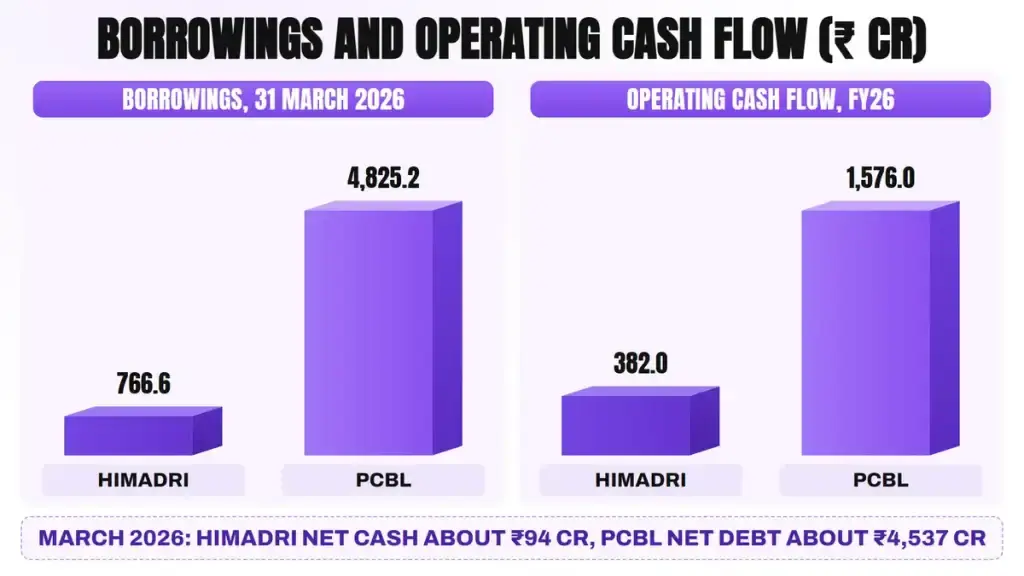
PCBL's debt is the main difference. It carries about ₹4,537 Cr of net debt, more than its equity, and paid ₹423 Cr of interest in FY26. It is working on this: net borrowings fell by ₹454 Cr in FY26, and its operating cash flow of ₹1,576.0 Cr was strong because about ₹529 Cr came out of working capital as inventories and receivables fell. Net capex was ₹724 Cr. In H1 FY27 it still made ₹363.12 Cr of operating cash, but inventories almost doubled to ₹1,981 Cr, largely paid for by ₹1,020.91 Cr more owed to suppliers, and net debt rose to about ₹4,691 Cr by 30 September 2026. For more on reading this ratio, see Debt to Equity Ratio Explained.
Himadri starts from net cash, but it is now using cash. By 30 September 2026 it had net debt of about ₹520 Cr, as receivables rose to ₹1,026 Cr from ₹696 Cr in March and operating cash flow for H1 FY27 was minus ₹154 Cr. Its total equity rose to ₹5,188 Cr. Its FY26 operating cash flow of ₹382.0 Cr was about half its profit of ₹755 Cr, so its profit has turned into cash more slowly than PCBL's.
Risks for Each Company
Himadri
- Battery delays. The 40,000-tonne cathode plant has slipped from Q3 FY27 to the end of FY28, and customer approval of a cathode can take 12 to 18 months.
- Price competition from China. Himadri says its LFP will have to be priced in line with Chinese suppliers, so margins in that business are not yet known.
- Working capital. Receivables of ₹1,026 Cr and negative operating cash flow in H1 FY27 are worth watching while it spends ₹800 Cr to ₹900 Cr on capex.
- Lower-margin trading. Tyre trading lifts revenue but adds little profit, which pulls down the margin percentage.
PCBL
- Debt. Net debt of about ₹4,691 Cr (September 2026) and ₹423 Cr of interest in FY26 leave less room if margins fall.
- Volume. Carbon black volume fell about 17% in Q2 FY27, and the 7% volume target for FY27 looks hard. Capacity use was about 60% on an annualised basis.
- Feedstock and freight. It buys feedstock oil linked to crude prices, and freight costs rose sharply in the quarter. Russian supply cuts have tightened feedstock worldwide.
- Imports and rivals. Cheap Russian carbon black competed with its prices in India, and management says some rivals are chasing volume at low prices.
- One-off support. The ₹33 Cr US tariff refund lifted Q2 FY27 EBITDA and will not repeat.
Which Is Stronger on Each Measure?
| Measure | Stronger | Why |
|---|---|---|
| Scale in carbon black | PCBL | 9,00,000 tonnes of capacity against 2,50,000, about 3.6 times larger |
| Speciality carbon black capacity | Level | 1,32,000 tonnes at PCBL against 1,30,000 at Himadri |
| Use of capacity | Himadri | 88% in Q2 FY27 against about 60% annualised at PCBL |
| Feedstock control | Himadri | Makes its own oil from 6,00,000 tonnes of coal tar distillation; PCBL is still approving its plant |
| Revenue size | PCBL | ₹8,189 Cr in FY26 against ₹4,661 Cr |
| Margins | Himadri | About 21.6% EBITDA margin in FY26 against about 13.2% |
| Profit trend, FY22 to FY26 | Himadri | Profit up about 19 times; PCBL's profit down about 54% |
| Returns | Himadri | ROCE 32% against about 8.0% |
| Balance sheet | Himadri | Net cash of about ₹94 Cr against net debt of about ₹4,537 Cr (March 2026) |
| Cash flow in FY26 | PCBL | ₹1,576.0 Cr of operating cash flow against ₹382.0 Cr |
| Latest quarter growth | Himadri | Revenue up 57.93% and profit up 31.33%; PCBL up 14% and 20% |
| Other income streams | PCBL | 122 MW of power plants and Aquapharm's ₹1,443 Cr of revenue |
| Battery materials scope | Himadri | Cathode and anode powders, the largest parts of a cell |
| Battery materials risk | PCBL | Smaller projects, such as a ₹329 Cr acetylene black plant, with one line already running |
Explore our Products
Research Framework

Emerging Titans
Combination of quantitative analysis, industry tailwinds, and management assessment - SPRINT investment philosophy

Tiny Titans
Heavy emphasis on scuttlebutt research, plant visits, and early on-ground signals
Read our full company report: PCBL Chemical: Carbon Black Margins and Battery Materials.
Conclusion
On carbon black alone, PCBL is the larger maker by far, and the two have about the same speciality capacity. On almost every financial measure in this comparison, Himadri is stronger today: higher margins, higher returns, a profit that has grown every year and a balance sheet that started FY27 with net cash. PCBL is stronger on scale, on cash generation in FY26 and on having power sales and Aquapharm alongside carbon black.
Their battery plans point in different directions. Himadri is going after the large, heavy materials of a cell, cathode and anode powder, which needs big plants and long approvals, and its main plant is now due at the end of FY28. PCBL is going after small, high-value additives, conductive blacks and silicon, with smaller sums and one line already running.
Which of the two looks more suitable depends on what an investor is studying. Someone focused on balance sheet strength and current profitability will find Himadri's numbers stronger. Someone focused on carbon black scale, a possible recovery in volumes and lower-cost battery additives will find PCBL's plans more relevant, along with the risk that its debt brings. For more companies in the battery chain, see our list of EV stocks in India for 2026.
FAQs
Himadri vs PCBL: which is better?
+Neither is better on every measure. Himadri is stronger on margins (about 21.6% EBITDA margin in FY26 against about 13.2%), returns (ROCE 32% against about 8.0%) and balance sheet (net cash against about ₹4,537 Cr of net debt in March 2026). PCBL is stronger on scale, with 9,00,000 tonnes of carbon black capacity against 2,50,000, and had higher operating cash flow in FY26.
Which company has more carbon black capacity, Himadri or PCBL?
+PCBL has about 9,00,000 tonnes a year, about 3.6 times Himadri's 2,50,000 tonnes. Their speciality carbon black capacity is almost the same: 1,32,000 tonnes at PCBL and 1,30,000 tonnes at Himadri.
What battery materials is Himadri making?
+Himadri is building LFP cathode powder, with a 2,000-tonne first line due in Q3 FY27 and a 40,000-tonne plant now due at the end of FY28. It started a 200-tonne anode plant on 23 April 2026, sells ENERGEX conductive carbon black grades and is building a 200-tonne carbon nanotube plant.
What battery materials is PCBL making?
+PCBL has commissioned a 1,000-tonne super-conductive black line, is building a 4,000-tonne acetylene black plant with about ₹329 Cr of planned investment, and is developing nano-silicon for anodes through Nanovace, its 51% joint venture with Kinaltek. It is not planning graphite anodes at this stage.
How much debt do Himadri and PCBL have?
+On 30 September 2026, PCBL had borrowings of ₹4,927.4 Cr and net debt of about ₹4,691 Cr, about 1.15 times its equity. Himadri had borrowings of ₹1,155.8 Cr and net debt of about ₹520 Cr, up from net cash of about ₹94 Cr in March 2026 as it spent on capex and working capital.
How did Himadri and PCBL do in Q2 FY27?
+Himadri's revenue rose 57.93% to ₹1,691 Cr and its profit after tax rose 31.33% to ₹231 Cr. PCBL's revenue rose 14% to ₹2,474 Cr and its profit after tax rose 20% to ₹74 Cr, while its carbon black volume fell about 17%.

High growth stock specialist, Value Educator
Shashank Mahajan is an equity research professional with over 12 years of experience in identifying high-potential SME and micro-cap stocks at an early stage. He follows a rigorous scuttlebutt research–driven approach, combining on-ground insights with deep financial analysis. Shashank specializes in uncovering under-researched and under-owned companies with strong management quality and long-term growth potential. Through disciplined research and early identification, he focuses on spotting tomorrow’s market leaders before they enter the mainstream investor radar.
More about Shashank Mahajan →
PCBL Chemical: Carbon Black Margins and Battery Materials

KEC International: Record Orders, Weak Margin, High Debt

Sona BLW: EV Revenue Now Tops Half of Its Auto Sales

HPL Electric & Power: Smart Meters, Wires and Two Engines

Kaynes Technology: EMS, Chip Plants and ₹10,563.5 Cr Orders

Sterlite Technologies: Glass Rods to Hyperscaler Deals
Explore our Products
Research Framework
Emerging Titans
Combination of quantitative analysis, industry tailwinds, and management assessment - SPRINT investment philosophy
Tiny Titans
Heavy emphasis on scuttlebutt research, plant visits, and early on-ground signals



India's Aerospace Opportunity
Global Demand. Supply Bottlenecks. Opportunities Ahead.
Don't Miss This Exclusive Webinar!
Join Value Educator to decode the key trends shaping India's aerospace sector and learn how to identify tomorrow's potential leaders in the space.
- How the aircraft value chain works, layer by layer
- Indian companies supplying global aircraft makers
- A framework to judge any aerospace company

 Orders
 Subscription
 Share with friends


Required Details
₹23999.00
(12 month subscription)
As per SEBI regulations, all users are mandated to complete the KYC that is validated for 1 year. Post payment, you will be redirected to the KYC screen


No comments yet. Be the first to comment!