
Himadri Speciality Chemical: Coal Tar to LFP Cathode
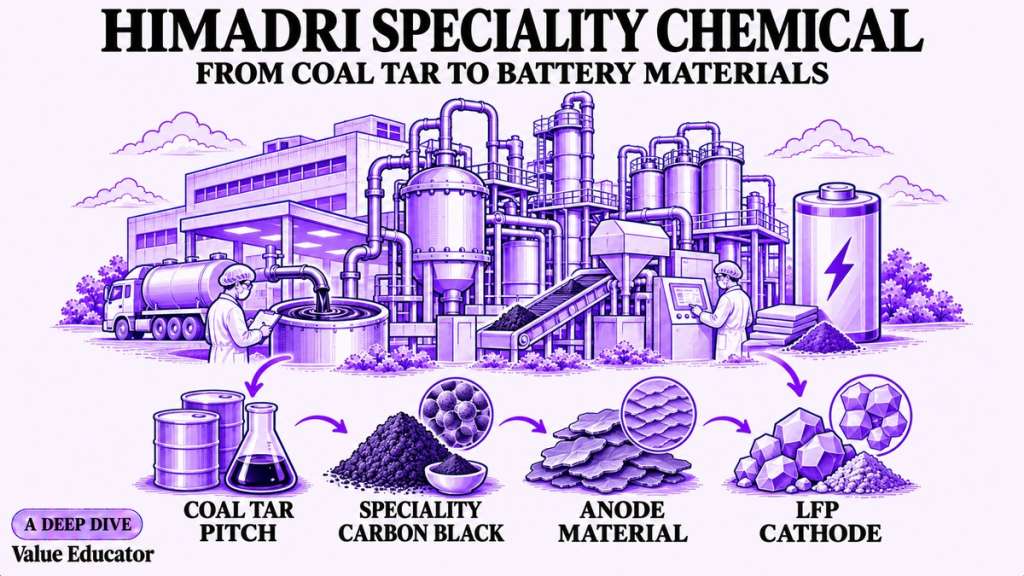
On 23 April 2026, a small plant at Mahistikry in West Bengal started making battery anode material. It can make 200 tonnes a year. That is tiny next to the giant Chinese plants that make most of the world's battery materials. But the company behind it spent more than ten years on the chemistry, and it makes the main raw material for it in its own plants.
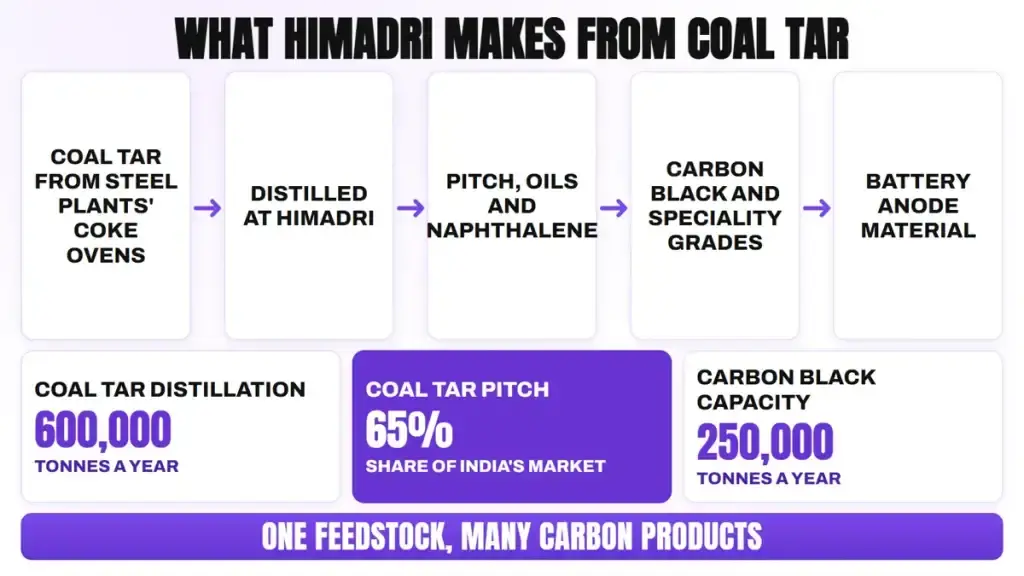
That company's main business looks nothing like batteries. It buys coal tar, a thick black liquid that comes out of the coke ovens of steel plants, and splits it into useful parts. The heaviest part is coal tar pitch, which is the binder that holds together the carbon blocks used by aluminium smelters and the graphite electrodes used in steel furnaces. Another part is an oil that goes into carbon black, which is a fine black powder that makes tyres strong and gives colour to plastics, paints and inks.
That same carbon chemistry now reaches into batteries. A lithium-ion cell has two electrodes. The cathode is the positive side, and in the cheaper and safer cells used in many electric vehicles and in grid storage it is a powder called lithium iron phosphate, or LFP. The anode is the negative side, and it is mostly graphite, which is a form of carbon. Management says the anode and the cathode together make up 65% of the cost of a cell.
That company is Himadri Speciality Chemical Ltd (NSE: HSCL), based in Kolkata. It made ₹4,661 Cr of revenue in FY26, almost all of it from carbon materials and chemicals. It says it holds a 65% share of India's coal tar pitch market. Now it is building a battery materials business on top. The anode plant is running, and a first LFP cathode line of 2,000 tonnes a year is due in the October to December quarter of 2026. After that comes a first phase of 40,000 tonnes, planned at a cost of ₹1,125 Cr.
So Himadri sits at the very start of two chains. In the old one, its pitch and carbon black go into aluminium, steel and tyres. In the new one, it wants to sell the cathode and anode powders that cell makers turn into batteries for electric vehicles and storage.
Himadri Speciality Chemical in five numbers
- Q2 FY27 revenue of ₹1,691 Cr, up 57.93%
- H1 FY27 profit after tax of ₹460 Cr
- A 65% share of India's coal tar pitch market
- A 200-tonne anode plant running since April 2026
- A 40,000-tonne LFP cathode first phase costing ₹1,125 Cr
So a company that turned a steel-plant by-product into ₹755 Cr of profit in FY26 now wants to make the two largest materials inside a battery cell. How much of that shows up in the numbers today? Let's first understand the company, and then look at the latest quarter.
Himadri Speciality Chemical: Company Overview
Himadri Speciality Chemical Ltd was incorporated on 28 July 1987 and has its registered office in Kolkata. Anurag Choudhary is its Chairman, Managing Director and CEO, and the promoters held 52.50% of the company in March 2026, up from 45.43% in March 2022. Himadri distils coal tar from steel plants into coal tar pitch, oils and naphthalene, and makes carbon black, speciality carbon black, SNF and PCE admixtures and clean power, from eight plants in India and China. It is now adding battery materials: a 200-tonne anode plant is running, and an LFP cathode line is due in Q3 FY27. It had 1,161 permanent employees in March 2026, sells in 61 countries, and exports made up 31.54% of FY26 revenue. Revenue from operations was ₹4,661 Cr in FY26 and profit after tax was ₹755 Cr. Read this BESS Stocks in India 2026: Battery Storage Value Chain
"Know what you own, and know why you own it."
— Peter Lynch
Most of Himadri's profit today comes from coal tar pitch and carbon black, while the battery business is still in testing. Knowing which part earns the money and which part is a plan is the first step to reading its results.
The Quarter Revenue Grew 57.93%
Let's look at Q2 FY27, the July to September quarter that Himadri reported on 16 October 2026. Consolidated revenue from operations was ₹1,691 Cr, up 57.93% from ₹1,071 Cr a year ago. It was also 18.13% more than the ₹1,432 Cr of Q1 FY27. Profit after tax rose 31.33% to ₹231 Cr.

As we can see, most of that revenue growth came from prices. Himadri sold 1,46,806 tonnes in the quarter, against 1,35,513 tonnes a year ago, or about 8% more. Management says the prices of its raw materials and of its finished products both went up. It passes higher raw material costs on to customers, but with a lag of about a month. So revenue grew much faster than tonnes.

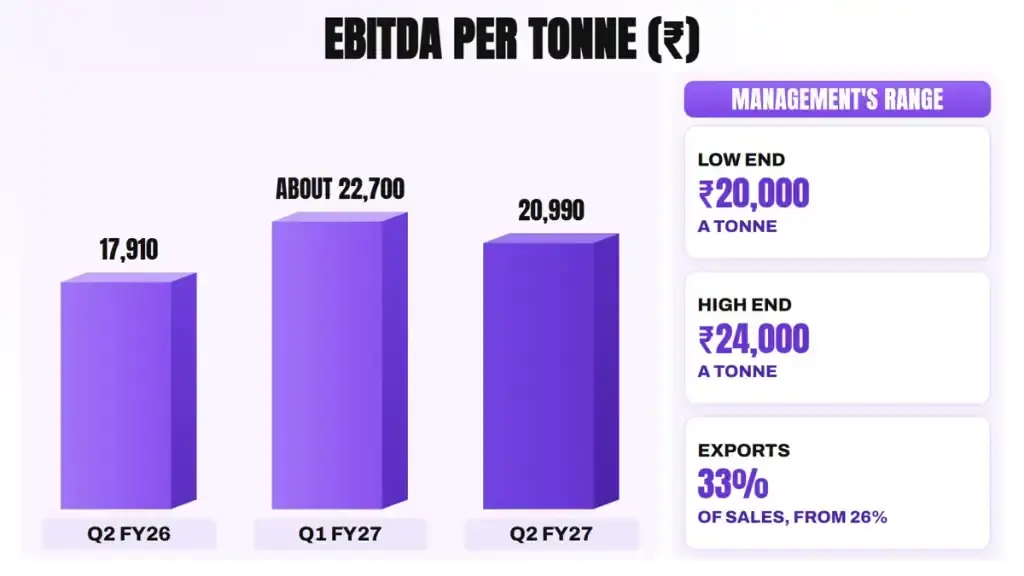
That pass-through also explains the margin. Read this EBITDA Explained: Uses and Limits EBITDA was ₹303 Cr, up 27.48%, and the EBITDA margin was about 17.9%, against about 22.2% a year ago. When a company passes on a higher raw material cost rupee for rupee, its revenue grows but its margin as a percentage gets thinner. That is why management asks investors to track EBITDA per tonne instead. It says this was about ₹20,990 a tonne in Q2 FY27, against ₹17,910 a year ago.
That per-tonne number was about ₹22,700 in Q1 FY27, so the quarter gave back a part of that gain. Management gives two reasons. Exports rose to 33% of sales from 26% a year ago, just as container freight rates jumped. And some price rises at the end of the quarter will reach customers only in the next month. It expects the per-tonne EBITDA to move between ₹20,000 and ₹24,000 from quarter to quarter.
Beyond the core business, two smaller items moved the consolidated numbers. The Others segment brought in ₹144 Cr, mostly Birla Tyres tyres that Himadri sells on a trading basis. Management says these sales brought about ₹140 Cr of revenue but only about ₹1 Cr of EBITDA. A sand-mining unit in Bengal also had costs but no revenue while it waited for an environmental clearance. Management says that clearance came in October, the unit starts work this quarter, and it could bring about ₹500 Cr of yearly revenue in time. That is why consolidated profit of ₹231 Cr was below the standalone ₹240 Cr.
That first half shows the same picture at a larger scale. H1 FY27 revenue was ₹3,123 Cr, up 42.66%. EBITDA was ₹616 Cr, up 30.27%, and profit after tax was ₹460 Cr, up 29.32%. That half-year profit is already about 61% of the ₹755 Cr Himadri made in all of FY26.
Where the Cash Went in the First Half
Now let's follow the cash, because the first half used more of it than usual. Read this Cash Flow Statement Explained Trade receivables rose to ₹1,026 Cr in September 2026 from ₹696 Cr in March, as sales grew. Trade payables went the other way, to ₹160 Cr from ₹375 Cr. Working capital took up ₹686 Cr in the half, and operating cash flow was a negative ₹154 Cr.
That cash went into plants as well. Management says Himadri has spent more than ₹400 Cr on capex so far this year, and it expects ₹800 Cr to ₹900 Cr for the full year. To cover the gap, borrowings rose to about ₹1,155.8 Cr in September from about ₹766.6 Cr in March. Against that, the company held about ₹636.1 Cr of cash, bank deposits and liquid investments, so its net debt was about ₹519.8 Cr. Its equity was ₹5,188 Cr.
So the debt is small next to the equity, but the direction matters. Management calls it a timing effect. It says net working capital was 37% of sales in Q2 FY27, against 41% in Q1 FY27, and that receivable days were 65 against 63 a quarter earlier. It expects the next two quarters to bring working capital down and the full year's operating cash flow back above zero.
How a Coal Tar Distiller Became a Carbon Company
Now that we have seen the quarter, let's go back and see how a coal tar distiller became a carbon company. Himadri was set up in Kolkata in 1987, and Anurag Choudhary is now its Chairman, Managing Director and CEO. Its business starts at the steel plant. When coking coal is heated into coke for blast furnaces, the coke ovens give off coal tar. Himadri buys this tar from steel plants in India and abroad and distils it.
For years that tar business was mostly a commodity business. The pitch went to aluminium smelters and graphite electrode makers, and the oils went into carbon black for tyre makers. Prices moved with coal tar and crude oil, and so did the margin. In FY22, Himadri made ₹2,791 Cr of revenue and only ₹163 Cr of EBITDA, a margin of about 5.8%.
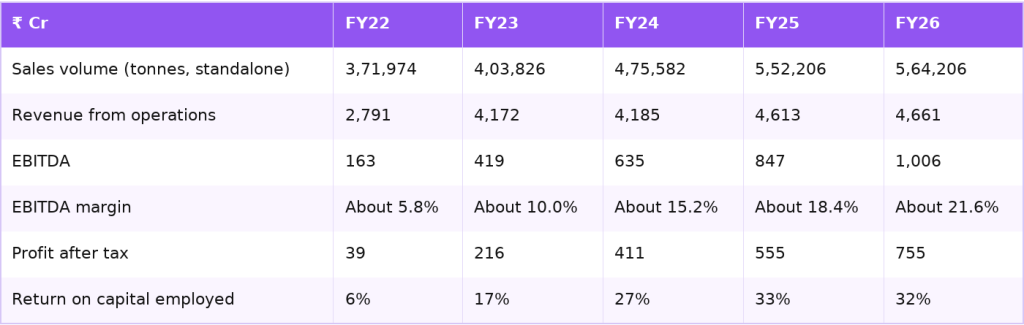
That table shows what changed over four years. Revenue grew about 14% a year from FY22 to FY26. EBITDA grew 58% a year, and profit after tax grew 110% a year. Volumes rose about 52% over the same years. The rest of the gain came from the mix: more speciality carbon black, which earns more per tonne, and pitch grades made to each customer's needs.
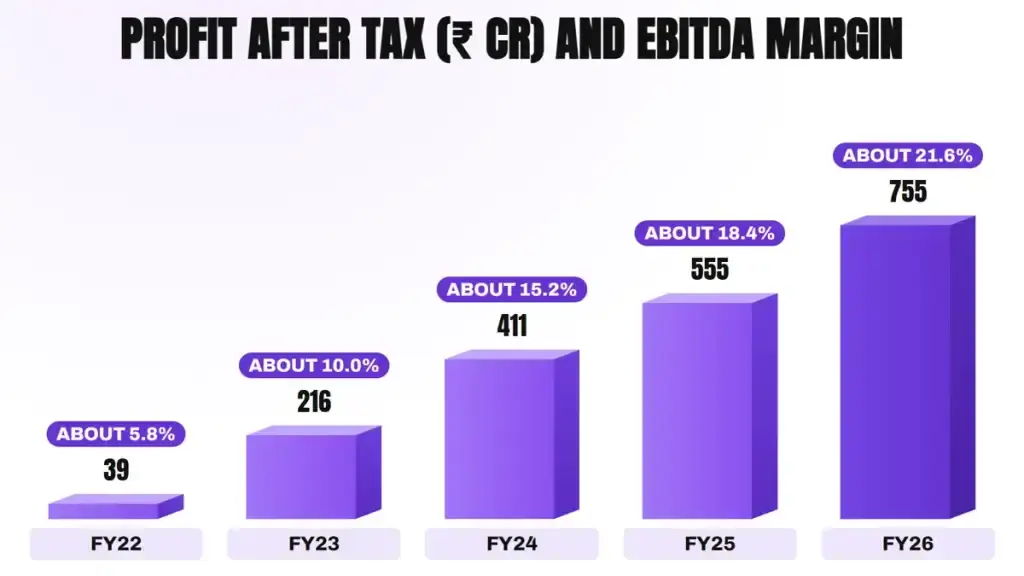
That shift also changed how management talks about the business. It no longer guides a margin percentage. It guides profit after tax and EBITDA per tonne, because a percentage moves with raw material prices even when the profit per tonne holds. It also says return on capital employed, or ROCE, is the test for every new project, and that about 30% is the level it wants to keep.
"Our philosophy remains unchanged: invest patiently in science, execute with discipline, and scale when the technology and the market are ready." - Anurag Choudhary, Chairman, Managing Director and CEO, October 2026
Three Segments, One Carbon Chain
Next, let's split the business into its parts, because each one sells to a different buyer. Himadri reports three segments. Carbon materials and chemicals is nearly the whole company. Power is the clean electricity it makes at its own plants, which meets all of its own electricity needs. Others is new and holds mostly the Birla Tyres trading sales.
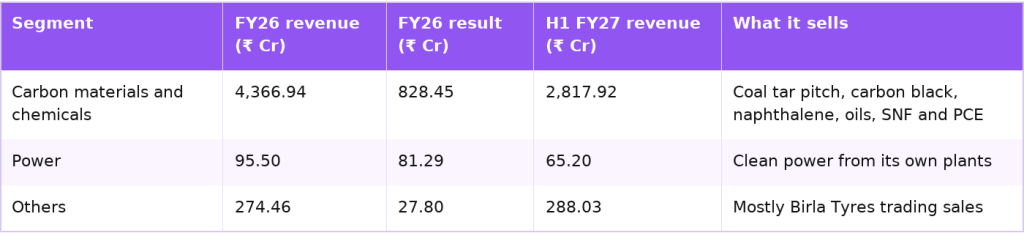
Those segment numbers are before sales between the segments, and the result is profit before interest and tax. The carbon segment is also where carbon nanotubes and super speciality carbon black will show up. Management says it will report them inside this segment because they all come from carbon.

Coal Tar Pitch and Naphthalene
Let's start with coal tar pitch, the oldest product. Himadri can distil 600,000 tonnes of coal tar a year across its plants. It runs eight zero liquid discharge plants, seven in India and one at Longkou in China. It moves hot liquid pitch in a fleet of 292 heated tankers and ships exports from port terminals at Haldia and Mangalore.
That pitch business has a long qualification cycle. Management says a new coal tar pitch supplier needs about two years just to establish its quality with a customer, and that it sees no new players coming in. A smelter cannot afford a binder that cracks its carbon blocks, so it sticks with a supplier that works.
Beyond pitch, the lighter parts of the tar go into other products. Himadri says it holds about 67% of India's naphthalene market, which goes into dyes, resins and farm chemicals, and it sells naphthalene balls under its own Durofresh brand. It also makes SNF and PCE, which are admixtures that help concrete flow and need less water.
The next step in this tar line is two new molecules from the same oils. Anthraquinone goes into dyes and the making of hydrogen peroxide, and carbazole goes into medicines and electronics. Himadri is spending ₹248 Cr on 5,300 tonnes a year of both, and it says this will be India's first commercial carbazole plant. It now plans to start the whole capacity in Q4 FY27, instead of one phase this year and one next year.
Carbon Black and Speciality Grades
Now let's move to carbon black, the second large product. Himadri has about 250,000 tonnes a year of carbon black capacity, and about 130,000 tonnes of it can make speciality grades. It sells more than 70 speciality grades into tyres, rubber, plastics, coatings, inks and batteries. In Q2 FY27, its carbon black plants ran at 88% of capacity, and management expects 88% to 95%.
Those speciality grades are where its feedstock helps. Management says speciality carbon black needs a clean and stable raw material, and Himadri makes its own from coal tar. One battery-related range is ENERGEX, a conductive grade that helps electrons move inside a battery electrode. In Q2 FY27 these grades won approval for high-voltage cables and batteries, followed by commercial orders.
Beyond these grades, two more carbon projects build on this. A 200-tonne carbon nanotube plant costing ₹70 Cr is due in Q4 FY27, and carbon nanotubes are also used as conductive additives in lithium-ion cells. A 6,000-tonne super speciality carbon black line costing ₹170 Cr is due in Q4 FY28, and it will convert existing carbon black capacity to higher-value grades.
Birla Tyres and the Proposed Demerger
Finally, let's look at tyres, the newest business. In October 2023, Himadri and its partner Dalmia Bharat Refractories bought Birla Tyres through a resolution process. The plant restarted commercial production on 29 May 2025. The tyre business is part of Dalmia Bharat Refractories today, and Himadri sells its tyres on a trading basis. Those sales were ₹187 Cr in FY26.
On 21 September 2026, Himadri's board approved a plan to move that tyre business into Himadri through a demerger. Dalmia Bharat Refractories shareholders would get 1 Himadri share for every 260 shares they hold, and the plan still needs approvals from regulators, creditors and shareholders. The tyre business had a turnover of ₹149.31 Cr in FY26, or 3.39% of Himadri's turnover. Management targets about ₹3,000 Cr of tyre revenue in four years, with a passenger car tyre plant for EVs and SUVs by FY28.
Where Himadri Sits in the EV Battery Value Chain
Now let's place the battery plans in the EV value chain, because that is where the company wants its next leg of growth. An EV battery pack is made of cells. Each cell holds a cathode powder, an anode powder, an electrolyte and a thin separator. Cell makers buy these materials and turn them into cells, and battery and vehicle makers buy the cells.

That materials step is where China leads. Management says 100% of the world's commercial LFP cathode capacity is in China today, and the top five or six Chinese makers hold 75% to 80% of it. It puts world lithium-ion battery demand at about 1.6 TWh in 2025, rising to about 6.8 TWh by 2035. About half of today's cells use LFP, which it says needs about 1.6 million tonnes of LFP cathode material a year.
That market is why LFP matters for India's EV makers. LFP cells cost less, last longer and run cooler than many other lithium-ion types. So they suit mass-market cars, buses, two-wheelers and grid storage. India is building cell plants of its own, but those plants still need cathode and anode materials, and today most of these come from China.
That gap is the opening Himadri is aiming at. It says it is setting up the first commercial LFP cathode plant outside China. It also targets global buyers that want a second source of supply. In July 2025, management pointed to new US duties on Chinese anode material, which it said would take the effective duty to 165%.
The Battery Materials Plan, Step by Step
So what has Himadri actually built for batteries, and what is still a plan? Let's take each battery material in turn, because each one is at a different stage.

Anode Material From Its Own Pitch
We start with the anode, the only battery line that is already running. The 200-tonne anode plant at Mahistikry started on 23 April 2026. Himadri built the whole process in-house, from raw material to finished anode powder, after more than ten years of research. Its main raw material is a high-purity pitch that Himadri makes itself. Management says it will not need calcined petroleum coke, a raw material that many anode makers use.
That plant is a sampling plant, not a sales plant yet. Himadri has sent samples to cell makers in India and abroad, and management says the quality is close to the theoretical best of 360 milliampere-hours per gram for synthetic graphite. Customers are still testing the material, and there is no revenue from it yet. Management says it will announce the capex and timing for a large anode plant once it finishes the plant's engineering.
LFP Cathode, From 2,000 Tonnes to 40,000
Next, let's look at the cathode, which is the larger bet. Himadri's first LFP line of 2,000 tonnes a year is due to start trial production in Q3 FY27. Laboratory samples are already approved by customers, so the next step is plant samples, which should go out in Q4 FY27. Management says customers then take 12 to 18 months to approve a cathode for their cells.
That approval time is why the big plant moved.
"The big money is not in the buying and selling, but in the waiting."
— Charlie Munger
Himadri has chosen to wait for customer approvals before it builds the 40,000-tonne plant. The test is whether that patience turns into named customers by the time the plant starts. Until January 2026, management said the whole 40,000-tonne phase would be running by Q3 FY27. In April 2026 it changed the plan to the 2,000-tonne line first and the rest over the following year. In October 2026 it said the 40,000-tonne plant would start at the end of FY28, so that customer approvals are in place before the money is spent.
Beyond that first phase, the long-term plan is 200,000 tonnes a year. Management says that would feed about 100 GWh of cells, so the 40,000-tonne first phase would feed about 20 GWh. It expects the plant to run at more than 50% of capacity in its first year and above 90% from the second. It also says LFP revenue and margins will start to matter only from FY29.
What the LFP plan says: the 40,000-tonne first phase would feed about 20 GWh of cells, but it starts only at the end of FY28. Until then, the 2,000-tonne line is a sampling plant, and the cathode business will show up in the numbers from FY29.
Silicon Carbon Through Sicona
Then there is the newest anode type, which we know as silicon carbon. Himadri has invested in Sicona Battery Technologies of Australia and holds an exclusive licence to make Sicona's silicon carbon anode material in India. By August 2026 it had put about AUD 18.4 million into Sicona through convertible notes. Earlier, in September 2025, it had said its stake would be 17.6% after conversion.
That material packs much more energy into the same space. Sicona says its anode gives 20% or more energy density and 40% or more faster charging, and that cell makers can use it without changing their lines. Management says silicon carbon stores more than 4,000 milliampere-hours per gram, about ten times graphite. In 2026, Sicona won AUD 45 million of funding from the Australian Renewable Energy Agency and bought Advano of the US. It says 39 global carmakers and cell makers have signed NDAs with it, with 14 active qualification programmes. Himadri has not yet announced capex for silicon carbon in India.
Cell Makers Through IBC
Finally, let's look at the link to cell makers. Himadri holds 19.44% of International Battery Company, or IBC, a US cell developer with a 50 MWh cell plant in South Korea. In May 2025 it first bought 16.24% for USD 4.43 million. IBC is testing cells made with Himadri's LFP cathode, its anode material and Sicona's silicon carbon anode. Its India gigafactory is on track for Q1 FY28, through partnerships with large Indian companies.
That stake gives Himadri a test bench, not a captive buyer. Management says IBC will not buy Himadri's material itself. IBC gives technology to companies setting up cell plants, and Himadri's material can qualify inside those plants. Himadri also holds 40% of Invati Creations, a battery materials research company, which it bought for ₹45.16 Cr.
Why Himadri's Moat Is Hard to Copy
Now that we have seen the parts, let's understand the moat. Coal tar pitch and carbon black are old products, and anyone with money can build a carbon black plant. So the question is why customers keep coming back to Himadri, and why the same advantage might carry into batteries. Read this Economic Moat Explained
One part of the moat is feedstock. Himadri controls the first step of its chain, the distillation of coal tar, at a scale of 600,000 tonnes a year. That gives it its own clean oils for speciality carbon black and its own high-purity pitch for anode material. A rival that buys these inputs pays someone else's margin and gets less control over purity.
Another layer is qualification. A smelter or a tyre maker tests a new pitch or a new carbon black grade for a long time before it switches, and management says that takes about two years for coal tar pitch. Once Himadri is inside a customer's process, a rival has to win the same tests from scratch.
"In business, I look for economic castles protected by unbreachable moats."
— Warren Buffett
For Himadri, the walls are its own feedstock and the long tests a customer runs before switching. Whether the same walls hold in battery materials, against Chinese prices, is still open. The same is true in batteries, where a cathode needs 12 to 18 months of tests in a customer's cells.
That work needs research more than machines. Himadri spent ₹129 Cr on research and development in FY26, and it has more than 180 scientists, 28 of them with PhDs. It developed its anode process fully in-house, without a licensed technology. It also chose to make the same raw materials for both the old business and the new one, so the battery effort draws on skills it already uses every day.
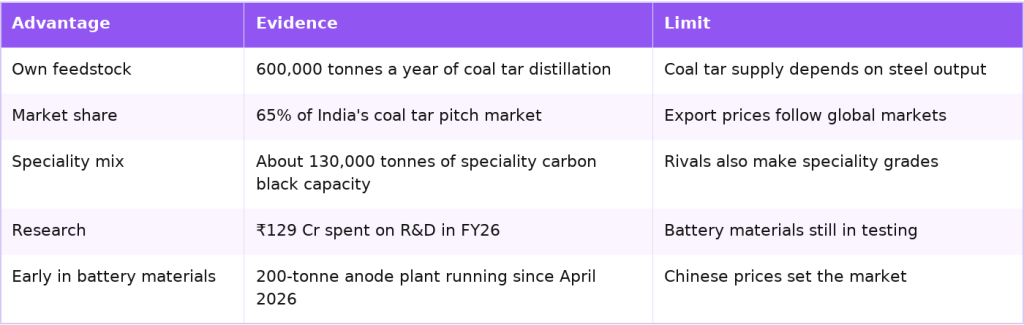

That table shows us where the moat is proven and where it is not yet. In carbon, the record is clear: EBITDA per tonne went from ₹17,910 to about ₹20,990 in a year, and ROCE was 32% in FY26. In batteries, the advantage is a plan backed by a working anode plant and lab-approved cathode samples, but no commercial sales yet.
Financials: Five Years of Revenue, Profit and Cash Flow
One quarter can mislead in a business whose prices follow coal tar and crude oil, so let's look at five full years together. EBITDA here excludes other income and foreign exchange gains, as the company reports it, and all figures are consolidated.
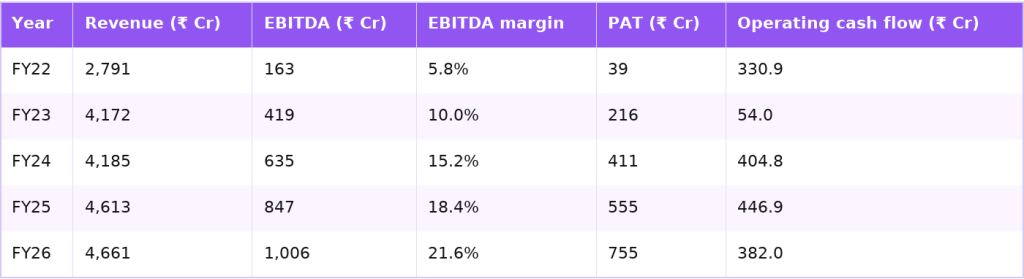
Revenue grew about 1.7 times in four years, from ₹2,791 Cr in FY22 to ₹4,661 Cr in FY26, while profit after tax grew about 19 times, from ₹39 Cr to ₹755 Cr. Most of that gap came from the margin: EBITDA went from about 5.8% of revenue in FY22 to about 21.6% in FY26, as the mix moved to speciality carbon black and other higher-value grades.
Cash flow has followed profit, with one weak year. From FY22 to FY26, operating cash flow added up to about ₹1,618.6 Cr, against about ₹1,976 Cr of profit after tax, or about 82%. It was only ₹54.0 Cr in FY23 and has been ₹382.0 Cr or more in each year since.
The balance sheet carried that growth with little debt. Himadri had net cash of ₹121 Cr in March 2026. In the first half of FY27, working capital and new plants took that to net debt of about ₹519.8 Cr against equity of ₹5,188 Cr, which is the number to watch as the capex plan runs.
"An investment in knowledge pays the best interest."
— Benjamin Franklin
Himadri's profit grew because years of work on carbon grades turned a commodity into speciality products. Its cash flow statement shows how much of that profit came back as cash, and both need to be read together.
What FY28 Could Look Like on Management's Numbers
So where does the business go from here? On 22 October 2026, management repeated its target of more than ₹1,100 Cr of profit after tax by FY28. That would be double the ₹555 Cr of FY25, and about 46% more than the ₹755 Cr of FY26.
That target leans on the carbon business and the new speciality plants, not on batteries. Management says it will come from the core business and from the new capacities that start over the coming periods. It says LFP will start to count only from FY29. The first half of FY27 already brought ₹460 Cr of profit, which is about ₹919.5 Cr for a full year at the same pace.


Now let's look at how the plan will be paid for. These four projects add up to ₹1,613 Cr of capex. Management puts the total at about ₹1,500 Cr over two years and says it will fund all of it from internal cash, not debt. It expects ₹800 Cr to ₹900 Cr of spending in FY27.
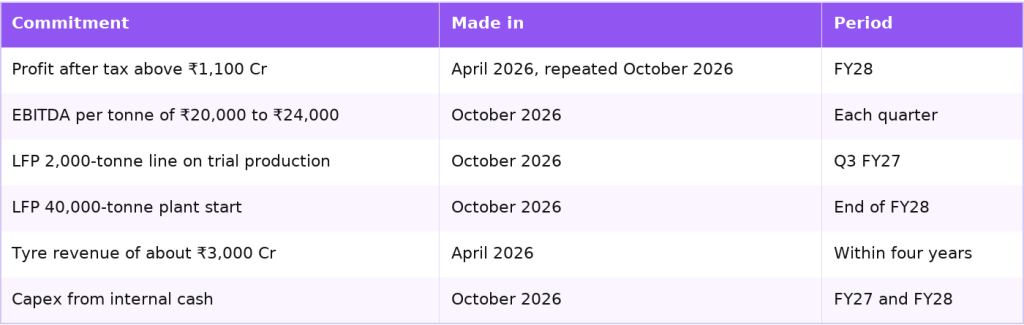
Those commitments are easier to judge against the past. So let's check what management said before against what it delivered.
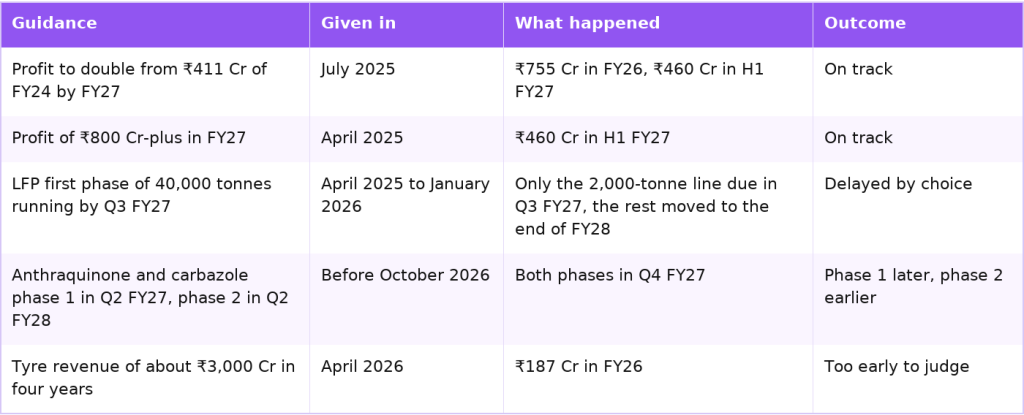
That record shows us a clear pattern. On profit, Himadri is on course: H1 FY27 profit of ₹460 Cr is already more than half of the ₹800 Cr-plus it promised for FY27. On new plants, the dates have moved. The LFP plant moved by more than a year, though management says it chose to wait for customer approvals instead of building ahead of orders. That makes the LFP dates and the first cathode orders the numbers to watch from here.
Key Risks
Now let's look at what could go wrong for Himadri, because a few of these risks already show in the latest half year.
- No battery revenue yet: the anode plant is in sampling and the LFP line has not started. Customers take 12 to 18 months to approve a cathode, and no large customer has been named. The battery business could take years to matter.
- LFP timeline has already moved: the 40,000-tonne plant was due by Q3 FY27 and is now due at the end of FY28. A further delay would push the payback on ₹1,125 Cr of capex further out.
- Chinese pricing: management says its cathode and anode prices will have to match Chinese suppliers, who hold all of the world's commercial LFP capacity. If Chinese prices stay low, margins on battery materials could be thin.
- Margin swings in the core business: the EBITDA margin was about 17.9% in Q2 FY27, against about 22.2% a year ago, and EBITDA per tonne came down from the previous quarter. Coal tar and crude prices, freight and export mix can move the profit per tonne.
- Cash flow and debt: operating cash flow was a negative ₹154 Cr in H1 FY27, and borrowings rose to about ₹1,155.8 Cr. With ₹800 Cr to ₹900 Cr of capex planned for FY27, the plan to fund it all from internal cash depends on working capital coming back.
- Tyres and other new lines: Birla Tyres made about ₹1 Cr of EBITDA on about ₹140 Cr of sales in Q2 FY27, and the target of ₹3,000 Cr in four years is far from ₹187 Cr in FY26. The demerger still needs approvals, and the tyre business will need capital.
- Feedstock supply: coal tar comes from steel plants' coke ovens, so its supply and price follow steel output, in India and abroad.
- Tax disputes: in March 2026, the standalone company had about ₹16.8 Cr of income tax claims and about ₹12.1 Cr of sales tax and VAT claims under appeal. Management does not expect a material effect, but the cases are not closed.
"There was no point committing capex ahead of the curve." - Anurag Choudhary, Chairman, Managing Director and CEO, October 2026
"The essence of investment management is the management of risks, not the management of returns."
— Benjamin Graham
No one can say when cell makers will approve Himadri's cathode or where Chinese prices will go. What an investor can do is watch the LFP dates, the cash flow and the profit per tonne each quarter, which is what the list above sets out.
Explore our Products
Research Framework

Emerging Titans
Combination of quantitative analysis, industry tailwinds, and management assessment - SPRINT investment philosophy

Tiny Titans
Heavy emphasis on scuttlebutt research, plant visits, and early on-ground signals
What to Track Next
If you follow Himadri, these are the signals that will show where it goes next.
- The start of the 2,000-tonne LFP line in Q3 FY27 and the first plant samples in Q4 FY27
- The first named cathode or anode customer, and any capex announced for a large anode plant
- EBITDA per tonne against the ₹20,000 to ₹24,000 range, and the export share after 33%
- Operating cash flow for FY27 after the negative ₹154 Cr of H1, and borrowings after ₹1,155.8 Cr
- Anthraquinone, carbazole and carbon nanotube plants in Q4 FY27
- Approvals for the Birla Tyres demerger and the tyre business's own EBITDA
For the other listed EV suppliers, from battery materials to car parts, see EV Stocks in India 2026: Battery Materials to Car Parts.
Compare: see how it measures up against its peers in Himadri vs PCBL: Carbon Black and Battery Materials, a side-by-side look at order books, margins and balance sheets.
Conclusion
Let's put it all together. Himadri Speciality Chemical has grown profit after tax from ₹39 Cr in FY22 to ₹755 Cr in FY26, mostly by moving its coal tar chemistry into higher-value grades. It made ₹460 Cr in the first half of FY27, and management guides more than ₹1,100 Cr for FY28, before LFP adds anything.
The battery materials business is the newer and less certain part. A 200-tonne anode plant is running, a 2,000-tonne LFP line is due in Q3 FY27, and the 40,000-tonne plant is now set for the end of FY28. What happens next depends on whether cell makers approve Himadri's cathode and anode, whether it can match Chinese prices and still earn a 30% ROCE, and whether the cash used in H1 FY27 comes back.
FAQs
What does Himadri Speciality Chemical do?
+Himadri distils coal tar from steel plants into coal tar pitch, oils and naphthalene, and makes carbon black and speciality carbon black. Its products go into aluminium smelters, graphite electrodes, tyres, plastics, inks and construction. FY26 revenue from operations was ₹4,661 Cr.
How did Himadri Speciality Chemical do in Q2 FY27?
+Consolidated revenue rose 57.93% to ₹1,691 Cr, mostly on higher prices, while sales volume rose about 8%. EBITDA rose 27.48% to ₹303 Cr and profit after tax rose 31.33% to ₹231 Cr. EBITDA per tonne was about ₹20,990, against ₹17,910 a year ago.
What is Himadri's battery materials plan?
+Himadri started a 200-tonne anode material plant on 23 April 2026, and its 2,000-tonne LFP cathode line is due for trial production in Q3 FY27. The 40,000-tonne first phase of LFP cathode, costing ₹1,125 Cr, is now due at the end of FY28. The long-term plan is 200,000 tonnes, enough for about 100 GWh of cells.
Where does Himadri fit in the EV battery value chain?
+Himadri wants to supply the two largest materials inside a lithium-ion cell, the LFP cathode and the anode, to cell makers in India and abroad. Management says these two materials make up 65% of a cell's cost, and that all of the world's commercial LFP capacity is in China today.
What profit does Himadri target for FY28?
+Management targets more than ₹1,100 Cr of profit after tax in FY28, double the ₹555 Cr of FY25. Himadri made ₹755 Cr in FY26 and ₹460 Cr in H1 FY27. Management says LFP will start to count only from FY29.
What are the main risks for Himadri Speciality Chemical?
+The battery business has no revenue yet, and the 40,000-tonne LFP plant has moved from Q3 FY27 to the end of FY28. Cathode and anode prices will have to match Chinese suppliers. Operating cash flow was a negative ₹154 Cr in H1 FY27 and borrowings rose to about ₹1,155.8 Cr.

High growth stock specialist, Value Educator
Shashank Mahajan is an equity research professional with over 12 years of experience in identifying high-potential SME and micro-cap stocks at an early stage. He follows a rigorous scuttlebutt research–driven approach, combining on-ground insights with deep financial analysis. Shashank specializes in uncovering under-researched and under-owned companies with strong management quality and long-term growth potential. Through disciplined research and early identification, he focuses on spotting tomorrow’s market leaders before they enter the mainstream investor radar.
More about Shashank Mahajan →
PCBL Chemical: Carbon Black Margins and Battery Materials

KEC International: Record Orders, Weak Margin, High Debt

Sona BLW: EV Revenue Now Tops Half of Its Auto Sales

HPL Electric & Power: Smart Meters, Wires and Two Engines

Kaynes Technology: EMS, Chip Plants and ₹10,563.5 Cr Orders

Sterlite Technologies: Glass Rods to Hyperscaler Deals
Explore our Products
Research Framework
Emerging Titans
Combination of quantitative analysis, industry tailwinds, and management assessment - SPRINT investment philosophy
Tiny Titans
Heavy emphasis on scuttlebutt research, plant visits, and early on-ground signals



India's Aerospace Opportunity
Global Demand. Supply Bottlenecks. Opportunities Ahead.
Don't Miss This Exclusive Webinar!
Join Value Educator to decode the key trends shaping India's aerospace sector and learn how to identify tomorrow's potential leaders in the space.
- How the aircraft value chain works, layer by layer
- Indian companies supplying global aircraft makers
- A framework to judge any aerospace company

 Orders
 Subscription
 Share with friends


Required Details
₹23999.00
(12 month subscription)
As per SEBI regulations, all users are mandated to complete the KYC that is validated for 1 year. Post payment, you will be redirected to the KYC screen


No comments yet. Be the first to comment!