
Quality Power: Architect of the Energy Shift

Every time you hear about an AI data centre being announced in Navi Mumbai, a solar park commissioned in Rajasthan, or a new HVDC corridor connecting renewable-rich states to power-hungry cities, there's a quiet question hiding underneath the headline: how does all that electricity actually get there, cleanly and reliably?
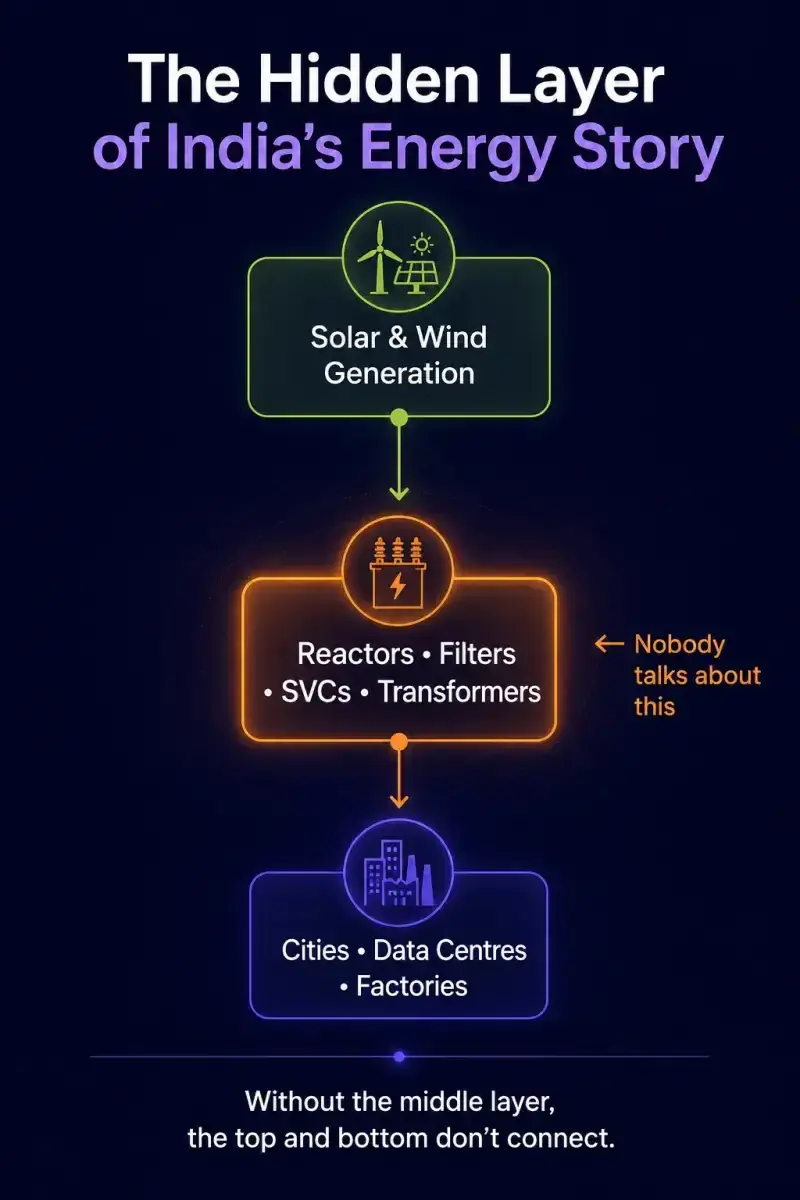
Strip the news cycle down to its fundamentals and you keep arriving at the same answer. High-voltage electrical infrastructure. Reactors, filters, capacitors, transformers, and the complex power quality systems that keep grids from destabilising under the sheer weight of modern energy demand.
Most investors never think about any of this. They follow the generation story: who's building the solar farms, who's winning the wind contracts. The transmission and power quality layer, by contrast, is almost invisible to the casual observer.
Which is precisely where Quality Power sits. And precisely why it deserves a closer look.
"The future is already here — it's just not evenly distributed." — William Gibson
Why Electricity Is the Connective Tissue of Every Major Investment Theme
Think about the biggest investment narratives in India right now: artificial intelligence, data centres, green energy, EV infrastructure, defence manufacturing, railway modernisation. Now ask yourself what they actually have in common.
At first glance, genuinely very little. Different industries, different balance sheets, different regulatory environments.
Except electricity.
Every single one of these themes is, at its core, a massive bet on electricity. On generating more of it, transporting it more efficiently, and consuming it in increasingly sophisticated ways. Data centres are just power-hungry buildings. EVs are batteries that need charging. Green energy is fundamentally about generating power far from where it's needed and moving it somewhere useful. Smart manufacturing runs on reliable, high-quality electricity.
None of these themes work if the grid doesn't work.
And this is the part most people gloss over. Generating electricity is step one. Moving it efficiently, at scale, across hundreds of kilometres, without losing most of it to heat and resistance along the way, is an entirely different engineering challenge. It requires step-up transformers, transmission corridors running at 400 kV or 765 kV, sophisticated reactive power management, harmonic filters, and a growing array of power quality systems.
Pull any one of those pieces out and the whole chain fails.
Quality Power manufactures the components that hold that chain together. Not the cables and towers you can see from the highway. The specialised, high-voltage electrical equipment that sits inside substations, at the heart of HVDC projects, and within the reactive power management systems that keep grids stable. The parts nobody notices until something goes wrong.
What Quality Power Actually Does
Quality Power is a Hyderabad-based manufacturer of critical energy transition equipment, high-voltage grid connectivity systems, and power automation technology. It operates in what is technically called the heavy electrical equipment sector, a description that somewhat undersells the technical complexity of what it actually makes.
The company's product portfolio breaks down into four broad categories, each serving a distinct but interconnected part of the power infrastructure stack.
Reactors are Quality Power's original core. These include Series Reactors for fault current limiting and harmonic filtering, Shunt Reactors for long-line reactive power compensation, and the most technically demanding category of all: FACTS and HVDC Reactors. This last group covers AC/DC Filters, Smoothing Reactors, and Thyristor Controlled Reactors used in high-voltage direct current transmission systems. These are components that sit at the frontier of power engineering, enabling long-distance renewable energy transmission with minimal losses.
Transformers form the second pillar. Quality Power doesn't make commodity distribution transformers. It focuses on special purpose variants: converter duty transformers, arc furnace transformers, earthing transformers, and instrument transformers including current and potential transformers. Each application is technically demanding and commands meaningfully higher margins than standard transformer manufacturing.
Power Quality and FACTS Systems represent perhaps the most relevant segment for investors thinking about the future of grid infrastructure. Static Var Compensators (SVCs), STATCOMs, harmonic filters, and metal-enclosed capacitor banks are the systems that actively manage power quality on modern grids, compensating for the voltage fluctuations, reactive power imbalances, and harmonic distortions that renewable energy sources introduce at scale.
PLCC Components, including wave traps, round out the portfolio. These are used in power line carrier communication systems, the technology that utilities use to transmit control signals along high-voltage power lines themselves.
Taken together, this is a highly technical, deeply specialised product suite. The kind that takes years to develop, years more to get approved by utilities and system integrators, and serves customers who simply cannot afford to compromise on quality.
"Time is the friend of the wonderful business." — Warren Buffett
The Competitive Moat: Why This Is Harder Than It Looks
The natural question for any investor is: what stops someone else from doing this?The answer is quite a lot.
High-voltage component manufacturing is one of the most thoroughly protected industrial niches in the world, not through patents or regulatory capture, but through the sheer difficulty of developing the required technical expertise and winning the necessary approvals.
Consider the customer approval cycle alone. Before Quality Power can supply a reactor or SVC to a major utility or Tier-1 system integrator, that product has to go through extensive type testing, field validation, and vendor qualification. This process typically takes four to five years. You cannot shortcut it. You cannot buy your way through it. You simply have to show up, deliver, and wait.
The customers on the other side of that process, Hitachi, ABB, Siemens, GE Vernova, are equally deliberate. In a world where a failed substation component can cause a regional blackout, they are not shopping on price. They are evaluating technical capability, manufacturing quality, locational advantage, and track record. Price is almost secondary.
Quality Power has earned a position inside this ecosystem. The company has even secured a supply tie-up with a global giant valued at $17 billion, for a niche product that has fewer than six manufacturers in the entire world. That's not a commercial relationship you stumble into. It's the result of years of sustained investment in technical capability.
The management team has also demonstrated something rarer in Indian small-cap land: genuine alignment with minority shareholders. Promoters hold 73.91% of the company, which concentrates incentives sharply. More tellingly, management previously chose to forgo a Rs. 5 Crore dividend to retain capital in the business, and extended a Rs. 12.5 Crore loan to the company at a below-market 7% interest rate. These are the kinds of decisions that don't make headlines, but say a great deal about how management thinks about their role as stewards of the business.
"You don't have to predict the future. You have to prepare for it." — Peter Drucker
Three Megatrends That All Point to the Same Beneficiary
Here's where the story becomes genuinely interesting. Quality Power doesn't need to pick a winner in the energy transition. It benefits regardless of which direction the transition takes, because the infrastructure that carries electricity from source to consumer needs upgrading either way.The AI Power Surge
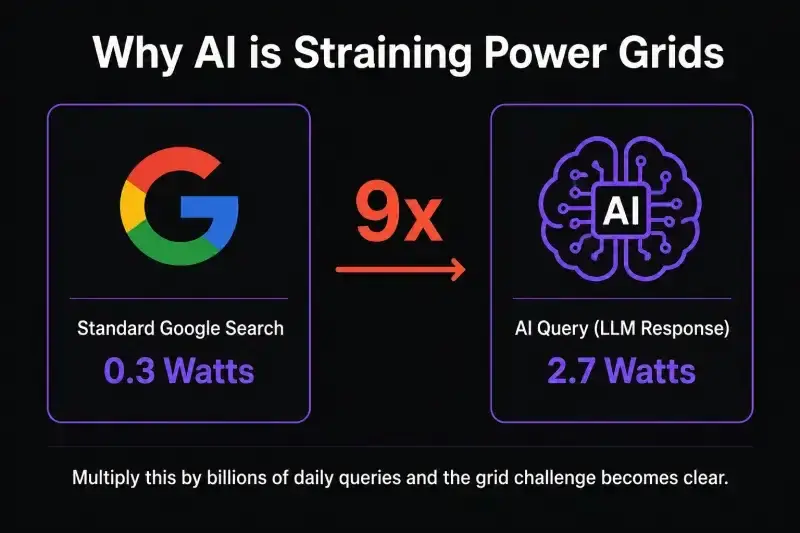
The energy economics of artificial intelligence are stark. Generating a single AI response consumes roughly 2.7 watts, nearly nine times the 0.3 watts used by a standard Google search. Multiply that by billions of daily queries, compound it across the explosive growth of large language models and agentic AI systems, and you arrive at a power consumption challenge that is straining grids that were never built for it.
Data centres are being announced across India at a pace not seen before. Each one requires not just a grid connection, but a reliable, high-quality grid connection, free from voltage sags, harmonic distortions, and reactive power imbalances. Power quality equipment, including the SVCs and harmonic filters that Quality Power manufactures, is precisely what enables data centres to operate without interruption. This is demand that barely existed a decade ago and is growing very fast now.
The HVDC Imperative
Renewable energy has a geography problem. India's best solar resources are in Rajasthan and Gujarat. Its best wind resources are in Tamil Nadu, Gujarat, and increasingly offshore. But the cities and industrial corridors that actually need the power, in Maharashtra, Karnataka, Uttar Pradesh, are hundreds of kilometres away.
Transmitting renewable energy over long distances using conventional AC technology is inefficient. The fluctuating nature of solar and wind generation creates reactive power challenges that worsen with distance. The solution, increasingly adopted globally and now accelerating in India, is High Voltage Direct Current transmission. HVDC minimises transmission losses over long distances, handles the variability of renewables more effectively, and enables asynchronous interconnection of grid regions.
HVDC systems require a highly specialised set of components: DC filters, smoothing reactors, thyristor valves, and associated power quality equipment. Quality Power manufactures precisely these components. Its Turkish subsidiary Endoks, acquired in 2011, extends this capability into European HVDC markets.
This is not a future opportunity. HVDC projects are being tendered and contracted now. The National Electricity Plan envisions multiple HVDC corridors as a core part of India's transmission backbone. Quality Power is already inside this ecosystem.
Global Grid Modernisation
Ageing infrastructure is not just an Indian problem. Europe's electricity grid was built for a world of centralised coal and nuclear generation. It was not designed for distributed renewables, cross-border power trading, or the volatile load profiles introduced by large-scale EV adoption. Upgrading it represents a capital investment cycle estimated at €584 billion. The United States has committed $70 billion to grid modernisation under recent infrastructure legislation.Quality Power's Turkish subsidiary Endoks directly serves the European market, benefiting from geographic proximity and a favourable R&D tax regime that has compressed its effective tax rate to near zero while sustaining approximately 30% operating margins. European revenue exposure combined with Turkish cost structure, all in technically complex FACTS and STATCOM products, is a combination that's hard to replicate.
"In God we trust. All others must bring data." — W. Edwards Deming
The Numbers That Validate the Thesis
Every compelling narrative eventually has to answer the same question: does it show up in the financial statements?
The answer lies in understanding how to interpret a company's financial reports and key metrics. If you're not confident reading financial statements, our guide on How to Read a Balance Sheet Like a Professional Investor is a great place to start.
For Quality Power, it does.
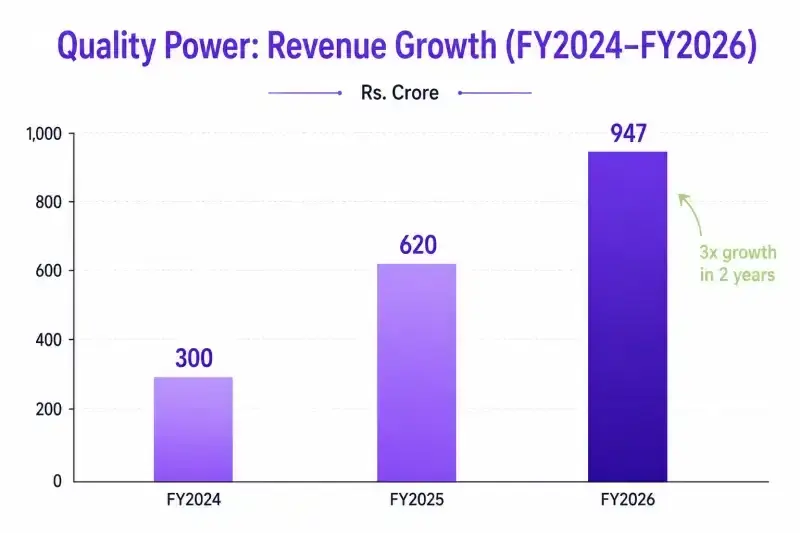
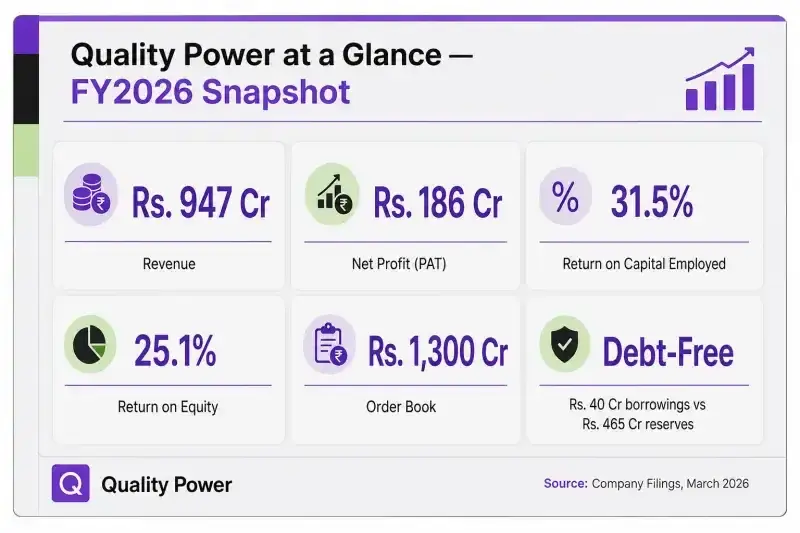
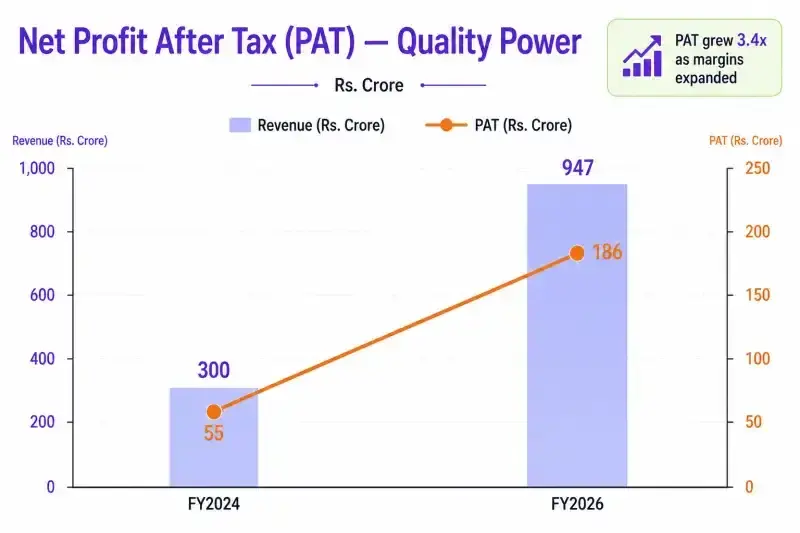 Revenue has grown from Rs. 300 Crore in FY2024 to Rs. 947 Crore in FY2026, more than a tripling in two years, and it marginally exceeded the Rs. 900 Crore projection that had earlier been flagged as an ambitious target. Net Profit After Tax followed an even steeper arc, rising from Rs. 55 Crore in FY2024 to Rs. 186 Crore in FY2026.
The quality of those earnings matters as much as their size. Return on Capital Employed stands at 31.5% and Return on Equity at 25.1%, both meaningfully above industry averages. These are not the return ratios of a company simply riding an industry tailwind. They reflect a business that is genuinely converting capital into value at a healthy clip.
Return on Equity is one of the most powerful indicators of management quality and capital efficiency. Learn how to interpret it in our detailed guide, Return on Equity (ROE) Explained: A Step-by-Step Guide for Investors.
The balance sheet is also worth noting. Quality Power is practically debt-free, carrying just Rs. 40 Crore in borrowings against Rs. 465 Crore in reserves. In a capital-intensive industrial sector where companies routinely lever up to fund growth, that kind of financial discipline is unusual. It also means the company retains significant capacity to pursue acquisitions or fund expansions without needing to dilute equity.
A strong balance sheet isn't just about low debt—it's also about understanding leverage. Read What is Debt to Equity Ratio? Why it Matters for Small Cap Investing to see why this metric matters.
The order book provides further comfort. A Rs. 1,300 Crore backlog gives the business approximately 1.4 times its FY2026 revenue in already-secured work. That is meaningful revenue visibility in a business where client approvals take years and order wins are hard-fought.
The current market cap of Rs. 9,722 Crore against a trailing P/E of 80 reflects the growth expectations already embedded in the stock. This is not a cheap stock by conventional measures. But high-quality compounders in structural growth industries rarely are, and the relevant question for investors is whether the growth trajectory justifies the multiple, not whether the number looks comfortable in isolation.
Building the Business Through Acquisition: The Inorganic Playbook
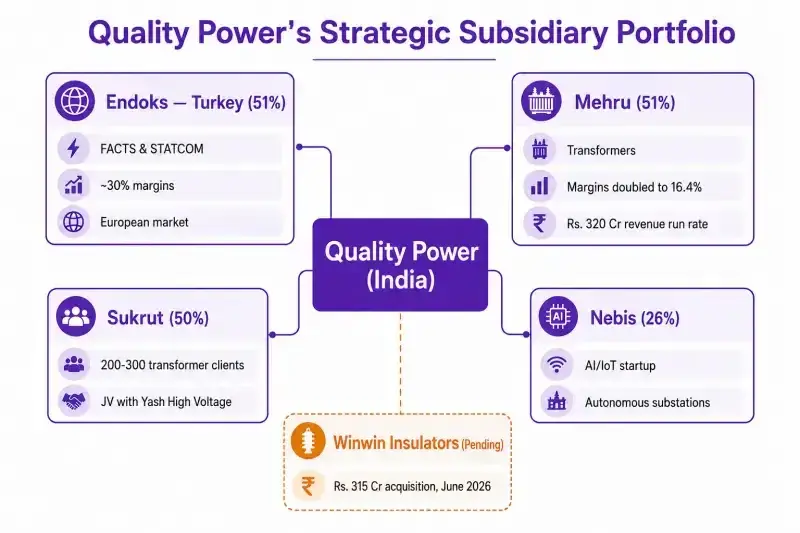
Quality Power's growth story is not purely organic. The company has consistently pursued a strategy of acquiring technically capable businesses, often struggling or undervalued ones, and systematically improving their operations.
Endoks (Turkey, 51% stake) is the clearest example of this strategy working at scale. Acquired in 2011, the company manufactures FACTS systems and STATCOMs for European utilities and system integrators. It operates in a near-zero tax environment due to Turkish R&D incentives, generating approximately 30% operating margins despite Turkey's challenging macroeconomic environment. Companies operating in hyperinflationary economies often develop a certain discipline about cost management that serves them well in global markets.
Mehru (51% stake) focuses on transformers. Under Quality Power's ownership, Mehru's operating margins have doubled to 16.4%, and its annualised revenue run rate is approaching Rs. 320 Crore. Management has announced a Rs. 50 Crore greenfield expansion for Mehru in Turkey, leveraging cheaper land costs while maintaining proximity to European customers.
Sukrut (50% stake) provides access to a distribution network spanning 200 to 300 transformer clients through a joint venture with Yash High Voltage. This is not a manufacturing play so much as a customer relationship asset, a pipeline for cross-selling Quality Power's product range into an established client base.
Nebis (26% stake) is the most forward-looking piece of the portfolio. This AI and IoT startup is developing autonomous, unmanned power substations, the next generation of grid infrastructure that reduces operational costs, improves reliability, and enables remote monitoring at scale. It is early stage, and the financial contribution is minimal for now. But strategically, it signals that Quality Power is not just manufacturing the components for today's grid. It is also placing bets on what tomorrow's substation might look like.
The most recent addition to this playbook is the June 2026 term sheet to acquire 100% of Winwin Speciality Insulators for approximately Rs. 315 Crore. Insulators are a natural adjacency, a component used extensively in the same high-voltage applications that Quality Power's core products serve. If the Winwin integration follows the pattern set by Endoks and Mehru, investors can reasonably expect margin improvement and revenue acceleration from the acquired entity over the following two to three years.
The Risks Investors Need to Understand
An investment thesis that only tells the positive story is an incomplete one. Quality Power operates in an attractive space, but it is not without meaningful risks.Valuation concentration of expectations. A P/E of 80 prices in a long runway of high growth. If revenue growth moderates due to project delays, order book conversion issues, or macroeconomic headwinds, the valuation compression could be painful. High-multiple industrial stocks rarely get the benefit of the doubt when results disappoint.
Execution complexity of the acquisition strategy. Managing a portfolio of companies across Turkey and India, with varying stages of maturity and different management teams, is genuinely difficult. The Endoks and Mehru turnarounds have been successful so far. But the Winwin acquisition at Rs. 315 Crore is a meaningful capital deployment, and integration risk is real.
Turkey's macroeconomic volatility. Both Endoks and the planned Mehru expansion are anchored in Turkey, a market that has experienced significant currency depreciation and hyperinflation over the past several years. The near-zero R&D tax rate and high margins provide a substantial cushion, but a sharp deterioration in the Turkish lira or the regulatory environment could affect subsidiary earnings in ways that are hard to predict from India.
Concentrated promoter holding. The 73.91% promoter stake is a sign of conviction, but it also means public float is limited. Thin float can amplify price volatility and may create governance-related concerns if the business ever faces a situation where independent shareholders need to scrutinise management more closely.
Revenue concentration risk. Power infrastructure projects in India can face delays due to land acquisition, environmental clearances, or shifts in government capital expenditure priorities. A slowdown in utility spending, even a temporary one, can have an outsized impact on order book replenishment and revenue recognition.
None of these risks are thesis-breaking in isolation. But they need to be understood and monitored, particularly given the premium valuation the stock currently commands.
"The stock market is a device for transferring money from the impatient to the patient." — Warren Buffett
Explore our Products
Research Framework

Emerging Titans
Combination of quantitative analysis, industry tailwinds, and management assessment - SPRINT investment philosophy

Tiny Titans
Heavy emphasis on scuttlebutt research, plant visits, and early on-ground signals
What Quality Power Actually Represents
The simplest way to understand Quality Power is through an analogy.India's energy transition is a construction project of extraordinary scale. Thousands of kilometres of new transmission corridors, hundreds of HVDC converter stations, tens of thousands of new substations, and a complex web of power quality management infrastructure designed to hold it all together as the generation mix shifts decisively toward renewables.
In any construction project, there are the contractors you see: the ones with cranes and hard hats and names on hoardings. And then there are the specialist subcontractors whose work is invisible to passers-by but without which the building doesn't stand. The firms doing the structural steelwork, the electrical cabling, the fire suppression systems.
Quality Power is that specialist subcontractor in India's energy transition. Its products are not glamorous. You will not see them in advertisements or featured in government press releases. But they are load-bearing. Without FACTS systems managing reactive power, long-distance HVDC lines become unstable. Without harmonic filters, data centres experience power quality problems that disrupt operations. Without high-quality reactors and SVCs, grid stability deteriorates as renewable penetration rises.
The company sits at the intersection of multiple structural tailwinds, the AI power surge, the HVDC imperative, and the global grid modernisation wave, without needing any single one of them to fully materialise in order to grow. If even two of these three trends play out over the next decade, the demand environment for Quality Power's products will be substantially larger than it is today.
The financial trajectory already suggests the business is executing on this opportunity: revenues tripling, profits more than tripling, order books at record levels, return ratios well above cost of capital.
The deeper question for investors is a familiar one. At a P/E of 80, how much of this story is already priced in, and how much runway remains?
Valuation plays a crucial role in investment decisions. Our article The P/E Ratio Decoded: Trailing vs. Forward, and What is a "Good" P/E? explains how investors should interpret high P/E stocks.
That is a judgement each investor has to make for themselves, with eyes open to both the opportunity and the risks. But the business itself, technically differentiated, strategically positioned, financially sound, and backed by a management team with genuine conviction, is the kind of business worth understanding deeply before making that call.
Because the energy transition isn't slowing down. And the companies quietly enabling it, below the surface, out of the headlines, doing the unglamorous work of keeping the lights on, may turn out to be some of the most important investments of this decade.
For more such articles and deep dives comment "Quality" in the comments.
This article is intended for educational and informational purposes only and should not be construed as financial advice. Please consult a registered investment advisor before making any investment decisions.
If you enjoy deep, data-backed stock breakdowns like this one, don't miss A Fundamental Checklist: How to Research a Stock in 1 Hour, where we cover a practical framework for evaluating any listed company before investing.
FAQs
What does Quality Power actually manufacture?
+Quality Power manufactures specialised high-voltage electrical equipment used in power transmission and grid infrastructure. Its core products include reactors (series, shunt, and HVDC), special purpose transformers, power quality systems like Static Var Compensators (SVCs) and STATCOMs, harmonic filters, and PLCC components like wave traps. These are the components that sit inside substations and HVDC corridors, keeping electricity stable as it travels from generation sources to end consumers.
Why is Quality Power considered a beneficiary of the AI boom?
+AI data centres consume significantly more power than conventional internet infrastructure. Generating a single AI response uses roughly 2.7 watts compared to 0.3 watts for a standard Google search, nearly nine times more. As data centres multiply across India, each one needs a high-quality, stable grid connection free from voltage fluctuations and harmonic distortions. Quality Power's SVCs and harmonic filters are precisely the equipment that makes this possible, putting the company directly in the path of AI-driven power demand growth.
What is HVDC and why does it matter for Quality Power?
+HVDC stands for High Voltage Direct Current transmission. Unlike conventional AC transmission, HVDC is far more efficient for carrying electricity over long distances, which makes it essential for India's renewable energy ambitions since the best solar and wind resources are located hundreds of kilometres away from major demand centres. HVDC systems require specialised components including DC filters, smoothing reactors, and thyristor-controlled reactors, all of which Quality Power manufactures. The company's Turkish subsidiary Endoks also supplies HVDC-related FACTS systems to European markets.
How has Quality Power grown financially in recent years?
+The company's growth has been steep. Revenue grew from Rs. 300 Crore in FY2024 to Rs. 947 Crore in FY2026, more than tripling in two years. Net profit over the same period rose from Rs. 55 Crore to Rs. 186 Crore. The company maintains a Return on Capital Employed of 31.5% and is practically debt-free, with only Rs. 40 Crore in borrowings against Rs. 465 Crore in reserves. It also carries a Rs. 1,300 Crore order book, providing roughly 1.4 times its annual revenue in already-secured work.
What is Quality Power's acquisition strategy and which companies has it bought?
+Quality Power has a consistent track record of acquiring technically capable but underperforming companies and improving their operations. Key acquisitions include Endoks in Turkey (51% stake), which manufactures FACTS and STATCOM systems for European markets at around 30% operating margins; Mehru (51% stake), a transformer manufacturer whose margins have doubled to 16.4% under Quality Power's ownership; and Sukrut (50%), which provides access to 200-300 transformer clients. The company also holds a 26% stake in Nebis, an AI and IoT startup developing autonomous substations. In June 2026, it signed a term sheet to acquire 100% of Winwin Speciality Insulators for Rs. 315 Crore.
What are the key risks of investing in Quality Power?
+The most significant risk is valuation. At a trailing P/E of around 80, the stock prices in a long runway of high growth, leaving little room for execution missteps. Beyond that, the company's heavy reliance on Turkey for two subsidiaries exposes it to currency and macroeconomic risk given Turkey's history of hyperinflation. Managing a multi-country portfolio of acquisitions at different maturity stages also adds operational complexity. Finally, India's power infrastructure projects are prone to delays due to land acquisition and regulatory approvals, which can affect order book conversion timelines.

High growth stock specialist, Value Educator
Shashank Mahajan is an equity research professional with over 12 years of experience in identifying high-potential SME and micro-cap stocks at an early stage. He follows a rigorous scuttlebutt research–driven approach, combining on-ground insights with deep financial analysis. Shashank specializes in uncovering under-researched and under-owned companies with strong management quality and long-term growth potential. Through disciplined research and early identification, he focuses on spotting tomorrow’s market leaders before they enter the mainstream investor radar.

Zen Technologies: Revenue Fell After a Big Win



PNG Jewellers: A 194-Year-Old Name Goes National
Explore our Products
Research Framework
Emerging Titans
Combination of quantitative analysis, industry tailwinds, and management assessment - SPRINT investment philosophy
Tiny Titans
Heavy emphasis on scuttlebutt research, plant visits, and early on-ground signals


 Orders
 Subscription
 Share with friends
 Logout


Required Details
₹23999.00
(12 month subscription)
As per SEBI regulations, all users are mandated to complete the KYC that is validated for 1 year. Post payment, you will be redirected to the KYC screen


No comments yet. Be the first to comment!