
Yash Highvoltage: Bushing Maker With ₹760 Cr of Orders
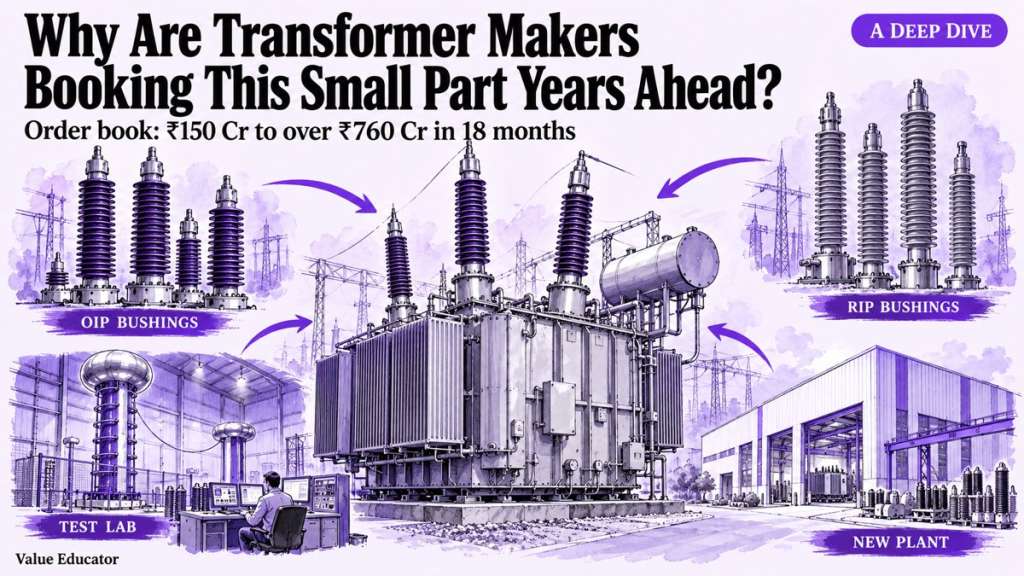
On 21 October 2026, a Vadodara company reported that its revenue for the April to September half had nearly doubled. That growth comes from India's grid. Under the government's distribution reform scheme, 5,90,369 transformers have been sanctioned for replacement, and only about 22% of them were installed by 2025. India's peak power demand is about 243 GW today and is expected to cross 400 GW by 2030.
That replacement drive has large money behind it. The distribution scheme is backed by a large government outlay that runs until FY28, and states are now placing transformer orders to meet it. India also had about 263 GW of renewable capacity against a target of 500 GW, and every new gigawatt needs step-up transformers to reach the grid.
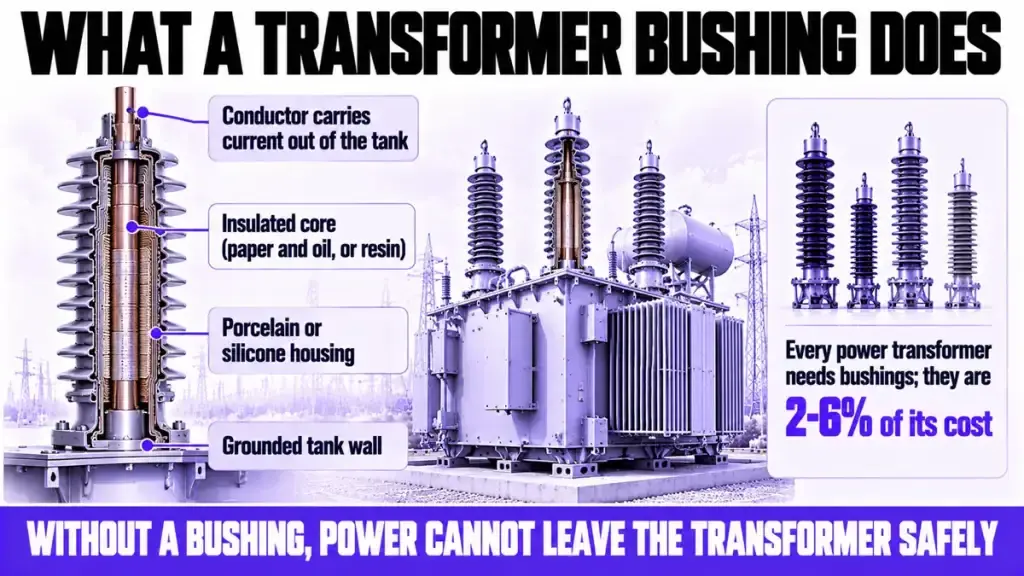
Every one of those transformers needs a small part that cannot be skipped. A bushing simply means the insulated tube that carries a high-voltage conductor safely through the transformer's steel tank to the outside line. Without it, the live conductor would touch the earthed tank and the transformer would fail, often in a fire. Each transformer needs five to seven bushings, and there is no substitute.
Transformer makers buy these bushings from a very small group of specialists. Large makers such as Hitachi Energy, Siemens and GE build the transformers and sell them to utilities, renewable parks and industry. They depend on bushing suppliers they have approved, because a faulty bushing can destroy a transformer worth crores. Utilities take eight to ten years to qualify a new bushing supplier.
One Vadodara company has spent more than two decades building that trust. Yash Highvoltage Ltd (BSE: 544310) makes condenser-graded transformer bushings for high voltages and high currents. It says it is one of fewer than 12 independent bushing makers in the world, and the only independent one from India. It has installed more than 50,000 bushings for over 1,000 customers in more than 60 countries.
Its newest step is the RIP bushing, short for resin-impregnated paper, a dry bushing whose insulating core is set in resin instead of soaked in oil. RIP bushings need no maintenance, are lighter and are less likely to catch fire than older oil-impregnated (OIP) bushings. Until now, Yash has imported the cores for its RIP bushings. Its new plant, which raised its first invoice on 30 September 2026, will make them in Vadodara.
Yash Highvoltage in five numbers
- H1 FY27 revenue of ₹194.5 Cr, up 95% from ₹99.6 Cr a year ago
- An EBITDA margin of 28.1% in H1 FY27, against 23.3% a year ago
- An order book of over ₹760 Cr on 30 September 2026, up from about ₹400 Cr in March 2026
- More than 50,000 bushings installed in over 60 countries
- Capacity rising to about 15,000 bushings a year with the new plant and an expansion
So how did a bushing maker double its revenue in a single half-year? Let's first understand the company, and then look at the latest results.
Yash Highvoltage: Company Overview
Yash Highvoltage Ltd is a Vadodara maker of condenser-graded transformer bushings. It was incorporated in 2002, its present management took it over in 2008, and it is led by Keyur Shah, its chairman and managing director. It makes RIP, RIS, OIP and high-current bushings up to 245 kV and up to 25,000 A, and says it is one of fewer than 12 independent bushing makers in the world. Its two plants, including the new Jarod plant that raised its first invoice on 30 September 2026, will take capacity to about 15,000 bushings a year. It had 208 permanent employees at the end of FY26 and listed on the BSE SME platform in December 2024. Revenue was ₹235.1 Cr in FY26 and ₹194.5 Cr in H1 FY27, and at the end of September 2026 it held ₹69.2 Cr of cash, with debt of only 0.03 times equity. Read this The Silent Gatekeeper of India's Power Grid
"Behind every stock is a company. Find out what it's doing."
— Peter Lynch
For Yash, what it is doing is simple to state: making a part that no transformer can ship without, for customers who take years to approve a new supplier.
The Half-Year That Nearly Doubled Revenue
Let's look at H1 FY27, the April to September half, which Yash reported on 21 October 2026. As a company listed on the BSE SME platform, it reports every six months. Revenue from operations was ₹194.5 Cr, up 95% from ₹99.59 Cr a year ago.

That growth came with a higher margin, and the gross margin explains most of it. Gross margin rose to 48.3% from 42.4%, as RIP bushings made up 86% of revenue and retrofits and services grew. EBITDA rose 136% to ₹54.7 Cr, and the margin reached 28.1%. Read this EBITDA Explained: Uses and Limits
The other costs grew more slowly than revenue. Employee costs and other expenses each roughly doubled, while revenue nearly doubled too, so their share of revenue stayed close to flat. Profit after tax rose to ₹36.2 Cr from ₹13.7 Cr, and earnings per share to ₹12.5 from ₹4.8. Depreciation rose to ₹4.4 Cr from ₹2.6 Cr as new machines came in, while finance costs stayed small at ₹2.4 Cr, so almost all of the extra gross profit reached the bottom line.

That half-year also shows the usual pattern of the business. Transformer makers take more bushings in the second half of the year, so the second half is normally stronger. In FY26, revenue was ₹99.59 Cr in the first half and ₹135.5 Cr in the second, and the EBITDA margin rose from 23.3% to 27.4%. This year, the first half alone came close to last year's second half.
That half-year built on a strong FY26. Revenue rose from ₹108.5 Cr in FY24 to ₹149.6 Cr in FY25 and ₹235.1 Cr in FY26. EBITDA, as the company reports it, was ₹60.4 Cr in FY26, a margin of 25.7%, and profit after tax was ₹37.4 Cr.
That growth also showed up on the balance sheet. Property, plant and equipment rose to ₹112.3 Cr in September 2026 from ₹45.2 Cr in March, as the new plant moved out of construction. Shareholders' funds rose to ₹319.6 Cr from ₹184 Cr after the share issue, and debt stayed small, at 0.03 times equity.
That growth also brought cash this time. Operating cash flow was ₹45.2 Cr in H1 FY27, against ₹4.8 Cr a year ago. Read this Cash Flow Statement Explained The company spent ₹69.9 Cr on investments, mostly the new plant, and raised money through a share issue. It held ₹69.2 Cr of cash and ₹26.4 Cr of other bank balances at the end of September 2026.
The Orders Behind the Book
So what will keep this going? The order book was over ₹760 Cr on 30 September 2026. It was ₹150 Cr in March 2025 and ₹400 Cr in March 2026, so it nearly doubled again in six months.
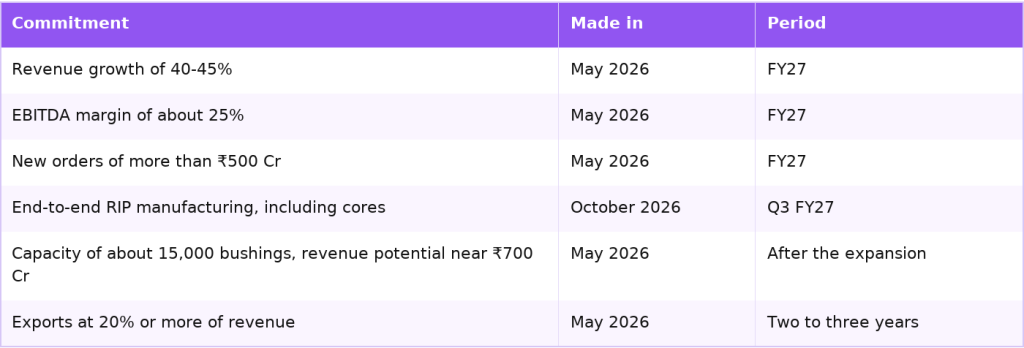
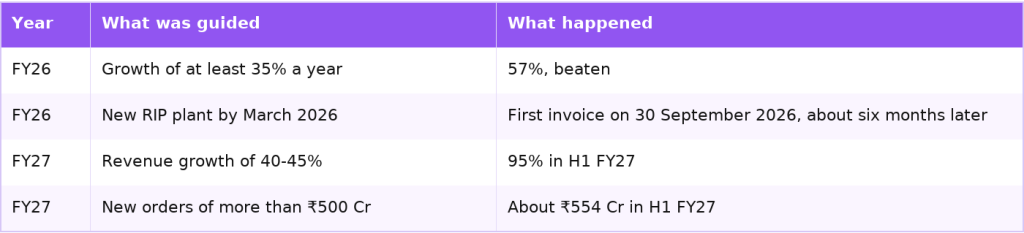
Those numbers also tell us how many new orders came in. Adding back the half-year's revenue, Yash booked about ₹554 Cr of new orders in H1 FY27. In May 2026, management had set a target of more than ₹500 Cr of new orders for the whole of FY27, so it passed that target in the first half.
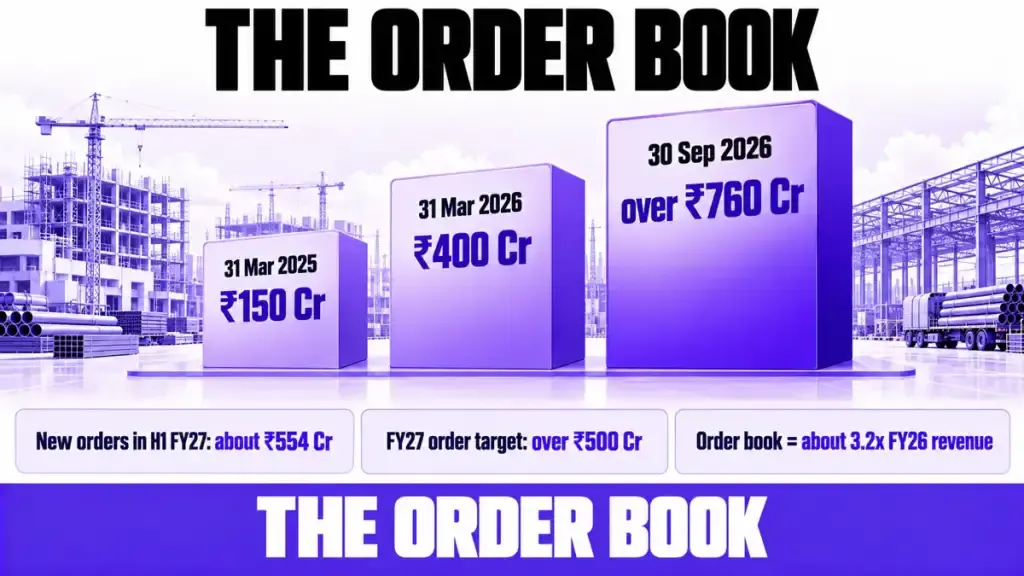
We can put that book against revenue too. An order book of over ₹760 Cr is about 3.2 times FY26 revenue of ₹235.1 Cr, so Yash has more than three years of last year's sales already in hand. That is a long runway for a component maker.
Customers also accept this kind of pricing. When copper, aluminium or currency costs rise after an order, transformer makers usually agree to pay the increase, so Yash passes most material costs on rather than absorbing them.
Many of these orders are long. Transformer makers now place blanket orders that cover 24-36 months of deliveries, so that they can be sure of getting bushings. Yash builds expected price and currency moves into these orders, and customers accept later increases in commodity costs.

Why a small part has a large order book: a bushing is a small share of a transformer's cost, but a transformer cannot ship without it. When every transformer maker is expanding together, the few approved bushing makers get booked years ahead.
From a Takeover in 2008 to a Listed Exporter
To see why customers give Yash such long orders, let's go back to where it started. The company was incorporated in Vadodara in 2002, and its present management took it over in 2008. It made its first export a year later, in 2009, and opened a new manufacturing bay in 2011.
That early work was about earning approvals. In 2012, Yash won major approvals from NTPC and made a 16 kA high-current bushing. In 2013, it signed a representation agreement with the Swiss bushing maker Moser Glaser for its RIP bushings in India, and by 2016 it had become the first Indian small company to localise dry-type RIP bushing technology.
The firsts kept coming after that. Yash developed a 52 kV, 6,300 A hybrid RIP and OIP bushing for a POWERGRID STATCOM, which it says was a world first. It launched OIP bushings with silicone insulators, supplied India's first localised RIS bushing, and moved up to 245 kV in both OIP and RIP. It also made its first bulk export of more than 120 IEEE-standard OIP bushings to the US.
Those years built the base for the listing. Yash listed on the BSE SME platform on 19 December 2024, and its laboratory gained ILAC and NABL accreditation the same year. In 2026, it set up its US subsidiary, bought half of Sukrut Electric and had its R&D unit recognised by the government.
So the growth we see today depends on approvals that took close to two decades to collect. A rival starting now would need years of type tests and utility approvals before it could bid for the same transformers. Read this Economic Moat Explained That is the main reason the order book can grow as fast as it has.
"A truly great business must have an enduring moat that protects excellent returns on invested capital."
— Warren Buffett
For Yash, the moat is the list of approvals it has collected since 2008. Each new export market, starting with the US, has to be won the same slow way.
Three Kinds of Bushings
Now let's see what Yash actually sells, and the market it sells into. India's transformer market is put at about $3 Bn in 2025, rising to about $4.47 Bn by 2030, and the global bushing market at about $1.8 Bn in 2023, rising to about $3 Bn by 2033. India's national electricity plan also sets aside a large sum for new transmission lines up to 2032, and every new substation on those lines needs transformers and bushings.
Within that market, Yash reports one business, transformer bushings, but it makes several types for different jobs. In H1 FY27, RIP bushings gave 86% of revenue, OIP bushings 9%, high-current bushings 2% and other products 3%.

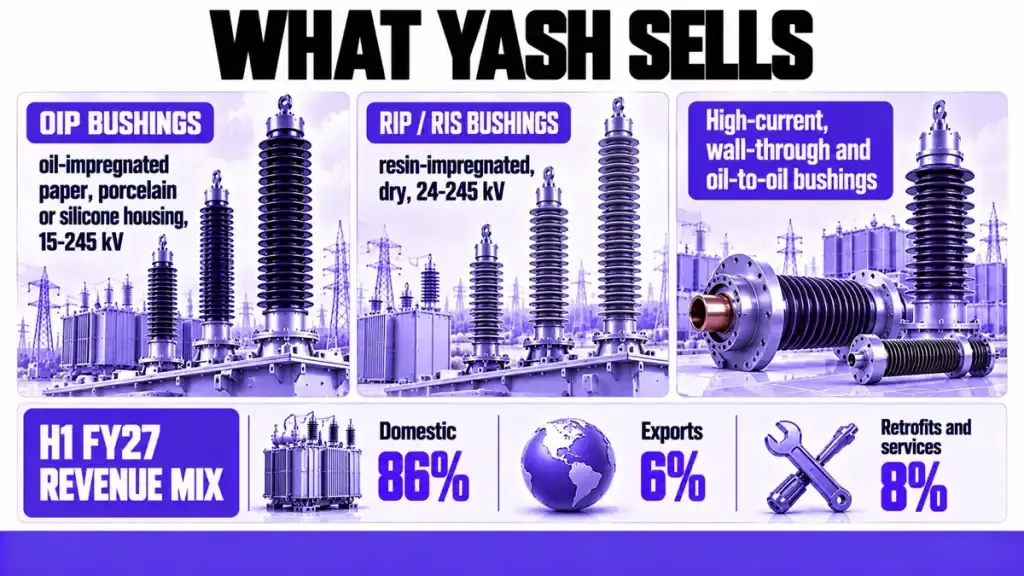
These products differ in how they are built and who buys them. OIP bushings run from 15 kV to 245 kV and carry up to 3,150 A as standard, with porcelain or silicone housings. RIP and RIS bushings run from 24 kV to 245 kV and are built to the IEC 60137:2017 standard. Yash also makes wall-through and oil-to-oil bushings up to 245 kV. RIP bushings are the high-value product sold mainly in India. OIP bushings are cheaper and carry oil, and they are Yash's main export. High-current bushings carry thousands of amperes at lower voltages for power plants and furnaces.
That product mix sits alongside a shift in who buys. Domestic sales gave 86% of H1 FY27 revenue, exports 6% and retrofits and services 8%, against 5% and 4% a year earlier. You can read this as the first sign of the two higher-margin lines management keeps talking about. Both lines are still small, but both are growing faster than the business as a whole.
RIP Bushings and the New Plant
Let's start with RIP bushings, the core of the business. Around the world, RIP bushings are taking a growing share of new installations, rising from about 35% in 2023 towards about 45% expected for 2025. They need no maintenance for life, use fire-retardant materials and are 30-40% lighter than OIP bushings.
Those bushings are not new for Yash, but it has not made them from start to finish. In 2016, it became the first Indian small company to localise dry-type RIP bushing technology, through a collaboration with the Swiss company Moser Glaser. It has supplied more than 18,400 RIP bushings since 2017. But in India today, more than 95% of RIP cores are imported, from Europe and China.
That is what the new plant changes. The plant at Jarod, Vadodara, raised its first invoice on 30 September 2026, for RIP bushings assembled and tested there with imported cores. Management expects end-to-end manufacturing, including the cores, in Q3 FY27.
We can see how far the plant has come from the company's own progress list. The factory building, the bushing assembly hall and the packing area are complete. A winding machine from IMPL has been commissioned, the autoclave and resin-mixing machines are working and prototype trials are under way. A second winding machine from Menzel was being commissioned, with completion expected in October 2026. The plant adds about 6,000 bushings a year of capacity.
"Predicting rain doesn't count. Building arks does."
— Warren Buffett
For Yash, the demand forecast is the rain. The ark is a plant that can make its own RIP cores, and that part is due only in Q3 FY27.
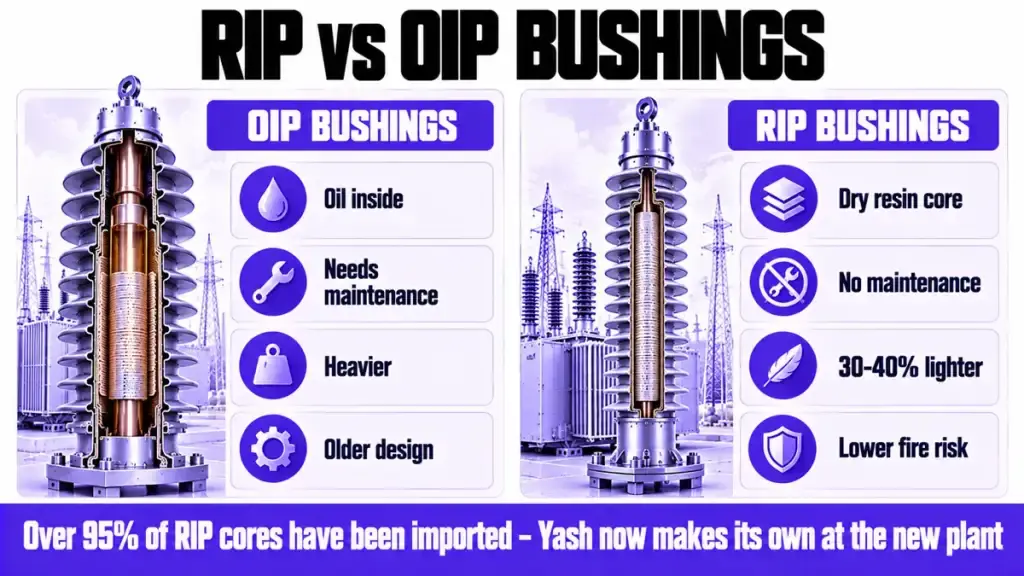
Those cores bring three effects. It cuts import duties, freight and lead times, which run at 12-16 weeks for imported cores. It lets Yash sell RIP bushings outside India for the first time. And it raises the voltage range, because the plant's design was expanded from 220 kV to 550 kV.
OIP Bushings and Exports
Next, let's look at OIP bushings, the oldest product and the main export. OIP bushings use paper soaked in oil, and many utilities around the world still specify them. Yash has supplied more than 29,650 OIP bushings, and it was the first Indian bushing maker to offer OIP bushings with silicone insulators.
That product now has a new door into the US. In H1 FY27, Yash became the first Indian maker, and one of a few in the world, to complete seismic qualification tests of IEEE-standard 138 kV and 230 kV OIP bushings. That lets it supply customers in earthquake-prone parts of the US. It also tested and supplied its first 245 kV wall-through bushing to a large public-sector company.
That demand has been limited by autoclaves, the ovens that dry and impregnate OIP cores. Management says OIP bushings are in short supply in India, and Yash is adding autoclaves at its existing plant. Together with the new RIP plant, that takes capacity to about 15,000 bushings a year.
That capacity also supports exports beyond the US. Yash has a distribution agreement with Weidmann for Europe and North Africa, and with Electro Link for the UK and Ireland. These partners sell Yash's bushings in markets where buyers want a local name to deal with.
High-Current Bushings
Now let's turn to high-current bushings, a small but technically demanding line. Generator transformers at power plants and transformers for industrial furnaces carry very large currents at lower voltages. Their bushings must carry that current without overheating.
Yash makes high-current bushings from 4,000 A to 25,000 A, at 24-52 kV. It says it was the first Indian maker of a 25,000 A transformer bushing, and it booked India's first order for one in 2024. It has supplied more than 4,870 high-current bushings so far.
Retrofits and Services
Next, let's look at retrofits, which grew fastest in H1 FY27. Bushings last about 30 years on average, but heat and voltage can age them sooner. Spare parts for old designs are often hard to find because the original makers have stopped making them or have closed.
Yash replaces old bushings with its own, often upgrading an OIP bushing to a dry RIP one. It has retrofitted more than 900 bushings, including 245 kV and 145 kV RIP bushings at state utility substations in eastern and western India. It also runs on-site testing and repair. Management describes retrofits and exports as higher-margin business, and retrofits and services rose to 8% of revenue.
That business also includes testing. Yash's service team runs on-site capacitance and dissipation-factor tests on bushings, which help a utility spot a failing bushing before it damages the transformer. It also repairs porcelain bushings and overhauls them. For a utility with an ageing fleet of transformers, that service can lead straight to a replacement order.
The Push Into the US and Sukrut
Finally, let's look at the two newer pieces: the push into the US and Sukrut, the transformer-components business. The US grid is in its largest upgrade cycle in decades. The company cites estimates that the US needs about 100 GW of new peak capacity by 2030, that US power-transformer demand has grown 119% since 2019, and that about 40 million US transformers are past their design life.
That demand is why Yash has built a sales network there. Its approvals so far cover leading domestic, multinational, state-owned and renewable-energy utilities, and the US is the next market where it is collecting them. Its US subsidiary signed representation agreements with Ensales Electrical Associates and Gateway Power Sales covering 22 states, and on 12 October 2026 it added EHV Solutions for five more states. The representatives sell high-current and OIP bushings now, and RIP/RIS bushings up to 230 kV from 2027.
That timing matters because US capacity is being added now. The company notes that Hitachi, Siemens, Eaton, Prolec GE, Schneider and HD Hyundai are all expanding transformer production in the US, and each new plant needs bushings. It also cites estimates that data centres could use 6.7-12% of US electricity by 2028. Selling into the US is not simple, though: utilities and transformer makers there must first approve an Indian supplier, and Yash is now going through those approvals.

Closer to home, Yash owns 50% of Sukrut Electric, a Pune maker of transformer tanks and accessories, with Quality Power owning the other half. For Yash, Sukrut adds tanks and fabrications, the parts that transformer makers buy alongside bushings, so the same sales teams can offer both. Sukrut has turned profitable within nine months of the purchase. It moved from a loss of ₹2.19 Cr in FY26 to a profit of ₹55 lakh in H1 FY27.
"We are on track to commission end-to-end manufacturing of resin-impregnated paper (RIP) and resin-impregnated synthetic (RIS) bushings at our new greenfield facility in Jarod during Q3 of the current financial year." - Keyur Shah, Yash Highvoltage
Why Transformer Makers Rarely Change a Qualified Supplier
Now that we have seen each product, let's understand what keeps customers with Yash. It starts with approval. A utility or transformer maker tests a new bushing supplier's processes and products for years before it lets that supplier into its transformers, because a failed bushing can set a transformer on fire.
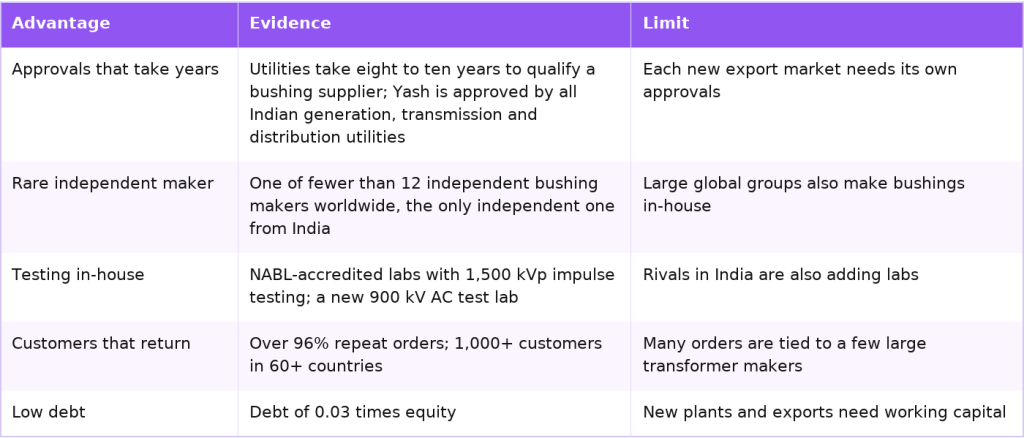
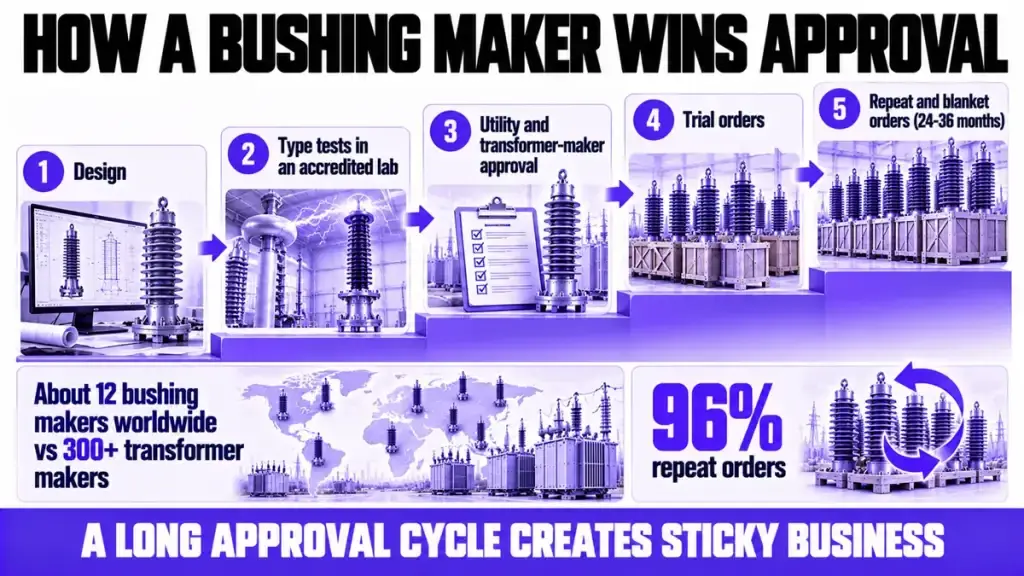
The numbers on each side of that market show why approval is worth so much. The company counts about 12 bushing makers worldwide against more than 300 transformer makers, every one of which needs bushings. When so few suppliers serve so many buyers, the approved ones can choose their orders.
That position shows in market share too. In October 2025, management said its product range maps to about 30-35% of the Indian bushing market. For a company of Yash's size, that is a large share of a market that every transformer maker depends on.
That approval reaches every corner of India's power system. Yash says its bushings are installed in all of India's nuclear power plants, and that it is approved by every generation, transmission and distribution utility in India. A transformer maker bidding for a utility contract needs bushings from an approved supplier, which pulls orders towards Yash.
Its testing backs that up on every unit. Its NABL-accredited laboratories test partial discharge and dissipation factor, run power-frequency tests up to 600 kV and impulse tests up to 1,500 kVp. Every OIP bushing is pressure-tested with oil at 1.8 kg/cm2 for 16 hours to prove it does not leak, and the company guarantees a dissipation factor below 0.4% for all its OIP bushings. Those are the tests a transformer maker checks before it accepts a supplier, and Yash runs them on every unit rather than on samples. The new plant adds a shielded test lab rated at 900 kV AC.
"Slowly and steadily our export is also increasing, our retrofit business is also increasing." - Keyur Shah, Yash Highvoltage
Its people bring experience from the global majors. Hartmuth Fethke, a non-executive director, spent more than 40 years at ABB Micafil and HSP, part of Siemens, designing high-voltage equipment and bushings. R. N. Nayak, another director, is a former chairman and managing director of POWERGRID. Its chief operating and technology officers came from Alstom, Schneider Electric, ABB, CG Power, Siemens and Trench.
That experience is backed by its own research. The government recognised Yash's R&D unit in 2026, and the company spent about ₹1 Cr on research and development in FY26, mostly on new designs such as the 550 kV range, the seismic-qualified IEEE bushings and the wall-through bushing it supplied this year.
That bench extends to its advisers. Pramod Rao, a senior technical adviser, spent more than 45 years in high-voltage engineering and once led CG's bushings and instrument-transformer business in India. Y. V. Joshi spent more than 37 years at GETCO, Gujarat's state transmission utility. Vincent Liotta, who advises on Europe, worked at Hitachi Energy, ABB and Siemens Energy, and David Stockton, who advises on global strategy, worked at ABB.
Beyond people, the new plant then adds cost and range. Making RIP cores in-house removes import duties and freight, shortens lead times and opens exports of RIP bushings. That would let Yash compete abroad in the fastest-growing type of bushing, with a cost base that importers of cores cannot match.
Financials: Profit Grew Faster Than Cash
We have already seen the latest half-year. Now let's look at the longer record, with full years from FY24 and the two latest half-years. EBITDA here includes other income, as the company reports it.

Revenue grew about 2.2 times in two years, from ₹108.5 Cr in FY24 to ₹235.1 Cr in FY26, and the EBITDA margin rose from 20.4% to 25.7%. Profit after tax grew about three times, from ₹12.3 Cr to ₹37.4 Cr, because more of each extra rupee of revenue reached the bottom line.
Cash did not keep pace with profit in those years. Operating cash flow fell from ₹14.4 Cr in FY24 to ₹8.8 Cr in FY26 while profit tripled, because inventory rose from about ₹21.7 Cr to ₹66.7 Cr and receivables from about ₹12.5 Cr to ₹30.6 Cr. That changed in H1 FY27: working capital took only ₹5.8 Cr, and operating cash flow of ₹45.2 Cr was higher than the profit of ₹36.2 Cr.
The growth has been funded mostly with equity, not debt. Shareholders' funds rose from about ₹41.7 Cr in March 2024 to ₹184 Cr in March 2026 after the listing, and to ₹319.6 Cr in September 2026 after the preferential issue, while debt stayed at about 0.03 times equity.
"Beware of little expenses; a small leak will sink a great ship."
— Benjamin Franklin
For Yash, the leak to watch is working capital. One good half-year of cash does not yet show that inventory and receivables will stay in check as the new plant ramps up.
What the Next Two Years Look Like on Management's Numbers
So what could all of this add up to for you as a reader following Yash? In May 2026, management guided revenue growth of 40-45% for FY27, without counting on cores from the new plant. It expected an EBITDA margin of about 25%. The first half came in far above that, with revenue up 95%.
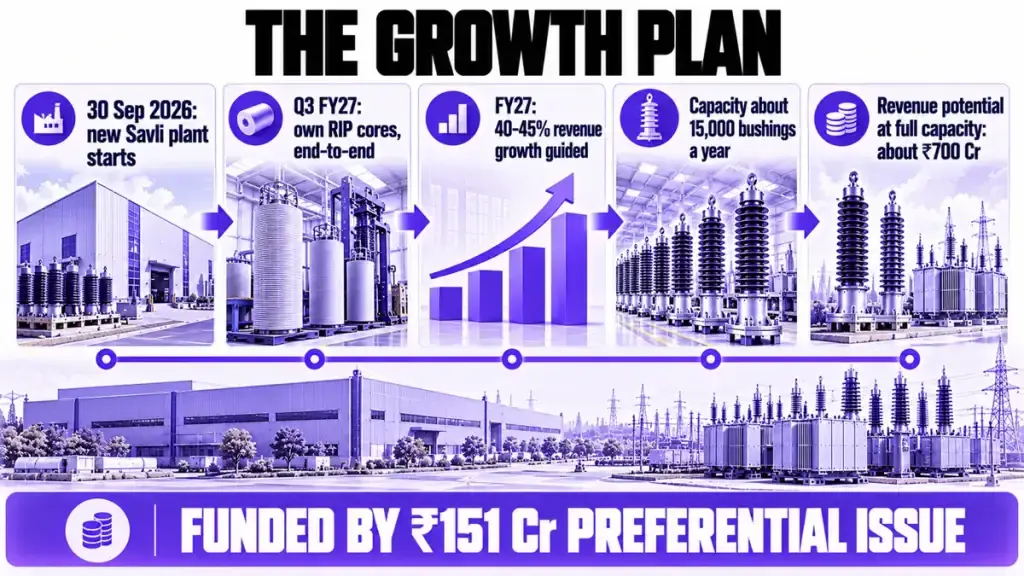
On FY26 revenue of ₹235.1 Cr, growth of 40-45% would mean about ₹329-341 Cr in FY27. The first half has already delivered ₹194.5 Cr. If the second half only matched the first, FY27 revenue would reach about ₹389 Cr, well above the guided range. Because transformer makers usually take more bushings in the second half, that guidance now looks conservative, but management has not changed it.
That plant also sets the longer ceiling. You should read these figures as management's view of what the capacity can do, not as guidance for a particular year. Management says capacity of about 15,000 bushings could support revenue of close to ₹700 Cr. The company also projects that the new plant could take revenue to three to four times its level within five years of full-scale operation.
The new plant also changes what Yash can sell abroad. With its own cores, it can offer RIP bushings to the export markets it already serves with OIP bushings, and it is building a 550 kV range for global customers. Management has said it will not move to 765 kV or HVDC bushings until the new plant and products are stable.
That growth needs money, and the company has raised it. In August 2026, it raised ₹151 Cr through a preferential issue to WhiteOak Capital, ValueQuest, Motilal Oswal, Malabar India Fund and others. Of that, ₹80 Cr is for capital spending, ₹36.75 Cr for working capital and ₹30 Cr for general purposes. The investors included WhiteOak Capital and ValueQuest at ₹29 Cr each, Motilal Oswal at ₹15 Cr and Ashika Global Finance at ₹10 Cr, with Malabar India Fund taking the warrants. ₹60 Cr came as warrants, of which 25% has been paid so far.
These commitments come with a record we can check. In October 2025, management targeted growth of at least 35% a year, as it said it had kept up in the past; FY26 revenue grew 57%. The new plant was first targeted for March 2026 and raised its first invoice on 30 September 2026.
Key Risks
No business grows in a straight line, so let's look at what could go wrong for Yash.
- New-plant ramp-up: the plant began with imported cores, and full core production is due only in Q3 FY27. If core quality or type tests take longer, the cost and export benefits would come later, as the plant itself did.
- Import dependence until then: foreign-exchange spending was about ₹130.6 Cr in FY26 against export earnings of about ₹17.2 Cr, mostly for cores and materials. The Swiss partner's core supply runs only until mid-2027.
- Working capital: operating cash flow was only about ₹8.8 Cr in FY26 as inventory rose to about ₹66.7 Cr. Inventory was ₹71.8 Cr and receivables ₹69.5 Cr in September 2026, so fast growth can again tie up cash.
- Dilution: the ₹151 Cr preferential issue added new shares, and ₹60 Cr of warrants can still be converted over 6-18 months.
- Competition and capacity: new bushing plants are starting in India, and more supply below 400 kV could pressure prices once the present shortage eases.
- Seasonality: transformer makers take more bushings in the second half, so revenue and margins can swing between halves.
- Controls: in March 2026, ₹2.10 Cr was paid to a fraudster after an e-mail that appeared to come from a regular supplier changed its bank details.
"The essence of investment management is the management of risks, not the management of returns."
— Benjamin Graham
None of these risks can be timed in advance. What an investor can do is watch the few numbers below that will show early whether the plan is slipping.
Explore our Products
Research Framework

Emerging Titans
Combination of quantitative analysis, industry tailwinds, and management assessment - SPRINT investment philosophy

Tiny Titans
Heavy emphasis on scuttlebutt research, plant visits, and early on-ground signals
What to Track Next
If you follow Yash, these are the signals that will show whether the plan is on track.
- In-house RIP core production at the new plant in Q3 FY27
- FY27 revenue against the guided 40-45%, after H1 growth of 95%
- The order book after H2 FY27, against over ₹760 Cr in September 2026
- The first RIP export orders and US orders through the new sales network
- Export share moving towards 20% of revenue
- Inventory, receivables and operating cash flow as the plant ramps up
Conclusion
Let's step back and put it all together. Yash has spent more than two decades getting approved by India's utilities and by transformer makers abroad, for a part that every transformer needs. With every transformer maker expanding together, its revenue nearly doubled in a half-year, its margin rose to 28.1%, and its order book passed ₹760 Cr.
So the next two years will show whether the new plant can carry that growth further. Making its own RIP cores would cut costs and open exports, and the US network is already in place. If the cores come on time, revenue could keep growing far faster than the 40-45% guided. If they slip, Yash will still have a large order book, but it will keep relying on imported cores and Indian demand. The cautious thread is cash: operating cash flow was only about ₹8.8 Cr in FY26, and fast growth can again tie up money in inventory and receivables. The next two half-years, starting with core production in Q3 FY27, will show which way it goes.
FAQs
What does Yash Highvoltage do?
+Yash Highvoltage is a Vadodara company that makes condenser-graded transformer bushings for high voltages and high currents. It says it is one of fewer than 12 independent bushing makers in the world and the only independent one from India, and it has installed more than 50,000 bushings for over 1,000 customers in more than 60 countries.
What is a transformer bushing?
+A bushing is the insulated tube that carries a high-voltage conductor safely through a transformer's steel tank to the outside line. Each transformer needs five to seven bushings, and there is no substitute. Utilities take eight to ten years to qualify a new bushing supplier.
How did Yash Highvoltage perform in H1 FY27?
+Revenue from operations rose 95% to ₹194.5 Cr from ₹99.59 Cr a year earlier. The EBITDA margin rose to 28.1% from 23.3%, and profit after tax rose to ₹36.2 Cr from ₹13.7 Cr. RIP bushings made up 86% of revenue.
How big is Yash Highvoltage's order book?
+The order book was over ₹760 Cr on 30 September 2026, up from about ₹400 Cr in March 2026 and about ₹150 Cr in March 2025. That is about 3.2 times FY26 revenue of ₹235.1 Cr. Yash booked about ₹554 Cr of new orders in H1 FY27, against a target of more than ₹500 Cr for the whole year.
What is the new RIP bushing plant?
+The plant at Jarod, Vadodara, raised its first invoice on 30 September 2026 for RIP bushings assembled with imported cores. Management expects end-to-end manufacturing, including the cores, in Q3 FY27. With an expansion of OIP capacity, it takes total capacity to about 15,000 bushings a year, which management says could support revenue of close to ₹700 Cr.
What are the main risks for Yash Highvoltage?
+The main risks are a slower ramp-up of in-house core production, dependence on imported cores until then, working capital (operating cash flow was only about ₹8.8 Cr in FY26), dilution from the ₹151 Cr preferential issue and warrants, new bushing capacity in India, and swings between the two halves of the year.

High growth stock specialist, Value Educator
Shashank Mahajan is an equity research professional with over 12 years of experience in identifying high-potential SME and micro-cap stocks at an early stage. He follows a rigorous scuttlebutt research–driven approach, combining on-ground insights with deep financial analysis. Shashank specializes in uncovering under-researched and under-owned companies with strong management quality and long-term growth potential. Through disciplined research and early identification, he focuses on spotting tomorrow’s market leaders before they enter the mainstream investor radar.
Atlanta Electricals: Capacity Nearly Quadrupled in a Year
Kirloskar Oil Engines: Data Centres, Nuclear and the Navy
Quality Power: Reactor Maker With a ₹1,945.5 Cr Order Book
Azad Engineering: Turbine Blades, Jet Engines and Orders
Cyient DLM: Aircraft Electronics and a Record Order Book

Zen Technologies: Revenue Fell After a Big Win
Explore our Products
Research Framework
Emerging Titans
Combination of quantitative analysis, industry tailwinds, and management assessment - SPRINT investment philosophy
Tiny Titans
Heavy emphasis on scuttlebutt research, plant visits, and early on-ground signals


 Orders
 Subscription
 Share with friends


Required Details
₹23999.00
(12 month subscription)
As per SEBI regulations, all users are mandated to complete the KYC that is validated for 1 year. Post payment, you will be redirected to the KYC screen


No comments yet. Be the first to comment!