
Pondy Oxides: From Old Batteries to Copper Cathodes
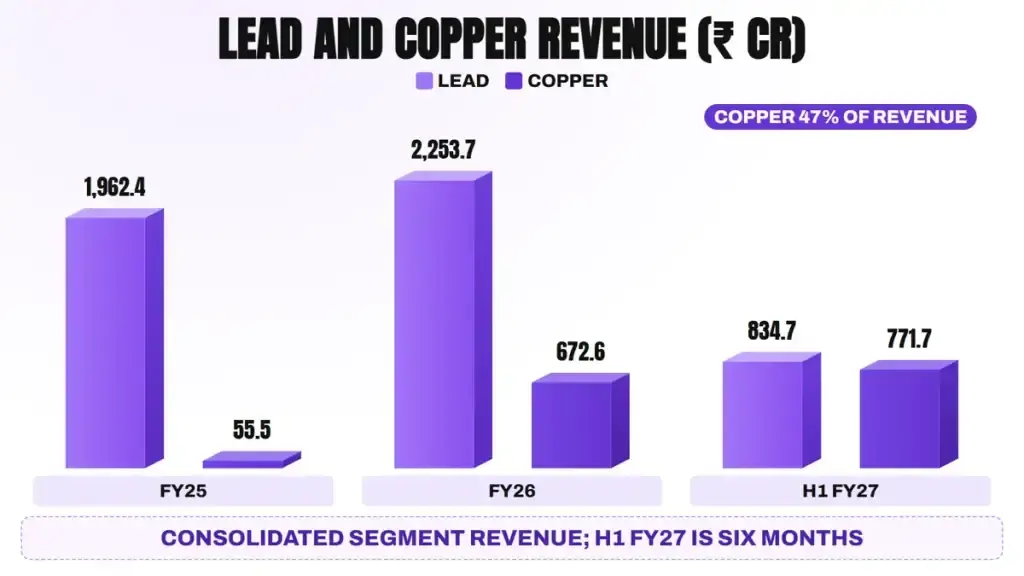
In FY25, copper brought a Chennai metal recycler ₹55.5 Cr of revenue. In FY26 it brought ₹672.6 Cr. In the first half of FY27, from April to September 2026, it brought ₹771.7 Cr, or 47% of everything the company sold.
Yet for about thirty years, this company has been known for a different metal: lead. You will find lead in cars, two-wheelers, home inverters and telecom towers, because all of them run on lead-acid batteries. A lead-acid battery is a heavy box of lead plates sitting in acid. When such a battery dies after a few years, the lead inside is still good, and it can be melted, cleaned and made into new lead again and again.
That is what this company does. It buys scrap, including old batteries, from more than 90 countries, melts and refines it, and sells the lead back to battery makers. Most of what it sells is not plain lead, though. A lead alloy is a mix of lead with small amounts of calcium, tin or antimony, made to a set recipe, and the company makes more than 100 of them. Such alloys are called value-added products, because they earn more per tonne than pure lead, and they made up 65% of the company's lead revenue in FY26.
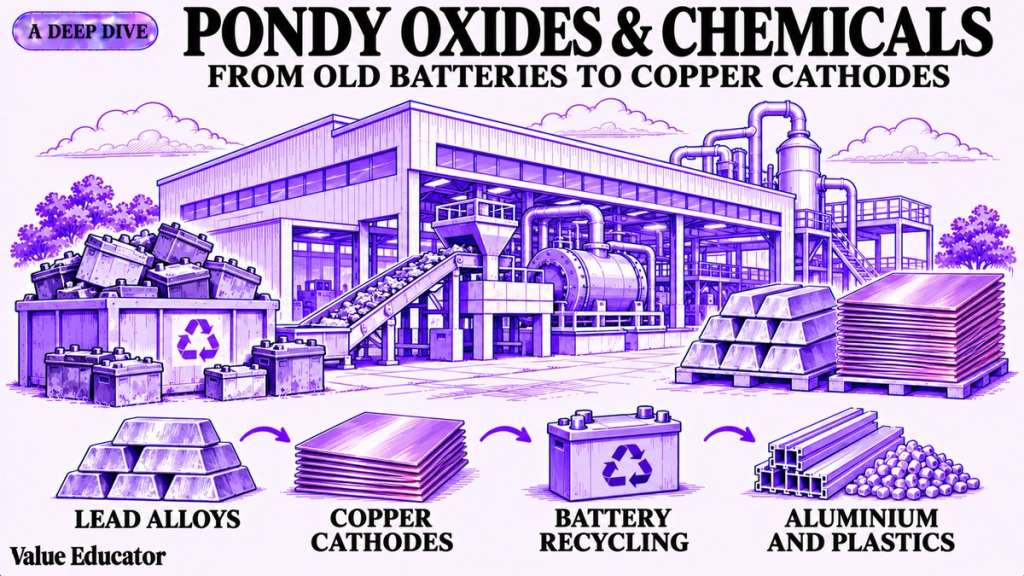
That recycler is Pondy Oxides and Chemicals Ltd (NSE: POCL). It runs four recycling lines, lead, copper, aluminium and plastics, from plants in Tamil Nadu and Andhra Pradesh, and it can make 2,04,000 tonnes of lead a year. In 2019 its lead became the first Indian 3N7 lead brand registered on the London Metal Exchange, or LME, which is the world's main exchange for industrial metals. A brand registered there can be delivered against LME contracts, and that tells buyers its purity is steady.
The same exchange sets the standard for the company's next product. A copper cathode is a plate of refined, high-purity copper, and LME Grade A cathode is the grade traded on the LME. The company is building a plant to make it.
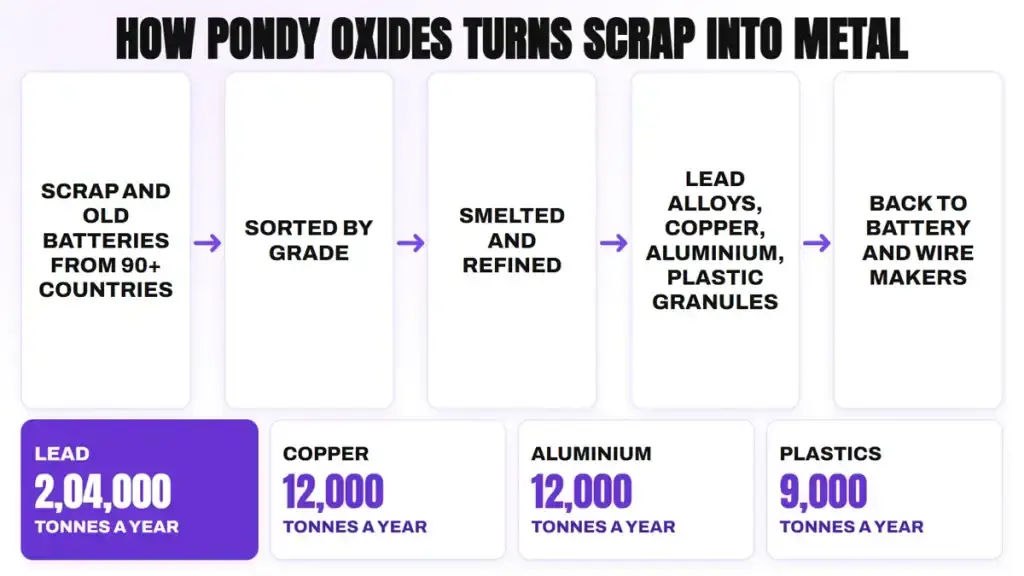
So where does Pondy Oxides fit in the battery world? It works at the end of a battery's life and at the start of the next one. It does not make batteries. It takes the metal out of old ones and sells it back to the people who do.
Pondy Oxides in five numbers
- H1 FY27 revenue of ₹1,638.7 Cr, up 33%
- Copper at 47% of H1 FY27 revenue, after ₹55.5 Cr in all of FY25
- Lead sales of 31,679 tonnes in H1 FY27, down 33.2%
- Operating cash flow of ₹297.2 Cr in H1 FY27, with borrowings down to ₹2.4 Cr
- A ₹200 Cr, 36,000-tonne copper cathode plant, its first half due by December 2026
So the company is growing on copper while its oldest business, lead, has had a hard year. Let's first understand the company, and then look at the latest quarter, where we can see both sides together.
Pondy Oxides and Chemicals: Company Overview
Pondy Oxides and Chemicals Ltd was set up in Tamil Nadu in 1995 and is based in Chennai. Ashish Bansal is its Chairman and Managing Director, and the promoter group held 36.39% of the company in September 2026. It recycles scrap into pure lead and lead alloys for battery makers, recycled copper for wire makers, aluminium alloys and plastic granules. It runs lead smelters in Tamil Nadu and Andhra Pradesh, including the automated Thervoy Kandigai plant, a copper unit in Andhra Pradesh, and aluminium and plastics plants in Tamil Nadu, with more than 500 employees. Its lead has been a registered 3N7 brand on the London Metal Exchange since 2019, and it listed on the NSE in 2023. Standalone revenue from operations was ₹2,938.7 Cr in FY26, and by September 2026 its borrowings were down to ₹2.4 Cr, with ₹108.1 Cr of cash. Read this BESS Stocks in India 2026: Battery Storage Value Chain
"Know what you own, and know why you own it."
— Peter Lynch
Pondy Oxides is no longer only a lead recycler. Knowing how much of its revenue and profit now comes from copper is the first step to reading its results.
The Quarter Lead Supply Ran Short
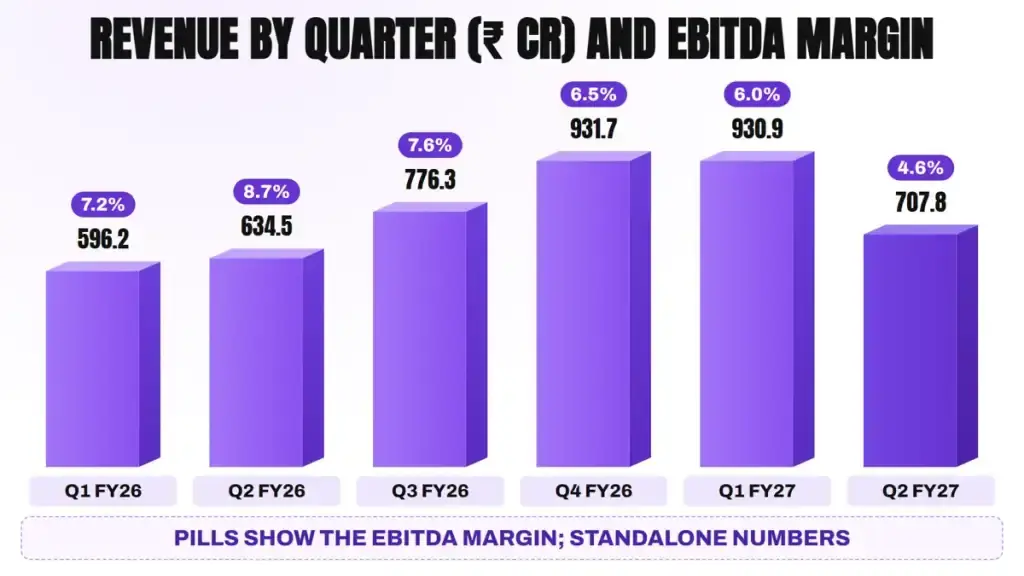
Now let's look at Q2 FY27, the July to September quarter that the company reported on 12 November 2026. In this quarter the supply of lead scrap ran short, and that shaped every number. Revenue from operations was ₹707.8 Cr, up 12% from ₹634.5 Cr a year ago, but 24% lower than the ₹930.9 Cr of Q1 FY27.
These are standalone numbers, which is how the company presents its business. Profit moved more sharply than revenue. EBITDA, the profit before interest, tax and depreciation, was ₹32.9 Cr, against ₹55.1 Cr a year ago, a fall of 40%. The EBITDA margin came down from 8.7% to 4.6%. Profit after tax was ₹20.1 Cr, against ₹35.6 Cr, a fall of 43%.

Now, the main reason for that fall was lead. The company sold 15,749 tonnes of lead in the quarter, against 24,878 tonnes a year ago. Management says geopolitical events in West Asia disrupted shipping routes in the first half of the year, which delayed raw material and made it harder to get.
That shortage matters more for this company than for most, as you can see from where its scrap comes from. About 84% of its lead scrap is imported, so a shipping problem quickly becomes a production problem.
"Risk comes from not knowing what you're doing."
— Warren Buffett
For a recycler, knowing what you are doing starts with knowing where the scrap comes from. The first half of FY27 showed how much of Pondy's lead volume depends on ships arriving on time.
The profit on each tonne of lead also came down. EBITDA per tonne is the profit before interest, tax and depreciation that the company earns on each tonne it sells, and it is the measure the company itself tracks. For lead it was ₹15,811 in Q2 FY27, against ₹19,970 a year ago and ₹21,595 in Q1 FY27.
So what pushed it down? We can see two things. The share of alloys went from about 85% of the lead segment in Q1 FY27 to about 60% to 65% in Q2 FY27, because customers asked for more pure lead. Power, fuel, freight and fluxes, the materials added during smelting, also cost more. So cost of goods sold rose 19%, faster than the 12% rise in revenue.
Against that, copper was the stronger part of the quarter. The company sold 2,039 tonnes of copper, more than double the 967 tonnes of Q2 FY26. But copper EBITDA per tonne came down to ₹36,979 from ₹48,488 in Q1 FY27. Management says the Q1 figure was a one-off, when a short squeeze in the market let it sell at higher prices, and that its range of ₹35,000 to ₹40,000 per tonne still holds.
Those copper volumes also move from quarter to quarter, because the process runs in several stages. In Q1 FY27 the company sold 4,001 tonnes, almost double the Q2 figure.

The First Half Was Better Than the Quarter
So what does the full first half tell us? The picture is mixed. Revenue was ₹1,638.7 Cr, up 33% from ₹1,230.7 Cr. EBITDA was ₹88.7 Cr, down 10%, and profit after tax was ₹56.4 Cr, down 11%. The EBITDA margin for the half was 5.4%, against 8.0% a year ago.
That half-year view also changes how lead looks. Lead EBITDA per tonne for the half was ₹18,617, a little above the ₹18,510 of H1 FY26 and in line with the ₹18,000 level management has guided for. So the change is mostly about volume, not the profit on each tonne. The company sold 31,679 tonnes of lead in the half, against 47,408 tonnes a year ago.
But copper went the other way. The company sold 6,040 tonnes, against 2,074 tonnes, and copper EBITDA per tonne rose 30% to ₹44,536. Exports made up 46% of revenue in the half, and within each metal, exports were 55% of lead sales and 39% of copper sales.
What the half year says: lead lost volume but kept its profit per tonne, at ₹18,617 against ₹18,510. Copper added volume and profit per tonne. So the lead problem in H1 FY27 was about getting scrap, not about selling metal.
Cash Came Back and Debt Went Away
Now we come to the strongest number of the half, which was cash. Operating cash flow came back to ₹297.2 Cr in H1 FY27, after a negative ₹53.9 Cr in all of FY26. Read this Cash Flow Statement Explained Trade receivables went from ₹263.0 Cr in March 2026 to ₹141.8 Cr in September, and inventory from ₹268.8 Cr to ₹211.3 Cr.
The company used that cash to repay ₹149.7 Cr of short-term loans. Borrowings came down from ₹152.1 Cr to ₹2.4 Cr, and it held ₹108.1 Cr of cash and ₹19.8 Cr of other bank balances.
Part of this cash came from lower activity. When a recycler buys and sells less metal, less money is tied up in stock and in customers' hands. Still, it leaves the company with no net debt as it builds a ₹200 Cr plant, and finance cost came down to ₹0.6 Cr in the quarter from ₹1.3 Cr a year ago.
How a Lead Smelter Became a Four-Metal Recycler
So how did this company reach a point where it can build a ₹200 Cr plant from its own cash? Let's go back to the start. Pondy Oxides was set up in Tamil Nadu in 1995, and in its first years it made lead chemicals such as litharge and red lead, and zinc oxide. In 2006 it opened its first lead smelter in Tamil Nadu, with room for 18,000 tonnes a year, and a second smelter followed in Andhra Pradesh in 2015.
Since then the company has grown in steps. In 2020 it bought Meloy Metals, which added 48,000 tonnes of capacity. In 2021 it started recycling copper, in 2022 plastics, and in 2023 aluminium, the same year it listed on the NSE.
Then in 2024 it bought 123 acres at Mundra in Gujarat and raised ₹307.5 Cr through a preferential issue and a qualified institutional placement, a share sale to large investors. In 2025 its new Thervoy Kandigai plant in Tamil Nadu took its lead capacity up by 72,000 tonnes, and by early 2026 copper capacity reached 12,000 tonnes a year.
Those steps show up in the lead volumes. The company sold 68,322 tonnes of lead in FY22 and 1,00,727 tonnes in FY26.


This table shows that FY26 was the best year so far. Revenue grew 45% and profit after tax more than doubled, from ₹65.1 Cr to ₹138.7 Cr. Lead volumes crossed 1,00,000 tonnes, and copper went from a small line to ₹672.6 Cr of revenue.
That growth did not lift the return on equity in every year. It came down in FY24, which the company puts down to new equity, and stayed at 11% in FY25, the year it raised ₹175 Cr through a qualified institutional placement.
You will also notice in this table that the margins are thin in every year. A recycler buys metal at close to the market price and sells it at close to the market price. It earns on the gap, which for lead is about ₹18,000 on a tonne that sells for about ₹2.6 lakh. That is why the company tracks profit per tonne and not the margin. Read this EBITDA Explained: Uses and Limits
Four Recycling Lines, but Two Carry the Business
Now let's look at the four recycling lines one by one. The company reports two segments, lead and copper, and these two carry the business. Read this Segment-Wise Revenue Analysis Explained Aluminium and plastics are too small to report on their own and sit together under "others".

These segment numbers are consolidated, so they include the company's subsidiaries.
Lead, the Battery Metal
Let's begin with lead, which is still the core. The company has three lead plants: 48,000 tonnes a year at its first smelter in Tamil Nadu, 84,000 tonnes in Andhra Pradesh, and 72,000 tonnes at Thervoy Kandigai. That last plant is fully automated, and it started in two phases from FY26. In H1 FY27, Thervoy Kandigai ran at 40% of its capacity, and management expects 70% in the coming quarters.
Its buyers are lead-acid battery makers, and more than half of its lead is exported. The company sells to customers in more than 20 countries, including Japan, South Korea, Thailand, Indonesia and the Netherlands. In FY26, its export revenue reached USD 200 million.
Those alloys matter for profit, and this is where we see why. Management says an alloy usually earns 0.75% to 1.25% more margin than pure lead, and some earn 1.5% to 1.75% more.
The alloys also lift the price per kg. The company's average lead price is about ₹260 per kg, higher than plain lead, because tin alloys carry costly tin, which sells at about $45,000 a tonne.
"Ability to make is fully functional, and we can make much more than this." - Ashish Bansal, Chairman and Managing Director, November 2026
Copper, the New Growth Line
Next comes copper, which is now almost half the business. The company started copper recycling in 2021 at its Andhra Pradesh plant. It added 6,000 tonnes of capacity in Q4 FY26, taking the total to 12,000 tonnes a year, and management says it ran the copper plant at full capacity in H1 FY27.
Almost all of that copper scrap, about 99%, is imported, and 39% of copper sales are exports. Its buyers are mostly copper wire makers.
Copper earns more per tonne than lead, but less per rupee. In H1 FY27, the lead segment earned a result of about 6.5% of its revenue and copper about 3.7%. Copper is far costlier than lead, so even ₹44,536 of EBITDA on a tonne is a small share of what that tonne sells for. That is why copper adds a lot of revenue and a smaller amount of profit.
The company also hedges all the copper it recycles, to protect itself from price moves between buying scrap and selling metal. Today it sells recycled copper in trade grades such as Clove, Cobra and Mill Berry. From the new plant, it plans to sell LME-grade cathodes, which earn more per tonne. We will come back to that plant in the section on FY27 and FY28.
Aluminium and Plastics, the Small Lines
Now we come to the two small lines, aluminium and plastics. The aluminium plant can make 12,000 tonnes of alloys a year, from imported scrap, mostly for automobile makers. The plastics plant makes 9,000 tonnes of recycled plastic granules a year, from scrap that is 92% domestic, for automobile, appliance, furniture, paint and battery makers.
Together these two plants brought in ₹37.0 Cr of revenue in H1 FY27, with a segment result of ₹2.3 Cr, after a loss of ₹2.4 Cr a year ago.
Another group company, POCL Future Tech Pvt Ltd, is being merged into the company. Its stated objects include recycling e-waste, electric vehicles and their parts, metals and plastics. The Chennai bench of the National Company Law Tribunal allowed the first step of the merger on 3 November 2026.
Where Pondy Fits in the Battery Value Chain
So where does a merger with an e-waste and EV recycling company fit in? To see where Pondy fits, let's follow one battery through the value chain. A battery maker buys lead and alloys and builds a battery. The battery goes into a car, a two-wheeler, an inverter or a telecom tower.
After a few years that battery dies, and a collector picks it up. A recycler like Pondy Oxides breaks it, takes the lead out and refines it, and the lead goes back to a battery maker.
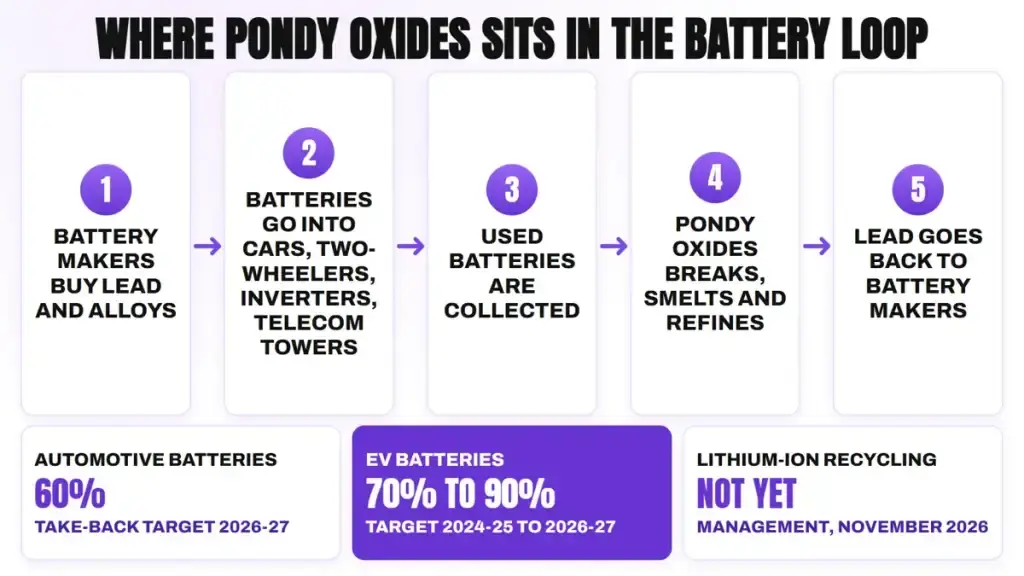
That loop is becoming more formal under India's Battery Waste Management Rules. Under these rules, a battery maker must make sure that a share of the batteries it sells is collected and recycled. It meets this target by buying Extended Producer Responsibility credits, or EPR credits, from approved recyclers.
Those targets are rising. For automotive batteries the target is 60% in 2026-27. For electric vehicle batteries it rises from 70% in 2024-25 to 80% in 2025-26 and 90% in 2026-27. The GST rules on metal scrap have also changed, so that more unregistered scrap sellers have to come into the tax net.
The same rules bring more competition for domestic scrap, because battery makers are starting to recycle their own batteries. Management said in July 2025 that one large battery maker that earlier gave its scrap batteries to recycling partners would now recycle them in its own plant.
That domestic scrap is not cheap either. The company still buys most of its scrap abroad, and management says domestic scrap is slightly costlier than imported scrap.
The Lithium-ion Question
Now we come to the question every EV investor will ask. An electric car or scooter runs on a lithium-ion battery, not a lead-acid one. So will Pondy Oxides recycle lithium-ion batteries too?
That answer has moved over the past year. In October 2025, management said it was looking at entering lithium-ion recycling on a commercial scale from around 2027. In September 2025 it had bought a small stake in ACE Green Recycling, a US company doing research on recycling all kinds of lithium-ion batteries, for $5,00,007.60.
By August 2026, management said it was still studying the business with technical partners. It added that in India mostly the LFP type of lithium-ion battery is available, where the metal that can be recovered is only about 1.5% to 2% and the rest, iron phosphate, has little value.
Then in November 2026, the answer was clearer. Management said the company is not looking at lithium-ion recycling yet, because it does not see the feasibility, the volumes do not justify it, and newer chemistries such as sodium-ion batteries may change the market over the next four or five years.
That stance is not a closed door. The company's letter to shareholders for FY26 puts it this way.
"The opportunity is real; we will be ready when the time is right." - Ashish Bansal, Chairman and Managing Director, 2026
There is also a second battery question for us: whether lead-acid batteries lose ground to lithium-ion in uses like telecom backup. Management says this shift has happened at only one company in India so far, and that its battery customers abroad do not expect such a shift in the coming year.
Beyond batteries, copper ties the company to a different part of the energy chain. Management says copper is always connected to the power and energy storage sectors, and that the company is working on a couple of niche copper products for such uses, with higher margins than plain cathode. It has not named them yet.
Why Pondy's Moat Is Hard to Copy
So what lets a recycler keep its thin gap on each tonne? For Pondy Oxides, the moat comes from buying, approvals and recipes, and each one has a limit.


Of these, the approvals are the hardest part to copy.
"In business, I look for economic castles protected by unbreachable moats."
— Warren Buffett
Pondy's moat is narrower than a castle wall: approvals, alloy recipes and a buying network. The test is whether they keep battery makers buying when scrap is short. Management says many of its rivals deliver large volumes into LME warehouses because they do not sell directly to battery makers or are not approved by them, which is not the case for Pondy.
The harder part is the raw material. The company's buying network did not protect it from the shipping problems of 2026. Its answer has been to sign exclusive deals with large scrap yards, which for copper collect on its behalf, to buy from new regions such as South America and Southeast Asia, and to buy more scrap at home.
That choice also keeps costs down. The company has decided not to set up its own yards abroad, which management says would raise costs.
Financials: Thin Margins, Rising Profit and Uneven Cash Flow
One quarter can mislead in a business that lives on the gap between scrap and metal prices, so let's look at the full years together. These are standalone numbers, the basis on which the company presents its business; the first half of FY27 is shown for comparison.

Revenue roughly doubled in four years, from ₹1,454.8 Cr in FY22 to ₹2,938.7 Cr in FY26, and profit after tax grew about 2.9 times, from ₹48.2 Cr to ₹138.7 Cr. The EBITDA margin stayed between 5.1% and 5.6% for four years and rose to 7.4% in FY26, the year lead volumes crossed 1,00,000 tonnes and copper reached ₹672.6 Cr of revenue.
Cash flow has been more uneven than profit. From FY22 to FY26, operating cash flow added up to about ₹59.2 Cr, against about ₹340.7 Cr of profit after tax, or about 17%. It was negative in FY25 and FY26, when receivables and stock grew with the business, and it turned to ₹297.2 Cr in the first half of FY27 as receivables and inventory came down.
The balance sheet now carries almost no debt. Borrowings fell from ₹152.1 Cr in March 2026 to ₹2.4 Cr in September, and net worth stood at ₹811.1 Cr. The test from here is whether cash stays positive once lead volumes and copper cathode sales build up again.
"Beware of little expenses; a small leak will sink a great ship."
— Benjamin Franklin
On an EBITDA margin of 4.6% to 7.4%, a few thousand rupees of extra freight or fuel on each tonne is the small leak. That is why Pondy's profit per tonne matters more than its revenue.
What FY27 and FY28 Could Look Like on Management's Numbers
So what does management expect from here? Its plan for FY27 and FY28 has two parts: bring lead volumes back, and add copper cathodes.

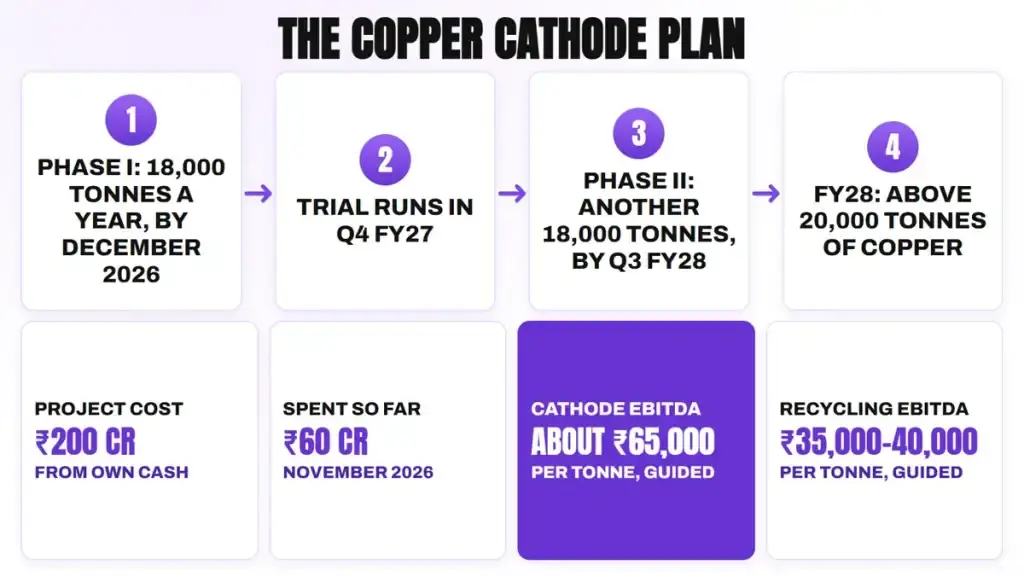
That cathode plant is the largest project the company has taken on. It is coming up at Thervoy Kandigai and will cost about ₹200 Cr, paid from the company's own cash. About ₹60 Cr had been spent by November 2026.
That means the rest of the spend comes quickly. Management says Phase I will need about ₹140 Cr in all, spent over the next two to three months, and Phase II the remaining ₹60 Cr in FY28. Equipment installation was due to start in the first week of December 2026.
This plant will use two steps, pyro-refining and electro-refining, to turn copper scrap into LME Grade A cathode. Phase I needs about 19,000 to 20,000 tonnes of scrap a year. About 6,000 tonnes will come from the company's own copper recycling, which is 60% to 70% of what that unit makes, and about 13,000 to 13,500 tonnes will be bought, mostly from abroad. Management says it has already tied up more scrap than the plant needs.
Now let's do the arithmetic on management's own numbers, which is not a forecast. If the company sells 16,000 tonnes of cathode at about ₹65,000 of EBITDA a tonne, that is about ₹104 Cr of EBITDA a year. If it sells 1,00,000 tonnes of lead at ₹18,000 a tonne, that is about ₹180 Cr.
Together those two would be more than the ₹218.1 Cr of EBITDA the company made in all of FY26. Both numbers depend on scrap supply and costs, which the first half of FY27 has shown can change quickly.
Beyond FY28, the company has a Target 2030: more than 15% volume growth a year, more than 20% growth a year in revenue and profit, an EBITDA margin above 8%, a return on capital above 20%, and more than 60% of revenue from value-added products. Management says these targets remain in place. For the second half of FY27, the company plans ₹164 Cr of capex, after ₹16 Cr in the first half.
Guidance Against Delivery
So how has the company's guidance compared with its delivery? Here is the record we could match against the filings.
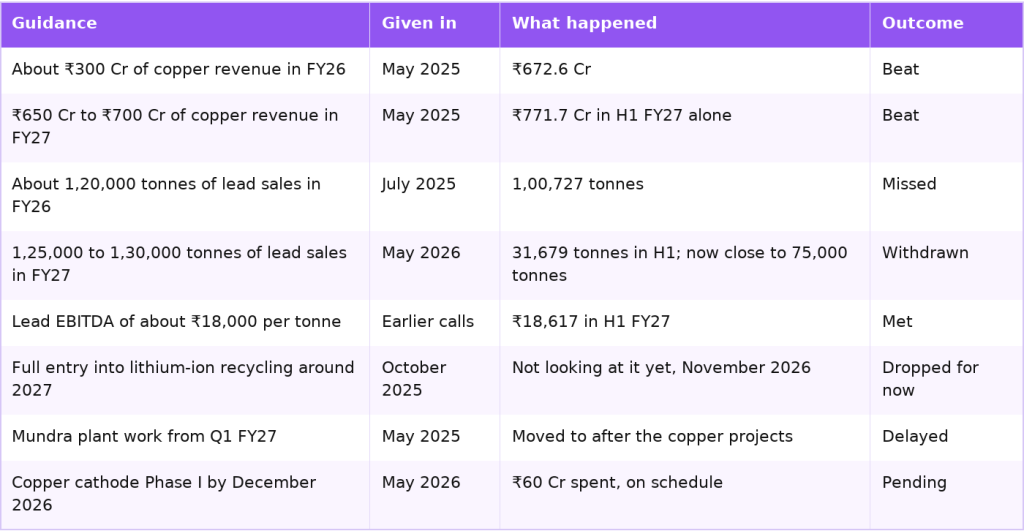
That record shows a clear pattern. Copper has beaten every target set for it, and by a wide margin. Lead volumes have fallen short two years running, first by about 16% in FY26 and then by much more in FY27. New ventures, Mundra and lithium-ion, have been pushed back. The cathode plant is the next test of whether a stated date is met.
Key Risks
Now let's look at what could go wrong for Pondy Oxides, because the first half of FY27 has already shown several of these risks.
- Scrap supply and shipping: about 84% of lead scrap is imported. Shipping disruptions cut lead sales by 33.2% in H1 FY27, and management withdrew its FY27 lead guidance. Management's plan for FY28 assumes the current difficulties continue, but a new disruption would hit volumes again.
- Passing on costs: the company is renegotiating contracts with buyers, which typically start in January and February, to pass on higher freight, fuel and flux costs. If buyers do not accept them, lead EBITDA per tonne could stay near the ₹15,811 of Q2 FY27.
- Thin margins: the EBITDA margin was 4.6% in Q2 FY27. A small change in the price gap between scrap and metal moves profit sharply.
- Customer concentration: three customers made up about 58% of FY26 revenue. Losing one would change the numbers quickly.
- A new plant on a new process: the cathode plant is the company's first electro-refining plant. A delay or a slow start would push back the copper plan, and about ₹140 Cr will be spent on Phase I in a short time.
- Competition for scrap and for copper: battery makers now recycle their own batteries, and other recyclers are also adding copper capacity. More buyers for the same scrap could raise its price.
- The battery shift: if lithium-ion replaces lead-acid in more uses, lead demand would slow. The company has stepped back from lithium-ion recycling for now, so it would not gain from that shift soon.
- Cash flow in a growth year: operating cash flow was negative in FY25 and FY26 as receivables and stock grew. The strong H1 FY27 cash flow came partly from lower volumes, and it could reverse when volumes return.
- Promoter holding: the promoter group held 36.39% in September 2026, against 39.34% a year earlier, after a promoter sold 2.95% of the company in June 2026.
"Definitely, that guidance does not hold intact for this financial year." - Ashish Bansal, Chairman and Managing Director, November 2026
"The essence of investment management is the management of risks, not the management of returns."
— Benjamin Graham
No one can say when shipping routes will settle or what buyers will pay for alloys next year. What an investor can do is watch lead volumes, profit per tonne and the cathode start-up each quarter, which is what the list below sets out.
Explore our Products
Research Framework

Emerging Titans
Combination of quantitative analysis, industry tailwinds, and management assessment - SPRINT investment philosophy

Tiny Titans
Heavy emphasis on scuttlebutt research, plant visits, and early on-ground signals
What to Track Next
If you follow Pondy Oxides, these are the signals that will show where it goes next.
- Lead sales each quarter against the 25,000-tonne run rate planned for FY28
- Lead EBITDA per tonne returning to ₹18,000 to ₹20,000 from Q4 FY27, and the share of value-added products
- Copper cathode Phase I: commissioning by December 2026, trial runs in Q4 FY27, and the first cathode EBITDA per tonne
- Copper recycling EBITDA per tonne against the ₹35,000 to ₹40,000 range
- New contracts from January and February, and whether they pass on higher costs
- Operating cash flow and borrowings as lead volumes return
- Any decision on lithium-ion recycling or on the Mundra land
For the other listed EV suppliers, from battery materials to car parts, see EV Stocks in India 2026: Battery Materials to Car Parts.
Conclusion
Let's put it all together. Pondy Oxides has grown from ₹1,454.8 Cr of revenue in FY22 to ₹2,938.7 Cr in FY26, and its profit after tax rose from ₹48.2 Cr to ₹138.7 Cr. Lead built the company, and copper is now about half of it, at 47% of H1 FY27 revenue.
Still, the first half of FY27 tested the lead business hard. Shipping problems cut lead sales by a third, and the profit on each tonne came down in the latest quarter. At the same time, the company paid down nearly all its debt and kept building its copper cathode plant from its own cash. The cautious thread is that lead volumes depend on imported scrap and on buyers accepting higher prices, and the cathode plant is the first of its kind for the company. The next two quarters, with new contracts from January and Phase I trial runs, will show which thread is stronger.
What happens next depends on whether lead volumes come back to 25,000 tonnes a quarter, whether buyers accept higher prices for its alloys, and whether the cathode plant starts on time and earns close to ₹65,000 a tonne.
FAQs
What does Pondy Oxides and Chemicals do?
+Pondy Oxides buys scrap, including old lead-acid batteries, from more than 90 countries and recycles it into pure lead and lead alloys for battery makers. It also recycles copper, aluminium and plastics. It can make 2,04,000 tonnes of lead a year, and its FY26 revenue was ₹2,938.7 Cr.
How did Pondy Oxides do in Q2 FY27?
+Revenue from operations rose 12% to ₹707.8 Cr, but EBITDA fell 40% to ₹32.9 Cr and profit after tax fell 43% to ₹20.1 Cr. Lead sales were 15,749 tonnes against 24,878 tonnes a year ago, because shipping disruptions in West Asia made scrap harder to get.
How big is copper for Pondy Oxides now?
+Copper brought ₹55.5 Cr of revenue in FY25, ₹672.6 Cr in FY26 and ₹771.7 Cr in H1 FY27, or 47% of revenue in the half. Management expects copper to be about 45% of FY27 revenue.
What is the copper cathode plant?
+Pondy Oxides is building a 36,000-tonne copper cathode plant at Thervoy Kandigai in Tamil Nadu for about ₹200 Cr from its own cash. Phase I of 18,000 tonnes is due by December 2026, with trial runs in Q4 FY27, and Phase II by Q3 FY28. Management guides about ₹65,000 of EBITDA per tonne of cathode.
Does Pondy Oxides recycle lithium-ion batteries?
+No. In October 2025 management spoke of entering lithium-ion recycling from around 2027, but in November 2026 it said it is not looking at it yet, because the volumes do not justify it. The company holds a small stake in ACE Green Recycling, a US company researching lithium-ion recycling.
What are the main risks for Pondy Oxides?
+About 84% of its lead scrap is imported, so shipping problems hit volumes, as in H1 FY27 when lead sales fell 33.2%. Margins are thin, at 4.6% EBITDA in Q2 FY27, three customers made up about 58% of FY26 revenue, and the cathode plant is a new process for the company.

High growth stock specialist, Value Educator
Shashank Mahajan is an equity research professional with over 12 years of experience in identifying high-potential SME and micro-cap stocks at an early stage. He follows a rigorous scuttlebutt research–driven approach, combining on-ground insights with deep financial analysis. Shashank specializes in uncovering under-researched and under-owned companies with strong management quality and long-term growth potential. Through disciplined research and early identification, he focuses on spotting tomorrow’s market leaders before they enter the mainstream investor radar.
More about Shashank Mahajan →
PCBL Chemical: Carbon Black Margins and Battery Materials

KEC International: Record Orders, Weak Margin, High Debt

Sona BLW: EV Revenue Now Tops Half of Its Auto Sales

HPL Electric & Power: Smart Meters, Wires and Two Engines

Kaynes Technology: EMS, Chip Plants and ₹10,563.5 Cr Orders

Sterlite Technologies: Glass Rods to Hyperscaler Deals
Explore our Products
Research Framework
Emerging Titans
Combination of quantitative analysis, industry tailwinds, and management assessment - SPRINT investment philosophy
Tiny Titans
Heavy emphasis on scuttlebutt research, plant visits, and early on-ground signals



India's Aerospace Opportunity
Global Demand. Supply Bottlenecks. Opportunities Ahead.
Don't Miss This Exclusive Webinar!
Join Value Educator to decode the key trends shaping India's aerospace sector and learn how to identify tomorrow's potential leaders in the space.
- How the aircraft value chain works, layer by layer
- Indian companies supplying global aircraft makers
- A framework to judge any aerospace company

 Orders
 Subscription
 Share with friends


Required Details
₹23999.00
(12 month subscription)
As per SEBI regulations, all users are mandated to complete the KYC that is validated for 1 year. Post payment, you will be redirected to the KYC screen


No comments yet. Be the first to comment!