
Subros vs Lumax Auto vs Sona BLW: EV Auto Parts Compared
Subros, Lumax Auto Technologies and Sona BLW Precision Forgings (Sona Comstar) are three listed Indian auto parts makers that often appear on lists of auto ancillary stocks for electric vehicles. Each one sells to carmakers today, and each one says the shift to electric cars will raise what it can sell per vehicle. But they make very different parts, and they are at very different points on the road to electric.
All three grew revenue by about 35% in the quarter to 30 September 2026. Behind that shared number, Sona already earns 51% of its automotive product revenue from battery electric vehicles, Lumax has 9% of its order book tied to electric vehicles, and Subros says its first electric programme is still at "very negligible numbers". That is why investors searching "Subros vs Sona BLW" need a side-by-side view. This page compares the three on business, EV exposure, growth, margins, order books, debt and cash flow, using the same period for each in every row.
Figures as of 20 November 2026. This page is research, not a recommendation to buy or sell any stock.
Subros vs Lumax Auto vs Sona BLW at a Glance
| Measure | Subros | Lumax Auto Technologies | Sona BLW (Sona Comstar) |
|---|---|---|---|
| Business | Car, bus and truck air-conditioning systems and compressors | Plastic interiors, gear shifters, frames, electronics and CNG parts | Driveline gears, differentials, starter and traction motors, controllers |
| Plants | 9 locations in India | 29 plants in 7 states | 12 manufacturing plants; sites in India, the USA, Mexico, China and Serbia |
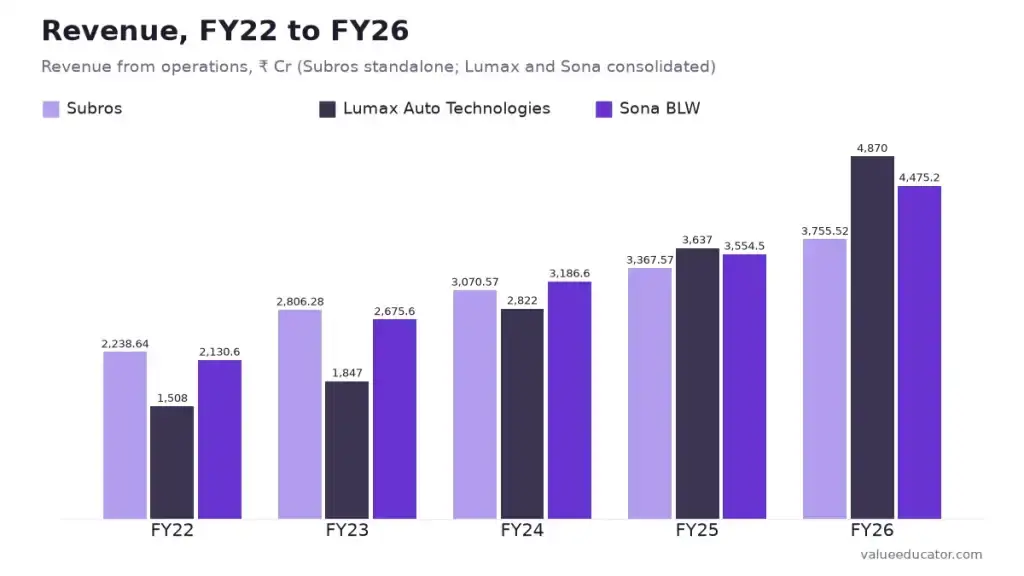
| Revenue, FY26 | ₹3,755.52 Cr | ₹4,870 Cr | ₹4,475.2 Cr |
| EBITDA margin, FY26 | 9.70% | 14.5% | 24.7% |
| Profit after tax, FY26 | ₹165.78 Cr | ₹337 Cr (before minority interest) | ₹640.2 Cr |
| ROCE, FY25 (as each company reports it) | Not disclosed | 18% | 18.4% |
| Net debt or net cash, 30 Sep 2026 | Net cash about ₹2.7 Cr | Net debt ₹41 Cr | Net cash ₹1,496.1 Cr |
| Order book, 30 Sep 2026 | Not disclosed; two 2026 awards worth ₹2,505 Cr | ₹1,879 Cr, mostly executed by FY29 | ₹25,100 Cr, counted over ten years |
| EV share of revenue | Not disclosed; EV ramp-up "very negligible" in Q2 FY27 | Not disclosed | 51% of automotive product revenue, Q2 FY27 |
| EV share of order book, 30 Sep 2026 | Not disclosed | 9% (₹166 Cr) | 61% (₹15,200 Cr) |
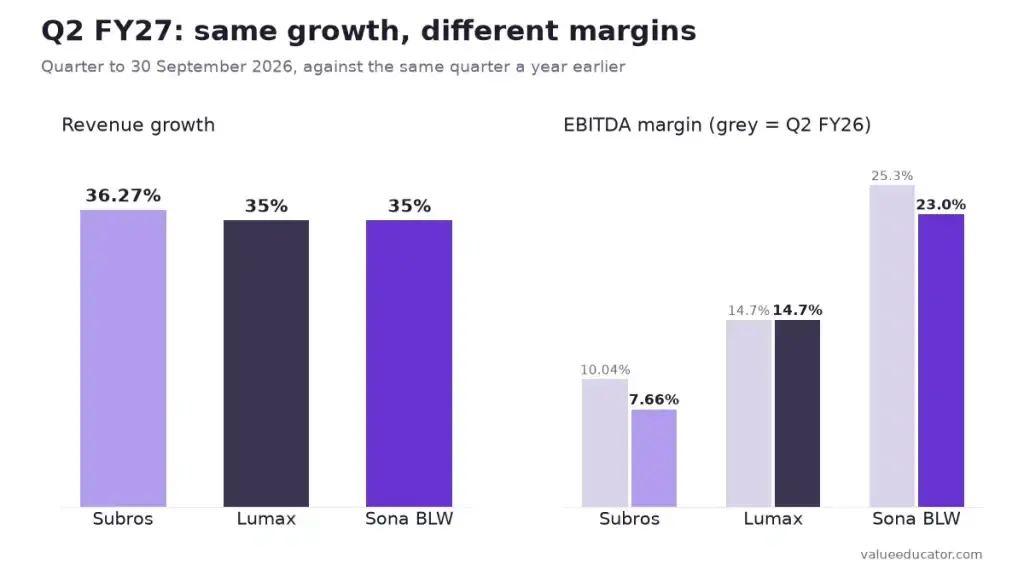
| Revenue growth, Q2 FY27 | 36.27% | 35% | 35% |
| Customers | Maruti Suzuki about 84% of FY25 revenue | Mahindra 30%, Bajaj 16%, Maruti 10% of H1 FY27 revenue | 7 of the world's top 10 car makers; top-customer share not disclosed |
| Key risk | One customer, thin margin, EV revenue only from November 2027 | Input costs and a long road from order book to EV revenue | China's rare earth curbs, and US and EV demand cycles |
The table shows three different shapes. Sona has the highest margin, the most cash and by far the deepest EV exposure. Lumax has the largest revenue and the most even mix of products, but little EV work yet. Subros has the smallest revenue and thinnest margin, and its EV story is mostly still ahead of it.
Business Models: Which Part of the Car Each One Makes
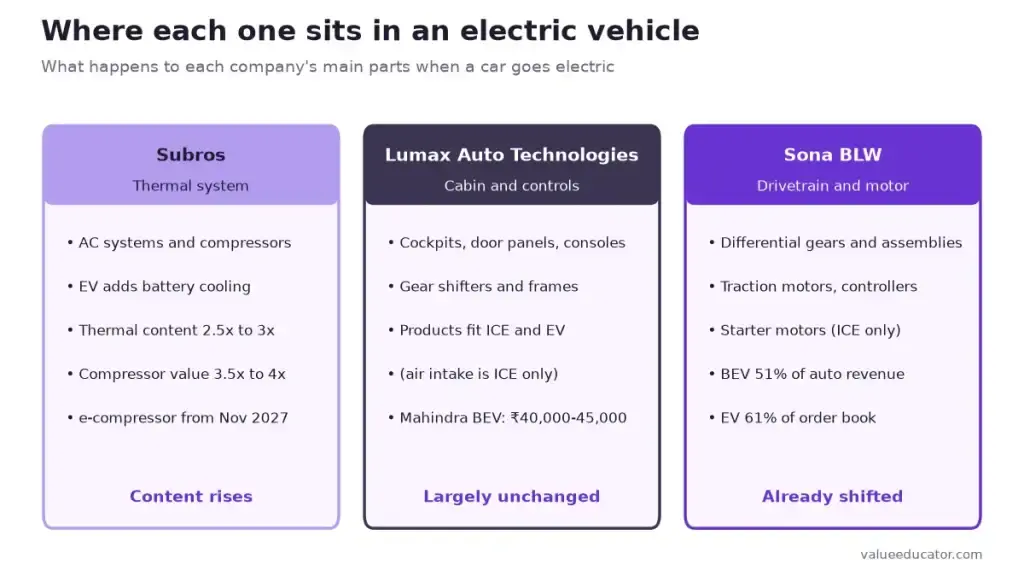
The three companies sit in different parts of the car. That matters for EVs, because an electric car drops some parts, keeps others and adds new ones.
Subros: the car's cooling system
Subros was established in 1985 as a joint venture of the Suri family with Denso and Suzuki Motor. Denso owns 20% and Suzuki 11.96%. It makes complete air-conditioning systems, compressors, heat exchangers and hoses for cars, buses, trucks, tractors, railways and home ACs, and reports them all as one thermal products segment.
In Q2 FY27, cars gave about ₹1,050 Cr of revenue, or close to 88% of the total. Maruti Suzuki took about 84% of FY25 revenue. The company says an EV needs 2.5 to 3 times the thermal content of a petrol or diesel car, and 3.5 to 4 times the compressor value, because the battery and the cabin both need cooling. That is the core of its EV case.
Lumax Auto Technologies: interiors, shifters and electronics
Lumax Auto Technologies belongs to the Lumax-DK Jain group (the lighting company Lumax Industries is a separate listed firm). It runs five product lines from 29 plants: advanced plastics (cockpits, door panels and consoles), structures and control systems (frames and gear shifters), mechatronics (electronics), alternate fuels (CNG parts) and aftermarket. In Q2 FY27, advanced plastics gave ₹886 Cr, structures and control systems ₹258 Cr, alternate fuels ₹109 Cr, mechatronics ₹93 Cr and aftermarket ₹131 Cr.
Most of what Lumax makes is not tied to the engine. The company says all its products for carmakers serve both ICE and EV platforms, except air-intake systems. It has eight partnerships with firms in Japan, Italy, Spain, Israel and India, and its content per passenger vehicle is ₹70,000 to ₹75,000.
Sona BLW: the drivetrain and the motor
Sona Comstar was founded in 1995 and is based in Gurugram. It makes differential gears and assemblies, which pass power to the wheels in every car, plus starter motors for petrol cars and traction motors and controllers for electric two- and three-wheelers. It also has a railway business (brakes, couplers, suspension) and a small robotics business.
Sona sells worldwide. It supplies 7 of the world's top 10 passenger car makers and 3 of the top 10 EV makers. In FY26, about 56% of its revenue came from India, up from about 39% in FY25, and the other 44% came from abroad.
EV Exposure: What Each Company Discloses
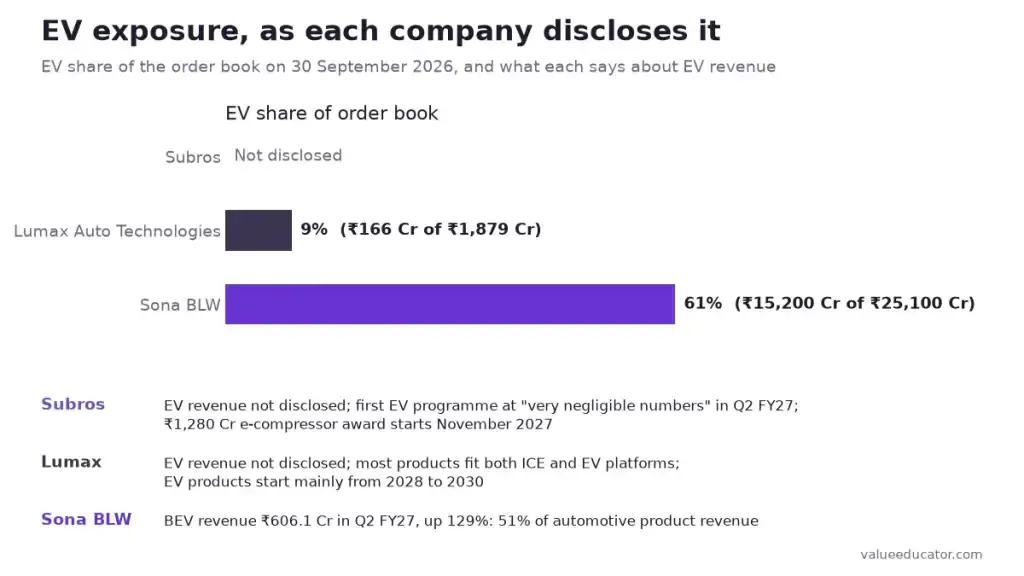
This is the measure that separates the three most, and it is also where each company reports differently. The fairest comparison uses only what each one discloses, and marks the rest as not disclosed.
Sona BLW: half of auto revenue already electric
Sona reports its battery electric vehicle (BEV) revenue every quarter. In Q2 FY27, BEV revenue was ₹606.1 Cr, up 129% from ₹264.7 Cr a year earlier, and 51% of automotive product revenue. For H1 FY27 the share was 48%. The share was 25% in FY22, 26% in FY23, 29% in FY24, 36% in FY25 and 35% in FY26, when BEV revenue fell 6%.
Its order book is even more electric. Of ₹25,100 Cr on 30 September 2026, automotive EV programmes were ₹15,200 Cr (61%, across 44 programmes) and non-EV automotive programmes ₹7,700 Cr (31%). The rest was railways and robotics. In Q2 FY27 alone it added ₹3,600 Cr of new orders, including a ₹700 Cr limited-slip differential for a global EV maker and ₹1,250 Cr of extra traction motor volumes for an Indian two-wheeler maker.
Lumax: an order book still mostly ICE
Lumax does not report an EV share of revenue. It does split its order book of ₹1,879 Cr by powertrain: ICE ₹1,334 Cr (71%), CNG ₹379 Cr (20%) and EV ₹166 Cr (9%). The company aims to raise revenue from what it calls future and clean mobility from 6% in FY25 to 20% by FY31.
There is a nuance. Because most Lumax parts fit any powertrain, a cockpit or door panel for an electric SUV may sit in its revenue without being counted as "EV-only". For Mahindra's BEV models, its content can reach ₹40,000 to ₹45,000 per vehicle. It says its EV product basket of 3 to 5 products should see production starts mainly from 2028 to 2030.
Subros: the EV compressor arrives in 2027
Subros does not report an EV share of revenue either. In Q1 FY27, it said thermal systems for hybrid, electric and CNG vehicles were about 25% of revenue, but that figure mixes three fuel types. In Q2 FY27, it said its first EV programme was still at "very negligible numbers".
Its big EV step is the electric compressor. In January 2026 it won an award worth about ₹1,280 Cr over seven years to supply e-compressors for electric and hybrid cars, with the first start of production in November 2027. It is building capacity for 400,000 e-compressors a year at an investment of about ₹175 Cr, with technology help from Denso and Toyota Industries. At peak, the company expects about ₹250 Cr of revenue a year from this line, close to 7% of FY26 revenue.
Latest Quarter: Q2 FY27 Side by Side
All three report the quarter to 30 September 2026. Subros announced on 3 November 2026, Lumax on 24 October 2026 and Sona on 26 October 2026.
| Q2 FY27 (vs Q2 FY26) | Subros | Lumax Auto Technologies | Sona BLW |
|---|---|---|---|
| Revenue | ₹1,198.90 Cr (₹879.83 Cr) | ₹1,555.5 Cr (₹1,156.4 Cr) | ₹1,546.4 Cr (₹1,143.5 Cr) |
| Revenue growth | 36.27% | 35% | 35% |
| EBITDA | ₹91.47 Cr (₹87.98 Cr) | ₹228.2 Cr (₹170.1 Cr) | ₹356.2 Cr (₹289.1 Cr) |
| EBITDA margin | 7.66% (10.04%) | 14.7% (14.7%) | 23.0% (25.3%) |
| Profit after tax | ₹44.62 Cr (₹40.59 Cr) | ₹116.7 Cr (₹77.6 Cr) | ₹223.4 Cr (₹172.8 Cr) |
| Profit growth | 9.93% | 50% | 29% |
| PAT margin | 3.7% | 7.5% | 14.4% |
The growth is almost identical, but what reached the bottom line is not. Lumax held its margin and grew profit faster than revenue. Sona's margin fell by 2.3 points on product mix and higher input prices, yet profit still rose 29%. Subros's margin fell by about 2.4 points, so EBITDA rose only 3.96% on 36.27% more revenue.
Subros named the reasons: gas and import freight costs up 200% to 300%, with cost recovery from customers coming a quarter or more later, and plants running almost at full capacity. Lumax said cost pass-through could dilute its margin by 30 to 40 basis points. Sona said the same lag applies to its pass-through clauses. Margins are measured a little differently, so read the table with care: Lumax includes other income in EBITDA, and Sona's revenue includes a small foreign exchange gain. Our guide to EBITDA and its limits explains why such definitions matter.
Five-Year Financials: FY22 to FY26
The tables use each company's own reported figures for the same five years. Subros is standalone; Lumax and Sona are consolidated.
| Revenue (₹ Cr) | FY22 | FY23 | FY24 | FY25 | FY26 |
|---|---|---|---|---|---|
| Subros | 2,238.64 | 2,806.28 | 3,070.57 | 3,367.57 | 3,755.52 |
| Lumax Auto Technologies | 1,508 | 1,847 | 2,822 | 3,637 | 4,870 |
| Sona BLW | 2,130.6 | 2,675.6 | 3,186.6 | 3,554.5 | 4,475.2 |
| EBITDA margin / PAT (₹ Cr) | FY22 | FY23 | FY24 | FY25 | FY26 |
|---|---|---|---|---|---|
| Subros margin | 7.10% | 6.72% | 8.78% | 10.22% | 9.70% |
| Subros PAT | 32.59 | 48.08 | 97.66 | 150.39 | 165.78 |
| Lumax margin | 10.8% | 12.1% | 14.6% | 14.2% | 14.5% |
| Lumax PAT (before minority interest) | 82 | 111 | 167 | 229 | 337 |
| Sona margin | 26.2% | 26.0% | 28.3% | 27.4% | 24.7% |
| Sona PAT | 361.5 | 395.3 | 517.3 | 601.2 | 640.2 |
Lumax grew fastest over the five years, with revenue up 3.2 times from FY22 to FY26, helped by buying the cockpit maker IAC India and the CNG parts maker Greenfuel. Sona's revenue rose 2.1 times, with a dip in growth in FY25 and a jump of about 26% in FY26. Subros's revenue rose 1.7 times, but its profit rose from ₹32.59 Cr to ₹165.78 Cr as its margin recovered from the FY23 low.
Sona has kept the highest margin throughout, but it is also the one whose margin has fallen the most from its peak, from 28.3% in FY24 to 24.7% in FY26. The company says it still sees 23% to 25% as a fair range. Lumax's margin has stayed near 14% to 15% for three years, and Subros's has stayed under 11%.
Order Books and Growth Plans
Order books are the hardest measure to compare here, because each company defines its own, and Subros does not publish one at all.
Sona: a ten-year view of awarded programmes
Sona's net order book of ₹25,100 Cr is the total revenue expected over the next 10 years from awarded programmes not yet at full production, after removing programmes that will end, with a discount for delays. It equals 5.6 times FY26 revenue. That long horizon makes it larger than a typical one- to three-year order book, so it should not be set against Lumax's figure as if they were the same thing. The company says its own aspiration implies a 25% revenue growth rate.
Lumax: a three-year execution plan
Lumax's ₹1,879 Cr order book on 30 September 2026 was up from ₹1,600 Cr three months earlier, and 85% of it is new business. It plans to execute ₹258 Cr in FY27, ₹1,117 Cr in FY28 and ₹504 Cr in FY29, which gives a clearer near-term view than a ten-year total. On the same basis it is about 0.4 times FY26 revenue. Lumax expects FY27 revenue growth of 20% to 25%, close to ₹6,000 Cr, and repeats its target of about ₹1,000 Cr of EBITDA in FY28. A new ₹150 Cr mechatronics plant at Manesar is to start in Q3 FY28.
Subros: two large awards, no total
Subros reports individual awards rather than a total order book. Besides the ₹1,280 Cr e-compressor award, it won an HVAC award worth about ₹1,225 Cr in October 2026, with production from FY29. Together the two come to ₹2,505 Cr over several years. Its new Kharkhoda plant, an investment of about ₹150 Cr built to serve Maruti's new site, started commercial supply in October 2026. Management expects margins in the "high single digit" range for now.
Balance Sheet and Cash Flow
| 30 Sep 2026 / H1 FY27 | Subros | Lumax Auto Technologies | Sona BLW |
|---|---|---|---|
| Borrowings | ₹98.96 Cr (₹29.81 Cr in March 2026) | Long-term debt ₹442 Cr, debt-to-equity 0.26 | ₹469.4 Cr |
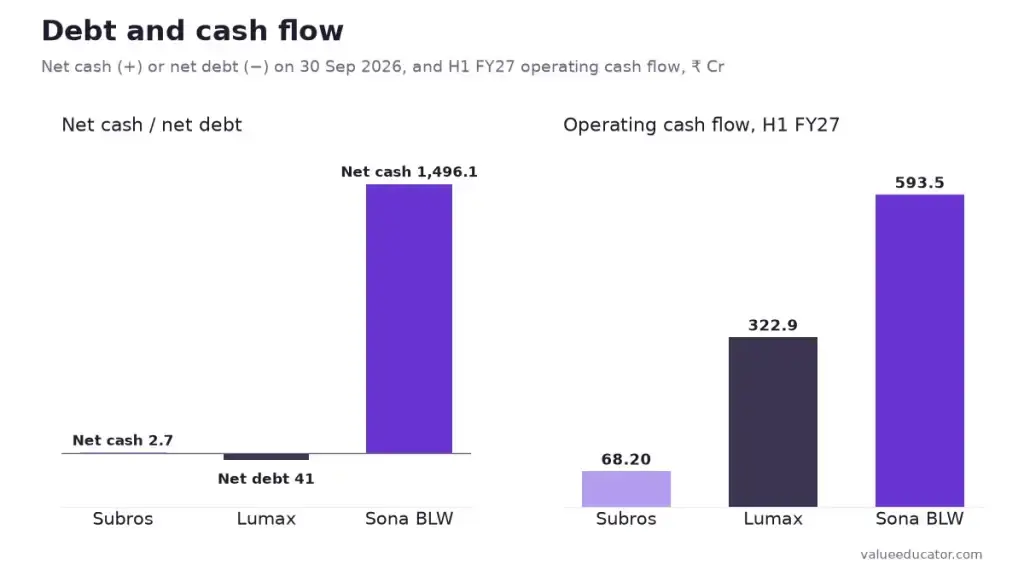
| Net debt or net cash | Net cash about ₹2.7 Cr | Net debt ₹41 Cr | Net cash ₹1,496.1 Cr |
| Operating cash flow, H1 FY27 | ₹68.20 Cr | ₹322.9 Cr | ₹593.5 Cr |
| Operating cash flow, FY26 | ₹105.32 Cr | ₹460.2 Cr | ₹659.1 Cr |
Sona has the strongest balance sheet. Its cash, deposits and mutual funds were ₹1,965.5 Cr on 30 September 2026, far more than its borrowings, and it produced ₹445.6 Cr of free cash flow from operations in H1 FY27. Its FY26 operating cash flow was about 103% of profit.
Lumax is close to debt-free on a net basis, with net debt of only ₹41 Cr, and its FY26 operating cash flow of ₹460.2 Cr was well above its profit of ₹337 Cr. It plans capex of about ₹300 Cr in FY27, of which ₹60 Cr was spent in H1.
Subros has moved from almost no borrowing to ₹98.96 Cr in six months, taken mainly for the Kharkhoda plant, and its cash and current investments of ₹101.62 Cr now roughly match that debt. Its FY26 operating cash flow of ₹105.32 Cr was below its profit of ₹165.78 Cr, after it ended an early-payment discount with customers. Our cash flow statement guide shows why profit and cash can differ.
Risks for Each Company
Subros
- One customer: Maruti Suzuki took about 84% of FY25 revenue, so Subros moves with one carmaker's volumes and pricing.
- Thin margin: at 7.66% in Q2 FY27, small cost increases make a large difference to profit.
- Late EV revenue: e-compressor supply starts only in November 2027, and the first phase will use 80% to 85% imported content.
Lumax Auto Technologies
- Input costs: the company itself names polymer prices, electronic parts, freight and the rupee as key risks.
- Slow EV shift: only 9% of the order book is EV, and most EV products start from 2028 to 2030.
- Few large customers: Mahindra alone gave 30% of H1 FY27 revenue.
Sona BLW
- Rare earth magnets: China's limits on heavy rare earth exports continue. Sona moved to light rare earth materials, but supply remains a risk for motor makers.
- Global EV cycles: BEV revenue fell 6% in FY26, and about 44% of revenue comes from outside India, so overseas EV demand matters.
- Margin drift: EBITDA margin has fallen from 28.3% in FY24 to 23.0% in Q2 FY27, at the low end of the company's 23% to 25% range.
Which Is Stronger on Each Measure?
None of the three is stronger on every measure. The table shows which one leads on each, using the figures above.
| Measure | Stronger | Why |
|---|---|---|
| EV share of revenue | Sona BLW | 51% of automotive product revenue in Q2 FY27; the other two do not disclose one |
| EV share of order book | Sona BLW | 61% against 9% at Lumax; Subros does not disclose one |
| Revenue, FY26 | Lumax | ₹4,870 Cr, against ₹4,475.2 Cr at Sona and ₹3,755.52 Cr at Subros |
| Five-year revenue growth | Lumax | 3.2 times from FY22 to FY26, against 2.1 times and 1.7 times |
| Q2 FY27 revenue growth | Level | 36.27%, 35% and 35% |
| Q2 FY27 profit growth | Lumax | 50%, against 29% at Sona and 9.93% at Subros |
| EBITDA margin | Sona BLW | 23.0% in Q2 FY27, against 14.7% and 7.66% |
| Balance sheet | Sona BLW | Net cash ₹1,496.1 Cr on 30 September 2026 |
| Near-term order visibility | Lumax | ₹1,117 Cr of its order book is planned for FY28 alone |
| Customer spread | Sona BLW | Global customer base; Subros depends on one carmaker |
| EV content gain per car (company estimate) | Subros | 2.5 to 3 times the thermal content in an EV than in an ICE car, from a small EV base |
Explore our Products
Research Framework

Emerging Titans
Combination of quantitative analysis, industry tailwinds, and management assessment - SPRINT investment philosophy

Tiny Titans
Heavy emphasis on scuttlebutt research, plant visits, and early on-ground signals
Read our full company report: Sona BLW: EV Revenue Now Tops Half of Its Auto Sales.
Conclusion
Sona BLW is already an EV parts company. Half of its auto revenue and 61% of its order book come from electric vehicles, it has the highest margin and it holds net cash. What it depends on is global EV demand, access to rare earth materials, and holding its margin inside its own 23% to 25% range.
Lumax Auto Technologies is a powertrain-neutral supplier with the fastest growth of the three over five years. Its EV exposure is small today, at 9% of its order book, but most of its parts fit any car. What it depends on is converting a ₹1,879 Cr order book on time and keeping input costs in check.
Subros is the earliest-stage EV story here. It earns little from EVs now, depends heavily on Maruti Suzuki and has the thinnest margin, but the e-compressor award could add about ₹250 Cr a year at peak. What it depends on is a smooth start in November 2027 and margins recovering as costs are passed on. For more companies across the EV supply chain, see our guide to EV stocks in India for 2026, and the full stories of Subros and Lumax Auto Technologies.
FAQs
Subros vs Lumax Auto vs Sona BLW: which is better?
+None is stronger on every measure. Sona BLW has the deepest EV exposure, with 51% of automotive product revenue from battery EVs in Q2 FY27, the highest EBITDA margin at 23.0% and net cash of ₹1,496.1 Cr. Lumax has the largest FY26 revenue at ₹4,870 Cr and grew profit 50% in Q2 FY27, but only 9% of its order book is EV. Subros has the thinnest margin and earns little from EVs until its e-compressor supply starts in November 2027.
Subros vs Sona BLW: which has more EV exposure?
+Sona BLW, by a wide margin. Its BEV revenue was ₹606.1 Cr in Q2 FY27, and EV programmes were ₹15,200 Cr of its ₹25,100 Cr order book. Subros does not disclose an EV share; its first EV programme was at very negligible numbers in Q2 FY27, and its ₹1,280 Cr e-compressor award starts production in November 2027.
Which of the three grew fastest in Q2 FY27?
+Revenue growth was almost the same: 36.27% at Subros and 35% at both Lumax and Sona. Profit growth differed more: 50% at Lumax, 29% at Sona and 9.93% at Subros, whose EBITDA margin fell to 7.66% from 10.04%.
What share of Lumax Auto Technologies' order book is for EVs?
+On 30 September 2026, EV programmes were ₹166 Cr, or 9%, of the ₹1,879 Cr order book. CNG was ₹379 Cr (20%) and ICE ₹1,334 Cr (71%), though the company says most of its products fit both ICE and EV platforms.
Why is Sona BLW's order book so much larger than Lumax's?
+Sona counts expected revenue from awarded programmes over the next 10 years, which gives ₹25,100 Cr, or 5.6 times FY26 revenue. Lumax's ₹1,879 Cr is planned for execution between FY27 and FY29. The two figures use different time spans, so they are not directly comparable.
Which has the strongest balance sheet?
+Sona BLW, with net cash of ₹1,496.1 Cr on 30 September 2026 and ₹593.5 Cr of operating cash flow in H1 FY27. Lumax had net debt of ₹41 Cr. Subros had borrowings of ₹98.96 Cr, roughly matched by ₹101.62 Cr of cash and current investments.

High growth stock specialist, Value Educator
Shashank Mahajan is an equity research professional with over 12 years of experience in identifying high-potential SME and micro-cap stocks at an early stage. He follows a rigorous scuttlebutt research–driven approach, combining on-ground insights with deep financial analysis. Shashank specializes in uncovering under-researched and under-owned companies with strong management quality and long-term growth potential. Through disciplined research and early identification, he focuses on spotting tomorrow’s market leaders before they enter the mainstream investor radar.
More about Shashank Mahajan →
PCBL Chemical: Carbon Black Margins and Battery Materials

KEC International: Record Orders, Weak Margin, High Debt

Sona BLW: EV Revenue Now Tops Half of Its Auto Sales

HPL Electric & Power: Smart Meters, Wires and Two Engines

Kaynes Technology: EMS, Chip Plants and ₹10,563.5 Cr Orders

Sterlite Technologies: Glass Rods to Hyperscaler Deals
Explore our Products
Research Framework
Emerging Titans
Combination of quantitative analysis, industry tailwinds, and management assessment - SPRINT investment philosophy
Tiny Titans
Heavy emphasis on scuttlebutt research, plant visits, and early on-ground signals



India's Aerospace Opportunity
Global Demand. Supply Bottlenecks. Opportunities Ahead.
Don't Miss This Exclusive Webinar!
Join Value Educator to decode the key trends shaping India's aerospace sector and learn how to identify tomorrow's potential leaders in the space.
- How the aircraft value chain works, layer by layer
- Indian companies supplying global aircraft makers
- A framework to judge any aerospace company

 Orders
 Subscription
 Share with friends


Required Details
₹23999.00
(12 month subscription)
As per SEBI regulations, all users are mandated to complete the KYC that is validated for 1 year. Post payment, you will be redirected to the KYC screen


No comments yet. Be the first to comment!