
Subros: India's Car AC Maker Bets on EV Compressors
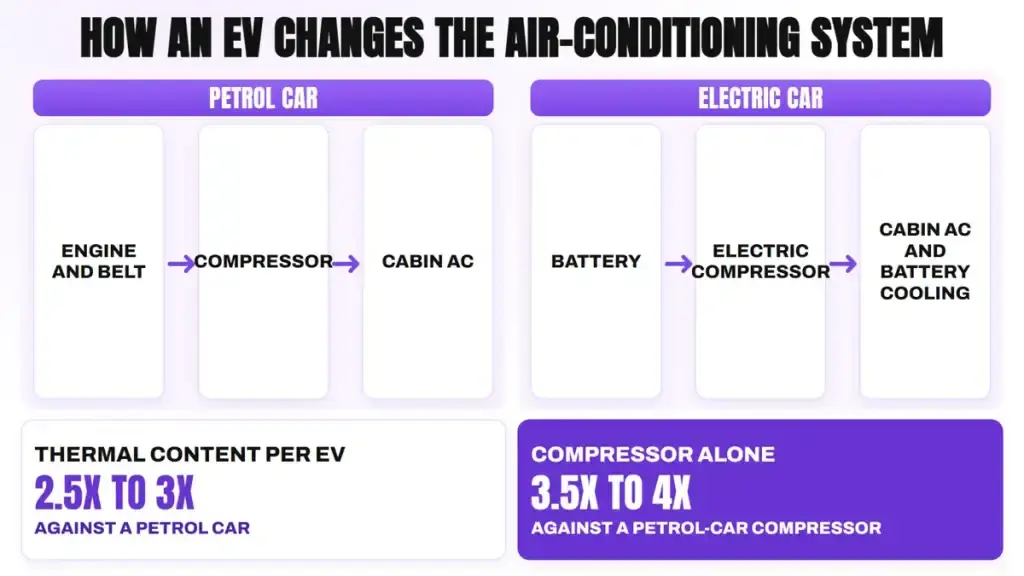
In a petrol car, the air-conditioner's compressor is driven by the engine through a belt. The compressor squeezes the refrigerant gas, and that is what lets the AC pull heat out of the cabin. When the engine stops, the compressor stops too.
An electric car has no engine to turn that belt. So its compressor needs its own electric motor, powered from the battery. That part is called an electric compressor. And in an EV, the AC loop has a second job. It also cools the battery and the motor, which must stay inside a narrow temperature band to last long and stay safe. This whole job of moving heat around a vehicle is called thermal management.
That makes the thermal system worth much more in an EV. One Indian maker of vehicle air-conditioning says the thermal content in an EV is normally 2.5x that of a petrol car, and in some cases 3x. For the compressor alone, it is 3.5x to 4x.
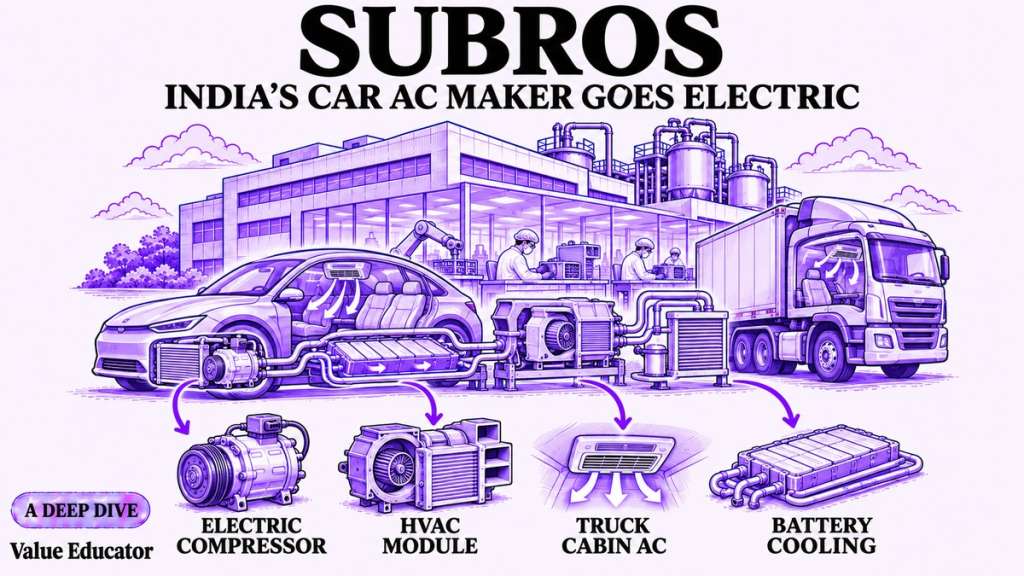
That maker is Subros Ltd (NSE: SUBROS). It makes compressors, condensers, radiators, hoses and the other parts of a vehicle AC loop. It also makes the HVAC module, which is the box behind the dashboard that heats, cools and blows air into the cabin. It holds a 41% share of business in passenger-car AC and 43% in truck AC. In January 2026, it won a business award worth about ₹1,280 Cr from Maruti Suzuki to make electric compressors for EV and hybrid cars in India, spread over about seven years.
Subros in five numbers
- Q2 FY27 revenue of ₹1,198.90 Cr, up 36.27%
- EBITDA margin of 7.66% of net sales, against 10.04% a year ago
- A 41% share of business in passenger-car AC and 43% in truck AC
- A ₹1,280 Cr electric compressor business from Maruti Suzuki, with the first supplies due in November 2027
- A ₹1,225 Cr HVAC business award from Maruti Suzuki in October 2026
So a company that already cools four in ten of India's new cars is now preparing for the EV version of the same job. But the latest quarter shows both sides of its business: record sales and a thinner margin. Let's first understand the company, and then look at the latest quarter.
Subros: Company Overview
Subros Ltd was set up in 1985 as a joint venture between the Suri family of India, DENSO Corporation and Suzuki Motor Corporation, and has its registered office in New Delhi. The Indian promoters hold 36.79%, DENSO 20% and Suzuki 11.96%. Shradha Suri is Chairperson and Managing Director, and Parmod Kumar Duggal is Executive Director and CEO. Subros makes compressors, HVAC modules, condensers, radiators, hoses and the other parts of the vehicle AC loop for cars, trucks, buses, tractors and railway coaches, in technical collaboration with DENSO. It has nine plants at seven locations, from Noida and Manesar to Chennai, Pune, Karsanpura, Nalagarh and Kharkhoda, and had 4,394 permanent employees in March 2026. Revenue from operations was ₹3,755.52 Cr in FY26, borrowings were only ₹29.81 Cr in March 2026, and ICRA rates its long-term borrowing AA (Stable). Read this Shivalik Bimetal: The Quiet EV Supplier
"Know what you own, and know why you own it."
— Peter Lynch
Subros is easy to describe as a car AC maker, but its numbers depend on three separate things: car output, the cost of metals and imported parts, and how fast EVs grow. Knowing which one moves the result is the first step to reading it.
The Quarter Revenue Grew 36.27% and the Margin Fell
Let's look at Q2 FY27, the July to September quarter that Subros reported on 3 November 2026. Revenue from operations was a record ₹1,198.90 Cr, up 36.27% from ₹879.83 Cr a year ago and 16.16% higher than the ₹1,032.11 Cr of Q1 FY27.

As we can see, the growth came mainly from volume. India's car and truck makers had a strong quarter after the GST cut, and management says Subros was running at almost 100% of its capacity. The company says revenue also rose because customers paid for higher commodity prices, currency moves and minimum wages, and because two new petrol-car models started production in the quarter.

That chart shows a steady climb: ₹878.25 Cr in Q1 FY26, ₹947.68 Cr in Q3 FY26, ₹1,049.76 Cr in Q4 FY26 and ₹1,198.90 Cr now. The profit did not keep pace. EBITDA rose only 3.96% to ₹91.47 Cr, and profit after tax rose 9.93% to ₹44.62 Cr. Note that Subros reports EBITDA with other income included and as a share of net sales, and we use its numbers as reported. Read this EBITDA Explained: Uses and Limits
Most of the squeeze came from materials. Material cost rose to 76.57% of net sales, against 73.08% a year ago. Management names four commodities in its products, plastic, aluminium, copper and steel, and says all four have been at their peak since February. The gases used in its processes, such as PNG, LPG and helium, are up 200% to 300%. So is the freight on parts imported from China and Japan.
Still, Subros does pass these costs on, but late. Its contracts with carmakers adjust prices for commodities and currency with a one-quarter lag. So the Q2 cost increase comes back only in Q3, and only if prices do not rise again. Management says carmakers are under cost pressure too and have not agreed to monthly adjustment.
Beyond costs, product mix took a little more off the margin. Because carmakers' lines were running flat out, Subros served them first and cut back on aftermarket sales, which earn a better margin. One more item explains part of the gap against last year: other income included a Gujarat government incentive of ₹0.64 Cr this quarter, against ₹13.40 Cr a year ago.
One cost did improve. Employee cost came down to 8.48% of net sales from 10.39%, as revenue grew faster than wages. That came after a hard Q1, when Haryana raised minimum wages by roughly 30% to 32% and Uttar Pradesh by about 26% to 28%.
That same pattern shows over the half year. H1 FY27 revenue was ₹2,231.01 Cr, up 26.90%. EBITDA was ₹178.47 Cr, up only 1.58%, and the EBITDA margin came down to 8.03% from 10.03%. Profit after tax was ₹86.02 Cr, up 5.86%.
Where the Quarter's Revenue Came From
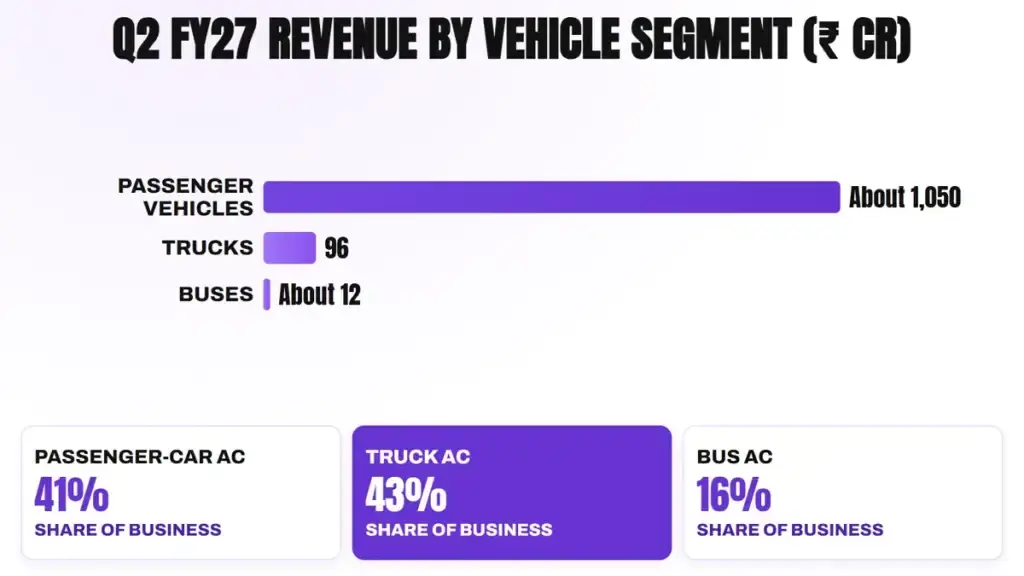
Now let's split the quarter by vehicle. Out of ₹1,198.90 Cr, management says about ₹1,050 Cr came from passenger vehicles, ₹96 Cr from trucks and about ₹12 Cr from buses. The rest came from tractors, the aftermarket and other lines.
The smaller lines grew faster. The commercial vehicle business grew 54% and bus AC grew 64% in the quarter. Subros held its share of business at 41% in passenger vehicles, raised it to 43% in truck AC and stood at 16% in bus AC.
The Business Already Won
Now let's look at the business already won. Subros does not report an order book the way a project company does. A car part maker wins a model, and then supplies it for the life of that model, often six or seven years. So the useful number is the value of new business awards over a model's life.
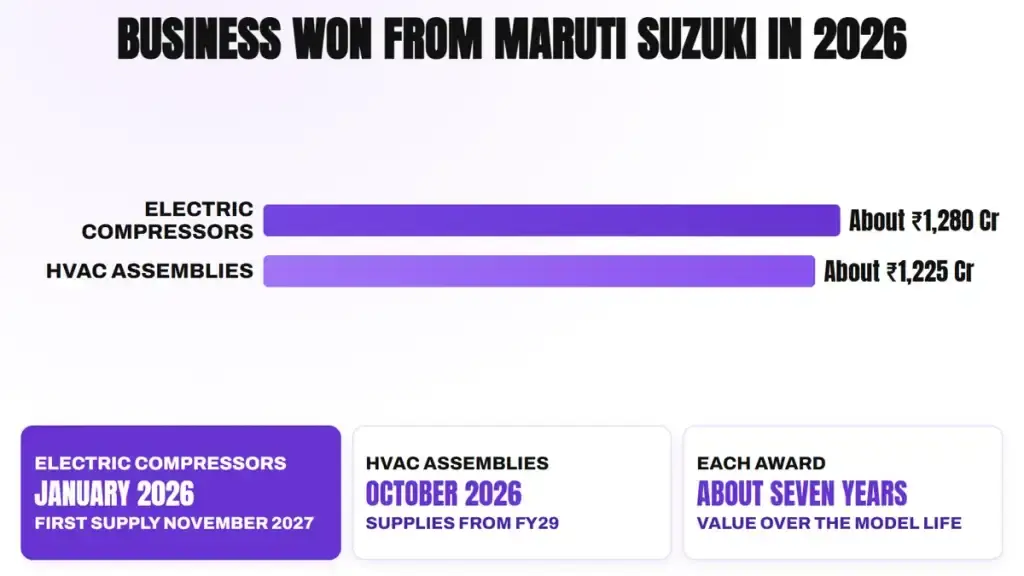
Two large awards came in 2026. In January, Maruti Suzuki confirmed electric compressors for its coming EV and hybrid models, worth about ₹1,280 Cr over about seven years. In October, it awarded HVAC assemblies worth about ₹1,225 Cr over about seven years, which the company says will grow its business in western India. Management says supplies for this HVAC award start in FY29.
Beyond cars, railways add a smaller layer. Subros completed a railway AC order of about ₹32 Cr last year and won a ₹52 Cr annual maintenance tender for railway AC that runs over the next three years. In November 2026 management said about ₹40 Cr of new railway business was secured, with supplies starting in December.
What the 2026 awards say: the two Maruti Suzuki awards add up to about ₹2,505 Cr over about seven years each, against FY26 revenue of ₹3,755.52 Cr. The electric compressor business alone could bring about ₹250 Cr a year at its peak.
How a 1985 Joint Venture Became India's Largest Car AC Maker
Now that we have seen the quarter, let's go back to the start. Subros was set up in 1985 as a joint venture between the Suri family of India, Japan's DENSO Corporation and Suzuki Motor Corporation. It has had technology collaboration with DENSO and Suzuki since 1986. DENSO is one of the world's largest makers of vehicle thermal systems, and Suzuki owns the controlling stake in Maruti Suzuki.
Those three partners still hold most of the company. The Indian promoters hold 36.79%, DENSO 20% and Suzuki 11.96%, with the public holding 31.25%. Shradha Suri is Chairperson and Managing Director, and Parmod Kumar Duggal is Executive Director and CEO. The company calls itself the largest air-conditioning and thermal products company in India.
It has nine plants at seven locations: Noida, Manesar, Pune, Chennai, Karsanpura in Gujarat, Nalagarh in Himachal Pradesh and the new site at Kharkhoda in Haryana. Most of them sit near the car plants they supply. Its two technical centres and a tool engineering centre are in Noida.

As the table shows, revenue grew in every one of those years, and the margin first rose and then slipped. From FY23 to FY25 the EBITDA margin went from 6.72% to 10.22%, helped by local sourcing of parts. Material cost came down from 76.80% of net sales in FY23 to 74.07% in FY24. In FY26 it came back to 9.70% as commodity prices and the rupee turned against it, and in H1 FY27 it slipped to 8.03%.
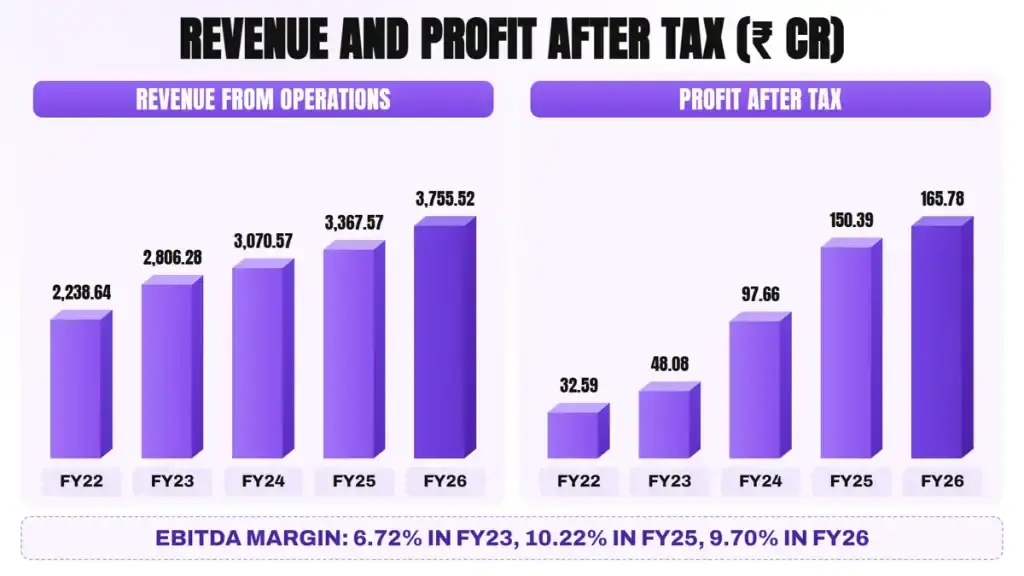
That record shows us the shape of the business. Subros grows with India's car output, and its profit depends on how well it controls the cost of metals, imported parts and labour that make up most of its cost.
"Our aspiration to get into two digit, whatever target we have set for the long-term, still are intact." - Parmod Kumar Duggal, Executive Director and CEO, May 2026
One Product Family, Five Kinds of Vehicles
Now let's look at the business by customer, because each type of vehicle buys for a different reason. Read this Segment-Wise Revenue Analysis Explained Subros reports a single segment, thermal products. But it sells to car, bus, truck, tractor, refrigerated transport and railway makers, and makes parts for home ACs too.

Passenger Cars and Maruti Suzuki
Let's start with cars, which bring in close to nine-tenths of revenue. Subros makes the full AC loop for a car: the compressor, the HVAC module, the condenser and radiator, and the hoses and pipes that connect them. In Q1 FY27 it supplied about ₹695 Cr of AC products to Maruti Suzuki, and more than ₹200 Cr to other carmakers such as Mahindra and Renault.
Maruti Suzuki is by far its largest customer. In FY25 Subros sold goods worth ₹2,837.64 Cr to Maruti Suzuki, about 84% of its revenue, and in FY26, 82.00% of its sales went to related parties. Maruti counts as a related party because Suzuki owns 11.96% of Subros.
Beyond Maruti, the move to SUVs helps a little. Management says the AC content in an SUV is about 8% to 10% higher than in a small car. Its current capacity is about 2.6 million HVAC units, 2.3 million sets of hoses and tubes, 2.2 million compressors and 2.4 million to 2.5 million heat exchangers.
Trucks and the Cabin AC Rule
Next, let's look at trucks, the fastest-growing line of the past year. From June 2025 the government made air-conditioned cabins mandatory for N2 and N3 trucks, the medium and heavy goods categories. Subros's truck AC sales grew 111% in FY26 to about ₹263 Cr.
That line is still growing. Management said in August 2026 that it aims for about ₹300 Cr from trucks in FY27, and ₹400 Cr to ₹450 Cr in the next two to three years. It puts the truck cabin AC market at about ₹600 Cr to ₹700 Cr today, and names MAHLE, Sanden and Air International among its rivals here.
Buses, Railways and Tractors
Now let's turn to three smaller lines that management wants to build. In buses, Subros has a 16% share of business, and it counts electric buses among its targets. In railways, it now supplies AC for driver cabins and coaches. Management's goal is for railways to cross ₹100 Cr in the next three years.
After railways, tractors are the newest line. AC cabins are optional on tractors. But Mahindra's export tractors for Japan and the US use them, and management says other tractor makers are now in talks.
Home AC Compressors, an Open Option
Finally, let's look at a possible new market. The government has said compressors for home ACs and refrigerators must meet Indian standards from 2027, which could favour local makers. Management calls it a very large market, but says the date has been extended before, so the business case will wait until the date is firm. Management also says data-centre cooling uses a different kind of compressor that Subros does not make.
Where Subros Sits in the EV Value Chain
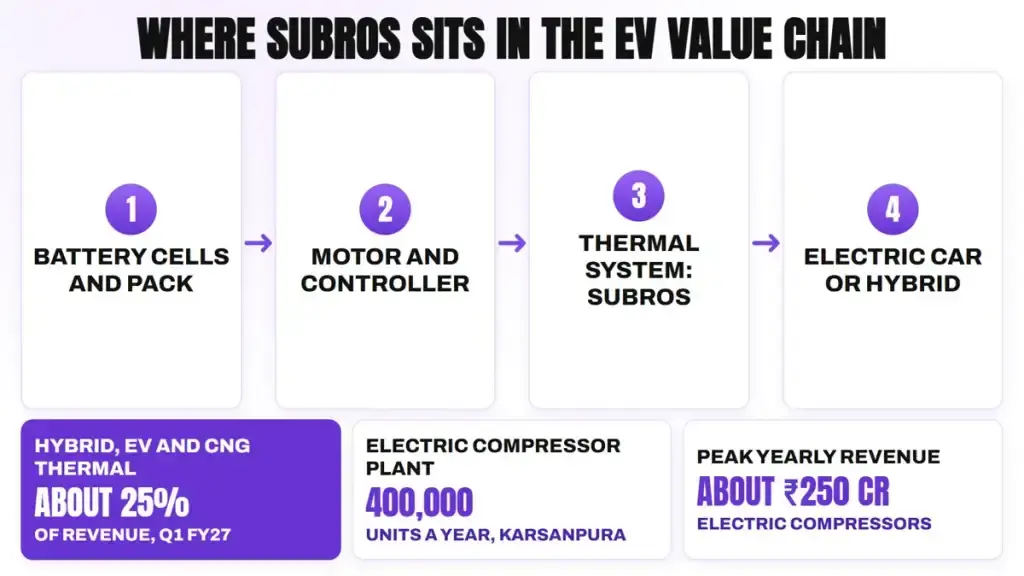
Now let's place Subros in the EV chain. An electric car is built from a battery pack, a motor and controller, the charging parts, and the body and cabin. Subros's place is the thermal system that runs through all of them. It cools the cabin, and in an EV it also helps hold the battery and motor at the right temperature.
That chain is growing in India.
"I very frequently get the question: 'What's going to change in the next 10 years?' I almost never get the question: 'What's not going to change in the next 10 years?'"
— Jeff Bezos
Whether a car runs on petrol, a hybrid engine or a battery, its cabin still needs cooling. What changes is the part that does it, and that is the change Subros is preparing for. EVs made up 8.26% of all vehicle sales in FY2025-26, and in September 2026 a record 36,010 electric cars were registered, about 8.3% of cars. Most of that EV share is two- and three-wheelers, but cars are where Subros's content lies. The proposed CAFE III fuel-efficiency rules for 2027 to 2032 give carmakers extra credits for EVs, so carmakers have a reason to sell more of them.
Subros already earns from the shift. Thermal systems for hybrid, electric and CNG vehicles together made up about 25% of revenue in Q1 FY27 and grew 9%. The company does not split out pure-EV revenue. Management says a new EV programme started supplies in Q2 FY27, but only in very small numbers so far.
Still, the big step is the electric compressor. In January 2026, DENSO, Toyota Industries and Subros agreed to make electric compressors of 20cc, 27cc and 34cc in India through Subros. In August 2026 they signed a technology assistance agreement for it. Subros is building a plant at Karsanpura, Gujarat, for 400,000 electric compressors a year, at a cost of about ₹175 Cr.
That plant will localise the product step by step. In the first phase about 80% to 85% of the parts will be imported and assembled in India. In the second phase the imported share comes down to about 55%, and the final aim is about 70% local content. Supplies for three Maruti Suzuki models start in phases: in November 2027, in February 2028 and later in 2028.
As for revenue, management puts the yearly revenue from this business at about ₹250 Cr at its peak. It expects the product to reach its company-level margin between FY28 and FY29, and better margins once localisation reaches the final phase.
Carmakers also want better ACs in petrol and hybrid cars. Under the CAFE rules, some credits are linked to AC efficiency, and management says it is at an advanced stage of talks with carmakers on more efficient ACs. It does not expect this to raise the content per car much.
Why Subros's Moat Is Hard to Copy
Now that we have seen the parts, let's understand the moat. Car AC is not a secret technology. Global makers such as MAHLE and Sanden also sell in India. So what keeps a carmaker giving four in ten of its AC orders to Subros? Read this Economic Moat Explained
One part of the moat is the technology partner. DENSO is a shareholder and has been Subros's technology partner since 1986. That gives Subros designs that carmakers already trust, and the new electric compressor also comes with DENSO's and Toyota Industries' help. The cost of that is a royalty of about 3% to 6% on different contracts, which management says will be the same for electric compressors.
Another layer is the full loop. Subros says it is the only integrated maker of vehicle AC systems and thermal products in India, making the compressor, HVAC module, heat exchangers and connecting parts in its own plants. A carmaker can buy the whole system from one supplier, tested together.
Beyond the product, location and time add a third layer. Subros puts plants next to its customers: Kharkhoda is built to supply Maruti Suzuki's newest plant in Haryana. A new supplier needs years of testing on each model before it can win one. The company spent ₹35.98 Cr on research and development in FY26, about 0.96% of turnover, and opened a new technology and innovation centre in 2026 for electric mobility and thermal products.


That table shows us the real test of the moat.
"The single most important decision in evaluating a business is pricing power."
— Warren Buffett
Subros wins a large share of carmakers' AC business, but the last four quarters show how slowly it can pass on a jump in costs. Its margin over the next few quarters is the clearest test of its pricing power. A 41% share of business proves carmakers trust Subros. Whether it can earn a fair margin on that share depends on how much pricing power it has when costs jump, and the last four quarters show that power is limited.
Financials: Five Years of Revenue, Margins and Cash Flow
One quarter can mislead in a business where costs are passed on with a lag, so let's look at the full years together. The figures are standalone, as Subros's only joint venture is small, and EBITDA includes other income and is shown as a share of net sales, as the company reports it.

Revenue grew about 1.7 times in four years, from ₹2,238.64 Cr in FY22 to ₹3,755.52 Cr in FY26, while profit after tax grew about 5.1 times, from ₹32.59 Cr to ₹165.78 Cr. Most of that profit jump came between FY23 and FY25, when the EBITDA margin rose from 6.72% to 10.22% as material cost came down. Since then the margin has slipped to 9.70% in FY26 and 8.03% in H1 FY27.
Cash flow has been steady relative to profit. From FY23 to FY26, operating cash flow added up to about ₹586.27 Cr, against about ₹461.91 Cr of profit after tax, or about 127%, helped by depreciation on its plants. It dropped to ₹105.32 Cr in FY26 from ₹174.84 Cr, because Subros stopped taking early payment from customers at a discount and held more inventory while shipments from abroad took longer.
The balance sheet carries little debt. Borrowings were ₹29.81 Cr in March 2026 and about ₹98.96 Cr in September 2026, mainly a term loan for the Kharkhoda plant. The new plants at Kharkhoda and Karsanpura are the next test of how fast that spending turns into revenue and cash.
"Beware of little expenses; a small leak will sink a great ship."
— Benjamin Franklin
For a company that spends about three-quarters of its sales on materials, a small rise in metal or freight costs moves the margin. That is why Subros's yearly margin matters as much as its revenue.
What FY27 and FY28 Could Look Like on Management's Numbers
So where does the business go from here? Management does not give a revenue target for the company. It says Subros will grow in line with the vehicle industry, and in November 2026 it said it sees no challenge to demand in H2 FY27 or in the next year.
Capacity is the first constraint, and it is being added now. The Kharkhoda plant, an investment of about ₹150 Cr, started commercial billing in October 2026. Phase 1 has capacity for about 4.75 lakh units and, with Phase 2, about 9.5 lakh units, to match Maruti Suzuki's plant there. Supplies for the first model start from 1 December 2026, and management expects Q4 FY27 to be the first full quarter.

That plant should add about ₹200 Cr to ₹250 Cr of yearly revenue once it runs at 90% to 95% of capacity, which management expects within two years. At Karsanpura, besides the electric compressor line, Subros is adding about 500,000 units a year of compressor capacity for petrol cars at a cost of about ₹90 Cr. In November 2026 management said it would bring forward expansion that was planned for next year, so it does not run short of capacity.
Margins are the open question. Management says that if commodity prices stay at their peak, the EBITDA margin will be in the high single digits for as long as these costs last. It is asking carmakers for a one-time settlement for the extra costs, and expects that to take another two quarters or so.

Those commitments are easier to judge against the past. So let's check what management said before against what it delivered.
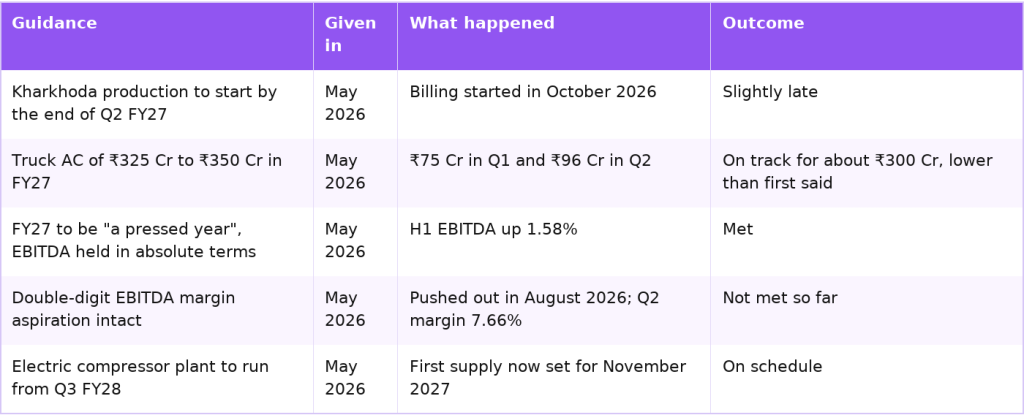
That record shows us a clear pattern. Subros has delivered the volumes and the new capacity, a little late in places. What it has not delivered is the margin it hoped for, because the cost of metals, imported parts and labour has risen faster than its customers have paid for them. That makes the margin the number to watch.
Key Risks
Now let's look at what could go wrong for Subros, because the last four quarters have already shown some of these risks.
- One large customer: Maruti Suzuki bought about 84% of Subros's goods in FY25, and both large 2026 awards came from it. A slowdown at Maruti, or a model that loses favour, would show directly in Subros's numbers.
- Costs passed on late: prices adjust for commodities and currency with a one-quarter lag. When costs keep rising, as they have since February 2026, the margin falls each quarter. Q2 FY27 EBITDA margin was 7.66%, against 10.04% a year ago.
- Labour costs: wages in Haryana and Uttar Pradesh rose by about 25% to 35% in the April to June quarter of 2026, and Subros is still asking customers to share that cost.
- Imports and freight: many materials and parts come from Japan and China. Freight on them rose 200% to 300%, and transit times stretched from 25 to 28 days to 45 to 60 days, which pushed up inventory.
- Cash flow and borrowings: operating cash flow fell to ₹105.32 Cr in FY26 from ₹174.84 Cr in FY25, partly because Subros stopped taking early payment from customers at a discount. Borrowings rose to about ₹98.96 Cr in September 2026 from ₹29.81 Cr in March, mainly for the Kharkhoda plant.
- Electric compressor execution: the first phase depends on 80% to 85% imported parts, and revenue starts only from November 2027. If Maruti's EV models sell slowly, the plant will run below capacity.
- Competition in EV thermal systems: global thermal makers such as MAHLE and Sanden also compete in India. Electric cars were about 8.3% of car registrations in September 2026, so the volume is small for now.
- Tax and other disputes: claims not acknowledged as debts came to ₹79.47 Cr in March 2026, including customs matters of ₹37.59 Cr, GST matters of ₹20.16 Cr and income tax matters of ₹11.12 Cr.
"In case these things are not settling down and peaks have not come down to the normal commodity prices, we will be into high single digit EBITDA margin." - Parmod Kumar Duggal, Executive Director and CEO, November 2026
"Risk means more things can happen than will happen."
— Howard Marks
No one can say when metal prices will ease, how fast Maruti's EVs will sell or when a cost settlement will come. What an investor can do is watch the margin, the new plants and the cash flow each quarter, which is what the list below sets out.
Explore our Products
Research Framework

Emerging Titans
Combination of quantitative analysis, industry tailwinds, and management assessment - SPRINT investment philosophy

Tiny Titans
Heavy emphasis on scuttlebutt research, plant visits, and early on-ground signals
What to Track Next
If you follow Subros, these are the signals that will show where it goes next.
- The EBITDA margin after 7.66% in Q2 FY27, and any one-time cost settlement with carmakers
- Material cost as a share of net sales after 76.57%
- Kharkhoda supplies from December 2026 and the first full quarter in Q4 FY27
- Truck AC revenue against about ₹300 Cr for FY27, and railway supplies from December
- The electric compressor plant at Karsanpura and the first supply in November 2027
- Operating cash flow and borrowings after ₹98.96 Cr
For the other listed EV suppliers, from battery materials to car parts, see EV Stocks in India 2026: Battery Materials to Car Parts.
Compare: see how it measures up against its peers in Subros vs Lumax Auto vs Sona BLW: EV Auto Parts Compared, a side-by-side look at order books, margins and balance sheets.
Conclusion
Let's put it all together. Subros has grown revenue from ₹2,238.64 Cr in FY22 to ₹3,755.52 Cr in FY26, and made a record ₹1,198.90 Cr in Q2 FY27. Carmakers give it 41% of their car AC business and 43% of their truck AC business. In 2026 it also won about ₹2,505 Cr of new lifetime business from Maruti Suzuki, including its first electric compressors. The cautious thread is the margin, which has slipped in recent quarters as costs ran ahead of prices, and the reliance on one carmaker. The next two quarters will show whether the cost settlement with carmakers comes through.
Still, the next step depends on two things outside the factory. What happens next depends on whether carmakers pay back the jump in costs fast enough to lift the margin from 7.66%, and whether Maruti's EVs sell in enough numbers to fill a 400,000-unit electric compressor plant from 2027.
FAQs
What does Subros do?
+Subros makes air-conditioning and thermal systems for vehicles in India: compressors, HVAC modules, condensers, radiators, hoses and the other parts of the AC loop. It supplies cars, trucks, buses, tractors and railway coaches, in technical collaboration with DENSO. FY26 revenue from operations was ₹3,755.52 Cr.
How did Subros do in Q2 FY27?
+Revenue from operations rose 36.27% to a record ₹1,198.90 Cr. EBITDA rose 3.96% to ₹91.47 Cr, but the EBITDA margin came down to 7.66% of net sales from 10.04%, as material cost rose to 76.57% of net sales. Profit after tax rose 9.93% to ₹44.62 Cr.
Why did Subros's margin come down?
+Management says plastic, aluminium, copper and steel have been at their peak since February 2026, and freight on parts from China and Japan rose 200% to 300%. Carmakers pay back commodity and currency changes with a one-quarter lag, and Subros also cut aftermarket sales to serve carmakers. Management expects a high single-digit EBITDA margin while these costs stay high.
Where does Subros fit in the EV value chain?
+Subros makes the thermal system, which cools the cabin and, in an EV, also helps keep the battery and motor at the right temperature. Management says the thermal content in an EV is 2.5x to 3x that of a petrol car. Hybrid, electric and CNG vehicle thermal systems made up about 25% of revenue in Q1 FY27.
What is Subros's electric compressor business?
+In January 2026, Maruti Suzuki awarded Subros electric compressors for its EV and hybrid models, worth about ₹1,280 Cr over about seven years. Subros is building a 400,000-unit plant at Karsanpura, Gujarat, for about ₹175 Cr, with DENSO and Toyota Industries' technical help. The first supply is due in November 2027, and management sees about ₹250 Cr of yearly revenue at the peak.
What are the main risks for Subros?
+Maruti Suzuki bought about 84% of Subros's goods in FY25, so its fortunes are closely tied to one carmaker. Costs are passed on with a lag, so rising metal, freight and wage costs hit the margin first. The electric compressor plant starts with 80% to 85% imported parts, and claims not acknowledged as debts came to ₹79.47 Cr in March 2026.

High growth stock specialist, Value Educator
Shashank Mahajan is an equity research professional with over 12 years of experience in identifying high-potential SME and micro-cap stocks at an early stage. He follows a rigorous scuttlebutt research–driven approach, combining on-ground insights with deep financial analysis. Shashank specializes in uncovering under-researched and under-owned companies with strong management quality and long-term growth potential. Through disciplined research and early identification, he focuses on spotting tomorrow’s market leaders before they enter the mainstream investor radar.
More about Shashank Mahajan →
Azad Engineering vs MTAR vs Unimech: Aerospace Parts
Subros vs Lumax Auto vs Sona BLW: EV Auto Parts Compared
Jyoti CNC vs Macpower CNC: Machine Tool Makers Compared
Data Patterns vs Astra Microwave vs Apollo Micro

Himadri vs PCBL: Carbon Black and Battery Materials

Inox Wind vs Suzlon: Wind Turbine Makers Compared
Explore our Products
Research Framework
Emerging Titans
Combination of quantitative analysis, industry tailwinds, and management assessment - SPRINT investment philosophy
Tiny Titans
Heavy emphasis on scuttlebutt research, plant visits, and early on-ground signals



India's Aerospace Opportunity
Global Demand. Supply Bottlenecks. Opportunities Ahead.
Don't Miss This Exclusive Webinar!
Join Value Educator to decode the key trends shaping India's aerospace sector and learn how to identify tomorrow's potential leaders in the space.
- How the aircraft value chain works, layer by layer
- Indian companies supplying global aircraft makers
- A framework to judge any aerospace company

 Orders
 Subscription
 Share with friends


Required Details
₹23999.00
(12 month subscription)
As per SEBI regulations, all users are mandated to complete the KYC that is validated for 1 year. Post payment, you will be redirected to the KYC screen


No comments yet. Be the first to comment!