
Lumax Auto Technologies: Gear Shifters, Cabins and EV Parts

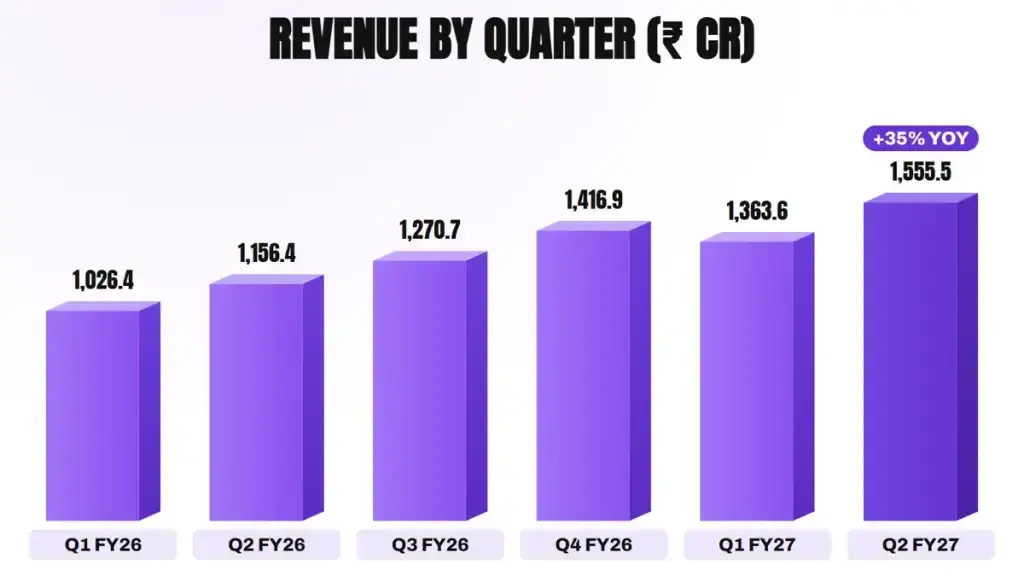
In FY05, an Indian auto parts maker had one plant, one product line and about ₹100 Cr of revenue. It made lamps for two-wheelers, and it had fewer than 10 engineers, who mostly built parts to drawings that customers handed to them. In FY26, the same company had 29 plants, five product lines and ₹4,870 Cr of revenue, about 49 times as much. In the July to September quarter of 2026 alone, it sold ₹1,556 Cr of parts.
That growth came from a simple idea: sell more parts into every vehicle. When you sit in a new SUV, much of what you touch comes from such suppliers. The dashboard and the centre console in front of you are called the cockpit. The panels on the inside of the doors, the roof lining above you and the plastic trims around the cabin are all moulded parts. The lever you use to change gears is the gear shifter, and the box below it that links the lever to the gearbox is the shift tower.
Then there are the parts you do not see. A car that can be tracked on a phone app needs a device called a telematics unit, a small computer with a SIM card that sends the car's location and health data. It needs antennas to pick up GPS and mobile signals. A CNG car needs steel tubes and fittings that carry gas from the cylinder to the engine. And the newest cars carry an electronic box called a body control module, which switches the lights, wipers, locks and windows.
That parts maker is Lumax Auto Technologies Ltd (NSE: LUMAXTECH), based in Gurugram and part of the Lumax-DK Jain group. It makes all of these parts, through its own plants and through joint ventures with partners from Japan, Italy, Spain and Israel. Its sister company, Lumax Industries, is a separate listed firm that makes car lamps. This article is about Lumax Auto Technologies.
The company measures its growth with one number, content per vehicle, which is the value of Lumax parts that can go into one vehicle. Management puts it at about ₹70,000 to ₹75,000 for a passenger vehicle and about ₹22,000 to ₹25,000 for a two-wheeler. The company says this number has gone up about 5x in the last five years.
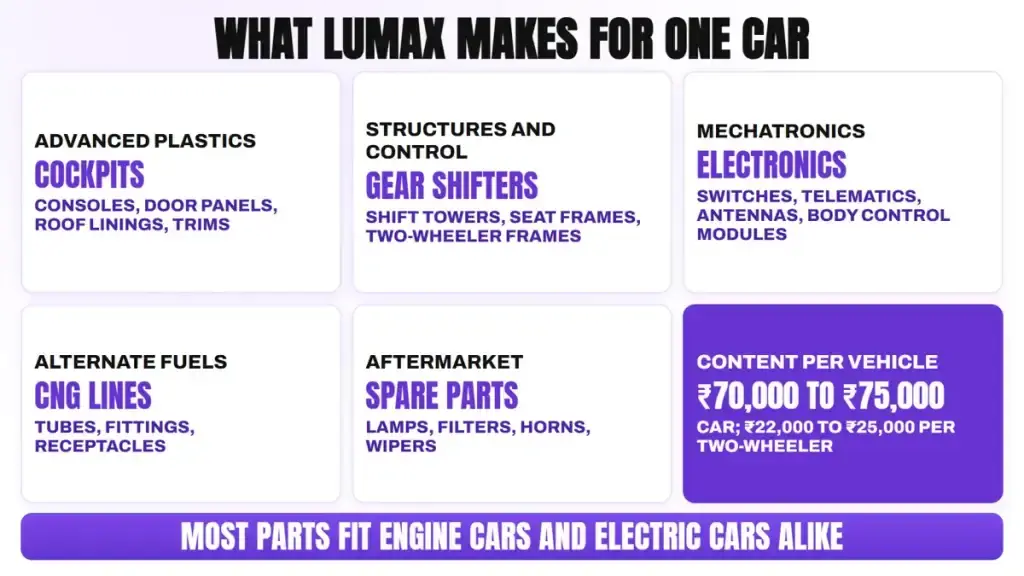
So Lumax sits at a clear point in the auto chain. The company calls its portfolio powertrain agnostic, which means its parts fit a vehicle whatever drives the wheels. It does not make engines, batteries or motors. It makes the cabin, the controls and the electronics around them, and the company says all of its parts for car makers fit both engine cars and electric vehicles, except air intake systems, which are for engine cars only, and CNG parts, which are fuel-specific.
Lumax Auto Technologies in five numbers
- Q2 FY27 revenue of ₹1,556 Cr, up 35%
- An EBITDA margin of 14.9% in H1 FY27, up from 14.0%
- An order book of ₹1,879 Cr in September 2026, with 85% of it new business
- About ₹6,000 Cr of revenue expected in FY27
- A target of ₹1,000 Cr of EBITDA in FY28
So a company that began with two-wheeler lamps now earns more in one quarter than it did in all of FY22. How did that show up in the latest numbers? Let's first understand the company, and then look at the latest quarter.
Lumax Auto Technologies: Company Overview
Lumax Auto Technologies Ltd was incorporated in 1981 and is based in Gurugram, Haryana, as part of the Lumax-DK Jain group. Dhanesh Kumar Jain is the Chairman, Deepak Jain the Vice Chairman and Anmol Jain the Managing Director, and the promoters held 55.98% of the company in March 2026. It makes car cockpits, door panels and trims, gear shifters, frames, switches, telematics units, antennas, oxygen sensors and CNG parts, partly through joint ventures with partners from Japan, Italy, Spain and Israel, and it sells spare parts under the Lumax brand. It runs 29 plants in seven states, and in FY26 it had 2,857 permanent employees and 8,673 contract workers. Revenue from operations was ₹4,870 Cr in FY26, and in September 2026 its net debt was only about ₹41 Cr. Its sister company, Lumax Industries, is a separately listed maker of car lamps. Read this Sedemac Mechatronics: 1.45 Million Controllers a Quarter
"Know what you own, and know why you own it."
— Peter Lynch
Lumax is easy to confuse with its lamp-making sister company and hard to sum up in one product. Knowing which of its five product lines brings in the revenue, and which customers buy them, is the first step to reading its results.
The Quarter Revenue Crossed ₹1,500 Cr
Let's look at Q2 FY27, the July to September quarter that the company reported on 24 October 2026. Revenue from operations was ₹1,555.5 Cr, up 35% from ₹1,156.4 Cr a year ago and 14% higher than the ₹1,363.6 Cr of Q1 FY27. It was the first time quarterly revenue crossed the ₹1,500 Cr mark.
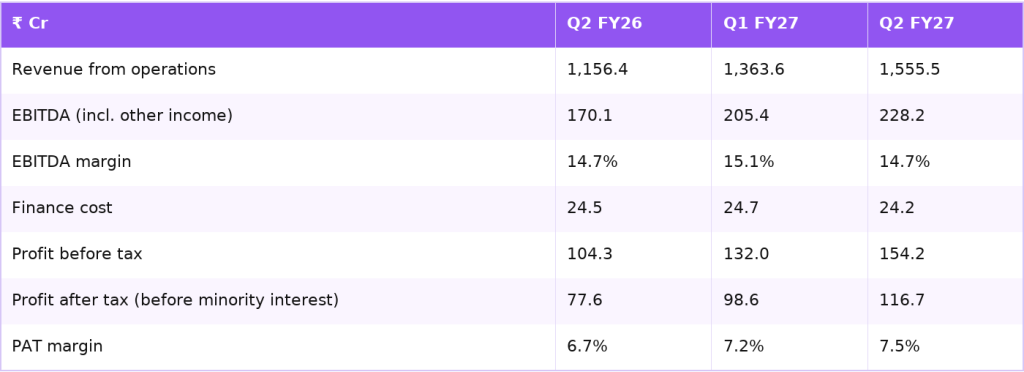
As we can see, profit grew faster than revenue. Read this How to Read a Profit & Loss Statement EBITDA rose 34% to ₹228.2 Cr, but profit after tax rose 50% to ₹116.7 Cr, because depreciation and finance cost grew more slowly than the business. Finance cost was in fact a little lower than a year ago, at ₹24.2 Cr against ₹24.5 Cr. The profit that belongs to Lumax's own shareholders, after the partners' share in the joint ventures, was about ₹105.5 Cr.
That growth came from every product line, but not at the same pace. Advanced Plastics, the line that includes the car cockpits and door panels, brought in ₹886 Cr, up 44%. Structures and Control Systems, which holds the gear shifters, brought in ₹258 Cr, up 28%. Alternate Fuels grew 46% to ₹109 Cr, Mechatronics grew 36% to ₹93 Cr, and the Aftermarket grew 11% to ₹131 Cr.
That growth also had help from the industry. Management says vehicle production in India grew 19% in the quarter, to 106 lakh units, helped by lower GST rates and a low base a year ago. Passenger vehicle production grew 25%, two-wheelers 17% and commercial vehicles 34%. So Lumax grew faster than the vehicles it supplies, which is what a rising content per vehicle should do.
Beyond growth, the margin slipped a little from the quarter before, to 14.7% from 15.1%. Management says this came from higher prices of plastics, electronic parts and freight. Lumax passes most of these costs on to the car makers, but with a lag of about one quarter. The cost and the recovery both add to revenue without adding profit, so the margin gets diluted by about 30 to 40 basis points.
That same pattern shows in the first half, at a larger scale. H1 FY27 revenue was ₹2,919.1 Cr, up 34%. EBITDA was ₹433.6 Cr at a margin of 14.9%, against 14.0% in H1 FY26, and profit after tax rose 64% to ₹215.3 Cr.
Beyond the profit line, the cash flow kept pace. Operating cash flow in the first half was ₹322.9 Cr, against ₹321.7 Cr a year ago. Capex in the half was only about ₹60 Cr, against a full-year plan of about ₹300 Cr, as most new plants start production in the second half. In September 2026 the company had free cash of about ₹401 Cr, long-term debt of ₹442 Cr and a debt-to-equity ratio of 0.26. Net of cash, debt was only about ₹41 Cr.
The Orders Behind FY28
Now let's look at the order book, because it shows how much new business is already won. For a parts maker, the order book means the expected revenue from new parts that car makers have chosen Lumax to supply on vehicles that will be launched over the next few years.
At the end of September 2026 that book was ₹1,879 Cr, up from ₹1,600 Cr in June 2026. About 85% of it is new business, meaning products or customers that do not bring in revenue today.

That book has grown in steps. It was ₹1,300 Cr when the FY25 results came out in May 2025, ₹1,500 Cr in June 2025, ₹1,357 Cr in September 2025, ₹1,450 Cr in December 2025 and March 2026, and then ₹1,600 Cr and ₹1,879 Cr in the two quarters since. Every quarter, some orders turn into running revenue and leave the book, while new wins come in.
The company also shows when this book should turn into revenue. About 14%, or ₹258 Cr, is expected in FY27, about 59%, or ₹1,117 Cr, in FY28, and the remaining 27%, or ₹504 Cr, in FY29. By segment, Advanced Plastics holds ₹834 Cr, Mechatronics ₹512 Cr, Alternate Fuels ₹379 Cr and Structures and Control Systems ₹154 Cr.
What the order book says: ₹1,117 Cr of new business is due to start in FY28. That is about 23% of FY26 revenue, and it is the main base under management's ₹1,000 Cr EBITDA target for that year.
How a Lamp Maker Became a Cabin and Controls Supplier
Now that we have seen the quarter, let's go back and see how a lamp maker became a cabin and controls supplier. The company began as Lumax Auto Electricals, set up to make two-wheeler lighting at Bhosari near Pune, and was later renamed Lumax Auto Technologies. The wider Lumax group has eight decades of history and began as Globe Auto Industries, a trading firm. Dhanesh Kumar Jain is the Chairman, Deepak Jain the Vice Chairman and Anmol Jain the Managing Director.
For many years Lumax grew through joint ventures. It brought in a global partner for each new product and made that product in India. Cornaglia of Italy came in 2007 for emission parts, Mannoh of Japan in 2008 for gear shifters, and then FAE of Spain, Ituran of Israel, Yokowo of Japan and Alps Alpine of Japan between 2017 and 2021, for sensors, telematics, antennas and switches.
Then came two acquisitions that changed the size of the business. On 10 March 2023, Lumax bought 75% of IAC India, a maker of car cockpits and door panels whose largest customer is Mahindra & Mahindra. In November 2024 it bought 60% of Greenfuel Energy Solutions, a maker of CNG parts. In May 2025 it bought the remaining 25% of IAC India, which has since been merged into Lumax Auto Technologies.
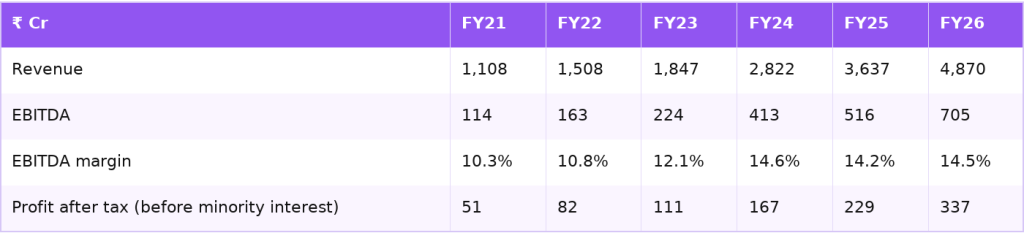
That table shows what IAC did to the business. Revenue jumped about 53% in FY24, the first full year with IAC, and the EBITDA margin jumped to 14.6% from 12.1%. Management says IAC's EBITDA was about ₹90 Cr when Lumax bought it and about ₹210 Cr in FY25, and that it paid an enterprise value of close to 6 times EBITDA.
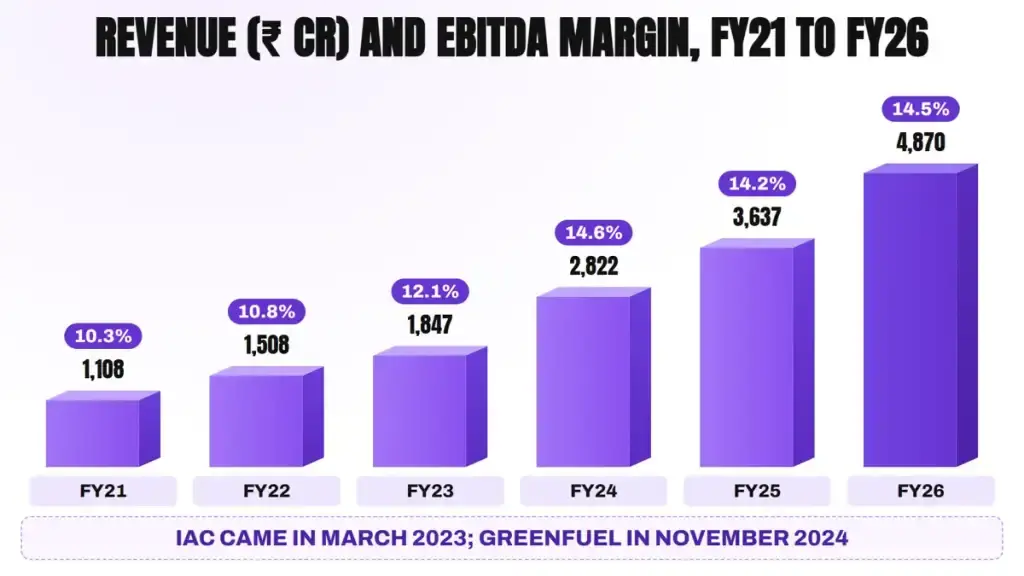
Over five years, revenue grew at 34% a year and profit after tax at 46% a year. FY26 alone added 33.92% to revenue, helped by the first full year of Greenfuel, which brought in about ₹383.2 Cr. The margin went from 10.3% in FY21 to 14.5% in FY26, as the mix moved to larger interior systems and higher-value parts.
"We are pleased to report another strong quarter, despite a challenging operating environment, with revenue growth of 35% year-on-year and faster profitability growth of 50% year-on-year." - Anmol Jain, Managing Director, October 2026
Five Product Lines and the Customers Behind Them
Now let's split the business into its parts, because each line sells a different kind of product. Read this Segment-Wise Revenue Analysis Explained Lumax reports its revenue in five product lines, plus a small line of other products.
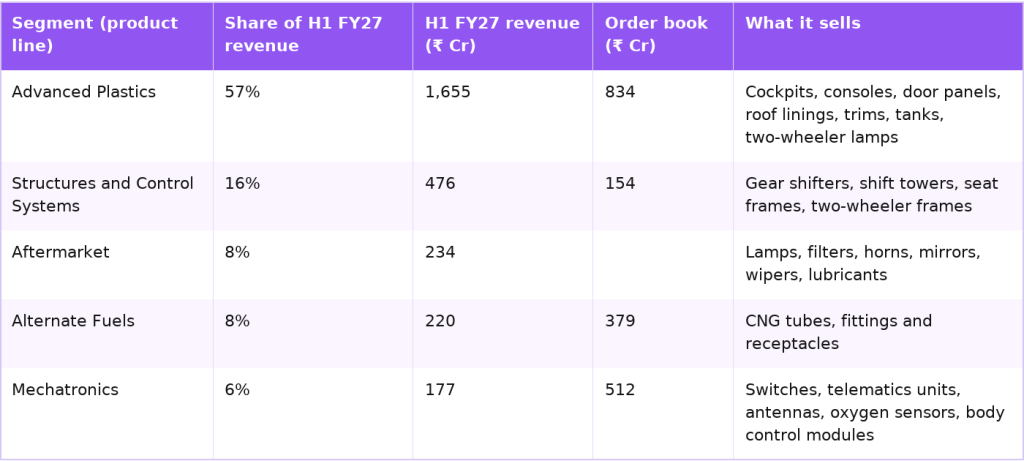
Those lines also sell to a fairly short list of buyers. In H1 FY27, Mahindra & Mahindra made up 30% of revenue, Bajaj Auto 16%, Maruti Suzuki 10%, Lumax Industries 6%, Tata Motors 6% and Honda Motorcycle and Scooter 5%. By vehicle type, passenger vehicles made up 53% of revenue and two- and three-wheelers 27%.

Advanced Plastics and the IAC Cockpits
Let's start with Advanced Plastics, now more than half the business. Revenue in H1 FY27 rose 45% to ₹1,655 Cr, from ₹1,138 Cr. The IAC business, which makes cockpits, consoles and door panels, is about 60% of this line. The rest comes from Lumax Cornaglia, which makes air intake systems and urea tanks, and from two-wheeler lamps and moulded parts for Bajaj Auto and Honda.
Its biggest customer, through IAC, is Mahindra & Mahindra. In May 2025 management said its share of Mahindra's integrated cockpits and door panels was close to 90% to 95%. It also said the content per vehicle on Mahindra's new battery electric SUVs could be as high as ₹40,000 to ₹45,000, because those cabins use more soft-touch, premium interior parts.
A new IAC plant at Chakan, near Pune, is in its start of production phase for new Mahindra orders. Management expects the products from it to launch around December or January.
Gear Shifters in Structures and Control Systems
Next, let's look at Structures and Control Systems. Its main business is Lumax Mannoh, a 55% joint venture with Mannoh of Japan that makes manual, automatic, AMT and DCT gear shifters. The company says it holds a market leadership position in gear shifters in India, and its revenue was about ₹395.5 Cr in FY26. Its customers include Maruti Suzuki, Mahindra & Mahindra, Toyota, Tata Motors and Honda Cars.
This line also makes metal parts for two-wheelers, such as frames and swing arms for Bajaj Auto. Management says the frame business is strong on the Chetak, Bajaj's electric scooter. H1 FY27 revenue rose 24% to ₹476 Cr, from ₹380 Cr. Newer products here include monostable e-shifters, the electronic shifters that newer automatic cars use.
Mechatronics and the Body Control Module
Now let's move to Mechatronics, the smallest of the OEM lines but the one management expects to grow fastest. It sells power window switches with Alps Alpine, antennas with Yokowo, telematics units with Ituran and oxygen sensors with FAE. H1 FY27 revenue rose 45% to ₹177 Cr, from ₹122 Cr.
Next comes the newest product, the body control module. Lumax began production in July 2026 under a technology tie-up with a large Japanese parts maker, and management says it already has a ₹250 Cr order book for it. On 24 October 2026 the board approved a new Mechatronics plant at Manesar, Haryana, with a capital outlay of about ₹150 Cr. It will make body control modules and other electronic parts, start in two phases from Q3 FY28, and could reach a peak turnover of about ₹500 Cr a year.
Management says Mechatronics is about 20% of the company's content per vehicle today, and it aims for close to ₹1,000 Cr of revenue from this line by FY31.
Alternate Fuels and the CNG Tubes
Now let's look at Alternate Fuels, which is the Greenfuel business. It makes CNG delivery systems, including the steel tubes and fittings that carry gas from the cylinder to the engine. Greenfuel's revenue was about ₹383.2 Cr in FY26, its first full year inside Lumax, and H1 FY27 revenue rose 30% to ₹220 Cr.
One product here is new for India. Ferrule-less tubes and fittings join CNG lines without a separate metal ring, and the industry used to import them. The company says it is the first domestic supplier to make them in India. A new Greenfuel plant at Nashik began production in Q3 FY27 for Mahindra & Mahindra, and another at Manesar is being set up for Maruti Suzuki.
The Aftermarket
Finally, let's look at the Aftermarket, which sells spare parts under the Lumax brand to repair shops. It has more than 500 channel partners and more than 35,000 retail touch points. Its H1 FY27 revenue grew only 9% to ₹234 Cr, as higher prices for non-lighting parts cut demand. Management still aims for 15% to 20% growth a year over three to five years.
Where Lumax Sits in the EV Value Chain
Now let's place Lumax in the shift to electric vehicles, the theme behind a lot of interest in auto parts today. An electric car replaces the engine, the fuel tank and the exhaust with a battery, a motor, a motor controller and charging parts. The cabin, the seats, the doors and the electronics stay.
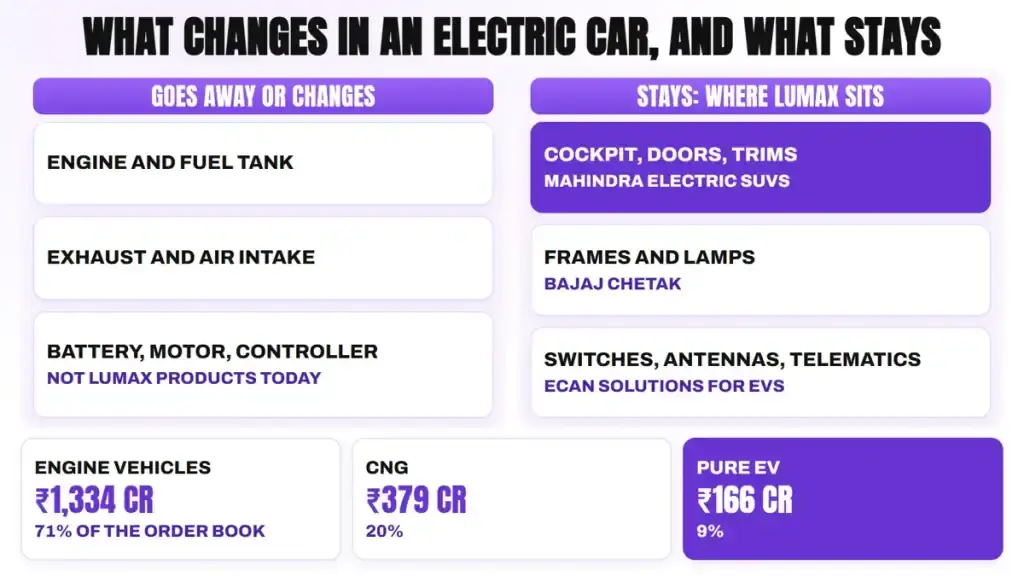
Lumax sits mostly in the parts that stay, which is what powertrain agnostic means in practice. Its cockpits go into Mahindra's electric SUVs, its frames and lamps into the Bajaj Chetak, and its telematics team has added solutions built for EVs. Only the air intake systems are for engine cars alone, and the CNG parts are fuel-specific.
That shows in the order book. In September 2026, pure EV programmes made up about 9% of the ₹1,879 Cr book, or ₹166 Cr, and CNG programmes 20%, or ₹379 Cr. The remaining 71%, or ₹1,334 Cr, was for engine vehicles. About 22%, or ₹420 Cr, was for new technologies.
That 9% is lower than an older figure. In May 2025, management said battery electric platforms made up almost 40% of the then ₹1,300 Cr book. The company has not bridged the two figures, and they may not be measured the same way. The safer reading is that most of Lumax's EV revenue today comes from cabin and control parts that it would sell to an engine car too.
Beyond the order book, management has been clear about which EV parts it will chase and when. It says many EV-only parts, such as battery-related parts, are bought as commodities that car makers keep close control of. So it has narrowed its EV plan to a basket of three to five products, where it is sourcing technology and looking at acquisitions, with production starting between 2028 and 2030.
"If you're competitor focused, you have to wait until there is a competitor doing something. Being customer focused allows you to be more pioneering."
— Jeff Bezos
Lumax's EV plan follows its customers: it supplies the cabins, frames and electronics that Mahindra's and Bajaj's electric vehicles need, and picks EV-only parts only where it can add value.
The bigger goal is wider than EVs. The company aims for 20% of revenue from future and clean mobility by FY31, against 6% in FY25. That bucket includes EV parts, CNG and hydrogen systems from Greenfuel, and the telematics and software work at SHIFT, its technology centre in Bengaluru.
Why Lumax's Moat Is Hard to Copy
Now that we have seen the parts, let's understand the moat. A door panel or a gear lever looks simple to make, yet car makers keep giving Lumax more parts on each new model. Here is what sits behind that. Read this Economic Moat Explained
One part of the moat is technology through partners. Lumax has eight partnerships across Japan, Italy, Spain, Israel and India. Each brings a proven product and its design know-how, and Lumax brings the Indian plants and the car-maker ties. A new rival would need its own partner, its own approvals and years of supply record for each product.
Another layer comes from being chosen early. Car makers pick interior and control suppliers well before a model is launched, and Lumax's order book shows how long that runs: orders won today turn into revenue across FY27, FY28 and FY29. A high share at Mahindra & Mahindra has also kept bringing parts on new Mahindra models.
"A truly great business must have an enduring moat that protects excellent returns on invested capital."
— Warren Buffett
For Lumax, the question is whether its partners, its early selection on new models and its plants near customers keep car makers coming back when rivals bid for the same parts.
Beyond partners and timing, location adds a third layer. Lumax runs 29 plants in seven states, close to the auto hubs of Pune, Nashik, Manesar and Bengaluru. Large moulded parts such as cockpits are bulky, so a plant near the car maker's line helps. It also has more than 500 R&D specialists and three R&D, engineering and tech centres.

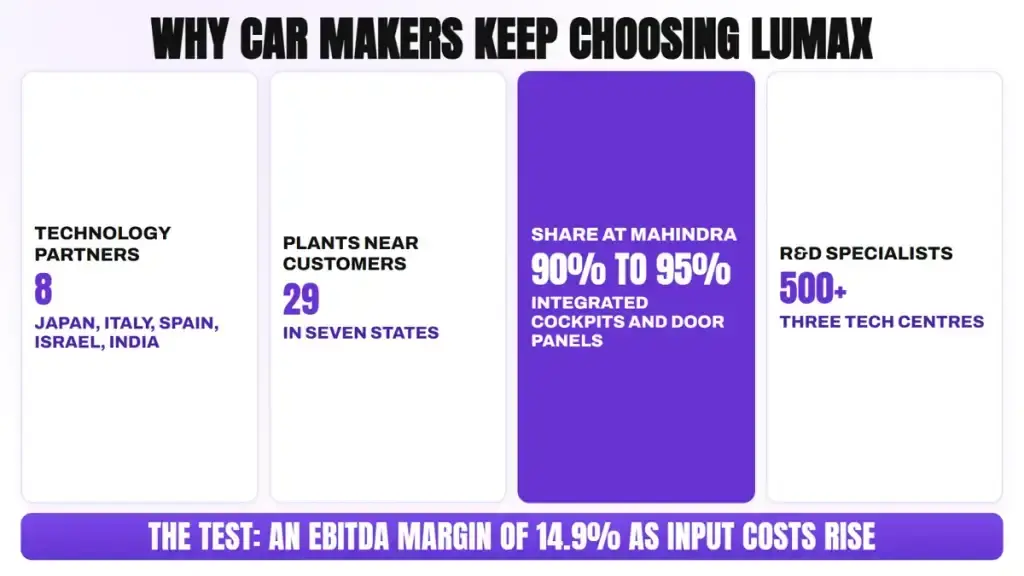
That table shows us why the margin is the real test of the moat. If car makers value what Lumax brings, it should hold its margin even when input costs rise. So far it has: the EBITDA margin was 14.5% in FY26 and 14.9% in H1 FY27, even with a lag in passing on costs.
Financials: Five Years of Revenue, Margins and Cash Flow
One quarter can mislead when two acquisitions changed the size of the business, so let's look at the full years together. EBITDA here includes other income and profit is before the joint-venture partners' share, as the company reports them.
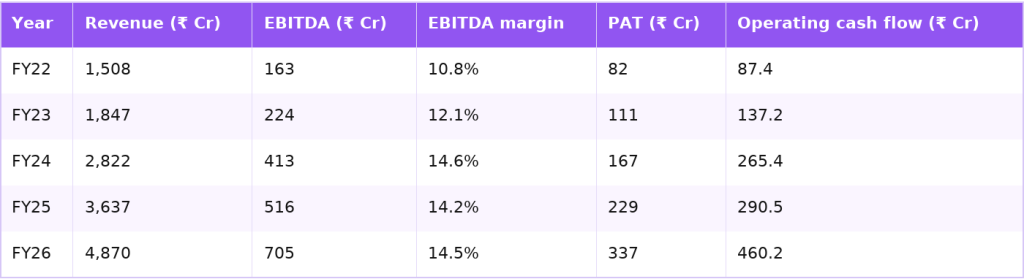
Revenue grew about 3.2 times in four years, from ₹1,508 Cr in FY22 to ₹4,870 Cr in FY26, and profit after tax grew about 4.1 times, from ₹82 Cr to ₹337 Cr. The biggest step came in FY24, the first full year with IAC, when the EBITDA margin rose to 14.6% from 12.1%.
Cash flow has kept up with profit. From FY22 to FY26, operating cash flow added up to about ₹1,240.7 Cr, against ₹926 Cr of profit after tax, or about 134%.
The balance sheet carries some debt from the acquisitions, but not much net of cash. In September 2026 long-term debt was ₹442 Cr, the debt-to-equity ratio was 0.26 and net debt was only about ₹41 Cr, with about ₹300 Cr of capex planned for FY27.
"Earnings can be as pliable as putty when a charlatan heads the company reporting them."
— Warren Buffett
Cash flow is the check on reported profit. For Lumax, operating cash flow has been higher than profit after tax over five years, which is what an investor wants to see in a growing parts maker.
What FY27 and FY28 Could Look Like on Management's Numbers
So where does the business go from here? On 27 October 2026, management said it now expects revenue growth of 20% to 25% in FY27, or close to ₹6,000 Cr. It expects growth of 15% to 20% in the second half, on a higher base.
Now let's put that outlook against the first half. H1 FY27 revenue was ₹2,919.1 Cr. Reaching about ₹6,000 Cr needs about ₹3,081 Cr in H2. That is about 14.6% more than the ₹2,687.6 Cr of H2 FY26, against 34% growth in the first half. So the outlook already assumes a slower second half.
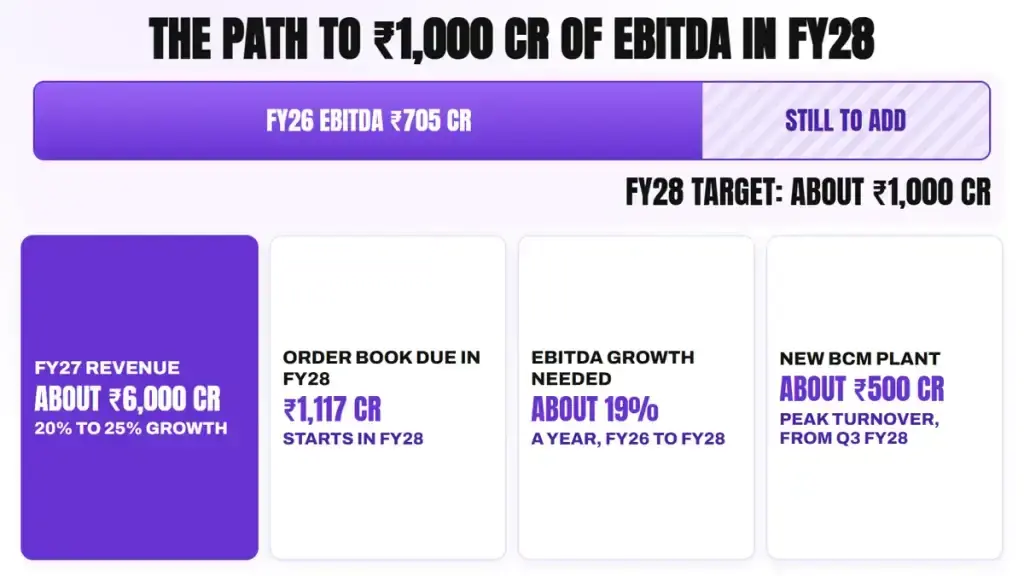
Beyond FY27, the target is in profit, not revenue. Management has kept its target of about ₹1,000 Cr of EBITDA in FY28, against ₹705 Cr in FY26. That needs EBITDA to grow at about 19% a year over two years. The ₹1,117 Cr of the order book due in FY28 and the new plants are meant to carry much of that.
After FY28, the longer plan is called the 20.20.20.20 North Star. It aims for revenue to grow at least 20% a year from FY25 to FY31, to about ₹11,000 Cr, of which about ₹8,500 Cr would be organic. It also aims for ROCE above 20% by FY28, against 18% in FY25, 20% of revenue from future and clean mobility, and an EBITDA margin that moves towards 20% over the long term. Over the next few years, management hopes to add 100 to 200 basis points and reach about 17% to 18%.
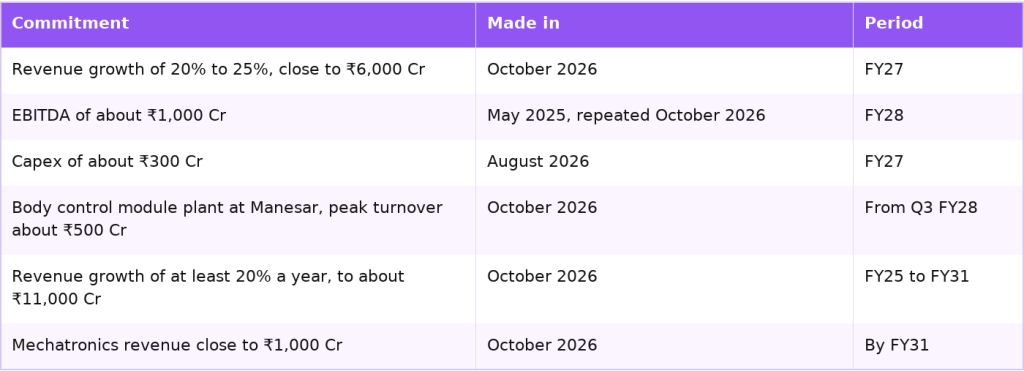
Those commitments are easier to judge against the past. So let's check what management said before against what it delivered.
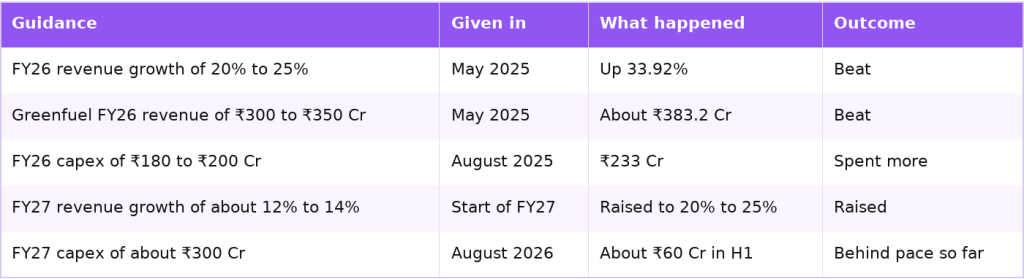
That record shows us a clear pattern. Revenue targets have been beaten, and the FY27 outlook was raised after a strong first half. Capex has tended to run above plan over a full year, while the FY27 plan is back-loaded into the second half. That makes the new plants and the margin the numbers to watch from here.
Key Risks
Now let's look at what could go wrong for Lumax, because some of these risks already show in the latest numbers.
- Customer concentration: Mahindra & Mahindra made up 30% of H1 FY27 revenue and Bajaj Auto 16%. A weak model cycle at either one would show quickly in Lumax's numbers.
- Input costs and the lag: plastics, electronic parts and freight costs are rising. Lumax recovers most of this from car makers with a lag of about one quarter, and the margin dipped to 14.7% in Q2 FY27.
- Slower second half: the FY27 outlook implies about 14.6% growth in H2, against 34% in H1. Management itself expects industry growth to slow after the low base of last year and the GST cut.
- A small EV share: pure EV programmes are about 9% of the order book, and the plan for EV-only parts aims at production only from 2028 to 2030. If EV adoption speeds up, Lumax could miss early orders for EV-only parts.
- Dependence on partners: much of the technology in Mechatronics and gear shifters comes from joint venture partners. In FY27 Lumax sold its stake in the Jopp joint venture to the partner, and the joint ventures' partners also take about 11% of profit as minority interest.
- Execution of new plants: the Chakan IAC plant, the Manesar Mechatronics plant and two Greenfuel plants all start in the next few quarters. Delays would push back the revenue in the order book.
- Aftermarket slowdown: the Aftermarket grew only 9% in H1 FY27, against the company's own aim of 15% to 20%.
- Tax disputes: claims not acknowledged as debts included about ₹30.6 Cr of income tax and about ₹4.5 Cr of GST matters in March 2026. The company expects favourable decisions and has not made a provision.
"Rising input costs, including crude-linked polymer prices, elevated lead time and costs for electronic components, freight and rupee depreciation, remain a key monitorable." - Anmol Jain, Managing Director, October 2026
"Risk comes from not knowing what you're doing."
— Warren Buffett
Lumax's risks are easy to name: a few large customers, input costs passed on with a lag and new plants that must start on time. Knowing them is what lets an investor read each quarter's numbers calmly.
Explore our Products
Research Framework

Emerging Titans
Combination of quantitative analysis, industry tailwinds, and management assessment - SPRINT investment philosophy

Tiny Titans
Heavy emphasis on scuttlebutt research, plant visits, and early on-ground signals
What to Track Next
If you follow Lumax Auto Technologies, these are the signals that will show where it goes next.
- H2 FY27 revenue against the outlook of 20% to 25% growth, close to ₹6,000 Cr for the year
- The EBITDA margin against 14.9% in H1 FY27, as input cost recoveries come in
- The order book after ₹1,879 Cr, and the EV share after 9%
- Start of production at the Chakan IAC plant and the two Greenfuel plants
- Body control module sales against the ₹250 Cr order book, and the Manesar plant from Q3 FY28
- Progress towards ₹1,000 Cr of EBITDA in FY28
For the other listed EV suppliers, from battery materials to car parts, see EV Stocks in India 2026: Battery Materials to Car Parts.
Compare: see how it measures up against its peers in Subros vs Lumax Auto vs Sona BLW: EV Auto Parts Compared, a side-by-side look at order books, margins and balance sheets.
Conclusion
Let's put it all together. Lumax Auto Technologies has grown from ₹1,108 Cr of revenue in FY21 to ₹4,870 Cr in FY26, and it made ₹2,919.1 Cr in the first half of FY27 alone. The IAC and Greenfuel acquisitions moved it from small parts to whole cabins and CNG systems, and the EBITDA margin rose from 10.3% in FY21 to 14.9% in H1 FY27. The cautious thread is the second half, where the FY27 outlook implies much slower growth, and the reliance on Mahindra & Mahindra, which made up 30% of H1 FY27 revenue. The next few quarters will show whether the new plants start on time.
Still, the next step depends on new products more than on acquisitions already made. What happens next depends on whether the ₹1,879 Cr order book turns into revenue on time, whether body control modules and other electronics scale up, and whether Lumax keeps winning parts for electric cars as well as for engine cars.
FAQs
What does Lumax Auto Technologies do?
+Lumax Auto Technologies makes parts for cars, two-wheelers and commercial vehicles: cockpits, door panels and trims, gear shifters, frames, switches, telematics units, antennas and CNG parts. It also sells spare parts under the Lumax brand. FY26 revenue was ₹4,870 Cr.
Is Lumax Auto Technologies the same as Lumax Industries?
+No. Both belong to the Lumax-DK Jain group and are listed separately. Lumax Industries makes car lamps, while Lumax Auto Technologies makes interiors, gear shifters, electronics and CNG parts. Lumax Industries made up 6% of Lumax Auto Technologies' revenue in H1 FY27.
How did Lumax Auto Technologies do in Q2 FY27?
+Revenue from operations rose 35% to ₹1,555.5 Cr, the first quarter above ₹1,500 Cr. EBITDA rose 34% to ₹228.2 Cr at a 14.7% margin, and profit after tax rose 50% to ₹116.7 Cr.
What is Lumax Auto Technologies' order book?
+The order book was ₹1,879 Cr in September 2026, and about 85% of it is new business. About ₹258 Cr is expected to turn into revenue in FY27, ₹1,117 Cr in FY28 and ₹504 Cr in FY29.
How much of Lumax's business comes from electric vehicles?
+Pure EV programmes made up about 9% of the September 2026 order book, or ₹166 Cr, and CNG programmes 20%. The company says its parts fit both engine and electric vehicles, except air intake systems and CNG parts, and it plans a basket of three to five EV-only products with production from 2028 to 2030.
What are the main risks for Lumax Auto Technologies?
+Mahindra & Mahindra made up 30% of H1 FY27 revenue and Bajaj Auto 16%. Input costs are passed on to car makers with a lag of about one quarter, the FY27 outlook implies slower growth in the second half, and several new plants must start on time.

High growth stock specialist, Value Educator
Shashank Mahajan is an equity research professional with over 12 years of experience in identifying high-potential SME and micro-cap stocks at an early stage. He follows a rigorous scuttlebutt research–driven approach, combining on-ground insights with deep financial analysis. Shashank specializes in uncovering under-researched and under-owned companies with strong management quality and long-term growth potential. Through disciplined research and early identification, he focuses on spotting tomorrow’s market leaders before they enter the mainstream investor radar.
More about Shashank Mahajan →
PCBL Chemical: Carbon Black Margins and Battery Materials

KEC International: Record Orders, Weak Margin, High Debt

Sona BLW: EV Revenue Now Tops Half of Its Auto Sales

HPL Electric & Power: Smart Meters, Wires and Two Engines

Kaynes Technology: EMS, Chip Plants and ₹10,563.5 Cr Orders

Sterlite Technologies: Glass Rods to Hyperscaler Deals
Explore our Products
Research Framework
Emerging Titans
Combination of quantitative analysis, industry tailwinds, and management assessment - SPRINT investment philosophy
Tiny Titans
Heavy emphasis on scuttlebutt research, plant visits, and early on-ground signals



India's Aerospace Opportunity
Global Demand. Supply Bottlenecks. Opportunities Ahead.
Don't Miss This Exclusive Webinar!
Join Value Educator to decode the key trends shaping India's aerospace sector and learn how to identify tomorrow's potential leaders in the space.
- How the aircraft value chain works, layer by layer
- Indian companies supplying global aircraft makers
- A framework to judge any aerospace company

 Orders
 Subscription
 Share with friends


Required Details
₹23999.00
(12 month subscription)
As per SEBI regulations, all users are mandated to complete the KYC that is validated for 1 year. Post payment, you will be redirected to the KYC screen


No comments yet. Be the first to comment!