
GMDC: A ₹13,000 Cr Push Into Copper, Rare Earths

An ambitious journey into coal, copper and India’s rare-earth supply chain
There is a listed Indian mining company whose valuation increasingly reflects expectations of a business that has not fully started producing yet. That company is Gujarat Mineral Development Corporation (GMDC), and its old identity is almost deliberately unglamorous. It digs a soft brown fuel out of Gujarat, sells it to industrial customers, and has spent decades doing what commodity companies usually do: manage mines, volumes, prices and costs.
But underneath that familiar business sits a much stranger ambition. The company is preparing for coal blocks in Odisha, an underground copper project, a rare-earth value chain, limestone supply and technologies that could turn coal into higher-value chemicals.
That creates a mismatch. The resources are real. The projects are real. Capital is being deployed. Yet the earnings engine visible in today's financial statements is still overwhelmingly tied to the old business.
Markets do not normally pay a premium simply for geological potential. At some point, a resource has to become a mine, a mine has to become production, production has to become cash flow, and cash flow has to earn an attractive return on capital.
So the real mystery is not what this company owns. It is what investors are already assuming it will become — and whether management can close the gap between ambition and execution.
The company at the centre of that transformation is Gujarat Mineral Development Corporation — GMDC.
“Resources are the starting point. Execution is the value creator.”
The company that used to have one obvious identity
For most of its existence, GMDC has done one unglamorous thing extremely well: dig lignite — a soft, high-moisture brown coal — out of Gujarat's coastal districts and sell it to cement plants, ceramics units, textile mills, brick kilns and captive power users.As of FY26, GMDC operated four active lignite mines — Mata-no-Madh, Bhavnagar, Umarsar and Tadkeshwar — after Rajpardi was shut down. Alongside lignite, it has bauxite, fluorspar, silica sand, bentonite and ball-clay operations. Mining contributed about 92% of FY26 revenue, with power making up the balance.
Management has described roughly 1,500 customers, with the top ten contributing about a quarter of sales, while many mineral sales are secured through advance payments or letters of credit. That can reduce working-capistress even when commodity prices are volatile.
The volume problem: the old engine still has to deliver
FY2025 was a strong operating year: revenue from operations ₹2,851 crore, EBITDA ₹992 crore, PBT ₹897 crore and lignite sales volume 80.2 lakh MT.But GMDC has a history of ambitious volume targets followed by delays. FY25's 10-million-tonne target became roughly 8 million tonnes, with management citing the Rajpardi safety closure and Bhavnagar land-acquisition delays. FY26 dispatches were 78.84 lakh MT.
That matters because the new strategy is being built on the cash flows of the old one. The core mine portfolio still has to deliver volume and margin.
GMDC has set a FY27 lignite dispatch target of 97 lakh MT — roughly 23% above FY26 actual dispatches. June 2026 lignite volume was about 24.1 lakh MT versus 19.8 lakh MT a year earlier, around 22% higher.
The warning is equally important. Consolidated sales rose from ₹733 crore in Jun-25 to ₹907 crore in Jun-26, and operating profit rose from ₹169 crore to ₹191 crore. Yet PAT was ₹163 crore versus ₹164 crore. Volume growth has not yet translated into comparable bottom-line growth.
Odisha: The Biggest Operating-Scale Opportunity
GMDC’s Odisha portfolio represents one of the biggest potential additions to its future operating scale. “Baitarni West has more than 1 billion tonnes of geological resources, with management disclosures indicating substantial mineable reserves and a targeted peak capacity of 15 MTPA.”, with potential expansion to 22.5 MTPA. This makes it the company’s flagship Odisha growth engine. Burapahar adds roughly 380 million tonnes of mineable reserves with a rated capacity of around 6 MTPA, providing a second-stage growth opportunity along with the potential for underground coal gasification (UCG).
Beyond these two projects, Kudanali-Lubri represents longer-dated optionality, although further exploration is required before its scale can be assessed. The Odisha portfolio also has a potential demand linkage through GUVNL, with coal intended to support around 4,400 MW of thermal capacity, providing a clearer eventual demand base for production.
However, these are future production assets, and their value will depend heavily on execution. Land acquisition, mine-plan approvals, statutory clearances, project development and production ramp-up remain decisive milestones. The resource base is substantial, but investors will need to track how efficiently GMDC converts these resources into actual production, revenue, cash flow and returns on capital.
Replacing depletion before it becomes a problem
Lakhpat-Punrajpar became operational in 2026. Bhavnagar also demonstrated the payoff from clearing land constraints: full-year sales volume rose 27% and Q4 FY26 volume rose 57% year on year. The lesson is that execution can unlock growth — but usually after the original timetable.
GMDC’s project pipeline is increasingly shifting the company beyond its traditional lignite business. The largest near-to-medium-term opportunity is its Odisha coal portfolio, led by Baitarni West, which has around 1.097 billion tonnes of geological resources, 468 million tonnes of mineable reserves and a planned peak capacity of 15 MTPA. Burapahar adds another significant asset, with around 380 million tonnes of mineable reserves and rated capacity of 6 MTPA. Along with Kudanali Lubri, the Odisha portfolio gives GMDC access to more than 2 billion tonnes of geological resources.
The company is also building a substantial Gujarat lignite and mineral pipeline. Six new lignite mines — including Lakhpat-Punrajpar, Panandhro Extension, Bharkandam, Ghala, Valia and Damlai — are being developed to strengthen long-term production capacity. GMDC has indicated that its lignite and coal mines could together deliver more than 37 million tonnes of annual output by FY2030 once fully operational.
Beyond energy minerals, GMDC is developing a second growth engine around critical minerals. The Ambaji copper project is a long-gestation opportunity involving underground mining, while the Ambadungar rare-earth project is intended to build capabilities across the rare-earth value chain. These projects are strategically important because they could gradually increase the contribution of non-lignite businesses and diversify GMDC’s earnings base.
There is also a limestone and downstream-resource opportunity emerging in Gujarat. GMDC has been expanding its limestone resource base and has entered into long-term supply arrangements, creating a potential source of relatively visible demand as new mines are developed. In parallel, the company is evaluating underground coal/lignite gasification at selected assets, including Valia, Ghala and Burapahar, which could potentially connect its resource base with downstream products such as syngas, chemicals and industrial fuels.
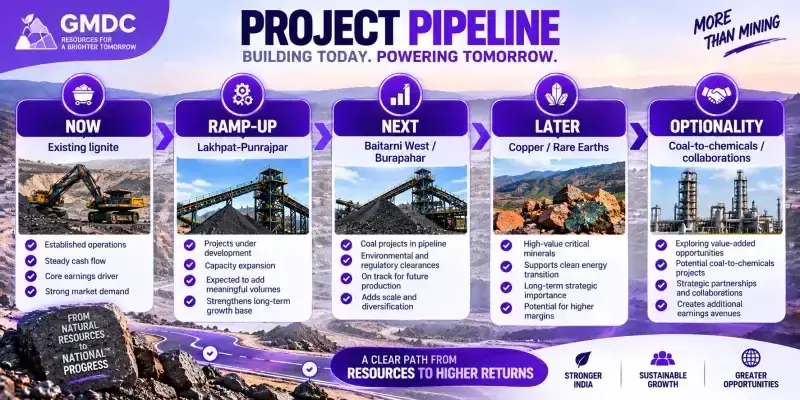
Taken together, the pipeline is substantial, but the value is still largely contingent on execution. The key question is not whether GMDC has resources, but how quickly those resources can move through land acquisition, statutory approvals, mine development, commissioning and production ramp-up. That makes Baitarni West, the Gujarat mine pipeline, Ambaji copper and Ambadungar rare earths the most important milestones to track over the next few years.
“Growth benefits investors only when the business can invest at incremental returns that are enticing.”
— Warren Buffett
Limestone: the quieter industrial optionality
GMDC has cited more than 800 million tonnes of cement-grade limestone reserves and pursued long-term supply arrangements, including a 40-year limestone supply agreement with JK Cement for a greenfield cement plant in Western Kutch.
The opportunity is longer-duration industrial linkage, but the value remains conditional on actual offtake, execution and returns on incremental capital.
Copper: entering a completely different mineral cycle
At Ambaji in Banaskantha, GMDC has been progressing a copper project across roughly 184 hectares. The FY2024–25 annual report described around 7.3 million tonnes of reserves containing copper, lead and zinc, plus trace elements including silver, cadmium, germanium and selenium.
Management has described principal copper content in the 1.5%–1.75% range, total metal content above 10%, potential mine life of 15–22 years and margins above 40%. The catch is operational: the deposit sits beneath a residential area in an ecologically sensitive zone, requiring an underground mine.
Management's May 2025 commentary pointed to FY28 as the operating horizon. This remains development-stage optionality, not current earnings.
Rare earths: the project that can change how the market sees GMDC
Ambadungar in Gujarat's Chhota Udaipur district is arguably the most strategically differentiated part of the portfolio. GMDC is targeting light rare earths and a downstream chain rather than simply selling raw ore.
FY2025 disclosures described more than 1 million tonnes of identified TREO, planned capacity of roughly 18,000 TPA of mixed rare-earth carbonate at Ambadungar, around 12,000 TPA of TREO separation capacity at Bharuch and roughly 1,800 TPA of Nd-Pr oxide. Later FY2026 disclosures refer to updated exploration estimates and planned ore production of about 1.6 MTPA.
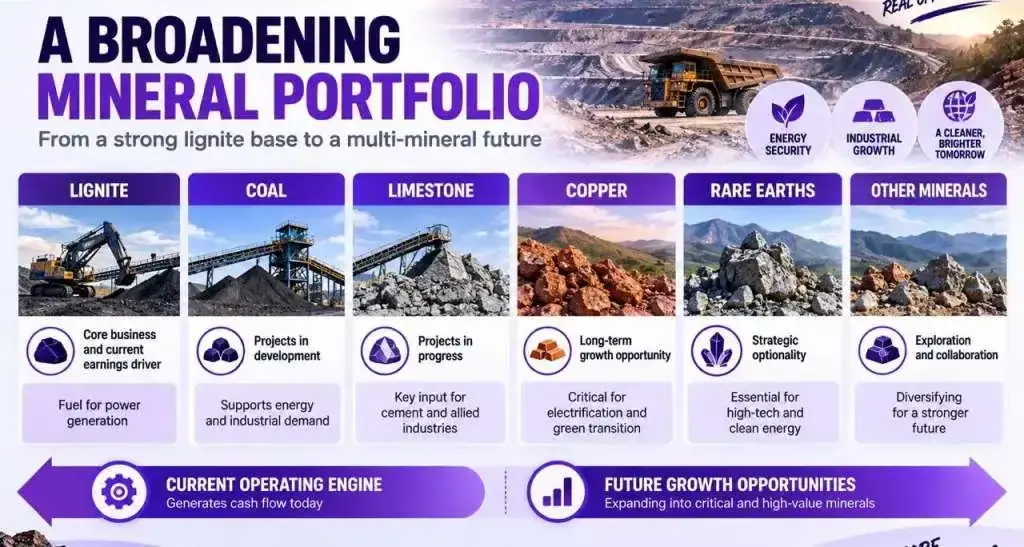
These figures belong to different project stages and estimates. They should not be stacked together as current production. The economic test is beneficiation, chemical processing, separation, capex, product quality and commercialisation. The ambition is a mine-to-magnet chain: mining → beneficiation → chemical processing → separation → downstream manufacturing. Potentially higher value, but also much higher execution complexity.
“Critical minerals are no longer simply commodities; access to them is becoming a question of strategic supply-chain security.”
— Adapted from the IEA’s 2026 critical-minerals declaration
2026: the rare-earth strategy becomes more connected
In June 2026, GMDC announced a partnership with the University of Cambridge to establish a Rare Earth Supply Chain Observatory at its International Centre of Excellence in Mining. The two-year programme was announced with an investment of £600,000 and is designed around AI-enabled tracking of the chain from mine to magnet.
On 31 July 2026, the Board approved a proposed MoU with IREL to explore rare-earth collaboration and a proposed MoU with GNFC to evaluate coal-to-chemicals opportunities, including gasification technologies such as Underground Coal Gasification.
These are collaboration proposals, not completed commercial projects. Their value today is strategic optionality.
The power business: one plant is still a drag
The 250 MW Akrimota Thermal Power Station has been a chronic loss-maker, but generation increased from 88.1 million units in FY25 to 268.6 million units in FY26 — a 205% jump. The segment still posted a pre-tax loss of ₹114 crore.
Wind and solar, by contrast, generated about ₹51 crore of FY26 pre-tax profit on ₹130 crore of renewable revenue. The turnaround in ATPS is underway, not complete.
Project Shikhar: the four-times vision
Project Shikhar is the umbrella behind the transformation. Management has described a goal of quadrupling revenue by 2030, with lignite, coal and critical minerals eventually contributing roughly equally.The plan implies more than ₹13,000 crore of capex through 2030. Management's own breakdown shows land acquisition, rehabilitation and resettlement consuming a large share of the planned spend. That explains why execution can be slow and then accelerate suddenly once clearances arrive.
The Capital Question: ₹1,248 Crore of CWIP
GMDC entered FY26 with a strong internal capital base, with reserves of ₹7,009 crore and fixed assets of ₹2,007 crore, reflecting a sizeable existing productive asset base. At the same time, capital work in progress (CWIP) stood at ₹1,248 crore, representing capital committed to projects and assets that have not yet fully entered the earnings engine. The company also had borrowings of ₹317 crore, which have increased but remain moderate relative to its overall balance sheet, while cash equivalents of around ₹540 crore provide additional funding flexibility. Total assets stood at approximately ₹8,984 crore, indicating an expanding balance sheet as the company invests in its next phase of growth.
The more important development is the increase in CWIP from ₹775 crore in FY25 to ₹1,248 crore in FY26.
This represents a significant rise in capital already committed to projects that are yet to become fully productive. For investors, the key question is therefore not simply how much GMDC is investing, but how efficiently this capital is converted into commissioned assets, operating profit and cash flow. The next test for the company will be commissioning and cash-flow conversion.
The financial bridge: profit is not the same as deployable cash
FY26 standalone operating cash flow was ₹743.72 crore versus ₹1,068.18 crore in FY25, while asset/project-related purchases were about ₹1,034 crore. That implies an approximate ₹290 crore standalone free-cash-flow gap before financing effects.
That is not automatically negative for an expansion-stage mining company. It becomes a problem only if the capital being spent does not eventually produce higher cash generation and better capital returns. https://valueeducator.com/fundamental-analysis-basics/capital-intensive-business-explained
The ₹522.65 crore exceptional item also reinforces why operating cash flow is a better reality check than headline PAT. https://valueeducator.com/fundamental-analysis-basics/cash-flow-statement-explained
The first thing to understand: FY26 profit needs a footnote
GMDC’s financial journey over the past decade shows a business that has gone through significant cycles while maintaining a strong underlying resource base. Sales moved from around ₹1,430 Cr in FY15 to ₹2,523 Cr in FY26, reflecting long-term expansion despite periods of volatility. The sharp increase in sales during FY22–FY23 was followed by a moderation, with FY26 sales remaining broadly stable compared with the preceding years.Profitability has been more volatile than revenue. PAT increased from roughly ₹520 Cr in FY15 to ₹957 Cr in FY26, but the journey included periods of significant fluctuation, including a sharp decline around FY21 followed by a strong recovery in FY22–FY23. By FY26, profit had recovered to a much stronger level, although the underlying quality of earnings needs to be considered alongside exceptional items and other income.
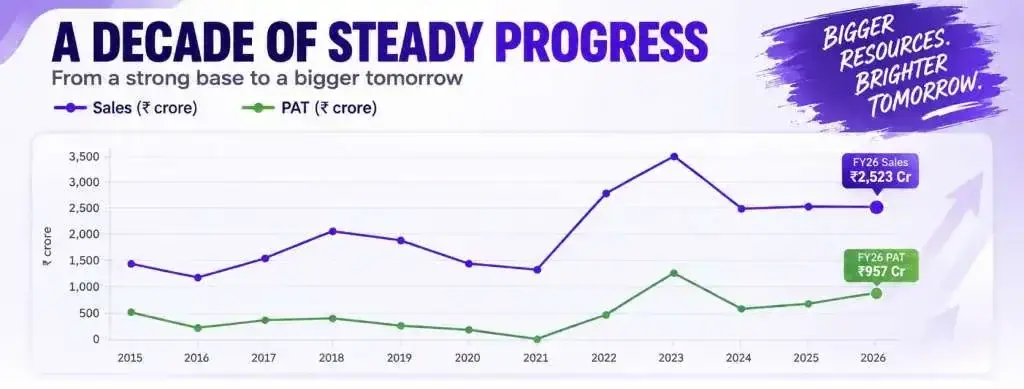
The bigger takeaway is that GMDC has built a sizeable financial base from its existing resource businesses. The next phase of the story, however, depends on whether this base can be converted into sustained growth through new mines, higher production and critical-mineral projects. In other words, the historical chart shows the strength of the foundation; the upcoming project pipeline will determine whether that foundation can support a much larger earnings base. FY26 headline profit benefited materially from a ₹522.65 Cr exceptional ITC gain, while other income was also substantial. As a result, headline PAT is not a clean measure of the underlying operating earnings power of the business.
Project maturity ladder
GMDC’s project portfolio spans multiple stages of maturity, and this distinction is important when assessing the company’s potential value. The existing Gujarat lignite operations represent the current earnings engine and should primarily be valued on their proven earnings and cash-flow generation. At the next stage, Lakhpat-Punrajpar represents an operational/ramp-up opportunity, where investors should focus on how quickly production scales and contributes to earnings.
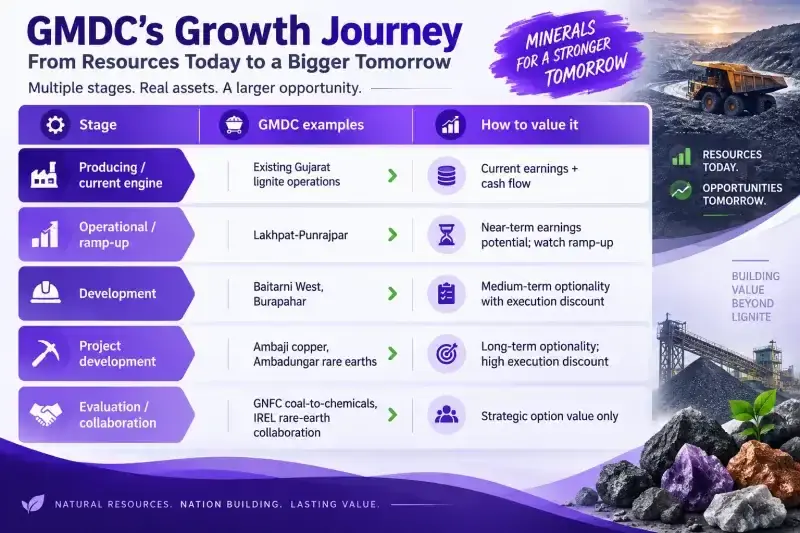
Further along the maturity curve are Baitarni West and Burapahar, which represent medium-term growth opportunities but still carry an execution discount because development, approvals and ramp-up remain ahead. The Ambaji copper and Ambadungar rare-earth projects sit at an even earlier stage and should therefore be treated primarily as long-term optionality rather than valued as established future earnings.
At the earliest stage are initiatives such as the GNFC coal-to-chemicals evaluation and IREL rare-earth collaboration. These should currently be treated as strategic options rather than established earnings contributors. Overall, the maturity ladder highlights an important point for investors: GMDC’s portfolio contains significant resources and opportunities, but each project deserves a valuation that reflects its stage of development, execution risk and distance from actual cash generation.
The GMDC flywheel — and where it can break
GMDC’s growth flywheel starts with existing lignite cash flow, which can be reinvested into new mines and higher production. Higher production can then drive higher cash flow, allowing the company to expand further into critical minerals, build a broader earnings base and ultimately improve ROCE.
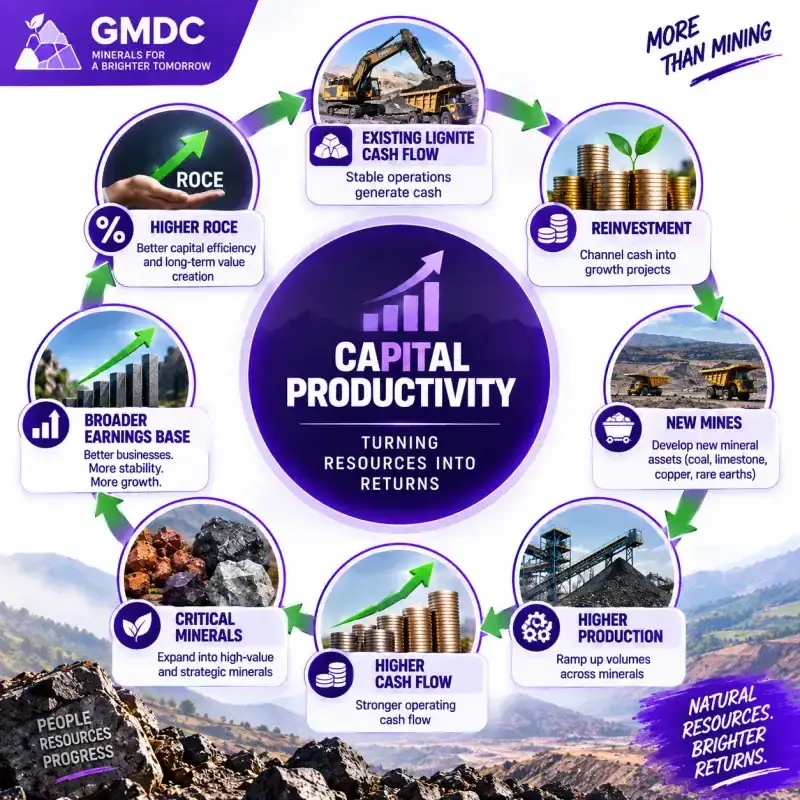
The key break point is capital productivity. If CWIP continues to rise but commissioned assets do not generate proportionately higher operating profit and cash flow, diversification could enlarge the balance sheet without creating equivalent shareholder value.
What actually has to go right?
Lignite volumes must rise without destroying margins. The 97 lakh MT FY27 target needs to translate into sustainable operating profit, not just higher sales.
New mines must move from capital employed to cash generation. Lakhpat-Punrajpar is an encouraging step; the wider Gujarat pipeline must follow.
Odisha must become an operating asset, not remain a resource story. Baitarni West and Burapahar have scale, but land, clearances, development and ramp-up remain decisive.
Copper and rare earths must clear technical and regulatory milestones. Recovery rates, beneficiation, separation, capex, product quality and commercialisation determine economics.
Capital returns must improve. With ROE at 4.22% and ROCE at 10.8%, the expanding asset base needs better earnings conversion. https://valueeducator.com/fundamental-analysis-basics/return-on-equity-roe-explained
Key Risks to Watch
GMDC’s transformation comes with several important risks. Execution risk remains significant because many of the company’s most exciting projects are still at the development stage, making timely commissioning and ramp-up critical to the investment thesis. Commodity-cycle risk is another factor, as lignite, coal, copper and other minerals operate under different pricing and demand cycles, which can create volatility in earnings.
There is also capital-allocation risk, particularly with ₹1,248 Cr of CWIP that needs to be converted into productive, cash-generating assets. Earnings-quality risk should also be monitored because exceptional items and high other income can distort headline profit and make underlying operating performance harder to assess.
Regulatory and environmental risk is inherent in mining and mineral-processing projects, as these developments require multiple approvals and clearances. Valuation risk is also relevant, with the supplied 32.1× P/E implying that the market is already discounting a meaningful degree of future success. Finally, there is guidance-slippage risk, as several project and capex timelines have moved from their original plans, highlighting the importance of tracking whether future milestones are delivered as promised. https://valueeducator.com/fundamental-analysis-basics/the-pe-ratio-decoded-trailing-vs-forward-and-what-is-a-good-pe
“There can be more risk in thinking you know something than in accepting that you don’t.”
— Howard Marks
Explore our Products
Research Framework

Emerging Titans
Combination of quantitative analysis, industry tailwinds, and management assessment - SPRINT investment philosophy

Tiny Titans
Heavy emphasis on scuttlebutt research, plant visits, and early on-ground signals
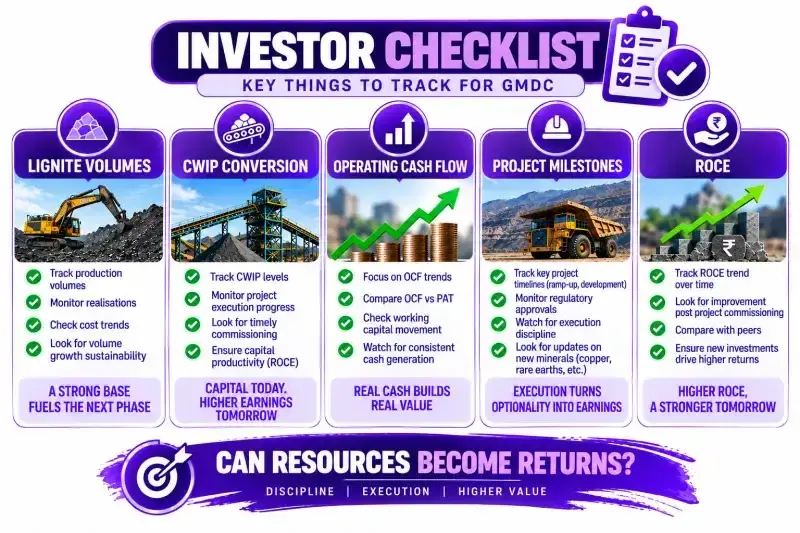
Investor checklist: what to track every quarter
Conclusion
GMDC is compelling because several stories are running at once: a mature but volatile lignite business, a large Odisha coal expansion, a strategically important rare-earth project, an underground copper project, limestone optionality and a thermal power plant being pushed toward recovery.
The market has already begun to value GMDC less like a conventional lignite miner and more like a strategic mineral platform. That is where the opportunity lies — and where the risk lies. https://valueeducator.com/fundamental-analysis-basics/economic-moat-explained
If Odisha becomes operational, if rare earths move from technology and resource statements into production, if Ambaji clears its underground-mining hurdles, and if the existing lignite engine keeps generating cash, the portfolio could look very different from the company investors knew a few years ago.
But if timelines keep slipping, CWIP keeps rising without corresponding cash generation, and ROCE remains modest, the future-facing valuation becomes much harder to defend.
the story has changed — now execution has to prove it. GMDC is no longer simply a Gujarat lignite company. It is attempting to build a broader resource platform spanning lignite, Odisha coal, copper, rare earths, limestone and selected value-added energy businesses.
The first part of the transformation is visible: capital is being deployed, new assets are moving through the pipeline and early FY27 lignite volumes are improving. The second part remains unproven: those assets must become production, operating cash flow and better returns on capital.
That is the real investment thesis. Not simply more tonnes underground, but whether management can turn geological potential into economic value — at a valuation that already assumes a meaningful part of that future.
“Price is what you pay. Value is what you get.” — Warren Buffett
RESOURCES ARE THE STARTING POINT.
EXECUTION IS THE VALUE CREATOR.
FAQs
What is the central transformation GMDC is attempting to achieve?
+GMDC is attempting to transform itself from a Gujarat-focused lignite mining company into a broader multi-mineral resource platform. While lignite remains the existing earnings engine, the company is building a pipeline spanning Odisha coal, copper, rare earths, limestone and selected value-added energy opportunities. The success of this transformation will depend on whether these resources can eventually become productive assets generating revenue, cash flow and attractive returns on capital.
Why does GMDC’s FY26 headline PAT of ₹957 Cr require caution?
+GMDC’s FY26 headline PAT needs to be viewed carefully because the reported profit benefited materially from a ₹522.65 Cr exceptional ITC gain, while other income was also substantial. This means the ₹957 Cr headline PAT does not represent a clean measure of the company’s underlying operating earnings power. Investors therefore need to look beyond reported profit and examine operating performance and cash generation.
Which project is associated with GMDC’s underground copper opportunity?
+The Ambaji copper project in Banaskantha is GMDC’s underground copper opportunity. The project covers roughly 184 hectares, with the FY2024–25 annual report describing around 7.3 million tonnes of reserves containing copper, lead and zinc along with several trace elements. Management has indicated a potential mine life of 15–22 years, but because the deposit lies beneath a residential area in an ecologically sensitive zone, underground mining is required. The project therefore remains development-stage optionality rather than current earnings
What does the ₹1,248 Cr CWIP figure make especially important for investors?
+The ₹1,248 Cr of capital work in progress shows that a significant amount of capital has already been committed to projects and assets that have not yet fully entered the earnings engine. CWIP increased from ₹775 Cr in FY25 to ₹1,248 Cr in FY26. The key question for investors is therefore not simply how much GMDC is investing, but whether this capital can be converted efficiently into commissioned assets, operating profit and cash flow.
Why is Odisha important to GMDC’s future growth story?
+Odisha represents one of GMDC’s biggest potential additions to future operating scale. The Baitarni West project has more than 1 billion tonnes of geological resources, with substantial mineable reserves and a targeted peak capacity of 15 MTPA, potentially expandable to 22.5 MTPA. Burapahar adds another significant coal opportunity. However, these resources are not yet equivalent to operating earnings because land acquisition, approvals, mine development and production ramp-up still need to be completed.
What is GMDC’s FY27 lignite dispatch target?
+GMDC has set a FY27 lignite dispatch target of 97 lakh MT, which is roughly 23% higher than its FY26 dispatches of 78.84 lakh MT. Early FY27 performance showed some improvement, with June 2026 lignite volume reaching about 24.1 lakh MT compared with 19.8 lakh MT a year earlier. However, the company still needs to demonstrate that higher volumes can translate into stronger and sustainable bottom-line growth.

High growth stock specialist, Value Educator
Shashank Mahajan is an equity research professional with over 12 years of experience in identifying high-potential SME and micro-cap stocks at an early stage. He follows a rigorous scuttlebutt research–driven approach, combining on-ground insights with deep financial analysis. Shashank specializes in uncovering under-researched and under-owned companies with strong management quality and long-term growth potential. Through disciplined research and early identification, he focuses on spotting tomorrow’s market leaders before they enter the mainstream investor radar.

Glenmark: The USD 700 Mn Cancer Deal and Its Brands

Pharma Stocks in India 2026: Generics, APIs and CDMOs

Granules India: From Paracetamol to a 65% Gross Margin

Natco Pharma: After Revlimid, 29 Patent Challenges

Shilpa Medicare: Cancer APIs, Films and Biosimilars

Alembic Pharma: US Plants Pay Back, Margin Hits 22.2%
Explore our Products
Research Framework
Emerging Titans
Combination of quantitative analysis, industry tailwinds, and management assessment - SPRINT investment philosophy
Tiny Titans
Heavy emphasis on scuttlebutt research, plant visits, and early on-ground signals



Modern Warfare to Multibaggers
Key Trends. Strategic Shifts. Opportunities Ahead.
Today at 7:00 PM IST. Room opens 30 minutes before.
Don't Miss This Exclusive Webinar!
Join Value Educator to decode the key trends shaping India's defence sector and learn how to identify tomorrow's potential leaders in the space.
- In-depth research on India's defence sector
- Live Q&A session
- Actionable takeaways for long-term investors

 Orders
 Subscription
 Share with friends


Required Details
₹23999.00
(12 month subscription)
As per SEBI regulations, all users are mandated to complete the KYC that is validated for 1 year. Post payment, you will be redirected to the KYC screen


No comments yet. Be the first to comment!