
Transrail Lighting: A Line Builder With Its Own Tower Plants

Between 30 September and 6 October 2026, a Mumbai transmission line builder announced two batches of orders worth ₹574 Cr and ₹412 Cr. Much of that work was not for new lines at all. It was for old lines that need to carry more power on the same towers. Those orders came from POWERGRID, among others, for lines in West Bengal and Tamil Nadu.
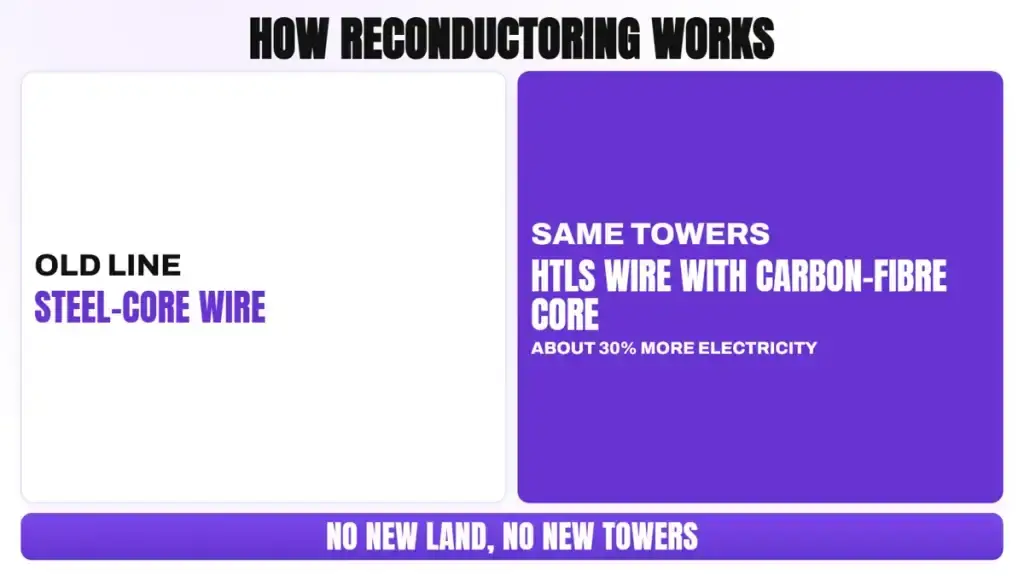
So how do you push more power through a line without building a new one? You use reconductoring, which means taking down the old wires on an existing line and stringing new, better wires on the same towers. India needs this because new lines take years. A new route needs land, forest clearances and the consent of thousands of land owners along the way. Old routes already have all of that. Years are saved.
That new wire is an HTLS conductor, which means a high-temperature, low-sag conductor. It has a light carbon-fibre core in place of the usual steel core. So it can run hotter without sagging towards the ground. Heat is what limits an old line. Management says such a line can carry about 30% more electricity than before.
That brings us to the buyer. POWERGRID is India's central transmission company. It plans and owns most of the high-voltage lines that move power between states. It does not build them with its own crews. Instead, it splits each line into packages and gives each package to an EPC contractor, short for engineering, procurement and construction. The contractor designs the towers, buys or makes the steel and wire, lays the foundations, erects the towers and strings the line. POWERGRID pays it in stages as the work moves along.
That contractor here is Transrail Lighting Ltd (NSE: TRANSRAILL). It has built transmission lines for about four decades, and it has done more than 20 jobs at a time for POWERGRID. What makes it unusual is that it makes the parts too. It runs its own tower plants at Deoli, Vadodara, Butibori and Silvassa, and its own conductor and pole plant at Silvassa. Its HTLS conductors are made there with a carbon core from Epsilon, a French company.
That reach also goes far beyond India. In FY26, about 50.5% of the company's revenue came from projects outside India, in places such as Bangladesh, Nepal, Tanzania and Botswana.
Transrail Lighting in five numbers
- Q2 FY27 revenue of ₹2,056 Cr, up 32%, the highest in its history
- An order book of ₹14,218 Cr in September 2026, plus ₹1,747 Cr of orders in October
- Tower capacity of 1,84,400 tonnes a year, up from 84,000 before its 2024 listing
- About 50.5% of FY26 revenue from outside India, across a footprint of 64 countries
- Operating cash flow of ₹435 Cr in H1 FY27, against ₹29 Cr a year earlier
So a line builder that makes its own towers and wire is now winning reconductoring jobs with its own conductors. What did that do to its numbers? Let's first understand the company, and then look at the latest quarter.
Transrail Lighting: Company Overview
Transrail Lighting Ltd traces its roots to 1984, when Transrail Engineering Company began with foundation work on a 132 kV line, and it is headquartered at Bandra Kurla Complex in Mumbai. Its founder, Digambar Bagde, is the Executive Chairman, Randeep Narang is the Managing Director and CEO, and the promoter company Ajanma Holdings held 69.91% of the shares in March 2026. The company is an EPC contractor for power transmission and distribution, with smaller civil, railway, solar and poles and lighting businesses. It makes its own lattice towers at Deoli, Vadodara, Butibori and Silvassa, its own conductors and poles at Silvassa, and runs a tower testing station at Deoli. It has more than 2,900 employees and a footprint in 64 countries. Revenue was ₹6,880 Cr in FY26, and net debt was ₹143 Cr in September 2026. Read this Yash Highvoltage: Bushing Maker With ₹760 Cr of Orders
"Risk comes from not knowing what you're doing."
— Warren Buffett
Transrail has spent four decades learning one trade: building high-voltage lines, and making the towers and wires that go into them. That depth of know-how is what lets it bid for 765 kV and HVDC lines at home and lender-funded lines abroad.
The Quarter With Transrail's Highest Revenue
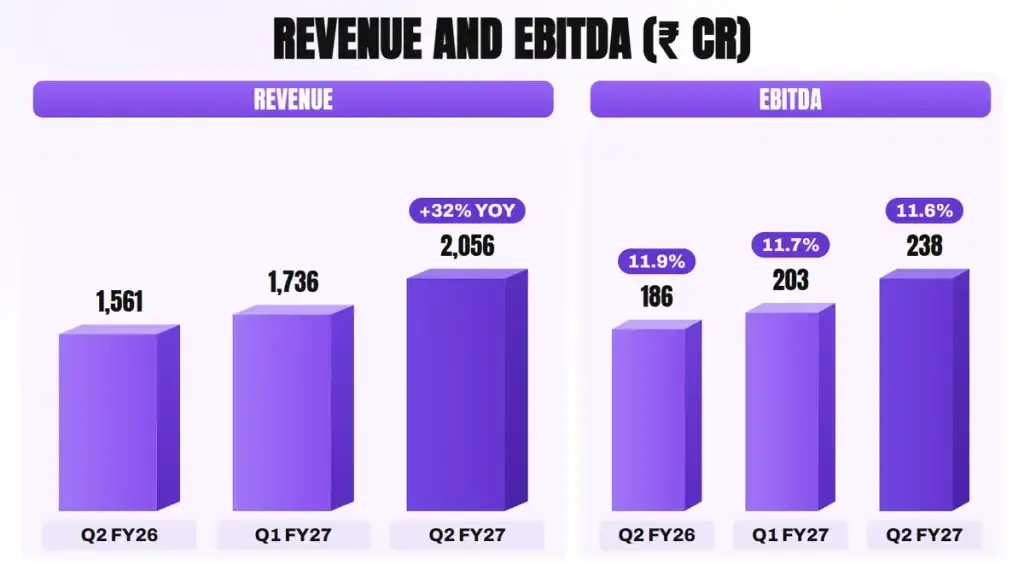
Let's look at Q2 FY27, the July to September quarter, which the company reported on 3 November 2026. Revenue was ₹2,056 Cr, up 32% from ₹1,561 Cr a year ago. That is the company's highest revenue in any quarter so far. A record. It also came after a first quarter of ₹1,736 Cr, so revenue rose 18% in three months.

That jump has a simple cause. EPC revenue is booked as work gets done on the ground, so it follows the stage each project is in, and a quarter full of projects at the building stage bills far more than a quarter full of projects still on the drawing board. By December 2025, about 20 projects had been finished, and the new ones then spent months in design and approvals. By Q2 FY27 those new projects had reached the stage where towers go up and wires get strung, which is where most of the money is billed.
That growth carried through to EBITDA, which rose 28% to ₹238 Cr, at a margin of 11.6%. Read this EBITDA Explained: Uses and Limits That is a little above management's FY27 guidance of about 11%. The margin also sits close to the 11.9% the company earned for the whole of FY26.
But profit after tax grew less, by 12% to ₹104 Cr. Three lines below EBITDA explain the gap. Depreciation rose 35% to ₹20 Cr as the new plants started running. Interest rose 22% to ₹73 Cr, because the company funds its working capital with bank limits. The biggest item was tax, which rose to ₹54 Cr from ₹33 Cr. It included a one-time charge of ₹14.30 Cr, which we come back to near the end. Management expects the tax rate to return to about 25-26%, and the profit margin to settle between 5.5% and 6%.
So the quarter was strong on revenue and margin, and the tax line hid part of it. Cash was better still. Operating cash flow for the half year was ₹435 Cr, against just ₹29 Cr in H1 FY26. Net working capital stayed at 82 days, close to the 81 days of March 2026. Net debt was ₹143 Cr, and debt to equity was 0.31 times. Both CRISIL and India Ratings now rate the company's long-term borrowing at AA-, and India Ratings upgraded it in August 2026.
That cash pattern is not a one-quarter event, as you can see from FY26. Operating cash flow for the full year was ₹642.92 Cr, against a profit of ₹403.59 Cr. So the company turned about 1.6 times its profit into operating cash. Read this Cash Flow Statement Explained One reason is supplier credit. Trade acceptances, which are bills the company's banks accept on its behalf to pay suppliers later, were about ₹1,200 Cr in March 2026. That is cheap working capital for a contractor of this size.
The Orders Behind the Order Book
Now let's turn from revenue to orders, because an EPC company's future is in its order book.
"Behind every stock is a company. Find out what it's doing."
— Peter Lynch
For an EPC contractor like Transrail, what it is doing shows up first in the order filings: which lines it won, in which countries, and with whose conductors. Transrail ended September 2026 with ₹14,218 Cr of unexecuted orders. New orders in H1 FY27 were ₹1,638 Cr. Then the pace picked up sharply, with ₹1,747 Cr of new orders declared in October alone.
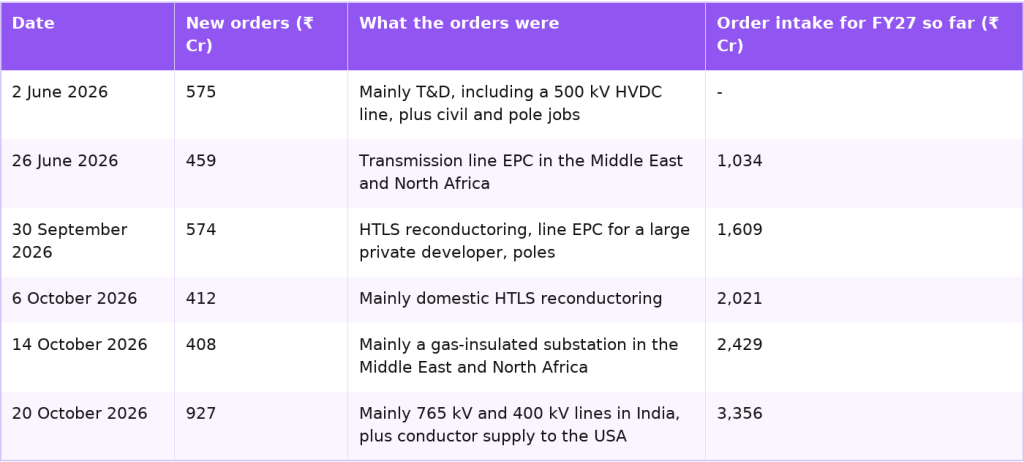
That table shows a clear shift in the mix. Look at the new work. The reconductoring jobs added up to ₹777 Cr, across five jobs where Transrail supplies its own carbon-core conductor and does the stringing. In October the company also won a gas-insulated substation in the Middle East and North Africa and a conductor order from the USA.
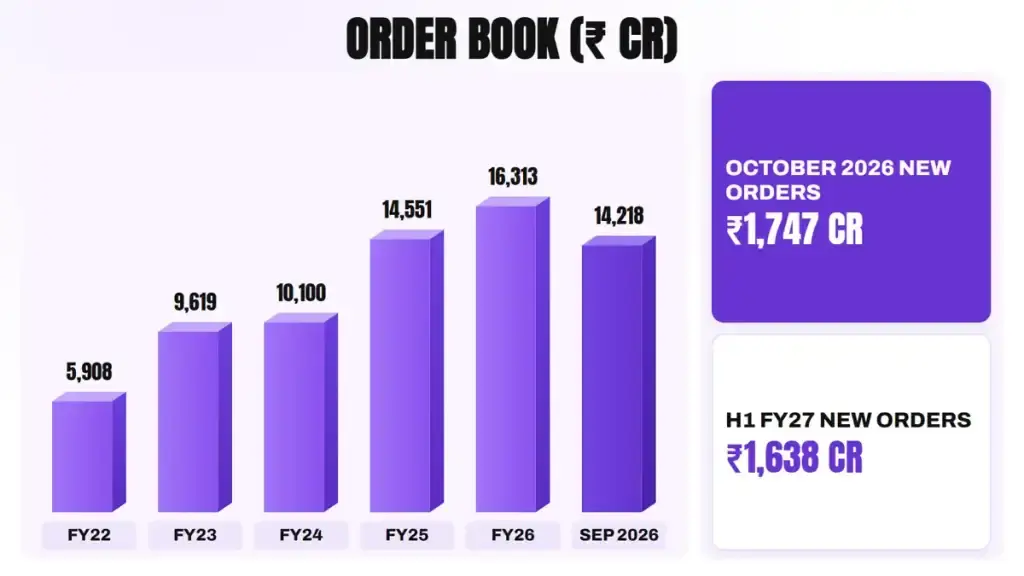
So how far does today's book go? The ₹14,218 Cr book is about 2.1 times FY26 revenue of ₹6,880 Cr. Projects usually run for 24 to 30 months. With the October orders added, the book comes to about ₹15,965 Cr. Management says it has bid for projects of about ₹18,000 Cr that are under evaluation, and expects to bid for another ₹30,000 Cr in the rest of the year.
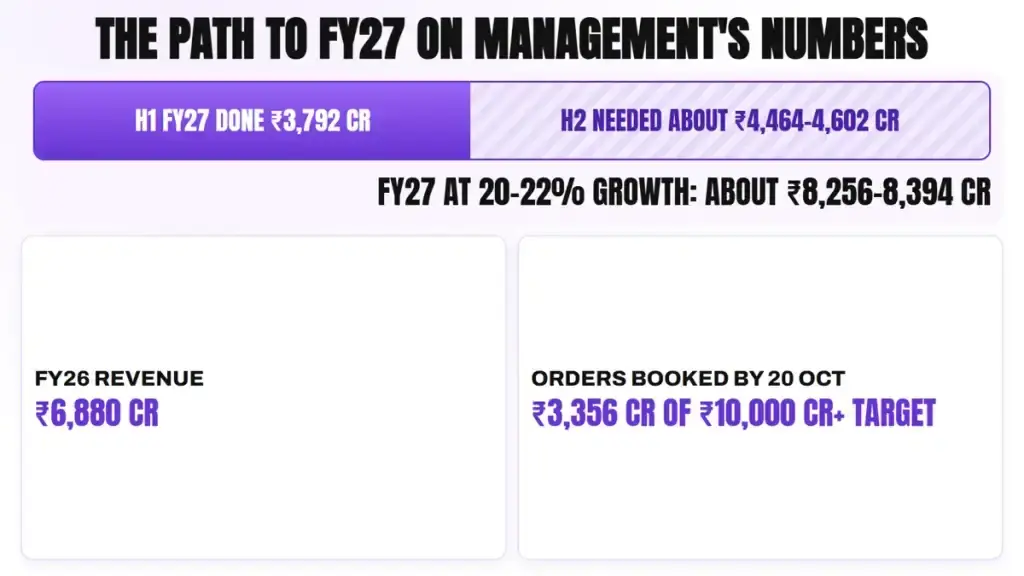
Why the win rate matters: management says Transrail usually wins 10-12% of what it bids. On bids of about ₹48,000 Cr, that rate points to about ₹4,800-5,760 Cr of new orders. Added to the ₹3,356 Cr already booked, that comes to about ₹8,156-9,116 Cr. So the FY27 target of more than ₹10,000 Cr needs a better hit rate or more bids.
How a 132 kV Foundation Job Became a 64-Country Business
That order book took four decades to build, so let's go back to the start. The start was small. Transrail began in 1984 as Transrail Engineering Company, with foundation work on a 132 kV line. Its founder, Digambar Bagde, still leads the board as Executive Chairman. It won its first direct 400 kV line job in 1987 and set up its first tower factory in Baroda in 1993.
Each step after that added one more part of the line. A conductor factory came up in Silvassa in 2007, and the first international turnkey project followed in 2008. The Deoli tower plant near Wardha opened in 2009, and a tower testing station came up there in 2010. In 2012 the company built its first 800 kV HVDC line, the Champa to Kurukshetra link. Substations and railway electrification came in 2017, and a civil division in 2018.
"Since listing, we have not missed any of our revenue or margin guidance, and we continue to be confident to achieve the same trend this year." - Randeep Narang, Managing Director and CEO, November 2026
That record is now public. Transrail listed in December 2024 through an IPO of ₹838.91 Cr. Of that, ₹400 Cr was fresh money for the company and the rest was sold by an existing shareholder. Part of the fresh money paid for the factory expansion, which we look at in the segments below. Ajanma Holdings, the promoter's holding company, owned 69.91% of the shares in March 2026.

Those five years show the scale of the change. Every line grew. Revenue grew about 2.9 times from FY22 to FY26, which the company puts at 31% a year. EBITDA grew about four times, so margins widened along the way. The order book grew from ₹5,908 Cr to ₹16,313 Cr. In FY26 alone, the company finished more than 20 large projects, including seven 765 kV lines in India, and supplied 1,50,000 tonnes of towers.
So the company has kept growing in step with its book. But which parts of the business are doing the growing?
Five Business Lines, One Transmission Core
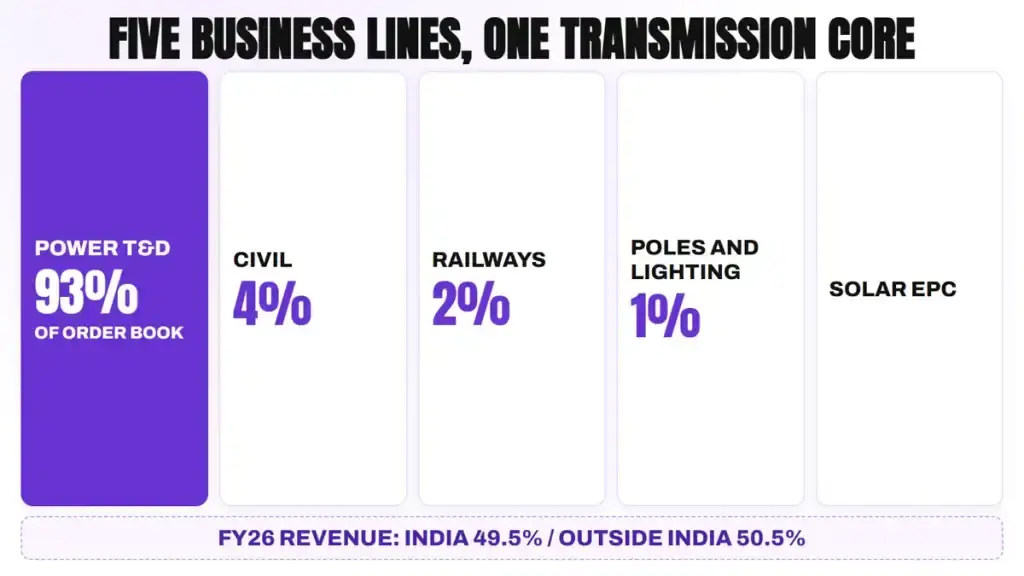
Now let's break the company into its business lines. Transrail reports five: power transmission and distribution, civil construction, railways, poles and lighting, and solar EPC. Power T&D is by far the largest. It made up 93% of the September 2026 order book and 89% of new orders in H1 FY27.
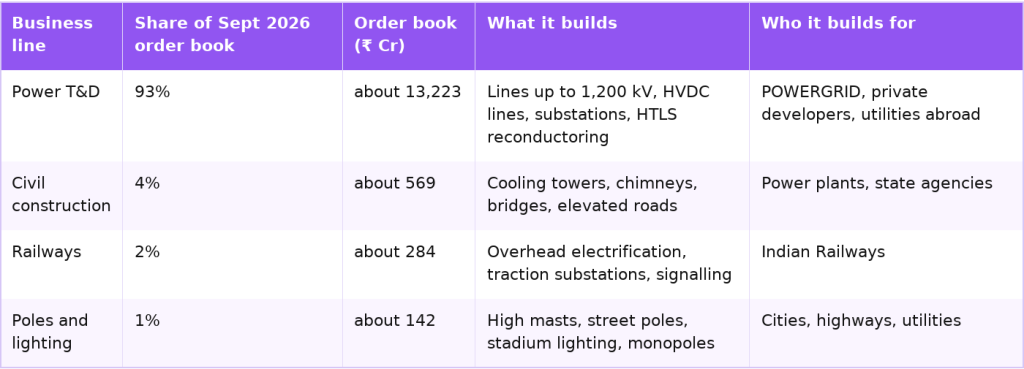
These lines differ in what they build and for whom. Read this Segment-Wise Revenue Analysis Explained T&D builds the network that carries power over long distances, for utilities and developers. The other three are much smaller, and each serves its own buyer: power plants and road agencies, Indian Railways, and city and highway authorities.
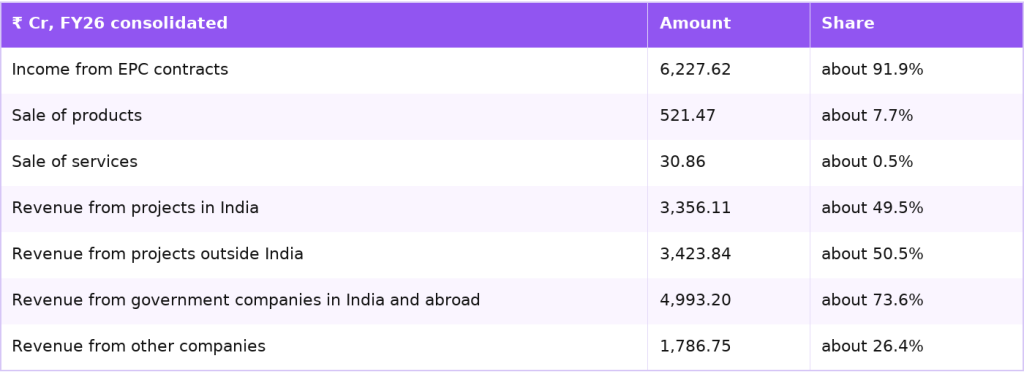
That second table shows how the company earns its money. Almost all its money comes from EPC contracts, where its own towers and wire go into its own projects. Products sold to other buyers are a small part, and management wants that share to grow. The geographic split is close to even, and about three quarters of revenue comes from government-owned buyers in India and abroad.
Transmission Lines in India
Let's begin with the core, which is high-voltage lines in India. The sector data here comes from the government's National Electricity Plan. It plans about ₹9.15 lakh Cr of transmission spending up to 2032. India's ultra-high-voltage lines are expected to grow 26%, from 5,12,621 circuit km in FY26 to about 6,48,000 circuit km by FY32.
A circuit kilometre is the industry's unit for line length. It means one km of a full circuit, with all three phase wires strung. So a double-circuit line counts twice its route length. Transrail has built more than 37,675 circuit km of lines since it began.
This demand comes from new power plants, most of them solar and wind farms far from cities. India's installed generation is expected to rise from 552.9 GW in June 2026 to 874 GW by FY32. Renewable capacity alone is expected to double, from 308 GW to 615 GW. Those farms sit in deserts and open land, so each one needs new lines to reach cities.
Transrail works on the biggest of those lines. In FY26 it completed seven 765 kV projects, including the Khetri to Narela line for POWERGRID. That line carries 8.1 GW of renewable power from Rajasthan to the Delhi region. It also built one package of the 800 kV HVDC line from Khavda in Gujarat to Nagpur. HVDC means high-voltage direct current, used for very long lines because it loses less power over distance. In June 2026 it won a 500 kV HVDC line from a large developer.
POWERGRID is its biggest customer in India. Management has put its share of POWERGRID's orders at about 8-10%. The next wave is the Green Energy Corridor Phase III, which management says has an outlay of about ₹1.86 lakh Cr. That includes about ₹1.36 lakh Cr for lines inside states and ₹50,000 Cr for battery storage. Most of it will be bid out to private developers, who are already Transrail's customers.
Then there is reconductoring, the newest piece, and the one where Transrail's own conductor factory and its own stringing crews come together on a single job. Transrail won five such jobs, worth ₹777 Cr, for POWERGRID lines in West Bengal and Tamil Nadu and for others. It makes the conductor itself and also restrings the line. Management calls these quick jobs with better margins. Its partner Epsilon is also building a carbon-core plant in South India, due in about six months.
Lines Abroad, From Africa to the Americas
Next, let's look at the half of the business outside India, which you may not expect from a Mumbai contractor. Transrail has a footprint in more than 28 African countries. There, it builds lines, substations and rural electrification projects. Most of these are paid for by lenders such as the World Bank, the African Development Bank, KfW and BOAD. Management says it works abroad only on projects funded by such multilateral lenders. That lowers the chance of not being paid.
That funding follows a large need. The World Bank and the African Development Bank run the Mission 300 programme, which aims to connect 300 million people in Sub-Saharan Africa to electricity by 2030. In August 2025, management put the African tenders it qualified for that year at about ₹25,000-30,000 Cr.
Its recent foreign projects show the range, so let's go through a few. In H1 FY27 it finished a 400 kV river-crossing line in Bangladesh, with towers more than 120 metres tall and piles driven 113 metres below the riverbed. It also completed an 18 km, 400 kV cross-border line connecting Nepal to the New Butwal substation. It is building the 400 kV TaZa line in Tanzania and a 400 kV substation at Mmamabula in Botswana. Its Cameroon line won a RoSPA Silver Award for safety.
Beyond Africa and Asia, the newest markets are richer ones. In Q1 FY27 Transrail supplied its first monopoles to Australia, a country that needs almost 10,000 circuit km of new lines. It won a gas-insulated substation in Jordan, and a conductor order from the USA in October 2026. These are small seed orders for now, as management itself says. They do show that Transrail's products pass the tests of developed-market buyers.
That growth abroad came alongside faster growth at home. Revenue from projects in India rose from ₹2,192.50 Cr in FY25 to ₹3,356.11 Cr in FY26, about 53% more. So the share earned outside India came down from about 57.9% to about 50.5%, even as foreign revenue grew. Bangladesh shows how large a single foreign job can be. It was a ₹4,500 Cr book, and by August 2026 only about ₹300 Cr of it was left to do.
Towers, Conductors and Poles
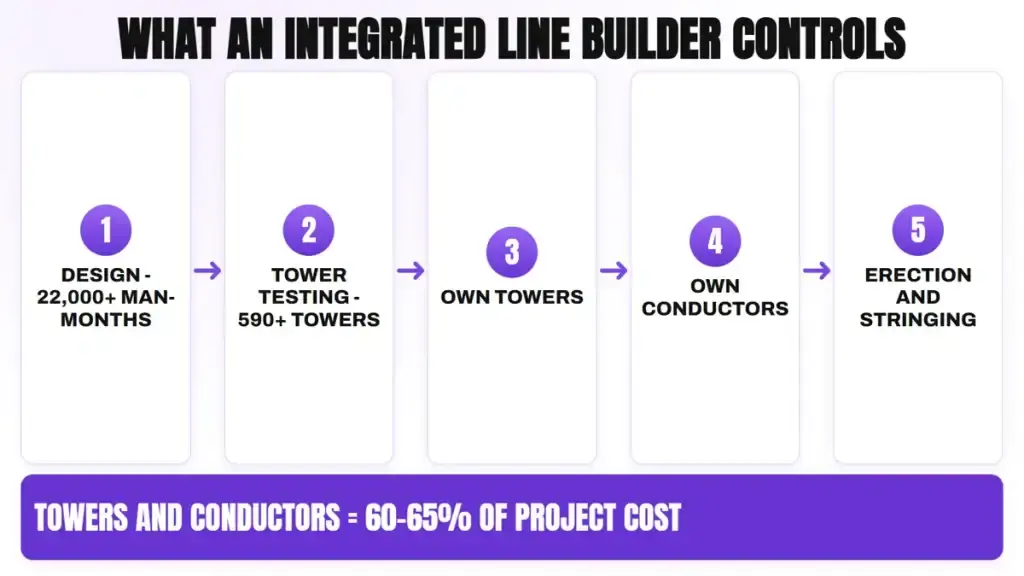
Now let's move to the factories, because, as you will see, they feed every line above. Towers and conductors make up 60-65% of the cost of a transmission project. So a contractor that makes them itself controls most of its supply. That matters.
That is why the company has spent so heavily on capacity since its IPO. Before the IPO, Transrail could make 84,000 tonnes of towers a year. That doubled to 1,72,400 tonnes by the FY26 results, which included the new Butibori plant near Nagpur that started production in April 2026. It then rose to 1,84,400 tonnes in September 2026, after 12,000 tonnes were added at Silvassa. Conductor capacity rose from 24,000 km to 40,800 km a year in September 2026, a 70% increase. The company expects towers to reach 2,00,000 tonnes and conductors 49,500 km by the end of FY27.
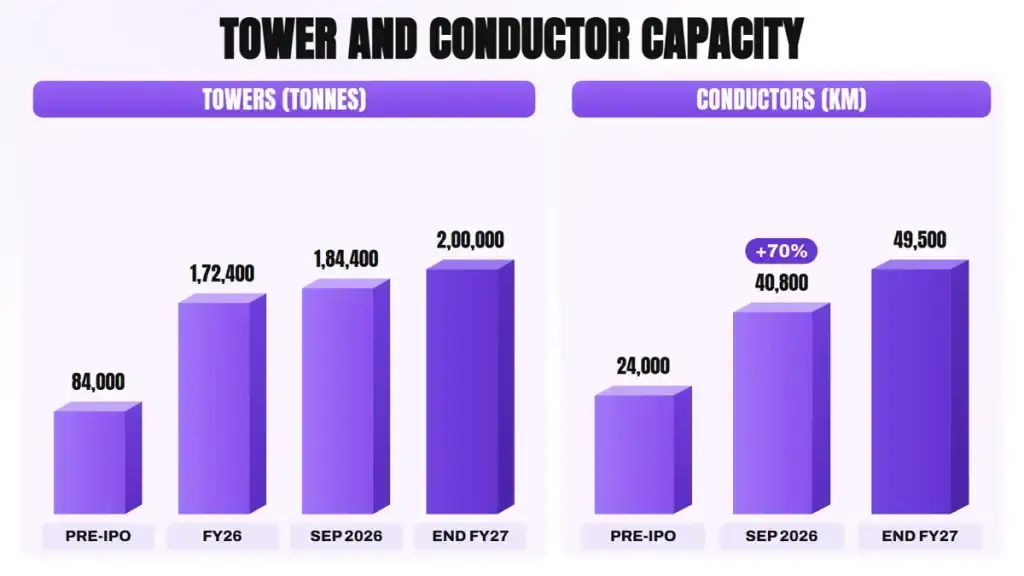
That capacity mostly goes into its own projects. Today 95% of what the plants make is used in Transrail's own lines, and 5% is sold outside. Management wants products sold outside to reach about 7% of revenue. It also has a monopole plant of 12,000 tonnes a year. A monopole is a single steel pole used in place of a lattice tower, where land is tight.
The conductor plant can switch between types as each job needs. It can make standard aluminium conductors or HTLS conductors on the same lines. Transrail supplied HTLS conductors to Cameroon and other foreign projects before it began winning reconductoring jobs in India in 2026.
Civil, Railways, Solar and Lighting
Finally, let's cover the smaller lines, which make up about 7% of the book. They are varied.
The civil division builds tall concrete structures for power plants. It commissioned cooling towers at Udangudi in Tamil Nadu and at Yadadri in Telangana, including towers 199 metres high. It is building a 275-metre chimney for a power plant at Koderma in Jharkhand. In June 2026 it agreed to buy Gactel Turnkey Projects, which adds induced-draft cooling towers, a smaller type used by industry and data centres.
The railway division builds the overhead wires that power trains. In H1 FY27 it completed 167 km of 25 kV overhead lines for Southern Railway. It also supplies masts for the bullet train project. Solar EPC builds solar plants, mainly abroad, and poles and lighting sells masts and street poles.
Beyond these lines, the newest step is power generation. In October 2026 the board approved buying 49% of NOPL Pace Green Energy for ₹20 Cr. It is building about 990 MW of solar plants in Maharashtra, at a project cost of about ₹3,900 Cr. The power is sold to MSEDCL, the state distribution company, at a fixed ₹3.10 a unit for 25 years.
Why an Integrated Line Builder Is Hard to Copy
Now that we have seen all five business lines, let's understand the moat. A transmission line is only as fast as its slowest part. Speed is everything. If the towers or the wire arrive late, the crews and cranes on site wait. So a contractor that makes its own towers and conductors can plan its own delivery dates.
That control matters most when demand is high and tower makers are busy, because a contractor that waits in a queue for steel towers can lose months on a line it promised to finish within two years. Transrail does not take projects without its own supply. Management says it can stagger output between projects, because each project runs for 24 to 30 months. In a busy market, that lets it promise and keep dates that others may struggle to meet.
Next comes approval, the second layer of the moat. A tower design has to be tested at full size before a utility will accept it. Transrail has its own tower testing station at Deoli, which has tested more than 590 towers, some taller than 95 metres. POWERGRID has rated the Deoli tower plant 'A Grade'. Behind the test station sits a design team with more than 22,000 man-months of engineering work. A new contractor would need years to build that record.
"The key to investing is not assessing how much an industry is going to affect society, or how much it will grow, but rather determining the competitive advantage of any given company and, above all, the durability of that advantage."
— Warren Buffett
India's transmission build-out will help many contractors. Transrail's own towers, conductors and test station are what decide whether it keeps its share and its margin as that build-out draws in new rivals.
"People who have done this before, who have backward integration, who have tower test stations, who have a full chain of backward support system to execute projects on time will be people who will thrive better." - Randeep Narang, Managing Director and CEO, November 2026
The third layer is the foreign record. Multilateral lenders choose contractors with a long list of finished projects. Transrail has more than two decades of work abroad, and more than 400 people from India working on its foreign sites. That record is hard to build quickly, because each new country needs a first project before the next one, and lenders look closely at how a contractor has worked under their rules before.
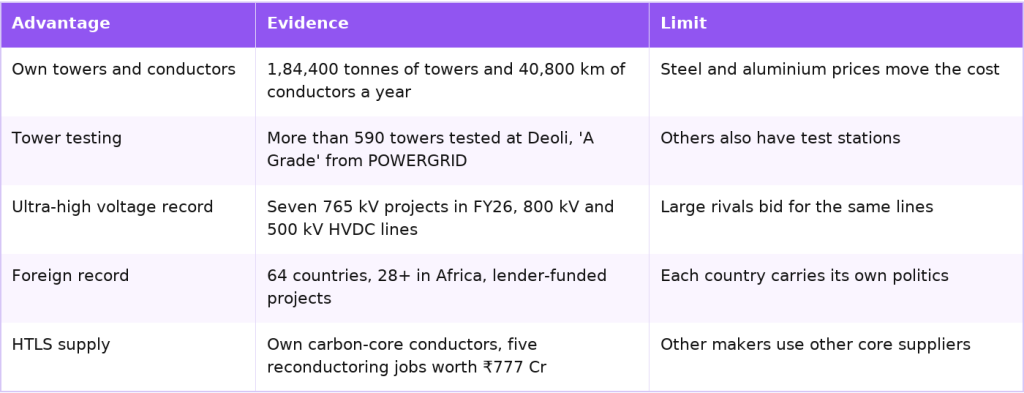
That table also shows why the margin is a test of the moat. A contractor with its own supply should earn more than one that buys everything. Transrail's EBITDA margin was 12.7% in FY25 and 11.9% in FY26. It stayed at 11.6% in Q2 FY27, even with higher fuel and freight costs from the West Asia conflict. Capital is used well too. Return on capital employed was 25.79% in FY26 and 25.1% in H1 FY27, which is high for a contractor that owns five plants.
Financials: Five Years of Growth, Margins and Cash
A single quarter can mislead in a project business, so let's look at five full years together. Revenue here includes other operating revenue, as the company reports it; EBITDA is the company's own measure, and profit is as reported.
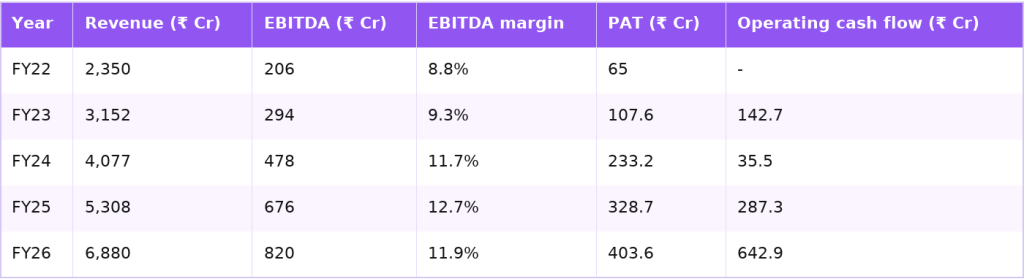
Revenue grew about 2.9 times in four years, from ₹2,350 Cr in FY22 to ₹6,880 Cr in FY26. EBITDA grew about four times, as the margin rose from about 8.8% to a peak of 12.7% in FY25 before settling at 11.9% in FY26. Profit grew faster still, about six times, from ₹65 Cr to ₹403.6 Cr.
Cash flow has caught up with profit over time. From FY23 to FY26, operating cash flow added up to about ₹1,108 Cr, against about ₹1,073 Cr of profit after tax. FY24 was the weak year, at about ₹35.5 Cr, while FY26 brought ₹642.9 Cr as collections improved and working capital fell to 81 days from 91 days in FY25.
The balance sheet has strengthened alongside. Net debt came down from ₹480 Cr in FY23 to ₹267 Cr in FY26 and ₹143 Cr in September 2026, and debt to equity from 0.78 times to 0.31 times. The IPO's ₹400 Cr of fresh money helped, and so did the cash from operations.
"Accounting is the language of business."
— Warren Buffett
In Transrail's accounts, the most telling line is operating cash flow set against profit. For a contractor paid in stages, that gap shows how well it collects for the work it has already done.
What FY27 Could Look Like on Management's Numbers
So where does the company go from here? Let's lay out management's numbers in order. For FY27, it guides for revenue growth of 20-22%, an EBITDA margin of more than 11% and new orders of more than ₹10,000 Cr. In November 2026 it went further. It expects about 20% growth for at least the next three years. That is a long promise.
Now let's put that guidance against the first half. FY26 revenue was ₹6,880 Cr, so 20-22% growth means about ₹8,256-8,394 Cr in FY27. H1 FY27 revenue was ₹3,792 Cr. So the second half needs about ₹4,464-4,602 Cr, or about 1.2 times the first half. That fits the usual pattern for EPC firms, where the second half is the heaviest.
That growth needs capacity, and management says the factories can carry it. With 2,00,000 tonnes of towers by the end of FY27, it says its plants can support an order book of about ₹16,000 Cr. It also says the current capacity is enough for 20-22% growth for the next three years. On top of that, the board approved ₹203 Cr in May 2026 for construction equipment.
"So 85%, 90% will be T&D. We are not diluting our profile in any way." - Randeep Narang, Managing Director and CEO, November 2026
Beyond the factories, the solar stake is the new piece of the plan. Transrail expects to put in about ₹500 Cr of equity over the next year, mostly from its own cash. It targets about 400 MW of the plants by March or April 2027, and the whole project by March 2028. Management says it will update its guidance next year as the plants start to earn.
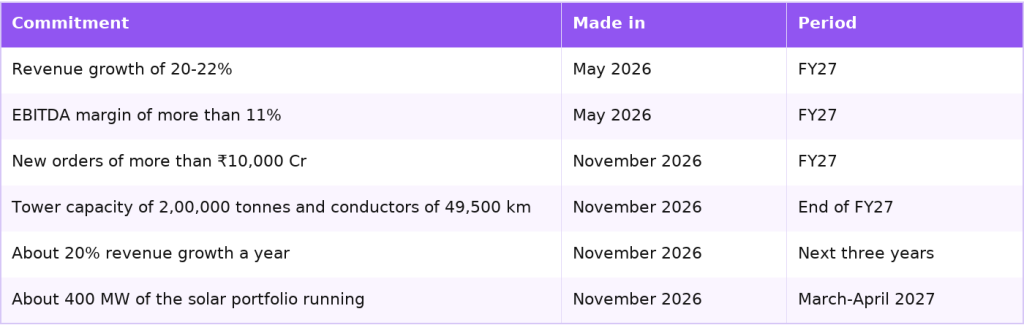
Those commitments are easier to judge against the past. Here is the record. It sets what management guided before against what it delivered.
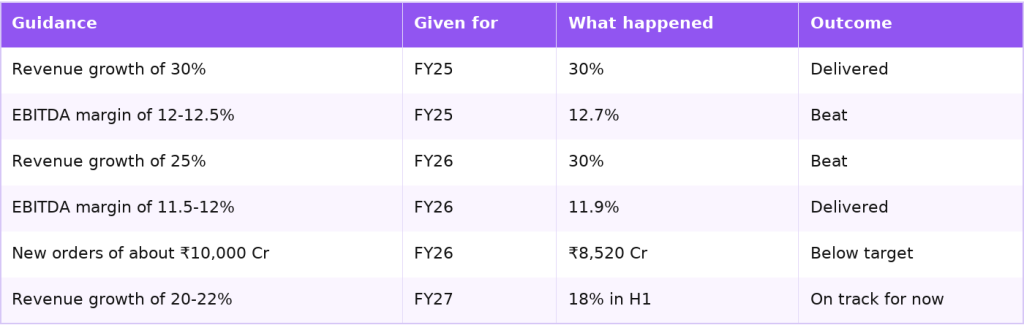
That record is strong on revenue and margins. Orders are the gap. The company met or beat every revenue and margin target since listing. The order target is the one it has not always reached, which is why the FY27 order number is worth watching.
Key Risks
Now let's look at what could go wrong for Transrail Lighting, because some of these risks are already in the filings.
- Order book shrank in the half: the order book fell from ₹16,035 Cr in June 2026 to ₹14,218 Cr in September, because revenue ran far ahead of new orders. H1 FY27 orders of ₹1,638 Cr were well below the yearly target. In FY26 too, orders of ₹8,520 Cr missed the target of about ₹10,000 Cr.
- Income tax search: the Income Tax Department searched the company's offices, plants and the homes of some directors and executives from 24 to 28 March 2026. In September 2026 the company filed a block return for April 2019 to March 2026 and paid ₹14.30 Cr of tax for an incorrect claim of expenses. The block assessment is still going on, and the auditors flag the matter.
- GST demand: in May 2026 an appeals order confirmed a GST demand of about ₹8.23 Cr and a penalty of about ₹42.74 Cr for FY20. The company says there is no material impact and is weighing its options.
- Receivables: receivables older than six months have risen, which management admits and expects to reduce. In Q1 FY27, net debt rose because of delayed collections before it came down again in Q2.
- Related-party dealings: in Q1 FY27 the company had an ₹80 Cr loan to a related party, which management said would be repaid with interest by September 2026. Gactel was bought from Ajanma Holdings, the promoter's own company. The promoter has also made a small pledge of shares, which management called 2-3% and expects to release in six to nine months.
- Fixed prices at home: domestic contracts are mostly fixed price. The company hedges metal prices when it bids, but fuel, freight and labour costs can still move.
- Foreign projects: about half of revenue comes from abroad. The West Asia conflict has already hit supply chains and logistics, and some foreign projects were delayed in Q1 FY27.
- New businesses: the solar stake needs about ₹500 Cr of equity, and the project is about ₹3,900 Cr with large debt. Data-centre and battery storage EPC are still at the team-building stage, and a QIP of up to ₹600 Cr is approved but not yet planned.
- Competition: management says big and small players are entering transmission EPC, which can push bid prices down.
"Risk means more things can happen than will happen."
— Howard Marks
Most of the items above may never hurt Transrail, from the block tax assessment to the GST appeal. But each one is possible, which is why the tracking list below matters.
Explore our Products
Research Framework

Emerging Titans
Combination of quantitative analysis, industry tailwinds, and management assessment - SPRINT investment philosophy

Tiny Titans
Heavy emphasis on scuttlebutt research, plant visits, and early on-ground signals
What to Track Next
If you follow Transrail Lighting, these are the signals we would watch, because they will show where it goes next.
- New orders in H2 FY27 against the target of more than ₹10,000 Cr, with ₹3,356 Cr booked by 20 October
- H2 FY27 revenue of about ₹4,464-4,602 Cr, the level the 20-22% guidance needs
- The outcome of the block tax assessment and the GST appeal
- Tower capacity reaching 2,00,000 tonnes and conductors 49,500 km by March 2027
- More HTLS reconductoring orders, and Epsilon's core plant in South India
- Equity put into the solar portfolio, and about 400 MW running by April 2027
Conclusion
Let's put it all together. Transrail Lighting has grown from a foundation contractor into a line builder with its own tower, conductor and pole plants, working in 64 countries. FY26 revenue was ₹6,880 Cr at an 11.9% EBITDA margin, and Q2 FY27 set a new quarterly record of ₹2,056 Cr.
But the harder part is the order book and the tax matters. The book needs a strong second half of orders to keep growing, and the tax assessment is still open. What happens next depends on whether October's ₹1,747 Cr of orders turns into a year of more than ₹10,000 Cr, and whether the new plants keep the margin above 11%.
FAQs
What does Transrail Lighting do?
+Transrail Lighting is an EPC contractor that builds high-voltage transmission lines, substations and HVDC lines, with smaller civil, railway, solar and poles and lighting businesses. It makes its own towers, conductors and monopoles, and has a footprint in 64 countries. FY26 revenue was ₹6,880 Cr.
How did Transrail Lighting do in Q2 FY27?
+Revenue rose 32% to ₹2,056 Cr, the highest in any quarter so far, and EBITDA rose 28% to ₹238 Cr at a margin of 11.6%. Profit after tax rose 12% to ₹104 Cr, held back by a one-time tax charge of ₹14.30 Cr. Operating cash flow for the half year was ₹435 Cr.
What is Transrail Lighting's order book?
+The order book was ₹14,218 Cr in September 2026, about 2.1 times FY26 revenue, and power T&D made up 93% of it. The company declared ₹1,747 Cr of new orders in October 2026, taking FY27 order intake to ₹3,356 Cr by 20 October.
What is HTLS reconductoring and why does it matter for Transrail?
+Reconductoring means replacing the wires on an existing line with better ones on the same towers. Transrail's HTLS conductors use a carbon core from Epsilon and, management says, let a line carry about 30% more electricity. It won five such jobs worth ₹777 Cr, including POWERGRID lines in West Bengal and Tamil Nadu.
How much manufacturing capacity does Transrail Lighting have?
+Tower capacity was 1,84,400 tonnes a year in September 2026, up from 84,000 tonnes before the IPO, and conductor capacity was 40,800 km a year. The company expects 2,00,000 tonnes of towers and 49,500 km of conductors by the end of FY27. About 95% of what the plants make goes into its own projects.
What are the main risks for Transrail Lighting?
+The order book fell from ₹16,035 Cr in June 2026 to ₹14,218 Cr in September, and H1 FY27 orders were ₹1,638 Cr against a full-year target of more than ₹10,000 Cr. An income tax block assessment after the March 2026 search is still open, and an appeals order confirmed a GST demand of about ₹8.23 Cr and a penalty of about ₹42.74 Cr. About half of revenue also comes from foreign projects.

High growth stock specialist, Value Educator
Shashank Mahajan is an equity research professional with over 12 years of experience in identifying high-potential SME and micro-cap stocks at an early stage. He follows a rigorous scuttlebutt research–driven approach, combining on-ground insights with deep financial analysis. Shashank specializes in uncovering under-researched and under-owned companies with strong management quality and long-term growth potential. Through disciplined research and early identification, he focuses on spotting tomorrow’s market leaders before they enter the mainstream investor radar.
Nuclear Power Stocks in India 2026: Suppliers and Orders
BESS Stocks in India 2026: Battery Storage Value Chain
Transformer Stocks in India 2026: Makers and Order Books

RACL Geartech: Gears for KTM, BMW and Royal Enfield

Skipper Limited: A Tower Maker With ₹10,066 Cr of Orders
Sedemac Mechatronics: 1.45 Million Controllers a Quarter
Explore our Products
Research Framework
Emerging Titans
Combination of quantitative analysis, industry tailwinds, and management assessment - SPRINT investment philosophy
Tiny Titans
Heavy emphasis on scuttlebutt research, plant visits, and early on-ground signals



Modern Warfare to Multibaggers
Key Trends. Strategic Shifts. Opportunities Ahead.
Don't Miss This Exclusive Webinar!
Join Value Educator to decode the key trends shaping India's defence sector and learn how to identify tomorrow's potential leaders in the space.
- In-depth research on India's defence sector
- Live Q&A session
- Actionable takeaways for long-term investors

 Orders
 Subscription
 Share with friends


Required Details
₹23999.00
(12 month subscription)
As per SEBI regulations, all users are mandated to complete the KYC that is validated for 1 year. Post payment, you will be redirected to the KYC screen


No comments yet. Be the first to comment!