
Windlas Biotech: The Contract Maker Behind Pharma Brands

On 5 November 2026, a company from Dehradun reported its 15th quarter in a row of record revenue. Its revenue for the July to September quarter was ₹264 Cr, up 19%, at a time when the Indian pharma market grew only 2.3% in volume. The same month, it said its sixth plant had started commercial supplies, and that two of its plants had received EU GMP certificates.
Most people who take its tablets have never heard its name. Pick up a strip of a well-known Indian brand of a diabetes or heart medicine, and the name on the box belongs to the brand owner. The company that developed the formula and pressed the tablets may be someone else. That someone else is called a CDMO, short for contract development and manufacturing organisation. It means a company that develops and makes medicines for other companies, which then sell them under their own brands.
One company has built most of its business this way. In FY26 it supplied 926 customers, including 8 of the top 10 Indian pharma companies, and made medicines for 5,644 of their brands. It owns the formula rights for 99% of the products it sells.
That company is Windlas Biotech Ltd (NSE: WINDLAS). It runs five working plants in Dehradun, Uttarakhand, with a sixth now coming on stream, and in FY26 its revenue from operations was ₹904 Cr.
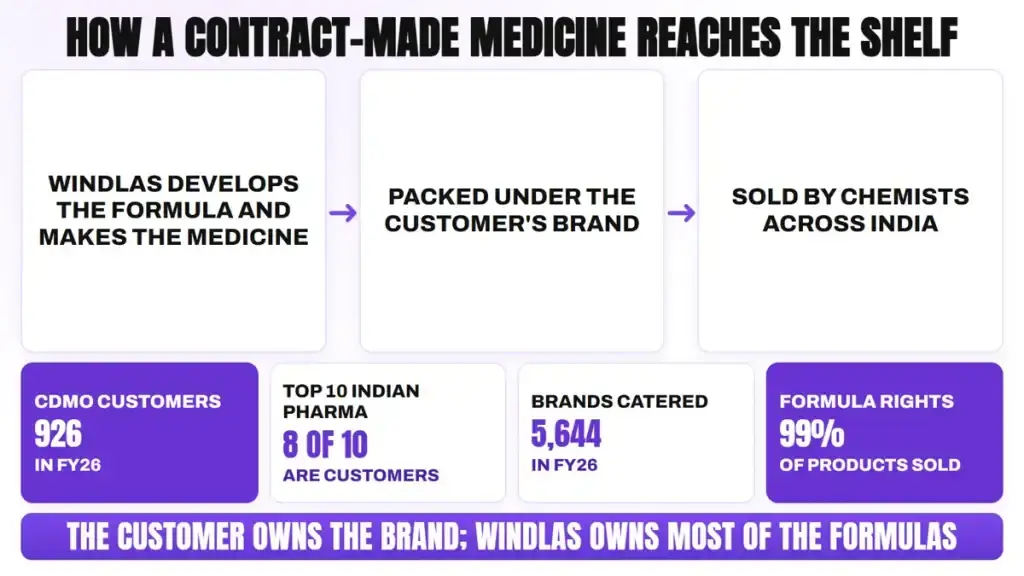
Those medicines are mostly branded generics. The term branded generics means copies of off-patent medicines that a company sells under its own brand name, through doctors and chemists. India's pharma market runs largely on these brands, and the brand owners now hand much of the making to partners like Windlas. Windlas also sells its own trade generics, a term that means generic medicines sold under the maker's own brand straight to stockists, without medical representatives visiting doctors.
Windlas Biotech in five numbers
- Q2 FY27 revenue of ₹264 Cr, up 19%
- Contract manufacturing revenue of ₹215 Cr in the quarter, up 34%
- 926 CDMO customers in FY26, with the top 10 at 32% of revenue
- Net liquidity of ₹223 Cr in September 2026, with no net debt
- Capacity of 8,522 Mn tablets and capsules a year, before the sixth plant
So a company most patients never see now earns more than ₹250 Cr a quarter from medicines sold under other names. Let's first understand the company, and then look at the latest quarter, where its largest business grew fastest.
Windlas Biotech: Company Overview
Windlas Biotech Ltd is a contract development and manufacturing company for generic medicines, with its registered office and plants in Dehradun, Uttarakhand, and a corporate office in Gurugram. It set up its first plant in 2001 and listed on the NSE and BSE in August 2021. Hitesh Windlass is the Managing Director and, from November 2026, the Chairman; Komal Gupta is the CEO and CFO. The company develops and makes tablets, capsules, liquids and injectables for Indian pharma brand owners, and also sells its own trade generic brands and exports. It runs five WHO-GMP plants in Dehradun, with a sixth that began supplies in September 2026, and had 1,385 employees in FY26. FY26 revenue from operations was ₹904.1 Cr, it had no net debt, and the promoter group held 61.9% of the shares in March 2026. Read this Pharma Stocks in India 2026: Generics, APIs and CDMOs
"Know what you own, and know why you own it."
— Peter Lynch
What Windlas does is easy to miss, because its name is not on the box. The sections below show what it makes, for whom, and how its plants earn.
The Quarter Windlas Crossed ₹500 Cr in a Half
Let's look at Q2 FY27, the July to September quarter, which Windlas reported on 5 November 2026. Revenue from operations was ₹264 Cr, up 19% from ₹222 Cr a year ago and above the ₹248 Cr of Q1 FY27. For the first half, revenue was ₹512 Cr against ₹432 Cr, up 18%. It was the first time the company crossed ₹500 Cr in a half year.
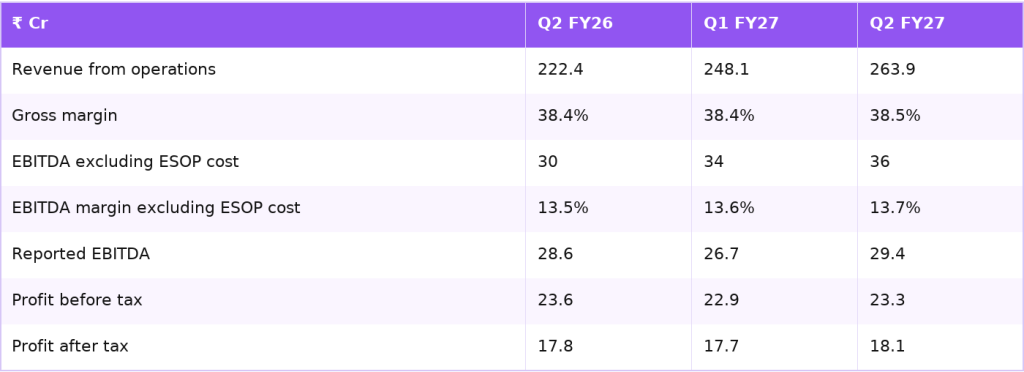
As we can see, that growth came almost entirely from the contract business. The Generic Formulations CDMO vertical brought in ₹215 Cr, up 34% from ₹160 Cr. Exports grew 26% to ₹12 Cr. The Trade Generics and Institutional vertical brought in ₹36 Cr, against ₹52 Cr a year ago, as the company replaced codeine-based cough syrups with other products.

That mix also shaped the margin. The gross margin was 38.5%, close to the 38.4% of a year ago. EBITDA before the cost of employee stock options was ₹36 Cr, up 20%, at a margin of 13.7%. For the half year, it was ₹70 Cr, up 23%, also at 13.7%.
That ESOP line is the key to reading this company's profit today. Read this EBITDA Explained: Uses and Limits An ESOP is an employee stock option plan, and the cost of the options is charged to the profit and loss account over the years they vest, even though no cash leaves the company. Windlas charged ₹14 Cr for ESOPs in H1 FY27, ₹7 Cr of it in Q2. Including that charge, reported EBITDA was ₹29 Cr for the quarter and ₹56 Cr for the half.

Below EBITDA, two more lines held profit back. Finance costs rose to about ₹2.3 Cr from about ₹1.0 Cr, as short-term borrowings went up. Depreciation stayed at about ₹7.6 Cr, because the sixth plant only started in the last month of the quarter. So reported profit after tax was ₹18 Cr, close to the ₹17.8 Cr of a year ago, while profit before the ESOP charge rose 29% to ₹25 Cr.
Those cost lines also show where the money goes as volumes rise. Employee cost, including the ESOP charge, was about ₹47.8 Cr in Q2 FY27, against about ₹36.4 Cr a year ago. In August 2026 management gave three reasons for the rise outside ESOPs: yearly pay increases, more contract workers as production grows, and a higher minimum wage set by the Uttarakhand government, part of it paid with retrospective effect. It added that its growth is mostly volume-driven, so more batches and more customers need more people.
The First Half and the Cash Behind It
Now let's widen the view to the first half, where the cash side is clearer. Profit before tax for H1 FY27 was ₹46.2 Cr, and earnings per share were ₹17.21, the highest for any half year so far. Profit after tax excluding the ESOP charge rose 33% to ₹50 Cr.
That profit turned into cash. Read this Cash Flow Statement Explained Operating cash flow was about ₹53.5 Cr for the half, and capex was about ₹19.8 Cr, mostly for the sixth plant. The company also paid ₹13 Cr of dividend for FY26, or ₹6.30 a share, and spent ₹47 Cr on a buyback of 4,70,000 shares, in which the promoters did not take part.
After those payments, the company still held net liquidity of ₹223 Cr in September 2026, against ₹251 Cr in March. It had no net debt. Return on capital employed was 28% and return on equity 24% for the half, even with the capital tied up in the new plant.
What the first half says: Windlas grew revenue 18% to ₹512 Cr, paid out ₹60 Cr to shareholders through a dividend and a buyback, and still ended September 2026 with ₹223 Cr of net liquidity.
How a Dehradun Family Plant Became a Contract Maker
Now that we have seen the quarter, let's go back and see how the company got here. Windlas set up its first plant in Dehradun in 2001. Its founder, Ashok Kumar Windlass, was its Managing Director from 1 April 2001 and a whole-time director from May 2021. On 5 November 2026, as part of a long-term succession plan, he stepped down from the board and became Founder President. The business is run by Hitesh Windlass, the Managing Director, who also became Chairman that day, with Manoj Kumar Windlass as Joint Managing Director and Komal Gupta as CEO and CFO.
After that first plant, the company grew one site at a time. Plant 4 began in 2009 and made the company's first product for the United States. Plant 2 followed in 2014 and Plant 3 in 2018. Plant 4 was run by a former associate company, Windlas Healthcare, which Windlas acquired and merged into itself.

That growth also drew outside money. The company took ₹750 Mn of growth capital from Tano India Private Equity Fund II. In August 2021 it listed on the NSE and BSE, and it used about ₹43.5 Cr of the issue money for its injectables plant. The promoter group held 61.9% of the shares in March 2026.
Since the listing, the numbers have grown steadily. Revenue rose from ₹465.9 Cr in FY22 to ₹904.1 Cr in FY26, a compound growth of 18% a year. It crossed ₹100 Cr of revenue in 2009-10, ₹200 Cr in FY14, ₹300 Cr in FY17, ₹750 Cr in FY25 and ₹900 Cr in FY26. By March 2026 it had reported 13 quarters in a row of record revenue, and Q2 FY27 made it 15. EBITDA before ESOP cost grew 19% a year over the same period, and the margin on that measure moved from 11.6% to 13.4%. The gross margin moved from 35.0% to 38.4%.

That margin path matters for a contract maker. Windlas describes itself as primarily a cost-plus business, which means it charges customers its cost plus an agreed margin. So when API prices go up or down, much of that change passes through to the customer. The margin moves mainly with the product mix, the share of harder-to-make products and how full the plants run.
"Consistency is not the most exciting word in business, but it is the one our customers & shareholders value the most." - Komal Gupta, CEO and CFO, November 2026
Three Verticals Built on the Same Five Plants
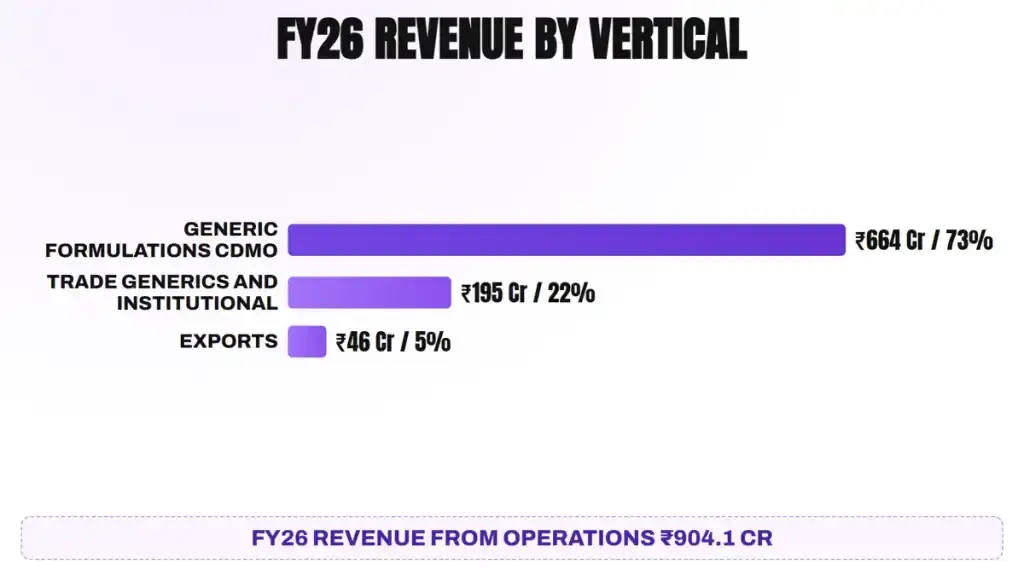
Now let's split the business, because Windlas sells the same plants' output in three different ways. The company reports one segment, pharmaceuticals, but it gives revenue for three verticals every quarter. Read this Segment-Wise Revenue Analysis Explained Each one serves a different buyer. As you will see, the first vertical earns most of the money today, while the other two give the plants extra work and a route into new markets.

These three verticals share one cost base. Each one draws on the same plants, the same quality systems and the same research team. That lets the company fill its plants from three sources instead of one.
Generic Formulations CDMO
Let's start with the largest vertical, contract development and manufacturing. Here Windlas develops a formula, gets the licence to make it and then makes it in bulk for a pharma company that sells it under its own brand. Almost all of these products are based on formulas whose rights Windlas owns from start to approval.
That ownership changes the relationship. A customer that wants to sell a new combination of two diabetes drugs can come to Windlas for a ready formula, instead of developing one itself. Windlas then makes it in its plants and the customer puts its name on the box. In FY26 the vertical served 926 customers, up from 757, and catered to 5,644 brands. It works with 8 of the top 10 and 15 of the top 20 Indian pharma companies.
That customer list has also become wider. The top ten customers made up 52% of CDMO revenue in FY22 and 32% in FY26. The largest single customer went from 13% to 7%. Many small customers mean that no single loss would hurt as much.
That vertical's mix has also moved towards harder products. Complex generics, which refers to fixed-dose combinations, modified-release tablets, chewables and similar formats, were 74% of CDMO revenue in FY26, against 67% a year earlier. Chronic and sub-chronic therapies such as diabetes, heart and nervous-system medicines were 53% of revenue.
Those harder products come out of its research centre in Dehradun, which is approved by DSIR, the government's research department. The team works on formats such as medicated chewing gum, chocolate-flavoured chewable tablets, dispersible tablets and sustained-release products. The number of complex generic variants it offered rose from 1,325 in FY22 to 4,393 in FY26.
"An investment in knowledge pays the best interest."
— Benjamin Franklin
For a contract maker, that knowledge sits in formulas it owns. Each new format gives a brand owner one more reason to stay.
That vertical drove the latest quarter. CDMO revenue grew 34% to ₹215 Cr in Q2 FY27 and 32% to ₹422 Cr in H1, about 82% of company revenue. Management said customers had given it a larger share of their portfolios and new products. That growth was mostly in volume. As a CDMO, Windlas says it does not gain much from price increases in the market, because that benefit goes to its customers, so it watches volume growth more closely. Its customers sell more units when their brands grow, and Windlas makes more units for them. In August 2026 it also said that some machines bought for Plant 6 had been put to work early in Plant 2, which added to output.
This vertical's newest part is injectables. Plant 5, which began in 2024, makes ampoules, liquid vials and lyophilised vials, which are freeze-dried powders that are mixed with water before an injection. The company spent about ₹74 Cr on it. In February 2026 management said the injectables plant could add about ₹100 Cr of revenue, and in August 2026 it said the business was now on track. In Q2 FY27, Plant 4 and Plant 5 received EU GMP certificates.
Trade Generics and Institutional
Next, let's look at the second vertical, where Windlas sells under its own name. Its trade generics go straight to stockists and distributors, with no medical representatives calling on doctors. They cost less than the big brands, and they are aimed largely at smaller towns and rural areas. The institutional part of this vertical sells to government and other large buyers through tenders.
This vertical grew fastest over five years. Revenue rose from ₹61 Cr in FY22 to ₹195 Cr in FY26, about 3.2 times. Windlas had 546 brands in FY26, up from 400, sold through 1,582 stockists and distributors across 29 states.
That growth paused in FY27. The vertical sold codeine-based cough syrups, and those products were discontinued as regulators tightened their oversight of codeine syrups. H1 FY27 revenue was ₹66 Cr against ₹96 Cr. In November 2026, management said it had used this period to replace codeine-based products with new launches that give the business a broader base.
Management is rebuilding along three lines. It is adding more products to the range, opening new states and deepening the ones it already sells in, and adding institutional accounts. It has also offered more liquid products and pack sizes, to keep its liquid lines busy after the codeine products went. Management also points to government support for cheaper generics, such as the Jan Aushadhi scheme, as a long-term driver for this vertical.
Exports
Finally, let's look at the smallest vertical, exports. Windlas sells generic medicines and health supplements to emerging and semi-regulated markets, under its own brands or the buyer's. In FY26 it exported 67 products to 10 countries.
That business takes time to build. Each product needs a dossier, which is the file of data a country's regulator wants before it approves a medicine, and each plant needs that country's approval. Plant 4 has approval from South Africa's drug regulator, and Plant 4 and Plant 5 have GMP certificates from the Philippines and now the EU.
Those approvals are starting to show up in revenue. Exports grew 40% to ₹46 Cr in FY26 and 46% to ₹23 Cr in H1 FY27. In Q1 FY27 alone, exports grew 79% to ₹11 Cr, as some long-running registrations turned into orders. Management does not name the markets or dossiers it is working on, because it treats that list as sensitive. They are still only about 5% of revenue, and management says the vertical has long lead times.
Why Owning the Formula Is the Moat
Now that we have seen the verticals, let's understand the moat. A pharma brand owner that hands its medicine to a contract maker is lending that maker its name. If a batch fails a test, the brand takes the blame. So brand owners audit their makers closely, and once a maker has passed, they do not like to move a product.
That trust takes years to build. A contract maker first has to develop a formula that works and get a licence for it. Then each customer audits its plant and approves it for that product. Only then does the first order arrive, and each new product goes through the same steps. Windlas has done this for thousands of products, and multinational and large Indian customers audit its plants regularly.
"It takes 20 years to build a reputation and five minutes to ruin it."
— Warren Buffett
A brand owner lends its name to every batch a contract maker ships, which is why it audits the plant before the first order and keeps checking after.
Let's look at it from the brand owner's side. If you sell a heart medicine that patients take every day for years, you cannot afford a single bad batch or a late delivery to chemists. So you would rather pay a maker you know a fair margin than save a little with one you have never audited. As we can see from the customer numbers, that is the choice hundreds of Indian pharma companies keep making with Windlas.
Then formula ownership adds a second layer. Windlas owns the rights to almost all the formulas it makes, and it calls this the source of both its gross margin and its customer stickiness. A customer that moves a product away would need a formula of its own. And since many of these are complex generics, they are harder for a small plant to copy.
Beyond formulas, quality rules add a third layer. India's revised Schedule M has made good manufacturing standards stricter, and Windlas says all five of its plants are WHO-GMP compliant and ready for them. Management expects brand owners to move work from smaller, non-compliant makers to larger, compliant ones. In FY26 it spent ₹83 Mn on research, up from ₹63 Mn.
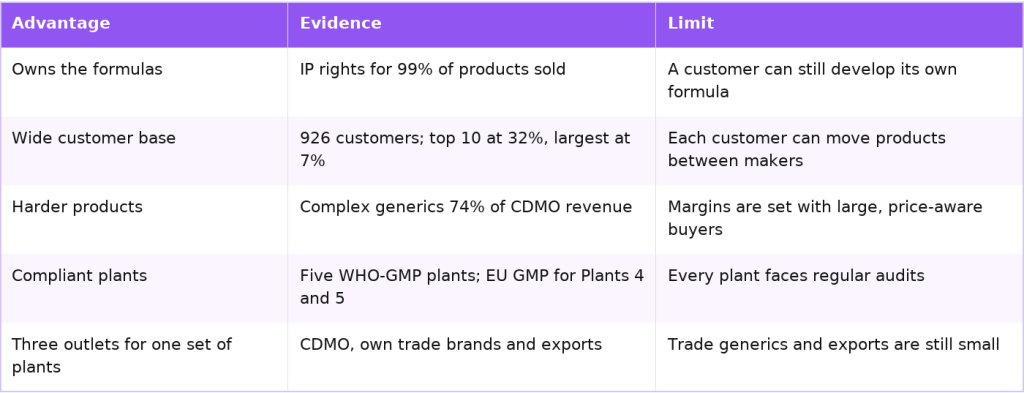
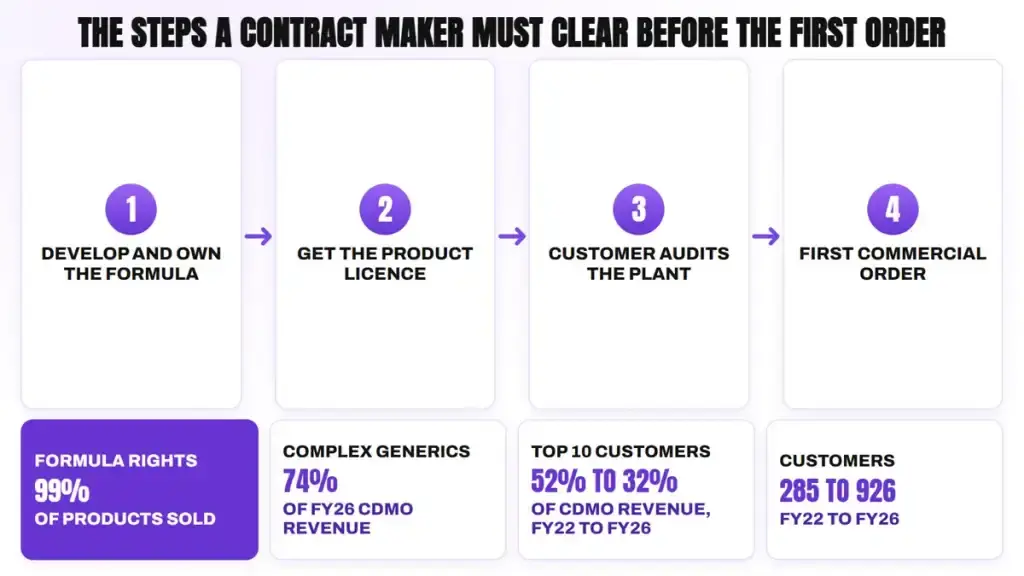
That table shows us why customer numbers are the real test of the moat. If brand owners value the formulas and the audits, the customer list should keep growing and the top customers should keep shrinking as a share. From FY22 to FY26, the customer count rose from 285 to 926, more than three times.
Six Plants in Dehradun and How Full They Run
Now let's look at the plants, because they decide how far revenue can grow before the next spend. Together, the four oral solid plants can make 8,522 Mn tablets and capsules a year, 61 Mn liquid bottles and 54 Mn pouches and sachets.
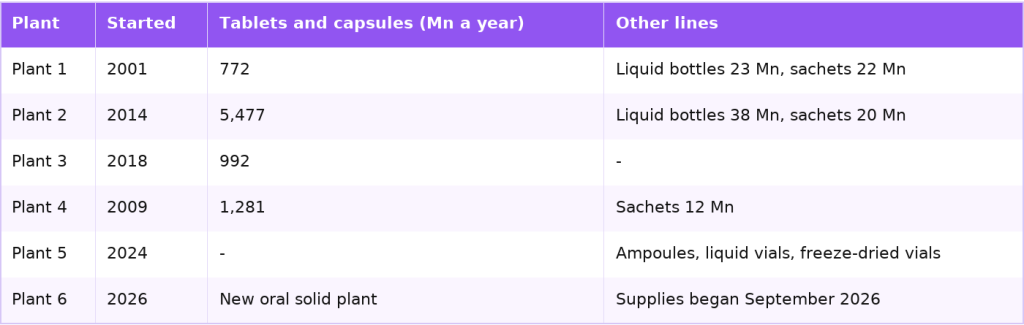
That capacity ran harder in FY26. The plants were used at 66% of capacity, against 59% in FY25. In August 2026 management said 60-65% is the highest level its kind of business usually runs at, which can stretch to about 70%. The gross block of fixed assets was ₹4,262 Mn in March 2026, and the company had 1,385 employees.
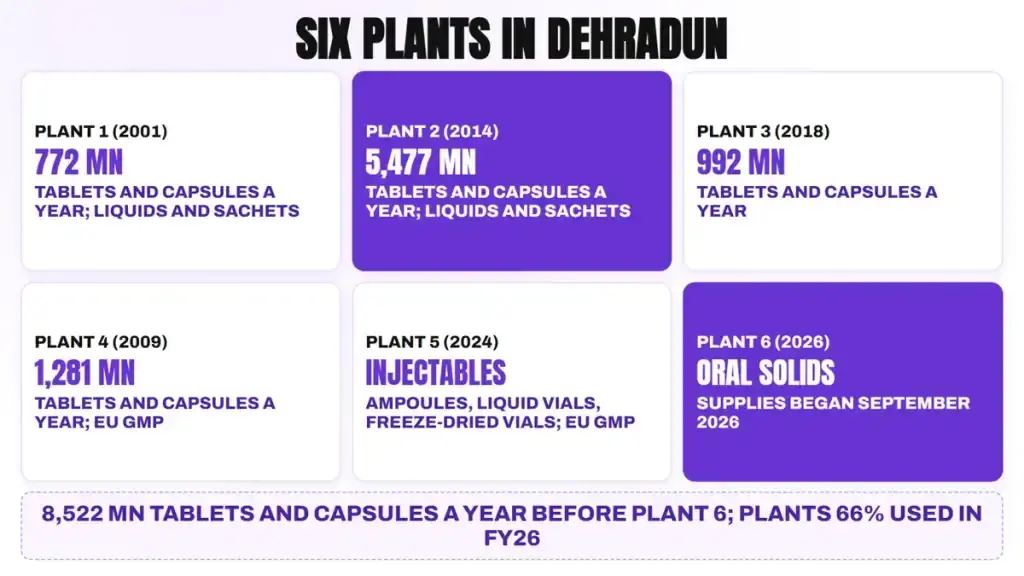
That is why Plant 6 matters. It is a brownfield site that Windlas bought and rebuilt for oral solids. In February 2026 management said it would cost about ₹50-60 Cr. It reached mechanical completion in FY26 and began commercial supplies in September 2026.
That plant should fill faster than the injectables plant did. Management calls Plant 6 an expansion of the core, because it makes the same oral solids that customers already buy. Injectables were a new dosage form, so both Windlas and its customers had to learn and test first. For Plant 6, customers mostly need to approve the new site for products they already buy, without waiting for new product development. Management also expects spare capacity to draw new customers that want a partner able to grow with them.
With Plant 6, management says the company can deliver about ₹1,000 Cr of revenue from oral solids and about ₹100 Cr from injectables, or ₹1,100 Cr in all. It adds that the plants can usually do 10-15% more than the first estimate through small changes, which it puts at a further ₹100-150 Cr. It spends ₹12-15 Cr a year on maintenance capex for this.
Even so, management prefers small steps to one big plant. In August 2026 it said a CDMO with a lot of empty capacity invites customers to push for low-margin work. It also said a new oral solid block on an existing site takes about a year, and an injectables line about 6-8 months once it decides, because the supporting work in Plant 5 is already done.
"Our space is not to try to come and say that we are the cheapest and the largest." - Hitesh Windlass, Managing Director, August 2026
Financials: Five Years of Revenue, Margins and Cash
One quarter can mislead, so let's look at five full years together. EBITDA is shown before the non-cash ESOP charge, as the company reports it; profit after tax is the reported figure, after that charge.

Revenue nearly doubled in four years, from ₹465.9 Cr in FY22 to ₹904.1 Cr in FY26, and EBITDA before the ESOP charge grew faster, to ₹121.4 Cr. The margin on that measure moved from 11.6% to 13.4%, helped by a richer product mix and fuller plants.
Reported profit grew more slowly, from ₹38.1 Cr to ₹66.5 Cr. The gap is mostly the ESOP charge, which rose to about ₹16.6 Cr in FY26 from about ₹2.5 Cr in FY25, and higher depreciation after the injectables plant and the Plant 2 extension came on stream.
Cash has followed profit, with some lumpy years. Operating cash flow added up to about ₹352.2 Cr over the five years, against about ₹413.6 Cr of EBITDA before the ESOP charge. FY22 was weak for cash because of working capital, and FY24 and FY26 were strong. The company paid for its plants from its own funds and had no net debt in March 2026, with net liquidity of ₹251 Cr.
"Show me the incentive and I will show you the outcome."
— Charlie Munger
Windlas has tied a large share of its staff pay to stock options. That charge lowers reported profit for now, but it also links the team's reward to the company's growth.
What FY28 Could Look Like on Management's Numbers
So where does the company go from here? Windlas does not give revenue guidance. Management has said this many times, and it asks investors to look at company-level growth, not single quarters or single verticals. What it does give are capacity numbers, a cost schedule and a payout policy.
Now let's put those numbers against what has been done so far. FY26 revenue was ₹904.1 Cr. The Q2 FY27 revenue rate alone is about ₹1,055.6 Cr a year. Against the ₹1,100 Cr that management says the plants can deliver with Plant 6, that leaves only about 4% of room, before the further ₹100-150 Cr it expects from small changes.
That gap explains why the next capex step is the number to watch. If revenue kept growing at the 18% a year of FY22-FY26, it would reach about ₹1,259 Cr in FY28. Management says it will add capacity before it becomes a limit, starting with injectables or a new block on an existing site, and will announce it when it decides.
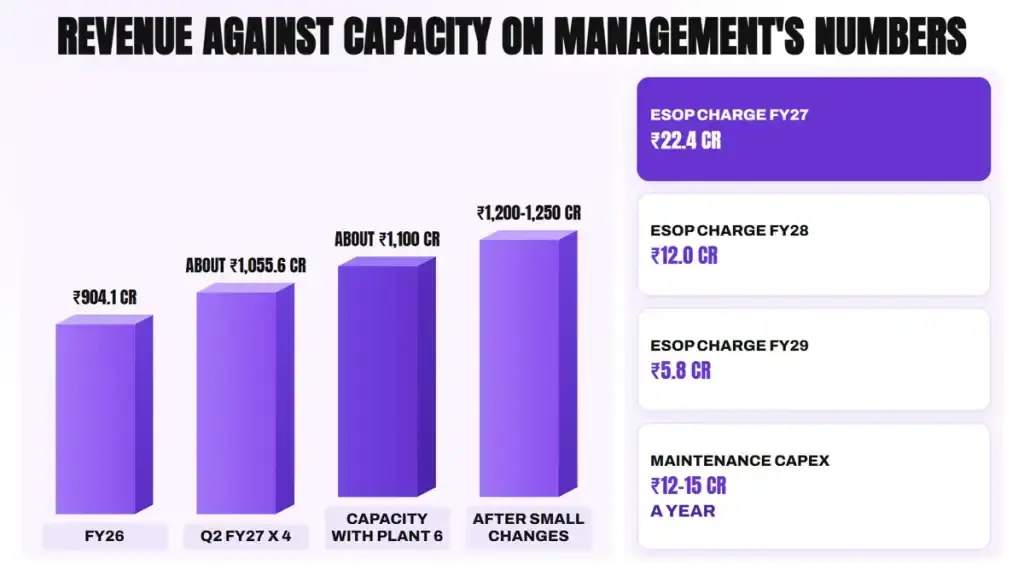
Beyond capacity, the ESOP charge is the second number to watch. The company's own schedule shows the non-cash charge peaking in FY27, at about ₹22.4 Cr for the year, and then shrinking to about ₹12.0 Cr in FY28 and ₹5.8 Cr in FY29. If that schedule holds and the business keeps its margin, reported profit should move closer to profit before the ESOP charge.
The shareholder side is the third piece. Earnings per share rose from ₹18.58 in FY22 to ₹31.60 in FY26, and the company aims to pay out about 20% of profit as dividend, if its capex and cash flow allow. The buyback also cut the paid-up share capital to ₹103.18 Mn in September 2026, from ₹105.53 Mn in March, so each remaining share now carries a slightly larger part of the profit.
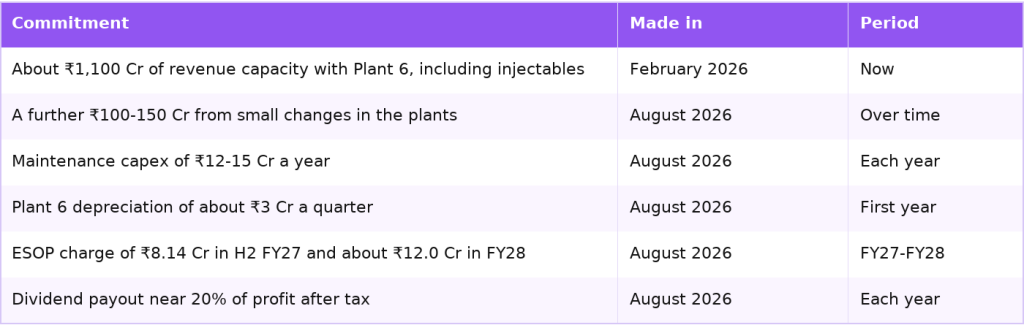
Those commitments are easier to judge against the past. So let's check what management said before against what it delivered.
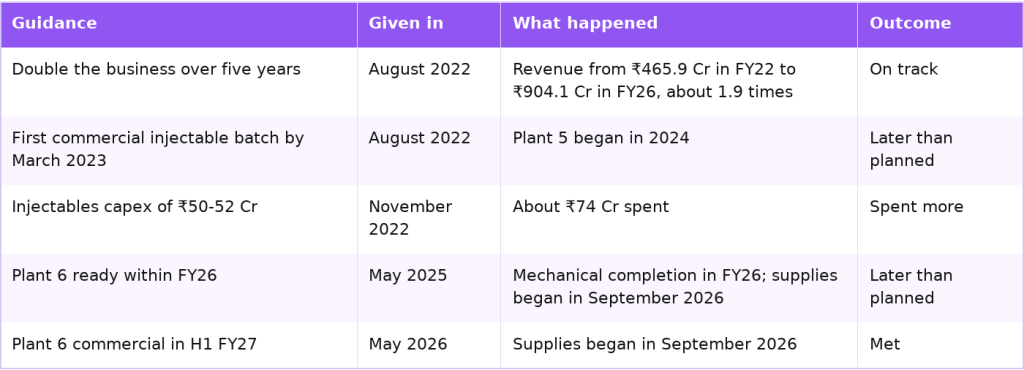
That record shows us a clear pattern. On growth, Windlas has done what it said: revenue nearly doubled in four years. On projects, it has run late, first with injectables and then with Plant 6. That makes the fill rate of Plant 6 and the timing of the next step the things to watch from here. For us, the useful test is simple: if Plant 6 fills and revenue keeps growing near its past pace, we should see the capacity question come up again within the next few quarters.
Key Risks
Now let's look at what could go wrong for Windlas Biotech, because some of these risks are already showing up in the numbers.
- Trade generics after codeine: the Trade Generics and Institutional vertical fell 31% in H1 FY27 after codeine-based cough syrups were discontinued. Institutional sales are lumpy, and in August 2026 management said the vertical's momentum had taken a hit for a few quarters.
- Reported profit lagging revenue: revenue grew 19% in Q2 FY27, but reported profit after tax rose only about 1.4%, because of the ESOP charge and higher finance costs. The ESOP charge runs into FY30 on the company's schedule.
- Working capital and borrowings: inventory rose to about ₹113.3 Cr in September 2026 from about ₹61.8 Cr in March, and receivables to about ₹288.6 Cr from about ₹227.4 Cr. Short-term borrowings rose to about ₹46.2 Cr from about ₹29.9 Cr. Management linked part of the stock build to geopolitical factors.
- API prices: in August 2026 management said API prices and availability were still volatile. As a cost-plus maker it passes much of this on, but sharp moves can squeeze margins while prices are reset with customers.
- Capacity and project delays: the plants already ran at 66% in FY26, and the Q2 FY27 revenue rate is close to the ₹1,100 Cr capacity. Past projects ran late, and no new capex has been announced yet.
- Customer and industry demand: the top ten customers still make up 32% of CDMO revenue. The company's growth also depends on Indian pharma volumes, which grew only 2.3% in Q2 FY27.
- Quality and regulation: every plant faces customer and regulator audits, and one failed inspection could stop supplies from that plant.
- Cyber security and leadership change: the company disclosed a cyber security incident on 30 October 2026 and said it had no material impact on operations. The founder left the board on 5 November 2026 as part of succession planning.
The company had no contingent liabilities in March 2026.
"With codeine being taken away, there has been some impact to our TGx and institutional vertical in terms of the momentum." - Komal Gupta, CEO and CFO, August 2026
"You can't predict. You can prepare."
— Howard Marks
For Windlas, preparing means watching a few numbers closely: trade generics after codeine, stock and receivables, API prices and how fast Plant 6 fills. The tracking list below covers each of them.
Explore our Products
Research Framework

Emerging Titans
Combination of quantitative analysis, industry tailwinds, and management assessment - SPRINT investment philosophy

Tiny Titans
Heavy emphasis on scuttlebutt research, plant visits, and early on-ground signals
What to Track Next
If you follow Windlas Biotech, these are the signals that will show where it goes next.
- Q3 FY27 revenue, and whether the record-revenue run reaches a 16th quarter
- Plant 6 customer approvals and how quickly it fills
- Trade Generics and Institutional revenue against ₹36 Cr in Q2 FY27, as new launches replace codeine syrups
- Any decision on new capacity, in injectables or oral solids
- Inventory, receivables and short-term borrowings against September 2026 levels
- Export orders after the EU GMP certificates for Plants 4 and 5
Conclusion
Let's put it all together. Windlas Biotech has grown from ₹465.9 Cr of revenue in FY22 to ₹904.1 Cr in FY26, mostly by developing and making branded generics for Indian pharma companies in its own Dehradun plants. Its own trade brands and exports now give the same plants two smaller outlets. In H1 FY27 it earned ₹50 Cr of profit before the ESOP charge, and it holds ₹223 Cr of net liquidity.
Still, the next step is different from the last one. What happens next depends on whether Plant 6 fills as fast as the earlier plants did, whether trade generics grow again after codeine, and when the company decides on its next block of capacity.
FAQs
What does Windlas Biotech do?
+Windlas Biotech develops and makes generic medicines for Indian pharma companies, which sell them under their own brands. It also sells its own trade generic brands and exports. In FY26 it served 926 contract customers, including 8 of the top 10 Indian pharma companies, and its revenue was ₹904.1 Cr.
How did Windlas Biotech do in Q2 FY27?
+Revenue from operations rose 19% to ₹264 Cr, its 15th record quarter in a row. EBITDA before the non-cash ESOP charge rose 20% to ₹36 Cr at a margin of 13.7%, and reported profit after tax was ₹18 Cr.
What are Windlas Biotech's business verticals?
+It has three: Generic Formulations CDMO, which was 73% of FY26 revenue, Trade Generics and Institutional at 22%, and Exports at 5%. In Q2 FY27 the CDMO vertical grew 34% to ₹215 Cr, while trade generics brought in ₹36 Cr after codeine-based syrups were discontinued.
Where are Windlas Biotech's plants?
+All its plants are in Dehradun. Four oral solid plants can make 8,522 Mn tablets and capsules a year, Plant 5 makes injectables, and Plant 6 began commercial supplies in September 2026. The plants were used at 66% of capacity in FY26.
What is Windlas Biotech's capacity plan?
+Windlas does not give revenue guidance. Management says that with Plant 6 its plants can deliver about ₹1,100 Cr of revenue, including about ₹100 Cr from injectables, with a further ₹100-150 Cr possible from small changes in the plants.
What are the main risks for Windlas Biotech?
+The main risks are slower trade generics after codeine syrups were discontinued, the ESOP charge on reported profit, higher stock, receivables and borrowings in September 2026, volatile API prices, and the need for new capacity as revenue nears what the plants can deliver.

High growth stock specialist, Value Educator
Shashank Mahajan is an equity research professional with over 12 years of experience in identifying high-potential SME and micro-cap stocks at an early stage. He follows a rigorous scuttlebutt research–driven approach, combining on-ground insights with deep financial analysis. Shashank specializes in uncovering under-researched and under-owned companies with strong management quality and long-term growth potential. Through disciplined research and early identification, he focuses on spotting tomorrow’s market leaders before they enter the mainstream investor radar.
More about Shashank Mahajan →
PCBL Chemical: Carbon Black Margins and Battery Materials

KEC International: Record Orders, Weak Margin, High Debt

Sona BLW: EV Revenue Now Tops Half of Its Auto Sales

HPL Electric & Power: Smart Meters, Wires and Two Engines

Kaynes Technology: EMS, Chip Plants and ₹10,563.5 Cr Orders

Sterlite Technologies: Glass Rods to Hyperscaler Deals
Explore our Products
Research Framework
Emerging Titans
Combination of quantitative analysis, industry tailwinds, and management assessment - SPRINT investment philosophy
Tiny Titans
Heavy emphasis on scuttlebutt research, plant visits, and early on-ground signals



India's Aerospace Opportunity
Global Demand. Supply Bottlenecks. Opportunities Ahead.
Don't Miss This Exclusive Webinar!
Join Value Educator to decode the key trends shaping India's aerospace sector and learn how to identify tomorrow's potential leaders in the space.
- How the aircraft value chain works, layer by layer
- Indian companies supplying global aircraft makers
- A framework to judge any aerospace company

 Orders
 Subscription
 Share with friends


Required Details
₹23999.00
(12 month subscription)
As per SEBI regulations, all users are mandated to complete the KYC that is validated for 1 year. Post payment, you will be redirected to the KYC screen


No comments yet. Be the first to comment!