
Missile and Ammunition Stocks: 2026 Outlook

1. Introduction:
For as long as anyone can remember, the logic of the battlefield has stayed pretty much the same: when the talking ends, and the shooting starts, the side with the bigger pile of ammo usually wins. It’s a grim reality that’s hitting home right now.
Everyone loves to talk about "smart" tech and flashy drones, they get all the headlines—but at the end of the day, you can't sustain a real conflict if you run out of missiles and shells by the first weekend. A high-tech arsenal is useless if it’s empty.
India is clearly reading the room. They’re done just being "customers" on the global market. There’s this massive, aggressive shift happening toward building things at home, basically making sure that if things ever go south, they aren’t waiting on a shipment from halfway across the world. It’s a total overhaul of their defense DNA, and it’s creating a massive opening for local shops and tech startups to finally prove what they can do.
Yet the market has been quick to react. Many listed defence companies have already seen significant investor interest, raising an important question as we approach 2026: is India’s missile and ammunition build-up still an underappreciated structural investment theme, or has it become a crowded trade riding the momentum of geopolitical headlines?
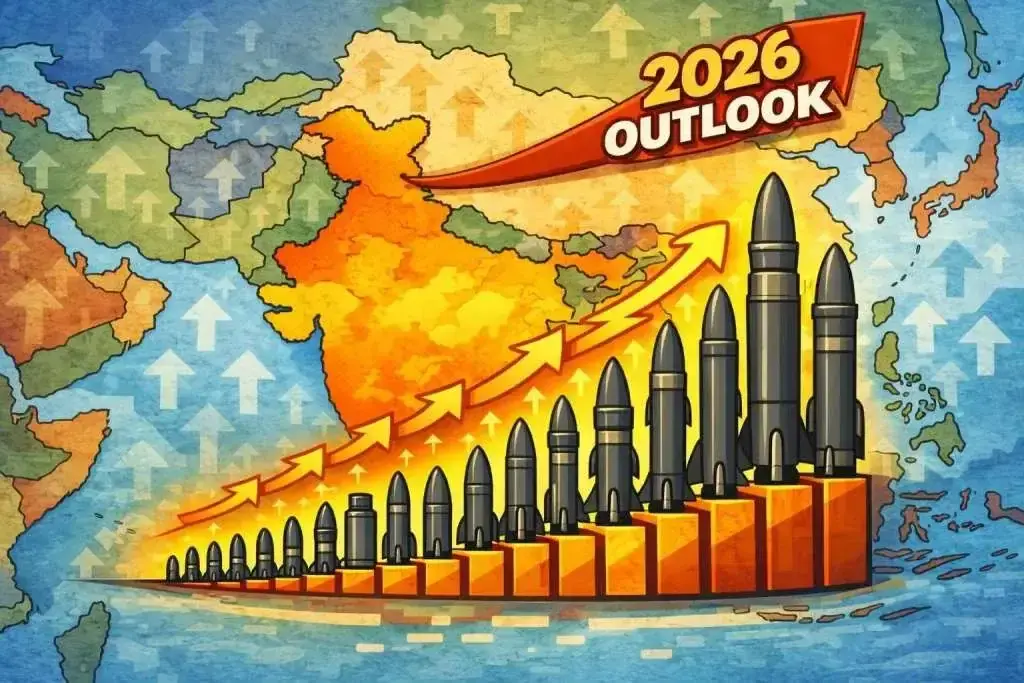
2. India’s Position in Global Geopolitics (2026 Perspective)
China’s missile game, specifically with their DF-21 and DF-26 "carrier killers," has basically forced India’s hand. You can’t just sit back when your rival can strike from thousands of miles away. This explains why India is suddenly obsessed with its own "missile ecosystem." It’s not just talk; they’re cranking out Akash surface-to-air systems and pushing the envelope with hypersonic trials. When they tested the MIRV-capable Agni-V recently, it sent a very clear message: India is building a long-term wall, not just a temporary fence.For anyone watching the money, this doesn't feel like a typical "spending spree" that will fizzle out in a year or two. This is a structural pivot. The proof is in the export numbers. Going from ₹2,059 crore to over ₹23,000 crore in less than a decade isn't a fluke; it’s a sign that Indian factories are finally finding their groove on the world stage. We're witnessing a complete DNA shift in how the country handles its own defense.
This isn't just a lucky streak; it’s a massive, intentional shift in how India handles its defense. For decades, the country was basically the world’s biggest "customer" for weapons. Now, that’s flipping. The goal is a domestic powerhouse, and between the new export policies, private companies finally getting a seat at the table, and DRDO’s research, the momentum is actually starting to look sustainable.
It should be noted that India’s defense budget was roughly ₹6.2 lakh crore for FY2025. That’s massive. But the real "aha" moment is where that money is going. Instead of sending those checks to foreign contractors, about 70–75% of the procurement budget is now strictly reserved for Indian companies. It’s a guaranteed payday for local manufacturers.
They’ve also played a bit of "hardball" with the Positive Indigenisation Lists. By essentially banning the import of over 400 items, everything from complex missile systems down to basic ammo, the government has forced a "make it or break it" scenario. If you want to sell to the Indian military now, you pretty much have to build it on Indian soil. It’s a total game-changer for the local market.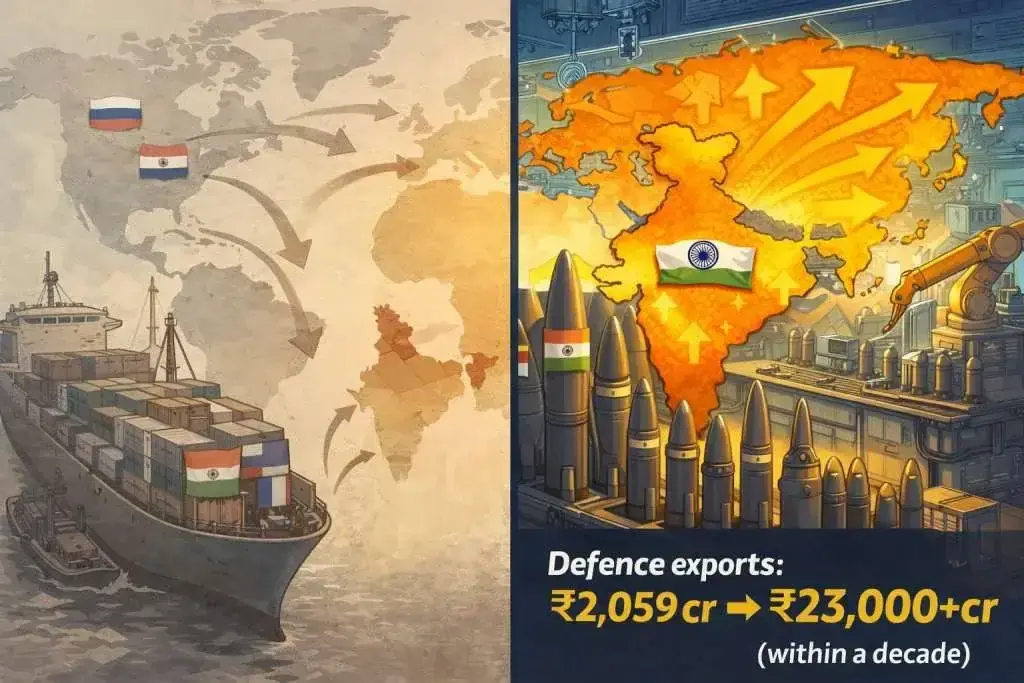
Read More: Best Defence Stocks in India 2026: Top Companies Benefiting from Rising Defence Spending
3. India’s Current Defence Production Capacity
3.1 What India Already Has: Key Strengths
India’s defense scene didn't just transform overnight. It’s been a long, hard-earned evolution. Over the last few decades, the country has gone from just "buying off the shelf" to building some serious muscle in areas like missiles and ammo. This hasn't happened in a vacuum, either; it's the payoff from years of DRDO grinding away on research, combined with the fact that private companies are finally getting a real seat at the table. If you look at the defense landscape today, it’s a completely different beast than it was ten years ago. It’s broader, more technical, and way more self-reliant.Then you’ve got the BrahMos. Honestly, this thing is a beast. It’s an Indo-Russian collab and still holds the crown as the fastest cruise missile on the planet. The scary part? You can fire it from basically anywhere—a truck, a ship, a jet, or even a sub. And India isn’t slowing down. Those 2024 hypersonic trials show they’re already gunning for speeds that most current radar systems can't even see coming.
India also maintains a strong ammunition manufacturing capacity, ranging from small-calibre rounds to heavy artillery shells. DRDO is working on advanced energetics and new ammunition technologies, including a ramjet-powered 155mm artillery projectile capable of reaching ranges of nearly 80 kilometres, significantly extending traditional artillery capabilities.
On the rocket artillery side, the Pinaka has really come into its own. It’s the Indian Army’s go-to for dumping high-volume firepower in a hurry. They’re constantly tweaking it, too, pushing the range and accuracy further to work alongside newer tactical tech like Pralay.
None of this works without the "invisible" tech behind it: solid propellants, rocket motors, and warhead engineering. This is the stuff DRDO and its partners have spent years perfecting. It’s the literal engine behind everything from air defense to those new hypersonic projects everyone is talking about.
The real story, though, is how much the private sector has stepped up. We’re seeing companies like Solar Industries, Bharat Forge, and L&T become absolute pillars of the supply chain. Solar is handling the explosives and propellants, Bharat Forge is crushing it with artillery and precision parts, and L&T is building the complex "guts" of missiles and launchers.
Basically, the old days of the government doing everything alone are over. We’re moving into this collaborative era where public R&D and private muscle are actually in sync. It’s not just making India safer at home; it’s finally making the country a serious player on the global export stage.
Read More: Future of Defence Sector in India – 2025 and Beyond
3.2 What India Still Lacks: Key Gaps
India’s defense story is impressive, but let’s be real, there are still some massive gaps. If you're looking at this as an investor or a researcher, these aren't just "challenges"; they are the bottlenecks. This is where we are dependent on foreign partners.Then we have the propulsion hurdle. While we’ve basically perfected the art of solid-fuel rockets, we’re still chasing that "holy grail": a 100% home-grown turbine engine for long-range cruise missiles.
It’s one thing to build a rocket that burns fast and hot, but building a turbine that can "breathe" and sustain flight over huge distances is a much more complex beast. Right now, closing that gap is the big focus if we want to stop relying on foreign engines.
It’s why the BrahMos still has a bit of an international "accent" under the hood. Until we can build our own jet engines for these systems, we’re essentially relying on someone else’s lungs.
The Deep End and the Heat
The underwater leg of the defense triad is another major work in progress. While the K-15 and K-4 missiles are huge milestones, building a seamless, long-range deterrent that launches from a sub is a whole different level of complexity. It’s evolving, but the "invisible" tech needed for underwater integration is still a massive R&D focus.
The "Glue" (System Integration)
Finally, it’s about integration. It’s one thing to have a seeker, an engine, and a warhead; it’s another thing entirely to make them talk to each other flawlessly in a hypersonic or MIRV system. This "system of systems" approach is the ultimate high-stakes puzzle. The Bottom Line: India has built a rock-solid foundation, but the "last mile" of self-reliance is all about these high-tech niches. For the market, these gaps aren't just problems; they're the roadmap for the next decade of defense spending.
Read more: Why Power Sector Stocks are Booming – Data & Trend Analysis
4. Defence Builder of India
Bharat Dynamics (BDL): The Government’s "Go-To" Missile Maker
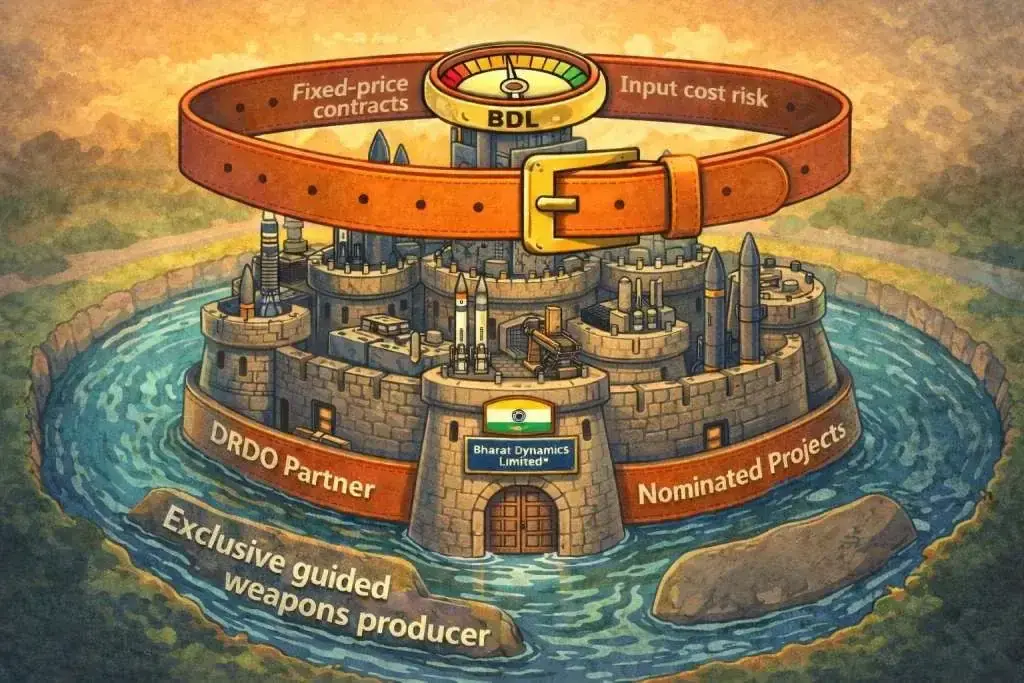
If you're looking for a company that is essentially "baked into" India’s defense strategy, BDL is it. They aren't just a vendor; they are the primary production partner for DRDO. In most of India’s big-ticket missile programs, BDL is the "nominated" lead. That’s a massive structural moat because it effectively locks out the competition before the race even starts.BDL is currently the only shop in India making certain guided weapon systems, we're talking surface-to-air missiles (SAMs), anti-tank missiles (ATGMs), and torpedoes. This monopoly has helped their order book skyrocket, jumping from about ₹10,500 crore in 2018 to a massive ₹26,000 crore by late 2025. With new factories coming online to handle the next generation of tech, they aren't just sitting on old contracts; they’re scaling up for the future.
The Reality Check
It’s not all easy wins, though. Because BDL is a Defense PSU, they mostly play by the government's rules. They operate on fixed-price contracts, which means their profit margins are on a tight leash. If raw material costs spike or inflation bites, BDL usually has to eat those costs. You aren't going to see wild, runaway profit margins here—the government makes sure of that.
The Bottom Line for Investors
Investing in BDL is a play on stability and "strategic necessity." You’re getting exposure to the very heart of India’s missile ecosystem with a backlog of work that stretches out for years. While the government-controlled pricing keeps the ceiling on profitability a bit low, the sheer predictability of the demand makes it a foundational pick in the defense space.
Read More: Technical vs Fundamental Analysis – Which One Should You Follow?
Solar Industries: From Mining Explosives to Defense Powerhouse
If you want to understand Solar Industries, you have to look at their "secret sauce": they don't just assemble things; they own the whole process. They’ve locked down about a quarter of India's explosives market, largely because they are backward integrated. They make their own detonators and nitrates in-house, which gives them a massive edge on costs and keeps their margins steady when everyone else is struggling with supply chain spikes. Plus, they aren't just a local player—they’re running the world’s largest single-location cartridge explosives plant in Nagpur and shipping to over 60 countries.
The Pivot to Defense
For years, Solar was mostly known for helping the mining industry, but the "new" Solar is all about defense. They’ve moved from basic explosives into high-stakes tech: fuzes, igniters, and rocket components. The big headline here is the Pinaka rocket system. They recently bagged a massive ₹6,084 crore order for these rockets, which basically supercharged their defense pipeline overnight.
As of late 2024, their order book was sitting at over ₹7,100 crore, and a huge chunk of that is now defense-related. They aren't stopping there, either. They’re currently building out new facilities around Nagpur to handle the "guts" of modern warfare—things like propellants, warheads, and full missile integration.
The Takeaway for Investors
What makes Solar interesting right now is the transition. You’re not just buying an industrial company; you’re buying a high-growth defense player that’s just starting to hit its stride. They have a "long runway" because India is desperate to stop importing ammunition and rockets. With their existing global footprint and their ability to manufacture the raw "energetic materials" that others have to buy, Solar is essentially building a fortress around its business model.
Read more: Economic Moat Explained: Why Some Companies Stay Dominant for Decades
Bharat Forge: From Car Parts to Combat Systems
If you think Bharat Forge is just a "metal-pounding" forging company, you’re looking at their past, not their future. As the muscle behind the Kalyani Group, they’ve taken decades of deep knowledge in metallurgy and material science and pivoted hard into defense.The real "moat" here isn't just their massive factories; it’s their Intellectual Property (IP). Through their subsidiary, Kalyani Strategic Systems, they own the designs for the platforms they build. They aren't just assembling someone else’s blueprints under license—they own the tech. That’s a game-changer because it means they can export globally without having to ask a foreign partner for permission.

Moving Up the Food Chain
Bharat Forge has pulled off something very few companies manage: they’ve moved from making "parts" to building "entire systems." They aren't just selling gears and shafts anymore; they are building the Advanced Towed Artillery Gun System (ATAGS). They recently locked in a massive ₹4,000 crore order for these guns from the Indian government, which is a huge vote of confidence.
As of late 2025, their defense order book has ballooned to nearly ₹9,500 crore. To keep up with that demand, they’re spinning up a monster facility in Jejuri, near Pune, capable of churning out 250 artillery guns and 1,000 armored vehicles a year. This isn't a "pilot project" anymore, it’s full-scale industrial warfare.
The Investor Reality
The "big picture" for investors is all about de-risking. Historically, Bharat Forge lived and died by the cyclical automotive market. By aggressively expanding into defense and aerospace, they are building a much more stable, high-margin revenue stream. They’ve positioned themselves as one of the few private players in India with the scale and the "brain power" to compete with global defense giants.
Larsen & Toubro (L&T): The Heavyweight of Indian Defense
If you’re looking at the Indian defense landscape, L&T is essentially the "anchor tenant." They didn't just jump on the "Make in India" bandwagon recently; they’ve been the go-to partner for the Ministry of Defense, DRDO, and ISRO for decades. They were building nuclear and space tech back when the private sector wasn't even allowed in the room. This has given them a level of institutional trust that you just can't buy or build overnight.The "Full-Stack" Engineer
What really sets L&T apart, their "moat" is that they don't just make parts; they build entire ecosystems. While other companies might focus on a single component, L&T handles the whole lifecycle. They are the ones designing, engineering, and integrating the complex "guts" of a platform.
Specifically, in the missile world, they are the ones building the launch platforms and subsystems that actually make the tech work in the field. Through their JV with MBDA, they’ve become a powerhouse in missile systems. They also have a massive footprint in naval modernization, building everything from warships to submarines at their Kattupalli shipyard. Whether it's artillery, armored vehicles, or high-end electronics, if it’s big, complex, and "mission-critical," L&T usually has their hands on it.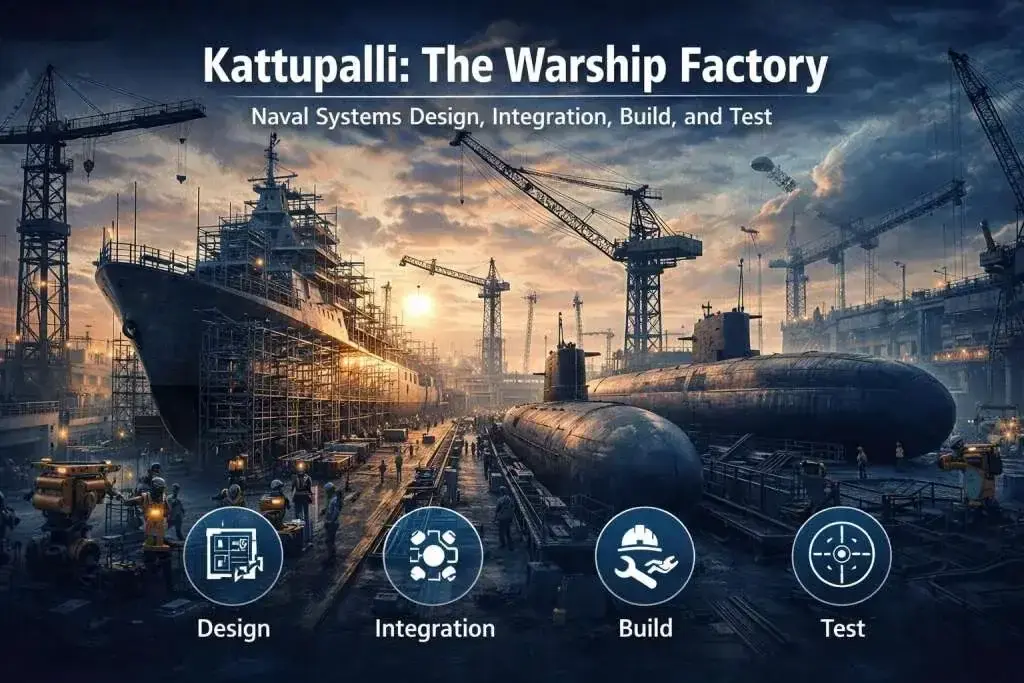
The Investor’s Angle: Stability Meets Growth
For an investor, L&T is basically a "proxy" for the entire country’s defense spending. If the government is pouring money into modernization, L&T is going to catch a huge chunk of that flow because of their sheer scale.
The beauty of L&T is that it’s not a "one-trick pony." Unlike pure-play defense stocks that can be volatile based on a single contract, L&T is a massive conglomerate. You get the high-growth "juice" from the defense and aerospace segments, but you’ve also got the stability of their global infrastructure and energy businesses. It’s a way to bet on the defense boom without betting the whole farm on a single niche.
Data Patterns: The "Silicon Brains" of Indian Defense
If you want to understand where the real "intelligence" of a missile or a fighter jet comes from, you look at Data Patterns. They aren't building the heavy hulls or the engines; they’re building the high-end electronics—the radars, the electronic warfare suites, and the avionics. They are essentially the "silicon brains" behind some of India’s biggest hits, including the BrahMos and HAL’s aircraft programs.The "Lego Block" Strategy
What’s really clever about their business model is their modular "building block" approach. They don't reinvent the wheel for every new project. Instead, they’ve developed a library of intellectual property that they can snap together like Lego blocks to build custom solutions for DRDO or ISRO in record time. This isn't just efficient; it’s a massive cost-saver that lets them scale across different platforms without blowing their R&D budget every single year.
Moving from "Parts" to "Systems"
Data Patterns is currently in the middle of a massive "level-up." They used to be the guys who supplied a niche electronic board to a bigger company. Now, they are the ones building the entire fire control system or the full electronic warfare suite. They’ve moved from being a sub-vendor to a full-blown systems provider.
The Investor’s Reality: Pure-Play Tech
For an investor, Data Patterns is probably the cleanest play you’ll find on the "electronics intensity" of modern war. Everything is becoming more sensor-heavy and software-driven, which plays right into their hands.
The numbers are honestly hard to ignore. We’re looking at EBITDA margins in the 35–40% range, which is sky-high for the defense sector. They are debt-free, have a rock-solid balance sheet, and an order book sitting at around ₹1,868 crore as of early 2026. Management is eyeing 20–25% growth, and with more exports on the horizon, this is less of a manufacturing story and more of a high-growth R&D story.
Astra Microwave: Mastering the "Invisible" Tech of Modern War
If you want to understand Astra Microwave, you have to look at the "invisible" side of the battlefield. They aren't building the tanks or the missile bodies; they are mastering the Radio Frequency (RF) and microwave tech that allows those systems to actually "see" and communicate. Started by a group of scientists back in the early 90s, they’ve gone from making small parts to being the go-to partner for DRDO and BEL on some of India's most high-stakes projects.
The "Astra" Edge: Inside the Brain of a Fighter Jet
What really gives them a "moat" is their in-house MMIC design. They aren't just buying chips and putting them on a board; they are designing the actual integrated circuits that make high-performance electronics possible. You’ll find their tech embedded in the Uttam AESA radar for the Tejas fighter, and their modules are the heartbeat of the Akash, Astra, and QRSAM missile systems. Between their specialized antenna testing labs and decades of "lab-to-field" experience, they’ve built a technical wall that’s incredibly hard for new competitors to climb.
The "System" Level-Up
Astra is currently in the middle of a strategic shift. For a long time, they were content being the "subsystem" guys. Now, they are pushing to provide complete systems. They’re also eyeing the stars, launching a new subsidiary specifically to take their RF expertise into the satellite and space sector.
The Takeaway for Investors
For anyone watching the ticker, Astra is a pure play on the "high-value" side of defense. We’re talking about a company that crossed ₹1,000 crore in revenue in FY2025 while maintaining EBITDA margins near 30%.
Their order book is sitting at roughly ₹1,952 crore, which means they have plenty of work lined up for the next few years. As modern warfare becomes more about "who sees whom first" (radars and electronic warfare), Astra is sitting right in the sweet spot of that demand. It’s a specialized, R&D-heavy business that’s perfectly aligned with the country’s push to stop importing its most sensitive tech.
Paras Defence: The Specialist Shop for High-Precision Tech
If you’re looking for the company that handles the "finer details" of Indian defense, it’s Paras. They’ve spent forty years carving out a space where almost no one else can compete: high-precision optics and niche engineering. While other companies are building the hulls of ships or the bodies of missiles, Paras is building the "eyes"—the ultra-high-precision lenses and thermal imaging components that actually make those platforms useful.The "Asia-Pacific Only" Moat
The real "flex" for Paras is their technical barrier to entry. They are currently the only private company in the entire Asia-Pacific region that can deliver a turnkey submarine optronic periscope. Think about the engineering required to make something that sensitive work under that much pressure, that’s a massive moat. Beyond optics, they handle the heavy-duty "guts" of rockets, like motor tubes, and they have a specialized niche in EMP protection (shielding military electronics from massive electromagnetic bursts). They aren't just a vendor; they are a strategic partner for DRDO and ISRO, often working on components that are so specialized they’re the only domestic option available.
Moving into the "New Age" of Warfare
Paras isn't just sticking to the legacy stuff, either. They are aggressively pushing into drone and anti-drone tech, which is basically the future of the battlefield. They’re scaling up their Navi Mumbai facility to move from just being a "parts supplier" to a company that delivers complete, complex systems.
The Investor’s Take: A Bet on "Niche"
For an investor, Paras is a play on the high-precision, high-margin side of the business. Their order book was sitting at roughly ₹928 crore by early 2025, and their revenue is steadily climbing as India’s space and defense programs go into overdrive. What makes them interesting is that they don't have the same "commodity" risk as bigger manufacturers. Their work is so specialized that they aren't easily replaced. If you believe modern warfare is becoming more about "seeing first" (optics) and "shielding better" (EMP protection), Paras is sitting in a very lucrative corner of the market.
Explore our Products
Research Framework

Emerging Titans
Combination of quantitative analysis, industry tailwinds, and management assessment - SPRINT investment philosophy

Tiny Titans
Heavy emphasis on scuttlebutt research, plant visits, and early on-ground signals
Conclusion: From Importer to Arsenal Builder: India’s Defence Shift
To wrap this up, the big takeaway is that India’s defense sector is finally shaking off its reputation as a "forever customer." We’re moving into a structural growth phase where the country isn't just buying weapons but building its own arsenal.It’s an evolution driven by high-stakes geopolitics and a massive internal push for self-reliance. For decades, India’s defense was an import-heavy machine; today, it’s becoming a domestic powerhouse fueled by a unique mix of government labs and aggressive private companies. Whether it’s the heavy artillery from Bharat Forge, the explosives from Solar Industries, or the "silicon brains" from Data Patterns and Astra Microwave, every layer of the value chain is filling in. We’re seeing a shift from simple parts to complex systems, including missiles, radars, and naval platforms, that are beginning to compete on the global stage.
If this deep dive gave you a better handle on how India is actually building its own arsenal, let me know. Drop a "Defence" in the comments—it helps me know the research is hitting the mark and that you're finding this stuff as interesting as I do.
Frequently Asked Questions (FAQ)
Why are missile and ammunition companies gaining investor attention in India?
+Missile and ammunition companies are gaining attention because India is increasing defence spending and pushing for domestic manufacturing. Rising geopolitical tensions and government policies focused on self-reliance are creating long-term demand for indigenous defence equipment.
Which Indian companies are key players in the missile and ammunition ecosystem?
+Some important listed companies in this ecosystem include Bharat Dynamics, Solar Industries, Bharat Forge, Larsen & Toubro, Data Patterns, Astra Microwave, and Paras Defence. Each of these companies operates in a different part of the defence value chain, from missile production and explosives to electronics and radar systems.
What role does the government play in the growth of the defence sector?
+The Indian government plays a major role as the primary buyer of defence equipment. Policies such as Aatmanirbhar Bharat, Positive Indigenisation Lists, and increased defence budgets encourage domestic manufacturing and create strong demand for Indian defence companies.
Why is defence manufacturing considered a long-term structural theme?
+Defence manufacturing usually involves long development cycles, large government contracts, and multi-year procurement programs. Once systems enter production, demand tends to remain stable for many years, making the sector structurally important rather than purely cyclical.
What technological gaps still exist in India’s missile ecosystem?
+India still faces challenges in areas such as advanced seeker technology, high-end electronics, jet engines for cruise missiles, advanced materials, and complex systems integration. Addressing these gaps could create opportunities for domestic companies over the coming years.
How are private companies contributing to India’s defence ecosystem?
+Private companies are increasingly playing a critical role. Firms like Solar Industries, Bharat Forge, and Larsen & Toubro are developing explosives, artillery systems, launch platforms, and missile components, complementing the work of government organizations such as DRDO and defence PSUs.
What should investors watch when analysing defence stocks?
+Investors should look at order book strength, technological capabilities, position in the defence value chain, export potential, and government policy support. Companies with strong R&D capabilities and long-term contracts often have better visibility of future growth.

High growth stock specialist, Value Educator
Shashank Mahajan is an equity research professional with over 12 years of experience in identifying high-potential SME and micro-cap stocks at an early stage. He follows a rigorous scuttlebutt research–driven approach, combining on-ground insights with deep financial analysis. Shashank specializes in uncovering under-researched and under-owned companies with strong management quality and long-term growth potential. Through disciplined research and early identification, he focuses on spotting tomorrow’s market leaders before they enter the mainstream investor radar.

Zen Technologies: Revenue Fell After a Big Win



PNG Jewellers: A 194-Year-Old Name Goes National
Explore our Products
Research Framework
Emerging Titans
Combination of quantitative analysis, industry tailwinds, and management assessment - SPRINT investment philosophy
Tiny Titans
Heavy emphasis on scuttlebutt research, plant visits, and early on-ground signals


 Orders
 Subscription
 Share with friends


Required Details
₹23999.00
(12 month subscription)
As per SEBI regulations, all users are mandated to complete the KYC that is validated for 1 year. Post payment, you will be redirected to the KYC screen


No comments yet. Be the first to comment!