
Defence Stocks in India 2026: List by Segment and Order Book
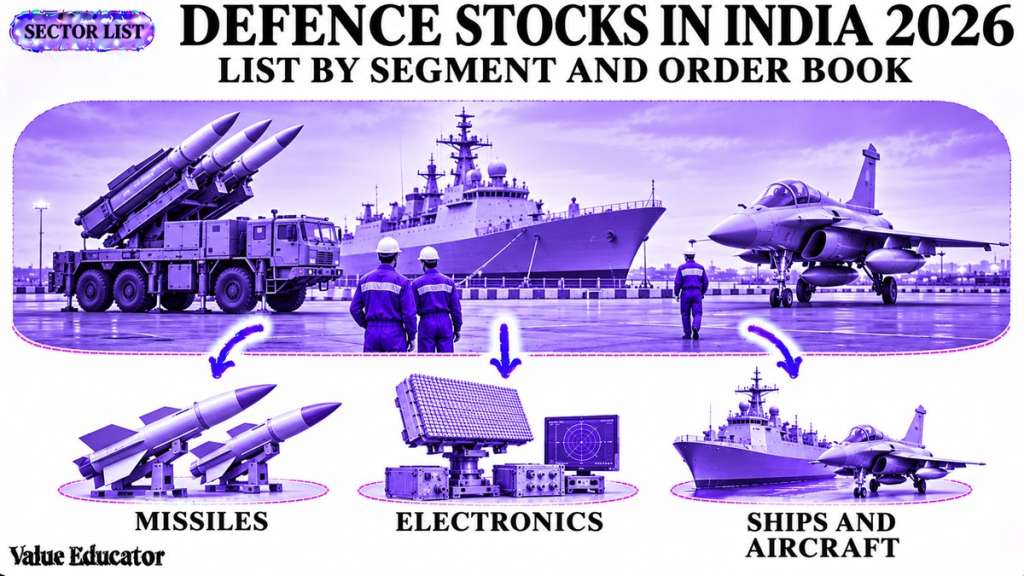
India now buys most of its new weapons from Indian companies. In FY26, the Ministry of Defence fully used its revised capital budget of ₹1.86 lakh Cr, and for FY27 about 75% of the capital acquisition budget is set aside for Indian defence companies. That money reaches a long chain of listed companies, from missile makers to the small suppliers of wires, steel and propellant inside each system.
This page lists the defence companies we have studied in depth, grouped by what they make. For each one we show the latest order book the company has reported and how many years of revenue it covers. Each row links to our full research on that company. The figures come from company filings and results calls, and the table is updated as new results come in.
Figures as of 13 November 2026. This page is research, not a recommendation to buy or sell any stock.
Defence Stocks in India at a Glance
The order book is the value of contracts a company has signed but not yet delivered. Dividing it by a year's revenue shows how many years of work are already in hand. A ratio of 3 means about three years of revenue is already contracted, if the company delivers on time.
| Company | Segment | What it makes for defence | Order book (date) | Order book ÷ FY26 revenue |
|---|---|---|---|---|
| Azad Engineering | Aerospace | Turbine and jet-engine airfoils | about ₹6,500 Cr (Mar 2026) | about 11x |
| Bharat Dynamics | Missiles and ammunition | Missiles for the Army, Navy and Air Force | ₹26,176 Cr (31 Mar 2026) | about 10.7x |
| MTAR Technologies | Aerospace, space and nuclear | Precision assemblies for space, nuclear and aerospace programmes | ₹5,143 Cr (30 Jun 2026) | about 5.9x |
| Premier Explosives | Missiles and ammunition | Solid propellant, chaffs, flares, igniters | ₹1,642 Cr (Oct 2026) | about 4.2x |
| Astra Microwave | Defence electronics | Radar and RF systems, Uttam radar arrays | about ₹4,300 Cr (Aug 2026) | about 3.7x |
| Unimech Aerospace | Aerospace | Engine tooling and flying parts | ₹855 Cr, incl. ₹589 Cr of long-term agreements (30 Sep 2026) | about 3.6x |
| Jyoti CNC | Machines for defence plants | 5-axis machining centres | ₹5,082 Cr, of which about ₹1,830 Cr aerospace and defence (Sep 2026) | about 2.4x |
| Cyient DLM | Defence electronics | Electronics manufacturing for aircraft and defence | ₹2,813.7 Cr (30 Sep 2026) | about 2.2x |
| Apollo Micro Systems | Missiles and ammunition | Missile electronics, naval mines, rockets | ₹1,765 Cr (30 Sep 2026) | about 2.0x |
| Rossell Techsys | Aerospace | Wire harnesses for military aircraft | ₹900 Cr confirmed, plus over ₹3,100 Cr of long-term agreements (30 Sep 2026) | about 1.9x (confirmed) |
| HBL Engineering | Defence electronics | Defence batteries, electronic fuzes, Kavach | about ₹5,902 Cr (Sep 2026) | about 1.8x |
| Zen Technologies | Training and counter-drone | Simulators and anti-drone systems | ₹1,239 Cr (30 Jun 2026), plus ₹472.5 Cr of orders since | about 1.8x |
| Data Patterns | Defence electronics | Radar and electronic warfare electronics | ₹927.7 Cr firm (30 Jun 2026); ₹2,654 Cr incl. July and agreed orders | about 1.0x firm; 2.9x incl. agreed |
| Krishna Defence | Naval | Special steel bulb bars for warship hulls | ₹117 Cr, plus ₹289 Cr tender pipeline (Jun 2026) | about 0.5x |
| Sansera Engineering | Aerospace | Aircraft and defence parts (ADS business) | ADS backlog ₹5,869.7 Cr (30 Sep 2026) | not comparable (backlog is for one business) |
| Axiscades | Defence electronics | Radar, missile and electronic warfare subsystems | Assured visibility ₹4,557 Cr to FY30 (not an order book) | not comparable |
| Dynamatic Technologies | Aerospace | Aircraft doors, flap track beams, aerostructures | Not disclosed | - |
| PTC Industries | Aerospace and materials | Titanium and superalloy melting and castings | Not disclosed | - |
| Taneja Aerospace | Aerospace | Private airfield and hangar leases | Rent due ₹161.3 Cr (Mar 2026), not an order book | - |
Azad's ratio is high because its order book covers long-term supply contracts for engine makers that run for many years, mostly for energy turbines. Bharat Dynamics' ratio is high partly because its FY26 revenue fell 27% while its order book grew. Read the ratio together with each company's delivery record, which our research covers.
Defence Stocks by Segment
Missiles and Ammunition
A missile is a chain of suppliers. Bharat Dynamics builds and integrates missiles for the forces. Apollo Micro Systems makes the onboard computers and guidance electronics, and is moving into naval mines and rockets. Premier Explosives makes the solid propellant that burns to push the missile, plus the chaffs and flares that protect aircraft. Our missile and ammunition stocks guide covers the wider group, including Solar Industries and Bharat Forge.
Defence Electronics and Radar
Electronics is the fastest-growing share of a modern weapon. Data Patterns designs radar and electronic warfare systems, Astra Microwave builds radar and RF systems including arrays for the Uttam radar, and Axiscades is turning into a defence electronics maker after selling its services arm. Cyient DLM manufactures electronics for aircraft and defence customers, and HBL Engineering makes defence batteries and electronic fuzes. Zen Technologies makes training simulators and counter-drone systems. For more, see defence electronics stocks and MTAR vs BEL.
Aerospace and Engines
Aircraft and engines need parts that take years to qualify. Azad Engineering makes turbine and jet-engine airfoils, PTC Industries melts titanium and superalloys and casts critical parts, and Unimech Aerospace makes engine tooling and now flying parts. Dynamatic Technologies builds aircraft doors and flap track beams, Sansera Engineering supplies aircraft and defence parts, Rossell Techsys builds wire harnesses for military aircraft, and MTAR Technologies makes precision assemblies for space, nuclear and aerospace programmes. Taneja Aerospace owns a private airfield near Hosur. Jyoti CNC supplies the 5-axis machines many of these plants use.
Naval and Shipbuilding
Warships need hull steel, systems and shipyards. Krishna Defence makes the special steel bulb bars used to stiffen warship hulls. The listed shipyards, Mazagon Dock, Garden Reach and Cochin Shipyard, are covered in our shipbuilding defence stocks guide.
Other Listed Defence Companies
Some of the largest defence companies are covered in our theme articles rather than a single deep dive:
| Company | Segment | Where we cover it |
|---|---|---|
| Hindustan Aeronautics (HAL) | Aircraft and helicopters | Highest order book stocks, PSU vs private |
| Bharat Electronics (BEL) | Defence electronics and radar | MTAR vs BEL, Highest order book stocks |
| Mazagon Dock, Garden Reach, Cochin Shipyard | Shipbuilding | Shipbuilding defence stocks |
| Solar Industries, Bharat Forge | Missiles, ammunition, artillery | Missile and ammunition stocks |
| Private defence names | Various | Goldman Sachs' 6 private defence picks |
What Drives Indian Defence Spending
Buying Indian is now the rule. For FY27, about 75% of the capital acquisition budget is reserved for Indian companies. The positive indigenisation lists bar imports of a growing number of items, so foreign suppliers have to build in India or partner with Indian firms.
Production and exports are at records. Defence production reached ₹1.78 lakh Cr in FY26, up 15.6% from the year before. Defence exports rose 62.7% to a record ₹38,424 Cr, and Indian defence products now go to over 80 countries. The government wants ₹3 lakh Cr of yearly production and ₹50,000 Cr of exports by 2029.
The money is being spent. In FY26 the ministry fully used its revised capital budget of ₹1.86 lakh Cr, the money it spends on new weapons. That matters more than the headline budget, because unspent money never becomes orders.
How to Read a Defence Company's Order Book
Defence stocks often move on order news. These checks separate a strong order book from a big number:
- How firm is it? Signed contracts are different from long-term agreements, award letters or "visibility". The table above shows which is which.
- How fast does it turn into revenue? Compare the order book with a year's revenue. A high ratio is only good if the company delivers on time. Missed inspections and trials push revenue into later years.
- Does one programme dominate? If a single missile, radar or aircraft makes up most of the book, a delay in that programme hits the whole company.
- Are margins steady? One strong year can come from a single high-margin order. Look at several years.
- Can it fund the work? Defence customers pay slowly, so cash gets tied up in inventory and receivables. Check operating cash flow, not just profit.
PSU or Private Defence Companies?
Public sector companies such as HAL, BEL and Bharat Dynamics hold the largest order books because they build complete platforms and systems for the forces. Private companies are usually smaller and grow faster, often as suppliers of subsystems, parts and materials to those PSUs and to foreign manufacturers. Many private companies also export, which spreads their risk beyond the Indian budget. Our PSU vs private defence stocks article compares the two in detail.
Key Risks for Defence Stocks
- Order timing: orders depend on government approvals, trials and budgets. A delayed tender can leave a quarter or a year with weak revenue.
- Slow payments: government customers often take months to pay, which ties up cash.
- Few customers: many defence companies sell to a handful of PSUs and the forces.
- Qualification: new parts and systems need long trials before they earn revenue.
- Valuations: when defence stocks are in the news, prices can run ahead of what the order books can deliver.
Explore our Products
Research Framework

Emerging Titans
Combination of quantitative analysis, industry tailwinds, and management assessment - SPRINT investment philosophy

Tiny Titans
Heavy emphasis on scuttlebutt research, plant visits, and early on-ground signals
Conclusion
India's defence money now flows mostly to Indian companies, and order books across the sector are at or near records. But an order book is only as good as its delivery. Use the table above to see where each company stands, then read our research on each one for its delivery record, margins and risks.
FAQs
Which are the top defence stocks in India for 2026?
+India's listed defence companies range from large PSUs such as HAL, BEL and Bharat Dynamics to smaller private suppliers. The table on this page lists the companies we have researched, with each one's order book and how many years of revenue it covers. We do not rank stocks as buys; read each company's research for its risks.
Which defence companies have the biggest order books compared with revenue?
+Among the companies we cover, Bharat Dynamics (about 10.7 times FY26 revenue), MTAR Technologies (about 5.9 times), Premier Explosives (about 4.2 times) and Astra Microwave (about 3.7 times) had the largest order books relative to revenue in our latest data. Azad Engineering's long-term contracts cover about 11 times revenue, mostly for energy turbines.
Which company makes missiles in India?
+Bharat Dynamics builds and integrates missiles for the armed forces. Private companies supply key parts: Apollo Micro Systems makes missile electronics and Premier Explosives makes solid propellant.
Are PSU or private defence stocks better?
+PSUs hold the largest order books; private companies are smaller and often grow faster as suppliers. The right choice depends on the company's order book, delivery record and valuation, not on ownership alone.
Which stocks rise during a war?
+Defence stocks often rise on news of conflict, but those moves can reverse quickly. What lasts is the order book and the company's ability to deliver it.
Is the defence sector good for long-term investing?
+Defence spending in India is long-term and backed by policy, but orders are lumpy and payments are slow. Long-term results depend on each company's execution, not on the sector alone.

High growth stock specialist, Value Educator
Shashank Mahajan is an equity research professional with over 12 years of experience in identifying high-potential SME and micro-cap stocks at an early stage. He follows a rigorous scuttlebutt research–driven approach, combining on-ground insights with deep financial analysis. Shashank specializes in uncovering under-researched and under-owned companies with strong management quality and long-term growth potential. Through disciplined research and early identification, he focuses on spotting tomorrow’s market leaders before they enter the mainstream investor radar.

Glenmark: The USD 700 Mn Cancer Deal and Its Brands

Pharma Stocks in India 2026: Generics, APIs and CDMOs

Granules India: From Paracetamol to a 65% Gross Margin

Natco Pharma: After Revlimid, 29 Patent Challenges

Shilpa Medicare: Cancer APIs, Films and Biosimilars

Alembic Pharma: US Plants Pay Back, Margin Hits 22.2%
Explore our Products
Research Framework
Emerging Titans
Combination of quantitative analysis, industry tailwinds, and management assessment - SPRINT investment philosophy
Tiny Titans
Heavy emphasis on scuttlebutt research, plant visits, and early on-ground signals



India's Aerospace Opportunity
Global Demand. Supply Bottlenecks. Opportunities Ahead.
Don't Miss This Exclusive Webinar!
Join Value Educator to decode the key trends shaping India's aerospace sector and learn how to identify tomorrow's potential leaders in the space.
- How the aircraft value chain works, layer by layer
- Indian companies supplying global aircraft makers
- A framework to judge any aerospace company

 Orders
 Subscription
 Share with friends


Required Details
₹23999.00
(12 month subscription)
As per SEBI regulations, all users are mandated to complete the KYC that is validated for 1 year. Post payment, you will be redirected to the KYC screen


No comments yet. Be the first to comment!