
Capital-Intensive Businesses Explained

When a company like Tata Steel reports a strong year, we look at revenue. We look at profits. We look at growth.
What we rarely look at is what it costs just to exist.
The blast furnaces.
The rolling mills.
The mines.
The power infrastructure.
Thousands of crores are locked into assets before a single rupee of revenue is earned.

That number changes everything.
Because in certain industries, profitability is not just about selling more.
It’s about whether those massive assets can earn enough to justify their own weight.
That hidden layer, the capital required just to operate, is what separates certain industries from the rest.
“Price is what you pay. Value is what you get.”- Warren Buffett
Some businesses can scale with ideas and talent.
Others can only scale by building more infrastructure.
And it is this distinction that defines capital-intensive businesses.
Understanding Capital-Intensive Businesses
A capital-intensive business is a business that requires a lot of investment in physical capital to operate or grow.
These are not peripheral investments that a business can or should do without.
In businesses such as steel, cement, aviation, power, telecom, or oil & gas, a business must invest heavily in plant, machinery, spectrum, aircraft, or extraction facilities before it can generate any significant revenues.
For instance, a cement production company would need to invest heavily before selling even a single bag of cement by acquiring limestone mines, constructing large kilns, and establishing grinding equipment and power sources.
Thousands of crores are locked in before any significant cash flows are generated.
This is the capital-intensive nature of a business.
Having understood the definition of a capital-intensive business is only the first step.
To truly appreciate capital-intensive businesses as investors or observers, we must try to grasp how these businesses work.
The Economics Beneath the Assets
Most of their costs are fixed.
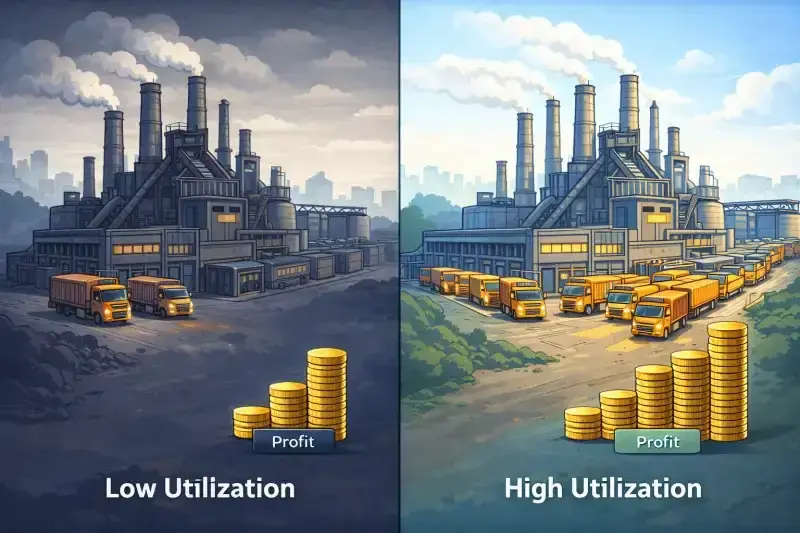
Once a plant is built, a steel mill constructed, or a telecom network installed, certain expenses do not disappear simply because demand weakens.
Maintenance continues whether production is high or low.
Interest on borrowings must be paid.
Depreciation is recorded year after year.
Operational overhead remains in place.
In other words, the business carries a large base of costs that do not adjust quickly with revenue.
This creates a powerful dynamic.
When production levels are low, fixed costs are spread across fewer units of output. Margins compress. Returns weaken.
But when demand rises and production increases, those same fixed costs are distributed across higher volumes. Margins expand. Returns improve sharply.
This is why profitability in capital-intensive industries is closely related to capacity utilization – the degree to which the assets are being utilized.
Assets are said to be under-earning if they are not being utilized sufficiently.
High utilization means the assets are being “sweated” efficiently.
The business itself may not change. The assets remain the same. What changes is how intensively they are used.
This explains why earnings in industries like steel, cement, airlines, or power generation often swing dramatically across economic cycles.
“Operating leverage is a double-edged sword.”- Aswath Damodaran
And once this structure is understood, the risks and opportunities of capital-intensive businesses become much clearer.
The Structural Risks
Once you understand how capital-intensive businesses are built, the risks stop feeling dramatic and start feeling inevitable.
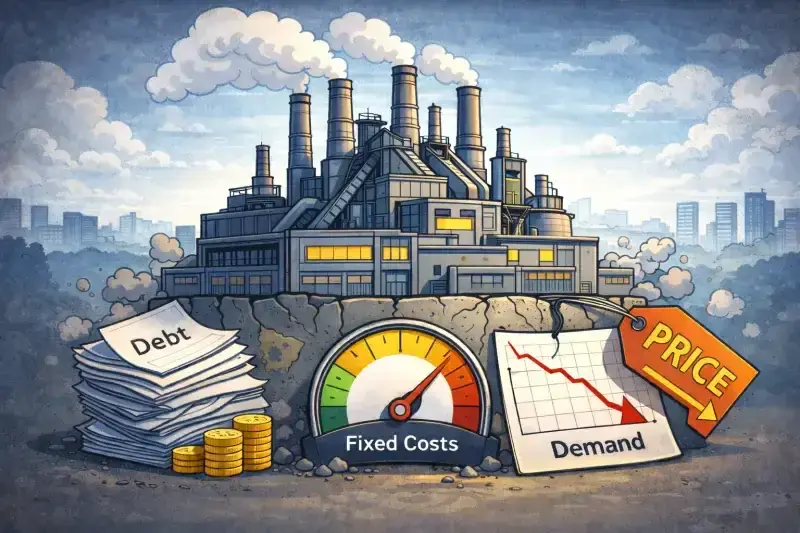
They are not accidents. They are consequences of the structure itself.
Fixed Costs Don’t Wait for Demand
In many businesses, costs can shrink when revenue shrinks.
Not here.
When a steel plant slows production or a cement facility operates below capacity, the bills don’t politely adjust downward. Equipment still needs maintenance. Skilled labor cannot simply disappear. Depreciation continues quietly in the background. Lenders still expect their interest.
So when revenue falls, profits don’t just dip, they can compress sharply. The cost base is stubborn. And that rigidity creates pressure very quickly.
- Demand Moves. Capacity Doesn’t.
Most capital-heavy industries are deeply tied to economic cycles.
Construction slows. Infrastructure spending pauses. Travel demand weakens. Commodity prices soften.
But the factories, plants, aircraft, and power stations that were built during optimistic years remain exactly where they are.
Capacity is fixed in the short term. Demand is not.
When too much supply meets slowing demand, prices weaken. Margins narrow. What looked like strong operating leverage in good times starts working in reverse.
Debt Amplifies Everything
Building large assets usually requires large capital, and that often means borrowing.
Debt is not inherently bad. In fact, it can accelerate growth when conditions are favorable.
But debt does not shrink just because profits do.
When operating earnings decline but interest obligations remain fixed, the balance sheet becomes the pressure point. What was manageable during expansion can feel suffocating during contraction.
“Leverage is like oxygen. You don’t notice it when it’s there, but you feel it when it’s gone.” - Warren Buffett
In capital-intensive businesses, leverage doesn’t just enhance returns. It magnifies outcomes in both directions. One simple way to understand this leverage is through the debt-to-equity ratio. Read More: What is Debt to Equity Ratio? Why it Matters for Small Cap Investing.
Long Recovery Periods
These businesses are built with long-term horizons in mind.
A steel mill or power plant is not expected to generate returns for three years; it is built to operate for decades.
That is certainly comforting, until the situation changes.
If the industry environment changes, demand does not recover as quickly as expected, or pricing power is reduced, the capital invested is not easily redirectible to another use.
Unlike a software company, which can easily shift its products, a blast furnace can’t easily reinvent itself.
Capital gets locked in.
Technology Can Outrun Infrastructure
In certain industries, assets age faster than expected.
Telecom networks must upgrade from one generation to the next. Power producers face environmental regulations that require cleaner technology. Airlines need more fuel-efficient fleets.
When technology shifts, companies may need to reinvest heavily, not to expand, but simply to remain competitive.
That adds another layer of capital pressure.
Regulation Isn’t a Side Factor
Many capital-intensive sectors operate under heavy regulatory oversight.
Mining licenses, spectrum auctions, environmental clearances, tariff controls, import policies, these are not small variables. They can alter the economics of an entire project.
And because so much capital is already committed, companies have limited flexibility when policies change.
In such industries, regulation becomes part of the business model.
Expansion at the Wrong Time
Perhaps the most underestimated risk is timing.
Expansion typically happens during strong demand cycles, when profits are high, and optimism is abundant.
But adding capacity near the peak of a cycle can leave a company overextended just as conditions begin to soften.
The result? High debt, excess supply, and falling margins, all at the same time.
Capital-intensive businesses reward discipline. They punish exuberance.
Taken together, these risks explain why such businesses can appear incredibly strong in upcycles and unexpectedly fragile in downturns.
The structure doesn’t change.
The environment does.
And in capital-intensive industries, that difference matters more than most investors realize.
When the Structure Works in Your Favor
The same cost structure that creates pressure in a downturn can create a magnified effect on profitability in a strong cycle.
After fixed costs are met, incremental revenues tend to go disproportionately to the profit line.
This explains why capital-intensive businesses often look average in a downturn but exceptional in a strong cycle.
But that volatility is precisely why disciplined analysis becomes critical.
Understanding when the structure is working in your favor, and when it is not, is what separates informed investing from speculation.
The difference between wealth creation and value destruction in these industries often comes down to one thing: disciplined analysis.
How to Evaluate a Capital-Intensive Business
Explore our Products
Research Framework

Emerging Titans
Combination of quantitative analysis, industry tailwinds, and management assessment - SPRINT investment philosophy

Tiny Titans
Heavy emphasis on scuttlebutt research, plant visits, and early on-ground signals
Once you understand the risks, the next step is figuring out whether a specific company can actually handle them.
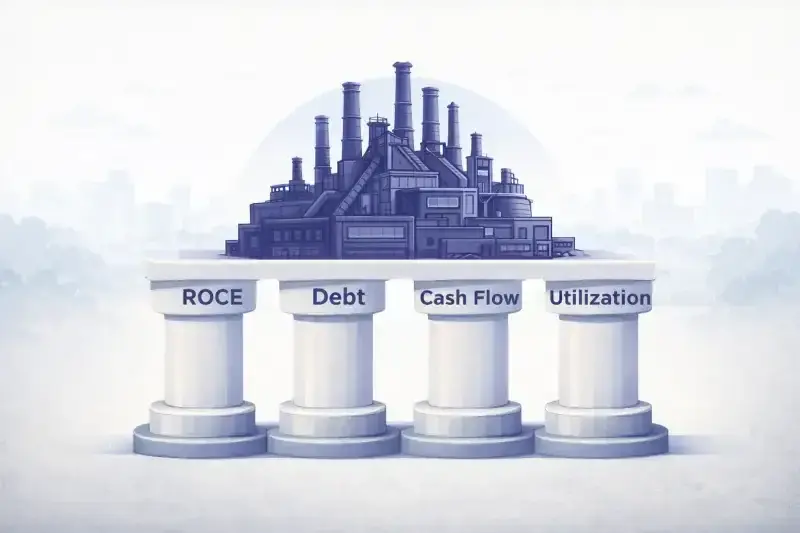
In capital-intensive industries, flashy revenue growth doesn’t tell you much. What matters is whether the money locked into the business is earning enough, and whether the company can survive when conditions turn.
This is usually thought about in a few layers.
- First, understand how heavy the structure really is.
Some businesses need very little infrastructure. Others need enormous physical assets just to function.
A simple way to see this is through the capital intensity ratio:
Capital Intensity = Total Assets ÷ Sales
This tells you how much asset base supports each unit of revenue. In steel, cement, telecom, and power, this number will naturally be high. That’s normal.
But once you confirm that the structure is heavy, the real question begins: is that capital being used well?
- Are returns strong enough to justify the investment?
This is where return on capital becomes critical.
ROCE = EBIT ÷ Capital Employed
“The ultimate test of a business is return on capital.”- Charlie Munger
If a company has billions tied up in plants and infrastructure, it should be earning healthy operating profits on that capital.
The key isn’t one exceptional year. The key is consistency. Can the business earn solid returns even when demand cools? Or do returns collapse every time the cycle softens?
In capital-intensive sectors, scale without returns is just expensive capacity.
- Look at asset efficiency, not just profits.
Because fixed assets dominate these businesses, you want to know how effectively they’re being used.
Fixed Asset Turnover = Sales ÷ Average Fixed Assets
This shows how much revenue the company generates from its long-term infrastructure.
If turnover improves over time, it usually means assets are being utilized better. If it weakens, it could signal underutilization or softer demand.
A plant sitting idle still costs money. Productivity matters.
- Then look at the balance sheet carefully.
Capital-intensive companies often carry debt. That’s not unusual. Infrastructure has to be financed somehow.
What matters is whether that debt is manageable.
The simple test is this: if earnings drop meaningfully for a year or two, does the company remain comfortable? Or does the balance sheet start to feel tight?
You can look at debt-to-equity for structure:
Debt-to-Equity = Total Debt ÷ Total Equity
But more than the ratio, focus on resilience. These industries are cyclical. A business that only works when conditions are perfect is fragile.
- Follow the cash, not just the income statement.
In capital-heavy businesses, profits don’t always mean cash.
They constantly spend on maintenance, upgrades, and sometimes expansion. So it’s important to check whether the business actually generates surplus cash after all that spending.
That’s where free cash flow comes in:
Free Cash Flow = Operating Cash Flow – Capital Expenditure
If free cash flow is consistently positive, it suggests the infrastructure is doing its job. If cash generation is weak year after year, the business may be reinvesting just to stay in place.If you’re new to cash flow analysis, understanding the cash flow statement is essential. Understanding the Cash Flow Statement: Operating, Investing, Financing Activities
Cash usually tells the more honest story.
- Don’t ignore the industry.
This is where many investors go wrong.
However, it is not possible for companies to function in isolation. In capital-intensive industries, the industry supply, price trends, regulatory changes, and economic demand play an important role.
A good company in an over-supplied industry can still fail. An average company in a tight cycle can temporarily look brilliant.
You have to ask: are new capacities being added aggressively? Are prices strong because demand is genuinely healthy, or because supply is temporarily tight?
Context matters as much as company-level numbers. Capital-intensive businesses are often deeply cyclical by nature. Read More:Circulation vs. Consumption Stocks: Which Type is More Recession-Proof?
- Finally, pay attention to capital allocation.
In these industries, expansion decisions carry long-term consequences.
Building new capacity near the top of a cycle can look bold in the short term, and painful later. Excess supply, high debt, and falling prices can take years to unwind.
Look at management’s history. Did past expansions improve returns? Or dilute them?
In capital-intensive businesses, discipline is often more important than ambition.
The Bottom Line
If you take a step back and really think about it, analyzing a capital-intensive business really comes down to one basic concept.
Is capital employed in this business earning sustainable returns with good leverage, efficient asset usage, hard cash flow, and smart growth?
If yes, capital intensity can become a strength.
If not, it becomes a weight the company has to carry.
And in these industries, that weight eventually shows.
Numbers and ratios only make sense in context.
To see how this framework works in practice, let’s look at a real-world example.
A Quick Real-World Glimpse
Think about a company like UltraTech Cement.
Long before it sells even a single bag of cement, an enormous amount of money has already been invested. Building the business itself requires massive cement plants, access to limestone mines, energy-intensive kilns, grinding units, and a distribution network that reaches across the country. All of this infrastructure has to be in place first.
In other words, this isn’t the kind of business where you can start with a small setup and gradually grow. The scale — and the investment — have to come upfront. The money goes in upfront, and once those facilities are built, they can’t simply be downsized or switched off overnight. They require maintenance, power, and capital support regardless of how demand moves. This is capital intensity in practice, heavy fixed costs, and long-term capital locked into physical assets.
When construction activity picks up — whether it’s highways, bridges, housing projects, or new infrastructure — the demand for cement naturally rises. As a result, cement plants start running closer to their full capacity.
What’s interesting is that nothing major inside the factory really changes. The same plants, the same machines, and the same workforce are already in place. The difference is simply that they begin producing more cement because demand is stronger. And since a large part of the costs is already sunk, making more cement means that these costs are distributed over a larger number of cement bags. That’s when margins start to look better, and the return on the money invested in those massive plants improves noticeably.
EBITDA margins can strengthen sharply during such phases, and free cash flow begins to reflect the efficiency of scale. In this environment, the same infrastructure that once looked expensive starts to look powerful. High utilization turns capital intensity into an advantage. This is also why investors often focus on EBITDA in capital-heavy industries. Read More: What is EBITDA? Why Investors Look at It (And Its Limitations)
But when demand slows, whether due to weaker real estate activity or broader economic softness, the structure feels very different. Utilization declines, pricing power erodes, and margins contract rapidly. Yet, costs of maintenance, depreciation, and debt servicing remain. The rate at which returns on capital erode exceeds the rate at which revenues erode. This is where the risks discussed earlier become visible: fixed cost rigidity and leverage amplify the downturn.
The assets themselves have not changed. What changes is the cycle. And that is the central lesson of capital-intensive businesses: they magnify both strength and stress, depending on the environment.
“Risk comes from not knowing what you’re doing.”- Warren Buffett
And this is true not just for one company, but for capital-intensive businesses as a whole.
Final Thoughts: When Structure Becomes Destiny
Capital-intensive businesses are not complicated once you understand what truly drives them. They are defined by structure. Large assets, high fixed costs, long investment cycles, and limited short-term flexibility. In strong environments, that structure amplifies profitability. In weak ones, it exposes fragility. The business may look the same on the surface, but underneath, the cycle is doing the real work.
For investors and observers, the lesson is simple but powerful. Don’t get carried away by revenue growth or peak-cycle margins. Look at returns on capital. Look at leverage. Look at cash flows. Look at utilization. And always ask whether the business can withstand a slowdown without structural damage. In capital-intensive industries, resilience is often more valuable than expansion.
If this breakdown helped you see these businesses differently, comment “Structure” below. It’s a small reminder that in capital-heavy industries, infrastructure doesn’t just support the business, it defines it.
FAQs ( Frequently Asked Questions )
Are capital-intensive businesses always risky?
+Not necessarily. They carry structural risks because of high fixed costs and large investments. However, well-managed capital-intensive businesses with strong returns on capital, disciplined leverage, and consistent cash flows can be very resilient and profitable over long cycles.
What industries are typically capital-intensive?
+Industries such as steel, cement, airlines, telecom, oil & gas, power generation, shipping, and infrastructure are classic examples. These sectors require large investments in physical assets before meaningful revenue is generated.
Why is ROCE so important in capital-intensive businesses?
+Because these businesses deploy large amounts of capital, it is crucial to know whether that capital is earning adequate returns. ROCE helps measure how efficiently operating profits are generated from invested capital, making it a key metric in such industries.
Can capital-intensive businesses generate high returns?
+Yes — especially during strong demand cycles. When utilization is high, fixed costs are spread over a larger output, leading to margin expansion and improved returns. However, those same businesses may face pressure during downturns.
How does debt affect capital-intensive companies?
+Debt often finances large infrastructure investments. While it can enhance returns in strong cycles, it increases vulnerability during downturns. In capital-intensive industries, leverage amplifies both gains and losses.

High growth stock specialist, Value Educator
Shashank Mahajan is an equity research professional with over 12 years of experience in identifying high-potential SME and micro-cap stocks at an early stage. He follows a rigorous scuttlebutt research–driven approach, combining on-ground insights with deep financial analysis. Shashank specializes in uncovering under-researched and under-owned companies with strong management quality and long-term growth potential. Through disciplined research and early identification, he focuses on spotting tomorrow’s market leaders before they enter the mainstream investor radar.

Glenmark: The USD 700 Mn Cancer Deal and Its Brands

Pharma Stocks in India 2026: Generics, APIs and CDMOs

Granules India: From Paracetamol to a 65% Gross Margin

Natco Pharma: After Revlimid, 29 Patent Challenges

Shilpa Medicare: Cancer APIs, Films and Biosimilars

Alembic Pharma: US Plants Pay Back, Margin Hits 22.2%
Explore our Products
Research Framework
Emerging Titans
Combination of quantitative analysis, industry tailwinds, and management assessment - SPRINT investment philosophy
Tiny Titans
Heavy emphasis on scuttlebutt research, plant visits, and early on-ground signals



Modern Warfare to Multibaggers
Key Trends. Strategic Shifts. Opportunities Ahead.
Today at 7:00 PM IST. Room opens 30 minutes before.
Don't Miss This Exclusive Webinar!
Join Value Educator to decode the key trends shaping India's defence sector and learn how to identify tomorrow's potential leaders in the space.
- In-depth research on India's defence sector
- Live Q&A session
- Actionable takeaways for long-term investors

 Orders
 Subscription
 Share with friends


Required Details
₹23999.00
(12 month subscription)
As per SEBI regulations, all users are mandated to complete the KYC that is validated for 1 year. Post payment, you will be redirected to the KYC screen


No comments yet. Be the first to comment!