
Circulation vs Consumption Stocks

Imagine this.
Nifty is falling every day, layoffs are in the news, your WhatsApp family group is full of “Market crash” forwards…
But your local kirana is still selling packets of salt, your mother is still buying hair oil, and the milkman still shows up every morning.
The stock market looks like a disaster movie.
But Real life?
Feels slower, tense, but still moving.
As Warren Buffett once famously said, “The stock market is a device for transferring money from the impatient to the patient.” And nowhere is that patience tested more than during downturns like these.
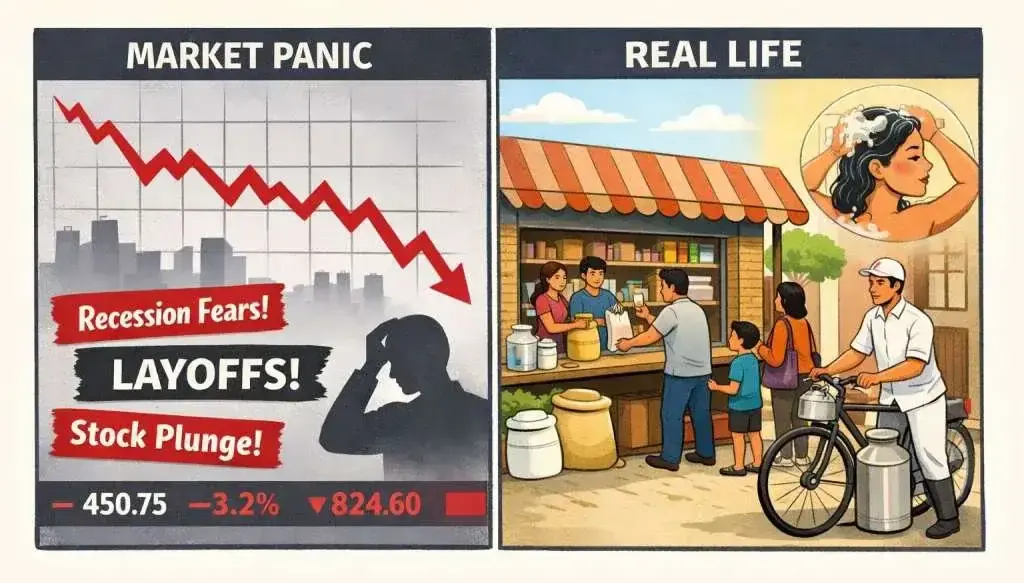
The difference is clearly evident in the market. When fear grips investors, money quietly rotates toward businesses people cannot postpone — food, soap, toothpaste, basic household products.
If everyday consumption is viewed as the mattress beneath the economy, it should show up when things get ugly. So instead of theory, let’s look at evidence — a simple comparison between Nifty FMCG and Nifty Infra, rebased to 100 during the COVID years.
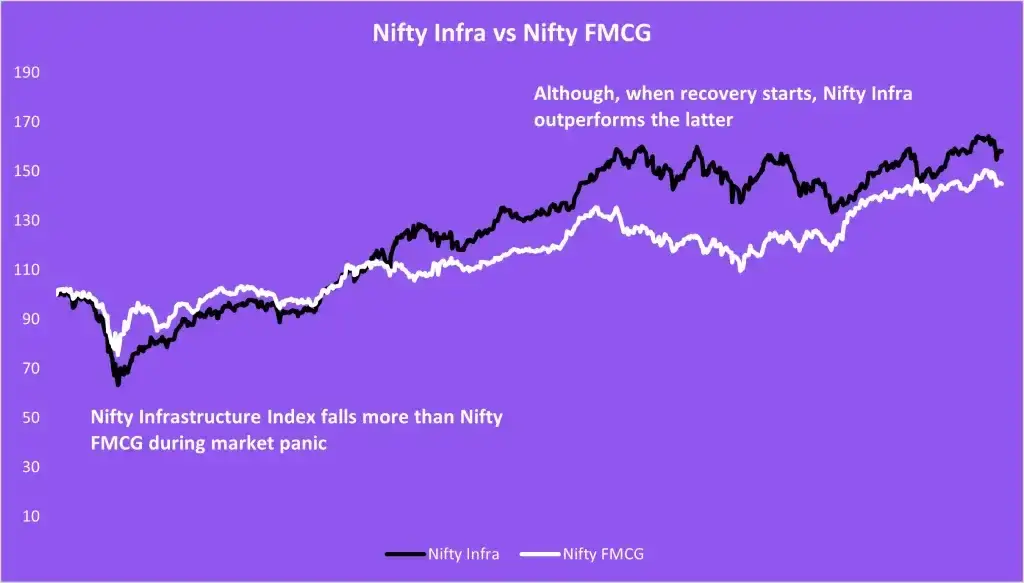
This is exactly where “circulation vs. consumption” stocks come into play — and understanding the difference can help you decide which types of companies are more recession-proof for your portfolio.
First, Plain English: What Are These Two?
Let’s drop the market jargon and talk like normal people.Consumption stocks are simply businesses that earn from your everyday routine. The stuff you buy without much planning — the biscuit with your evening chai, the shampoo you replace before it runs out, the late-night noodle packet when you don’t feel like cooking. Life keeps moving, and so does the spending.
Peter Lynch summed up the appeal of such businesses perfectly: “Invest in what you know.” And what do people know better than their own daily habits?
In India, this bucket is filled with familiar names. Companies like Hindustan Unilever, ITC, Nestlé India, Dabur, and Marico live inside millions of homes. Retail chains such as D-Mart and Trent step in when people are willing to browse and spend a little more. Then there are consumer durable makers like Voltas, Havells, and Bajaj Electricals — purchases you may delay, but rarely avoid forever.
They’re called consumption plays for a simple reason: as long as people continue living their daily lives, these companies continue ringing the cash register. Even when the economy gets shaky, households usually cut luxuries before they cut toothpaste or cooking oil.
Circulation stocks sit on the other side of the economy. You don’t exactly “consume” what they offer, but without them, business activity would slow to a crawl.
Start with banks and lenders. When names like HDFC Bank, ICICI Bank, SBI, or Bajaj Finance step up lending, it usually signals that money is actually moving around — businesses start thinking bigger, people don’t hesitate as much to spend, and the overall vibe turns positive.
Then you’ve got the companies that literally build that growth, like infrastructure players such as L&T, Siemens, and ABB India.
In the background, logistics firms like Adani Ports, CONCOR, and Delhivery keep things running so products reach where they’re supposed to. Steel, cement, and metal companies are part of this chain too, since they supply the raw stuff that everything else depends on.
These businesses generally do best when the economy feels active — factories are busy, projects are getting announced, and credit is not too hard to come by. But the other side matters just as much: the moment momentum fades, they’re usually the first to feel the slowdown.
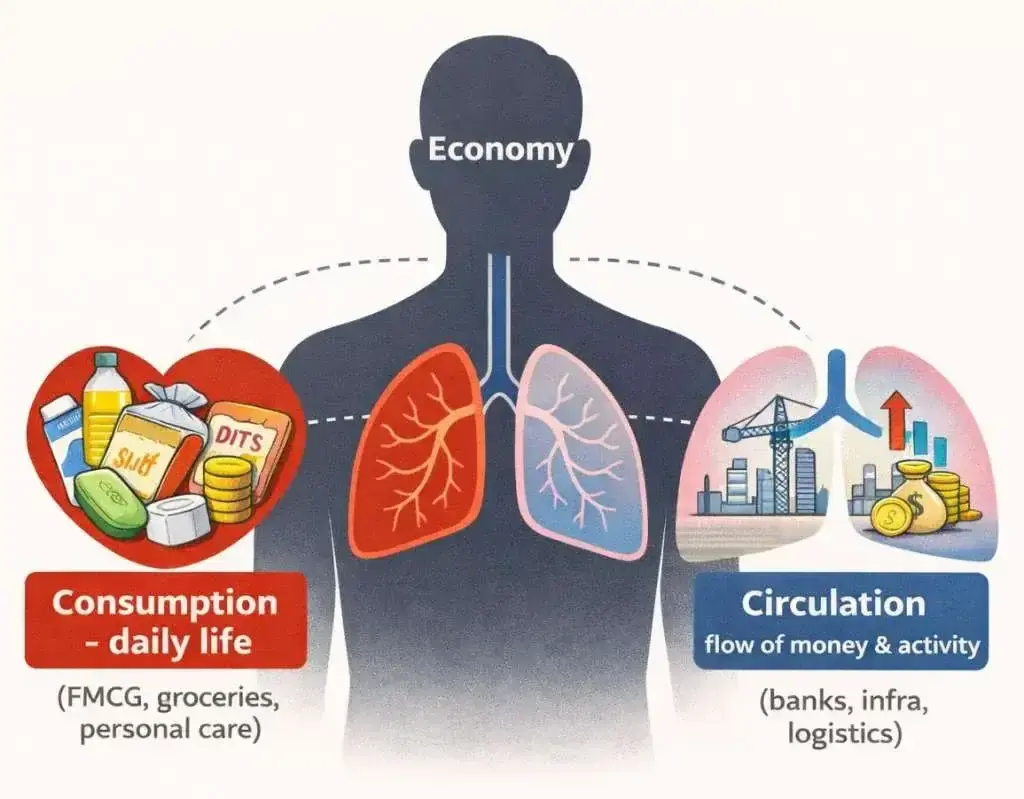
Put differently, consumption stocks reflect how people are living, while circulation stocks reflect how the economy itself is breathing. One is powered by daily habits; the other by economic momentum.
If you’re still getting comfortable with how markets function, read our articles on:
A Beginner's Guide to the Indian Stock Market
Recession Reality: What Actually Happens?
When the economy hits a rough patch, most households slip into caution mode. It’s not panic — just quiet prioritising.Large expenses are usually the first to be reconsidered. A new car suddenly feels unnecessary when the current one is doing fine. That phone upgrade loses its excitement. Plans to redo the kitchen or renovate the house are gently pushed to “maybe next year.”
Daily living, however, doesn’t offer that flexibility. Groceries still have to be bought. The jar empties, the milk finishes, the cooking oil runs low — and you refill them almost automatically. Toothpaste doesn’t last longer just because growth has slowed, and neither does soap or detergent. Even families watching every rupee tend to allow small, familiar comforts to remain.
John Templeton captured this behavioural truth decades ago: “The four most dangerous words in investing are: this time it’s different.” Spending patterns rarely change as much as headlines suggest. So the shift isn’t that people stop spending — they simply become selective. Wants step aside; needs stay put.
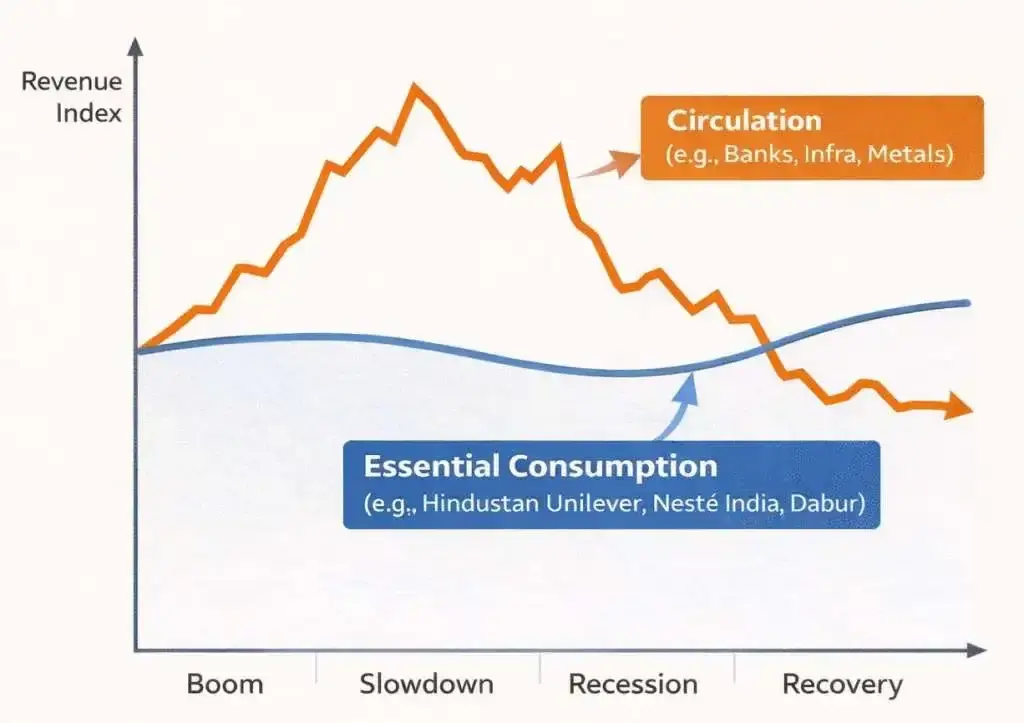
This is why investors often observe a familiar pattern during downturns: businesses built around essentials tend to remain steadier, while companies dependent on optional spending feel the strain much sooner.
So, Which Is More Recession-Proof?
Let’s keep the answer straightforward.Most of the time, consumption businesses — especially those selling everyday essentials — tend to handle economic stress better than circulation-driven companies. But it’s not as black-and-white as it sounds. Not every consumption company is automatically safe, and not every circulation business is fragile. The reality usually sits somewhere in the middle.
Let’s look at it from an Indian investor’s lens.
Part 1: Why Essential Consumption Often Holds Steady
Think about companies like Hindustan Unilever, ITC, and Nestlé India, as well as traditional household names such as Dabur, Marico, and Emami. Their products are woven into daily life — the kind people replace without much thought.When growth slows, households adjust rather than withdraw. Someone who once bought a premium shampoo may shift to a smaller pack. Families might cut down on restaurant visits but continue stocking basic food at home. Spending becomes smarter, not absent.
Because of this, these companies usually experience moderation rather than meltdown. Sales growth may cool off, yet it rarely drops off a cliff. Many of them also have the pricing muscle to quietly pass on part of their rising costs through small increases that most consumers barely notice.
Another advantage is familiarity. Strong brands and deep distribution networks mean their products are available almost everywhere — from supermarkets to the neighbourhood kirana store. That kind of reach acts like a cushion during uncertain periods.
Look back at previous slowdowns in India and a pattern often appears: FMCG stocks typically didn’t correct as sharply as cyclical sectors, bounced back sooner, and in some cases were already climbing while the broader economy was still finding its feet.
For retail investors, this relative stability gives them a “defensive” reputation.
Part 2: Why Circulation Stocks Feel the Pain More Quickly
Circulation businesses are deeply tied to confidence. When people and companies feel optimistic, these stocks thrive. When uncertainty creeps in, they’re usually the first to sense it.Take banks and lenders such as HDFC Bank, State Bank of India, Axis Bank, or Bajaj Finance. Their business depends on people being willing to borrow and businesses being willing to expand. In a slowdown, both groups tend to hesitate. Home purchases are delayed, car loans slow down, and entrepreneurs decide to “wait and watch” instead of taking on new risk.
At the same time, stress starts showing up quietly. Some borrowers struggle with repayments, forcing banks to be more cautious. Even the fear of rising bad loans is enough to make markets nervous, long before the actual damage shows up in numbers.
Now look at infrastructure and capital goods companies like Larsen & Toubro or Siemens.
Their order books depend on large projects — factories, highways, power plants. During uncertain times, these projects don’t get cancelled outright; they simply get postponed. And in this business, delay itself can hurt sentiment and valuations.
The same logic applies to logistics and trade-linked players such as Adani Ports and Container Corporation of India. When trade slows or companies move fewer goods, volumes soften. Even a small dip in activity can ripple through earnings because these businesses are built on scale.
The key thing to understand is this: circulation stocks don’t fail suddenly, but their fortunes swing with the economy’s mood. When growth slows, profits can wobble, guidance can turn cautious, and stock prices often react sharply — sometimes more than the actual business impact would justify.
George Soros once observed, “Markets are constantly in a state of uncertainty and flux.” Circulation stocks sit right at the center of that flux.
That’s why, during recessions or prolonged slowdowns, these stocks often fall harder and take longer to regain momentum. They need the full cycle — lower rates, policy support, rising demand, and improving confidence — to come together again.
Ironically, this sensitivity is also their strength. The very reason they struggle in bad times is why they can deliver powerful rallies when the economy turns. But in the middle of a slowdown, they rarely feel comfortable to hold — especially for retail investors seeking peace of mind rather than excitement.
The Twist: Recession-Resistant vs. Long-Term Wealth Creation
This is the point where many new investors trip up. Stability and wealth creation don’t always come from the same place.Consumption stocks are usually seen as steady performers. Their earnings tend to be more predictable, which makes them comforting to hold when markets get shaky. The catch? That reliability often comes at a price — quite literally — since these stocks frequently trade at higher valuations.
Circulation stocks sit on the opposite end. They can be unpredictable and move in cycles, which isn’t always easy on the nerves. But when the economy rebounds, they often gather momentum quickly and can deliver powerful returns — especially for investors who entered before the recovery became obvious.
Put simply, consumption stocks may help you sleep better during difficult phases, while circulation stocks have the potential to build wealth faster once growth returns.
read more on : How to Set Clear Financial Goals Before Buying Your First Stock
So the real question isn’t just which category is more recession-proof. It’s about timing and temperament — understanding where the economy stands and being honest about how much volatility you’re comfortable riding through.
India-Specific Angle: Why This Question Matters More Here
In India, this isn’t just a textbook investing debate — it plays out in real time because of how our economy behaves. We’re a young country with rising incomes, fast urban growth, and millions of people upgrading their lifestyles each year. Naturally, that creates a strong tailwind for consumption over the long run.But India also moves in bursts. One year feels full of opportunity; another reminds you how quickly global shocks, oil prices, or even a weak monsoon can change sentiment.
That’s why both sides of the market have had their moments. Consumption companies have quietly compounded wealth over time. Yet whenever the economy has truly picked up speed — whether during the mid-2000s boom, the investment cycle around 2014–2017, or the post-COVID surge — banks, infrastructure, and capital goods stocks have often delivered the kind of returns that grab headlines.
The real lesson? Don’t get too comfortable in one camp. Stick only to “safe” consumption, and you may miss powerful growth cycles. Go all-in on high-beta circulation, and downturns can feel far more painful than expected.
If you want to see how economic growth directly feeds into corporate profits, understanding the link between GDP and earnings can offer a valuable perspective.
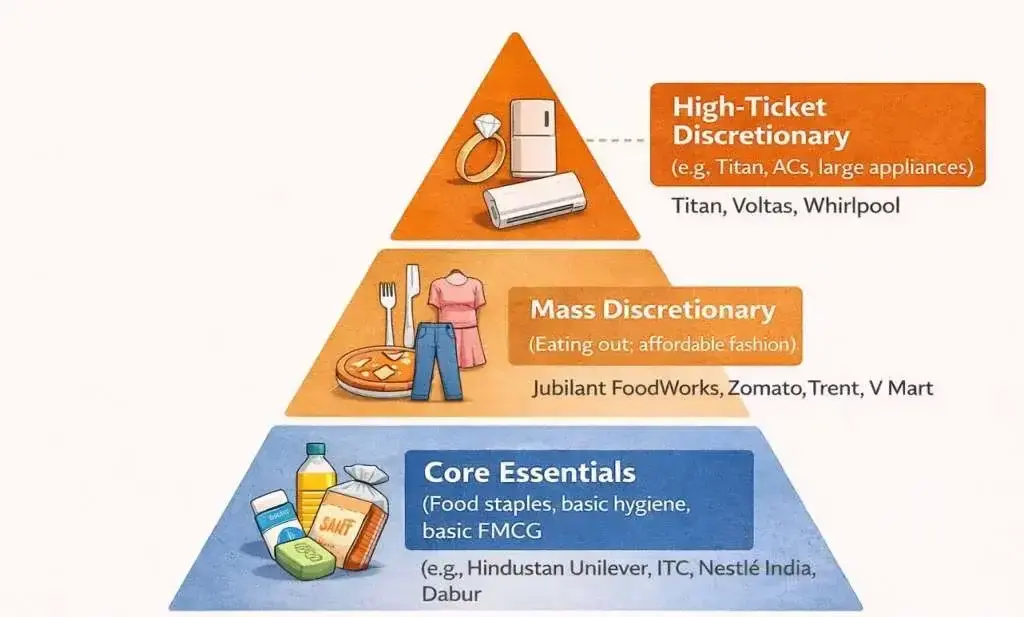
Different Types of Consumption: Not All Are Equal
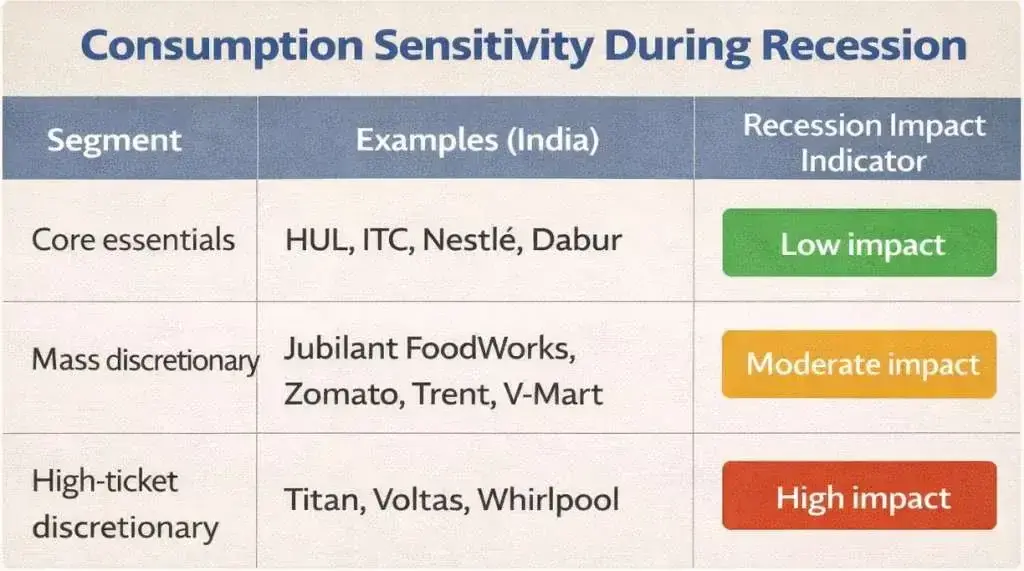
We often talk about “consumption” as if it’s one solid, dependable block. But if you step inside an actual household during a financial squeeze, you’ll notice something interesting — spending doesn’t vanish, it gets reshuffled.Some things are protected almost instinctively. Others are quietly pushed into the future.
Core essentials — life keeps running
- This is the boring stuff — and boring is good in investing. Food in the kitchen, soap near the sink, toothpaste that gets replaced before it’s fully finished.
- Businesses like Hindustan Unilever, ITC, Nestlé India, and Dabur thrive on these everyday habits.
- When money feels tight, families adapt rather than eliminate. Maybe the premium variant becomes the regular one. Maybe the large pack becomes a smaller refill. But skipping entirely? Rare.
Mass discretionary — where the trimming begins
- These are the little upgrades that make life enjoyable: ordering dinner after a long day, picking up an extra shirt, saying yes to small comforts.
- Companies such as Jubilant FoodWorks, Zomato, Trent, and V-Mart Retail sit right in this zone.
- During uncertain periods, the internal dialogue changes from “Why not?” to “Maybe not today.” People don’t walk away — they just become choosier.
High-ticket discretionary — confidence required
- Then some purchases need emotional comfort as much as financial ability: jewellery, air conditioners before summer, a big appliance upgrade.
- Firms like Titan Company, Voltas, and Whirlpool of India often notice the pause early.
- Because when the future feels slightly uncertain, most people default to a simple thought: Let’s wait. Not no — just not now.
Different Types of Circulation: Some Are More Resilient Than Others
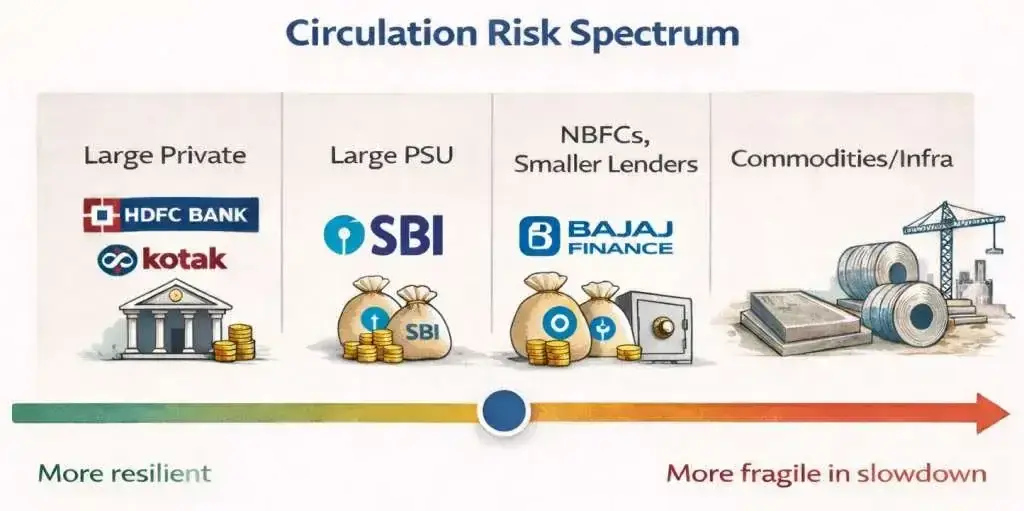
It’s tempting to treat circulation as one big, high-risk bucket. But once you look closer, the differences are hard to miss. Some businesses are designed to bend without breaking; others feel stress almost immediately when the economy loses momentum.
Large private banks — steady hands in rough weather
- Names like HDFC Bank, ICICI Bank, and Kotak Mahindra Bank usually walk into slowdowns better prepared than most. Strong balance sheets, diversified lending, and tighter risk culture give them breathing space.
- They don’t escape the slowdown — fewer people borrow, caution rises — but these phases often clear the field. As weaker lenders struggle, stronger banks quietly pick up customers and deepen their position.
NBFCs and smaller lenders — growth comes with vulnerability
- Many smaller lenders run faster during good times, but that speed needs constant fuel: liquidity, stable borrowing costs, and healthy repayments.
- When money becomes harder to access, or borrowers start missing payments, the pressure builds quickly. That’s why parts of the NBFC and microfinance space can look very strong in expansions and noticeably fragile in contractions.
Infrastructure and capital goods — powered by belief in the future
- Businesses such as Larsen & Toubro, Siemens, and Bharat Electronics Limited thrive when the country is building roads, factories, defence systems, and power projects.
- But when confidence dips, decision-makers hesitate. Projects aren’t always cancelled; they just sit on the drawing board longer. For these companies, delay alone can dull momentum. When the investment cycle returns, though, the revival can be just as dramatic.
Commodity-linked businesses — the emotional roller coaster
- Steel, metals, cement, shipping — industries where global prices often call the shots.
- One-year margins look extraordinary; another year, they shrink without much warning. It’s less about day-to-day execution and more about forces no single company can control.
Simple Mental Models For Retail Investors
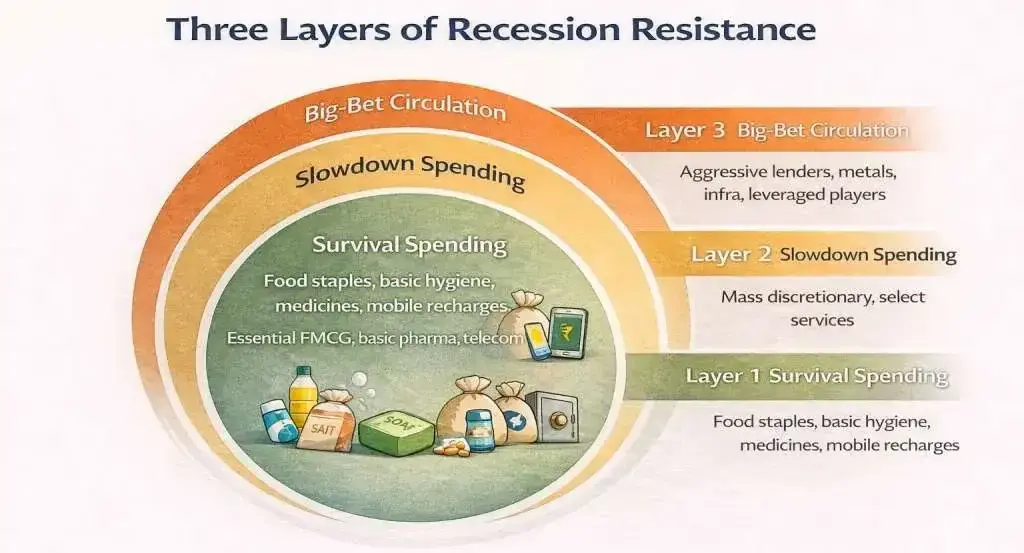
When markets turn uncertain, complicated theories don’t help much. What does help is a simple way to think about spending behavior. One useful approach is to picture recession resistance in three layers — almost like a priority list inside a typical Indian household.
Layer 1: Survival Spending — the last things people cut
Ask yourself: If money gets tight, what will people still pay for without debate?- Food staples
- Basic hygiene products
- Medicines
- Mobile recharges and essential data
These aren’t lifestyle choices — they’re part of daily functioning. Businesses tied to these needs usually stand closest to being recession-resilient because demand rarely disappears.
Layer 2: Slowdown Spending — the “let’s be a little careful” zone
Now think about expenses people hesitate over when the outlook feels uncertain.
- Eating out becomes occasional instead of routine
- Fashion and lifestyle purchases get spaced out
- Gadgets or appliances are researched longer before buying
- Vacations become shorter, cheaper, or postponed
Spending doesn’t fall off a cliff here — it simply cools. Companies in this layer often report slower growth rather than dramatic declines.
Layer 3: Big-Bet Circulation — most sensitive to the cycle
Finally, consider businesses that rely directly on economic momentum.- Lenders with aggressive or risk-heavy loan books
- Metals and commodity players
- Infrastructure firms without strong project visibility
- Highly leveraged companies
When activity slows, earnings in these areas can change quickly. For investors, they can feel uncomfortable to hold during downturns — yet they’re often the ones that rebound sharply when the cycle turns. Timing matters far more here than in the other layers.
Portfolio Construction: How To Mix Both Smartly
One of the biggest myths in investing is that you must pick a side — consumption or circulation. In reality, most resilient portfolios borrow strength from both. The idea isn’t perfection; it’s balance.
Think of your portfolio like a cricket team. You need dependable players who hold the innings together, stroke-makers who accelerate when conditions improve, and a few calculated risk-takers who can change the game — but without putting the entire match in danger.
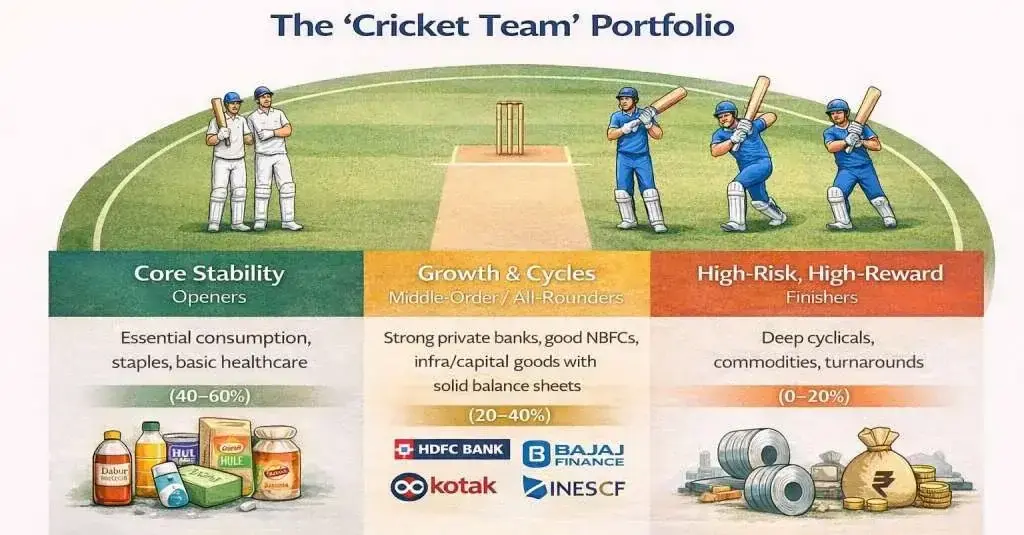
Core Stability (roughly 40–60%) — your shock absorbers
This is the portion meant to help you stay calm when markets aren’t.- High-quality consumption businesses
- Everyday healthcare or basic pharma
- Staples-focused retail
The goal here isn’t excitement — it’s durability. These companies often grow steadily, fluctuate less, and provide a cushion when the broader market feels unsettled.
Growth & Cycles (about 20–40%) — where momentum comes from
This bucket is for businesses that benefit when the economy finds its rhythm.- Strong private-sector banks
- Well-managed NBFCs
- Infrastructure and capital goods firms with healthy balance sheets
They may test your patience during slow phases, but when recoveries gather pace, this segment often does the heavy lifting for returns.
High-Risk, High-Reward (0–20%) — handle with self-awareness
Not every investor needs this slice, but some choose to keep a small allocation.
- Deep cyclicals
- Commodity businesses
- Turnaround stories
These can be rewarding if your timing and understanding are solid — and stressful if entered casually. Position size matters more here than stock selection.
Warren Buffett summarised this philosophy in simple terms when he quoted: “Diversification is protection against ignorance.” Not because diversification is magical — but because uncertainty is inevitable.
So how do you decide the right mix?
There’s no universal formula. It usually comes down to a few very personal factors:- How long can you stay invested
- How stable your income feels
- How do you react when your portfolio temporarily drops
Because in the end, the “best” portfolio isn’t the one with the highest theoretical return — it’s the one you can hold onto without losing sleep.
Also, read our article on: How to Set Clear Financial Goals Before Buying Your First Stock
Red Flags to Watch During Recessions
When the economy turns rough, markets stop being polite. They don’t reward stories or intentions; they expose weaknesses. That’s why downturns are less about finding the perfect stock and more about avoiding the obvious traps.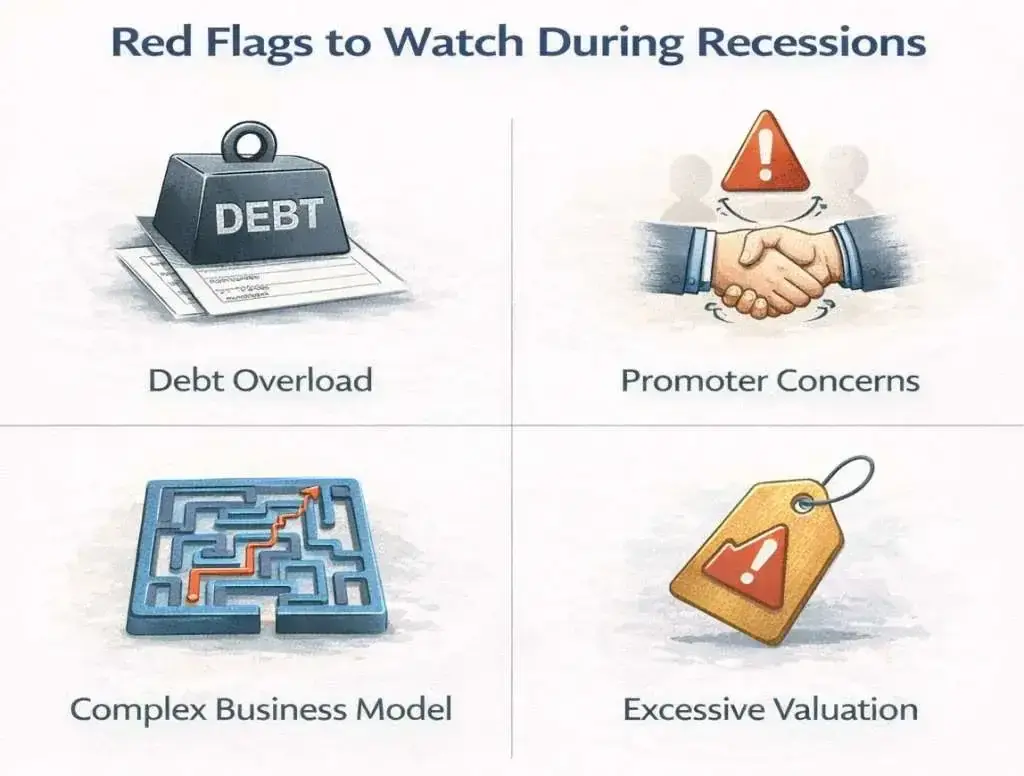
Debt — looks harmless until it isn’t
In good times, debt stays in the background. Cash flows come in, interest gets paid, and everything feels under control. In a slowdown, the mood changes fast. Earnings dip, but loan repayments don’t. For highly leveraged companies — especially in cyclical sectors — debt can turn from a tool into a chokehold.
Knowing how to quickly evaluate a company’s financial strength — especially its debt levels — can prevent costly mistakes during downturns. To know more about this read our article on: How to Read a Balance Sheet Like a Professional Investor.
Promoter quality — pressure reveals character
Stress has a way of showing you who’s really in charge. Frequent promoter share pledging, repeated equity dilution, or vague communication are usually small warnings before they become big problems. If promoters don’t respect minority shareholders when times are good, don’t expect miracles when things get hard.
Business model clarity — confusion is expensive in bad times
If you struggle to explain how a company makes money, that’s not intellectual humility — it’s a risk. Complicated structures and clever explanations may sound impressive during bull markets. In downturns, that complexity often becomes the very thing that breaks confidence.
Valuation — even safety has a limit
A strong brand or “defensive” label doesn’t make a stock immune to gravity.When expectations are sky-high, and growth slows even slightly, prices can fall harder than most investors expect. A great business bought at the wrong price can still deliver a disappointing experience.
Seth Klarman captured these risks perfectly: “Risk is not the same as volatility.” Prices can swing wildly without real danger — and sometimes things look stable while risk quietly builds underneath.
Final takeaway: How to Actually Use This Insight
When talk of a “recession” starts floating around, remember — investing is not a game of reflexes. It is a test of temperament.
First, don’t rush to sell.
Markets often fall faster than logic does. Acting out of fear usually locks in losses that patience could have healed.
Also read our article on: How to Stay Emotionally Strong During Market Crash
Take a quiet look at your portfolio.
What sits inside it? Businesses people rely on every day, or companies that thrive only when money is cheap and growth is everywhere?
Build a stronger foundation.
Make sure a meaningful part of your money is parked in dependable consumption names — the kind with trusted brands, steady cash flows, and balance sheets that don’t wobble at the first sign of stress.
Choose strength over stories.
Slowdowns have a way of exposing weak businesses. This is the time to lean toward proven players rather than hopeful narratives.
Zoom out.
Every recession feels permanent while you’re in it. None of them are. Good businesses outlive bad cycles — and patient investors benefit from that survival.
Explore our Products
Research Framework

Emerging Titans
Combination of quantitative analysis, industry tailwinds, and management assessment - SPRINT investment philosophy

Tiny Titans
Heavy emphasis on scuttlebutt research, plant visits, and early on-ground signals
Conclusion: What Really Holds Up in a Recession?
When the economy tightens, investing becomes less about chasing returns and more about understanding what truly endures. Some businesses stand like bedrock — powered by everyday needs that don’t disappear just because sentiment weakens. Others move with the rhythm of growth, accelerating in good times and slowing when confidence fades. Both have a role to play.
But resilience alone is not the destination.
A portfolio built only for safety may help you sleep well, yet it rarely creates exceptional wealth. On the other hand, leaning entirely on cyclical growth can make the journey far more turbulent than most investors expect.
The real advantage lies in balance.
Blend the quiet strength of essential consumption with selectively chosen circulation businesses, the kind prepared not just to survive slowdowns, but to expand when the cycle turns. This combination doesn’t aim to predict the future; it prepares you for it.
Because successful investing is rarely about reacting to every storm.
It is about building something steady enough to withstand uncertainty — and patient enough to benefit when the skies clear.
Look at your portfolio today — is it built only for growth phases, or is it prepared for tougher cycles as well?
Comment “BALANCED” if your approach prioritises resilience alongside growth, or “CYCLICAL” if your portfolio leans heavily toward economic momentum. Let’s see how investors here are positioning for the next phase of the market.
FAQs
Does “recession-proof” mean a stock price will never fall?
+Are FMCG and consumption stocks always safe investments?
+Can circulation stocks be good investments during a slowdown?
+How should first-time investors apply this framework?
+Does this framework work only for recessions like Covid?
+What’s the biggest mistake investors make during downturns?
+
High growth stock specialist, Value Educator
Shashank Mahajan is an equity research professional with over 12 years of experience in identifying high-potential SME and micro-cap stocks at an early stage. He follows a rigorous scuttlebutt research–driven approach, combining on-ground insights with deep financial analysis. Shashank specializes in uncovering under-researched and under-owned companies with strong management quality and long-term growth potential. Through disciplined research and early identification, he focuses on spotting tomorrow’s market leaders before they enter the mainstream investor radar.

Glenmark: The USD 700 Mn Cancer Deal and Its Brands

Pharma Stocks in India 2026: Generics, APIs and CDMOs

Granules India: From Paracetamol to a 65% Gross Margin

Natco Pharma: After Revlimid, 29 Patent Challenges

Shilpa Medicare: Cancer APIs, Films and Biosimilars

Alembic Pharma: US Plants Pay Back, Margin Hits 22.2%
Explore our Products
Research Framework
Emerging Titans
Combination of quantitative analysis, industry tailwinds, and management assessment - SPRINT investment philosophy
Tiny Titans
Heavy emphasis on scuttlebutt research, plant visits, and early on-ground signals



Modern Warfare to Multibaggers
Key Trends. Strategic Shifts. Opportunities Ahead.
Today at 7:00 PM IST. Room opens 30 minutes before.
Don't Miss This Exclusive Webinar!
Join Value Educator to decode the key trends shaping India's defence sector and learn how to identify tomorrow's potential leaders in the space.
- In-depth research on India's defence sector
- Live Q&A session
- Actionable takeaways for long-term investors

 Orders
 Subscription
 Share with friends


Required Details
₹23999.00
(12 month subscription)
As per SEBI regulations, all users are mandated to complete the KYC that is validated for 1 year. Post payment, you will be redirected to the KYC screen


No comments yet. Be the first to comment!