
Ajanta Pharma: Branded Generics and a 49% US Jump
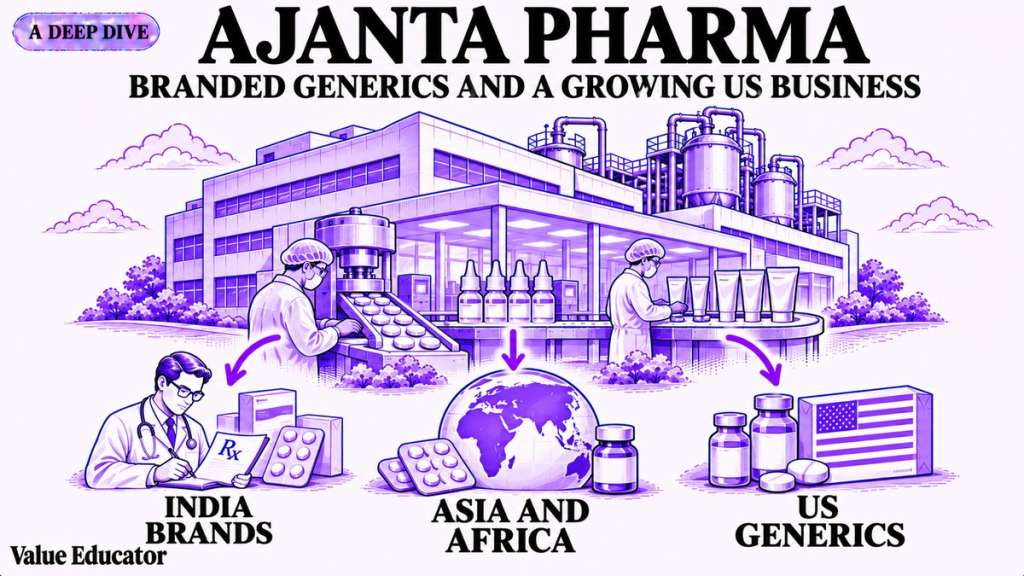
In FY23, an intense flu season hit the United States, and children were among the worst affected. One Indian medicine maker sold an oral suspension, a liquid medicine for children, that played a large part in treating them. The company stretched its resources to keep that medicine reaching American patients, even though the logistics costs were heavy. That year its EBITDA margin came in at 21%, against 28% a year earlier.
Four years later, the same company reported an EBITDA margin of 30% for the July to September quarter of 2026. Its revenue had grown to ₹1,794 Cr in that quarter alone. The rush to supply children's medicine was not what lifted it. What lifted it was the way the company had built its business, over many years, on medicines that carry its own brand name.
That idea needs a short explanation. A generic medicine is a copy of a medicine whose patent has expired. In the United States, generics are sold mostly on price, through large wholesalers and pharmacy chains, and the buyer rarely knows who made the tablet. In India, Asia and Africa, it works differently. There, a company sells its generic under its own brand name, and its medical representatives visit doctors to explain why that brand is worth prescribing. This is called a branded generic, and when doctors trust a brand, they keep writing it for years.
That is why branded generics usually earn higher margins than plain generics. The company is paid not only for making a tablet, but also for building a name that doctors remember. The hard part is the cost. Branded generics need a large field force, steady new launches and years of work in each country.
That company is Ajanta Pharma Ltd (NSE: AJANTPHARM). It sells branded generics in India and in more than 30 countries across Asia and Africa, and it sells plain generics in the US. About two-thirds of its revenue now comes from branded generics. In FY26 its revenue from operations was ₹5,453 Cr, up 17%, and its profit after tax crossed ₹1,000 Cr for the first time.

So this is a company with two very different engines: a branded business that grows steadily, and a US business that can grow very fast and then slow down. Both showed up in its latest numbers.
Ajanta Pharma in five numbers
- Q2 FY27 revenue of ₹1,794 Cr, up 33%
- Q2 FY27 EBITDA margin of 30%, against 27% a year ago (excluding forex effects)
- Branded generics at 66% of Q2 FY27 sales
- US generics revenue of ₹971 Cr in H1 FY27, up 49%
- Return on capital employed of 41% in September 2026
So how did a company that once leaned on India grow into one that sells in more than 30 countries? Let's first understand the company, and then look at the latest quarter.
Ajanta Pharma: Company Overview
Ajanta Pharma Ltd was incorporated in 1979 and has its registered office in Mumbai. It is a specialty pharmaceutical formulation company, which means it develops, makes and sells finished medicines rather than the raw drug ingredients. Most of its revenue comes from branded generics in India and in more than 30 countries across Asia and Africa, where it has its own teams on the ground. It also sells generic medicines in the US and supplies antimalarial medicines through aid agencies in Africa. It runs seven plants in India, two of them approved by the US FDA, and an R&D centre in Mumbai with more than 850 scientists. Its field force has more than 6,120 medical representatives. Mannalal B. Agrawal is the Chairman, Yogesh M. Agrawal the Managing Director and Rajesh M. Agrawal the Joint Managing Director. Revenue from operations was ₹5,453 Cr in FY26, and the company held net cash and investments of ₹574 Cr in September 2026. Read this Operating vs Net Profit Margin Explained
"The stock market is a device for transferring money from the impatient to the patient."
— Warren Buffett
Ajanta's branded business is built one doctor and one country at a time. Its results make the most sense when read over several years, not one quarter.
The Quarter Every Business Grew
Let's look at Q2 FY27, the July to September quarter in which every business grew, which Ajanta reported on 30 October 2026. Revenue from operations was ₹1,794 Cr, up 33% from ₹1,354 Cr a year earlier. It was also about 10.3% higher than the ₹1,626 Cr of Q1 FY27. Every one of its five businesses grew over the year.
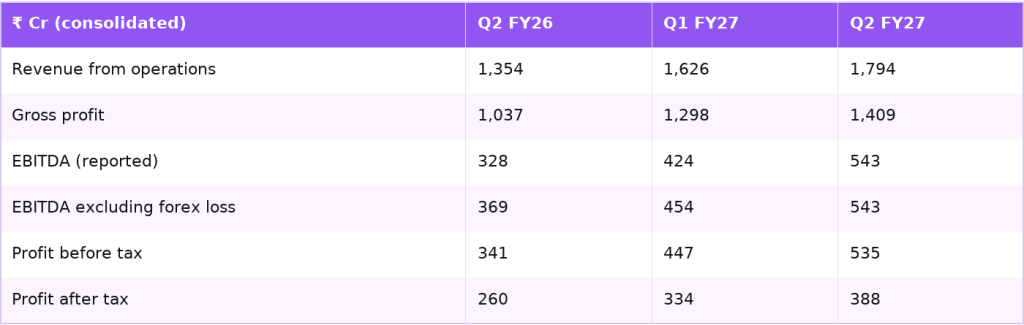
As we can see, the growth was spread across the map. India branded generics rose 16% to ₹504 Cr. Asia rose 18% to ₹366 Cr, and Africa rose 41% to ₹312 Cr. Together the branded business grew 23% to ₹1,182 Cr. The US business rose 41% to ₹484 Cr, and the Africa institution business, which sells antimalarial medicines to aid agencies, rose to ₹116 Cr from ₹32 Cr.
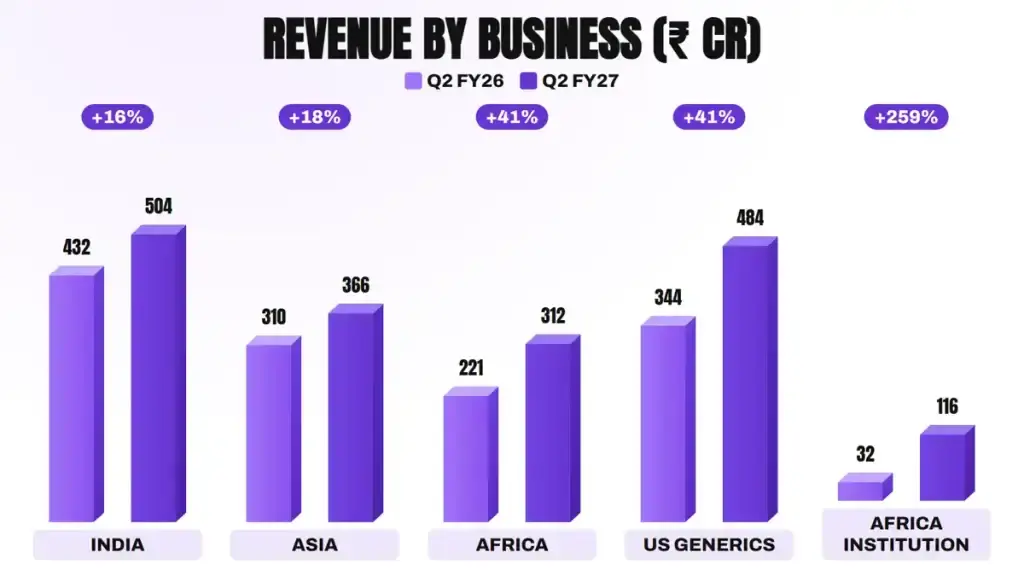
That growth also lifted the margins. The gross margin, which is what is left after the cost of materials, was 79%, against 77% a year ago. Management says most of that came from a favourable currency. Employee costs rose 21% to ₹384 Cr, and other expenses rose 23% to ₹483 Cr. Both rose much more slowly than revenue. Read this EBITDA Explained: Uses and Limits So EBITDA rose 47% to ₹543 Cr, at a margin of 30%.
There is one detail to keep in mind when reading these margins. Ajanta earns most of its revenue in foreign currency and protects it with forward contracts. When the rupee moves, the paper loss or gain on those contracts is booked in its accounts. In Q2 FY26 that loss was about ₹41 Cr, which is why the company shows an adjusted EBITDA of ₹369 Cr for that quarter. This quarter carried no hedge entry of that kind, so both EBITDA lines match.
Below EBITDA, profit after tax rose 49% to ₹388 Cr, about 22% of revenue. The tax rate rose to about 27%, against about 24% a year earlier, as one of its plants moves out of a tax exemption period.
That same pattern shows in the first half, at a larger scale. H1 FY27 revenue was ₹3,420 Cr, up 29% from ₹2,656 Cr. Adjusted EBITDA was ₹997 Cr, up 34%, at a margin of 29%. Profit after tax was ₹722 Cr, up 40%.
That first half also shows how much currency can move the numbers. Other income was ₹108 Cr in the half, and it included a forex gain of ₹69 Cr. Other expenses included a forex loss of ₹26 Cr. Taken together, currency added a net ₹43 Cr in the half, about 4.4% of the ₹982 Cr profit before tax. So the underlying business did most of the work, but not all of it.
What Drove the US Jump
Now let's look closer at the US jump, because it is the fastest-growing piece and also the one most likely to change pace. From the second half of FY26, Ajanta had a product in the US where only a few companies were selling. With so few competitors, the price stayed high and Ajanta's share stayed large. That product carried US sales through H2 FY26 and the first half of FY27.
Now new competitors have entered that product. Management expects a smaller share for Ajanta, and US sales to normalise in the coming quarters. Part of the US jump also came from a low base a year earlier and from currency. In constant currency, US growth was about 30-35%, and management estimates that the rupee's movement added about 4-5% across the export business.
A Stronger Balance Sheet
So did that growth stretch the balance sheet? It did not. Trade receivable days came down to 100 in September 2026 from 125 in March, as collections in the US improved. Inventory days came down to 52 from 63. Operating cash flow for the half was ₹750 Cr, against ₹529 Cr for the whole of FY26. Read this Cash Flow Statement Explained
So the company ended September 2026 with net cash and investments of ₹574 Cr. That was after it paid an interim dividend of about ₹400 Cr during the quarter. Return on capital employed rose to 41% from 33% in March, and return on net worth to 31% from 25%.
How Ajanta Built Four Businesses
Now that we have seen the quarter, let's go back and see how the business got here. Ajanta Pharma has its registered office in Mumbai, and it was incorporated in 1979. The Agrawal family runs it today: Yogesh Agrawal is the Managing Director and Rajesh Agrawal the Joint Managing Director.
So for most of its history, Ajanta's strength was branded generics. It built brands in India in eye care, skin care and heart care, and took the same model to Africa and Asia. In the US it sells plain generics that need approval from the US Food and Drug Administration. It also supplied antimalarial medicines to aid agencies in Africa.
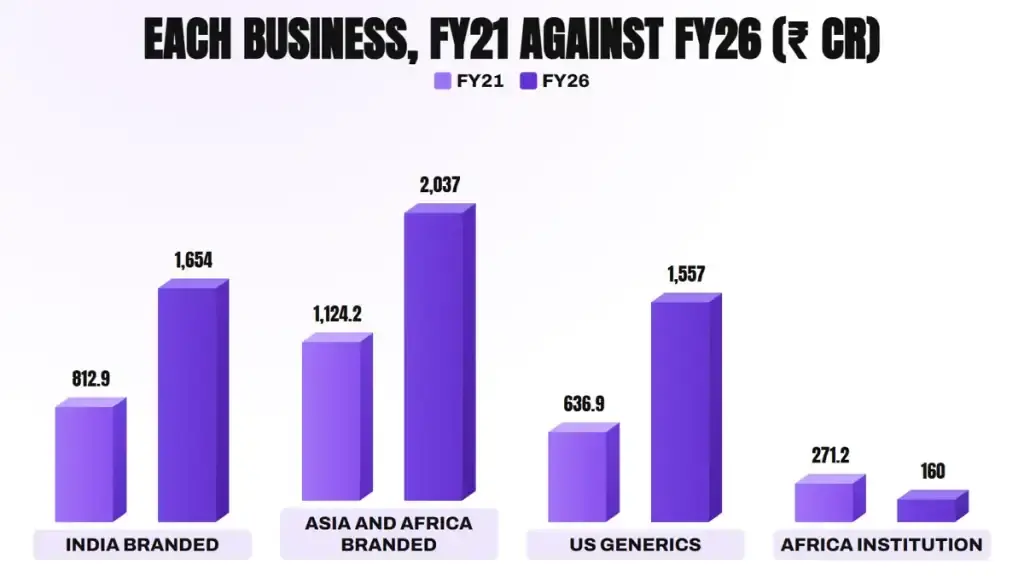
That mix looked like this in FY21. India brought in about ₹812.9 Cr of revenue. Branded generics in Asia and Africa together brought in about ₹1,124.2 Cr. The US brought in about ₹636.9 Cr, and the Africa institution business about ₹271.2 Cr. Total revenue from operations was ₹2,890 Cr, and the EBITDA margin was 35%.
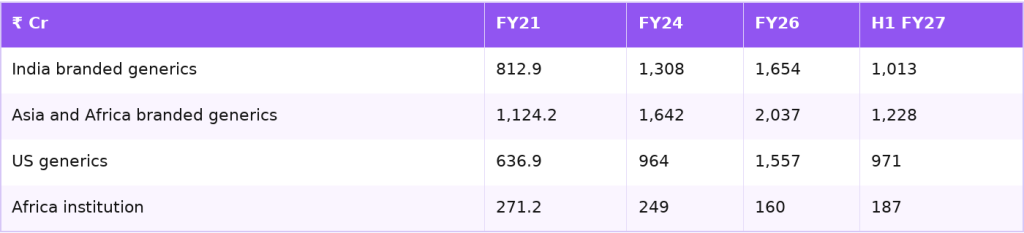
Then came two hard years. In FY22 the EBITDA margin came to 28%, against 35%, as marketing and R&D spending returned after the pandemic. In FY23 it went lower again, to 21%. Freight costs were high. The US business faced price cuts, and it also carried the cost of the flu-season supplies. The institution business shrank 5% as aid agencies bought less. Profit after tax was ₹588 Cr, 17% below FY22.
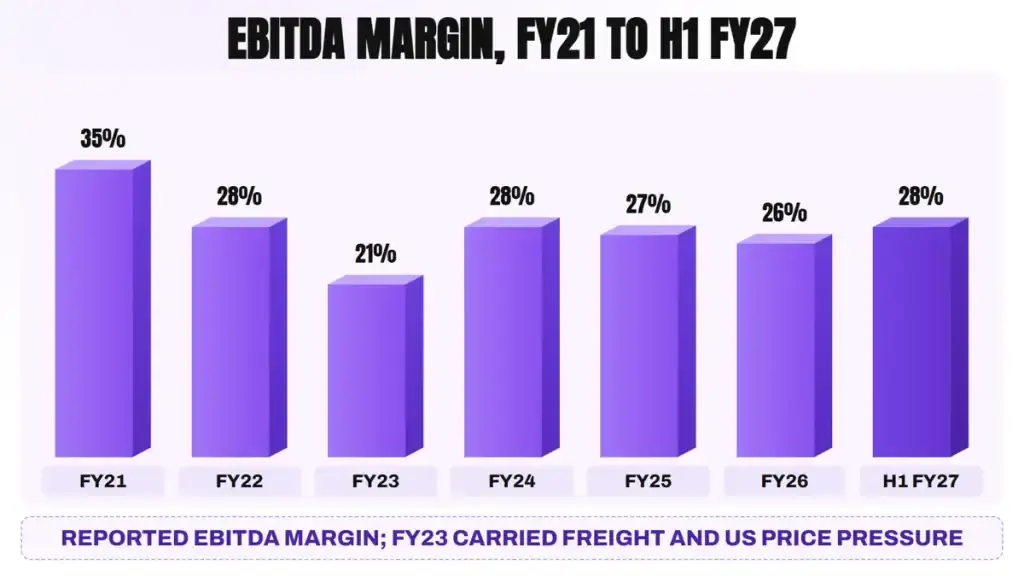
After that year, management chose to put more money behind the branded business. It filed more products, added medical representatives and entered new therapies. It said at the time that it expected margins to rise as branded generics grew and freight costs normalised. Both happened. In FY24 the EBITDA margin came back to 28%, and profit after tax rose 39% to ₹816 Cr.
"Know what you own, and know why you own it."
— Peter Lynch
Ajanta's margin moved with its mix: up when branded generics grew, and down when freight and US pricing pressed on costs. Knowing which business brings in the revenue is the first step to reading this company.
Since then, the US has become the surprise engine. US revenue was ₹964 Cr in FY24 and ₹1,047 Cr in FY25. In FY26 it jumped 49% to ₹1,557 Cr, helped by eight product launches over fifteen months. Over five years, US revenue grew about 2.4 times, while the institution business shrank.
That record also shows in what the company paid out. Ajanta returned ₹642 Cr to shareholders in FY24 and ₹701 Cr in FY25 through dividends and share buybacks. In FY26 it paid ₹350 Cr, and ₹400 Cr more in H1 FY27.
"We feel that emerging markets, we have all the growth drivers in place, so we should continue to post good growth." - Yogesh Agrawal, Managing Director, October 2026
Five Businesses With Different Growth Paths
Now let's split the business into its parts, because each one grows for different reasons. Ajanta reports one segment, pharmaceuticals, but it shows revenue for five businesses every quarter. Read this Segment-Wise Revenue Analysis Explained

These businesses sound alike, but as you will see, they earn their money in different ways. The three branded businesses depend on doctors and medical representatives, so they grow steadily. The US depends on approvals and on how many competitors sell each product, so it moves in jumps. The institution business depends on what aid agencies buy, so it is hard to predict.
India Branded Generics
Let's start with India, the largest single business. The Indian pharmaceutical market grew about 13% in the twelve months to September 2026. Management says better hospital access, government health schemes and wider insurance cover are behind that growth. It also sees unbranded trade generics growing more gently, which sends some prescriptions back to brands.
Yet Ajanta grew faster than that market. Its India sales grew about 17%, against about 13% for the market, over the same twelve months. Its volume growth was 18% ahead of the market, and its growth from new launches was 70% ahead. Its rank in the Indian market improved to 23rd in September 2026, from 24th in March.
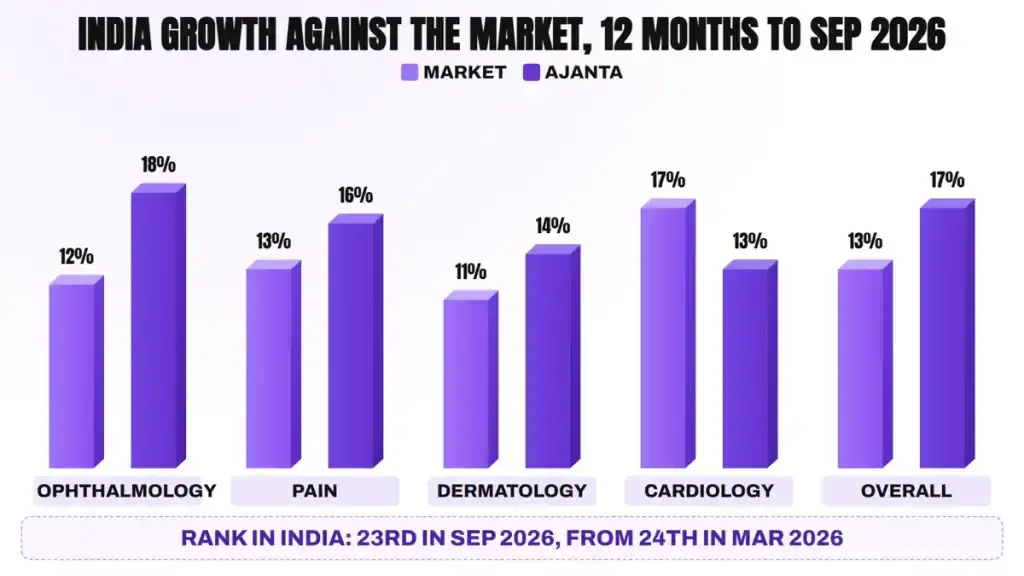
That business is built on four therapies. Cardiology is 37% of India sales, ophthalmology 28%, dermatology 22% and pain management 10%. Gynaecology and nephrology, which it entered recently, make up the rest. About 65% of the India portfolio is for chronic conditions, the long-term illnesses that patients treat for years. Its top ten brands make up 53% of India sales, and 18 of its brands sell more than ₹25 Cr a year.
That portfolio leads in some areas. In ophthalmology, Ajanta ranks first in its covered market, which means the part of the eye-care market where it sells products. In dermatology it ranks 12th in the whole Indian market. In cardiology, the market data show slower growth for Ajanta than the market, but management says its own sales grew in line with the market.
That growth also shows in field force productivity. Ajanta has about 3,750 medical representatives in India, after adding about 300 in FY26. Sales per representative per month rose to about ₹4.5 lakh in H1 FY27, from about ₹3.7 lakh in FY26. The company launched 26 new products in India in FY26, five of them first in the country, and 16 more in Q2 FY27.
India sales were ₹1,654 Cr in FY26, up 14%, and ₹1,013 Cr in H1 FY27, up 20%. This includes a smaller trade generics business, which brought in ₹104 Cr in the half. Management guides India growth in the mid-teens for FY27, and says it aims to grow 20-25% faster than the market.
"Our guidance is mid-teens and we've always maintained that we should be able to grow 20% to 25% faster than the IPM growth and the growth which is what we are doing." - Rajesh Agrawal, Joint Managing Director, October 2026
Asia Branded Generics
Next, let's look at Asia, the business that had the hardest year. Ajanta sells branded generics in 11 countries across the Middle East, Southeast Asia and Central Asia. In many of them it ranks among the top five players in the segments where it sells.
In FY26, Asia sales were about 1% lower, at ₹1,176 Cr. The cause was not demand. The conflict in the Middle East disrupted shipping routes, so the company could not get stock into some markets. In Q1 FY27, Asia sales came to only ₹255 Cr. The company then used other shipping routes, and Asia sales bounced back to ₹366 Cr in Q2 FY27, up 18%.
So H1 FY27 Asia sales were ₹621 Cr, almost flat. Management still guides mid-teens growth for Asia for the full year. It says some sales pushed out of Q1 will show up in the later quarters. The company launched four new products in the region in the half.
That growth plan has two parts. In countries where it already sells, Ajanta has a pipeline of products waiting for registration, and it keeps adding representatives as it launches them. It is also looking at new markets in the Middle East where it is not present yet. Across Asia and Africa together, it launched seven new products in H1 FY27.
Africa Branded Generics
Now let's move to Africa, the fastest-growing branded market right now. Ajanta sells branded generics in 21 African countries. Its Africa sales rose 15% to ₹861 Cr in FY26, and then 35% to ₹607 Cr in H1 FY27.
Management gives four reasons for that growth. The field force it added over the last two to three years is now more productive. Three new products reached African markets in the first half. The company is gaining share in its existing products. And currency movements helped. Management expects strong growth in the second half too, though slightly lower than in the first.
That field force has grown fast. In July 2025 management planned to take it from about 2,000 to about 2,250 people during FY26, and it ended the year with about 2,400. Across Asia and Africa together, Ajanta now has about 2,500 medical representatives, after adding about 100 in the first half. Each one sells about ₹8 lakh a month or more, almost twice the India level. Management plans to increase this field force by about 7-8% in FY27.
US Generics
Next, let's look at the US, a business built on approvals. Here Ajanta sells generics through wholesalers and pharmacy chains, and each product needs an ANDA, or Abbreviated New Drug Application. An ANDA is the approval the US FDA gives to sell a generic copy of a medicine.
Ajanta has 56 active ANDAs, plus 5 tentative approvals. It has 52 products on the shelf and 17 applications waiting for approval. In H1 FY27 it received four approvals, launched three products and filed one new application. Its target is five to six filings a year.
What makes this business different is the type of product. More than half of Ajanta's US products are delayed-release or extended-release medicines. These are tablets designed to release the drug slowly or later in the gut, and they are harder to copy than simple tablets. Fewer companies make them, so competition is often thinner. That is how the company had a product with limited competition through H2 FY26 and H1 FY27.
That pipeline is paid for by a shared R&D budget. About half of Ajanta's R&D spend goes to the US and half to India and the emerging markets. Ajanta also keeps away from patent challenges. Management says none of its planned filings are Para IV filings, which are applications that challenge a brand's patent to launch early. That keeps legal costs low, but it also means fewer large one-time wins.
That product explains the jump. US revenue was ₹971 Cr in H1 FY27, up 49%.

Its distributor Cencora named Ajanta its Manufacturer Partner of the Year in FY26, and the company won the DIANA award for best overall generic manufacturer for the fifth time.
Africa Institution
Finally, let's look at the smallest and least predictable business. Ajanta supplies antimalarial medicines, which are distributed through multilateral aid agencies across Africa. These agencies buy in large tenders, so sales jump in one year and shrink in the next.
Those swings show clearly in the numbers. This business brought in ₹249 Cr in FY24, ₹147 Cr in FY25 and ₹160 Cr in FY26. In H1 FY27 it brought in ₹187 Cr, more than in all of FY26. Management does not expect that level to continue in the second half.
The Brand Moat That Is Hard to Copy
Now that we have seen every business, let's understand the moat. A doctor who has prescribed one brand of eye medicine for years does not switch easily. A new rival would need to launch the product, get it registered, hire representatives and then convince the same doctors, one visit at a time. Read this Economic Moat Explained
Such loyalty starts with being first.
"In business, I look for economic castles protected by unbreachable moats."
— Warren Buffett
For a branded generics company, the moat is a doctor's habit of writing one brand, built over years by first launches, field visits and registrations in each country. About half of Ajanta's products were first to market in their segments. When a brand reaches doctors first, it often stays the brand they remember. Ajanta has more than 500 brands across its branded markets, and it launched 53 new products across its markets in FY26.
Another part is people. Ajanta has more than 6,120 medical representatives promoting its products. In each new country, that team takes years to build, and the company keeps adding to it.

Then come product development and plants. More than 850 scientists work at its R&D centre in Mumbai. It spent ₹252 Cr on R&D in FY26, about 5% of revenue, and it works on 15-20 products at a time. In H1 FY27 it spent ₹138 Cr, about 4% of revenue, and management expects spending to step up in the second half to bring the full year back to about 5%. It has seven plants in India, of which two are approved by the US FDA. Its major plants are at Paithan in Maharashtra, Guwahati in Assam, Pithampur in Madhya Pradesh and Dahej in Gujarat.
One more part is registrations. In emerging markets, each product must be registered separately in each country. That takes time, and on average about two years per approval. A company that already holds many registrations across 30 countries has a head start that a rival cannot buy quickly.
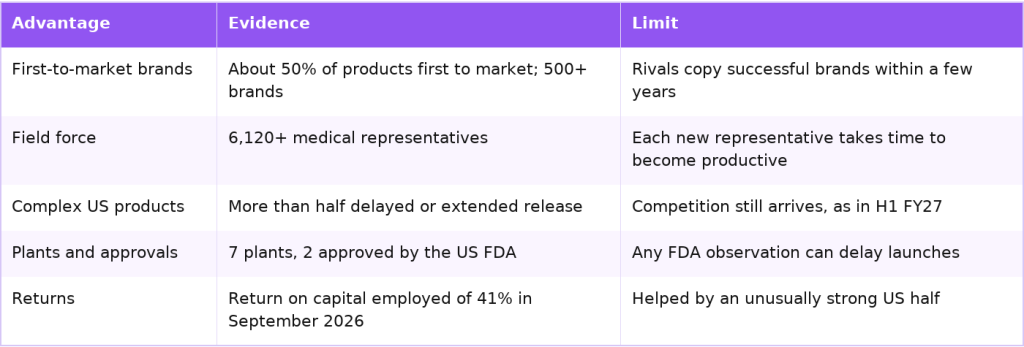
That table shows us why returns are the real test of the moat. Branded generics need constant spending on people and launches. If the brands are strong, that spending should still leave high returns. Ajanta's return on capital employed was 32-33% in each of FY24, FY25 and FY26, before the strong US half lifted it further.
Financials: Five Years of Revenue, Margins and Profit
One half year can mislead in a business with a lumpy US product and tender-based institution sales, so let's look at five full years together. Revenue here is revenue from operations, and EBITDA is as reported, including mark-to-market forex effects.
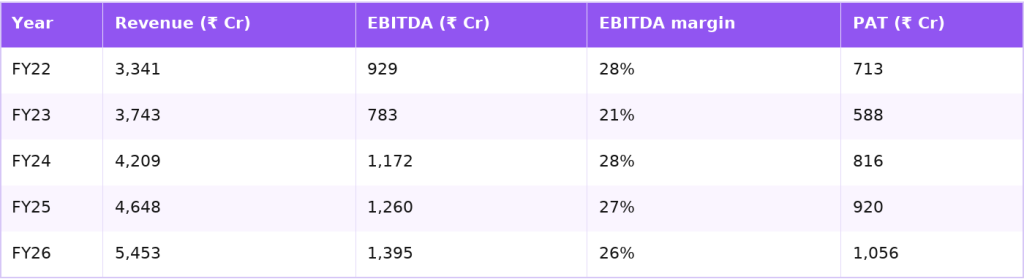
Revenue grew about 1.6 times in four years, from ₹3,341 Cr in FY22 to ₹5,453 Cr in FY26. Profit after tax grew about 1.5 times over the same years, but not in a straight line. FY23 was the low point, when the EBITDA margin came to 21% and profit was ₹588 Cr. From FY24 the margin settled at 26-28%.
Cash flow moved around more than profit. Operating cash flow was ₹785 Cr in FY24 and ₹1,157 Cr in FY25, but ₹529 Cr in FY26, as receivable days rose to 125 by March 2026. In H1 FY27 it came back to ₹750 Cr as US collections improved and receivable days came down to 100.
The balance sheet carried that growth with almost no debt. Ajanta returned ₹642 Cr to shareholders in FY24 and ₹701 Cr in FY25 through dividends and buybacks, and still held net cash and investments of ₹574 Cr in September 2026.
"In the short run, the market is a voting machine but in the long run, it is a weighing machine."
— Benjamin Graham
Ajanta's five-year table shows why: one year can swing with freight costs or a US product, but over five years the margin and the cash returned to shareholders are what get weighed.
What FY27 and FY28 Could Look Like on Management's Numbers
So where does the company go from here? For FY27, management guides revenue growth in the high teens, with a gross margin of about 78% and an EBITDA margin of about 27%, each within one percentage point. It expects R&D at about 5% of revenue, a tax rate of about 26.5% and capital spending of about ₹400 Cr.
Now let's put that guidance against the first half. High-teens growth of 16-18% on FY26 revenue would mean FY27 revenue of about ₹6,330-6,430 Cr. H1 FY27 was ₹3,420 Cr. So H2 would need about ₹2,900-3,010 Cr, only about 4-8% more than the ₹2,797 Cr of H2 FY26, against 29% growth in the first half.
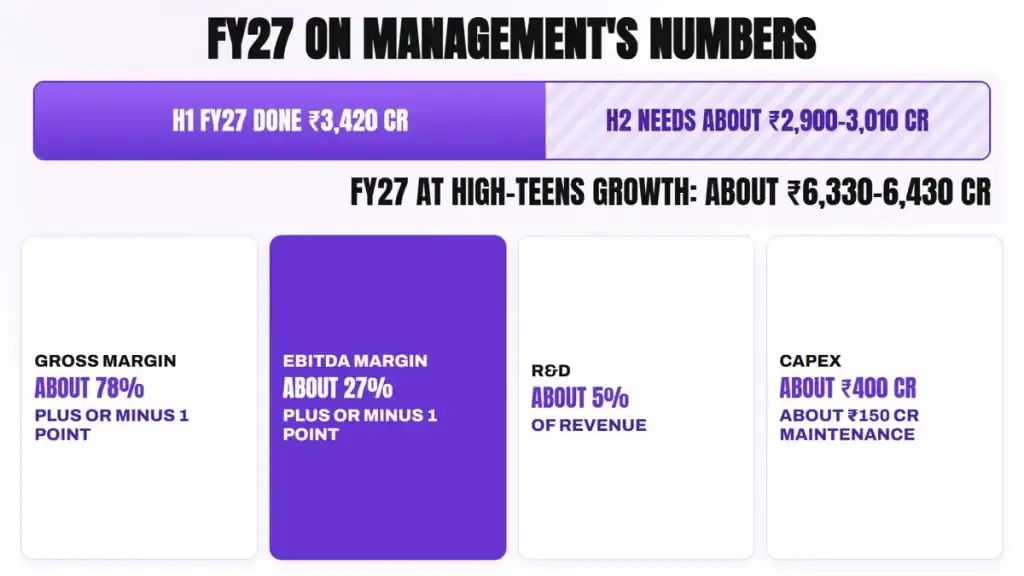
That gap has a clear explanation from management. US sales should normalise as new competitors enter. Institution sales should return to normal levels. And R&D and field force spending should step up in the second half. The same reasons apply to the margin. With an adjusted EBITDA margin of 29% in H1 and a full-year guide of about 27%, the second half margin would be lower than the first.
What the guidance implies: H1 FY27 revenue of ₹3,420 Cr is already about 53-54% of the high-teens revenue implied for FY27. So the guidance leaves room for a second half that grows only about 4-8%, as US prices settle and institution orders return to normal.
Beyond FY27, three projects add to the picture. One is capacity. Of the ₹400 Cr of capital spending, about ₹150 Cr is maintenance, and most of the rest is going into an expansion at the Pithampur plant to serve the emerging markets.
Another is a new product class. In FY26 Ajanta signed an agreement with Biocon to sell semaglutide, a weight-loss and diabetes medicine, in 26 emerging-market countries. Biocon will supply the product, and Ajanta will register and sell it. Management expects sales to start in FY28, slowly, because approvals take about two years in most countries.
In India, Ajanta planned to launch semaglutide under its own brand in the first wave of launches in March 2026. By July 2026, management said the Indian market for the medicine had grown more gently than the industry expected. So the emerging-market launch is a long build rather than a quick addition, and management folds it into its yearly guidance.
Then there are new therapies in India. Gynaecology and nephrology are still small, but management sees them as a three-to-five-year build.
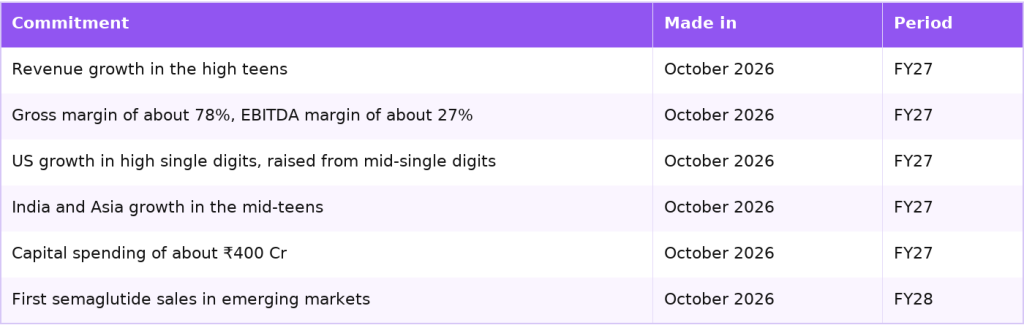
Those commitments are easier to judge against the past. So let's check what management said before against what it delivered.
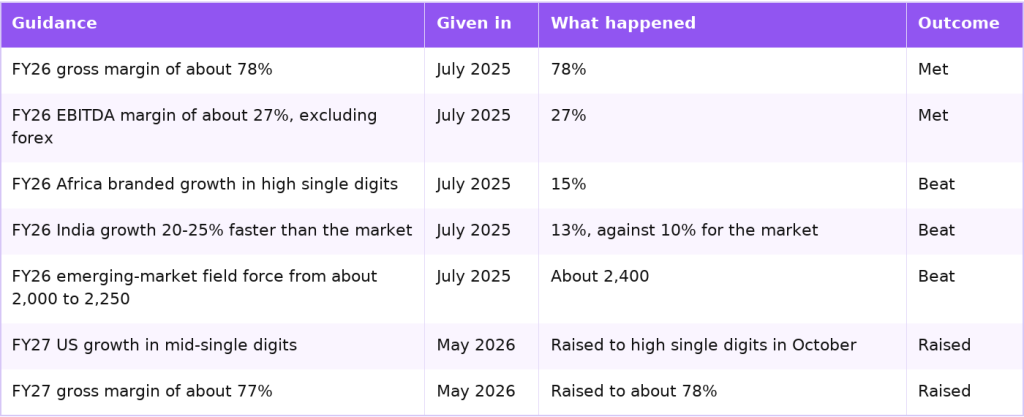
That record shows us a clear pattern. Management guides margins closely and has met them. It guides growth for the US and for institutions cautiously, because it cannot predict competitors or tenders, and those numbers have tended to come in higher.
Key Risks
Now let's look at what could go wrong for Ajanta Pharma, because some of these risks are already visible in the guidance.
- US competition: the limited-competition product that lifted US sales now has new competitors. Management expects US sales to normalise, and a generic's price can fall fast once several companies sell it.
- A slower second half: the FY27 guidance implies only about 4-8% revenue growth in H2, against 29% in H1, and a lower margin.
- Institution tenders: aid agency buying swings widely, from ₹249 Cr in FY24 to ₹147 Cr in FY25. The strong H1 FY27 is not expected to repeat in H2.
- Middle East disruption: the conflict cut Asia sales in FY26 and Q1 FY27. Another disruption to shipping routes could do the same.
- Currency: most revenue is in foreign currency. In FY26 the company booked a mark-to-market hedge loss of ₹103 Cr, and a weaker rupee has also flattered recent growth by about 4-5%.
- Price controls in India: about 11% of India sales are under the National List of Essential Medicines, whose prices the government controls. A wider price control list would hit margins.
- Income tax search: the Income Tax department searched some of the company's premises in August 2025. The company filed a return for the period from April 2019 to November 2025 showing no undisclosed income, but its auditors note that any impact cannot yet be estimated.
- Rising costs and tax: R&D and field force spending step up in H2, and the tax rate is rising as a plant leaves its exemption period.
"Next two quarters sales getting normalized, we have still in the beginning of the year we had given the guidance of the mid-single digit, which we are now revising to the high single digit for the US market." - Yogesh Agrawal, Managing Director, October 2026
"All I want to know is where I'm going to die, so I'll never go there."
— Charlie Munger
For Ajanta, the places to watch are clear from the list above: US competition, tender swings, currency and shipping routes. The tracking list below shows how to see which way each one goes.
Explore our Products
Research Framework

Emerging Titans
Combination of quantitative analysis, industry tailwinds, and management assessment - SPRINT investment philosophy

Tiny Titans
Heavy emphasis on scuttlebutt research, plant visits, and early on-ground signals
What to Track Next
If you follow Ajanta Pharma, these are the signals that will show where it goes next.
- US revenue in Q3 and Q4 FY27 as competition builds, and new ANDA approvals and launches
- Asia sales against the mid-teens guidance after the Q2 recovery
- India growth against the market, and progress in gynaecology and nephrology
- The EBITDA margin against about 27%, excluding forex effects
- Africa institution sales in H2 after the strong first half
- The Pithampur expansion and the first semaglutide registrations
- Any update on the income tax matter
Members can read our full Research Desk report on Ajanta Pharma, with its detailed scorecard and section-by-section analysis.
Conclusion
Let's put it all together. Ajanta Pharma has grown revenue from ₹2,890 Cr in FY21 to ₹5,453 Cr in FY26 by building branded generics in India, Asia and Africa and adding a US business on the side. After a hard FY23, its EBITDA margin came back to 27-28%, and in Q2 FY27 it reached 30%. Its balance sheet holds net cash, and it returns much of its profit to shareholders. The cautious thread is the second half, where the guidance implies much slower growth as US competition returns. The next two quarters will show how much of the branded growth holds on its own.
Still, the latest half year was helped by things that may not repeat: a US product with few competitors, large institution orders and a favourable currency. What happens next depends on whether the branded business in India, Asia and Africa keeps growing in the mid-teens once those effects fade, and whether new US approvals and the semaglutide launch can replace the product that is now facing competition.
FAQs
What does Ajanta Pharma do?
+Ajanta Pharma is a specialty pharmaceutical formulation company. It sells branded generics in India and in more than 30 countries across Asia and Africa, sells generic medicines in the US and supplies antimalarial medicines through aid agencies in Africa. FY26 revenue from operations was ₹5,453 Cr.
How did Ajanta Pharma do in Q2 FY27?
+Revenue from operations rose 33% to ₹1,794 Cr, and every business grew. EBITDA rose 47% to ₹543 Cr at a 30% margin, and profit after tax rose 49% to ₹388 Cr.
What are branded generics?
+A generic medicine is a copy of a medicine whose patent has expired. A branded generic is sold under the company's own brand name and promoted to doctors by medical representatives. Branded generics made up 66% of Ajanta's Q2 FY27 sales.
Why did Ajanta's US business grow so fast?
+US revenue rose 49% in FY26 to ₹1,557 Cr and 49% in H1 FY27 to ₹971 Cr, helped by new launches and a product with limited competition. New competitors have entered that product, so management guides US growth in high single digits for FY27.
What is Ajanta Pharma's guidance for FY27?
+Management guides revenue growth in the high teens, a gross margin of about 78% and an EBITDA margin of about 27%, each within one percentage point, R&D at about 5% of revenue and capital spending of about ₹400 Cr.
What are the main risks for Ajanta Pharma?
+New US competition on a key product, swings in aid agency orders, shipping disruptions in the Middle East, currency movements and price controls in India. An income tax search in August 2025 also has an impact that cannot yet be estimated.

High growth stock specialist, Value Educator
Shashank Mahajan is an equity research professional with over 12 years of experience in identifying high-potential SME and micro-cap stocks at an early stage. He follows a rigorous scuttlebutt research–driven approach, combining on-ground insights with deep financial analysis. Shashank specializes in uncovering under-researched and under-owned companies with strong management quality and long-term growth potential. Through disciplined research and early identification, he focuses on spotting tomorrow’s market leaders before they enter the mainstream investor radar.
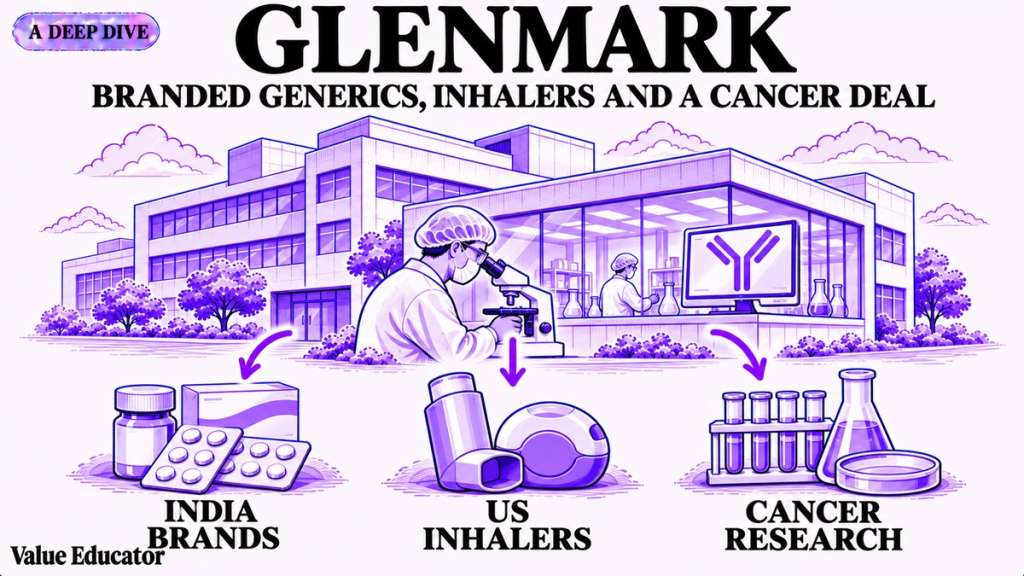
Glenmark: The USD 700 Mn Cancer Deal and Its Brands
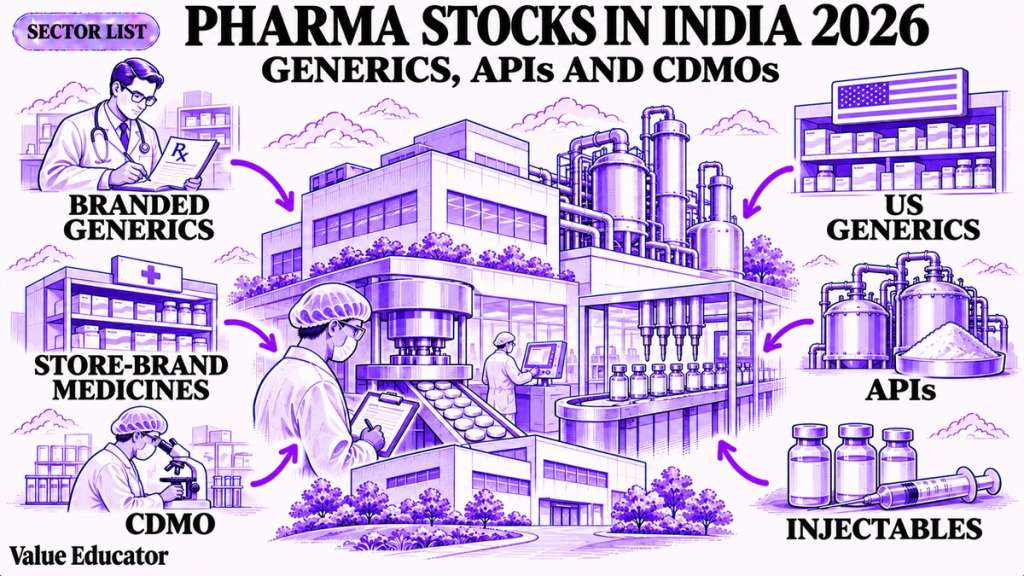
Pharma Stocks in India 2026: Generics, APIs and CDMOs
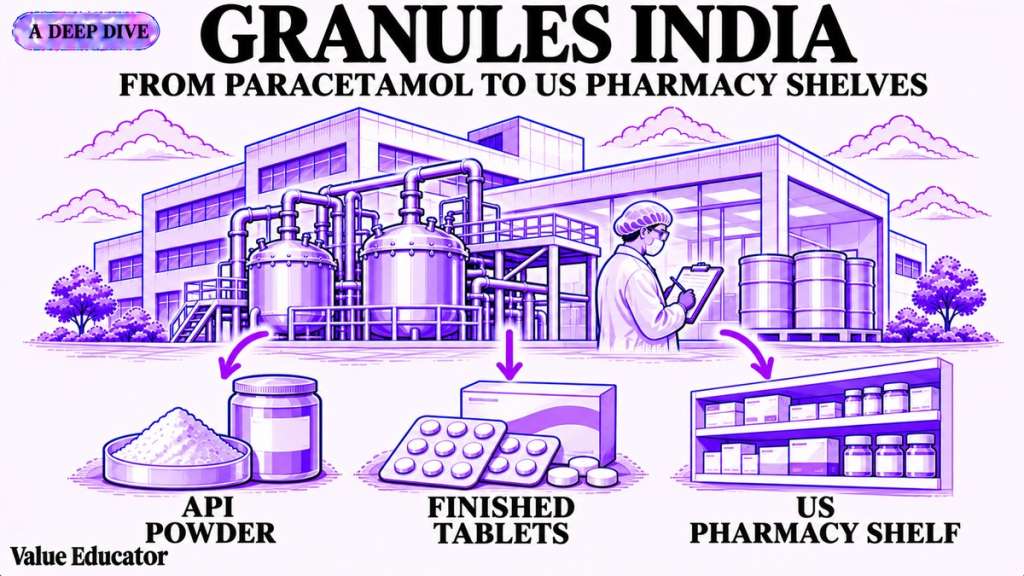
Granules India: From Paracetamol to a 65% Gross Margin
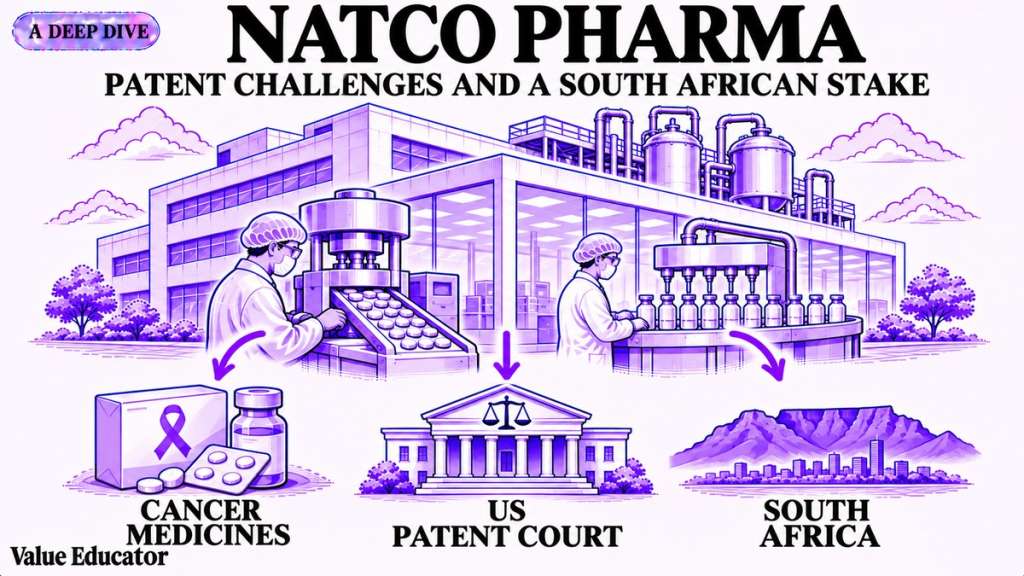
Natco Pharma: After Revlimid, 29 Patent Challenges
Shilpa Medicare: Cancer APIs, Films and Biosimilars
Alembic Pharma: US Plants Pay Back, Margin Hits 22.2%
Explore our Products
Research Framework
Emerging Titans
Combination of quantitative analysis, industry tailwinds, and management assessment - SPRINT investment philosophy
Tiny Titans
Heavy emphasis on scuttlebutt research, plant visits, and early on-ground signals



Modern Warfare to Multibaggers
Key Trends. Strategic Shifts. Opportunities Ahead.
Don't Miss This Exclusive Webinar!
Join Value Educator to decode the key trends shaping India's defence sector and learn how to identify tomorrow's potential leaders in the space.
- In-depth research on India's defence sector
- Live Q&A session
- Actionable takeaways for long-term investors

 Orders
 Subscription
 Share with friends


Required Details
₹23999.00
(12 month subscription)
As per SEBI regulations, all users are mandated to complete the KYC that is validated for 1 year. Post payment, you will be redirected to the KYC screen


No comments yet. Be the first to comment!