
APAR Industries: Google, Amazon and ₹12,025 Cr of Orders

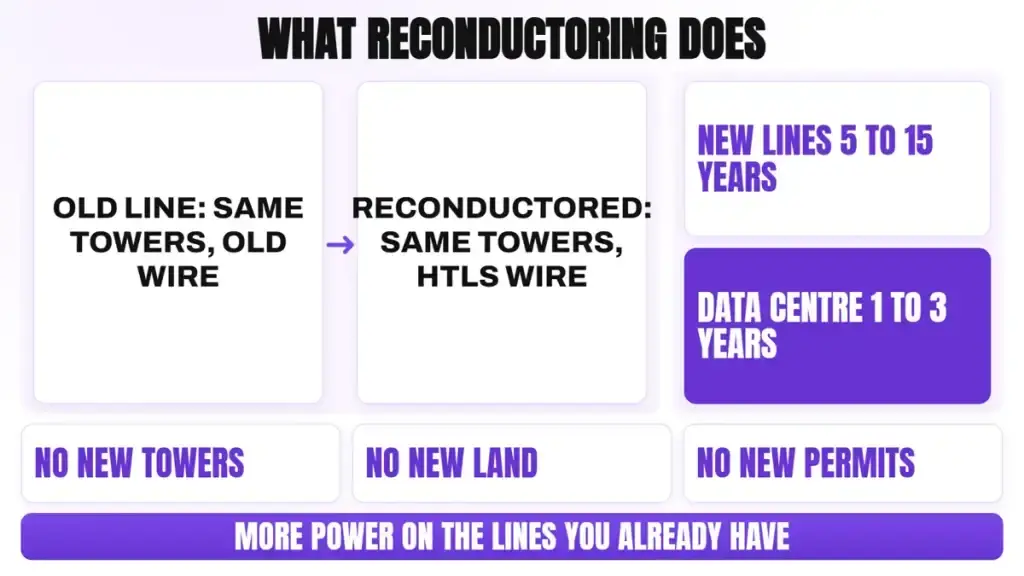
In September 2026, the US Department of Energy named 31 transmission projects across 26 states for a federal programme of about $1.9 bn. The goal is to free up 23 GW of extra transmission capacity, partly by reconductoring and rebuilding about 1,500 miles of existing lines. The US needs that capacity fast, because its data centres are being built much faster than its grid. New grid lines can take 5 to 15 years, against 1 to 3 years for a data centre.
So what is reconductoring? Reconductoring means taking the old wire off a transmission line and stringing a new, higher-capacity wire on the same towers. The wire itself is called a conductor, the bare metal cable you see hanging between pylons. A better conductor can carry far more power without new towers, new land or new permits. That is why both India and the US now treat it as the quickest way to add grid capacity.
That demand reaches suppliers through two kinds of buyers. One is the power utility. In the US, most utilities are regulated geographic monopolies, and a regulator decides how much they can spend. They buy conductor on multi-year rate contracts, and for one line they usually take a single vendor. The other buyer is the data-centre builder. Companies like Google, Amazon, Meta and Microsoft do not buy cable directly. Their electrical contractors do, from a list of approved vendors. A single cable package for one large AI data centre in the US can be worth ₹400 Cr to ₹1,000 Cr.
One Indian manufacturer now sells to both of those buyers. APAR Industries Ltd (NSE: APARINDS) calls itself the world's largest maker of aluminium and alloy conductors. It is also India's largest and the world's third-largest maker of transformer oils, and one of India's top six cable makers. Its most valuable conductor is the high-temperature low-sag conductor, or HTLS, which means a conductor that can run much hotter and carry more current without sagging between the towers. APAR has its own US arm, and its US revenue was about $269 mn in FY26.
That US business is now showing up in APAR's orders. In the latest quarter, its conductor order book reached ₹12,025 Cr, and 51% of it was for export.
APAR Industries in five numbers
- A conductor order book of ₹12,025 Cr in September 2026, 51% of it for export
- A cable order book of ₹3,012 Cr, with about ₹1,000 Cr of it from Google's US data centre and Amazon's largest data centre in India
- Q2 FY27 profit of ₹447 Cr, up 77.8%
- About ₹800 Cr of conductors and cables still in transit to US buyers at the end of September 2026
- US revenue of about $269 mn in FY26, up 49.7%
So the order book says APAR is selling more abroad than ever before. Yet its US revenue was lower in the latest quarter. Why? Let's first understand the company, and then look at the quarter where both of those things showed up together.
APAR Industries: Company Overview
APAR Industries Ltd was incorporated in Gujarat in 1989 and has its registered office in Vadodara and its corporate office in Mumbai, while the business itself entered conductors in 1958. It makes overhead conductors, transformer and specialty oils, lubricants and cables, and sells in more than 140 countries. Its manufacturing runs from 10 facilities in India and one in Sharjah in the UAE, and it has more than 1,900 employees. Kushal Desai is the Chairman and Managing Director and Chaitanya Desai the Managing Director, and the promoters held 55.42% of the shares in September 2026. Consolidated revenue was ₹22,902 Cr in FY26, and after the August 2026 share placement the company held cash and cash equivalents of ₹1,171 Cr against borrowings of about ₹888 Cr in September 2026. Read this TD Power: 93% of New Orders Now Come From Abroad
"We are stubborn on vision. We are flexible on details."
— Jeff Bezos
APAR's aim has stayed the same since 1958: carry electricity from where it is made to where it is used. The details keep changing, from Indian utilities to US data-centre contractors and now a conductor plant in China.
The Quarter When ₹800 Cr Was Still at Sea
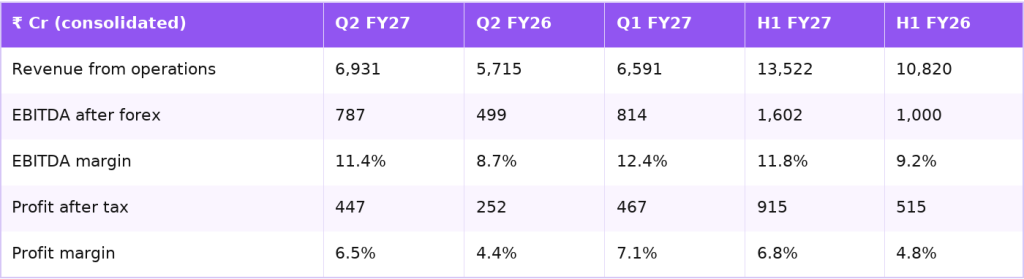
Let's look at Q2 FY27, the July to September quarter, which APAR reported on 29 October 2026, while part of its output was still at sea. Consolidated revenue was ₹6,931 Cr, up 21.3% from a year ago and 5.2% from the quarter before. Profit rose far more, as the table shows.
That revenue came mostly from India. Domestic revenue rose 34.3%, while exports fell 3.3%. Exports made up 27.6% of revenue in the quarter, against 34.7% a year ago. US revenue fell 29.7% from the same quarter last year.
But that US number does not show what the factories shipped. At the end of September, about ₹800 Cr of APAR's conductors and cables were still on their way to US customers. They had been sold on delivered duty paid terms, which means APAR pays the freight and the import duty and books the sale only when the goods reach the buyer. Containers were scarce, and freight rates had jumped, so some shipments left late in the quarter. Over ₹440 Cr of that amount was cables alone.
So the quarter's revenue missed a large slice of goods that were already made and sold.
"In the short run, the market is a voting machine but in the long run, it is a weighing machine."
— Benjamin Graham
One quarter of US revenue is a vote taken while about ₹800 Cr of goods were still at sea. The order books, which keep the weight of the business, tell a different tale. Management expects that revenue to show up in Q3 FY27. For the half year, exports still grew 3.7%, and domestic revenue grew 35.5%.
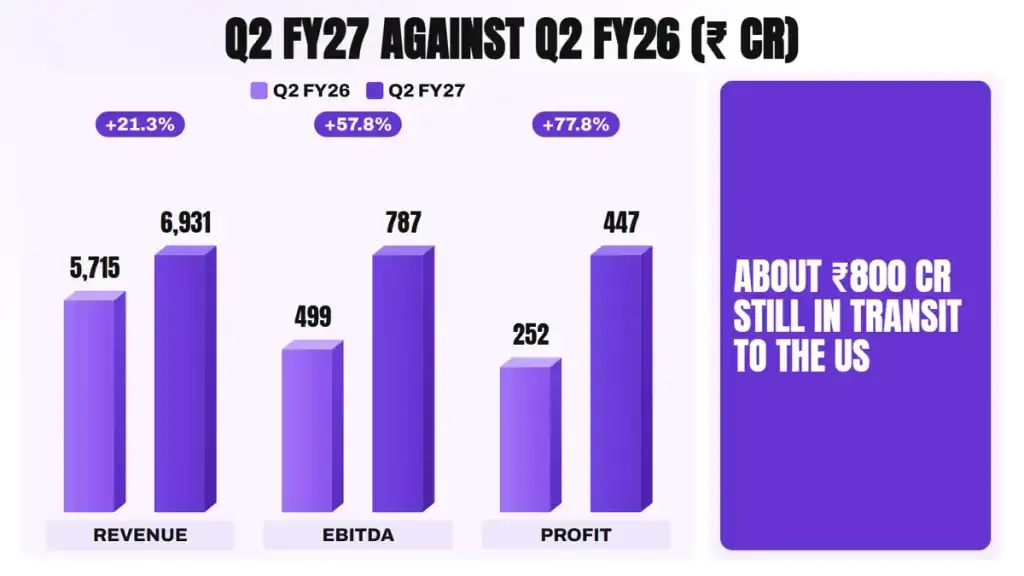
Next, let's see where that extra profit came from. EBITDA after forex rose 57.8% to ₹787 Cr, and the margin widened from 8.7% to 11.4%. Read this EBITDA Explained: Uses and Limits Most of that gain came from one business. The oil division's EBITDA rose from ₹105 Cr to ₹299 Cr. That rise of ₹194 Cr was about 67% of the group's EBITDA increase of ₹288 Cr.
That gain also shows in the cost lines. Raw material costs rose 20.5%, a little slower than revenue. Other expenses were almost flat, at ₹685 Cr against ₹684 Cr. So most of the extra revenue fell through to profit. Profit after tax rose 77.8% to ₹447 Cr, and the profit margin rose from 4.4% to 6.5%.
That made H1 FY27 the best half year in APAR's history for both revenue and profit. Revenue grew 25% to ₹13,522 Cr. Profit for the six months was ₹915 Cr, already about 94% of the ₹977 Cr APAR earned in all of FY26.
That half year also changed the balance sheet. In August 2026 APAR raised about ₹2,500 Cr through a qualified institutional placement, issuing 16,88,618 new shares. Total equity rose to ₹8,520 Cr in September 2026, from ₹5,393 Cr in March. Cash and cash equivalents stood at ₹1,171 Cr, against borrowings of about ₹888 Cr. In September 2026 CARE Ratings upgraded APAR's long-term rating to AA with a stable outlook, from AA-.
The Orders Behind the Order Book
Now let's look at the orders, because they show where APAR's next year of sales will come from. The conductor order book has grown sharply in a year, and its mix has moved abroad.
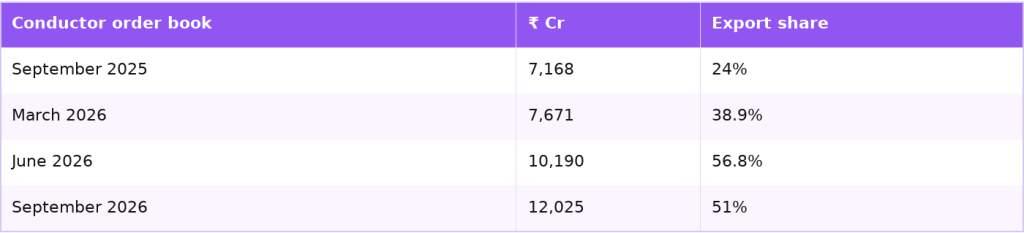
That jump came from two quarters of heavy ordering. New conductor orders were ₹5,245 Cr in Q1 FY27, with exports at 65.8% of them. They were ₹4,775 Cr in Q2 FY27, up 123.1% from a year earlier. So in six months APAR booked about ₹10,020 Cr of new conductor orders.
Those export orders came from some of the largest utilities in their markets. In Q1 FY27, two overseas utilities placed orders of more than ₹2,800 Cr, one in the US and one in Europe, with deliveries spread over the next few years. By September the book held about ₹3,000 Cr of such contracts from utilities in the UK and the US. These are rate contracts, which run for two to three years and are drawn down line by line.

Those orders also show APAR moving into newer products. It won its first order for a Z-shaped conductor from a Scandinavian utility, for a line that carries power from an offshore wind farm. Management describes a Z-shaped conductor as one that lets air flow through the conductor itself, so it moves far less than a normal conductor in high wind. It says only two other conductor makers in the world have made it so far.
Next came two orders for OPGW, or optical ground wire, which is the top wire on a transmission tower with optical fibres inside it. That wire protects the line from lightning and also carries data. In India, APAR won about ₹960 Cr from Karnataka for a 48-fibre OPGW job, its single largest OPGW order, done on a turnkey basis from design to delivery. It also won its first order for OPGW with 144 fibres, from a customer in Central America. More fibres per wire matter because grids now carry more data, especially near data centres.
That book converts to revenue fast. Management expects about 25% of the ₹12,025 Cr to be executed over the next two to three months, and the rest within 18 months. The conductor book alone is about 0.95 times FY26 conductor revenue of ₹12,712 Cr.
The cable order book moved even faster. It was ₹1,800 Cr in March 2026 and ₹1,925 Cr in June 2026. By September it had reached ₹3,012 Cr, and 32.5% of it was for export. The largest part of that rise is data-centre cable.
What the order books add up to: conductors and cables together held about ₹15,037 Cr of orders in September 2026. That is about 0.66 times APAR's FY26 revenue of ₹22,902 Cr, and it does not include the oil business, for which no order book is given.
How APAR Built a Business Abroad
Now that we have seen the quarter, let's go back and see how APAR's business abroad was built. The company entered the conductor business in 1958 and moved into transformer oils in 1969. It later added cables and automotive lubricants. Today it sells in more than 140 countries.
That growth has been fast over the last five years. Revenue rose from ₹6,388 Cr in FY21 to ₹22,902 Cr in FY26, a five-year growth rate of 29.1% a year. Exports grew from ₹2,619 Cr to ₹6,825 Cr over the same years. Profit after tax grew from ₹161 Cr to ₹977 Cr, a growth rate of 43.4% a year.
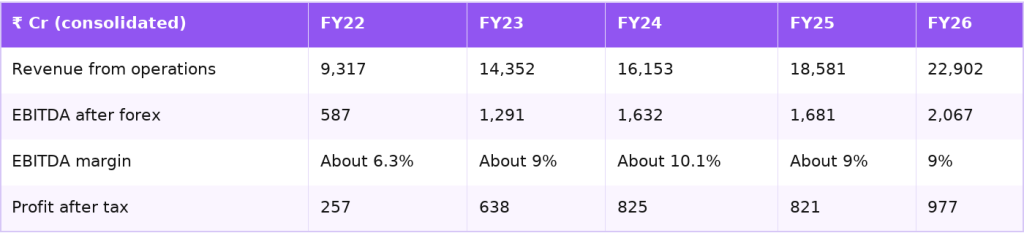
That table shows two phases. FY22 to FY24 was the margin phase, as APAR shifted its conductor mix toward premium products and its EBITDA margin rose from about 6.3% to about 10.1%. FY24 to FY26 was the scale phase, as revenue grew about 42% and the cable business grew into the second-largest segment.
That period also made the US APAR's biggest new market. APAR entered the US in 2016 with export sales. Its sales there crossed $1 mn in 2018 and $200 mn in 2024. It then set up a US subsidiary, now called APAR USA LLC, to sell and stock its products locally. By September 2026 that arm had three warehouses, covered 40 states and held 18 UL approvals. A UL approval is the US safety certification a cable needs before contractors will install it.
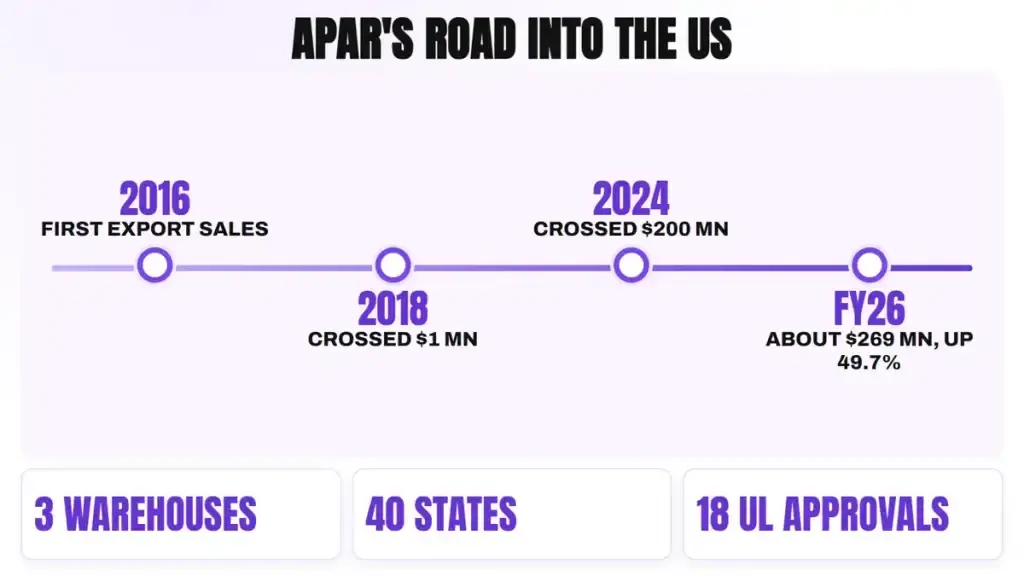
That US business grew 49.7% in FY26, to about $269 mn of revenue. The US buys building wire, solar and medium-voltage cables, grid and substation cables, and overhead conductor from APAR. Its main buyers are building contractors, renewable energy projects, data centres and utilities.
Since then the company has kept adding countries. It has a Brazilian subsidiary, renamed APAR Brazil Ltda in September 2026. It has offices in India, the UAE, Saudi Arabia, the US, Singapore and Brazil. And in October 2026 its Singapore subsidiary agreed to buy a 70% stake in a conductor maker in China, which we will come to later.
Three Businesses Built for the Grid
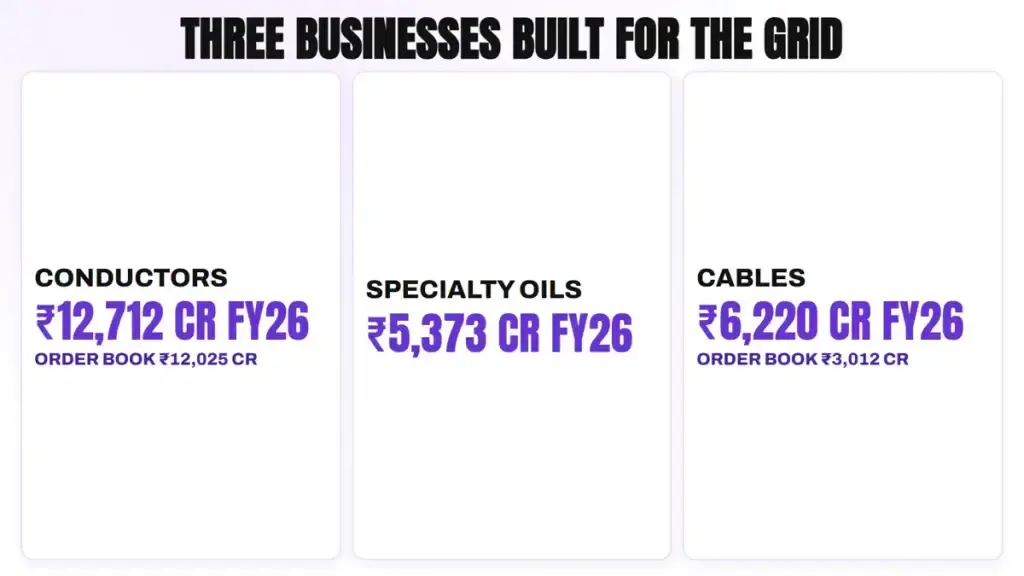
Now let's split APAR into its three businesses, all built for the grid. Conductors carry power across the country on overhead lines. Cables carry power and data underground, inside buildings, solar farms and data centres. Specialty oils fill and cool the transformers that step that power up and down.
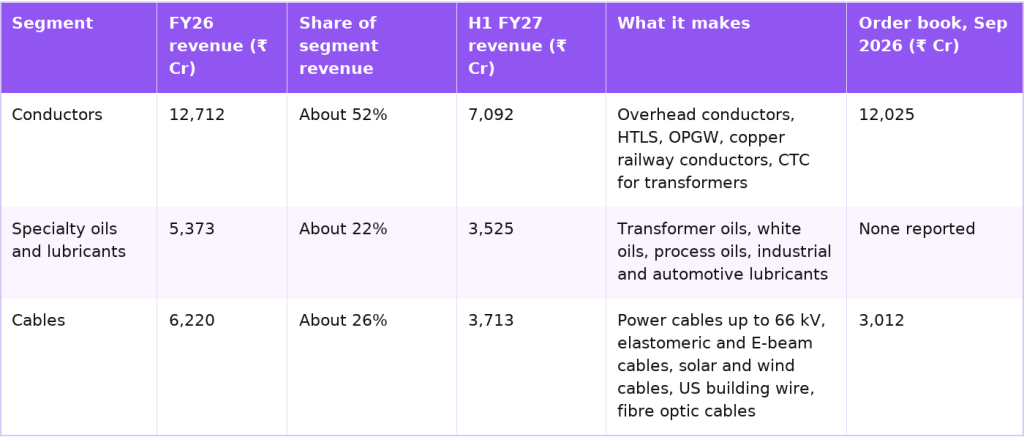
These segments sound alike, but each one sells to a different buyer. Conductors go mainly to utilities and the EPC companies that build transmission lines. Oils go to transformer makers such as Siemens Energy, Hitachi Energy and GE, and lubricants go to factories and tractor makers. Cables go to factories, railways, renewable energy developers, data-centre contractors and, through dealers, to homes. The segment figures include sales between the businesses, so they add up to more than group revenue. Read this Segment-Wise Revenue Analysis Explained
Conductors and the Reconductoring Push
Let's start with conductors, the largest business. In H1 FY27, India added about 8,775 circuit km of transmission lines, up 153% from a year earlier. In September 2026 the government approved state-level lines to carry up to 135 GW of renewable power by FY33. That plan adds about 51,126 circuit km of lines, with an expected investment of about ₹1.86 trillion.
Beyond those lines, two new rules from the Central Electricity Authority could push even more reconductoring. One caps how far a line may run above its rated temperature, at 10% to 15%. The other requires "N-1" reliability, which means the grid must keep running if any one line fails. Both rules make utilities either build second lines or put higher-capacity conductors on the lines they already have.
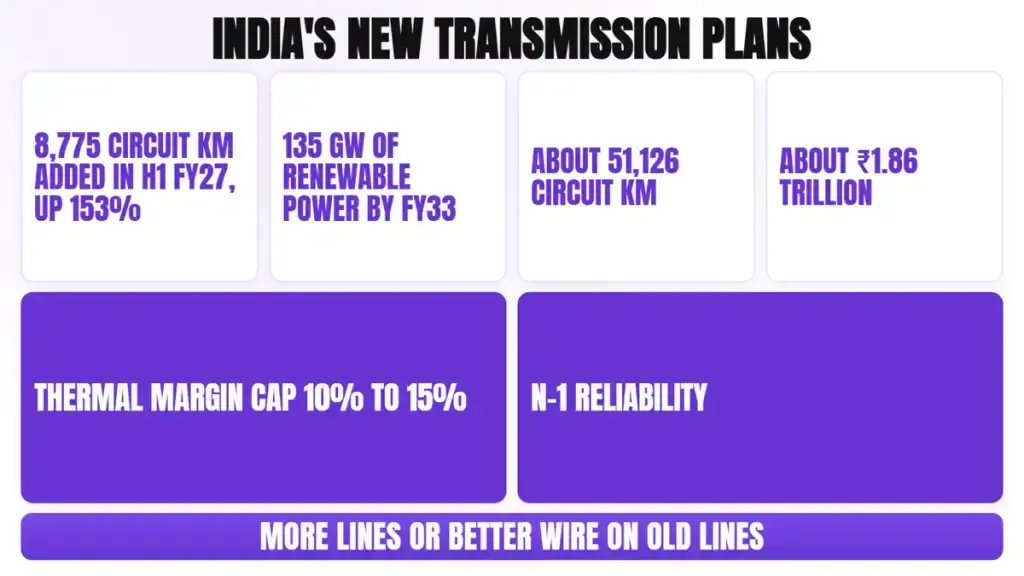
That is where APAR's product range comes in. It makes conventional ACSR conductors, high-efficiency AL59 conductors and HTLS conductors, including ACCC under a technology tie-up with CTC Global of the US. It also makes OPGW, copper conductors for railway electrification, and CTC, or continuously transposed conductors, which are the copper windings that go inside large transformers. Its two Odisha plants sit next to aluminium smelters, so they take molten aluminium directly instead of remelting ingots.
APAR also installs the conductor itself. It is India's largest player in live-line HTLS reconductoring, where the line keeps carrying power while the old wire is replaced. By October 2026 it had executed more than 305 turnkey reconductoring projects, covering 7,475 circuit km. It had also installed more than 24,760 km of OPGW.
"So I think being the largest player in the world on HTLS, we are actually in a very good position." - Kushal Desai, Chairman and Managing Director, October 2026
That premium range is why each tonne now earns more. Premium products were about 46% of conductor revenue in FY26. In Q2 FY27 the premium mix was 39.4%, against 45.3% a year ago, and 44.1% for the half year. Even so, EBITDA per tonne rose to ₹48,241 against ₹39,363 a year earlier, as APAR executed higher-margin orders.
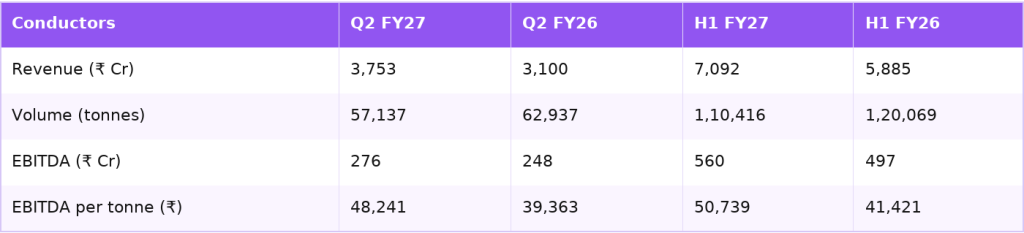
That table also shows revenue growing while tonnes shipped fell. Revenue rose 21.1% in the quarter, mostly because aluminium and copper prices were higher. Volume fell 9.2%, as some customers held back their manufacturing clearances when metal prices jumped. Exports were 23.6% of conductor revenue in Q2, and US conductor revenue grew 12.2%.
The plants are ready for more volume. Conductor capacity rose to 2,77,327 tonnes in FY26, from 2,14,438 tonnes in FY24. In FY26 APAR shipped 2,41,788 tonnes, and the business was running at about 80% of capacity in Q2 FY27.
Specialty Oils and the Transformer Market
Next, let's look at specialty oils, which go inside every large transformer. Transformer oil is a highly refined mineral oil that insulates a transformer's windings and carries away their heat. A transformer that runs for decades needs oil that does not break down, so utilities and transformer makers approve each oil supplier separately.
APAR has spent decades on those approvals. Its oils are approved by transformer makers such as GE, Schneider Electric, Siemens Energy, Hyundai Electric, Hitachi Energy and Toshiba. They are also approved by utilities in Saudi Arabia, Oman, Kuwait, Malaysia, South Africa, Indonesia and India's Power Grid. Its POWEROIL brand has about 60% of India's market for oil in power transformers. It is also the only Indian company to have supplied transformer oil to all of India's major HVDC projects.
That business is built around three plants. Two of them are in India, at Rabale in Navi Mumbai and at Silvassa, and one is at Hamriyah in the UAE. Installed capacity was 9,34,600 tonnes in FY26. Beyond transformer oil, the division makes white oils for cosmetics and pharmaceuticals, rubber process oils and lubricants, some under a licence from Eni of Italy. Exports were 39.8% of oil revenue in FY26.
This year the oil business made far more per litre than before. Base oil prices doubled after the Middle East conflict began, and refiners changed the crude they were running. APAR responded by buying more of its base oil on contracts instead of the spot market, and by selling mainly to steady, higher-quality customers. It cut sales to buyers who were very price-sensitive or slow to pay.
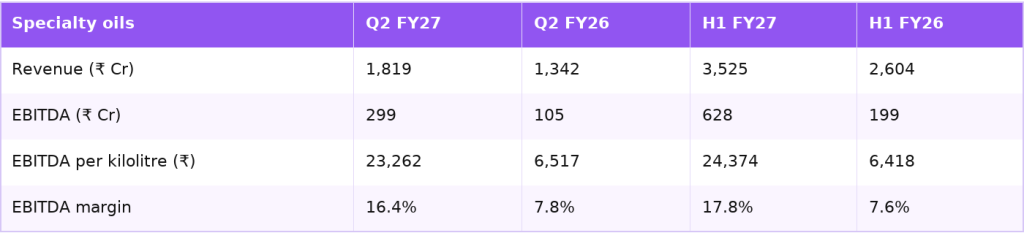
That choice shows clearly in the table. Revenue rose 35.6% in the quarter, while volume fell 20% to 1,28,590 kilolitres. EBITDA almost tripled, to ₹299 Cr. Management is clear that this is not a normal level of margin, and we come back to that later.
Cables and the Data-Centre Orders
Finally, let's look at cables, the business with the data-centre orders. US data centres are being built on a very large scale. By APAR's count, the US has more than 4,000 active data centres, with more than 500 under construction and about 2,500 more planned. India has no AI data centres of any size operating yet, management says, but large ones are now being built.
Those two markets want different cables. The US market is about 66% copper and 33% aluminium, and its data centres mostly use elastomeric cable, which means cable insulated with a rubber-like polymer called EPR that stays flexible and handles heat well. Until 2026, APAR's US cable sales were mostly aluminium. In Q1 FY27 it finished the approval process with the electrical contractors that build data centres for Meta, Microsoft and Google. Those approvals let APAR bid for copper cables, in low and medium voltage.
Those approvals brought the first large orders within a quarter. APAR won an order of more than ₹500 Cr from a contractor building a Google data centre in the US Midwest, its largest single US order so far. It also won the largest award for Amazon's biggest data centre in India, at two locations. Together these came to about ₹1,000 Cr of the ₹3,012 Cr cable book. Amazon's orders are due to be executed by March 2027, and most of the cable book before the end of FY27.
US data-centre cable also earns more than its Indian version. Management says the US specification is much higher, and the cable is harder to make. India is a very large market for the same products, but with more competition and lower margins.
"So the U.S. data center cables definitely offer a better margin profile compared to a similar product being sold in India because of a much higher spec." - Kushal Desai, Chairman and Managing Director, October 2026
That shift has kept the cable plants full. Cable capacity rose to 9,50,656 km in FY26, from 6,81,780 km in FY24, and it was more than 90% used in Q2 FY27. Some copper lines that make data-centre cable ran at 100% to 105%. Today APAR makes power cables up to 66 kV. New equipment will let it go to 132 kV and then 220 kV, which management sees as an FY28 business.

That margin has kept rising even with fewer US shipments in the quarter. Cable revenue grew 22.1% in Q2, and domestic cable revenue rose 71.4%. Copper was about 30% of the cable mix, against 20% a year ago. The EBITDA margin rose 80 basis points to 11%.
The cable business has other legs too. APAR says it is the most dominant player in India's wind cable market, with more than 70% share, and a leader in solar cables. It runs India's largest installed E-beam capacity, which uses electron beams to harden cable insulation. Its house-wire brand, APAR Anushakti, sold ₹384 Cr in FY26 through 642 distributors.
The Approvals That Are Hard to Copy
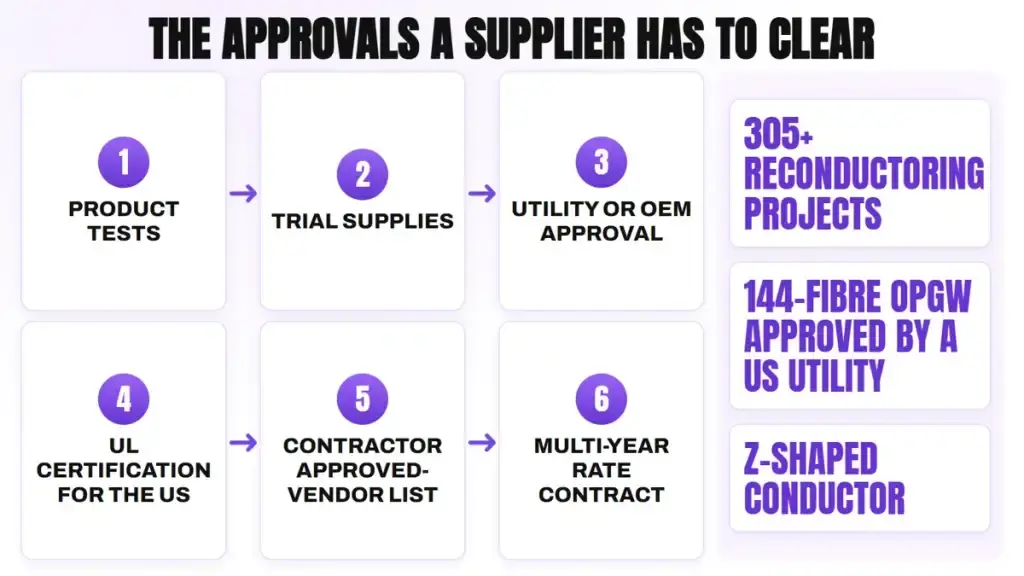
Now that we have seen all three businesses, let's understand APAR's moat, which comes from approvals that are hard to copy. In each business, the buyer is a utility, a transformer maker or a contractor that cannot afford a failure. A conductor that sags too far can trip a line. A bad batch of transformer oil can damage a transformer worth crores. So buyers approve each supplier for each product, often after years of tests and trial supplies.
APAR holds those approvals in many markets. Its transformer oils are approved by the world's largest transformer makers. Its cables carry UL certificates for sale in the US, and it holds the highest number of UL certificates of compliance from India for cable sales in the US. In Q1 FY27 it completed approvals with the contractors for Meta, Microsoft and Google. A US utility has approved its 144-fibre OPGW. Each of these took time, and a new rival would need the same approvals before its first large order. Read this Economic Moat Explained
That trust is also why utilities sign multi-year contracts with APAR.
"A truly great business must have an enduring moat that protects excellent returns on invested capital."
— Warren Buffett
For APAR, the moat is the list of approvals it holds with utilities, transformer makers and data-centre contractors. Each one takes years to earn and protects the premium products from plain price competition. Chinese conductor makers have a cost edge, because of the price gap between the Shanghai and London metal exchanges. But for multi-year rate contracts with utilities in the US and Europe, buyers care about delivery record and reliability as much as price. Management says APAR's credibility puts it in a better position than many international suppliers for such deals.
Those newest products widen the gap further. The Z-shaped conductor has, by management's account, been made by only two other conductor makers in the world. HTLS reconductoring needs engineering design, live-line installation and proof that the product performs, not only a factory. That is why APAR's EBITDA per tonne has stayed well above its own guidance of about ₹35,000 to ₹36,000 per tonne.
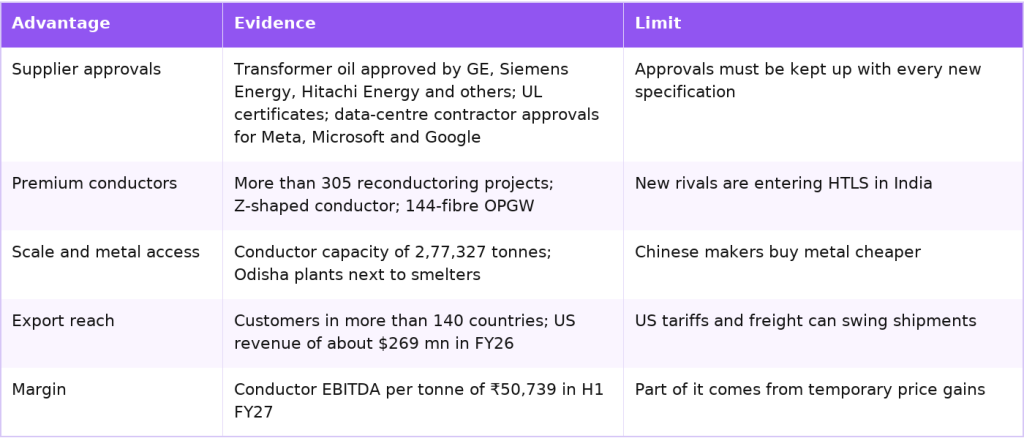
That table shows why the margin is the best test of the moat. A plain conductor maker competes on price per tonne. APAR earned ₹43,012 per tonne in FY26 and ₹50,739 in H1 FY27, well above its guided range. If that holds as metal prices settle, the approvals are doing their job.
Financials: Five Years of Growth, Margins and Cash
One quarter can mislead in a business with goods at sea and swinging metal prices, so let's look at five full years together. All figures are consolidated, and EBITDA is the company's own measure after open-period forex.
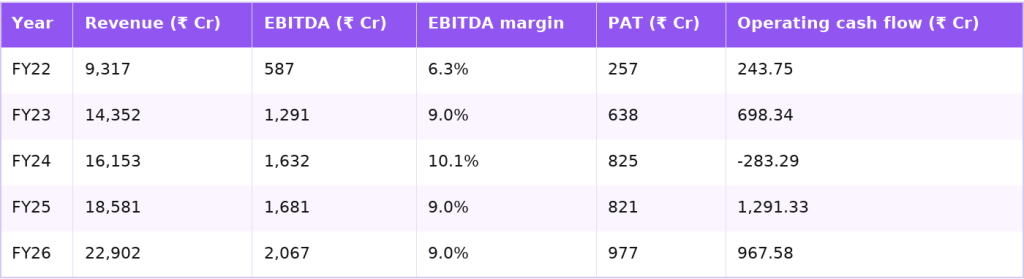
Revenue grew about 2.5 times in four years, from ₹9,317 Cr in FY22 to ₹22,902 Cr in FY26. Profit after tax grew faster, about 3.8 times, as the EBITDA margin rose from about 6.3% to about 9% and has stayed near that level since FY23. Part of the revenue growth in any year comes from aluminium, copper and base oil prices, because APAR's pricing passes metal costs on to customers.
Cash flow has followed profit, but with swings. Over the five years, operating cash flow added up to about ₹2,917.7 Cr, against about ₹3,518 Cr of profit after tax, or about 83%. FY24 was the weak year, with an outflow of ₹283.29 Cr, and H1 FY27 saw another outflow of ₹863 Cr as inventories rose with metal prices.
The balance sheet has carried that working capital with equity rather than debt. Shareholders' funds rose from ₹1,715 Cr in FY22 to ₹5,393 Cr in FY26, and to ₹8,520 Cr in September 2026 after the ₹2,500 Cr placement. Borrowings were ₹841 Cr in FY26, small against that equity.
"Over the long term, it's hard for a stock to earn a much better return than the business which underlies it earns."
— Charlie Munger
APAR's profit grew about 3.8 times in four years while its margin settled near 9%. Whether the business keeps earning that well, and turning profit into cash, matters more than any single quarter.
What FY28 Could Look Like on Management's Numbers
So where does APAR go from here? Management gives medium-term ranges rather than yearly numbers, so let's lay them out. For cables, it targets revenue growth of 25% a year at an EBITDA margin of 11% to 12%. For conductors, it guides EBITDA of about ₹35,000 to ₹36,000 per tonne, plus whatever extra the product mix adds.
That growth needs new plants, and most of the money is already being spent. APAR plans domestic capex of about ₹1,500 Cr over 12 to 15 months, the largest capex plan in its history. It had spent about ₹500 Cr of it by September 2026. Once this phase ends, management expects yearly capex of about ₹300 Cr to ₹400 Cr. For comparison, FY26 capex was ₹737 Cr.
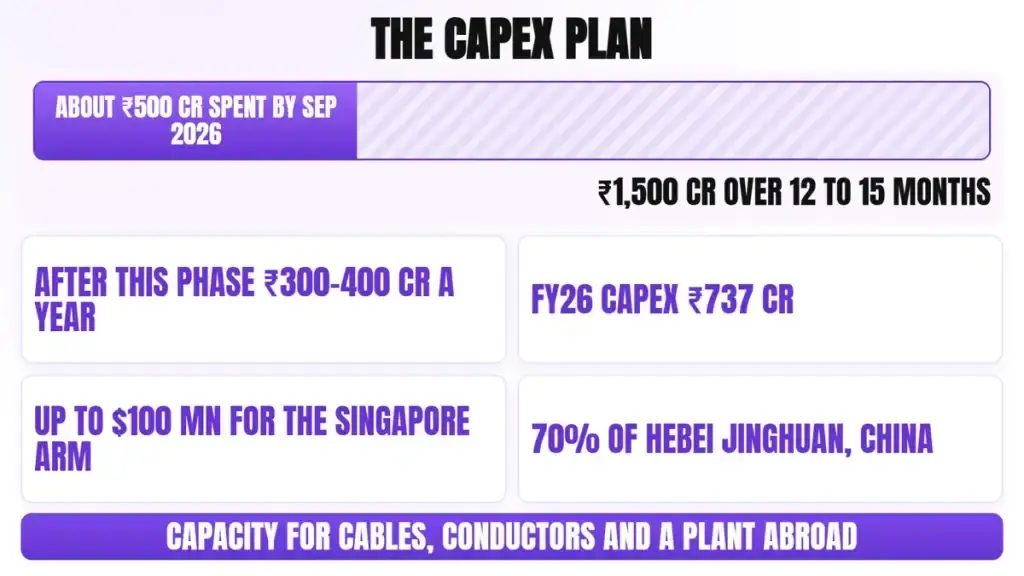
That domestic plan does not include the overseas step. In October 2026 the board approved a further investment of up to $100 mn in Petroleum Specialities Pte Ltd, APAR's wholly owned subsidiary in Singapore. That subsidiary then agreed to buy 70% of Hebei Jinghuan Cable Co. Ltd, a conductor maker in China. The plan is to run it as a 100% export-focused plant. The estimated price is RMB 24.85 mn at one times book value, paid in instalments from an escrow account.
Why would APAR buy a plant in China? The filing gives one reason: APAR wants to spread its aluminium conductor manufacturing across more countries. The deal also comes at a time when management says Chinese exporters hold a cost edge from cheaper metal in Shanghai, while APAR holds the approvals and the customer contracts.
"The cable business, we've been guiding 25% value growth. We are quite confident that we'll meet that." - Kushal Desai, Chairman and Managing Director, October 2026
Industry growth supports those targets, by management's estimate. It sees the cable industry growing about 15% to 20% a year, the conductor industry about 10%, and transformer oil about 5% to 7%. On top of that, the ₹800 Cr in transit should add to Q3 FY27 revenue.
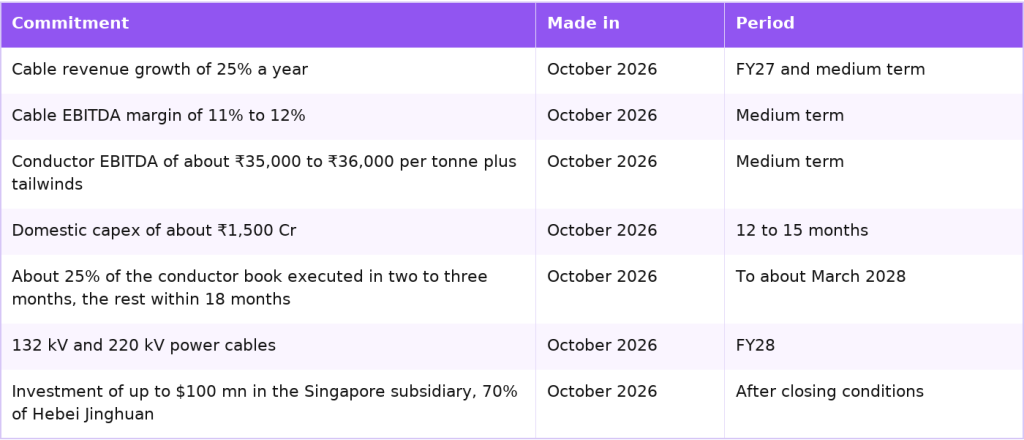
Those commitments are easier to judge against the past. So let's check what management has said before against what it delivered.
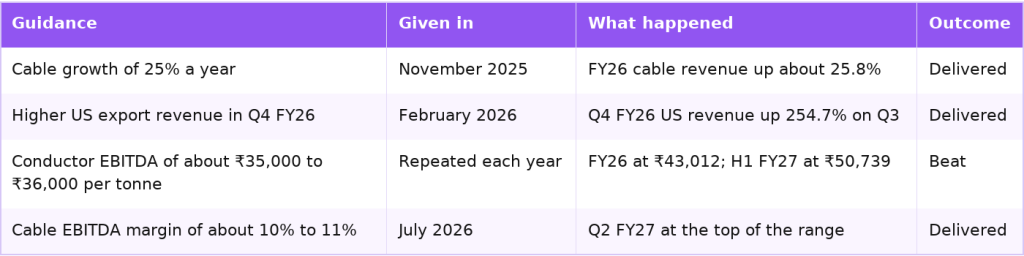
That record is good on the numbers it has guided. APAR has delivered its cable growth and beaten its conductor margin guide. In oil, the company now chooses margin over volume, so its volume does not track the market.
Key Risks
Now let's look at what could go wrong for APAR Industries, because the latest half year has already shown some of these risks.
- US revenue: US revenue fell 29.7% in Q2 FY27 and 21.5% in H1. In cables, US revenue fell 53.8% in the quarter, and exports fell to 19% of cable revenue from 42.3%. Most of this was goods in transit, but it also follows a period in early 2026 when US tariffs on these products stood at 54% and US ordering slowed.
- Conductor volumes: tonnes shipped fell 9.2% in Q2 and 8% in H1. Many customers are TBCB developers, who win transmission lines by bidding the lowest tariff and then have 36 months to build them. When metal prices jump, they delay clearances. If metal stays high, the catch-up in H2 could come later than management expects.
- Oil margins: management says the oil margins are not normal. EBITDA of ₹23,262 per kilolitre in Q2 compares with ₹6,517 a year earlier, and part of the gain comes from buying base oil on contract while spot prices rose. When the Middle East conflict ends, or base oil prices settle, this margin could shrink sharply. Oil volumes fell 16.9% in H1, and the Hamriyah plant in the UAE has had very little business.
- Cash flow: operating cash flow was negative ₹863 Cr in H1 FY27, against profit of ₹915 Cr. Inventories rose to ₹5,055 Cr from ₹4,153 Cr in March, and the company used QIP money to pay suppliers in cash. Read this Cash Flow Statement Explained Customer acceptances, a form of short-term trade credit, stood at about ₹3,500 Cr.
- Competition: Chinese conductor and cable exporters are very aggressive on standard products. In India, new rivals are entering HTLS, and some EPC companies now make their own conductors, so APAR's market share there may fall.
- The China plant: the target had no turnover in its 2025 financial year, and 70% of the price is held in escrow until the seller meets agreed conditions. Running a plant in China while competing with Chinese makers is new ground for APAR.
- One-time factors: heavy rain at Silvassa cut CTC capacity for about 20 days of the quarter, and some transformer makers have delayed their own expansions, which slows CTC demand.
- Dilution: the QIP added 16,88,618 shares, about 4% of the shares after the issue.
"So, by no means, these are normal margins, which are there." - Kushal Desai, Chairman and Managing Director, October 2026
"Risk means more things can happen than will happen."
— Howard Marks
For APAR, many things can happen at once: metal prices, freight, US tariffs and oil spreads all move outside its control. The tracking list below shows which of them are turning in its favour.
Explore our Products
Research Framework

Emerging Titans
Combination of quantitative analysis, industry tailwinds, and management assessment - SPRINT investment philosophy

Tiny Titans
Heavy emphasis on scuttlebutt research, plant visits, and early on-ground signals
What to Track Next
If you follow APAR Industries, these are the signals that will show where it goes next.
- Q3 FY27 results, and whether US revenue rebounds as the ₹800 Cr in transit is booked
- Conductor volumes in H2 FY27 against H1 FY27, and the order book after ₹12,025 Cr
- Oil EBITDA per kilolitre as base oil prices settle, against ₹23,262 in Q2
- Cable margins against the 11% to 12% target, and execution of the Google and Amazon orders by March 2027
- Closing of the Hebei Jinghuan deal and any new overseas plant
- Operating cash flow turning positive in H2 FY27
Conclusion
Let's put it all together. APAR Industries has turned its order book toward the world. Half of its ₹12,025 Cr conductor book is for export, utilities in the US and Europe have signed multi-year contracts, and its first large data-centre orders have come from Google in the US and Amazon in India.
The latest quarter hid much of that. Goods worth about ₹800 Cr were still at sea, and the profit jump leaned heavily on oil margins that management itself calls unusual. What happens next depends on whether US revenue catches up in Q3, whether conductor volumes recover in H2, and how much of the margin gain survives once oil prices settle.
FAQs
What does APAR Industries do?
+APAR Industries makes overhead conductors for transmission lines, transformer and specialty oils, lubricants and cables. In FY26 conductors had revenue of ₹12,712 Cr, specialty oils ₹5,373 Cr and cables ₹6,220 Cr, and consolidated revenue was ₹22,902 Cr. It sells in more than 140 countries.
How did APAR Industries do in Q2 FY27?
+Consolidated revenue was ₹6,931 Cr, up 21.3%, and EBITDA after forex rose 57.8% to ₹787 Cr at a margin of 11.4%. Profit after tax rose 77.8% to ₹447 Cr. US revenue fell 29.7% because about ₹800 Cr of conductors and cables were still in transit to US buyers at the end of September.
What is APAR Industries' order book?
+The conductor order book was ₹12,025 Cr in September 2026, with 51% of it for export, up from ₹7,168 Cr a year earlier. The cable order book was ₹3,012 Cr, with 32.5% for export. Together they come to about ₹15,037 Cr, about 0.66 times FY26 revenue.
What data-centre orders has APAR Industries won?
+APAR won an order of more than ₹500 Cr from a contractor building a Google data centre in the US Midwest, its largest single US order. It also won the largest award for Amazon's biggest data centre in India. Together these come to about ₹1,000 Cr of the ₹3,012 Cr cable book.
Why is APAR Industries buying a plant in China?
+In October 2026 APAR's Singapore subsidiary agreed to buy 70% of Hebei Jinghuan Cable Co. Ltd, a Chinese conductor maker, for an estimated RMB 24.85 mn at one times book value. The plant will be 100% export-focused, and APAR says it wants to spread its aluminium conductor manufacturing across more countries. The board also approved up to $100 mn of further investment in the Singapore subsidiary.
What are the main risks for APAR Industries?
+US revenue fell 29.7% in Q2 FY27, conductor volumes fell 9.2% as customers delayed clearances, and management says oil margins of ₹23,262 per kilolitre are not normal. Operating cash flow was negative ₹863 Cr in H1 FY27. Chinese exporters and new HTLS rivals in India add price competition.

High growth stock specialist, Value Educator
Shashank Mahajan is an equity research professional with over 12 years of experience in identifying high-potential SME and micro-cap stocks at an early stage. He follows a rigorous scuttlebutt research–driven approach, combining on-ground insights with deep financial analysis. Shashank specializes in uncovering under-researched and under-owned companies with strong management quality and long-term growth potential. Through disciplined research and early identification, he focuses on spotting tomorrow’s market leaders before they enter the mainstream investor radar.

Jyoti CNC: The 5-Axis Machines Behind India's Aircraft Parts

INOX India: The Rocket Order Behind a ₹2,268 Cr Book

Techno Electric: ₹11,000 Cr of Grid Orders and Data Centres

Sansera Engineering: Aircraft and Chip Parts Hit 14.9%

PTC Industries: The Titanium Melt Shop Behind Aerolloy

HBL Engineering: Defence Batteries, Fuzes and Kavach Orders
Explore our Products
Research Framework
Emerging Titans
Combination of quantitative analysis, industry tailwinds, and management assessment - SPRINT investment philosophy
Tiny Titans
Heavy emphasis on scuttlebutt research, plant visits, and early on-ground signals



Modern Warfare to Multibaggers
Key Trends. Strategic Shifts. Opportunities Ahead.
Don't Miss This Exclusive Webinar!
Join Value Educator to decode the key trends shaping India's defence sector and learn how to identify tomorrow's potential leaders in the space.
- In-depth research on India's defence sector
- Live Q&A session
- Actionable takeaways for long-term investors

 Orders
 Subscription
 Share with friends


Required Details
₹23999.00
(12 month subscription)
As per SEBI regulations, all users are mandated to complete the KYC that is validated for 1 year. Post payment, you will be redirected to the KYC screen


No comments yet. Be the first to comment!