
TD Power: 93% of New Orders Now Come From Abroad

Data centres in the United States are running out of patience with the grid. Waiting years for a grid connection is not an option when AI computers need power now, so many operators are building their own power plants on site. This is called behind-the-meter power, which simply means electricity made on the customer's own land instead of bought from the grid. Most of it comes from gas engines and gas turbines, and every one of them needs a generator.
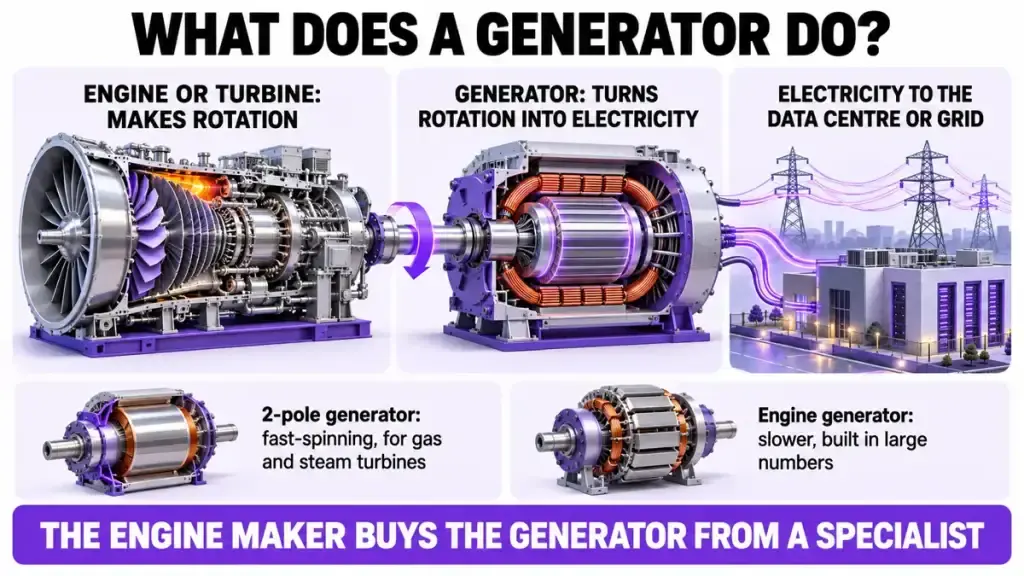
A generator is the machine that turns the spinning motion of an engine or turbine into electricity. The engine maker designs the engine, but it often buys the generator from a specialist, because winding copper coils around a steel core to exact limits is a craft of its own. That makes generator makers a quiet bottleneck in the power chain.
One Bengaluru company has become a supplier to many of those engine and turbine makers. TD Power Systems Ltd (NSE: TDPOWERSYS), set up in 1999 with technology from Toyo Denki of Japan, makes AC generators for steam turbines, gas turbines, gas and diesel engines and hydro plants, along with industrial and traction motors. It sells mostly to the companies that build turbines and engines, and they ship its generators to power plants in 113 countries.
That export business is now most of the company. In Q1 FY27, 93% of TD Power's new orders came from exports and deemed exports, and in August 2026 it signed a 10-year framework agreement with Siemens Energy to build large 2-pole generators on a build-to-print basis. A 2-pole generator means a fast-spinning generator built for gas and steam turbines rather than slower engines. Build-to-print means making a machine to the customer's own designs and drawings.
So the company you are looking at is an Indian factory riding someone else's power crunch. Its revenue has more than tripled in five years, and its order book keeps rising faster than it can ship.
TD Power in five numbers
- Order inflow of ₹734.1 Cr in Q1 FY27, up 87% from a year ago
- 93% of that inflow from exports and deemed exports
- Order book of ₹2,207.3 Cr at the end of June 2026
- FY27 revenue guidance raised to ₹2,600 Cr
- 8,375 generators installed in 113 countries
That is a fast climb for a company that lost money in FY17. So where are the orders coming from, and can the factory keep up? Let's first understand the company, and then look at the latest quarter, the biggest in its history.
TD Power Systems: Company Overview
TD Power Systems was set up in Bengaluru in 1999 with technology from Toyo Denki of Japan. It makes AC generators for steam turbines, gas turbines, gas and diesel engines and hydro plants, along with industrial, synchronous and traction motors, and sells them mostly to the global companies that build turbines and engines. It runs three plants in Bengaluru and a small unit in Turkey that now works mainly as a service base for Europe. By the end of June 2026, it had 8,375 generators and motors installed in 113 countries. Promoters held 26.9% of the shares in June 2026, and the company earned ₹1,869.5 Cr of consolidated total income in FY26. Read this TD Power Systems: Riding India's Capex Cycle
"Behind every stock is a company. Find out what it's doing."
— Peter Lynch
With TD Power, what the company does has shifted in three years. A maker of generators for Indian captive power plants now ships most of its orders abroad, to engine and turbine makers powering US data centres.
The Quarter Orders Crossed ₹700 Cr
Let's look first at Q1 FY27, the April to June quarter, when orders crossed ₹700 Cr for the first time. Total income on a consolidated basis was ₹640.1 Cr, up 71% from a year ago. EBITDA grew 72% to ₹121.7 Cr, at a margin of 19%, and profit grew 72% to ₹86 Cr.


That quarter was also larger than the one before it. Total income rose 8% from Q4 FY26, and profit after tax rose 20%, as more generators went out of the plants.
That profit growth kept pace with sales because costs grew in line. The gross margin was 34.7%, against 35.3% a year ago, as the company passed most of the rise in copper and steel prices to customers through price clauses. Employee costs rose to about ₹54.5 Cr from about ₹36.8 Cr as the company hired for higher output, and other expenses to about ₹45.9 Cr from about ₹24.3 Cr.
That order inflow matters most for what comes next. New orders of ₹734.1 Cr in the quarter compare with ₹391.8 Cr a year ago. Exports and deemed exports brought ₹683.6 Cr of it, against ₹257.3 Cr a year earlier, so almost all of the rise came from abroad. Deemed exports are generators sold to an Indian factory of a foreign turbine maker, which then ships the finished machine overseas. Read this MTAR: The Workshop Powering US AI Data Centres
"Despite differing views on the sustainability of this buoyancy in the media, the ground reality is that there is a tremendous shortage of power generation equipment, specifically in gas turbines, gas engines, transformers and generators." - Nikhil Kumar, Managing Director, TD Power Systems
That shortage shows in the order book. It stood at ₹2,207.3 Cr at the end of June 2026 for the manufacturing business. Generators and motors made up ₹1,929 Cr of it, railways ₹211 Cr, spares and aftermarket ₹22 Cr and the Turkey unit ₹46 Cr. Management expects about ₹700 Cr of new orders every quarter, or about ₹2,800 Cr for the full year.
That order book has climbed quarter after quarter. You can see it in the numbers management gives every quarter.

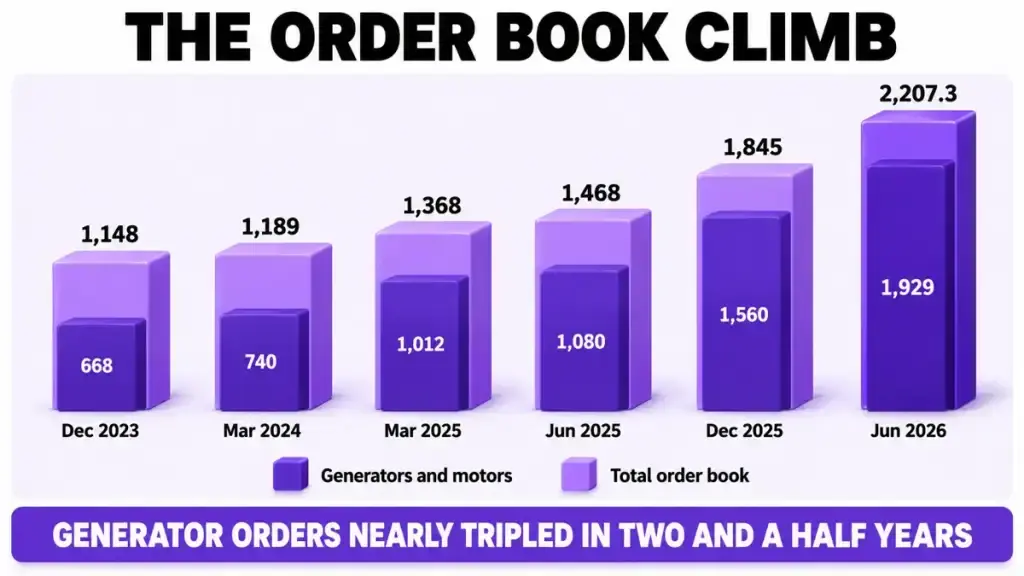
That climb came almost entirely from generators and motors, which nearly tripled in two and a half years. The railway part went the other way, as the company stopped taking railway orders. Quarterly order inflow also set one record after another: ₹413 Cr in Q4 FY25, ₹524 Cr in Q2 FY26, ₹656 Cr in Q3 FY26 and ₹734.1 Cr in Q1 FY27.
Six Years of Export Growth
So how did the company get here, after losing money in FY17? Over six years, growth came from a steady climb in exports, and then a jump when data centres started buying power plants.

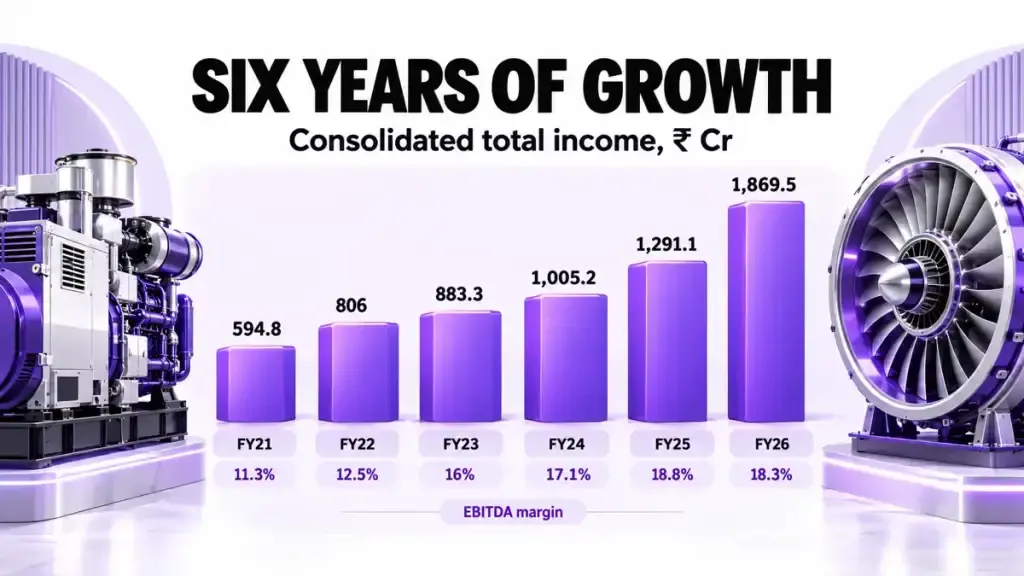
That table shows a business that grew about 26% a year in revenue and about 39% a year in EBITDA over FY21 to FY26. FY26 was the biggest step. Total income rose about 45% to ₹1,869.5 Cr, and profit after tax rose to about ₹239 Cr, the highest in the company's history for the third year in a row.
That growth came with a wider margin. The EBITDA margin rose from 11.3% in FY21 to 18.3% in FY26, because revenue grew much faster than employee and other costs. Depreciation stayed at about ₹20-23 Cr a year over this period, so most of the extra EBITDA reached profit.
That growth also changed where the company sells. Exports, including deemed exports, rose from 47% of turnover in FY23 to 67% in FY26. Their share of the order book, leaving out railways, was 56% in December 2023 and 75% by December 2025. In Q1 FY27, 93% of new orders came from abroad, so that share is likely to keep rising.
That use of the plants reached its limit in FY26. The company commissioned a third plant in Bengaluru during the year, for generators, motors and parts. It also runs a small factory in Turkey, which now works mainly as a service base for its machines in Europe.
That expansion was paid for from its own cash. At the end of June 2026, the company had cash and bank balances of about ₹240 Cr and borrowings of only ₹23.81 Cr. Its equity stood at about ₹1,158 Cr, against about ₹1,072 Cr three months earlier.
That cash also comes partly from customers. Other current liabilities, which include customer advances and tax provisions, rose to about ₹290 Cr in June 2026 from about ₹190 Cr in March, as the business grew. Management says some customers pay advances, while others buy on credit terms that it cannot change much without losing business. For FY27, it plans capital spending of about ₹50 Cr, mostly to remove bottlenecks in the existing plants.
Five Kinds of Generators, One Factory
Now let's look at what TD Power makes. It sorts its business by the machine that drives the generator, because each one needs a different design and goes to a different kind of customer.
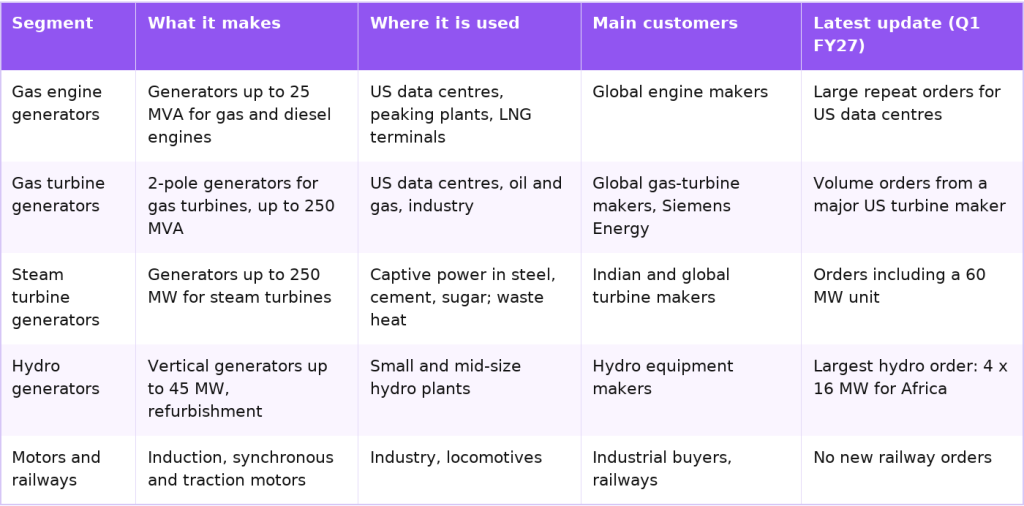
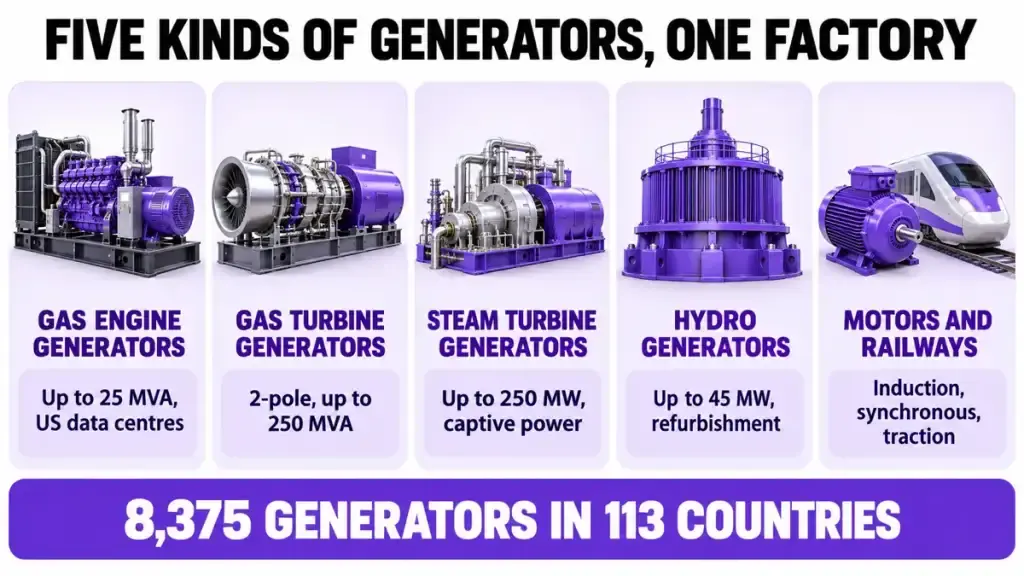
These lines sit inside a large market. The global generator market was about USD 52.8 billion and is projected to reach about USD 107.6 billion by 2035, growing about 8.2% a year, with data centres and industry among the drivers.
These five lines can sound alike, because each one makes electricity from rotation. The difference is speed and size. Engine generators turn slowly and come in large numbers, gas turbine generators spin fast and are larger, steam generators serve factories that make their own power, and hydro generators stand upright under a dam. In FY26, gas engine generators were the largest contributor to turnover, followed by steam turbine generators.
That mix also decides where the orders come from. At the end of June 2026, exports and deemed exports made up ₹1,533.2 Cr of the order book, or 69.5%, and domestic generator orders ₹395.4 Cr, or 17.9%. The rest was railways, spares and Turkey.
Gas Engine Generators for US Data Centres
Let's begin with gas engines, the line that grew fastest. The global gas engine market is expected to grow steadily as industry and data centres need continuous power, and the global gas generator market about 6.4% a year over 2026-2031. For TD Power, that growth comes mostly from one place: data centres in the United States.
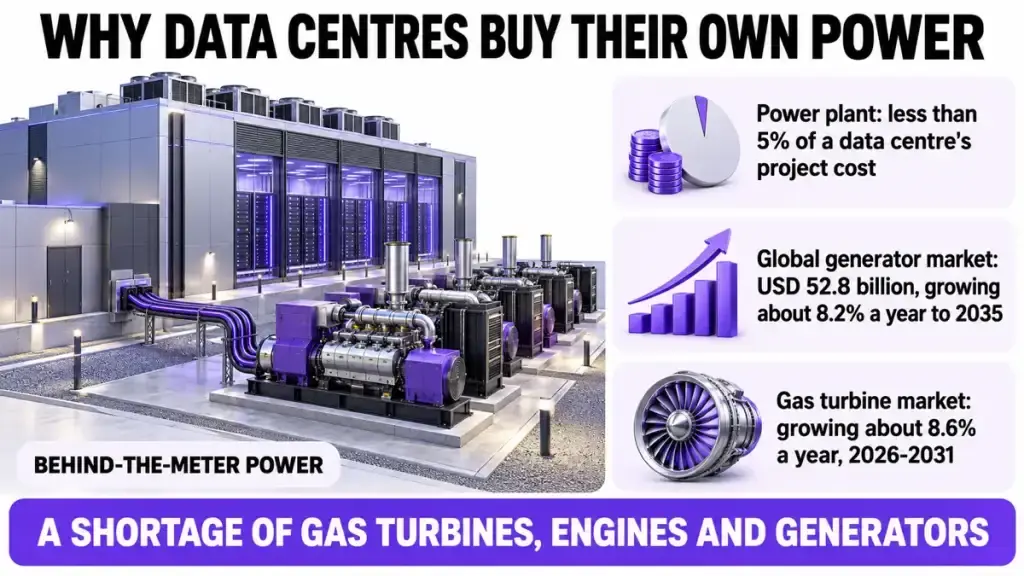
That demand reaches it through engine makers. A data centre that cannot wait for the grid installs a row of gas engines, each driving a generator, to power its servers. TD Power has a long-term supply agreement with INNIO, a gas engine maker, signed in 2009, and it supplies other global engine makers too.
That business won large repeat orders again in Q1 FY27. The company described them as large-volume orders from leading global engine makers across several ratings, all for US data centres. More high-volume programmes have been indicated for CY2027, and there is a competitor-replacement order expected for a mining customer in Africa. In India, it won an order for a machine of about 6 MW for the country's largest LNG terminal.
That demand is not only about data centres. Management also points to grid stabilisation, because grids that add more solar and wind need fast-starting gas engines to fill gaps when the sun sets or the wind dies down. Utilities also have to keep a certain mix of power sources. In its words, these factors are driving buying that customers cannot postpone.
That mix of buyers also spreads the demand, because grid operators, factories and data centres place orders for different reasons and on different timelines.
That demand also does not bend easily to prices. Management says the power plant is less than 5% of a data centre's project cost, so a buyer who needs electricity will pay more for the equipment rather than wait. That is one reason TD Power has kept its gross margin steady even as metal and freight costs rose.
Gas Turbine Generators and the Siemens Energy Deal
Next, let's look at gas turbines, the line that could change the company's size. The global gas turbine market is expected to grow about 8.6% a year over 2026-2031, as gas plants support grids that are adding more solar and wind. A gas turbine needs a 2-pole generator, which is larger and harder to make than an engine generator.
That is the market TD Power has been preparing for since 2012, when it signed a licence with Siemens to make 2-pole generators of up to 250 MVA. In Q1 FY27, it won significant volume orders from a major global gas-turbine maker for machines of 14-18 MW across several projects, and it expects a large order pipeline from a second major maker for 12-19 MW machines, all for US programmes.
That licence has given TD Power more than a decade of experience with 2-pole machines, mostly for steam turbines in India and abroad. It also means the factory already has the winding, balancing and testing set-up that a fast-spinning generator needs, which a new entrant would have to build first.
That work became much larger in August 2026. On 13 August, TD Power signed a build-to-print framework agreement with Siemens Energy, Inc. Build-to-print means it will make 2-pole generators to Siemens Energy's own designs, drawings and specifications. The agreement runs for 10 years and can be extended by 24 months, and each order will come as a separate purchase order with its own delivery dates.
Why the Siemens Energy deal matters: Siemens Energy makes gas turbines, and it has chosen an Indian factory to build generators to its own designs for ten years. That is a long qualification that rivals would have to repeat, at a time when turbine makers are short of generators.
That move into larger machines is a step up. Until now, TD Power's main business has been generators below 100 MW. Management calls the market for larger generators very large and dominated by very large players, and it says a large generator takes 18-20 months to build. So any revenue from the Siemens Energy work would come in FY28 or later, not in the FY27 guidance.
That step also has a leader with the right background. TD Power's chief executive, Deepak Kumar Sinha, earlier ran L&T-MHI Power Turbine Generators, which designs and makes turbines and generators for large thermal power plants in India. He brings experience of the larger machines the company now wants to build.
That deal was followed by a first order on TD Power's own design. On 1 October 2026, its US subsidiary won an order of about ₹192 Cr from a leading multinational corporation for 2-pole generators of TD Power's design, for gas turbines to be installed in the United States. Deliveries are scheduled between August 2027 and January 2028. The company calls it a significant entry into the global 2-pole market with its in-house design.
That gas turbine work could also lead back to steam. Many data centre plants run gas turbines on their own today, in what is called open cycle. Management expects them to add steam turbines later to use the waste heat, in combined cycle, though it says that could take years. Since TD Power already works with the major steam turbine makers, it expects a share of that work when it comes.
Steam Turbine Generators for Captive Power
Now let's turn to steam turbines, the steady base of the business. Steel, cement, sugar and chemical plants often make their own electricity from steam, using heat from their own processes. The global steam turbine market is expected to grow about 2.8% a year over 2026-2035, and management sees its own steam turbine business growing about 10-12% a year.
That business won orders across steel, cement and sugar in Q1 FY27, including projects in Africa and the Middle East. One captive power order was for a 60 MW 2-pole generator, among the largest in this segment. It also won orders from European and US turbine makers for waste-heat and industrial projects in the United States, and strong orders from Indian steel plants for machines of 15-45 MW.
That domestic demand is steady rather than fast. India is adding large coal plants of 600-800 MW, and management says makers in that range, such as BHEL, L&T and Mitsubishi, are booked for the next three to four years. TD Power's machines go to the smaller captive plants of steel, cement and sugar companies instead. Management says power demand from Indian industry is growing about 10-12%, and that large coal plants are being built in sizes of 600-800 MW, which are outside TD Power's range. It also does not expect large AI data centres in India soon, because they would need gas and water for their own power.
Hydro Generators, Motors and Railways
Finally, let's look at the smaller lines, which add balance. Hydro generators stand upright under a dam and turn slowly with the water. TD Power developed them with Voith of Germany in 2009, and it now works on small and mid-size hydro plants and on refurbishing old ones.
That hydro business had a strong quarter. It won its largest hydro order so far, from an Indian hydro equipment maker, for four 16 MW vertical generators for a major project in Africa. It also won orders from European and Indian makers for projects of 9-22 MW in Europe and India, and management expects this year to be one of its best in hydro, helped by refurbishment work in India. Demand also continues in South Asia, including Nepal, driven by new hydro projects there. Each hydro generator is designed for its own dam and water flow, so this work earns on engineering as much as on volume.
Those motors are the newest line, and they use many of the same skills as generators. A motor is a generator run in reverse: electricity goes in and rotation comes out. The company started making induction and synchronous motors in 2022, up to 20 MW and 50 MW, and it is qualifying them with customers in the United States and Europe. It has started separating its motor and generator lines to run each more efficiently.
That leaves railways, a line the company is now winding down to free space for generators. It makes traction motor parts under a long-term agreement with Alstom signed in 2017, and it had ₹211 Cr of railway orders in June 2026. Management is not taking fresh railway orders and will use that capacity for generators and motors once the Indian Railways contract is complete.
That leaves the Turkey unit, which TD Power set up in 2017 to make generators locally. It has about EUR 3-3.5 million of orders to deliver this year. Management plans to keep it as a service base for the many TD Power machines running in Europe.
The Approvals That Are Hard to Copy
Now that we have seen every product line, let's understand why its approvals are hard to copy, and why turbine and engine makers keep returning to TD Power. It starts with approvals. A turbine maker tests a new supplier's generator for months before it uses it in a product, and it qualifies each rating separately.
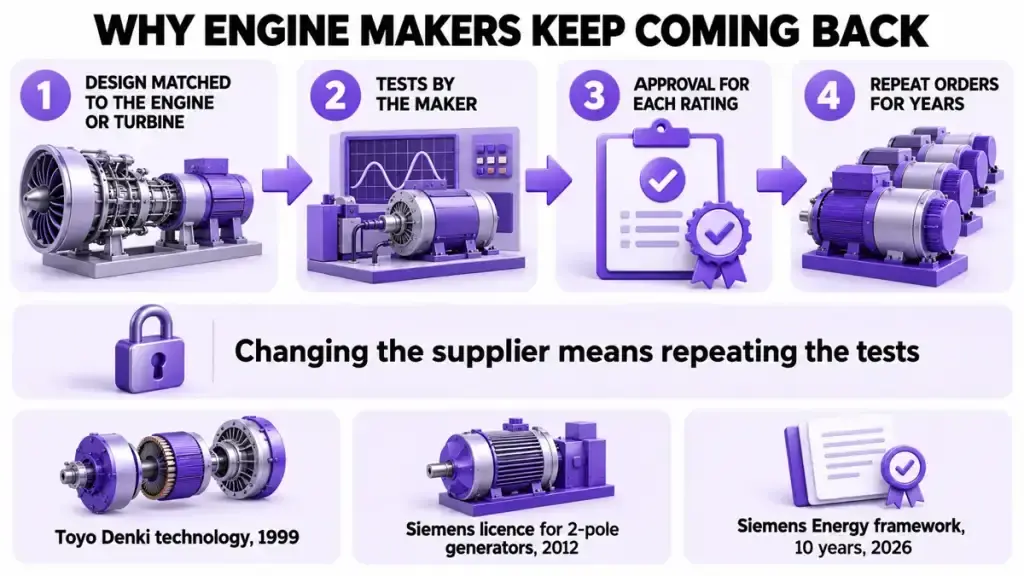
That approval is slow to win and costly to switch. A generator is matched to the engine or turbine it sits on, so changing the supplier means repeating the tests. Once a supplier is approved, engine makers order the same design again and again. Read this Economic Moat Explained Management says its growth comes mainly from going deeper with the engine and turbine makers it already serves, not from new names.
"The best business is a royalty on the growth of others."
— Warren Buffett
TD Power comes close to that. Each time an approved engine or turbine maker sells more machines, it orders more of the same generators.
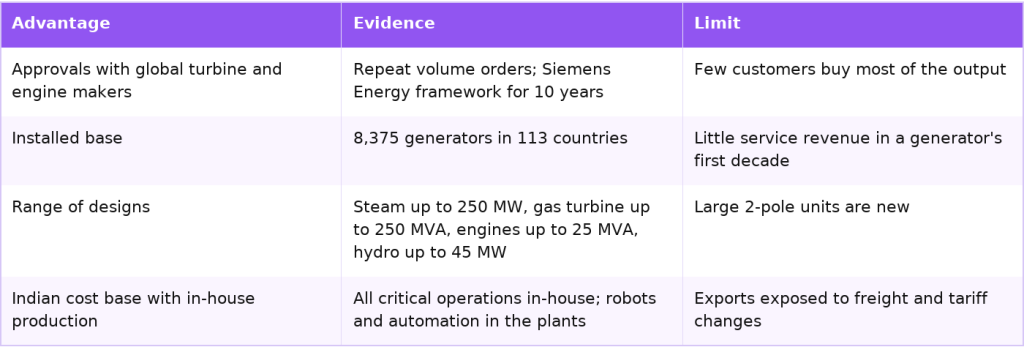
That approval also depends on how the machines are made. TD Power keeps all critical operations in-house, under one roof in Bengaluru, which lets it control quality and delivery times. Since 2017, it has replaced much of its conventional machinery with robots and automation for selected processes.
That know-how was built over two decades with partners. It started with technology from Toyo Denki of Japan, developed hydro generators with Voith, and took a licence from Siemens in 2012 for 2-pole generators of up to 250 MVA. Each partnership added a design range that it now sells on its own.
That base is also growing fast. The company counted 8,055 generators and motors supplied to 113 countries in its FY26 annual report, and 8,375 by the end of June 2026, so about 320 were added in a single quarter. Management says future growth will come from both more units and larger, higher-value machines.
That installed base is also a reference list. TD Power has 5,522 generators in Asia, 1,556 in Europe, 674 in North America and 312 in Africa. When a turbine maker wins a project in a new country, a supplier with machines already running nearby is easier to approve.
That base builds a small but steady service business, and it grows each time a new machine leaves the factory. Management says a well-made generator needs almost no service in its first ten years. Service has stayed at about 5-6% of sales, growing at the same pace as the business.
That strength also shows in how customers commit. Management says its customers, the engine and turbine makers, have taken large non-refundable advances from their own buyers. That gives them, and TD Power, more confidence that the demand will hold in the years ahead.
Financials: Returns and Cash Over Five Years
We have already seen six years of revenue and margins. Now let's look at what that growth did to returns, and how much of the profit came back as cash.
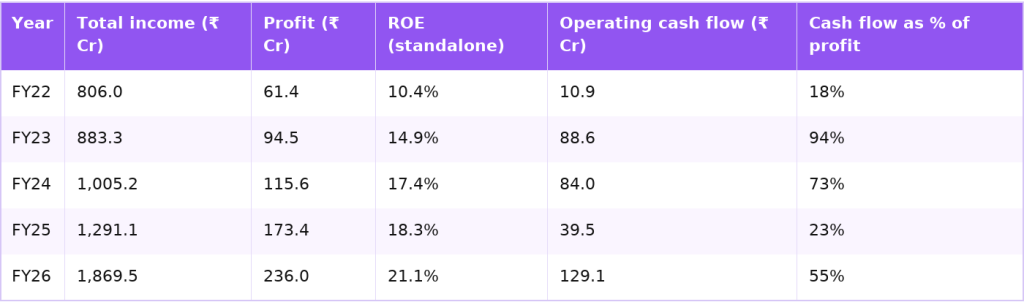
Total income grew about 2.3 times in four years, from ₹806 Cr in FY22 to ₹1,869.5 Cr in FY26, and profit grew about 3.8 times. Return on net worth, as the company reports it on a standalone basis, doubled from 10.4% to 21.1%. The company has almost no debt, with borrowings of only ₹23.81 Cr in June 2026, so that return comes from the business itself, not from borrowing.
Cash is the weaker part of the story. Over the five years, consolidated operating cash flow added up to about ₹352 Cr, against about ₹681 Cr of profit, or about 52%. The gap comes from working capital: as sales grow, more money sits in receivables and in stock waiting to be shipped. FY25 was the weakest year, when cash flow was only about 23% of profit, and FY26 recovered to about 55%.
"The stock market is filled with individuals who know the price of everything, but the value of nothing."
— Philip Fisher
For TD Power, the value question sits in this table: returns have doubled, and the next test is whether cash flow can keep up with profit as revenue grows another 39%.
What FY28 Could Look Like on Management's Numbers
So what could all of this add up to? Management has given a revenue target for FY27, a capacity plan for FY28 and a direction for FY29-FY30, so we can put them side by side.
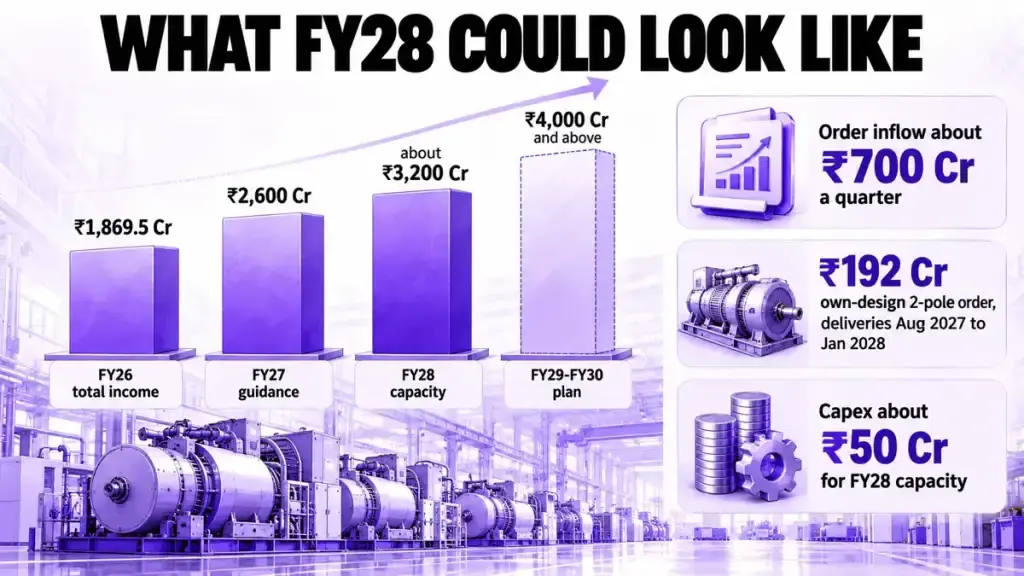
That plan starts with FY27, and you can measure it against what the company has already shown. Management raised its revenue guidance to ₹2,600 Cr, with a small chance of going above it, against ₹1,869.5 Cr of total income in FY26. That is growth of about 39%. Q1 FY27 total income of ₹640.1 Cr, repeated for four quarters, would already be about ₹2,560 Cr.
That revenue would also carry a margin. Management does not give an EBITDA margin target, but it says it manages margins through prices, cost cuts, product mix, exchange rates and how fully the plants are used. At the FY26 margin of 18.3%, ₹2,600 Cr of revenue would give about ₹476 Cr of EBITDA, against ₹342.9 Cr in FY26. This is our arithmetic, not a company forecast. Read this EBITDA Explained: Uses and Limits
Then comes capacity. With about ₹50 Cr of debottlenecking, management expects capacity for about ₹3,200 Cr of revenue in FY28. For FY29 and FY30, it is studying another round of expansion to take capacity to ₹4,000 Cr and above. It said it will share those plans with its Q2 FY27 results.
That book also covers most of this year's target. After ₹640.1 Cr in Q1, the company needs about ₹1,960 Cr more to reach ₹2,600 Cr, and the June order book was ₹2,207.3 Cr. Large 2-pole orders, like the ₹192 Cr one, will be delivered only from August 2027.
At about ₹700 Cr of new orders a quarter, or about ₹2,800 Cr a year, orders would roughly match the FY28 capacity. The order book of ₹2,207.3 Cr is about 1.2 years of FY26 income.
"They need electricity and there's no choice." - Nikhil Kumar, Managing Director, TD Power Systems
That growth has also changed who owns the company. At the end of June 2026, promoters held 26.9%, mutual funds and alternative funds 23.9% and foreign investors 26.2%. In August 2026, shareholders approved splitting each share of ₹2 face value into two shares of ₹1. Read this Corporate Actions Explained
That growth is also bringing in new money. In September 2026, the company allotted 12,50,000 shares to its two promoters at ₹600 each, raising ₹75 Cr. On 7 October 2026, it opened a qualified institutional placement, a share sale to large investors, after shareholders approved it in September.
The Plan for FY27 and FY28
Those targets come with dates, so let's list the plan for FY27 and FY28 that management has committed to.
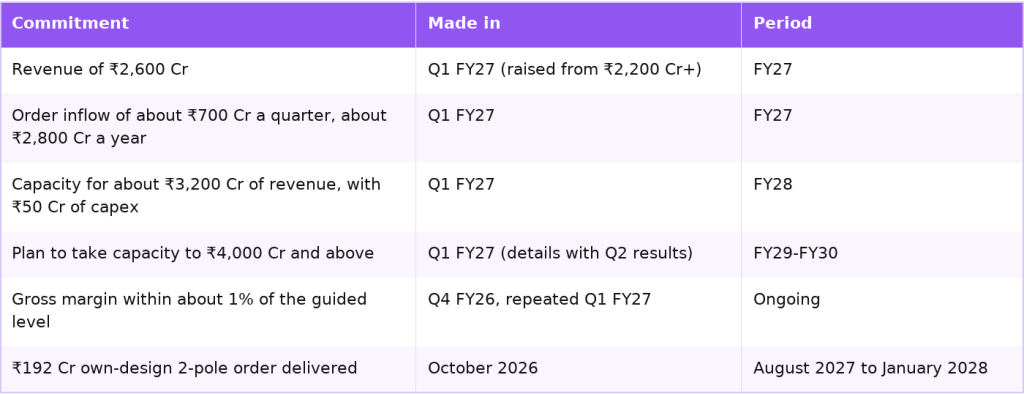
That plan comes with a record we can check, and it is a record of raising guidance and then beating it. For FY25, management first guided at least 17% growth, later about ₹1,250-1,275 Cr, and total income came in at ₹1,291.1 Cr. For FY26, it started at ₹1,500 Cr, raised it to ₹1,800 Cr, and delivered ₹1,869.5 Cr.
"Know what you own, and know why you own it."
— Peter Lynch
For TD Power, knowing why means tracking the quarterly order inflow, its export share and the receivables that come with faster growth.

Key Risks
No business grows in a straight line, so let's look at what could go wrong for TD Power.
- The data centre cycle: much of the growth comes from US data centres building their own power. If AI spending or project timelines change, engine and turbine makers could slow their orders.
- Few customers: a small number of global engine and turbine makers buy most of the output, so the loss or delay of one programme would matter.
- Working capital: receivables rose to about ₹785 Cr in June 2026 and inventory to about ₹569 Cr. Management says payment terms cannot be changed much without losing business, so funding needs may rise with growth.
- Execution: revenue has to grow about 39% in FY27, and capacity has to keep up. Debottlenecking, hiring and supplies all have to run on time.
- New, larger machines: large 2-pole generators take 18-20 months to build, and the own-design order is the company's first of its kind abroad.
- Trade and freight: almost all new orders are exports, so tariffs, freight costs and currency moves affect them.
- Dilution: the preferential issue and the share sale to large investors add new shares.
- Indian demand: management calls domestic demand subdued, growing about 10-12%, so the company leans even more on exports.
"You can't predict. You can prepare."
— Howard Marks
None of these risks can be timed in advance. What an investor can do is watch the few numbers below that will show early whether the plan is slipping.
Explore our Products
Research Framework

Emerging Titans
Combination of quantitative analysis, industry tailwinds, and management assessment - SPRINT investment philosophy

Tiny Titans
Heavy emphasis on scuttlebutt research, plant visits, and early on-ground signals
What to Track Next
If you follow TD Power, these are the signals that will show whether the plan is on track.
- Q2 FY27 results, due by mid-November 2026, and revenue against the ₹2,600 Cr target
- Order inflow staying near ₹700 Cr a quarter, and the export share of it
- Purchase orders under the Siemens Energy framework
- The capacity plan for FY29-FY30, promised with the Q2 results
- Receivables and inventory as the business grows
- The size of the share sale to large investors opened on 7 October 2026
Conclusion
Let's step back and put it all together. TD Power spent two decades building generators for turbine and engine makers, and the rush for power at US data centres has turned that into a fast-growing export business. Orders crossed ₹700 Cr in a quarter, 93% of them from abroad, and Siemens Energy has chosen it to build large generators for ten years.
So the next two years are about capacity and execution. The company has guided ₹2,600 Cr of revenue for FY27 and is building for about ₹3,200 Cr in FY28. If US power demand holds and the factories keep pace, TD Power could keep raising its targets as it has done for three years. If that demand cools, the orders that fill its plants today would slow. The cautious thread is cash: over five years, operating cash flow came to about half of profit, and receivables reached about ₹785 Cr in June 2026. The next few quarters, starting with the Q2 FY27 results and the first purchase orders under the Siemens Energy framework, will show which thread wins.
FAQs
What does TD Power Systems do?
+TD Power Systems is a Bengaluru company, set up in 1999 with technology from Toyo Denki of Japan, that makes AC generators for steam turbines, gas turbines, gas and diesel engines and hydro plants, along with industrial and traction motors. It had 8,375 generators and motors installed in 113 countries by June 2026.
Why do most of TD Power's orders now come from abroad?
+US data centres are building their own gas-engine and gas-turbine power plants instead of waiting for grid connections, and every engine or turbine needs a generator. In Q1 FY27, exports and deemed exports brought ₹683.6 Cr of TD Power's ₹734.1 Cr of new orders, or 93%.
What is the Siemens Energy agreement?
+On 13 August 2026, TD Power signed a 10-year build-to-print framework agreement with Siemens Energy, Inc. to make large 2-pole generators to Siemens Energy's designs. Each order will come as a separate purchase order, and management says revenue from such large machines would come in FY28 or later.
What is TD Power's revenue guidance?
+Management raised FY27 revenue guidance to ₹2,600 Cr, against ₹1,869.5 Cr of total income in FY26, and expects about ₹700 Cr of new orders a quarter. With about ₹50 Cr of debottlenecking, it expects capacity for about ₹3,200 Cr of revenue in FY28.
How strong is TD Power's balance sheet?
+At the end of June 2026, TD Power had cash and bank balances of about ₹240 Cr and borrowings of only ₹23.81 Cr, with equity of about ₹1,158 Cr. It also raised ₹75 Cr from its promoters in September 2026 and opened a share sale to large investors on 7 October 2026.
What are the main risks for TD Power?
+The main risks are a slowdown in US data centre power projects, dependence on a few global engine and turbine makers, rising receivables and inventory, execution of 39% growth in FY27, new and larger 2-pole machines, trade and freight costs, and dilution from new share issues.

High growth stock specialist, Value Educator
Shashank Mahajan is an equity research professional with over 12 years of experience in identifying high-potential SME and micro-cap stocks at an early stage. He follows a rigorous scuttlebutt research–driven approach, combining on-ground insights with deep financial analysis. Shashank specializes in uncovering under-researched and under-owned companies with strong management quality and long-term growth potential. Through disciplined research and early identification, he focuses on spotting tomorrow’s market leaders before they enter the mainstream investor radar.

Zen Technologies: Why Revenue Fell After Its Biggest Win

Data Patterns: India's Radar Designer and Its Waiting Orders
KSH International: The Wire Inside India's Transformers

Krishna Defence: The Steel Behind India's Warship Hulls

PNG Jewellers: A 194-Year-Old Name Goes National
Axiscades: From Services to Missile and Radar Electronics
Explore our Products
Research Framework
Emerging Titans
Combination of quantitative analysis, industry tailwinds, and management assessment - SPRINT investment philosophy
Tiny Titans
Heavy emphasis on scuttlebutt research, plant visits, and early on-ground signals


 Orders
 Subscription
 Share with friends
 Logout


Required Details
₹23999.00
(12 month subscription)
As per SEBI regulations, all users are mandated to complete the KYC that is validated for 1 year. Post payment, you will be redirected to the KYC screen


No comments yet. Be the first to comment!