
HBL Engineering: Defence Batteries, Fuzes and Kavach Orders

Every artillery shell, grenade, rocket and air-dropped bomb needs a small device that decides when it goes off. For decades India bought the core parts of that device from abroad. The two public sector makers of electronic fuzes for artillery, ECIL and BEL, used imported parts for about 80% of the bill of materials. So when a foreign supplier stops shipping, the ammunition line can stop with it.
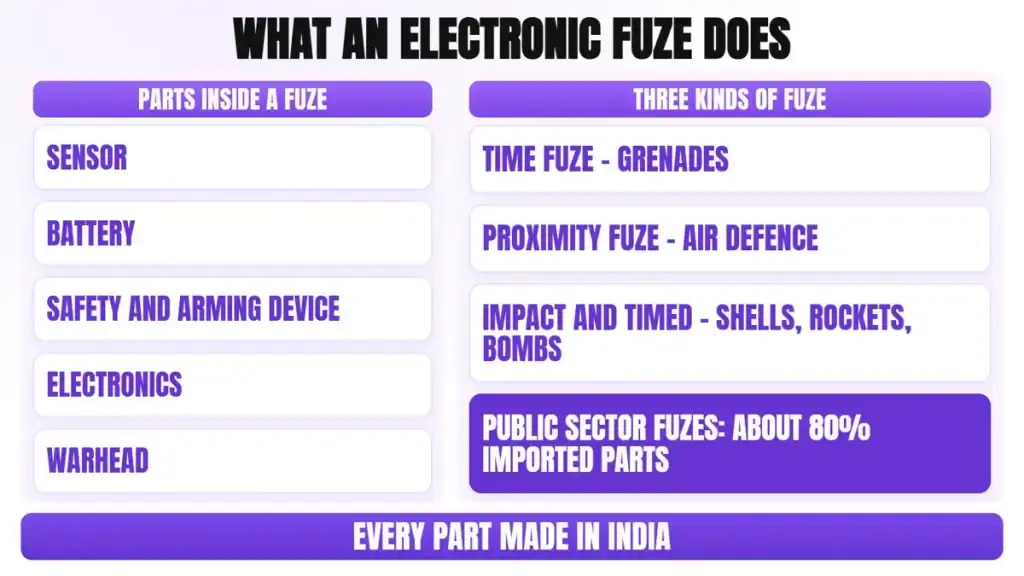
That small device is the electronic fuze, which simply means the trigger that sets off an explosive warhead at a preset moment, height or distance. That is why bullets do not need one, since they only pierce. But shells and bombs do, and the older mechanical fuzes are giving way to electronic ones where reliability and precision matter. The hardest fuze to make is a proximity fuze. It senses the target and fires as the shell passes close to it, which is why air-defence guns use it against aircraft and drones.
Making such a fuze in India means owning every part of it. That includes the sensor, the battery, the safety and arming device and the electronics. A company that buys even one of those parts from a foreign maker depends on that maker's export licence. So the buyer that cares most about this is the Ministry of Defence, which now gives a strong purchase preference to products made in India.
One Hyderabad company has spent twenty years building that kind of fuze from the inside out. HBL Engineering Ltd (NSE: HBLENGINE) began in 1977 by making batteries for defence aircraft, which India then imported. It still makes batteries for aircraft, missiles, torpedoes, submarines and battle tanks. Since 2006 it has developed every component of its electronic fuzes in-house, with no imported proprietary item. Its grenade fuzes are approved by the Ministry of Home Affairs and are already selling, and it expects Army approval during 2027.
Yet most investors know HBL for something else. Its railway electronics business makes Kavach, which is India's own automatic train protection system. Kavach watches a train's speed and the signals ahead, and it brakes the train itself if the driver does not. That business took HBL's revenue to ₹3,251.80 Cr in FY26. In the latest quarter, though, it was the defence side that grew fastest.
HBL Engineering in five numbers
- Q2 FY27 revenue of ₹862.94 Cr, with profit after tax of ₹178.46 Cr
- Defence and aviation batteries at ₹82.47 Cr in Q2 FY27, against ₹29.81 Cr a year ago
- An order book of about ₹5,902 Cr in September 2026, against ₹2,999 Cr in December 2025
- A ₹1,714 Cr Kavach order for locomotives, signed in May 2026 for delivery within 12 months
- Electronic fuze development since 2006, with Army approval for grenade fuzes expected in 2027
So a battery maker that became a Kavach company is now seeing its defence business grow. What changed in the latest quarter? Let's first understand the company, and then look at the quarter where the change first showed up.
HBL Engineering: Company Overview
HBL Engineering Ltd, earlier called HBL Power Systems, is based in Hyderabad and was founded in 1977 by Dr A J Prasad, who is still its Chairman and Managing Director. It reports three segments: industrial batteries, defence and aviation batteries, and electronics, which is mainly the Kavach train protection system. Its defence business supplies batteries for aircraft, missiles, torpedoes, submarines and armoured vehicles, and it has developed electronic fuzes with every component made in-house. The company runs five manufacturing facilities and a development centre in Telangana and Andhra Pradesh, and it had 2,455 employees in March 2026. The promoter group held about 59% of the shares. Revenue was ₹3,251.80 Cr in FY26, and the debt to equity ratio was 0.03. Read this Defence Electronics Stocks to Watch (2026)
"Behind every stock is a company. Find out what it's doing."
— Peter Lynch
HBL is often seen as a Kavach company, but it began as a defence battery maker and still runs nine business units. Knowing what each one does is the first step to reading its numbers.
The Quarter Defence Batteries Nearly Tripled
Let's look at Q2 FY27, the July to September quarter, which HBL reported on 7 November 2026. It was the quarter in which defence batteries nearly tripled, even though total revenue came in lower. Revenue was ₹862.94 Cr, against ₹1,203.16 Cr a year ago. That year-ago quarter was the peak of a large Kavach delivery for locomotives. So the drop in total revenue came from one segment, while the other two grew.

That table shows three businesses moving in three different ways. Defence and aviation batteries earned ₹82.47 Cr, about 2.8 times the year-ago figure. That is a big jump. Its segment result rose to ₹22.14 Cr from ₹1.45 Cr. Industrial batteries also grew about 11.1% to ₹411.62 Cr, while electronics, which is mostly Kavach, came in at ₹363.23 Cr against ₹793.58 Cr.

Those segment results also explain the margin. Our own EBITDA calculation gives about ₹227.1 Cr for the quarter, a margin of about 26.3%. Read this EBITDA Explained: Uses and Limits A year ago it was about 44.7%, when Kavach made up two-thirds of revenue. That gap is wide. Against the June quarter, though, the margin rose from about 22.4%. So the margin follows the Kavach mix, and the battery and defence businesses carry a steadier base below it.
That mix shows up in the cost lines as well, and you can see it in one number. Materials, after the change in inventory, took about 44.5% of revenue in Q2 FY27, against about 36.5% a year ago. Kavach work appears to use less bought-in material per rupee of revenue than batteries do. So a quarter with less Kavach and more batteries will always show a higher material share.
That quarter also improved on the one before it. Revenue rose about 39% over Q1 FY27, and profit after tax rose from ₹105.47 Cr to ₹178.46 Cr. One more item helped profit. HBL received ₹13.66 Cr from the Government of Telangana as compensation for land it had to give up, which it shows as an exceptional item.
All of these are standalone figures, which is how HBL reports its segments. The group accounts add three small subsidiaries, three associates and a joint venture. Consolidated revenue was ₹871.56 Cr in Q2 FY27, and profit was ₹192.75 Cr. That profit includes ₹7.24 Cr as HBL's share of its associates and joint venture.
Two of those associates are defence businesses too. Tonbo Imaging works in advanced imaging and Naval Systems and Technologies in naval technology, and HBL's exposure to all its associates was about ₹86.71 Cr in March 2026. Tonbo Imaging listed its shares on 23 October 2026, and HBL will show the effect on its investment from the next quarter.
The Orders Behind the ₹5,902 Cr Book
Now let's look at the orders, because they decide the next few quarters. HBL does not publish a full order book in its results. Its credit rating agency, CARE, puts it at about ₹5,902 Cr in September 2026, up from ₹2,999 Cr at the end of December 2025. Kavach and train management projects make up about ₹4,440 Cr of that, or about 75%.
That book nearly doubled in nine months, and the exchange filings show why. Since January 2026, HBL has announced seven Kavach orders for locomotives, all for version 4.0 of the system.
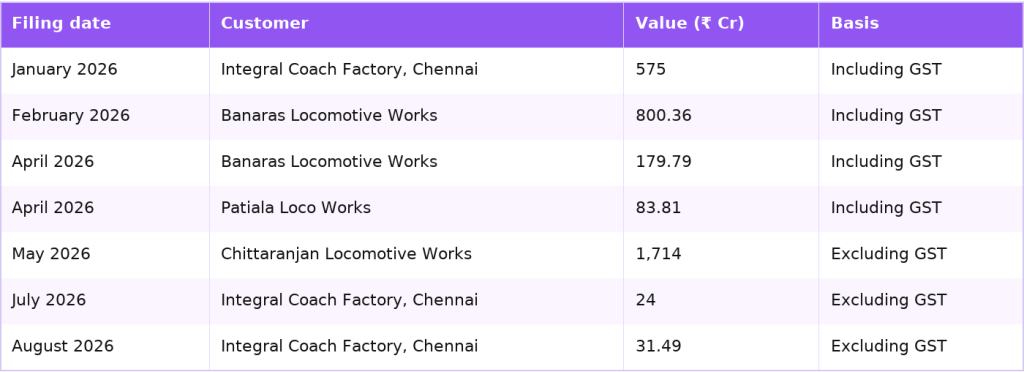
The largest of these, the ₹1,714 Cr order from Chittaranjan Locomotive Works, is due within 12 months of May 2026. Most of it is still to be delivered, which is why electronics revenue was modest in the first half. HBL also holds station and track orders from earlier years. For FY27, management planned to invoice ₹900 Cr of that station work, with ₹400 Cr more in FY28.
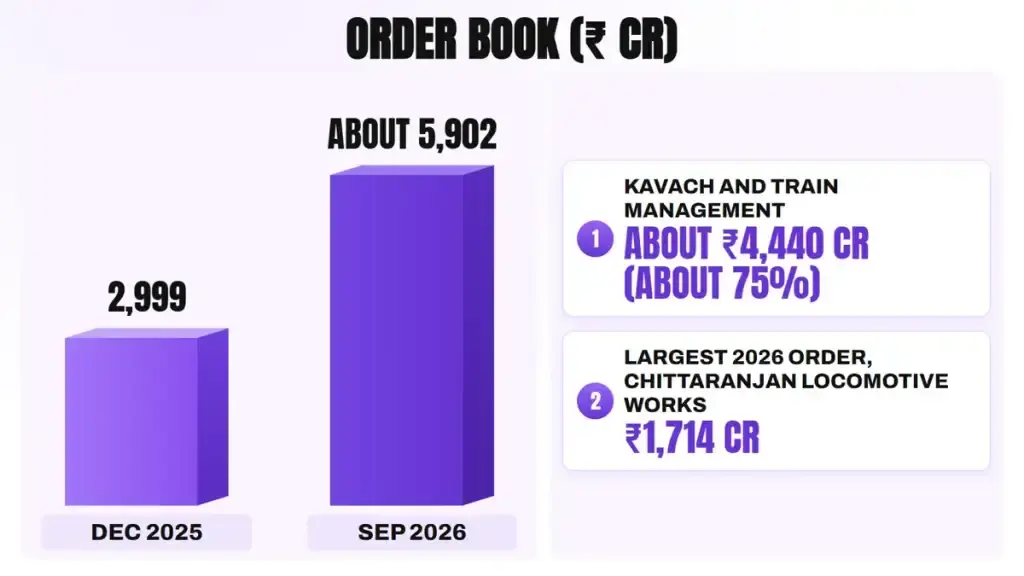
What the order book says: about ₹5,902 Cr is about 1.8 times FY26 revenue. Three-quarters of it is Kavach and train management work. That leaves about ₹1,462 Cr for batteries, defence and the rest, which turn over faster.
That order book sits on a strong balance sheet. Cash and cash equivalents were ₹224.62 Cr in September 2026, with another ₹321.83 Cr in current investments, while borrowings were only ₹28.65 Cr. So CARE reaffirmed its AA- rating with a stable outlook on 6 November 2026, after upgrading it in October.
How a Battery Maker Ended Up Building Kavach
Now that we have seen the quarter, let's go back and see how HBL got here. Dr A J Prasad founded the company in 1977 to make batteries for defence aircraft. His rule has stayed the same for almost fifty years, and it is simple to state: HBL looks for a technology gap, a product India imports or assembles with a foreign partner's parts, and fills it with its own R&D.
"We chose a niche for defense because the defence ministry has always been willing to pay a premium for quality products made in small volume as long as it is made in India." - Dr A J Prasad, Chairman and Managing Director, September 2025
The rule has a second half. HBL aims to be number one or two in a market of reasonable size, or number three in a large one, and it stays out of capital-heavy and consumer businesses. If it cannot reach that rank, it does not enter.
That rule explains the odd mix of products.
"The big money is not in the buying and selling, but in the waiting."
— Charlie Munger
HBL's own products show the same patience. Kavach took about 20 years to pay off, and the fuze work that began in 2006 is still waiting for its Army approvals. Kavach R&D began in 2005, with the active support of RDSO, the Railways' design body. It took 20 years to pay off. The fuze work began in 2006 and has not yet reached bulk sales, which fits what management says about its products taking about 15 years on average to go from idea to profit.
That patience shows clearly in the five-year numbers. In FY22 and FY23 revenue stayed between about ₹1,221 Cr and ₹1,350 Cr. Then Kavach orders arrived in waves, and FY26 revenue reached ₹3,251.80 Cr.
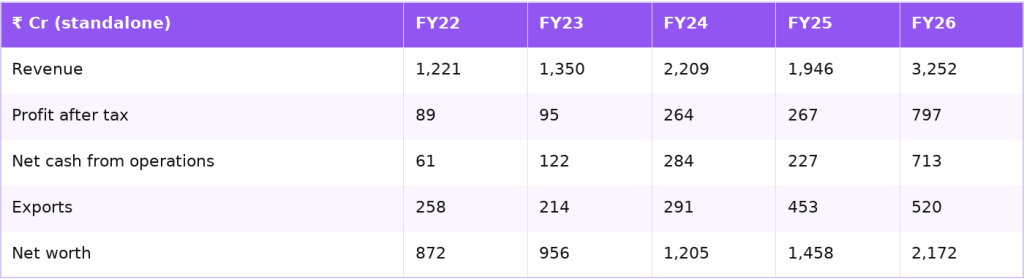
So revenue grew about 2.7 times in four years, and profit after tax about 9 times. We think one more line in that table deserves a second look. Over FY24 to FY26, cash from operations added up to about ₹1,224 Cr, against ₹1,328 Cr of profit after tax, so most of the profit came in as cash. Read this Cash Flow Statement Explained The jump in FY26 came almost entirely from electronics, whose revenue rose from ₹282.15 Cr in FY25 to ₹1,626.25 Cr. That FY25 dip is part of the record too. Kavach orders came later than expected, and HBL's version 4.0 certification arrived only in May 2025.
"The drought of Kavach orders has now become a flood." - Dr A J Prasad, Chairman and Managing Director, September 2025
That flood came with its own lesson, and it shows how this business works. In December 2024 HBL won a ₹1,522.40 Cr order to fit Kavach on 2,200 locomotives within 12 months. It got its version 4.0 approval only in May 2025. By the delivery deadline of 13 December 2025 it had installed 1,659 units, or 75.4%, and the other 541 units were cancelled under the order's terms. The orders signed in 2026 replaced that work.

Three Segments and the Defence Business Inside Them
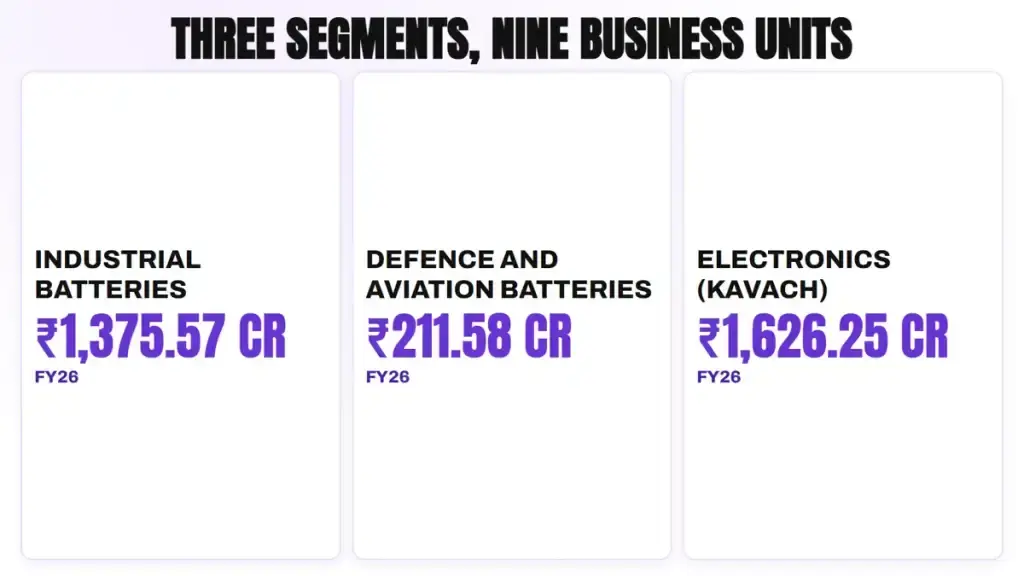
Now let's split HBL into the three segments it reports. Read this Segment-Wise Revenue Analysis Explained Each segment holds several business units. In all, the company counts nine units, from lead batteries to train management software.
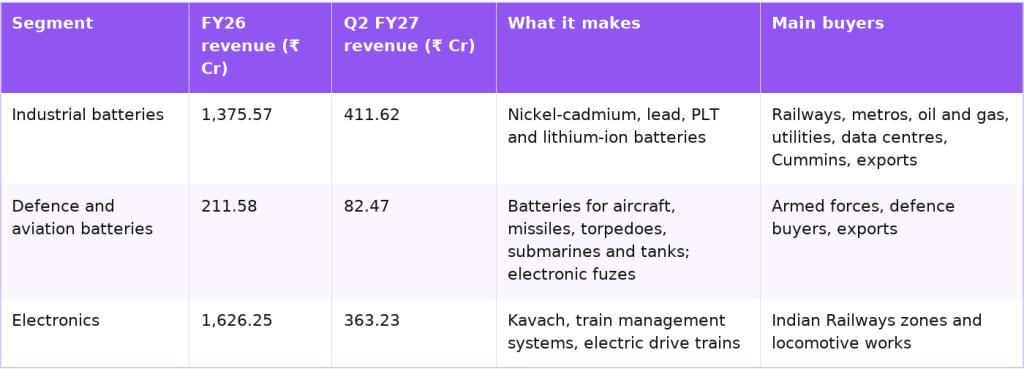
These segments sound alike, so let's tell them apart. Industrial batteries are sold to companies that need backup power, such as a refinery or a data centre. Defence batteries are built to military standards for a single weapon or platform, and they are replaced at regular intervals. Electronics is a different business altogether, because it sells complete systems to the Railways under tenders rather than parts or batteries to many buyers.
Defence and Aviation Batteries
Let's start with the segment that grew fastest. India's defence buyers now favour products made at home, and batteries are a recurring item. A submarine, a torpedo or an aircraft needs new batteries at fixed intervals. So while demand for any single battery is uneven from year to year, the total tends to rise.
HBL has made these batteries since its first product. Today it supplies batteries for all types of aircraft, missiles, armoured vehicles, torpedo propulsion and submarine propulsion. In each of them the buyer keeps a second source, but HBL calls itself the leading supplier. It also makes its own lithium cells for defence, under technology licensed from NSTL, a DRDO laboratory. It has invested about ₹200 Cr in that R&D and a modern production plant.
That work shows in the segment's numbers, though they move a lot from quarter to quarter. In FY26 the segment earned ₹211.58 Cr, and about ₹101.16 Cr of that, close to half, came from exports. Then in the September quarter it earned ₹82.47 Cr, its largest quarter in the last six.
Those exports are the part that has grown fastest. Defence and aviation exports were about ₹39.2 Cr in FY24, then ₹87.24 Cr in FY25 and ₹101.16 Cr in FY26. So foreign buyers now take almost as much as Indian ones. That spreads the segment across more defence budgets than India's alone.
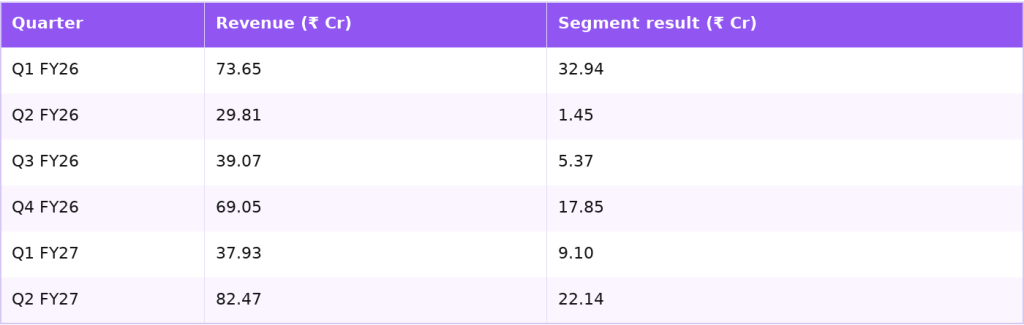
If you look only at the yearly numbers, you would miss this. Yearly revenue went from ₹227.22 Cr in FY25 to ₹211.58 Cr in FY26, so defence looked flat on a full-year view. The half-year tells us more, with ₹120.40 Cr against ₹103.46 Cr, and the September quarter alone brought more than two-thirds of it.
That table shows a lumpy business with a rising base. The segment result margin was about 26.8% in Q2 FY27, against about 4.9% a year ago. The segment's assets also rose to ₹527.55 Cr in September 2026, from ₹427.74 Cr in March.

The segment also holds a few rare products. HBL says it is the only supplier in India of voice and data communication systems for battle tanks and armoured personnel carriers. It built the platform management and steering systems for the Scorpene submarines to the customer's design. It is also doing R&D on sonar-based underwater electronics, with sales possible from FY28. Torpedo motor prototypes are due in FY27, and management expects sales from FY28.
Electronic Fuzes
Now let's turn to the fuzes, which sit inside the same segment. Their market is every explosive device the forces use. That includes grenades, artillery shells, rockets, missiles and bombs dropped from aircraft. Mechanical fuzes still serve much of that market, and the electronic fuzes from India's public sector makers have relied on imported core parts.
So HBL started on this problem in 2006. As the chairman tells it, the Army had decided around 1975 that its mechanical fuzes were no longer good enough, and it turned to imports. To him that was exactly the kind of gap HBL looks for. It chose to make every component itself, including the battery, the detonator and the safety device. It has since built fuzes for grenades, for artillery shells fired from 155 mm guns, for rockets launched by the Navy from ships, and proximity fuzes for air defence. A licensed plant for making fuzes is ready in Telangana.
Its first buyer came through the Home Ministry. HBL developed its grenade fuzes for the paramilitary forces as a development-cum-production partner of ARDE, a DRDO laboratory. HBL also holds the facilities and licences needed to handle explosive materials.
But a fuze cannot be sold until it passes trials on real weapons at declared firing ranges. The availability of those weapons and ranges sets the pace, which is why approval dates are hard to predict. So far, HBL's grenade fuzes are approved by the Ministry of Home Affairs, and sales have started. The company expects Army approval for grenade fuzes, and approval for 155 mm shell fuzes, during 2027. Several other types are waiting in line.
The pull from fuze buyers has grown fastest in air defence. In September 2025 the chairman told shareholders that the Army's air-defence wing came looking for HBL after a foreign supplier stopped shipping its fuze. He also said he would use the next year to ramp up production safely, which is why he expects fuze sales to build from FY28.
That approval date has moved before, and we show the full record in the guidance section. What management has said consistently is how large fuzes could be. A year ago it said fuzes would be its second-largest business by FY30. Now it names fuzes as one of the four units that will add most to sales over the next four years.
Electronics and Kavach
Next, let's look at the segment that made HBL's last two years. Kavach is being fitted across the Indian Railways network, and by July 2026 it was installed on over 6,000 locomotives, with another 7,300 or so under way. Beyond the locomotives, track-side work had been taken up across over 21,800 route km. Yet only a few suppliers hold RDSO approval to supply and install it.
Those few approved suppliers include HBL, which was the pioneer of Kavach and developed it with RDSO's support. It was the first supplier to receive version 4.0 approval, in May 2025. The system has two halves. One is the equipment on the locomotive, and the other is the station and track equipment that talks to it. HBL sells both.
Both halves together gave the segment its biggest year in FY26, when it earned ₹1,626.25 Cr with a segment result of ₹818.49 Cr. That is a result margin of about 50.3%. In H1 FY27 it earned ₹590.54 Cr, as the large locomotive orders of 2026 moved into production. Management expects Kavach sales of at least ₹1,900 Cr in FY27, made up of about ₹1,000 Cr from locomotives and ₹900 Cr from stations.
That estimate came after a setback in the tender for 6,300 locomotive units in January 2026, where other bidders quoted lower prices and HBL won nothing. The demand management saw for the next year fell from 18,429 units to 12,129. The 2026 orders from four locomotive works came after that tender, through separate contracts.
The same segment holds two newer businesses. HBL's train management systems control train movements from a central room. Less than 2% of the network uses one today, and HBL has installed four of these systems. Its competitors here are foreign companies. Still, the chairman does not expect another Kavach from it, and he puts the likely orders at ₹100-300 Cr a year. Its electric drive trains for 55-tonne trucks have run about 40,000 km in road trials, with pilot sales expected from July 2027.
Industrial Batteries
Now let's look at the oldest and steadiest part of HBL. Demand for nickel-cadmium batteries in India is coming from new refinery and power plant capacity, oil and gas pipelines and the growth of metro rail. Data centres are adding a second source of demand, because they need backup batteries that start instantly.
HBL is the world's second-largest supplier of industrial nickel-cadmium batteries. It is also the only maker of pure lead thin plate, or PLT, batteries in India. In FY26 its data-centre sales doubled, with orders from STT, NTT, Colt, CapitaLand, Digital Edge, Reliance and CtrlS. It is now doubling its PLT capacity. It has also supplied PLT batteries to Cummins India for about two decades, for Cummins' diesel generator sets.
Its sales reached ₹1,375.57 Cr in FY26, and Q2 FY27 set a six-quarter high for the segment. Within India, the Railways need nickel-cadmium batteries for the pantographs of electric locomotives, and management expects that demand to stay strong for the next five years. In UPS batteries, a market growing about 6% a year, HBL holds third place. Exports of nickel-cadmium batteries grew about 15% in FY26. Siemens of Germany has chosen HBL as one of its two suppliers for developing lithium-ion batteries for its trains. HBL also has large orders for lithium-ion batteries for Vande Bharat trains.
That overlap with defence is useful to see. HBL's PLT batteries also go into battle tanks, armoured vehicles and artillery guns, in India and abroad. So the same PLT plant at Nandigaon, near Hyderabad, serves both data centres and armoured vehicles.
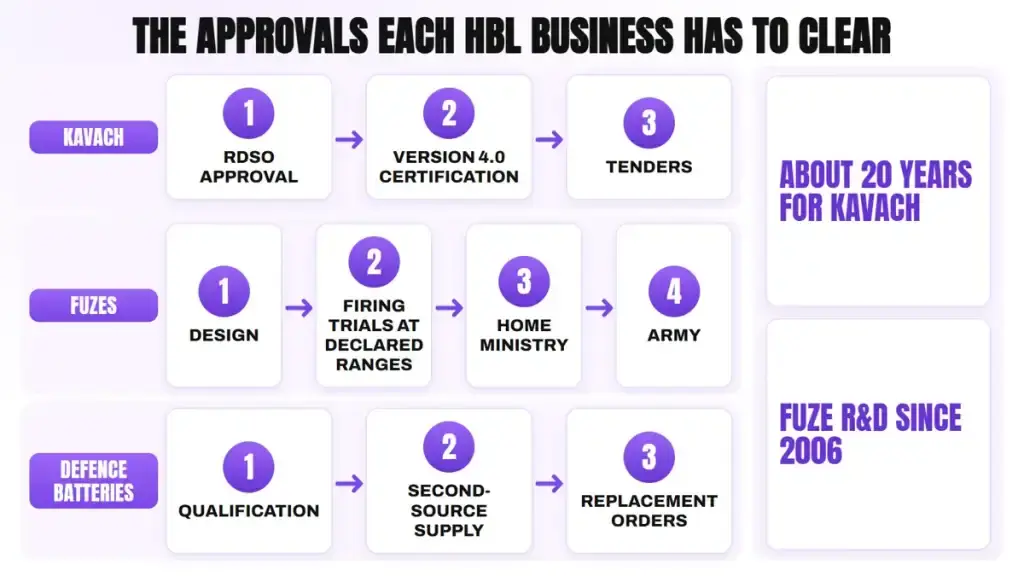
Why HBL's Approvals Are Hard to Copy
Now that we have seen all three segments, let's understand HBL's moat. Read this Economic Moat Explained In each of its businesses the buyer is a government body or a large operator that cannot afford a failure. A train that does not brake, a fuze that fires late or a submarine battery that fails can cost lives. So the buyer approves a supplier only after long trials, and then keeps buying from it.
Those trials take years to clear, and Kavach alone took about 20 years from the first R&D to large orders. Fuzes have been in development since 2006, and their approvals still wait on firing trials. A new entrant would have to repeat that work, and it would also have to make the parts at home. Defence buyers want those parts made in India, which rules out importing a kit and assembling it.
That trial cost is the first layer. The second layer is HBL's practice of building its own production equipment. Because it designs both the product and the machines that make it, it can start profitably at small volumes. That matters in defence, where each battery or fuze type sells in small numbers. HBL says this lowers its capital cost and makes niche products pay.
Beyond India there is a third layer, the global nickel-cadmium position we saw earlier. HBL exports to more than 50 markets, and its exports were ₹520 Cr in FY26. Customers in oil and gas or utilities rarely switch a battery that already works.
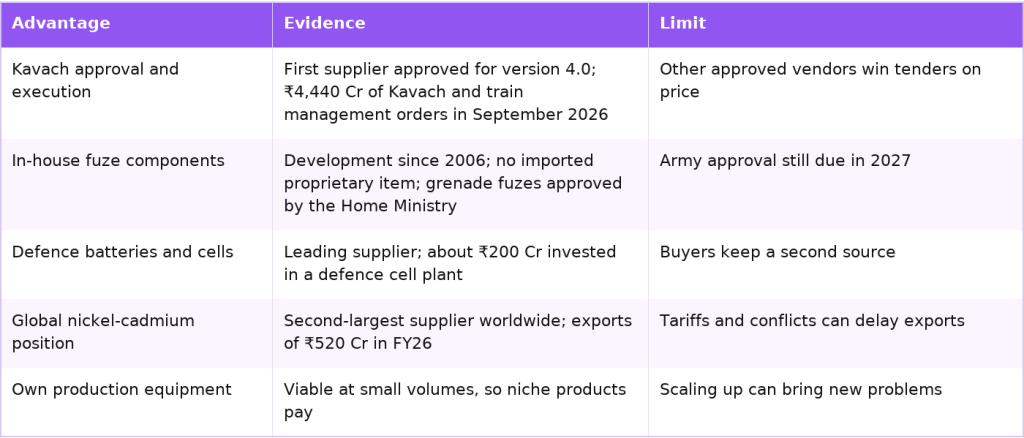
So when you weigh HBL against a new rival, ask one question. How many years of trials would that rival need? For Kavach the answer was about two decades, and for fuzes the clock has been running since 2006.
That table also shows where the moat is thinnest. Kavach is the largest business, yet it is the one where competitors are already approved. The defence and fuze businesses are smaller, but they are the hardest to copy. That is why the defence numbers matter more than their size suggests.
"The key to investing is not assessing how much an industry is going to affect society, or how much it will grow, but rather determining the competitive advantage of any given company and, above all, the durability of that advantage."
— Warren Buffett
For HBL, the most durable advantages sit in its smaller defence and fuze businesses, while Kavach, its largest business, already faces approved competitors.
Financials: Five Years of Revenue, Profit and Cash
HBL's results swing with Kavach deliveries, so let's look at five full years together. These are the company's own standalone figures, rounded to the nearest crore.
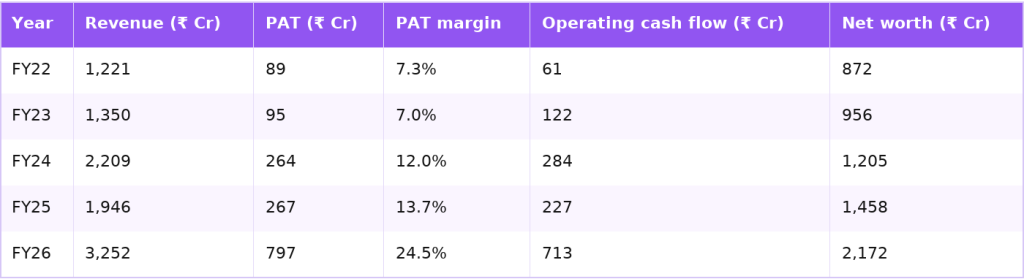
Revenue grew about 2.7 times between FY22 and FY26, and profit after tax grew much faster as Kavach, with a segment result margin of about 50.3% in FY26, became half of revenue. The profit margin rose from about 7.3% in FY22 to about 24.5% in FY26.
Cash has broadly kept up with profit. Over FY24 to FY26, operating cash flow added up to about ₹1,224 Cr against ₹1,328 Cr of profit after tax. In H1 FY27, though, operating cash flow was negative ₹31.80 Cr as inventories rose to ₹893.77 Cr.
The balance sheet carries very little debt. Borrowings were ₹28.65 Cr in September 2026, against cash and cash equivalents of ₹224.62 Cr and current investments of ₹321.83 Cr, and net worth has grown every year in the table.
"Beware of little expenses; a small leak will sink a great ship."
— Benjamin Franklin
For HBL the leak to watch is working capital. Stock built for large Kavach orders ties up cash until the locomotives are fitted and the Railways pay.
What FY27 and FY28 Could Look Like on Management's Numbers
So where does HBL go from here? You will not find a results briefing to answer that, because management does not hold one. Instead it writes notes to shareholders and sets out its outlook in the annual report. In May 2026 it said FY27 sales and profit would be significantly better than FY26, with variation from quarter to quarter.
So let's put that promise against the first half. FY26 revenue was ₹3,251.80 Cr, and H1 FY27 revenue was ₹1,482.48 Cr. So beating FY26 needs H2 revenue of more than about ₹1,769 Cr, about 1.19 times the first half. The order book supports that path. The ₹1,714 Cr locomotive order is due for completion within 12 months of May 2026, and ₹900 Cr of station work was planned for FY27.
That climb falls mostly on electronics. In H1 FY27 the segment earned ₹590.54 Cr, so reaching the Kavach estimate of at least ₹1,900 Cr would need about ₹1,309 Cr more in the second half.
That climb also needs plant and cash. Capital work in progress rose to ₹154.44 Cr in September 2026, from ₹127.48 Cr in March, and the rating agency lists the projects behind it: a lithium-ion battery division, infrastructure for electronic fuzes, charging hubs and IT systems. It expects HBL to pay for all of them from its own cash.
Beyond FY27, management gives a scenario rather than a forecast. It says the current businesses should together achieve more than ₹5,000 Cr of sales in FY30. A year earlier the same scenario was ₹4,500 Cr. This time, Kavach, nickel-cadmium batteries, electronic fuzes and truck drive trains are the four units it expects to add the most.

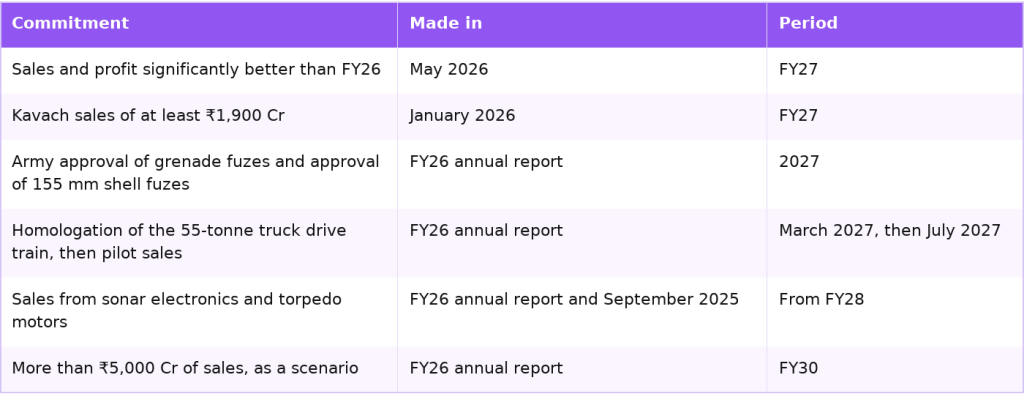
Those commitments are easier to judge against the past. So let's check what management said before against what it delivered.
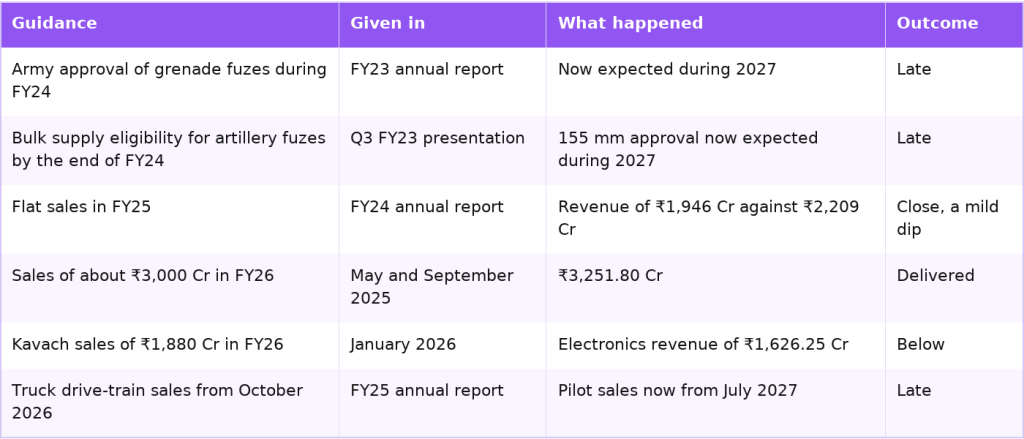
That record is mixed, as you can see. When orders were in hand, management delivered on revenue and even beat it. But dates that depend on outside approvals, such as fuze trials and truck homologation, have slipped more than once.
Key Risks
Now let's look at what could go wrong for HBL Engineering, because some of it has already shown up this year.
- Kavach dependence: electronics brought in about half of FY26 revenue and ₹818.49 Cr of the ₹1,130.89 Cr total segment result. When Kavach deliveries fell between big orders, H1 FY27 revenue dropped about 17.2%, to ₹1,482.48 Cr.
- Kavach competition: HBL won nothing in the 6,300-unit tender of January 2026 because rivals quoted lower prices. Management itself expects Kavach sales and profit could decline from FY29 as competition grows.
- Cancellations and delays: locomotive contracts are time-bound. In December 2025, 541 of 2,200 units were cancelled when the deadline passed, and installation depends on when railway sheds release locomotives.
- Cash flow: operating cash flow was negative ₹31.80 Cr in H1 FY27. Inventories rose to ₹893.77 Cr in September 2026 from ₹550.74 Cr in March, so more cash is tied up in stock until the locomotive orders are delivered.
- Fuze approvals: Army approval has moved from FY24 to 2027. The chairman also calls ammunition fuzes the least profitable fuze business, because they are bought in large volumes.
- Lumpy defence revenue: defence revenue swung between ₹29.81 Cr and ₹82.47 Cr a quarter over the last six quarters. Buyers also keep a second source for every battery.
- Telecom batteries and inputs: telecom operators are moving to lithium-ion, which leaves spare capacity and pressure on lead battery prices. Lead, nickel and cadmium prices can move margins.
- Promoter pay and succession: the chairman's commission on profits rose to ₹56.02 Cr in FY26 from ₹18.95 Cr. The founder still guides all nine units, and a plan to run each unit separately is still being built.
- Tax disputes: excise duty claims of ₹24.73 Cr, for years from 2008-09 to 2017-18, are pending before CESTAT in Hyderabad. HBL does not accept them as debts, so they are not provided for.
"Ironically, the ammunition fuses are the least profitable of these businesses because they're bought in large volume." - Dr A J Prasad, Chairman and Managing Director, September 2025
"Experience is what you got when you didn't get what you wanted."
— Howard Marks
HBL has already had that experience in Kavach, when it won nothing in a large tender, and in fuzes, where approvals have taken years longer than it expected.
Explore our Products
Research Framework

Emerging Titans
Combination of quantitative analysis, industry tailwinds, and management assessment - SPRINT investment philosophy

Tiny Titans
Heavy emphasis on scuttlebutt research, plant visits, and early on-ground signals
What to Track Next
If you follow HBL Engineering, these are the signals that will show where it goes next.
- H2 FY27 revenue against the roughly ₹1,769 Cr needed to beat FY26
- Delivery of the ₹1,714 Cr locomotive order before May 2027, and electronics revenue against the ₹1,900 Cr Kavach estimate
- Army approval of grenade fuzes and approval of 155 mm shell fuzes during 2027
- Defence and aviation revenue after ₹82.47 Cr in Q2 FY27
- New Kavach tenders, and the order book after about ₹5,902 Cr
- Operating cash flow and inventory after ₹893.77 Cr
Conclusion
Let's put it all together. HBL Engineering is best known for Kavach, which took FY26 revenue to ₹3,251.80 Cr. In Q2 FY27, though, Kavach revenue was between big deliveries, while defence batteries and industrial batteries both grew. Behind them sits an order book of about ₹5,902 Cr. The cautious thread is concentration: Kavach still earns most of the profit, competitors have already won tenders on price, and operating cash flow was negative in the first half. The next two quarters, and the fuze trials of 2027, will show which thread is stronger.
The defence side is still small, at about 6.5% of FY26 revenue. But it is the part of HBL that took longest to build and is hardest to copy. What happens next depends on whether the 2026 Kavach orders turn into revenue by May 2027, and whether the fuze approvals finally arrive in 2027.
FAQs
What does HBL Engineering do?
+HBL Engineering makes industrial batteries, batteries for defence aircraft, missiles, torpedoes, submarines and tanks, electronic fuzes, and the Kavach train protection system for Indian Railways. FY26 revenue was ₹3,251.80 Cr, of which electronics, mainly Kavach, earned ₹1,626.25 Cr.
How did HBL Engineering do in Q2 FY27?
+Standalone revenue was ₹862.94 Cr against ₹1,203.16 Cr a year ago, and profit after tax was ₹178.46 Cr. Defence and aviation batteries rose to ₹82.47 Cr from ₹29.81 Cr and industrial batteries grew about 11.1%, while electronics came in at ₹363.23 Cr against ₹793.58 Cr.
What is HBL Engineering's order book?
+The order book was about ₹5,902 Cr in September 2026, up from ₹2,999 Cr in December 2025. Kavach and train management projects made up about ₹4,440 Cr of it. The largest recent order is a ₹1,714 Cr Kavach order from Chittaranjan Locomotive Works, due within 12 months of May 2026.
What are HBL Engineering's electronic fuzes?
+An electronic fuze is the trigger that sets off a shell, grenade or bomb at a preset moment or distance. HBL has developed every fuze component in-house since 2006. Its grenade fuzes are approved by the Ministry of Home Affairs and selling, and it expects Army approval for grenade fuzes and approval for 155 mm shell fuzes during 2027.
How large is HBL Engineering's defence business?
+The defence and aviation batteries segment earned ₹211.58 Cr in FY26, about 6.5% of revenue, and about ₹101.16 Cr of that came from exports. In H1 FY27 it earned ₹120.40 Cr against ₹103.46 Cr a year earlier.
What could go wrong for HBL Engineering?
+Kavach earns most of the profit, and HBL won nothing in a 6,300-unit locomotive tender in January 2026 because rivals quoted lower prices. Locomotive contracts are time-bound, and 541 of 2,200 units were cancelled in December 2025. Operating cash flow was negative ₹31.80 Cr in H1 FY27, and fuze approvals have moved from FY24 to 2027.

High growth stock specialist, Value Educator
Shashank Mahajan is an equity research professional with over 12 years of experience in identifying high-potential SME and micro-cap stocks at an early stage. He follows a rigorous scuttlebutt research–driven approach, combining on-ground insights with deep financial analysis. Shashank specializes in uncovering under-researched and under-owned companies with strong management quality and long-term growth potential. Through disciplined research and early identification, he focuses on spotting tomorrow’s market leaders before they enter the mainstream investor radar.

Jyoti CNC: The 5-Axis Machines Behind India's Aircraft Parts

INOX India: The Rocket Order Behind a ₹2,268 Cr Book

APAR Industries: Google, Amazon and ₹12,025 Cr of Orders

Techno Electric: ₹11,000 Cr of Grid Orders and Data Centres

Sansera Engineering: Aircraft and Chip Parts Hit 14.9%

PTC Industries: The Titanium Melt Shop Behind Aerolloy
Explore our Products
Research Framework
Emerging Titans
Combination of quantitative analysis, industry tailwinds, and management assessment - SPRINT investment philosophy
Tiny Titans
Heavy emphasis on scuttlebutt research, plant visits, and early on-ground signals



Modern Warfare to Multibaggers
Key Trends. Strategic Shifts. Opportunities Ahead.
Don't Miss This Exclusive Webinar!
Join Value Educator to decode the key trends shaping India's defence sector and learn how to identify tomorrow's potential leaders in the space.
- In-depth research on India's defence sector
- Live Q&A session
- Actionable takeaways for long-term investors

 Orders
 Subscription
 Share with friends


Required Details
₹23999.00
(12 month subscription)
As per SEBI regulations, all users are mandated to complete the KYC that is validated for 1 year. Post payment, you will be redirected to the KYC screen


No comments yet. Be the first to comment!