Why ₹4 Lakh Crore Sudarshan Chakra Project Changes Everything for BEL, Data Patterns & Astra Microwave
The Project That Rewrites India’s Defence Playbook
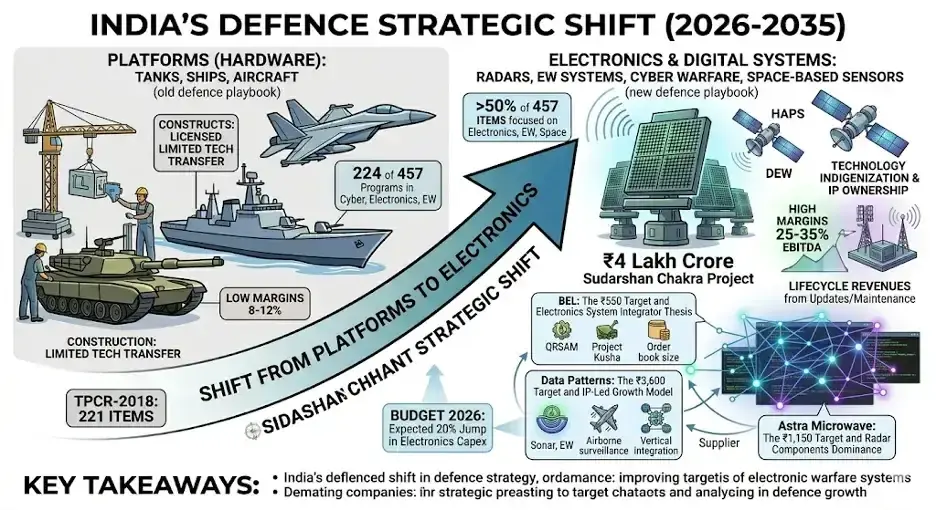
September 17, 2025. InCred Equities released a research report that most investors skimmed past without understanding its significance. Buried in the analysis was a single data point that should have made every defence stock investor sit up — the TPCR-2025 (Technology Perspective and Capability Roadmap) lists 457 items compared to just 221 in TPCR-2018. More striking, over 50% of these 457 items are now focused on electronics, electronic warfare, and space systems. Nearly half of all programs — 224 out of 457 — are in cyber systems, electronics, and EW. This isn’t incremental change. This is a complete strategic shift from platforms (tanks, ships, aircraft) to electronics (radars, EW systems, cyber warfare, networked sensors).
Alongside TPCR-2025 came the Sudarshan Chakra project — scheduled for completion by 2035 and requiring at least ₹4 lakh crore in investment across air defence systems, radars, High Altitude Pseudo Satellites (HAPS), directed-energy weapons (DEW), and space-based sensors. For context, India’s entire defence capital outlay in Budget 2026 is expected to be around ₹1.7-1.8 lakh crore. Sudarshan Chakra alone is budgeted at over double that amount, spread across 10 years. This is the largest single defence modernization initiative in Indian history, and it’s laser-focused on electronics and digital systems rather than conventional hardware.
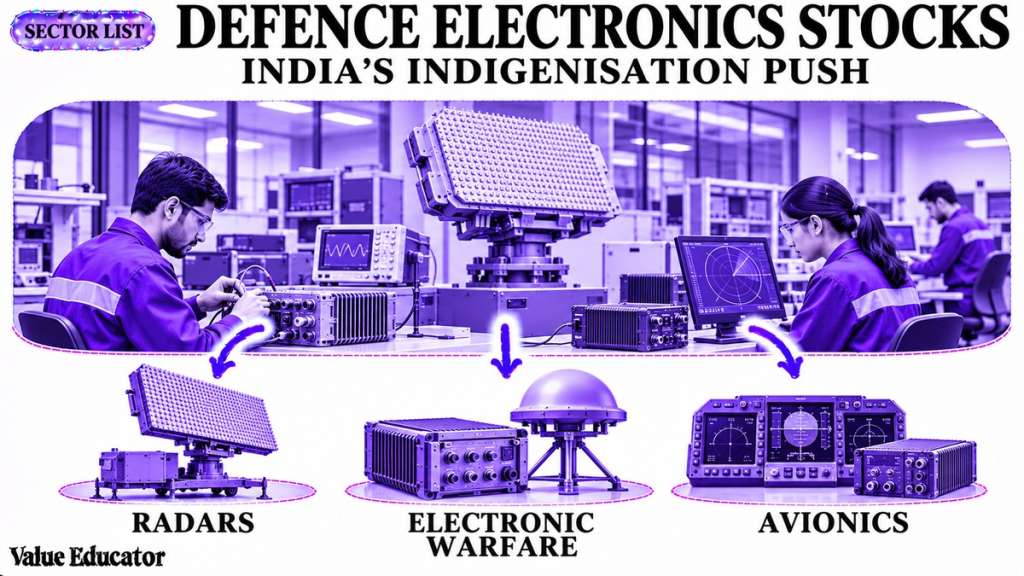
This is the conversation that reveals why defence electronics stocks like BEL, Data Patterns, and Astra Microwave aren’t just “good defence plays” — they’re positioned at the epicenter of a ₹4 lakh crore decade-long spending tsunami that fundamentally changes how India builds military capability. The old defence playbook was buying platforms from Russia, France, and Israel and assembling them locally with limited tech transfer. The new playbook is indigenizing the electronics — radars, EW suites, avionics, command systems — because that’s where wars are won in 2026 and beyond.
What makes this shift so important for investors is the margin profile and IP ownership differential. A company building airframes or ship hulls under licensed production earns 8-12% EBITDA margins because it’s essentially contract manufacturing with commoditized labor and materials. A company designing and manufacturing electronic warfare systems, radar signal processors, or satellite communication modules earns 25-35% EBITDA margins because it owns the IP, controls the supply chain, and faces minimal competition once selected. BEL’s current EBITDA margin runs at 20-22%. Data Patterns delivers 25-28% EBITDA margin. Astra Microwave runs at 28-30% EBITDA. These aren’t infrastructure contractors — they’re technology companies operating in defence.
If you’ve ever owned defence stocks and wondered why some deliver 40% annual returns while others in the “same sector” barely move 10%, this structural shift toward electronics explains everything. If you’re trying to decide which defence stocks to buy in 2026 and feel overwhelmed by dozens of names, understanding the TPCR-2025 electronics focus and Sudarshan Chakra’s ₹4 lakh crore budget gives you the filtering lens. And if you thought defence sector growth was all about geopolitical tensions and defence budget increases, you’re missing the bigger story — it’s about technology indigenization creating permanent market share gains for Indian companies in the highest-margin segments of the defence value chain.
When 224 out of 457 defence programs are electronics-focused and ₹4 lakh crore is allocated to electronic warfare and radars, you don’t bet on ship builders. You bet on the companies making the brains of those ships.

1. BEL: The ₹550 Target and Electronics System Integrator Thesis
From Supplier to System-Level Leader
Bharat Electronics Limited is India’s largest defence electronics company, and the shift from component supplier to system-level integrator is the entire investment case. Choice Broking’s February 2026 report lays out why BEL trades at ₹440-450 levels but deserves a ₹550 target price — a 22-25% upside. The company’s management guided for ₹27,000 crore order inflows in FY26, which Choice calls “conservatively framed” given that multiple large programs are now in advanced stages. The near-term optionality comes from Network for Spectrum (NGC) orders worth ₹3,000-5,000 crore expected in Q4 FY26, with another ₹10,000-12,000 crore spillover into H1 FY27. Add to this the LCA Tejas electronics orders worth ₹2,400 crore and electronic warfare programs like Satrugat and Samagat where trial resolution has materially improved, and you have visibility into ₹40,000+ crore of potential order inflows over the next 12-18 months.
The strategic shift Choice Broking highlights is critical for understanding BEL’s valuation re-rating potential. BEL is no longer just supplying radars or communication systems as components that get integrated by HAL or shipyards. The company is now taking leadership roles in programs like QRSAM (Quick Reaction Surface-to-Air Missile) and Project Kusha (long-range air defence system), where it’s the system integrator responsible for radar, command and control, missile guidance, and network integration.
This role increases execution stickiness because once BEL designs the system architecture, swapping them out mid-program is prohibitively expensive. It also increases pricing power — as the system integrator, BEL negotiates with the Ministry of Defence on overall system cost, not just component pricing. Most importantly, it generates lifecycle revenues from upgrades, maintenance, and technology insertion over 20-30 year platform lifecycles.
The indigenization level metric is what separates BEL from competitors. Current indigenization stands at approximately 70-75%, and the company is proactively redesigning semiconductor components to reduce dependence on imported chips. This supply chain de-risking is crucial given global chip shortages and geopolitical tensions. When TPCR-2025 emphasizes indigenization, BEL is already ahead of the curve with domestic design and manufacturing capability that takes competitors years to build. The margin protection this provides is significant — during 2021-2022 chip shortages, companies dependent on imported electronics faced 6-12 month delays and margin compression. BEL’s increasing indigenization buffered it from these disruptions and will continue protecting margins even if global supply chains face future shocks.
For investors evaluating the ₹550 target, the key is understanding BEL’s order book trajectory and EBITDA margin sustainability. The current order book stands at roughly ₹70,000+ crore providing 3+ years of revenue visibility. If the ₹27,000 crore FY26 order inflow guidance is indeed conservative and actual inflows hit ₹35,000-40,000 crore with NGC and Tejas programs, the order book expands to ₹80,000-85,000 crore by FY27.
With EBITDA margins holding at 20-22%, revenue growth of 12-15% annually, and the shift to system integrator roles commanding premium valuations, BEL deserves to trade at 30-35x P/E versus the current 28-30x. That alone gets you to ₹520-550 range. The downside risk is minimal — BEL has government ownership providing order book stability, and the company’s position as the default electronics partner for all major defence programs means revenue is sticky even if growth slows.
“In business, I look for economic castles protected by unbreachable moats. BEL’s moat is system integration capability that takes a decade to build.”
— Warren Buffett (adapted)
Like this analysis? Get powerful insights like this every week. No spam.
2. Data Patterns: The ₹3,600 Target and IP-Led Growth Model
Quality Over Scale in Electronics
Data Patterns trades around ₹2,700-2,800 levels in early 2026, but Choice Broking assigns a ₹3,600 target — implying 28-33% upside. What justifies this premium valuation for a company that’s far smaller than BEL or HAL? The answer lies in Data Patterns’ IP-led, system-centric growth strategy that consciously prioritizes earnings quality and long-cycle scale over near-term revenue acceleration. Unlike companies chasing every available tender to maximize topline growth, Data Patterns focuses on programs where it can deliver proprietary technology and command pricing power. This approach results in EBITDA margins of 25-28% versus the 15-18% typical of defence contractors focused purely on manufacturing.
The company’s core strength is radar and electronic warfare systems where it owns the underlying IP. Data Patterns doesn’t license technology from foreign OEMs and manufacture under transfer-of-technology agreements. It designs radar signal processors, electronic warfare receivers, and sonobuoy systems in-house using its own R&D. When the Navy needs a sonobuoy for anti-submarine warfare, Data Patterns doesn’t just assemble imported components — it designs the entire system from acoustic sensors to signal processing algorithms to data transmission protocols. This level of vertical integration in technology-intensive products creates two moats: first, import substitution is real because no foreign supplier is willing to transfer these capabilities; second, switching costs are prohibitive once Data Patterns’ systems are integrated into platforms like P-8I Poseidon maritime aircraft or naval destroyers.
The management commentary that Choice Broking references reinforces this quality-over-quantity approach. Data Patterns could chase low-margin integration contracts to inflate revenue by 40-50% in a single year. Instead, management focuses on multi-year programs like the Advanced Towed Array Sonar system for submarines where development takes 3-4 years but results in 15-20 year production contracts with minimal competition.
This patient capital deployment approach is rare in India’s defence sector where most companies chase quarterly revenue targets to satisfy PSU mandates or PE investor exit pressures. For long-term shareholders, Data Patterns’ willingness to sacrifice near-term revenue growth for sustainable margin expansion is exactly the right strategic choice.
The TPCR-2025 and Sudarshan Chakra alignment is particularly strong for Data Patterns. The company’s expertise in electronic warfare, radar systems, and sonar places it squarely in the 224 electronics-focused programs outlined in TPCR-2025. The ₹4 lakh crore Sudarshan Chakra investment will fund exactly the kind of network-centric, sensor-heavy, software-defined systems that Data Patterns specializes in. As InCred Equities noted, “In the future, Indian defence will be digital, networked, and electronic” — and Data Patterns is purpose-built for this future. The company’s focus on submarine sonar, airborne surveillance radars, and naval EW systems means it participates in three of the four highest-priority areas under Sudarshan Chakra (air defence, underwater warfare, and space-based sensors).
For investors, Data Patterns at ₹2,700-2,800 versus a ₹3,600 target requires belief in two things: first, that India will indeed follow through on TPCR-2025’s electronics indigenization push rather than reverting to foreign imports when programs face delays; second, that Data Patterns can maintain 25%+ EBITDA margins as it scales without succumbing to price competition from larger PSUs like BEL.
Both seem likely given the geopolitical imperative for self-reliance post-Russia-Ukraine war and Data Patterns’ track record of margin discipline. The downside risk is execution — if multi-year development programs face technical hurdles or certification delays, revenue growth could stagnate even as the order book looks healthy. But for patient investors with 3-5 year horizons, Data Patterns’ IP ownership and participation in the electronics-heavy TPCR-2025 make it one of the cleanest plays on defence indigenization.
“The best investment you can make is in yourself. The second best is in companies that own irreplaceable technology.”
— Warren Buffett (adapted)
Be part of the
Value Educator
community
Get exclusive insights tailored to
sharpen your investment decisions.
3. Astra Microwave: The ₹1,150 Target and Radar Components Dominance
Niche Leadership in Critical Subsystems
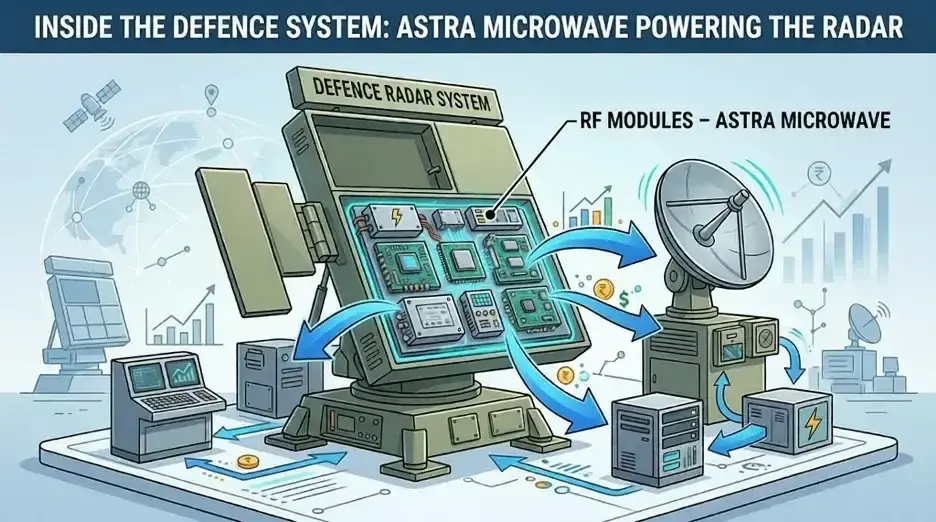
Astra Microwave Products operates in a narrower segment than BEL or Data Patterns but commands pricing power through specialization in RF (Radio Frequency) and microwave components critical for radars and electronic warfare systems. Motilal Oswal Financial Services suggests a ₹1,150 target price versus the ₹900-950 trading range in early 2026, implying 20-25% upside. The company manufactures components like transmit-receive modules, amplifiers, and antenna subsystems that go into nearly every radar system India produces — whether it’s BEL’s air defence radars, HAL’s airborne fire control radars, or DRDO’s long-range surveillance systems. This picks-and-shovels positioning in the radar value chain creates predictable revenue tied to overall defence electronics growth without requiring Astra to compete directly with larger system integrators.
The niche focus carries advantages that larger companies can’t replicate. Astra Microwave has spent two decades perfecting gallium nitride (GaN) based RF modules that deliver higher power density and efficiency than older gallium arsenide technology. This expertise isn’t something BEL or Data Patterns can build overnight — it requires specialized clean room facilities, materials science knowledge, and testing infrastructure. When DRDO designs a new AESA (Active Electronically Scanned Array) radar, Astra is one of maybe two domestic suppliers capable of manufacturing the transmit-receive modules at the required specifications. This duopoly-like positioning allows Astra to command 28-30% EBITDA margins versus the 15-18% typical of pure manufacturing subcontractors.
The TPCR-2025 alignment for Astra Microwave is indirect but powerful. As 224 out of 457 programs focus on electronics and EW, the demand for radar and EW systems explodes. Every radar system needs 500-5,000 RF modules depending on size and capability. Every EW suite needs 50-200 modules for jamming and deception functions.
Astra doesn’t need to win prime contracts — it wins as a Tier-1 supplier to whoever does win. When BEL gets a ₹10,000 crore radar contract, Astra typically gets ₹800-1,200 crore in component orders. When Data Patterns wins a ₹2,000 crore EW system contract, Astra gets ₹150-250 crore in subcontracts. This leverage to overall electronics spending creates upside even if Astra’s own direct contract wins are modest.
The risk with Astra is scale and customer concentration. BEL is the largest customer, accounting for 40-50% of revenue in recent years. If BEL faces order delays or shifts to alternate suppliers, Astra’s revenue gets hit. The company is working to diversify by targeting export markets and direct DRDO contracts, but customer concentration remains a risk factor. For investors, Astra Microwave is a higher-beta play on defence electronics growth — when the sector booms, Astra’s leverage to radar programs delivers outsized returns; when the sector faces headwinds, Astra feels it more acutely than diversified players like BEL. The ₹1,150 target is achievable if TPCR-2025 programs materialize and radar spending grows 15-20% annually. If programs delay, the stock could stagnate at ₹900-1,000 levels for extended periods.
“Risk comes from not knowing what you’re doing. In Astra’s case, risk comes from knowing exactly what one customer is doing.”
— Warren Buffett (adapted)
Join 1,45,000+ investors discovering under-researched small caps before they rerate.
4. Why Electronics Stocks Beat Platform Manufacturers in Returns
Margins, IP Ownership, and Lifecycle Revenue
When you compare returns delivered by electronics-focused defence companies versus platform manufacturers over the past 3-5 years, the difference is stark. BEL delivered 85% returns in 2024, Data Patterns was up 110% over two years post-IPO, and Astra Microwave climbed 65% in 2024. Compare this to Mazagon Dock Shipbuilding, which delivered 25% returns in 2024, or Garden Reach Shipbuilders at 30%. Both operate in defence, both benefit from indigenization, but the ship builders deliver half the returns of electronics companies. The reason isn’t company-specific execution — it’s structural differences in business models.
Platform manufacturers like shipyards or aircraft assembly units operate with 8-12% EBITDA margins because they’re essentially assembly operations with limited IP ownership. When Mazagon Dock builds a Scorpene-class submarine, it’s assembling components and systems designed by Naval Group France under technology transfer. Mazagon earns a margin on construction and assembly but doesn’t own the sonar technology, combat management system, or torpedo fire control systems. Those high-value components come from foreign suppliers or domestic specialists like BEL and Data Patterns. The final submarine might cost ₹30,000 crore to build, but Mazagon’s share of the value is labor and materials integration at thin margins. Electronics companies supplying the sonar and combat systems earn 25-30% margins on their smaller absolute contract values because they own the IP and control the supply chain.
The lifecycle revenue differential amplifies this margin advantage. A submarine built by Mazagon has a 30-40 year operational life, but most of Mazagon’s revenue is earned in the 5-7 year construction period. Post-delivery, the shipyard earns modest maintenance contracts maybe worth 10-15% of original construction value over the platform’s life. Compare this to BEL supplying the combat management system. BEL earns initial revenue from system delivery, then generates recurring income from software upgrades, sensor refresh cycles, technology insertions, and performance monitoring for 30-40 years. The lifecycle revenue can exceed 50-80% of initial contract value, and it’s earned at 30-35% margins since it’s software and technology services rather than hardware manufacturing. This recurring revenue model is what drives premium valuations for electronics companies versus platform manufacturers.
The TPCR-2025 shift toward electronics and subsystems over platforms is a structural tailwind for this margin and return differential. When defence budgets allocated 70% to platforms (ships, aircraft, tanks) and 30% to subsystems/electronics, platform manufacturers captured most of the spending.
As TPCR-2025 flips this to 50% electronics and subsystems, the share of defence spending flowing to high-margin electronics companies increases dramatically. BEL, Data Patterns, and Astra Microwave aren’t taking share from each other — they’re taking share from foreign suppliers and from the budget allocation that previously went to conventional platforms. This isn’t a zero-sum game within Indian defence companies; it’s a shift in how defence budgets get allocated that favors the segment where margins and returns are structurally superior.
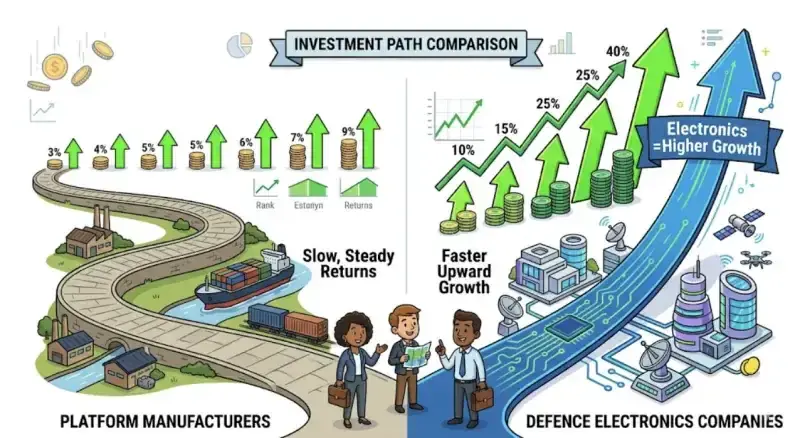
For investors trying to decide between defence platform stocks and electronics stocks, the framework should be: platforms for stability and dividend income (Mazagon Dock, Garden Reach), electronics for growth and capital appreciation (BEL, Data Patterns, Astra). Platform manufacturers deliver steady 8-12% annual returns with 3-4% dividend yields as they churn out ships and aircraft year after year.
Electronics companies deliver volatile but higher 15-25% annual returns as they win multi-year programs, scale production, and benefit from lifecycle revenue. Neither is “better” in absolute terms — match the choice to your portfolio needs and risk tolerance. But understand that the ₹4 lakh crore Sudarshan Chakra and TPCR-2025’s electronics focus structurally favor the electronics segment over the next 5-10 years.
“In the business world, the rearview mirror is always clearer than the windshield. Unless you’re investing in the electronics that define future warfare.”
— Warren Buffett
Market Cap focus
No. of ideas in a year
Holding period
Pricing

Emerging Titans
Combination of quantitative analysis, industry tailwinds, and management assessment - SPRINT investment philosophy
Multi Cap
20-25
3+ Years
Rs. 23,999/year

Tiny Titans
Heavy emphasis on scuttlebutt research, plant visits, and early on-ground signals
Exclusively for SME's
15-20
3+ years
Rs. 31,999/year
Conclusion
Many investors evaluate defence stocks based on visible factors like geopolitical tensions, rising defence budgets, or “Make in India” initiatives. While these factors do influence sentiment, they often overlook a deeper structural shift taking place within India’s defence strategy. Policies like TPCR-2025 and initiatives such as Sudarshan Chakra indicate a clear shift in focus toward defence electronics — including radar systems, electronic warfare, and communication technologies — where domestic companies have stronger capabilities and greater control over intellectual property.
This shift reflects how modern warfare itself is evolving. Today, strategic advantage is increasingly driven by technology-intensive systems rather than traditional platforms alone. As India allocates significant long-term capital toward building indigenous capabilities in these areas, companies involved in defence electronics may experience sustained growth, provided execution remains consistent.
It is also important to understand the current market context. Defence stocks have already seen strong price movements in recent years, leading some investors to feel that the opportunity has passed. However, much of this rally has been based on expectations. The actual impact of new policies and programs is likely to be reflected gradually in future financial performance. This creates a situation where investors need to balance optimism about long-term growth with awareness of short-term volatility and execution risks.
Ultimately, the key decision is not just whether to invest in defence, but how to approach the sector thoughtfully. Different segments — such as platforms versus electronics — may have different growth drivers, risk profiles, and return potential. Understanding these distinctions is essential for making informed investment choices aligned with one’s time horizon and risk tolerance.
As a learner and investor, focus on understanding the underlying trends shaping industries rather than reacting only to headlines or price movements. Try to identify where structural changes are happening, study how companies are positioned within those changes, and build your investment perspective step by step through informed analysis.
FAQs
Should I buy BEL at ₹450 or wait for correction to ₹400?
+
BEL has support from government ownership, ₹70,000+ crore order book, and 3+ years revenue visibility. Waiting for a ₹50 (11%) correction to enter might mean missing a ₹100 (22%) rally to the ₹550 target. Better approach: buy 60% position at current levels, keep 40% cash to average down if correction comes. The risk of being late exceeds the risk of being early by 10%.
Why should I choose electronics stocks over HAL which also benefits from defence spending?
+
HAL operates in aircraft manufacturing with 12-15% EBITDA margins versus BEL/Data Patterns at 22-28% margins. HAL’s growth is tied to Tejas fighter orders which have long gestation periods. Electronics stocks benefit from faster procurement cycles and participate in dozens of programs simultaneously. For growth and margin profile, electronics wins. For scale and government backing, HAL wins. Optimal strategy: 60% electronics, 40% HAL within defence allocation.
Is Data Patterns too expensive at 50x P/E versus BEL at 30x?
+
Data Patterns’ premium valuation reflects higher growth (20-25% revenue CAGR) and margin expansion potential versus BEL’s stable 12-15% growth. The PEG ratio (P/E divided by growth rate) is similar — BEL at 30x with 15% growth gives 2.0 PEG, Data Patterns at 50x with 25% growth gives 2.0 PEG. If you believe Data Patterns can sustain 25% growth for 3-5 years, the valuation is justified. If growth slows to 15%, it’s expensive.
What if defence budget growth disappoints in future years?
+
Even with flat defence budgets, the TPCR-2025 mandate to shift spending from platforms to electronics protects electronics companies. If total defence capex is ₹1.5 lakh crore and electronics share increases from 30% to 50%, that’s ₹75,000 crore for electronics versus ₹45,000 crore previously — 67% growth despite zero budget increase. The real risk is program delays, not budget cuts. Track quarterly order inflow data to monitor thesis.
Should I avoid these stocks given recent 40-60% run-ups in 2024-2025?
+
Stocks often run up ahead of fundamentals, then consolidate as earnings catch up. BEL, Data Patterns, Astra all saw strong rallies in 2024-2025 as the TPCR-2025 and Sudarshan Chakra stories emerged. But order books and earnings are only now reflecting these programs in FY26-27 results. If you believe ₹4 lakh crore spending over 10 years is real, the rally has room to run. If you think it’s hype, the stocks are expensive. Valuations are elevated but growth visibility justifies current levels.
How do I track if the TPCR-2025 thesis is playing out?
+
Monitor quarterly order inflows for BEL, Data Patterns, Astra. Check Ministry of Defence procurement announcements for electronics and EW programs. Track Defence Production Secretary speeches and Budget allocations. If Q1 and Q2 FY27 show ₹25,000-30,000 crore combined order wins for these three companies, the thesis is intact. If order inflows disappoint for two consecutive quarters, re-evaluate positioning.
About the author

Shashank Mahajan
High growth stock specialist, Value Educator
Shashank Mahajan is an equity research professional with over 12 years of experience in identifying high-potential SME and micro-cap stocks at an early stage. He follows a rigorous scuttlebutt research–driven approach, combining on-ground insights with deep financial analysis. Shashank specializes in uncovering under-researched and under-owned companies with strong management quality and long-term growth potential. Through disciplined research and early identification, he focuses on spotting tomorrow’s market leaders before they enter the mainstream investor radar.
Join 1,45,000+ investors discovering under-researched small caps before they rerate.













 Orders
 Subscription
 Share with friends


No comments yet. Be the first to comment!