
INOX India: The Rocket Order Behind a ₹2,268 Cr Book

In the September 2026 quarter, a US space company placed the largest single order in the history of a tank maker from Vadodara. The order covers 16 subcoolers and 16 storage tanks of 1,500 cubic metres each. Together it is worth more than ₹1,000 Cr, and some of the tanks weigh up to 450 tonnes. They will stand at a rocket launch site, holding the liquid oxygen and liquid methane that a rocket burns.
A rocket needs a tank maker because of one word, cryogenic, which simply means very cold. Oxygen, nitrogen, methane and hydrogen turn into liquids only when they are cooled far below zero. Liquid hydrogen, for example, has to be kept at about −253°C. In liquid form a gas takes up far less space, so anyone who moves gas in bulk needs tanks that keep heat out.
That is why a rocket launch pad looks like a small gas plant. Its tanks store the liquid propellants, and its pipes and pumps move them into the rocket just before the launch. Heavier rockets carry far more propellant, and they have to be filled in a short time. Management says the customer's founder has spoken of at least 1,000 launches a year, or about three a day. At that pace, one or two launch pads are not enough.
That chain has one piece in the middle, the subcooler. A subcooler is a large heat exchanger that uses liquid nitrogen to chill liquid oxygen or liquid methane below its usual temperature as it moves towards the rocket's propellant tanks. That keeps the propellant cold during a fast, high-volume filling. Of the 16 subcoolers in this order, 12 are for liquid oxygen and four are for methane.
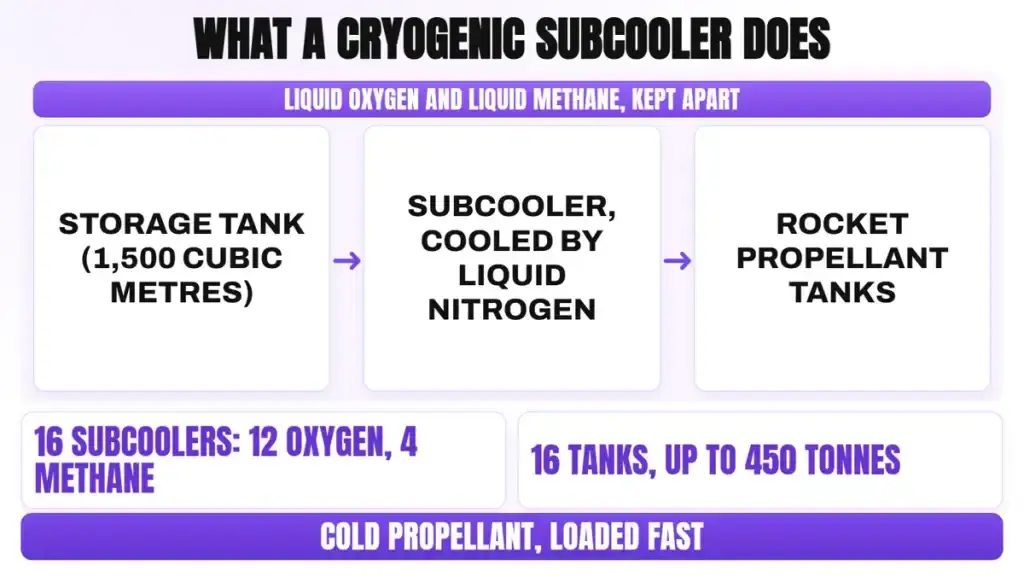
That tank maker is INOX India Ltd (NSE: INOXINDIA), which sells under the brand INOXCVA. For more than 30 years it has designed and built cryogenic equipment, from small 1-litre flasks to stationary tanks of 15,00,000 litres. Most of its revenue still comes from tanks and trailers for industrial gases and LNG. But the same skill has taken it to the ITER fusion reactor in France, to ISRO's launch pads and now to a chip plant in Dholera.
INOX India in five numbers
- Q2 FY27 revenue of ₹467 Cr, up 26.6%
- A record order book of ₹2,268 Cr in September 2026, 72% of it for export
- About ₹1,100 Cr of that book from space customers
- New orders of ₹1,028 Cr in the quarter, the highest ever
- FY26 revenue of ₹1,632 Cr at an EBITDA margin of 23.8%
So how did a gas tank maker end up at a rocket launch pad, and what is still happening in its older businesses? Let's first understand the company, and then look at the quarter where the space order showed up.
INOX India: Company Overview
INOX India Ltd was incorporated in 1976 and has its head office in Vadodara, Gujarat. It sells under the brand INOXCVA and has made cryogenic tanks since 1993, from 1-litre flasks to stationary tanks of 15,00,000 litres. Pavan Jain is the chairman, Deepak Acharya the CEO, and the promoters held 74.73% of the company in September 2026. It runs four plants in India, at Kalol, Silvassa, the Kandla SEZ and Savli, with a manufacturing and service centre in Brazil, and its team includes more than 450 engineers. Its four divisions make equipment for industrial gases, LNG and scientific research, plus stainless steel beer kegs. Revenue was ₹1,632 Cr in FY26, and the company had no net debt and about ₹384 Cr of net cash in September 2026. Read this MTAR: The Workshop Powering US AI Data Centres
"Behind every stock is a company. Find out what it's doing."
— Peter Lynch
INOX India is easy to file under gas tanks, but its order book now holds launch pad subcoolers, fusion reactor parts and chip-plant piping. Knowing which of these it is actually doing is the starting point.
The Quarter the Order Book Jumped
Let's look at Q2 FY27, the July to September quarter, when the order book jumped to a record. INOX India reported it on 3 November 2026. Revenue was ₹467 Cr, up 26.6% from ₹369 Cr a year ago. EBITDA rose 10.8% to ₹100 Cr, and profit after tax rose 7.8% to ₹66 Cr. For the half year, revenue reached ₹849 Cr, the highest in the company's history.
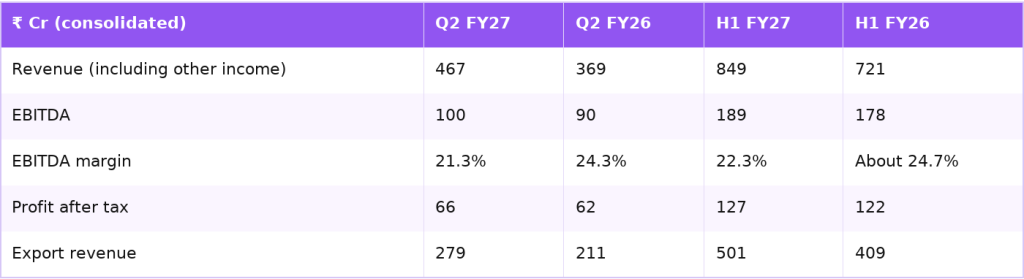
That growth came mostly from industrial gases and from exports. The industrial gas division brought in ₹285 Cr, against ₹212 Cr a year ago, and made up 61% of revenue. Exports were ₹279 Cr, or 60% of the quarter's revenue. In September alone the company shipped the first two 1,500 cubic metre tanks to the US space customer, along with large tanks for the Bahamas LNG project.
But profit grew at a lower rate than revenue, and the company gives clear reasons for the gap. Material cost was 43% of revenue, against 40.5% a year ago. Management says it priced some standard equipment keenly to win volume, and it also absorbed higher shipping costs on the large tanks it sent to the Bahamas and the US. Other expenses rose to 26.6% of revenue from 25.8%, mostly because of freight and sales commissions on those large tanks.
But two other cost lines moved the other way. Employee cost rose 23.4% in rupees, but it came to only 9.1% of revenue, against 9.3% a year ago. Depreciation went up because the new tank shop at Savli and leased trailers in Brazil were added to the books in the second half of FY26. So the EBITDA margin came in at 21.3%, against 24.3% a year ago, while the half-year margin stayed at 22.3%. Read this EBITDA Explained: Uses and Limits
That half-year figure matters because it is inside management's range. The company has guided for an EBITDA margin of 21-24%, and its CEO says the Q2 mix is not a structural change. He also expects margins to improve as the space order moves into execution. On that order the customer pays for transport from the factory gate, so freight costs stay with the buyer.

The Orders Behind the ₹2,268 Cr Book
Now let's look at the orders, because they decide the next two years. New orders in Q2 FY27 came to ₹1,028 Cr, against ₹374 Cr a year ago. That took the order book to ₹2,268 Cr, up about 50% from ₹1,514 Cr in March 2026. Of the book, ₹1,628 Cr is for export.

Those orders were also announced as they came in. The company filed two order updates with the exchanges during the half year, and both were led by the space customer.
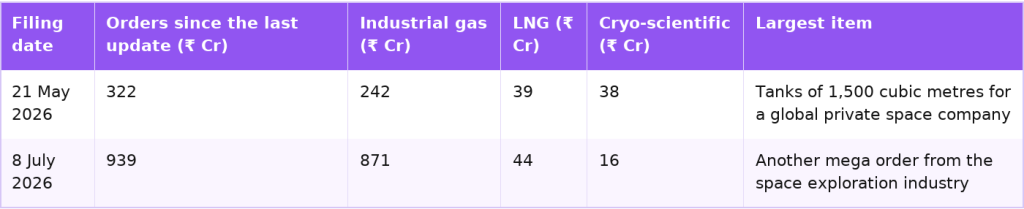
That table shows why the industrial gas book grew so fast. Industrial gas orders in H1 FY27 were ₹1,177 Cr, against ₹400 Cr in H1 FY26, and the division's backlog reached ₹1,457 Cr. That is 64% of the whole book.
What the order book says: ₹2,268 Cr is about 1.4 times FY26 revenue of ₹1,632 Cr. Management says 30-40% of the book is standard equipment and the rest is custom-built. The space order runs to March 2028, so this book is a two-year book, not a one-year one.
That book is backed by a balance sheet with no net debt. The company had about ₹384 Cr of net cash in September 2026, more than in March, even though inventory rose 12% to build for the larger book. Advances from customers and the release of contract assets paid for that build-up.
How a Gas Tank Maker Reached the Launch Pad
Now that we have seen the quarter, let's go back and see how INOX India reached the launch pad. Pavan Kumar Jain founded the company with the aim of making India self-reliant in cryogenic tanks, and it began making them in 1993. Its promoters still hold 74.73% of the company, and Deepak Acharya, who joined in 1992, runs it as CEO.
Its first step into space came early. In 2006 it completed the supply and installation of cryogenic equipment for ISRO's second launch pad. In 2018 it built and commissioned a thermal vacuum system for ISRO, a chamber that tests equipment under space-like cold and vacuum. Those jobs taught it how launch sites store and move propellants.
Then came the science projects. In 2014 it won a contract to make process pipe transfer lines for ITER, the experimental fusion reactor being built in France. It finished making those cryolines in 2021, and the work led to repair and installation jobs inside the ITER site. In 2019 it installed a mini LNG terminal at Kyleakin in Scotland, with two tanks of 1,000 cubic metres.
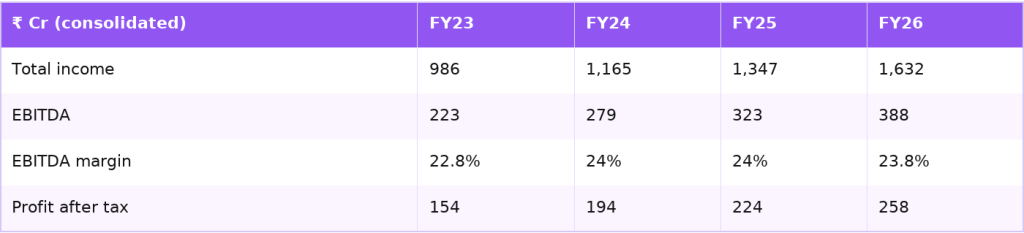
That record is steady rather than sudden. Total income grew about 1.66 times in three years, an 18% yearly rate, and the EBITDA margin stayed between 22.8% and 24%. FY26 total income rose 21.2%, and the company listed on the exchanges in December 2023.
"We have been doing it for many such projects, such as the ITER project, the Launchpad project, the Caribbean project. So many projects we have done for the first time." - Deepak Acharya, CEO, November 2026
Then came the newest step, the Savli plant near Vadodara, which opened in 2024 on 2,64,223 square metres. It first made stainless steel beer kegs, and then a new cryogenic tank shop was added. That is the plant where INOX India now plans to build the subcoolers for the US space company. We will come back to Savli and the new Kandla plant after the four divisions.
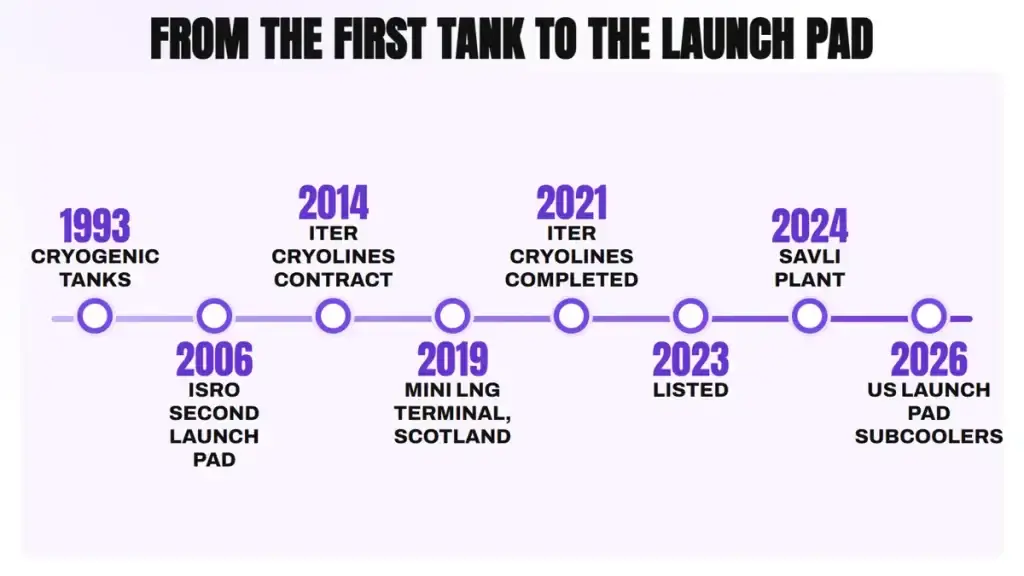
Four Divisions Built on One Cold Skill
Now let's split the company into its four divisions, which all rest on one skill: keeping a liquid very cold. The company reports industrial gas, LNG and cryo-scientific as its main divisions, with kegs inside "others".
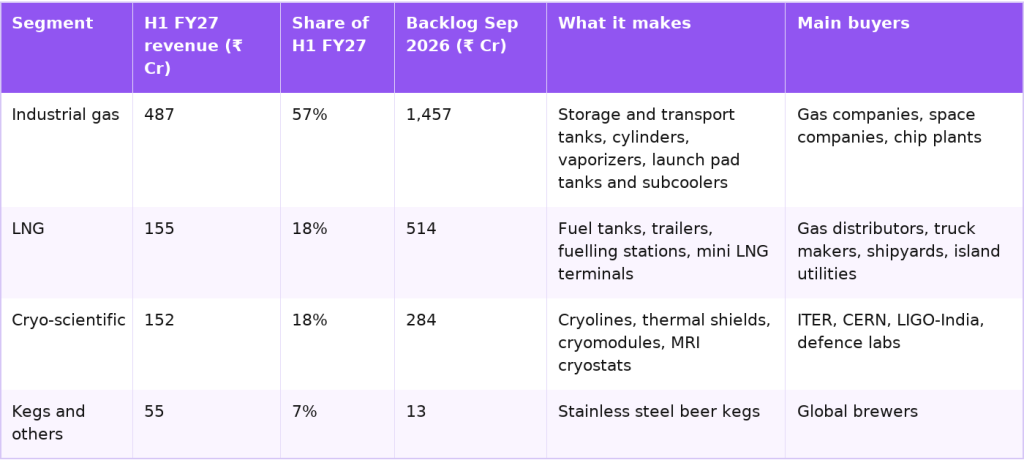
These divisions sound alike, but each one sells to a different buyer. Read this Segment-Wise Revenue Analysis Explained The industrial gas division makes standard and custom tanks for companies that sell oxygen, nitrogen and argon, and the space tanks sit here because they hold liquid oxygen and nitrogen. The LNG division sells equipment that uses natural gas as a fuel. The cryo-scientific division builds one-off systems for research projects, and the keg business is plain stainless steel work.

Industrial Gas, the Core
Let's start with the industrial gas division, the core of the company. Every steel plant, hospital and glass maker that buys oxygen or nitrogen in bulk needs a cryogenic tank on site and a trailer to refill it. Global hydrogen demand grew almost 3% in 2025 to more than 100 million tonnes. India's National Green Hydrogen Mission targets 5 million tonnes of green hydrogen a year by 2030, and liquid hydrogen needs the most demanding tanks of any gas.
That demand is what INOX India has served since 1993. Its range runs from 1-litre flasks to 15,00,000-litre storage tanks, and its transport tanks hold up to 60,000 litres. It also makes vaporizers, which turn the liquid back into gas at the customer's site. It has also shipped four liquid hydrogen tanks of 311 cubic metres each to Korea.
Those products add up to the company's largest division. Industrial gas revenue was ₹285 Cr in Q2 FY27 and about ₹875 Cr across FY26. In FY26 the company sold more than 300 transport tanks and semi-trailers for the first time. It also shipped more than 2 million disposable cylinders, the small single-use gas bottles it sells to US customers, even after US tariffs.
Next come the liquid cylinders, a smaller line that is growing fast. After the company rebuilt that production unit, it shipped more than 1,500 liquid cylinders worth more than ₹25 Cr in H1 FY27, against 1,600 in the whole of last year. Management says it is the only maker of liquid cylinders in India. In Q2 the division also won about ₹60 Cr of domestic orders for transport equipment, train tanks and large storage tanks.
The division also sells into new uses of cold storage. INOX India supplied vertical tanks to Highview Power for what it calls the world's largest liquid air energy storage project, in Manchester. It also won India's first order of its kind for a CO₂ battery energy storage project.
Space, Now Inside the Industrial Gas Book
Next, let's look at space, which now makes up almost half of the order book. The ISRO third launch pad project was publicly sized at about ₹3,850 Cr, and management says the cost may now be 10-15% higher. India's private launch companies are also building up. Management says the top five such startups project about ₹2,000-3,000 Cr of business for it over the next three to five years.
INOX India already knows that kind of work from ISRO. At the second launch pad it designed, made and commissioned the cryogenic propellant storage and servicing systems and the gas storage facilities. It has since made high-pressure kerosene tanks for rocket engine testing. In India it has supplied equipment to four of the five leading private space startups.
The US work began with tanks. A US space company ordered the largest tanks the industrial gas division had ever made, at 1,500 cubic metres each. In Q4 FY26 a leading US private space company placed an order of about ₹200 Cr. In Q1 FY27 a space exploration customer ordered eight more of those large tanks plus six other tanks.
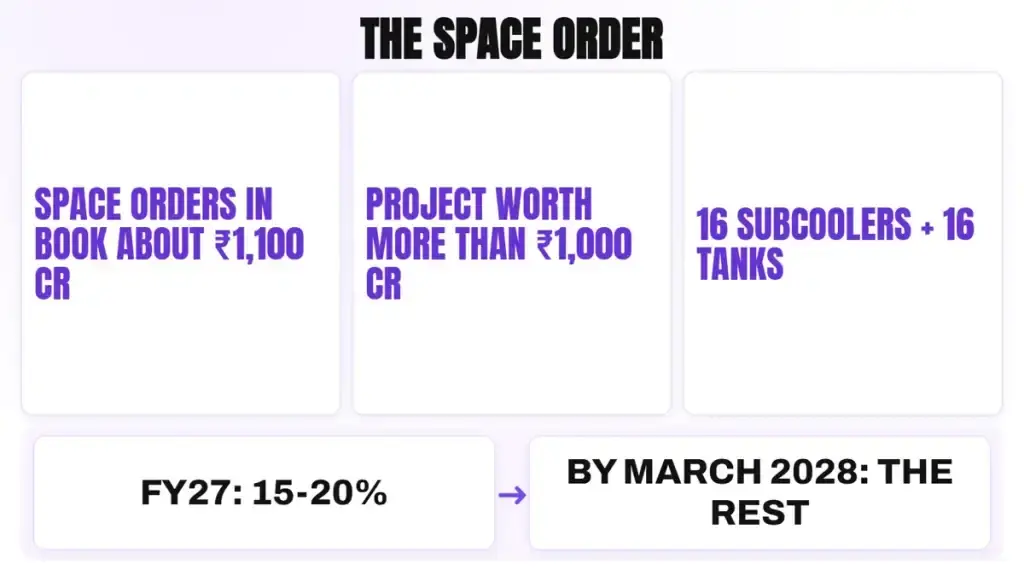
Then came the subcoolers, the biggest single order in the company's history. Management says the subcoolers alone are 60-70% of the space backlog. The whole project, with the tanks, is worth more than ₹1,000 Cr, and space customers make up about ₹1,100 Cr of the book. Management expects 15-20% of the order to be finished in this financial year and the rest by March 2028.
That work is harder than making a tank. Each subcooler needs deep hole drilling, automated orbital welding, tube expansion and strict cleaning. It is then tested with helium leak checks, internal camera inspection and repeated cooling cycles. The design has to cool very large flows while keeping the oxygen side and the fuel side fully apart, and the customer has approved the final design.
That approval also opens the next door. Management says this is only the customer's first launch pad requirement, and three or four more projects are in its pipeline. In Q1 FY27 INOX India also received the AS9100D aerospace certification. Until then it could supply only ground equipment, but now it can bid for parts that fly, such as propellant tanks. ISRO has visited its plant for the LVM3 rocket work, and the company has bid for a semi-cryogenic engine test facility.
Semiconductor Plants and Their Ultra-Pure Gases
Now let's move to semiconductors, the newest market for the same tanks and pipes. A chip plant runs on nitrogen, argon, helium and oxygen of extremely high purity, delivered cold and clean. Management says 12 companies have started semiconductor projects under the government's programme, and about 70% of that work is in Gujarat, at Dholera and Sanand. INOX India's plants sit close to both.
That closeness is already turning into small orders. Management says the company supplies equipment to Micron, Foxconn and Tata's Assam and Dholera projects, including vacuum-jacketed transfer lines. It launched India's first ultra-high-purity ammonia ISO tank container for chip and solar plants. It also won a liquid hydrogen tank order from a European customer for the semiconductor industry.
Then in Q2 FY27 it took on piping work too. It began the initial piping scope at Tata Electronics' fab in Dholera. Management says the first phase of that fab needs about 500-600 kilometres of piping. It has also bid for two larger jobs, one for ultra-high-purity gases and one for bulk gases, and expects results in four to six weeks.
"The only one thing in our mind was to enter into this sector. So even if it was a small order, the numbers are very small to mention here perhaps, but it was our entry into that market." - Deepak Acharya, CEO, November 2026
That entry needs welders, and India does not have enough of them yet.
"If you never want to be criticized, for goodness' sake don't do anything new."
— Jeff Bezos
INOX India's first chip-plant order is small by its own account. New markets usually start that way, and the size of the next Dholera orders will show whether this one grows. So the company opened the SemiOrbit welding centre at ITM SLS Baroda University, with INOX Air Products and Swagelok Bombay. Management says it will train 30-40 welders a month in orbital welding, the precise automatic welding that chip-plant piping needs.
LNG, From Trucks to Island Terminals
Next, let's look at LNG, the division that grew fastest in FY26. LNG is natural gas cooled into a liquid, so it can travel by truck or ship to places that have no pipeline. India's oil ministry targets 1,000 LNG fuelling stations. The small-scale LNG market was valued at $10 billion in 2023 and is projected to reach $16 billion by 2028.
INOX India sells most of the equipment along that chain. It makes LNG storage tanks, trailers, fuel tanks for trucks, fuelling stations and complete mini LNG terminals. A mini LNG terminal is a small import station for an island or a remote region that wants LNG for power. Its LNG revenue reached a record ₹457 Cr in FY26.
That record came largely from the Bahamas. The company's mini LNG terminal there uses ten vacuum-insulated tanks with 15,000 cubic metres of combined capacity. It supplied all ten large tanks within one year, and the project led to follow-on orders for Eleuthera and Great Abaco. Management says the Caribbean projects are exactly the kind of LNG power plant that US data centres may also need, from 50 megawatts up to 300 megawatts.
Beyond terminals, the division is also moving into ships and trains. Cochin Shipyard ordered six LNG fuel tanks of 800 cubic metres for ships it is building for the world's third-largest shipping company. More than 250 of the company's LNG semi-trailers already run on Indian roads, and in Q2 it won orders for more than 40 more. After Indian Railways launched an LNG train, INOX India received four related orders and has shipped two.
Those wins add to a book of ₹514 Cr in LNG. In Q2 the division also won about ₹14 Cr of orders from one domestic customer, a fuelling station for a city gas company and tanks for a glass plant at Bharuch. Management says it is technically qualified for an Andaman and Nicobar LNG terminal tender, and it has bid in Indonesia.
Cryo-Scientific, From ITER to LIGO
Now let's look at the cryo-scientific division, the smallest of the three main divisions but the one with the hardest jobs. ITER is the world's largest experimental fusion reactor, being built in France to test fusion as a source of power. Its superconducting magnets must be kept close to absolute zero with liquid helium. ITER's first plasma is expected in 2035, and fusion companies have raised more than $7 billion.
That cold has to be protected by layers of shields. A cryostat is the giant vacuum vessel that surrounds the reactor and keeps heat out, and thermal shield panels line it. INOX India built about 4 kilometres of jacketed cryolines and warm lines for ITER, and it now repairs the shields. It won a major contract to repair more than 200 cryostat thermal shield panels, and it also repairs the vacuum vessel thermal shield.
The ITER site has kept INOX India busy beyond the shields. It cooled the Magnet Cold Test Bench to 4 kelvin, which ITER uses to test its superconducting magnets. ITER has kept placing repeat orders, including one in Q1 FY27. That record helped it win cryogenic modules for CERN in Q1 FY27, its first order from the European particle physics laboratory.
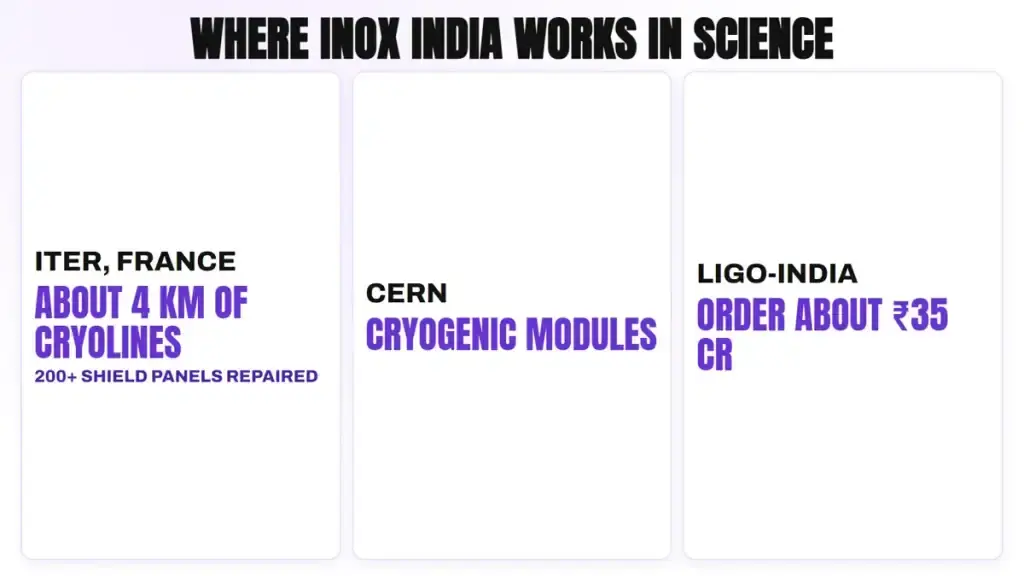
The same skills now serve projects in India. In Q2 FY27 the company won an order of about ₹35 Cr for cryogenic equipment for LIGO-India. LIGO-India is a gravitational wave observatory at Hingoli in Maharashtra, built with the LIGO Laboratory in the US and Indian institutes including RRCAT. Management says L&T holds the main order there, worth about ₹4,000 Cr.
Besides science, defence and nuclear work sit here too. For the Navy's air independent propulsion programme, the company designed and built India's first land-based liquid oxygen tank for submarine power systems. It has delivered that tank to L&T for final testing. It also makes vessels certified to the ESPN nuclear code, and management has said it can build small modular reactors in its factories.
These jobs show up in the numbers as lumpy revenue. The division earned ₹77 Cr in Q2 FY27, against ₹49 Cr a year ago, and holds a book of ₹284 Cr. It also won a ₹12 Cr piping order from a European customer during the quarter.
Beverage Kegs and the Brewers
Finally, let's look at kegs, the one business that is not cryogenic at all. A beer keg is a returnable stainless steel barrel, and large brewers buy them only from makers they have audited. INOX India makes them at Savli with technology from the Supermonte Group of Italy. Its plant can make about 3,00,000 kegs a year.
That approval process is where the business stands today. Heineken, AB InBev and Molson Coors have approved INOX India, and together they hold more than 40% of world beer volumes. In all, four of the five global brewers it targets have approved it, and the fifth audit is due in the coming months.
That work began to show in sales in Q2 FY27. Keg sales grew about 446% and the keg order book about 155%. The company signed a three-year global supply agreement with Heineken, whose stated need for 2027 is more than 4,00,000 kegs across 22 countries. That figure is the brewer's total need, to be shared among several suppliers, and INOX India's share relates to 2027 for now.
The Qualifications That Are Hard to Copy
Now that we have seen all four divisions, let's understand the moat, which comes from qualifications that are hard to copy. A cryogenic tank that leaks heat or cracks can waste a full load of gas or stop a launch, so buyers rarely try an untested supplier. Each market also has its own approval code.
Those approvals take years to collect. INOX India holds the ASME U and R stamps and DOT 39 for the US, EN 13458 and EN 13530 for Europe, and PESO and BIS approval in India. It holds IATF 16949 for its LNG truck tanks, FSSC 22000 for kegs, the ESPN nuclear stamp and now AS9100D for aerospace. Strict design and manufacturing rules are themselves a barrier to entry in this business.
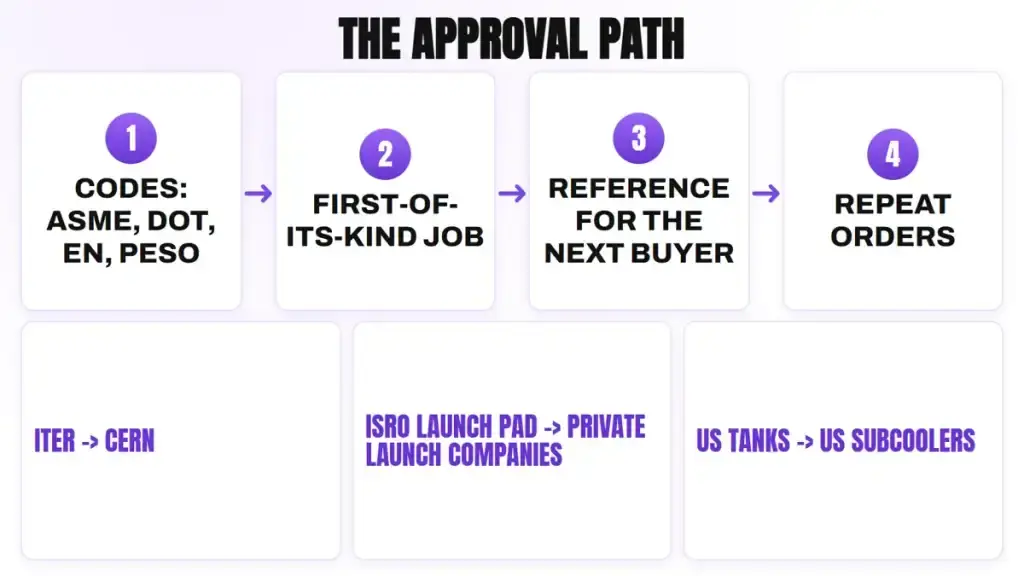
Beyond certificates, references matter even more. Each first-of-its-kind job becomes the proof for the next one.
"Time is the friend of the wonderful business, the enemy of the mediocre."
— Warren Buffett
Three decades of ISRO, ITER and LNG terminal jobs have built references that a new tank maker cannot buy, which is how a US launch site order came to a plant in Gujarat. The ITER cryolines led to repair jobs at the same site, and then to CERN. ISRO's second launch pad led to work with India's private launch companies. The US space customer started with one tank order in FY25, came back for more tanks, and then placed the subcooler order.
That is also why custom work earns more. Management says margins are higher on non-standard, custom-built equipment, which needs special engineering and project skills. Standard tanks face global competitors, and they are 30-40% of today's book. The rest of the book is custom work, where a buyer is paying for a design that only a few makers can deliver.
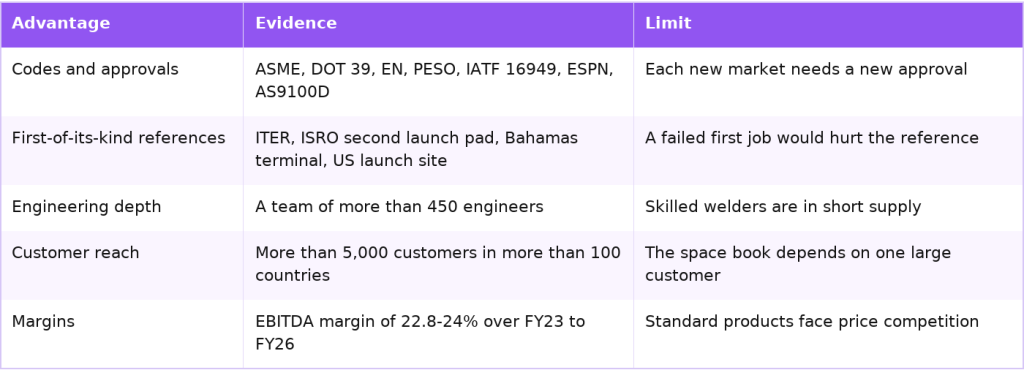
That table also shows the test for the moat. A business that buyers cannot easily replace should keep its margin even as it grows. Read this Economic Moat Explained Over FY23 to FY26, INOX India's EBITDA margin stayed between 22.8% and 24%, so the subcooler order will show whether custom work can lift it higher.
Savli, Kandla and the Room to Build
So where will all this equipment be made? INOX India has four plants in India, plus a manufacturing and service centre in Brazil and a stock-and-sale centre in the Netherlands.
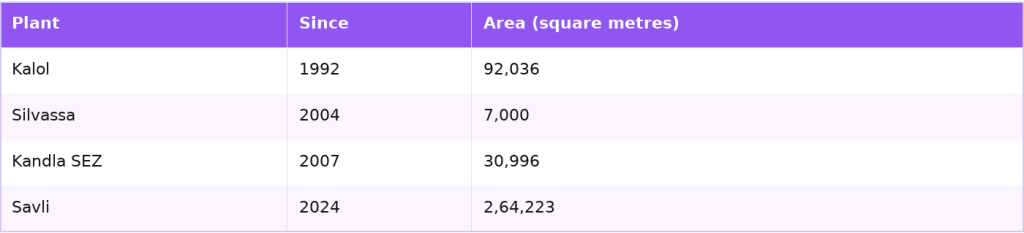
That table shows how much larger Savli is than the others. The company spent more than ₹100 Cr on the first phase from its own cash, and set it up in six months. In February 2026 management said the cryogenic shop there was about 70% used, and Kalol and Kandla were 85-90% full. Management says another half of that space is still free at Savli.
The next plant is at Kandla, and it is built for size. In May 2026 the company took about 7 acres of land near Kandla Port on a 30-year lease, about 2.5 kilometres from the port. The new plant will make tanks with a diameter of 8-9 metres, up to 60 metres long and up to 500 tonnes in weight. Those are the sizes needed for LNG mega storage tanks and large aerospace tanks, which are hard to make at the existing plants.
Management says the company needs no outside money for these plants. It has no net debt, and its available funds rose from about ₹257 Cr in March 2026 to about ₹384 Cr in September. Capex comes from its own profits, as it did for Savli.
Financials: Steady Margins, Slower Cash
Big custom orders make single quarters uneven, so let's look at four full years together. Total income includes other income, and EBITDA is the company's own measure, both as shown in its FY26 annual report.

Total income grew about 1.66 times in three years, and the EBITDA margin stayed in a narrow band of 22.8% to 24%. Profit after tax grew from ₹154 Cr to ₹258 Cr over the same period.
Cash flow did not keep pace. Operating cash flow came down from about ₹176.7 Cr in FY23 to about ₹116.6 Cr in FY26, while profit rose. Most of the gap sits in contract assets, which are work done but not yet billed: they rose from about ₹173.8 Cr to about ₹385.5 Cr during FY26 as the large Bahamas and space tanks were built.
The balance sheet has carried that build-up without debt. The company spent about ₹105.9 Cr on plants and equipment in FY26 from its own cash, and by September 2026 its net cash had risen to about ₹384 Cr as customer advances came in. Collections on the space order are the number to watch.
"You can't predict. You can prepare."
— Howard Marks
INOX India cannot control when a launch company or an island utility pays, but it has built Savli and is building Kandla from its own cash before the large orders peak.
What FY28 Could Look Like on Management's Numbers
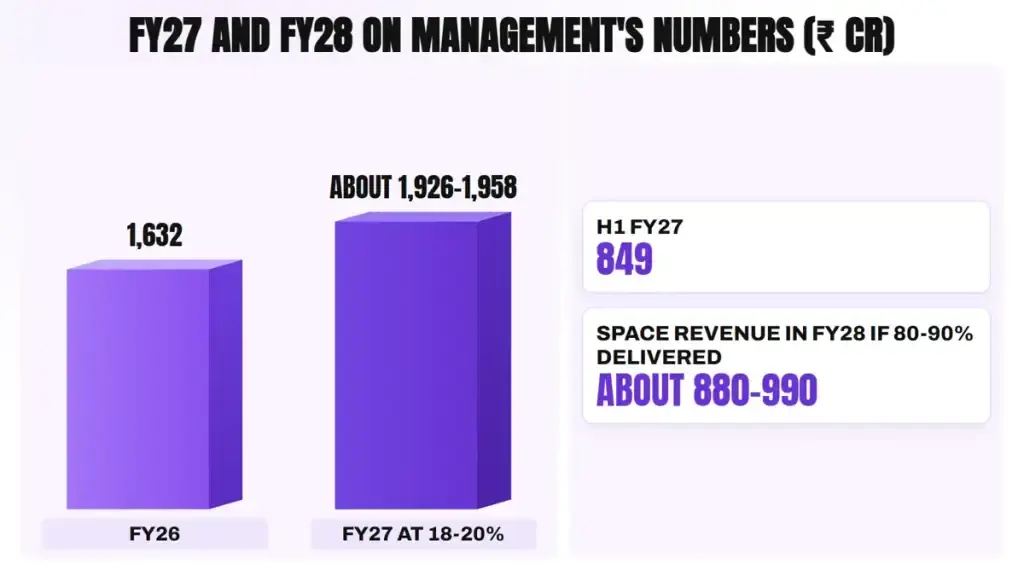
So where does the company go from here? Management's targets have stayed the same through FY27, so let's lay them out in order. In May 2026 it guided for revenue growth of 18-20% in FY27, and order intake of about ₹450-500 Cr a quarter. It also keeps an EBITDA margin range of 21-24%.
So let's put that guidance against the first half. H1 FY27 revenue grew 17.7% to ₹849 Cr. Growth of 18-20% on FY26 revenue of ₹1,632 Cr would mean about ₹1,926-1,958 Cr for FY27. So the second half would need about ₹1,077-1,109 Cr, about 1.27-1.31 times the first half.
Beyond FY27, the order book makes FY28 the bigger year. If 80-90% of the ₹1,100 Cr space book is delivered in FY28, as management expects, that alone is about ₹880-990 Cr of revenue in one year. In November 2026 the CEO said the company is growing at 18-20% at a minimum, and faster if bigger orders come.
"So if 3 rockets per day, 1 or 2 launch pads are not sufficient. That much I can tell you." - Deepak Acharya, CEO, November 2026
That growth will also need the new capacity on time. Kandla is now expected to finish by March 2027, and Savli has room for more sheds. Management says building a shed and its machines on land it already holds takes about a year in all.
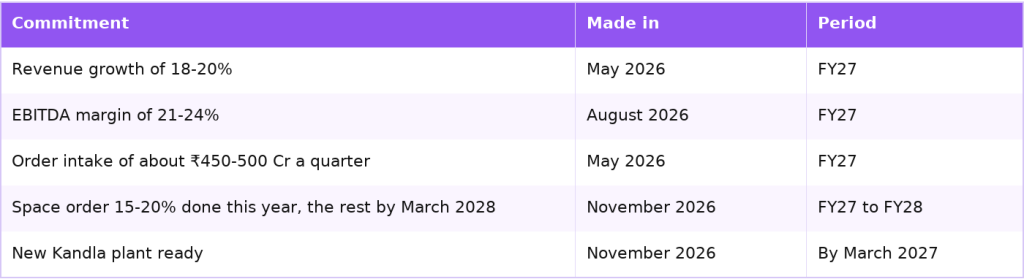
Those commitments are easier to judge against the past. So let's check what management has said before against what it delivered.
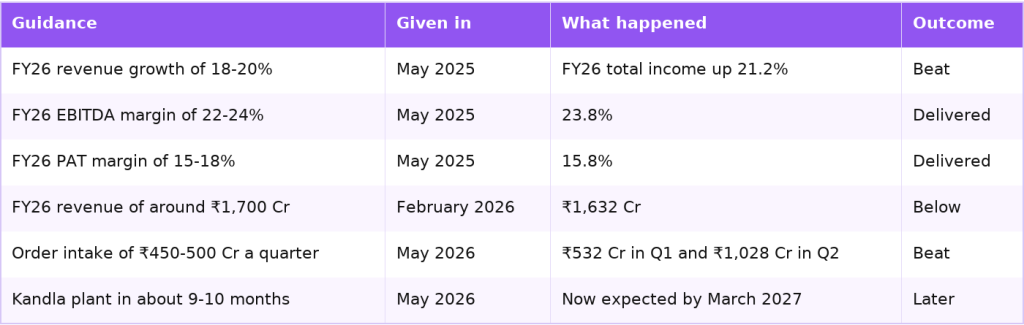
That record is mostly good, as you can see. The FY26 growth and margin targets were met, and order intake beat its target by a wide margin in both quarters of FY27. But the February 2026 revenue figure was not reached, and the Kandla date has moved twice.
Key Risks
Now let's look at what could go wrong for INOX India, because a record book also brings new kinds of risk.
- Margins: the EBITDA margin fell to 21.3% in Q2 FY27 from 24.3%. Material cost rose to 43% of revenue as the company priced standard equipment keenly and absorbed higher freight. If price competition in standard tanks continues, the margin could stay below the top of its 21-24% range.
- One large customer: about ₹1,100 Cr of the ₹2,268 Cr book, about 49%, comes from one US space customer. Management also says about half the book sits with two or three major customers. A delay or change at that customer would move a large part of FY28 revenue.
- A first-of-its-kind job: management calls the subcooler order the first of its kind, with large imported materials, thick forgings, deep hole drilling and orbital welding. Up to 10% of the work could shift beyond March 2028, and any quality problem would hurt the reference it is meant to build.
- LNG and science revenue: LNG revenue was ₹71 Cr in Q2 FY27, against ₹93 Cr a year ago, after the Bahamas tanks had lifted earlier quarters. LNG truck adoption has faced near-term challenges. Cryo-scientific orders in H1 FY27 were ₹108 Cr, down 47.3% from ₹206 Cr.
- Cash flow and contract assets: operating cash flow was about ₹116.6 Cr in FY26, against a profit of about ₹257.9 Cr. Contract assets, which are work done but not yet billed, rose from about ₹173.8 Cr to about ₹385.5 Cr in the year. Large custom projects tie up cash until they are delivered. Read this Cash Flow Statement Explained
- The US market: INOX India sold its US subsidiary's assets in 2018 and agreed not to compete there through a factory or distribution centre for ten years, until November 2028. In FY26 a US arbitration panel ordered it to pay about ₹848.96 lakh in legal and other costs over that clause. US tariffs also apply to its exports there.
- Kegs: the keg plant runs at only about one-third of its capacity, and FY26 keg sales were about 61,000 units. The fifth brewer approval is still pending, and the Heineken agreement does not fix INOX India's share.
- Pipeline language: the semiconductor bids, the ISRO third launch pad tender and the private space projections of ₹2,000-3,000 Cr are opportunities, not orders. The ISRO tender timing is not in the company's hands.
- Plants and people: the Kandla date has moved from about 9-10 months to March 2027. Management also says skilled welders are scarce, which is why it trains its own.
- Geopolitics: the West Asia conflict has raised freight costs and made shipping harder. In Q1 FY27 equipment worth about ₹32-35 Cr could not be shipped on time for those reasons.
"However, you know very well that the product needs, geopolitical uncertainties, increased logistic cost, all these are playing a vital role in today's scenario, and this is the fact we have to live with." - Deepak Acharya, CEO, November 2026
"Risk comes from not knowing what you're doing."
— Warren Buffett
INOX India knows cryogenic tanks well, but the subcooler order is new work at a new scale. Watching its execution, margins and collections is how to see whether that knowledge carries over.
Explore our Products
Research Framework

Emerging Titans
Combination of quantitative analysis, industry tailwinds, and management assessment - SPRINT investment philosophy

Tiny Titans
Heavy emphasis on scuttlebutt research, plant visits, and early on-ground signals
What to Track Next
If you follow INOX India, these are the signals that will show where it goes next.
- The EBITDA margin in Q3 FY27 against the 21-24% range, and material cost after 43%
- Dispatches to the US space customer every two to three months, and the share of that order done by March 2027
- Results of the two semiconductor bids for ultra-high-purity and bulk gases at Dholera
- The ISRO third launch pad tender and any order from India's private launch companies
- The Kandla plant starting by March 2027
- Order intake against ₹450-500 Cr a quarter, and the order book after ₹2,268 Cr
- The fifth brewer approval and keg plant use after one-third
Conclusion
Let's put it all together. INOX India is still mainly a maker of tanks and trailers for industrial gases and LNG, and that business earned ₹1,632 Cr in FY26 at a 23.8% EBITDA margin. On top of that core, three decades of first-of-its-kind work for ISRO, ITER and island LNG terminals have now brought a US launch site order worth more than ₹1,000 Cr.
That order has made the space sector almost half of a record ₹2,268 Cr book. The cautious thread is concentration and cash: one customer holds about ₹1,100 Cr of the book, and operating cash flow has trailed profit. The next few quarters, starting with the Q3 FY27 margin and the space dispatches, will show which thread is stronger. What happens next depends on whether INOX India can build the subcoolers on time and at a better margin, and whether chip plants, ISRO and the other launch companies turn their interest into orders.
FAQs
What does INOX India do?
+INOX India, which sells as INOXCVA, designs and makes cryogenic equipment: storage and transport tanks for industrial gases, LNG tanks, trailers and terminals, and systems for science projects such as ITER. It also makes stainless steel beer kegs at Savli. Revenue was ₹1,632 Cr in FY26 at an EBITDA margin of 23.8%.
How did INOX India do in Q2 FY27?
+Revenue rose 26.6% to ₹467 Cr, EBITDA rose 10.8% to ₹100 Cr and profit after tax rose 7.8% to ₹66 Cr. The EBITDA margin was 21.3% against 24.3% a year ago, while the H1 FY27 margin was 22.3%. Exports were ₹279 Cr, or 60% of revenue.
What is INOX India's order book?
+The order book was a record ₹2,268 Cr in September 2026, up about 50% from ₹1,514 Cr in March 2026. New orders in Q2 FY27 were ₹1,028 Cr, and 72% of the book is for export. Industrial gas, which includes the space tanks, holds ₹1,457 Cr of it.
What is INOX India's space order?
+A US space company ordered 16 subcoolers and 16 tanks of 1,500 cubic metres each for its launch infrastructure, a project worth more than ₹1,000 Cr. Space customers make up about ₹1,100 Cr of the order book. Management expects 15-20% of the order to be finished this financial year and the rest by March 2028.
Does INOX India work on nuclear fusion and semiconductors?
+Yes. It made about 4 kilometres of cryolines for the ITER fusion reactor in France and repairs more than 200 of its thermal shield panels, and it has won orders from CERN and LIGO-India. In semiconductors it began piping work at Tata Electronics' Dholera fab in Q2 FY27 and has bid for two larger gas projects.
What are the main risks for INOX India?
+About ₹1,100 Cr of the ₹2,268 Cr book comes from one US space customer, and the subcooler order is a first-of-its-kind job. The EBITDA margin fell to 21.3% in Q2 FY27 on pricing and freight, and operating cash flow was about ₹116.6 Cr in FY26 against a profit of about ₹257.9 Cr. The new Kandla plant has also moved to March 2027.

High growth stock specialist, Value Educator
Shashank Mahajan is an equity research professional with over 12 years of experience in identifying high-potential SME and micro-cap stocks at an early stage. He follows a rigorous scuttlebutt research–driven approach, combining on-ground insights with deep financial analysis. Shashank specializes in uncovering under-researched and under-owned companies with strong management quality and long-term growth potential. Through disciplined research and early identification, he focuses on spotting tomorrow’s market leaders before they enter the mainstream investor radar.

Jyoti CNC: The 5-Axis Machines Behind India's Aircraft Parts

APAR Industries: Google, Amazon and ₹12,025 Cr of Orders

Techno Electric: ₹11,000 Cr of Grid Orders and Data Centres

Sansera Engineering: Aircraft and Chip Parts Hit 14.9%

PTC Industries: The Titanium Melt Shop Behind Aerolloy

HBL Engineering: Defence Batteries, Fuzes and Kavach Orders
Explore our Products
Research Framework
Emerging Titans
Combination of quantitative analysis, industry tailwinds, and management assessment - SPRINT investment philosophy
Tiny Titans
Heavy emphasis on scuttlebutt research, plant visits, and early on-ground signals



Modern Warfare to Multibaggers
Key Trends. Strategic Shifts. Opportunities Ahead.
Don't Miss This Exclusive Webinar!
Join Value Educator to decode the key trends shaping India's defence sector and learn how to identify tomorrow's potential leaders in the space.
- In-depth research on India's defence sector
- Live Q&A session
- Actionable takeaways for long-term investors

 Orders
 Subscription
 Share with friends


Required Details
₹23999.00
(12 month subscription)
As per SEBI regulations, all users are mandated to complete the KYC that is validated for 1 year. Post payment, you will be redirected to the KYC screen


No comments yet. Be the first to comment!